
CS 123 INTRODUCTION TO COMPUTER GRAPHICS Describing Shapes
CS 123 | INTRODUCTION TO COMPUTER GRAPHICS Describing Shapes Constructing Objects in Computer Graphics Andries van Dam© Describing Shapes – 9/20/19 1/15
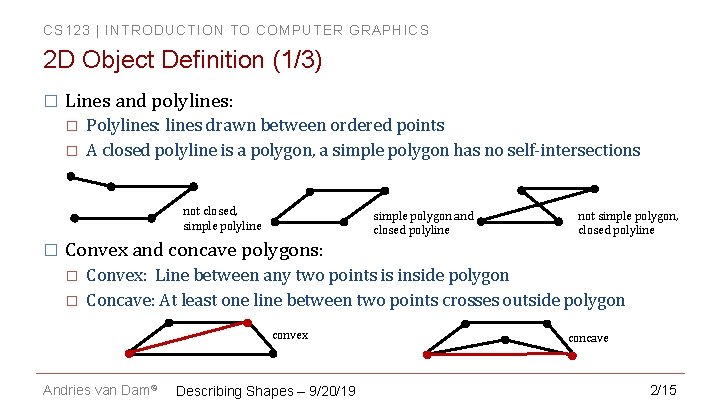
CS 123 | INTRODUCTION TO COMPUTER GRAPHICS 2 D Object Definition (1/3) � Lines and polylines: � � Polylines: lines drawn between ordered points A closed polyline is a polygon, a simple polygon has no self-intersections not closed, simple polyline � simple polygon and closed polyline not simple polygon, closed polyline Convex and concave polygons: � � Convex: Line between any two points is inside polygon Concave: At least one line between two points crosses outside polygon convex Andries van Dam© Describing Shapes – 9/20/19 concave 2/15
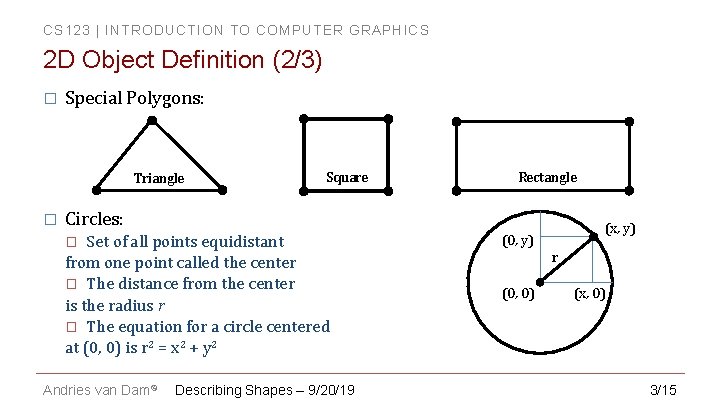
CS 123 | INTRODUCTION TO COMPUTER GRAPHICS 2 D Object Definition (2/3) � Special Polygons: Triangle � Square Rectangle Circles: Set of all points equidistant from one point called the center � The distance from the center is the radius r � The equation for a circle centered at (0, 0) is r 2 = x 2 + y 2 � Andries van Dam© Describing Shapes – 9/20/19 (x, y) (0, y) r (0, 0) (x, 0) 3/15
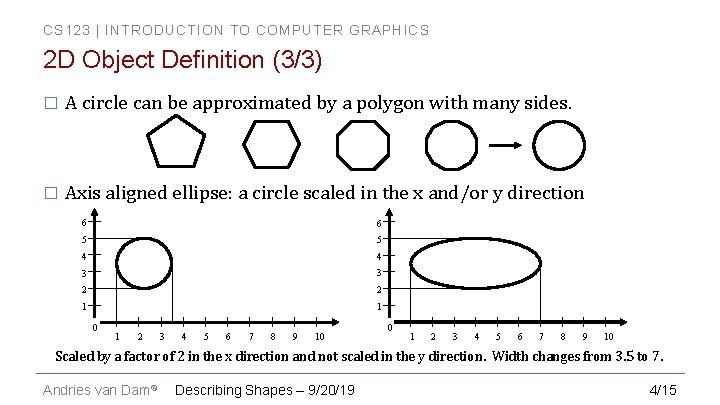
CS 123 | INTRODUCTION TO COMPUTER GRAPHICS 2 D Object Definition (3/3) � A circle can be approximated by a polygon with many sides. � Axis aligned ellipse: a circle scaled in the x and/or y direction 6 6 5 5 4 4 3 3 2 2 1 1 0 1 2 3 4 5 6 7 8 9 10 Scaled by a factor of 2 in the x direction and not scaled in the y direction. Width changes from 3. 5 to 7. Andries van Dam© Describing Shapes – 9/20/19 4/15
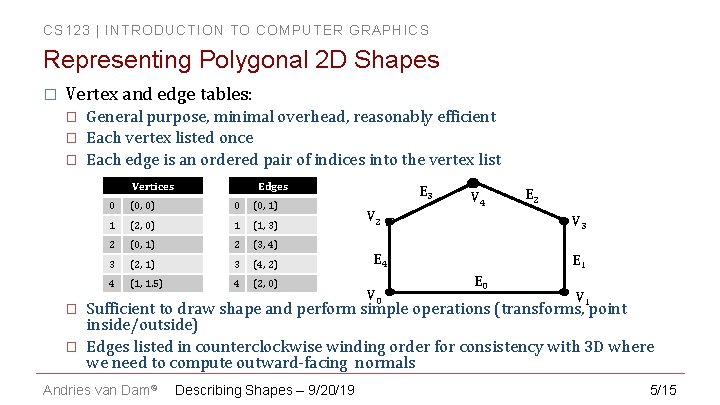
CS 123 | INTRODUCTION TO COMPUTER GRAPHICS Representing Polygonal 2 D Shapes � Vertex and edge tables: � � � General purpose, minimal overhead, reasonably efficient Each vertex listed once Each edge is an ordered pair of indices into the vertex list Vertices � � Edges 0 (0, 0) 0 (0, 1) 1 (2, 0) 1 (1, 3) 2 (0, 1) 2 (3, 4) 3 (2, 1) 3 (4, 2) 4 (1, 1. 5) 4 (2, 0) E 3 V 2 V 4 V 3 E 4 V 0 E 2 E 1 E 0 V 1 Sufficient to draw shape and perform simple operations (transforms, point inside/outside) Edges listed in counterclockwise winding order for consistency with 3 D where we need to compute outward-facing normals Andries van Dam© Describing Shapes – 9/20/19 5/15
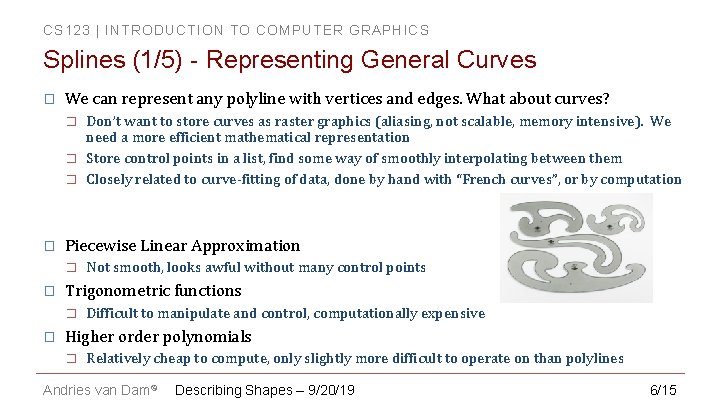
CS 123 | INTRODUCTION TO COMPUTER GRAPHICS Splines (1/5) - Representing General Curves � We can represent any polyline with vertices and edges. What about curves? � � Piecewise Linear Approximation � � Not smooth, looks awful without many control points Trigonometric functions � � Don’t want to store curves as raster graphics (aliasing, not scalable, memory intensive). We need a more efficient mathematical representation Store control points in a list, find some way of smoothly interpolating between them Closely related to curve-fitting of data, done by hand with “French curves”, or by computation Difficult to manipulate and control, computationally expensive Higher order polynomials � Relatively cheap to compute, only slightly more difficult to operate on than polylines Andries van Dam© Describing Shapes – 9/20/19 6/15
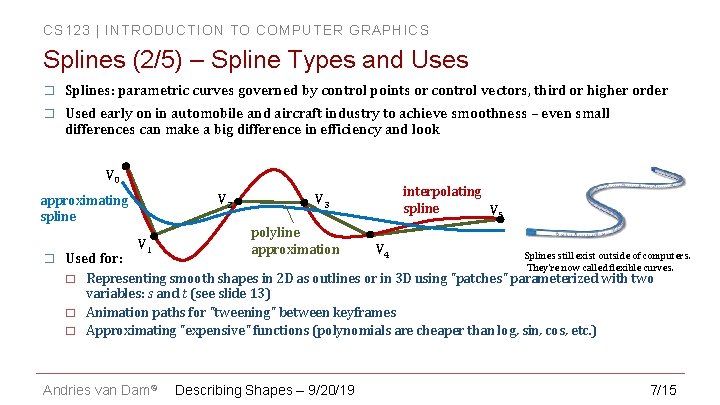
CS 123 | INTRODUCTION TO COMPUTER GRAPHICS Splines (2/5) – Spline Types and Uses � � Splines: parametric curves governed by control points or control vectors, third or higher order Used early on in automobile and aircraft industry to achieve smoothness – even small differences can make a big difference in efficiency and look V 0 V 2 approximating spline � Used for: � � � V 1 interpolating spline V 5 V 3 polyline approximation V 4 Splines still exist outside of computers. They’re now called flexible curves. Representing smooth shapes in 2 D as outlines or in 3 D using "patches" parameterized with two variables: s and t (see slide 13) Animation paths for "tweening" between keyframes Approximating "expensive" functions (polynomials are cheaper than log, sin, cos, etc. ) Andries van Dam© Describing Shapes – 9/20/19 7/15
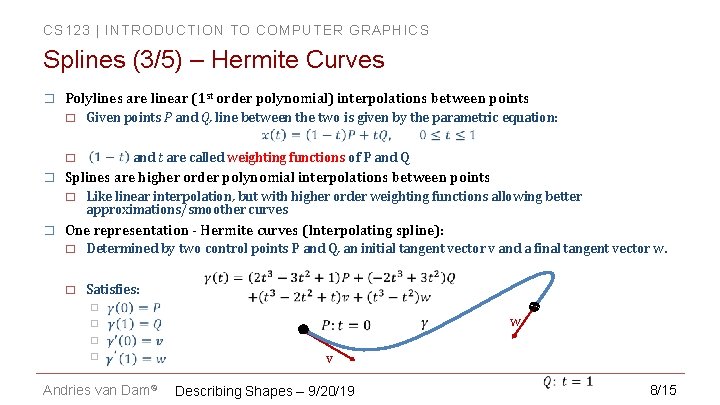
CS 123 | INTRODUCTION TO COMPUTER GRAPHICS Splines (3/5) – Hermite Curves � Polylines are linear (1 st order polynomial) interpolations between points � Given points P and Q, line between the two is given by the parametric equation: and t are called weighting functions of P and Q � � Splines are higher order polynomial interpolations between points � � Like linear interpolation, but with higher order weighting functions allowing better approximations/smoother curves One representation - Hermite curves (Interpolating spline): � Determined by two control points P and Q, an initial tangent vector v and a final tangent vector w. � Satisfies: � w � � � Andries van Dam© v Describing Shapes – 9/20/19 8/15
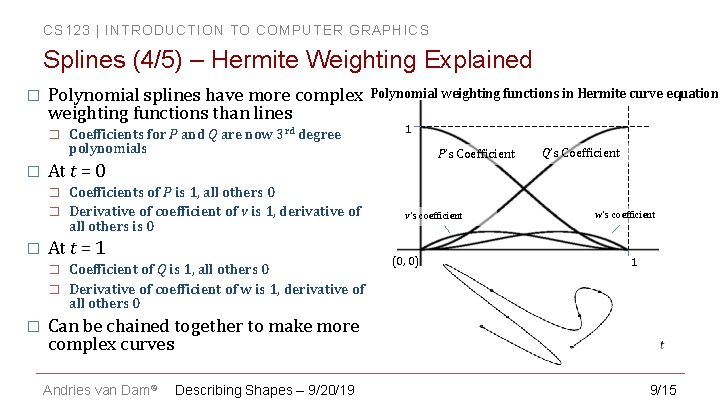
CS 123 | INTRODUCTION TO COMPUTER GRAPHICS Splines (4/5) – Hermite Weighting Explained � Polynomial splines have more complex weighting functions than lines � � � Coefficients of P is 1, all others 0 Derivative of coefficient of v is 1, derivative of all others is 0 At t = 1 � � � 1 P’s Coefficient At t = 0 � � Coefficients for P and Q are now 3 rd degree polynomials Polynomial weighting functions in Hermite curve equation Coefficient of Q is 1, all others 0 Derivative of coefficient of w is 1, derivative of all others 0 v’s coefficient (0, 0) Q’s Coefficient w’s coefficient 1 Can be chained together to make more complex curves Andries van Dam© Describing Shapes – 9/20/19 9/15
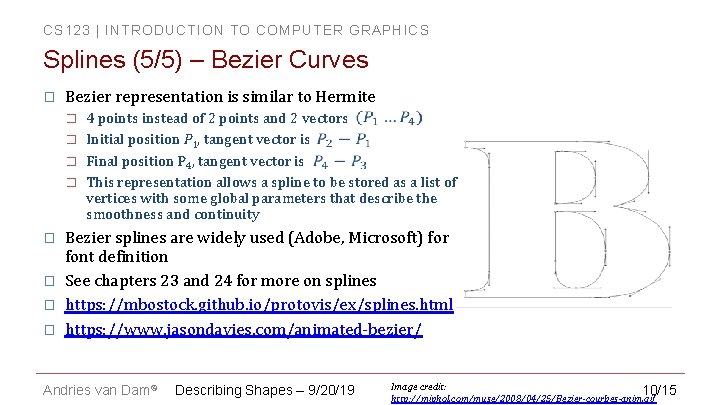
CS 123 | INTRODUCTION TO COMPUTER GRAPHICS Splines (5/5) – Bezier Curves � Bezier representation is similar to Hermite � � � � 4 points instead of 2 points and 2 vectors Initial position P 1, tangent vector is Final position P 4, tangent vector is This representation allows a spline to be stored as a list of vertices with some global parameters that describe the smoothness and continuity Bezier splines are widely used (Adobe, Microsoft) for font definition See chapters 23 and 24 for more on splines https: //mbostock. github. io/protovis/ex/splines. html https: //www. jasondavies. com/animated-bezier/ Andries van Dam© Describing Shapes – 9/20/19 Image credit: 10/15 http: //miphol. com/muse/2008/04/25/Bezier-courbes-anim. gif
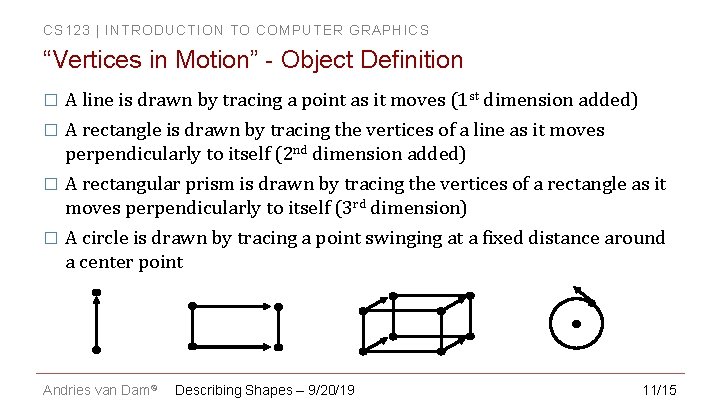
CS 123 | INTRODUCTION TO COMPUTER GRAPHICS “Vertices in Motion” - Object Definition � A line is drawn by tracing a point as it moves (1 st dimension added) A rectangle is drawn by tracing the vertices of a line as it moves perpendicularly to itself (2 nd dimension added) � A rectangular prism is drawn by tracing the vertices of a rectangle as it moves perpendicularly to itself (3 rd dimension) � A circle is drawn by tracing a point swinging at a fixed distance around a center point � Andries van Dam© Describing Shapes – 9/20/19 11/15
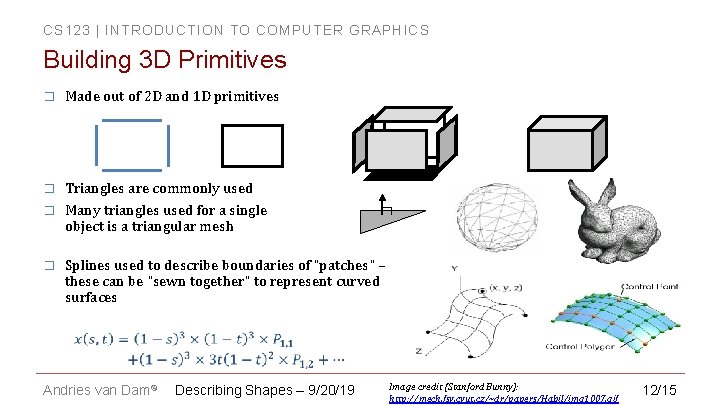
CS 123 | INTRODUCTION TO COMPUTER GRAPHICS Building 3 D Primitives � Made out of 2 D and 1 D primitives � Triangles are commonly used Many triangles used for a single object is a triangular mesh � � Splines used to describe boundaries of "patches" – these can be "sewn together" to represent curved surfaces Andries van Dam© Describing Shapes – 9/20/19 Image credit (Stanford Bunny): http: //mech. fsv. cvut. cz/~dr/papers/Habil/img 1007. gif 12/15
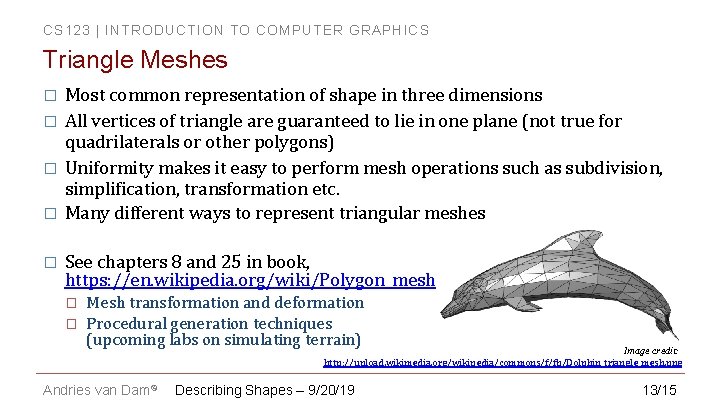
CS 123 | INTRODUCTION TO COMPUTER GRAPHICS Triangle Meshes � � � Most common representation of shape in three dimensions All vertices of triangle are guaranteed to lie in one plane (not true for quadrilaterals or other polygons) Uniformity makes it easy to perform mesh operations such as subdivision, simplification, transformation etc. Many different ways to represent triangular meshes See chapters 8 and 25 in book, https: //en. wikipedia. org/wiki/Polygon_mesh � � Mesh transformation and deformation Procedural generation techniques (upcoming labs on simulating terrain) Image credit: http: //upload. wikimedia. org/wikipedia/commons/f/fb/Dolphin_triangle_mesh. png Andries van Dam© Describing Shapes – 9/20/19 13/15
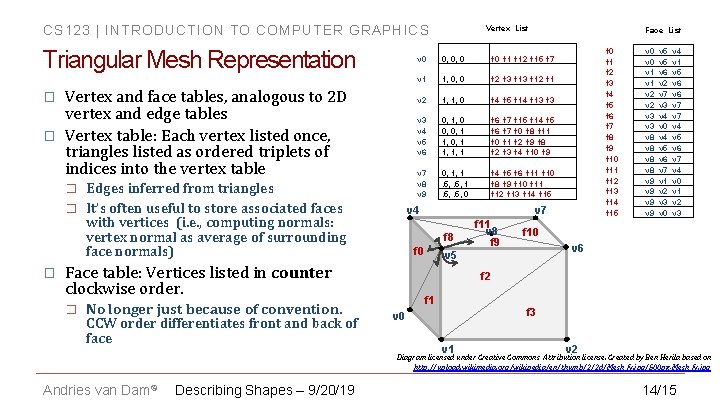
CS 123 | INTRODUCTION TO COMPUTER GRAPHICS Triangular Mesh Representation � � Vertex and face tables, analogous to 2 D vertex and edge tables Vertex table: Each vertex listed once, triangles listed as ordered triplets of indices into the vertex table � � � Edges inferred from triangles It’s often useful to store associated faces with vertices (i. e. , computing normals: vertex normal as average of surrounding face normals) No longer just because of convention. CCW order differentiates front and back of face Face List v 0 0, 0, 0 f 1 f 12 f 15 f 7 v 1 1, 0, 0 f 2 f 3 f 12 f 1 v 2 1, 1, 0 f 4 f 5 f 14 f 13 f 3 v 4 v 5 v 6 0, 1, 0 0, 0, 1 1, 1, 1 f 6 f 0 f 2 v 7 v 8 v 9 0, 1, 1. 5, 0 f 4 f 5 f 6 f 11 f 10 f 8 f 9 f 10 f 11 f 12 f 13 f 14 f 15 v 4 f 7 f 1 f 3 f 0 f 1 f 2 f 3 f 4 f 5 f 6 f 7 f 8 f 9 f 10 f 11 f 12 f 13 f 14 f 15 f 14 f 5 f 0 f 8 f 11 f 2 f 9 f 8 f 4 f 10 f 9 v 7 f 8 f 0 Face table: Vertices listed in counter clockwise order. � Vertex List f 11 v 8 f 9 v 0 v 1 v 2 v 3 v 8 v 8 v 9 v 9 v 5 v 6 v 2 v 7 v 3 v 4 v 0 v 4 v 5 v 6 v 7 v 1 v 2 v 3 v 0 v 4 v 1 v 5 v 6 v 7 v 4 v 0 v 1 v 2 v 3 f 10 v 6 v 5 f 2 f 1 f 3 v 0 v 1 v 2 Diagram licensed under Creative Commons Attribution license. Created by Ben Herila based on http: //upload. wikimedia. org/wikipedia/en/thumb/2/2 d/Mesh_fv. jpg/500 px-Mesh_fv. jpg Andries van Dam© Describing Shapes – 9/20/19 14/15
CS 123 | INTRODUCTION TO COMPUTER GRAPHICS Book Sections � Chapter 8 � Chapters 22 and 23 for splines (warning: pretty heavy math) Chapter 24 for implicit shapes � Chapter 25 for meshes � Andries van Dam© Describing Shapes – 9/20/19 15/15
- Slides: 15