
CS 122 Using Relational Databases and SQL Views
CS 122 Using Relational Databases and SQL Views, Indexes, and Transactions Chengyu Sun California State University, Los Angeles
Views create view_name as query; A virtual table consists of the results of a query Example: create a view members_salespeople_view (member_name, salesperson_name)
About Views A view can be used as a table in SQL statements n Except that some views cannot be updated The data in a view is dynamically computed n Changes to base tables are automatically reflected in the view
Why Views Present the data in a different way Simplify SQL queries Security reasons n E. g. expose only part of the data to certain type of users
Indexes Make query execution more efficient
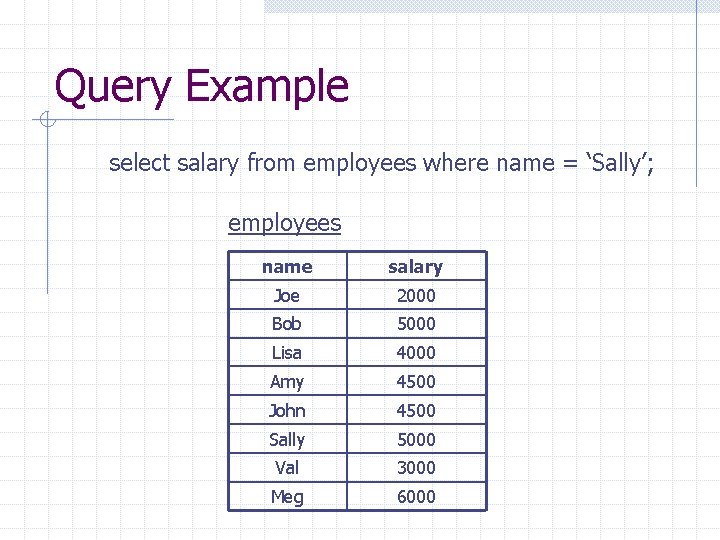
Query Example select salary from employees where name = ‘Sally’; employees name salary Joe 2000 Bob 5000 Lisa 4000 Amy 4500 John 4500 Sally 5000 Val 3000 Meg 6000
![Table Bob Lisa [Meg, 6000] Joe [Val, 3000] John [Sally, 5000] Index [John, 4500]](http://slidetodoc.com/presentation_image_h2/e7e850b0e371db12e8aacad9cb1bf547/image-7.jpg "Table Bob Lisa [Meg, 6000] Joe [Val, 3000] John [Sally, 5000] Index [John, 4500]")
Table Bob Lisa [Meg, 6000] Joe [Val, 3000] John [Sally, 5000] Index [John, 4500] Joe [Amy, 4500] Amy [Lisa, 4000] Bob [Bob, 5000] Amy [Joe, 2000] Search with an Index John Meg Lisa Sally Meg Sally Val
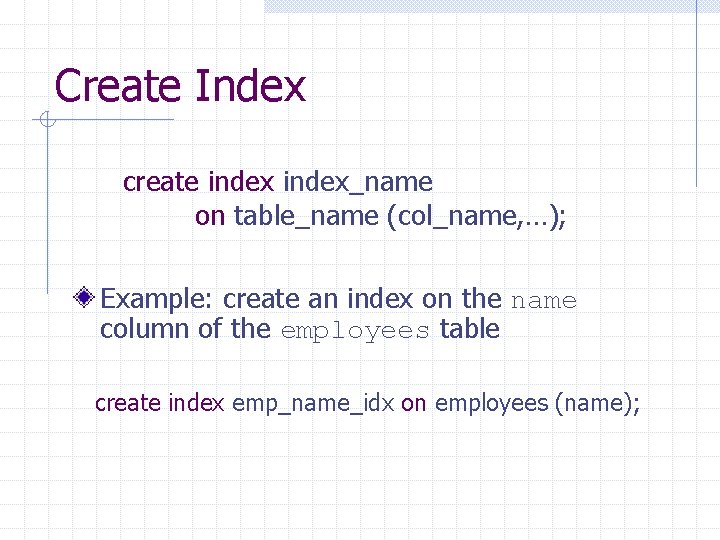
Create Index create index_name on table_name (col_name, …); Example: create an index on the name column of the employees table create index emp_name_idx on employees (name);
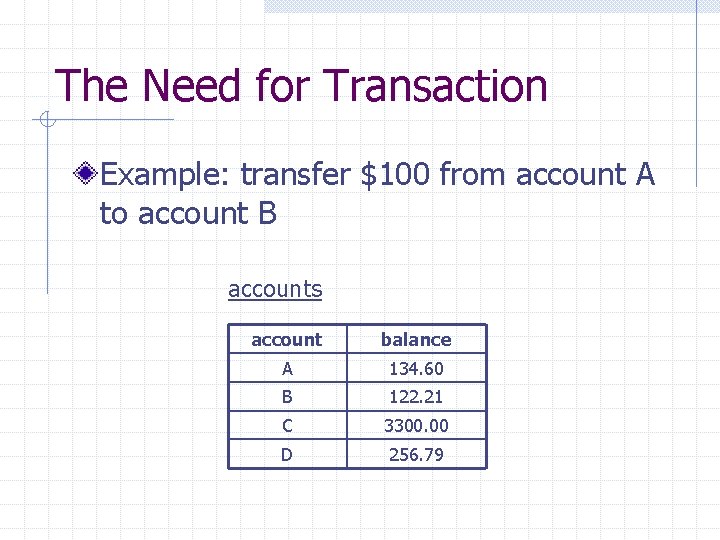
The Need for Transaction Example: transfer $100 from account A to account B accounts account balance A 134. 60 B 122. 21 C 3300. 00 D 256. 79
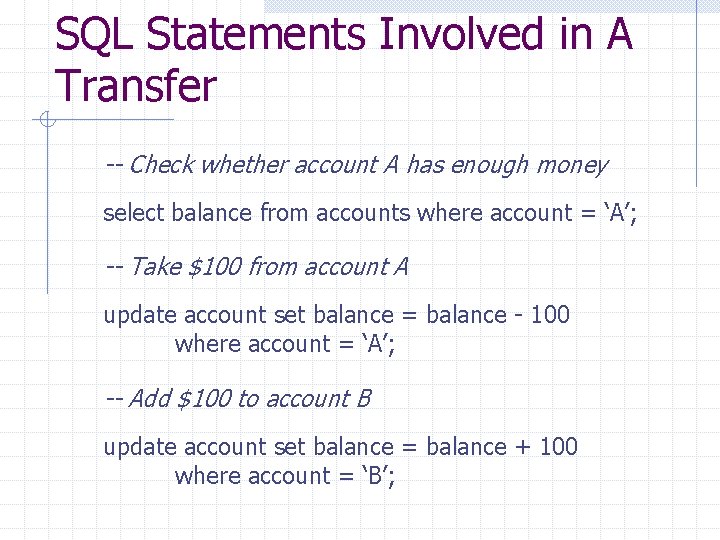
SQL Statements Involved in A Transfer -- Check whether account A has enough money select balance from accounts where account = ‘A’; -- Take $100 from account A update account set balance = balance - 100 where account = ‘A’; -- Add $100 to account B update account set balance = balance + 100 where account = ‘B’;
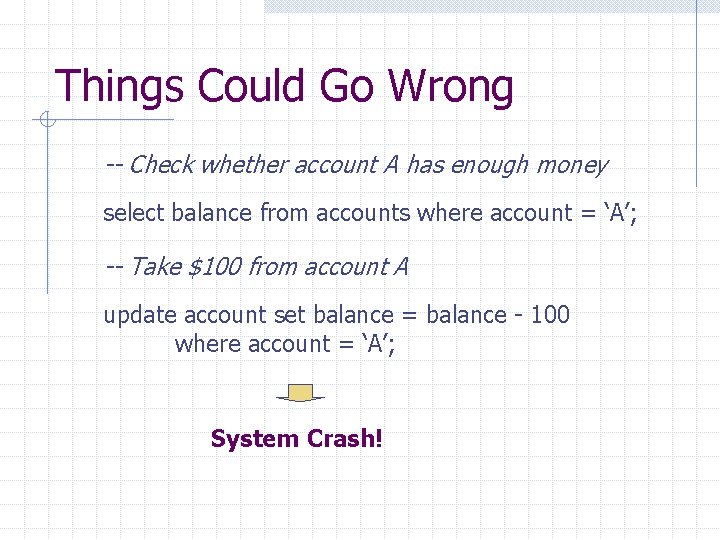
Things Could Go Wrong -- Check whether account A has enough money select balance from accounts where account = ‘A’; -- Take $100 from account A update account set balance = balance - 100 where account = ‘A’; System Crash!
Transaction A group of statements that are treated as a whole, i. e. either all operations in the group are performed or none of them are – the Atomicity property.
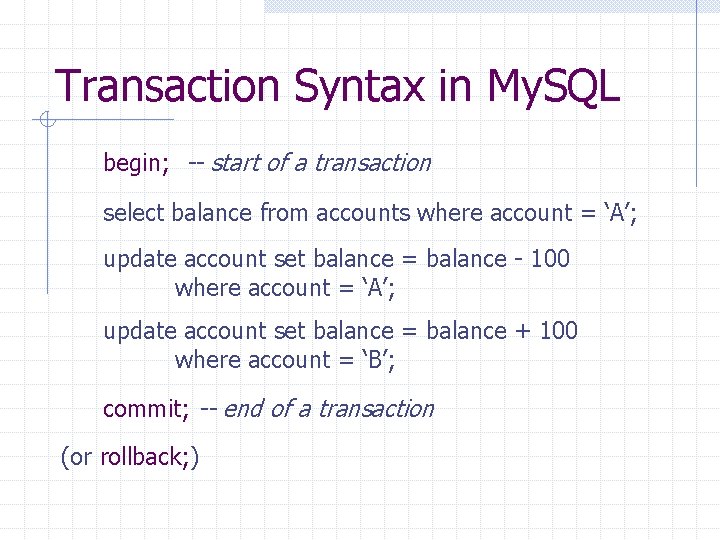
Transaction Syntax in My. SQL begin; -- start of a transaction select balance from accounts where account = ‘A’; update account set balance = balance - 100 where account = ‘A’; update account set balance = balance + 100 where account = ‘B’; commit; -- end of a transaction (or rollback; )
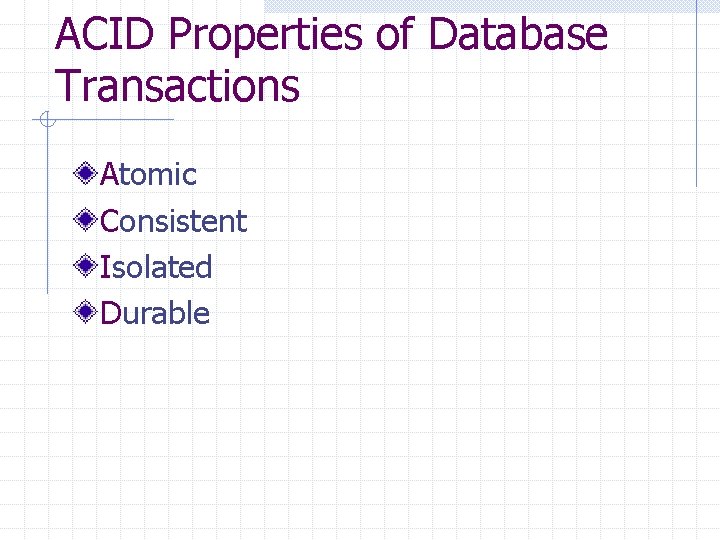
ACID Properties of Database Transactions Atomic Consistent Isolated Durable
- Slides: 14