
CS 121 Lecture 8 Finite Automata and Regular
- Slides: 25
CS 121: Lecture 8 Finite Automata and Regular Functions Adam Hesterberg https: //madhu. seas. Harvard. edu/courses/Fall 2020 Book: https: //introtcs. org How to contact us { The whole staff (faster response): CS 121 Piazza Only the course heads (slower): cs 121. fall 2020. course. heads@gmail. com
Today • Comparison of regular expressions and finite automata • Nondeterministic Finite Automata • Preview of next lecture: non-regular functions
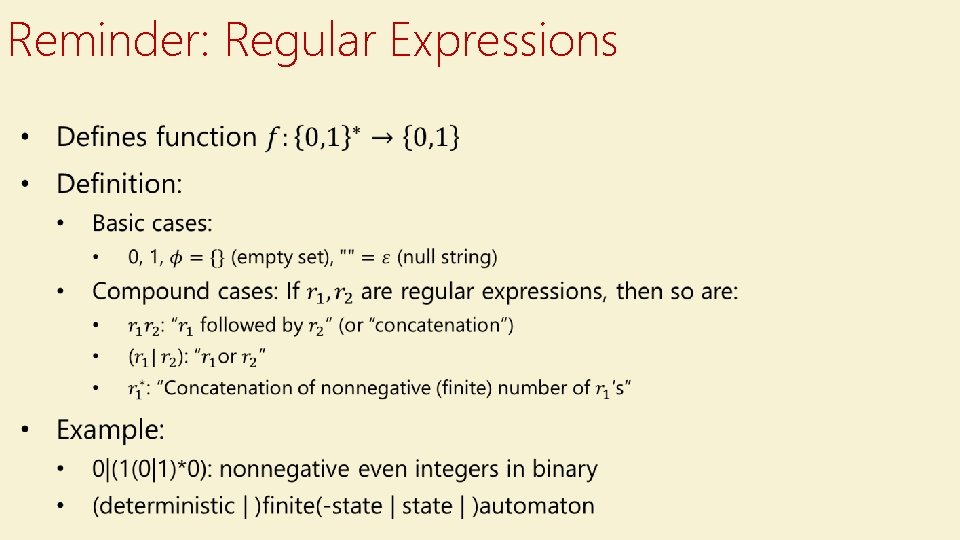
Reminder: Regular Expressions
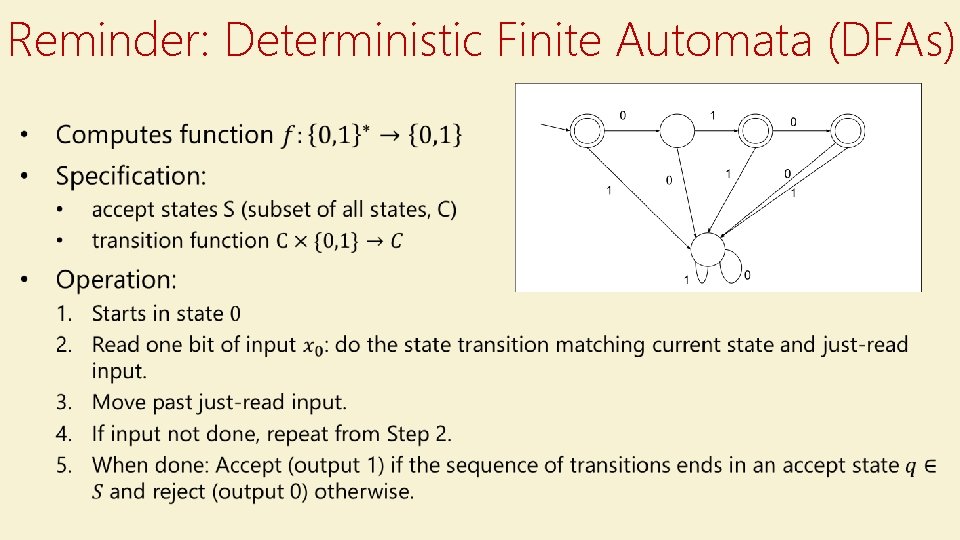
Reminder: Deterministic Finite Automata (DFAs)
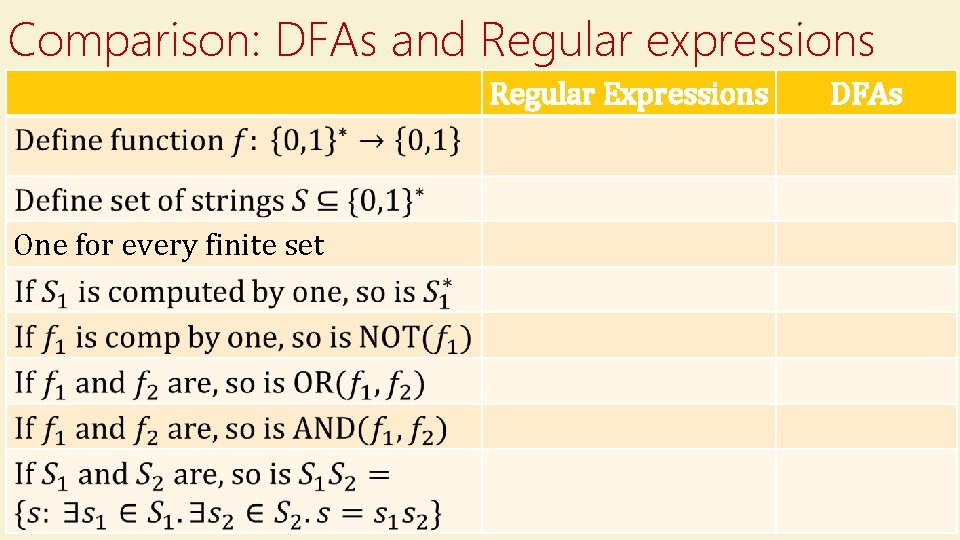
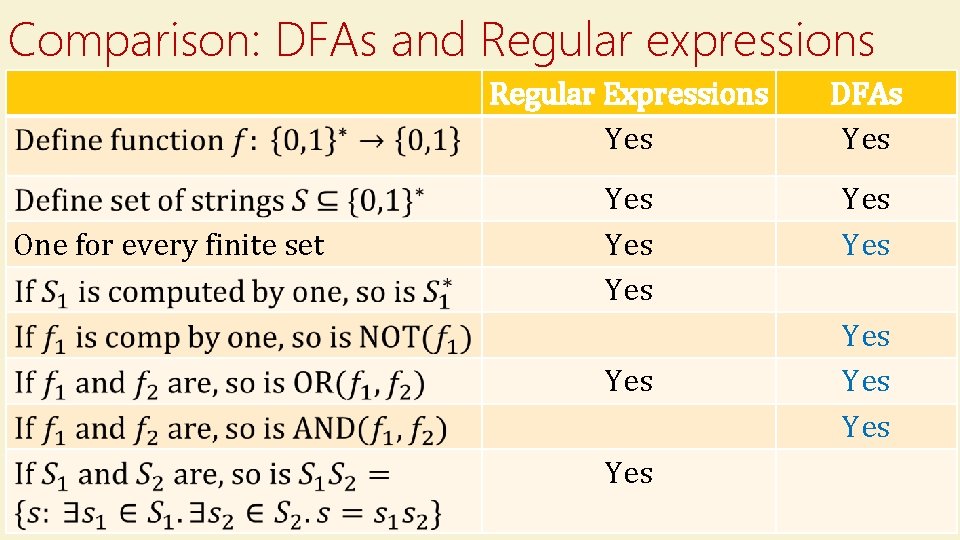
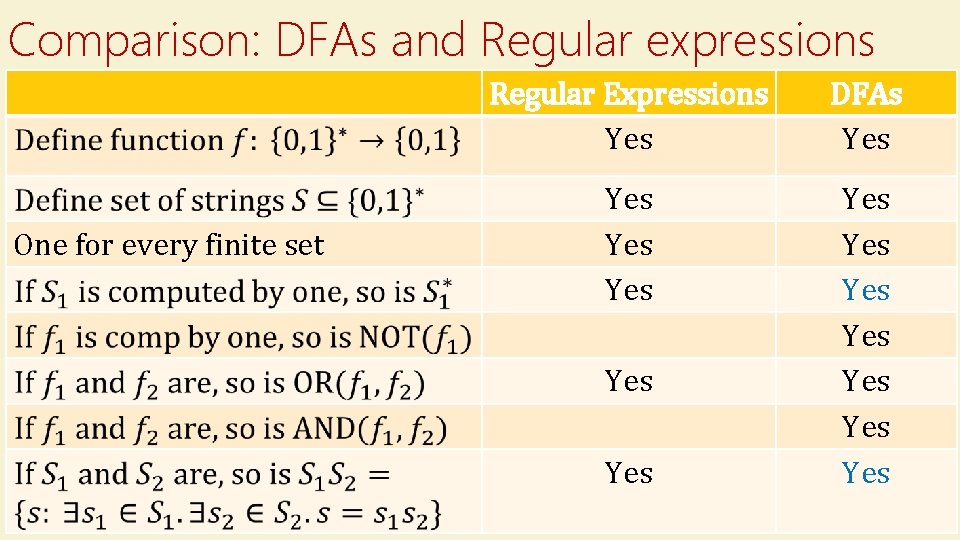
Comparison: DFAs and Regular expressions Regular Expressions One for every finite set DFAs
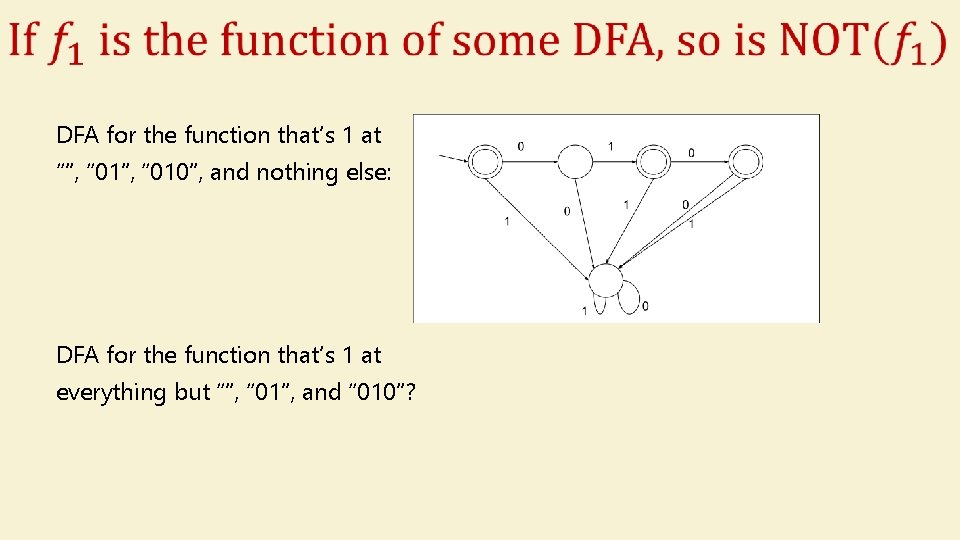
DFA for the function that’s 1 at “”, “ 010”, and nothing else: DFA for the function that’s 1 at everything but “”, “ 01”, and “ 010”?
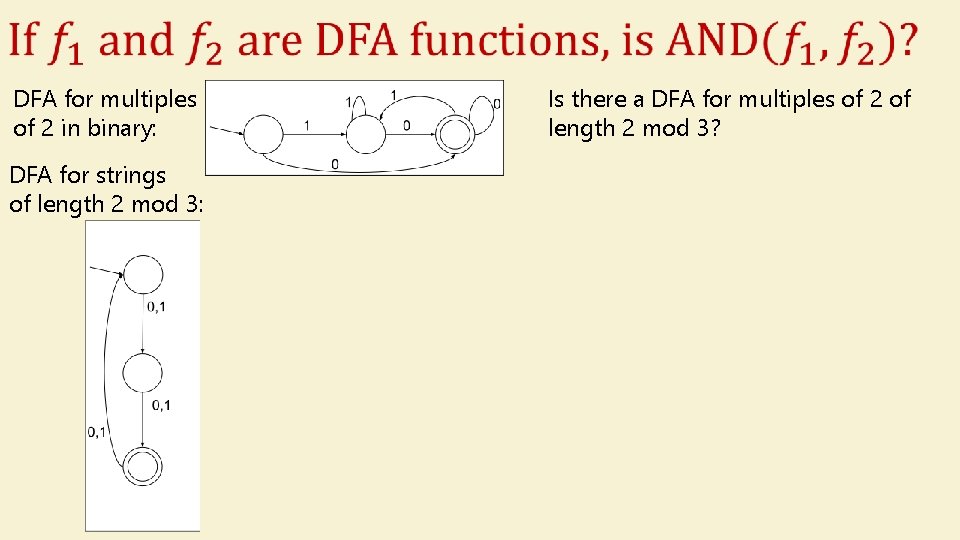
DFA for multiples of 2 in binary: DFA for strings of length 2 mod 3: Is there a DFA for multiples of 2 of length 2 mod 3?
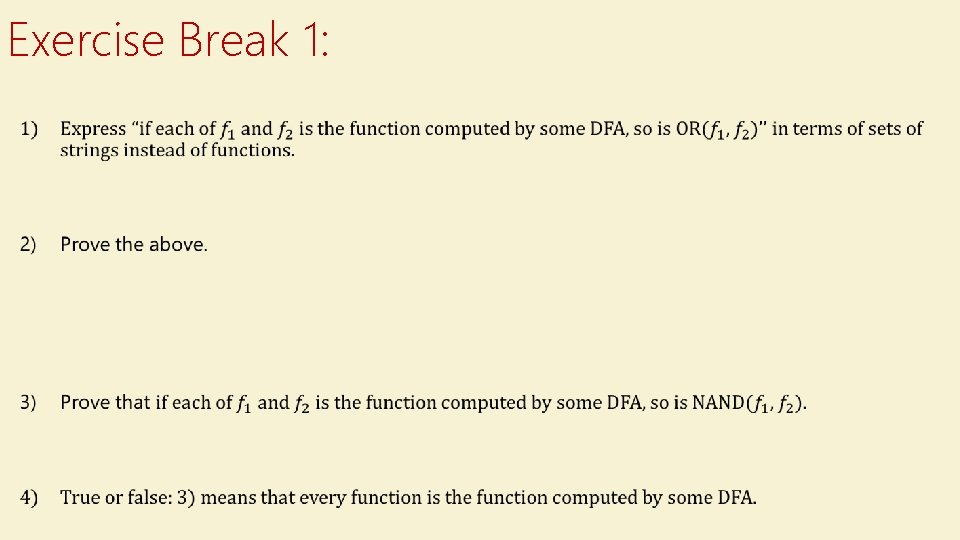
Exercise Break 1:
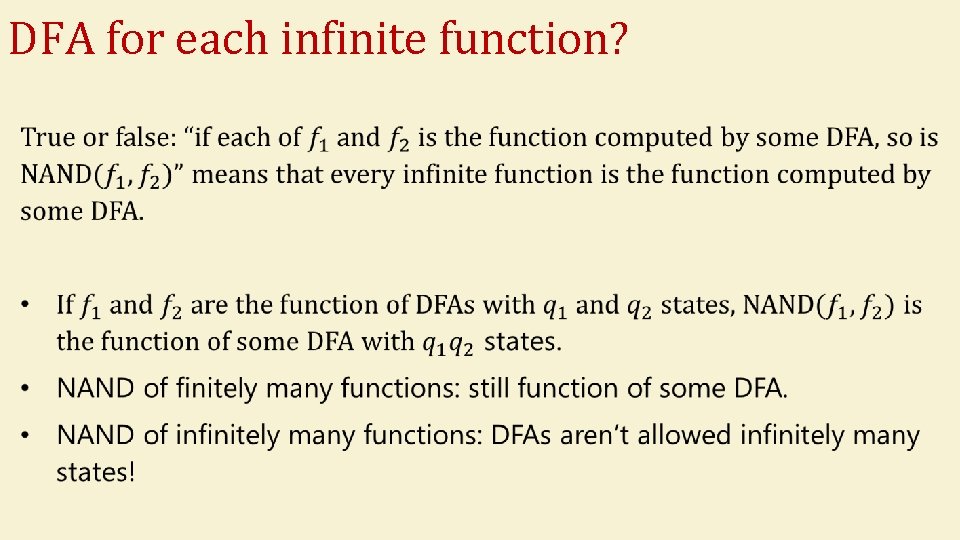
DFA for each infinite function?
Comparison: DFAs and Regular expressions One for every finite set Regular Expressions Yes DFAs Yes Yes Yes
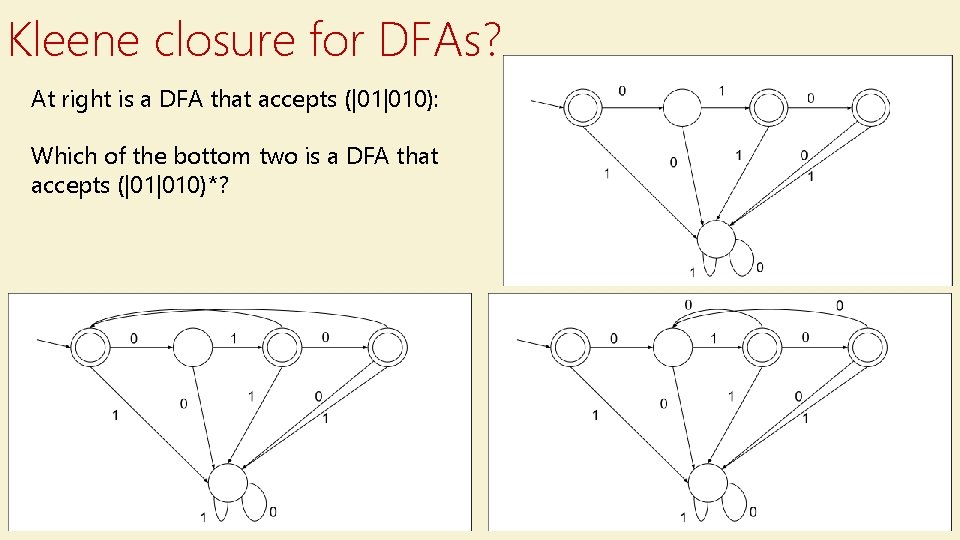
Kleene closure for DFAs? At right is a DFA that accepts (|01|010): Which of the bottom two is a DFA that accepts (|01|010)*?
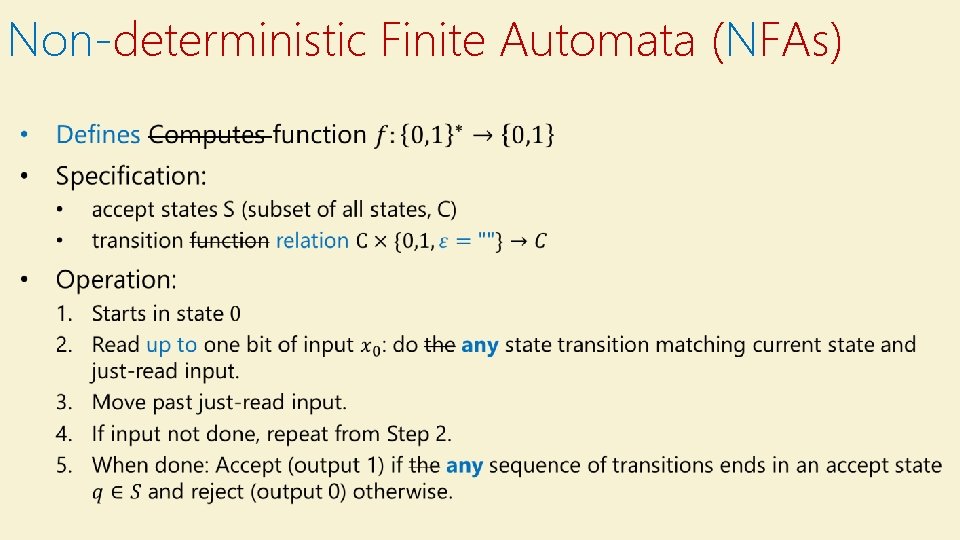
Non-deterministic Finite Automata (NFAs)
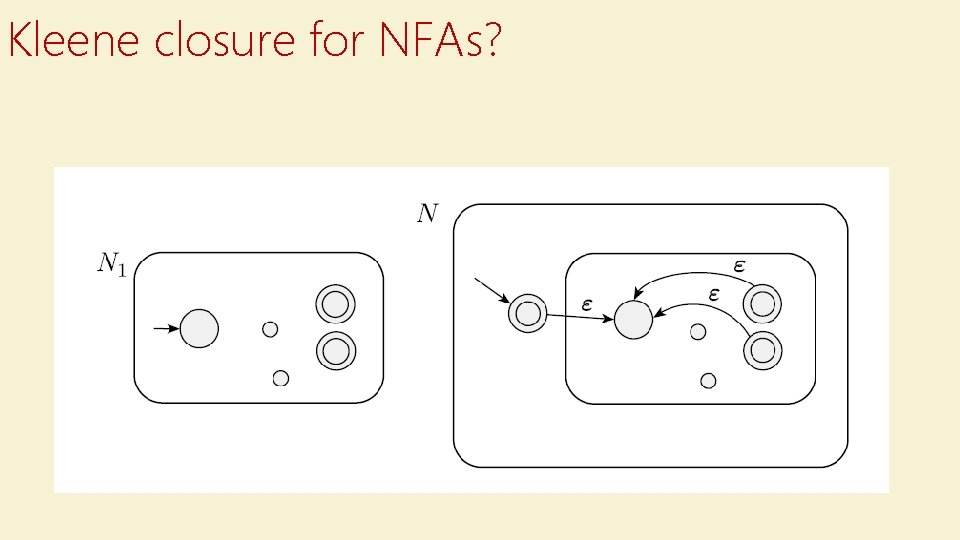
Kleene closure for NFAs?
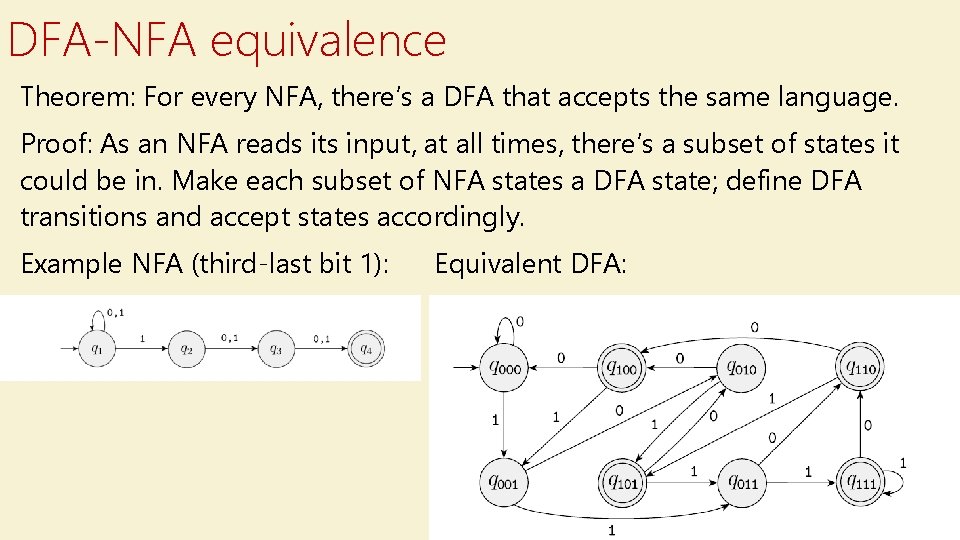
DFA-NFA equivalence Theorem: For every NFA, there’s a DFA that accepts the same language. Proof: As an NFA reads its input, at all times, there’s a subset of states it could be in. Make each subset of NFA states a DFA state; define DFA transitions and accept states accordingly. Example NFA (third-last bit 1): Equivalent DFA:
Kleene closure for DFAs, take 2
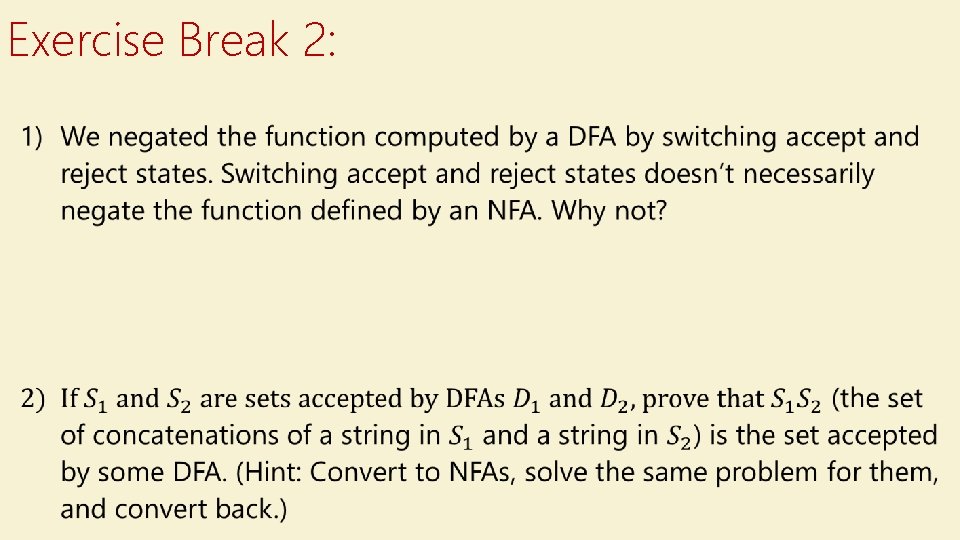
Exercise Break 2:
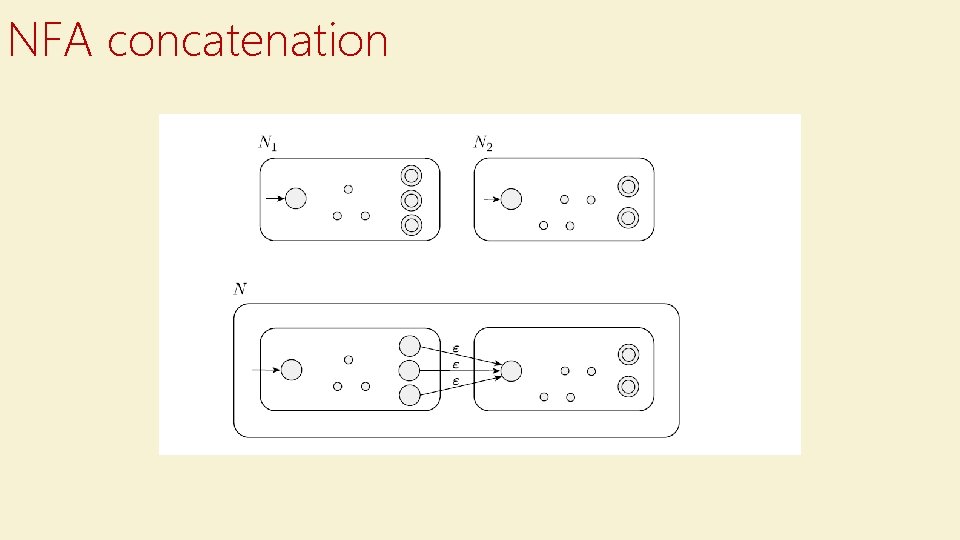
NFA concatenation
Comparison: DFAs and Regular expressions One for every finite set Regular Expressions Yes DFAs Yes Yes Yes Yes
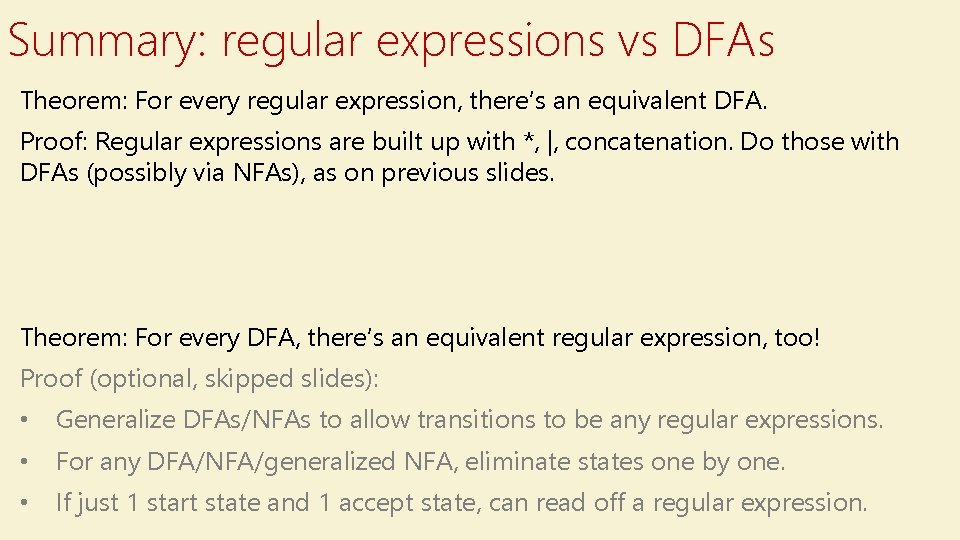
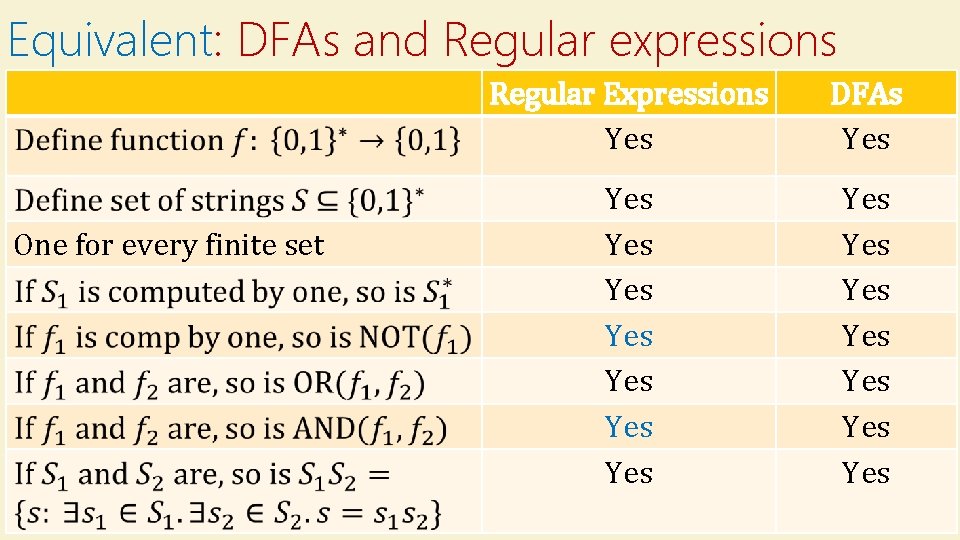
Summary: regular expressions vs DFAs Theorem: For every regular expression, there’s an equivalent DFA. Proof: Regular expressions are built up with *, |, concatenation. Do those with DFAs (possibly via NFAs), as on previous slides. Theorem: For every DFA, there’s an equivalent regular expression, too! Proof (optional, skipped slides): • Generalize DFAs/NFAs to allow transitions to be any regular expressions. • For any DFA/NFA/generalized NFA, eliminate states one by one. • If just 1 start state and 1 accept state, can read off a regular expression.
Equivalent: DFAs and Regular expressions One for every finite set Regular Expressions Yes DFAs Yes Yes Yes Yes
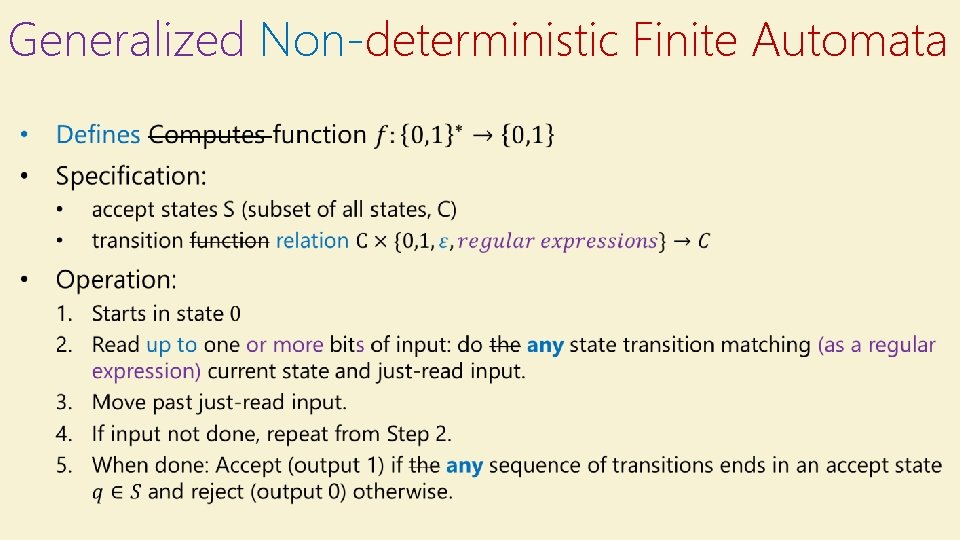
Generalized Non-deterministic Finite Automata
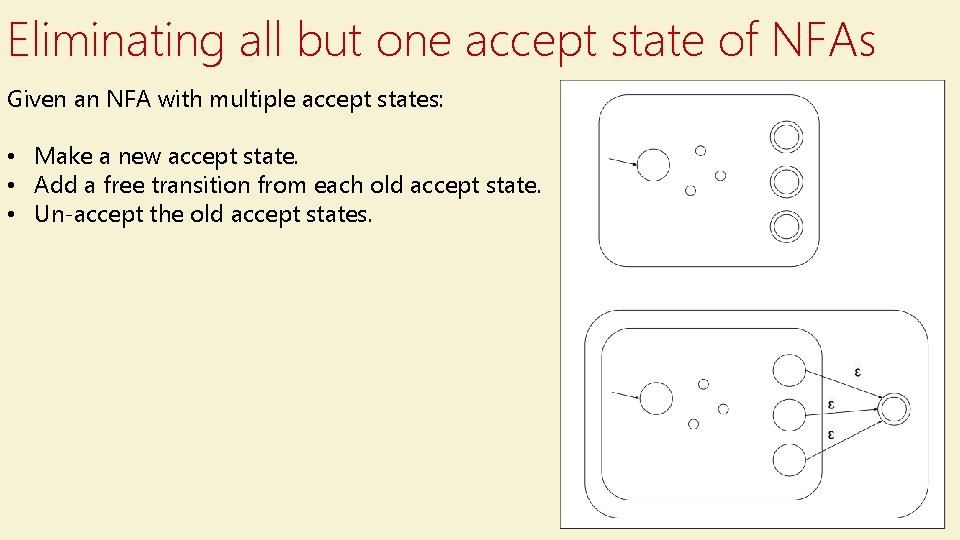
Eliminating all but one accept state of NFAs Given an NFA with multiple accept states: • Make a new accept state. • Add a free transition from each old accept state. • Un-accept the old accept states.
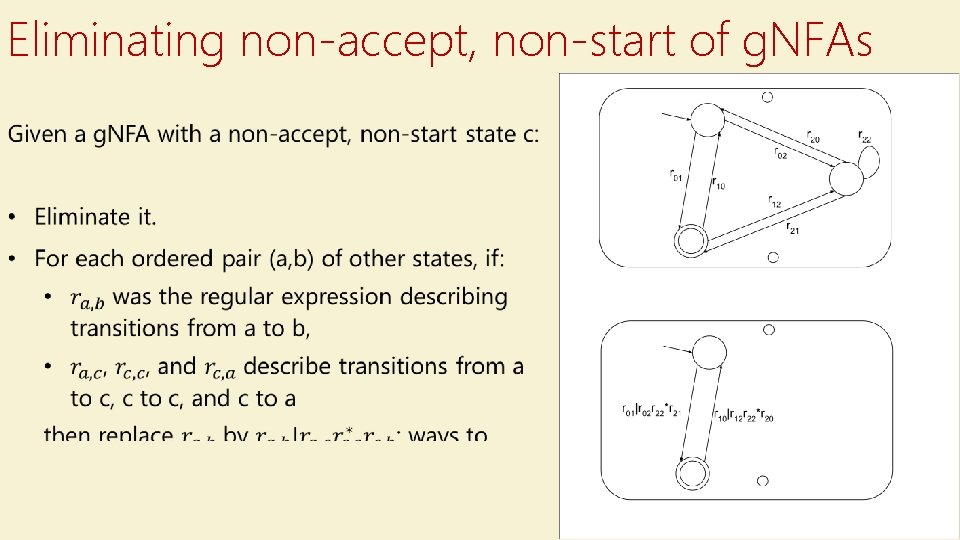
Eliminating non-accept, non-start of g. NFAs
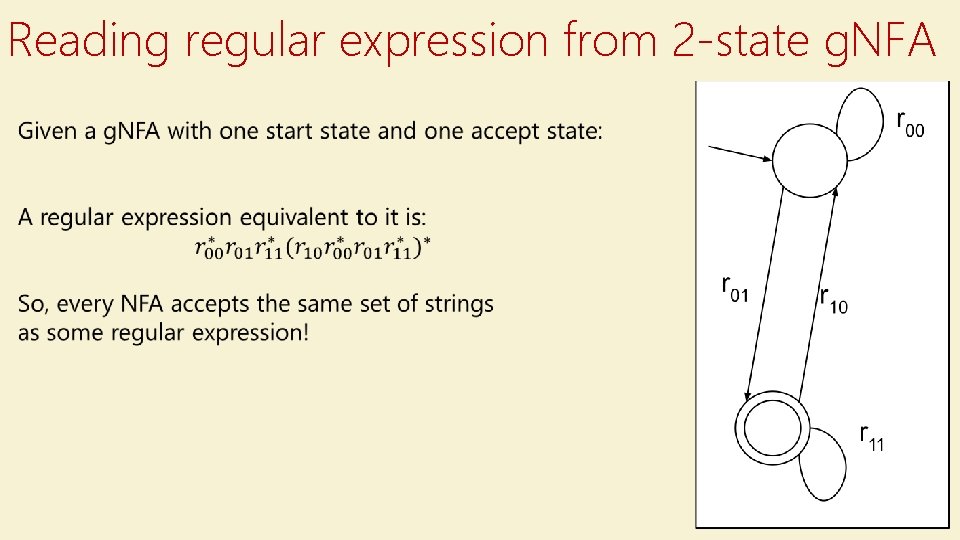
Reading regular expression from 2 -state g. NFA
Next lecture: • Recap of DFA-regexp equivalence • Limits of DFA • • • NAND circuits computed all (finite) functions. Do DFA compute all (infinite) functions? No. What are some functions that are not computed by DFA?