
CS 1201 Programming Language 2 By Nouf Aljaffan
CS 1201: Programming Language 2 By: Nouf Aljaffan Edited by : Nouf Almunyif Classes and objects III
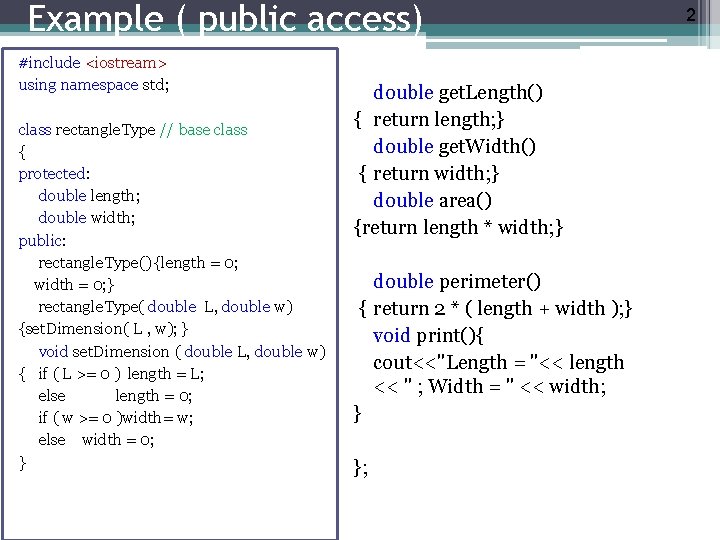
Example ( public access) #include <iostream> using namespace std; class rectangle. Type // base class { protected: double length; double width; public: rectangle. Type() {length = 0; width = 0; } rectangle. Type( double L, double w) {set. Dimension( L , w); } void set. Dimension ( double L, double w) { if ( L >= 0 ) length = L; else length = 0; if ( w >= 0 )width= w; else width = 0; } double get. Length() { return length; } double get. Width() { return width; } double area() {return length * width; } double perimeter() { return 2 * ( length + width ); } void print(){ cout<<"Length = "<< length << " ; Width = " << width; } }; 2
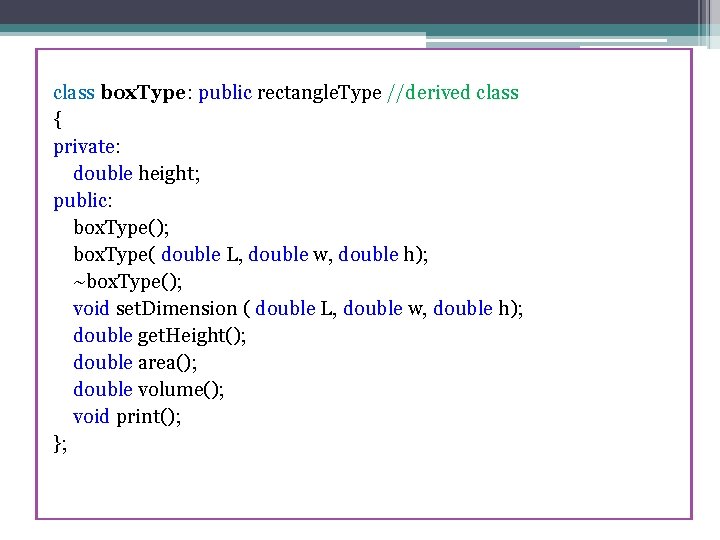
class box. Type: public rectangle. Type //derived class { private: double height; public: box. Type(); box. Type( double L, double w, double h); ~box. Type(); void set. Dimension ( double L, double w, double h); double get. Height(); double area(); double volume(); void print(); };
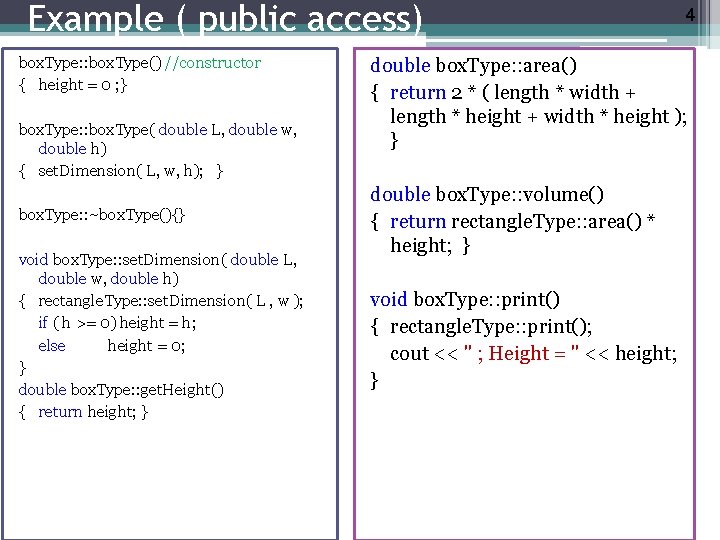
Example ( public access) box. Type: : box. Type() //constructor { height = 0 ; } box. Type: : box. Type( double L, double w, double h) { set. Dimension( L, w, h); } box. Type: : ~box. Type(){} void box. Type: : set. Dimension( double L, double w, double h) { rectangle. Type: : set. Dimension( L , w ); if ( h >= 0) height = h; else height = 0; } double box. Type: : get. Height() { return height; } 4 double box. Type: : area() { return 2 * ( length * width + length * height + width * height ); } double box. Type: : volume() { return rectangle. Type: : area() * height; } void box. Type: : print() { rectangle. Type: : print(); cout << " ; Height = " << height; }
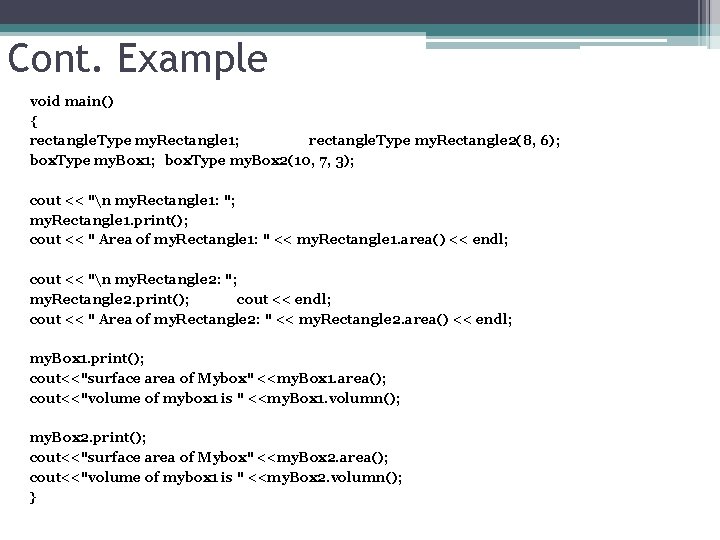
Cont. Example void main() { rectangle. Type my. Rectangle 1; rectangle. Type my. Rectangle 2(8, 6); box. Type my. Box 1; box. Type my. Box 2(10, 7, 3); cout << "n my. Rectangle 1: "; my. Rectangle 1. print(); cout << " Area of my. Rectangle 1: " << my. Rectangle 1. area() << endl; cout << "n my. Rectangle 2: "; my. Rectangle 2. print(); cout << endl; cout << " Area of my. Rectangle 2: " << my. Rectangle 2. area() << endl; my. Box 1. print(); cout<<"surface area of Mybox" <<my. Box 1. area(); cout<<"volume of mybox 1 is " <<my. Box 1. volumn(); my. Box 2. print(); cout<<"surface area of Mybox" <<my. Box 2. area(); cout<<"volume of mybox 1 is " <<my. Box 2. volumn(); }

Cont. Example
Over-written Functions • These functions are NOT overloaded, since they have exactly the same prototype (and header), and they are not in the same class. • They are over-written functions. • The over-written function that is closest to the object defined takes precedence.
public, (default) ▫ �its public members become public members of the derived class. �its protected members become protected members of the derived class. �Example : base class inherited as public
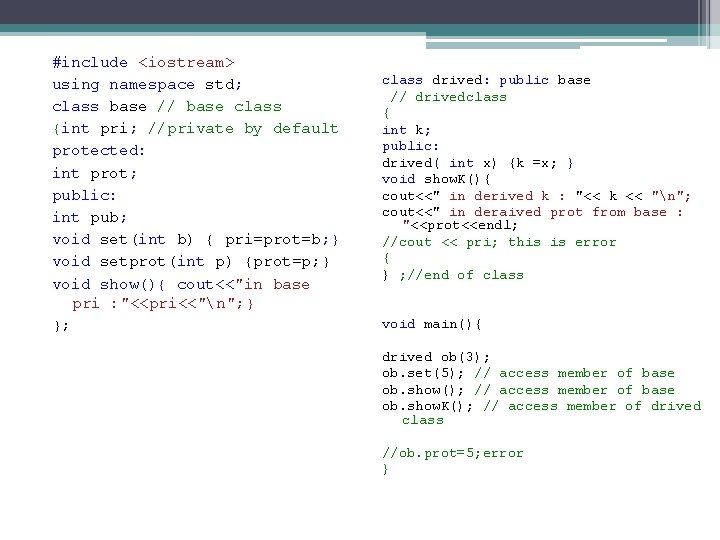
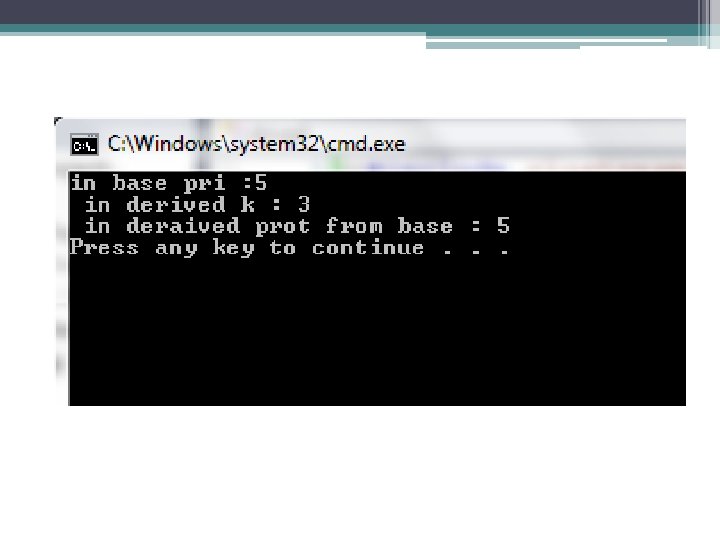
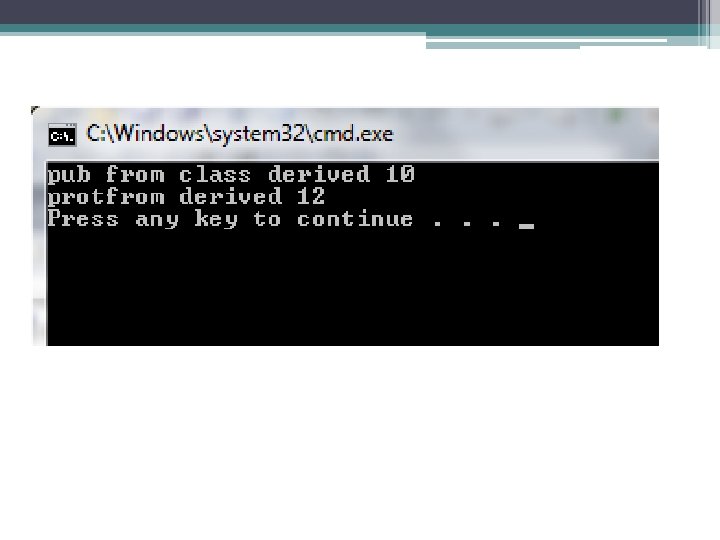
#include <iostream> using namespace std; class base // base class {int pri; //private by default protected: int prot; public: int pub; void set(int b) { pri=prot=b; } void setprot(int p) {prot=p; } void show(){ cout<<"in base pri : "<<pri<<"n"; } }; class drived: public base // drivedclass { int k; public: drived( int x) {k =x; } void show. K(){ cout<<" in derived k : "<< k << "n"; cout<<" in deraived prot from base : "<<prot<<endl; //cout << pri; this is error { } ; //end of class void main(){ drived ob(3); ob. set(5); // access member of base ob. show(); // access member of base ob. show. K(); // access member of drived class //ob. prot=5; error }
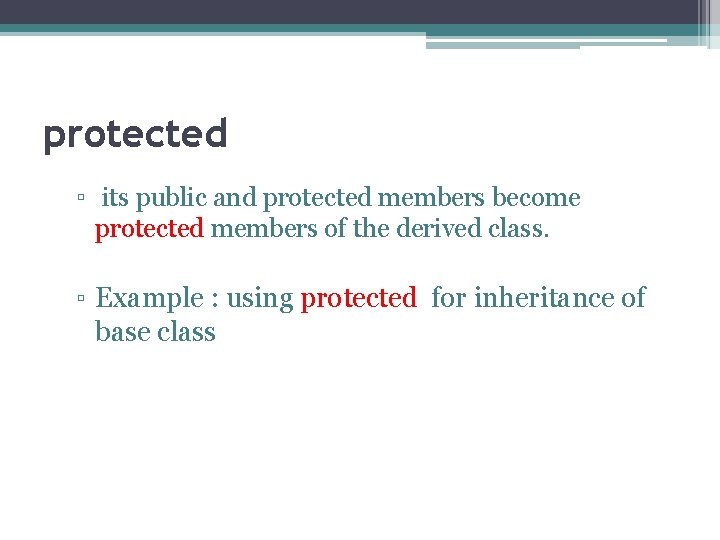
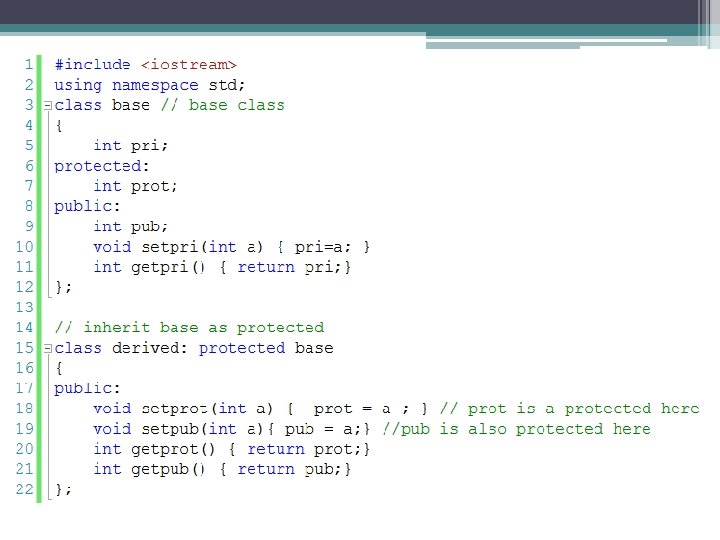
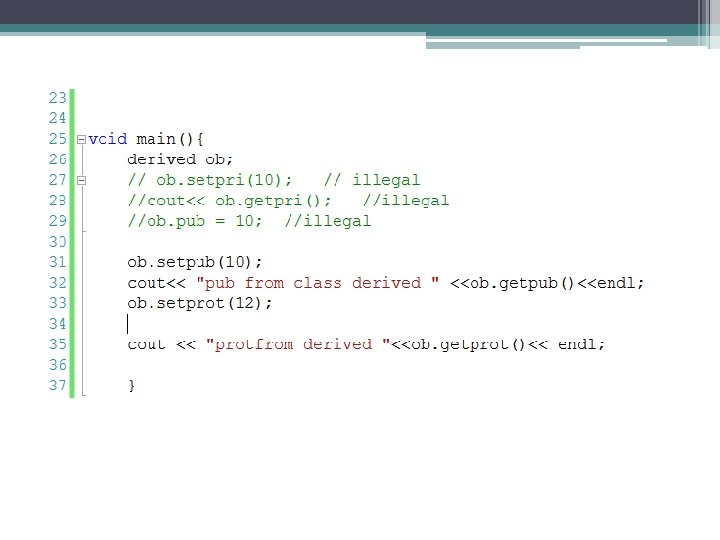
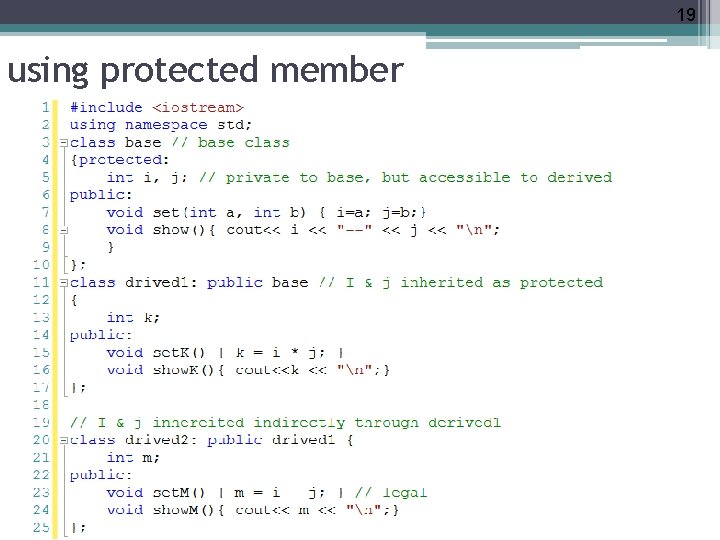
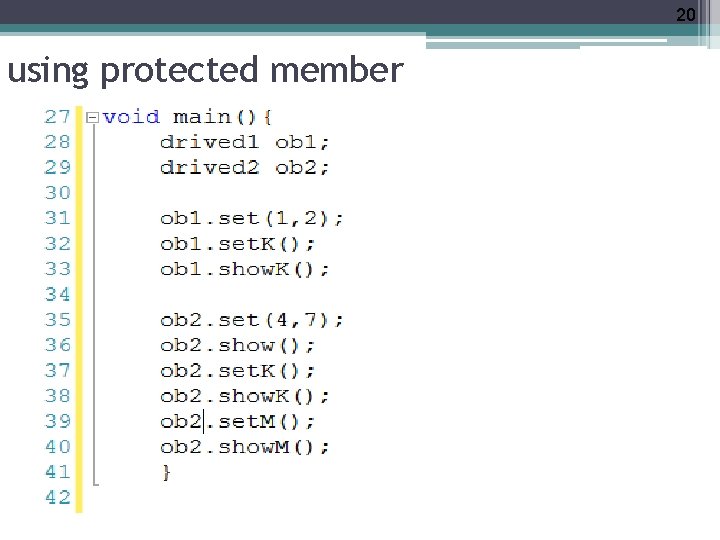
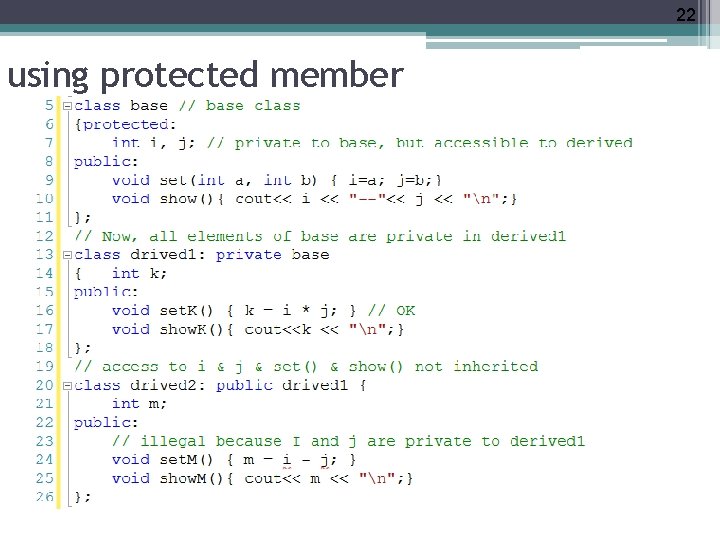
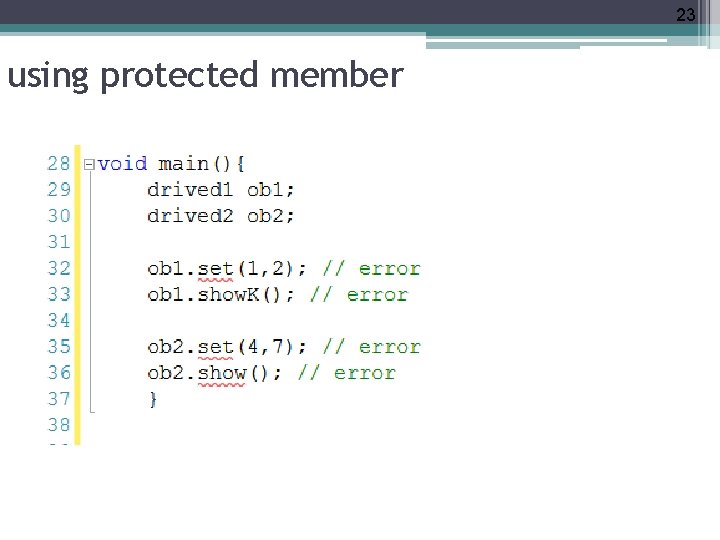
protected ▫ its public and protected members become protected members of the derived class. ▫ Example : using protected for inheritance of base class
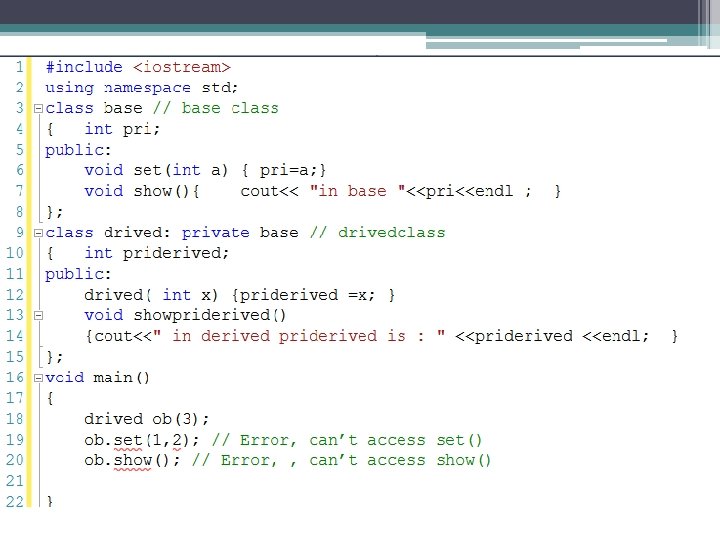
private ▫ its public and protected members become private members of the derived class. • In all cases, private members of a base class remain private to that base class.
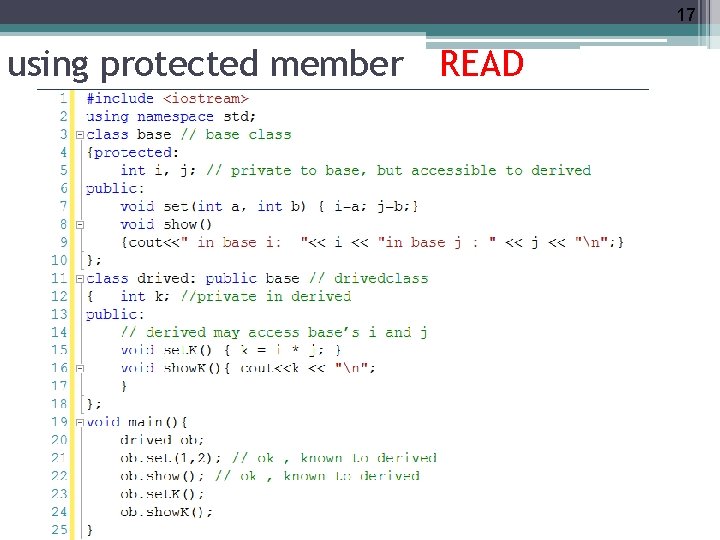
17 using protected member READ
19 using protected member
20 using protected member
22 using protected member
23 using protected member
- Slides: 23