
CS 112 Introduction to Programming Lecture 1 Introduction
![Comment on Course Eval q “[The problem sets] often take 6 -7 hours to](https://slidetodoc.com/presentation_image/2a7413ce7dcfea3289a2842726f05ba6/image-36.jpg "Comment on Course Eval q “[The problem sets] often take 6 -7 hours to")
- Slides: 42
CS 112 Introduction to Programming Lecture #1: Introduction Bryan Ford Computer Science Department Yale University 308 A Watson, Phone: 432 -6400 Email: bryan. ford@yale. edu Acknowledgements: most slides used in this class are from earlier CPSC 112 instructors, especially Richard Yang. Some slides are taken directly or adapted from those accompanying the two textbooks: Introduction to Programming in Java: An Interdisciplinary Approach by Robert Sedgewick and Kevin Wayne and Building Java Programs: A Back to Basics Approach by Stuart Reges and Marty Stepp.
What is Computer Science? q Late lonely nights in front of computers? q Computers? ALGORITHMIC THINKING al·go·rithm: a step-by-step procedure for solving a problem or accomplishing some end, especially by computers.
Fields of Computer Science q Artificial intelligence q Databases q Graphics and multimedia q Machine learning q Mobile computing q Robotics q Systems/networks q. . .
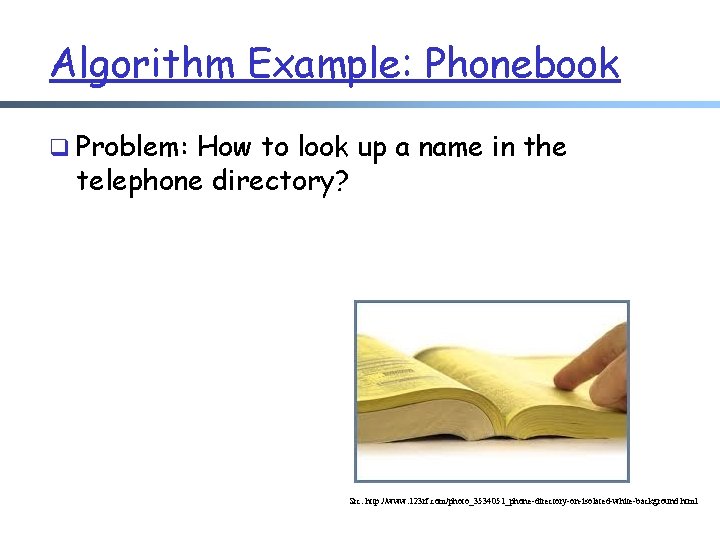
Algorithm Example: Phonebook q Problem: How to look up a name in the telephone directory? Src: http: //www. 123 rf. com/photo_3534051_phone-directory-on-isolated-white-background. html
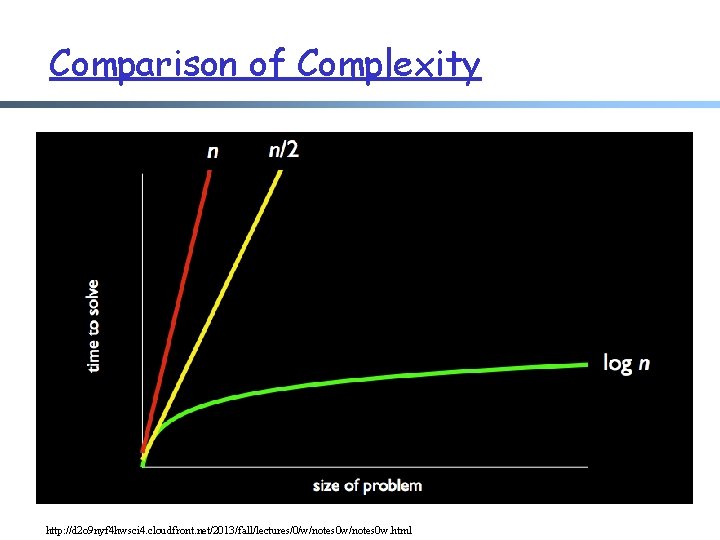
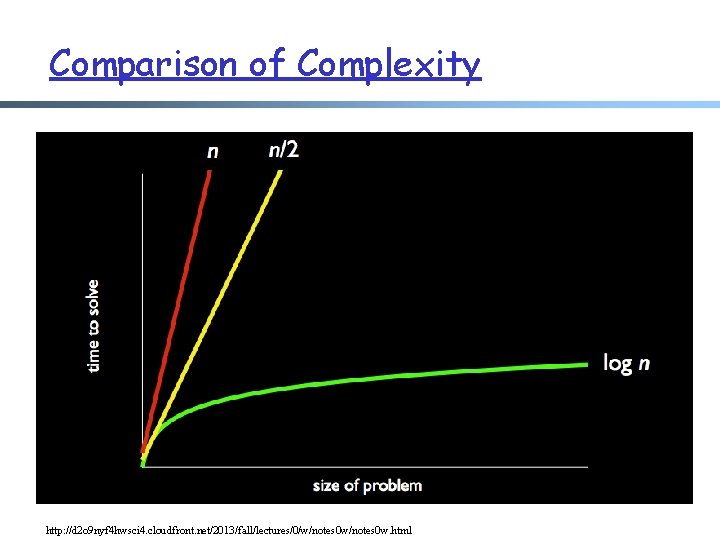
Comparison of Complexity http: //d 2 o 9 nyf 4 hwsci 4. cloudfront. net/2013/fall/lectures/0/w/notes 0 w. html
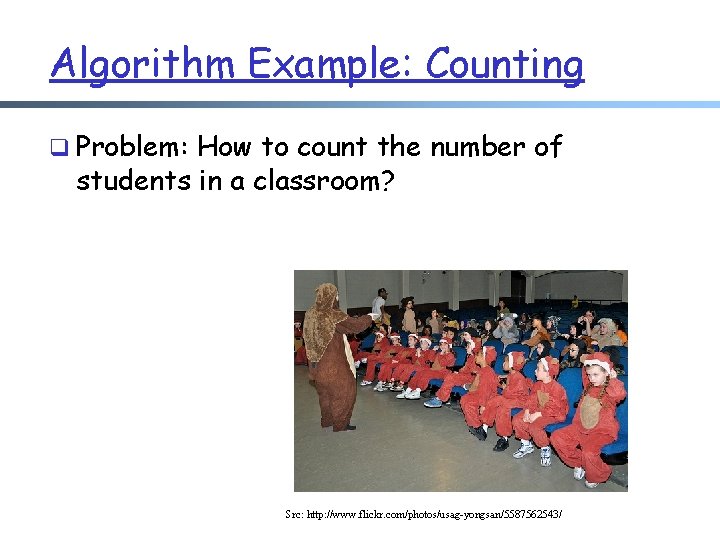
Algorithm Example: Counting q Problem: How to count the number of students in a classroom? Src: http: //www. flickr. com/photos/usag-yongsan/5587562543/
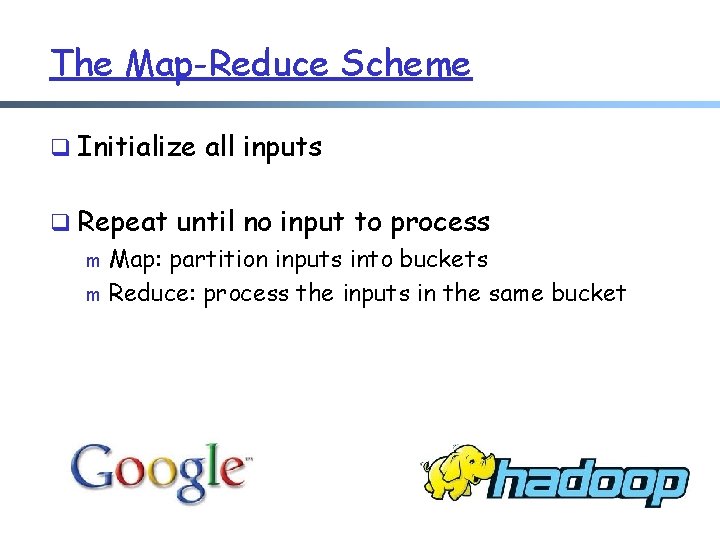
The Map-Reduce Scheme q Initialize all inputs q Repeat until no input to process m Map: partition inputs into buckets m Reduce: process the inputs in the same bucket
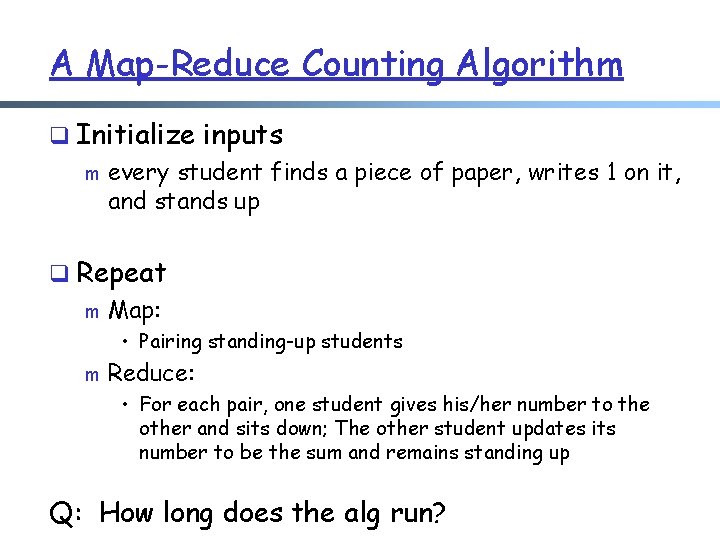
A Map-Reduce Counting Algorithm q Initialize inputs m every student finds a piece of paper, writes 1 on it, and stands up q Repeat m Map: • Pairing standing-up students m Reduce: • For each pair, one student gives his/her number to the other and sits down; The other student updates its number to be the sum and remains standing up Q: How long does the alg run?
Comparison of Complexity http: //d 2 o 9 nyf 4 hwsci 4. cloudfront. net/2013/fall/lectures/0/w/notes 0 w. html
What is Programming? q Programming: Design algorithms and express algorithms precisely in programs q Program: A set of instructions written in a computer language to be carried out by a computer. m We will be focusing on computer languages including Java and JS q Program execution: The act of carrying out the instructions contained in a program.
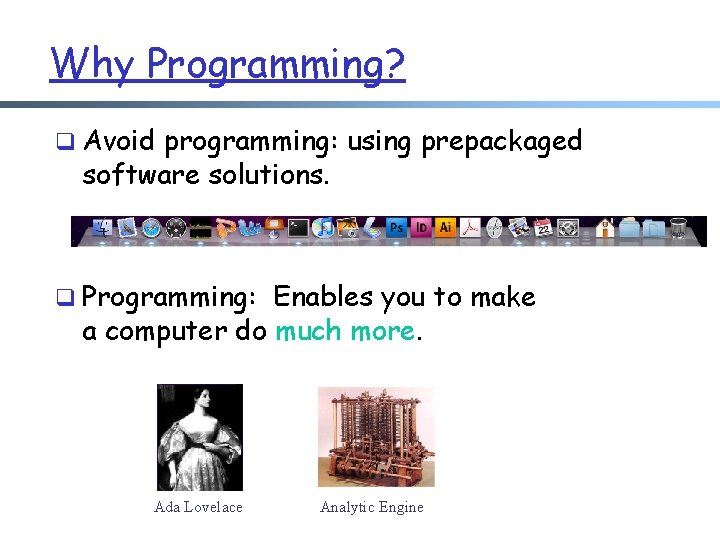
Why Programming? q Avoid programming: using prepackaged software solutions. q Programming: Enables you to make a computer do much more. Ada Lovelace Analytic Engine
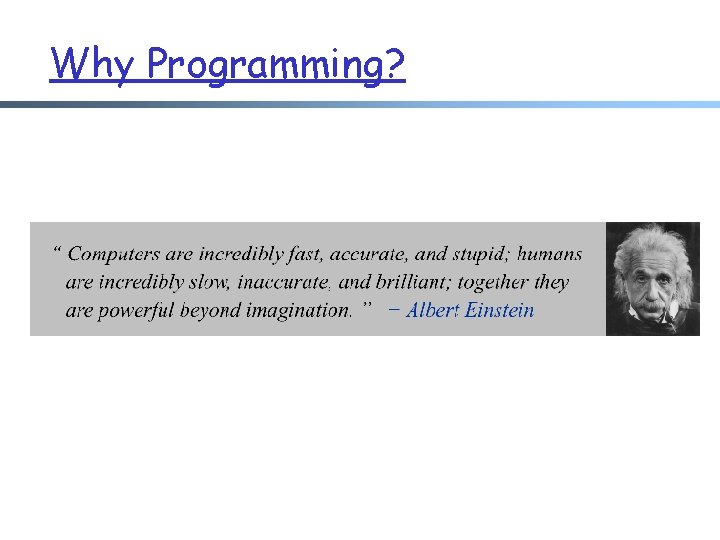
Why Programming?
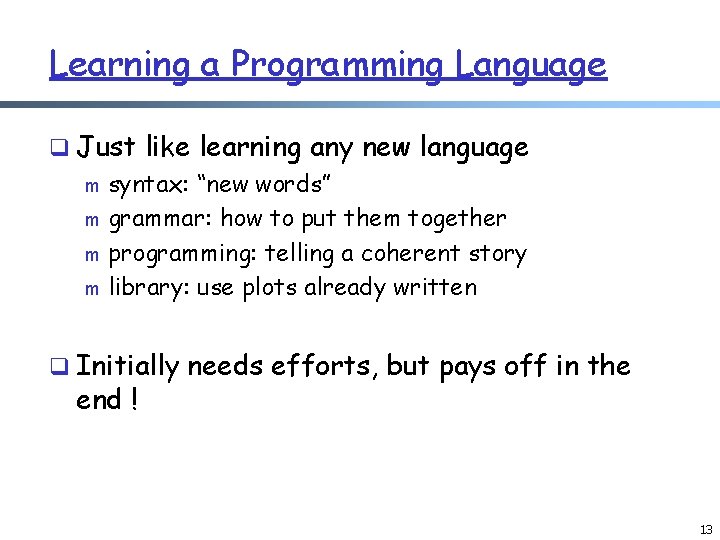
Learning a Programming Language q Just like learning any new language m syntax: “new words” m grammar: how to put them together m programming: telling a coherent story m library: use plots already written q Initially needs efforts, but pays off in the end ! 13
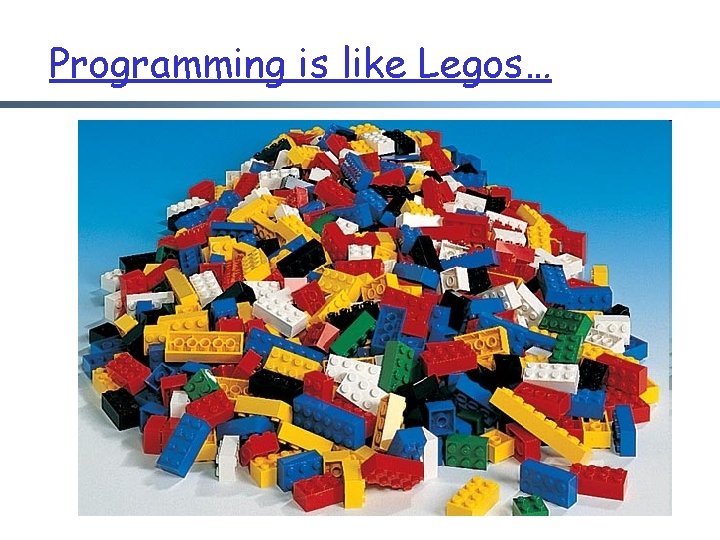
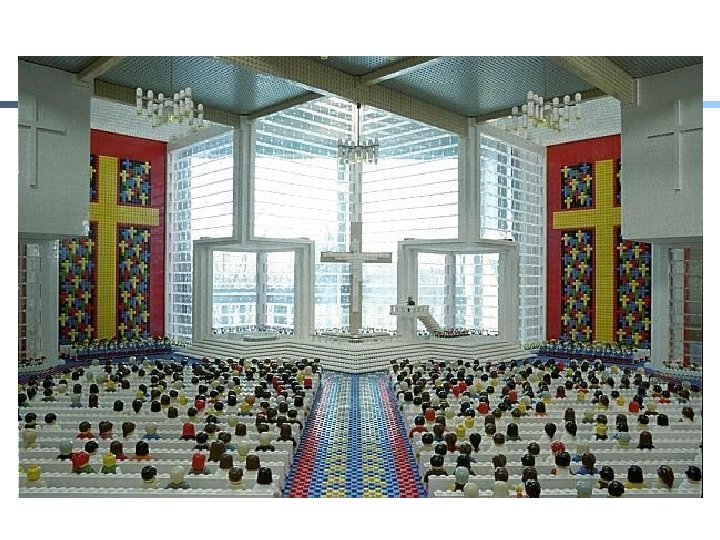
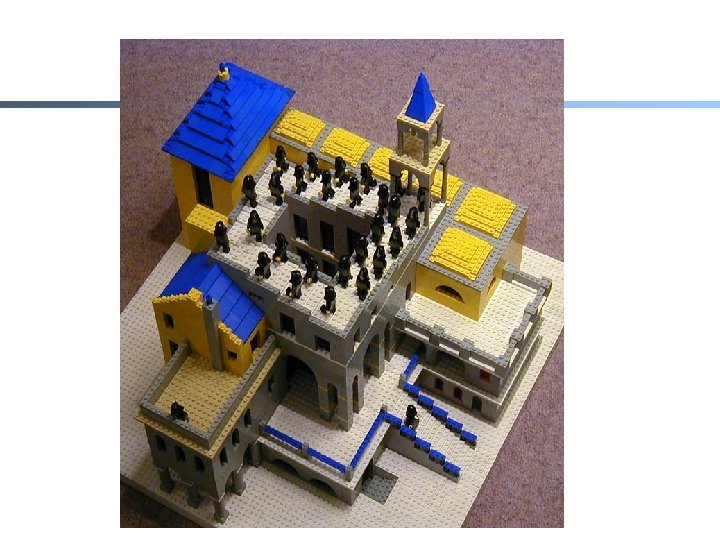
Programming is like Legos…
17
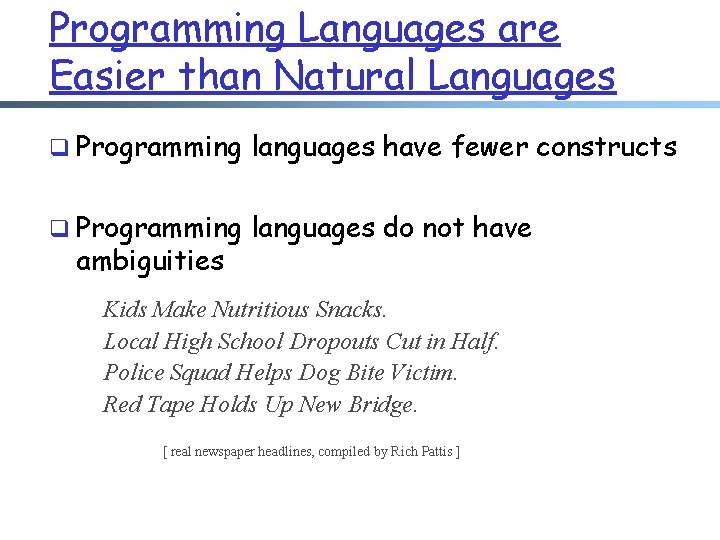
Programming Languages are Easier than Natural Languages q Programming languages have fewer constructs q Programming languages do not have ambiguities Kids Make Nutritious Snacks. Local High School Dropouts Cut in Half. Police Squad Helps Dog Bite Victim. Red Tape Holds Up New Bridge. [ real newspaper headlines, compiled by Rich Pattis ]
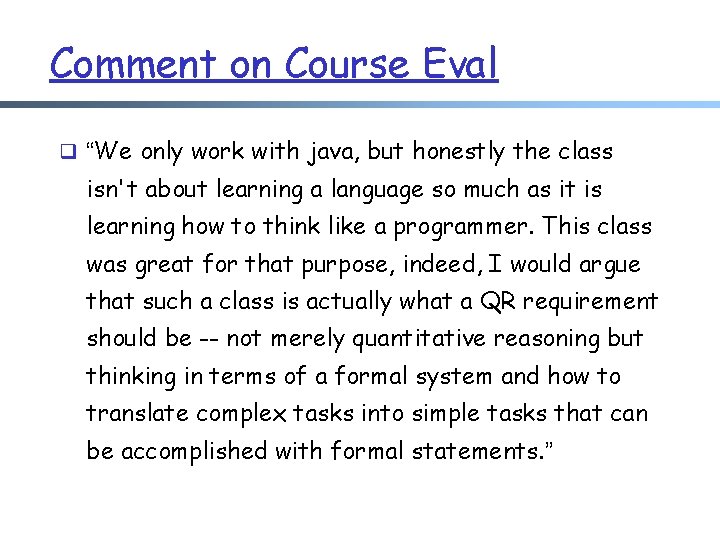
Comment on Course Eval q “We only work with java, but honestly the class isn't about learning a language so much as it is learning how to think like a programmer. This class was great for that purpose, indeed, I would argue that such a class is actually what a QR requirement should be -- not merely quantitative reasoning but thinking in terms of a formal system and how to translate complex tasks into simple tasks that can be accomplished with formal statements. ”
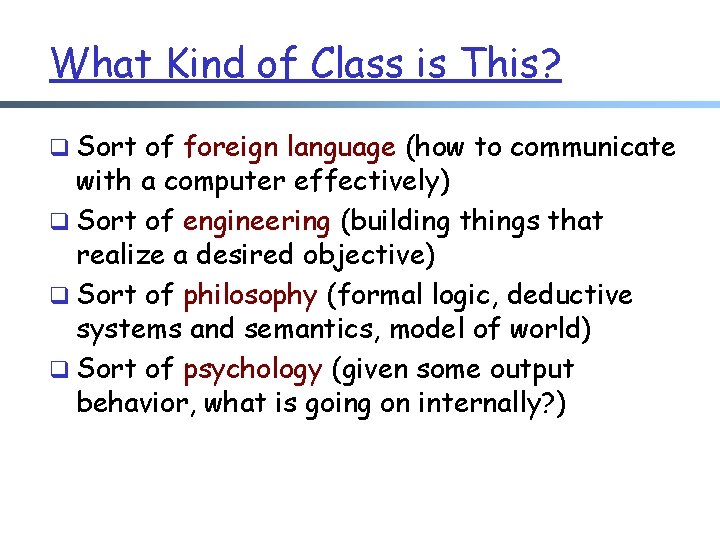
What Kind of Class is This? q Sort of foreign language (how to communicate with a computer effectively) q Sort of engineering (building things that realize a desired objective) q Sort of philosophy (formal logic, deductive systems and semantics, model of world) q Sort of psychology (given some output behavior, what is going on internally? )
Comment on Course Eval q “Econ major? History? English? Political Science? It matters not, my friend! You use a computer. Now is the time to take the reigns [sic] and truly control that machine that captures your attention for 35% of your day. ”
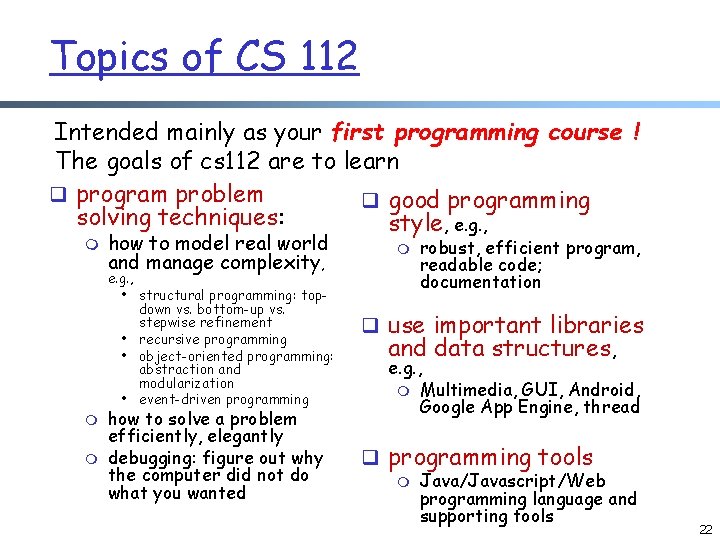
Topics of CS 112 Intended mainly as your first programming course ! The goals of cs 112 are to learn q program problem q good programming solving techniques: style, e. g. , m how to model real world and manage complexity, e. g. , • structural programming: topdown vs. bottom-up vs. stepwise refinement • recursive programming • object-oriented programming: abstraction and modularization • event-driven programming m m how to solve a problem efficiently, elegantly debugging: figure out why the computer did not do what you wanted m robust, efficient program, readable code; documentation q use important libraries and data structures, e. g. , m Multimedia, GUI, Android, Google App Engine, thread q programming tools m Java/Javascript/Web programming language and supporting tools 22
Other Option q CPSC 201 meets at the same time m If this class is too easy for you, consider switching to CS 201
Course Personnel: Instructor q Bryan Ford m Email: bryan. ford@yale. edu m Web: http: //bford. info/ m Office: AKW 411 m Research: Decentralized/Distributed Systems and Security/Privacy 24
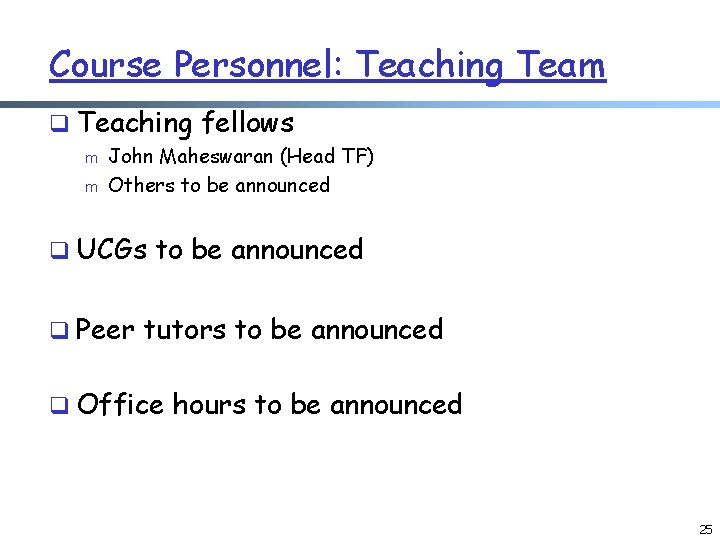
Course Personnel: Teaching Team q Teaching fellows m m John Maheswaran (Head TF) Others to be announced q UCGs to be announced q Peer tutors to be announced q Office hours to be announced 25
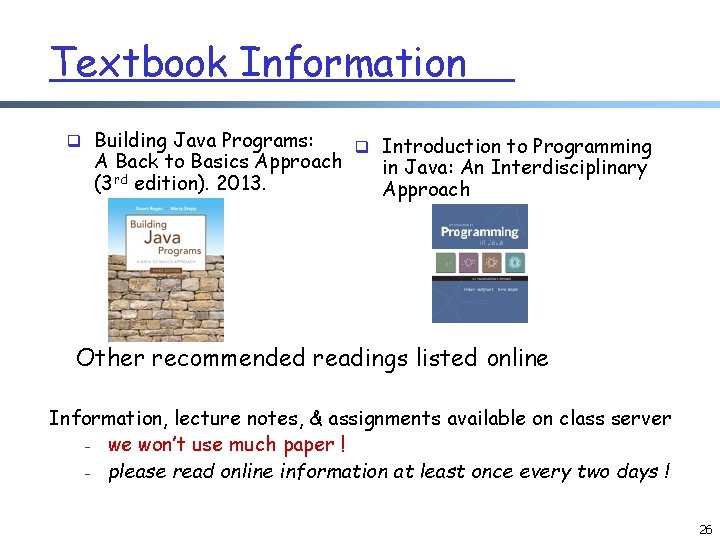
Textbook Information q Building Java Programs: A Back to Basics Approach (3 rd edition). 2013. q Introduction to Programming in Java: An Interdisciplinary Approach Other recommended readings listed online Information, lecture notes, & assignments available on class server - we won’t use much paper ! - please read online information at least once every two days ! 26
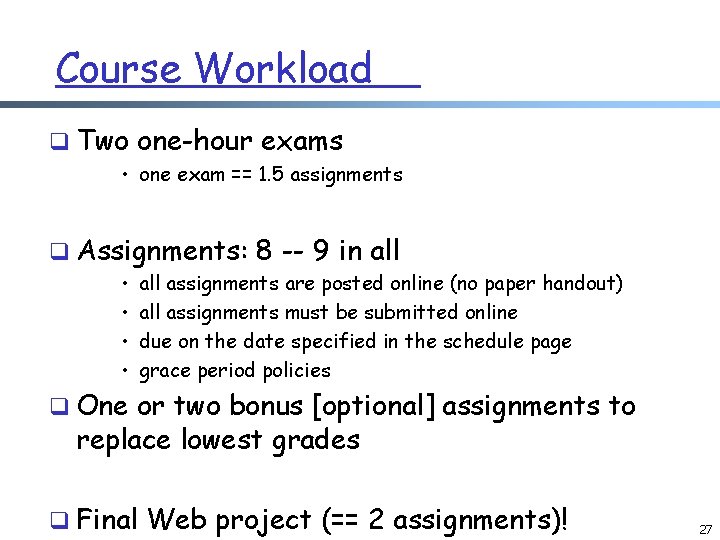
Course Workload q Two one-hour exams • one exam == 1. 5 assignments q Assignments: 8 -- 9 in all • • all assignments are posted online (no paper handout) all assignments must be submitted online due on the date specified in the schedule page grace period policies q One or two bonus [optional] assignments to replace lowest grades q Final Web project (== 2 assignments)! 27
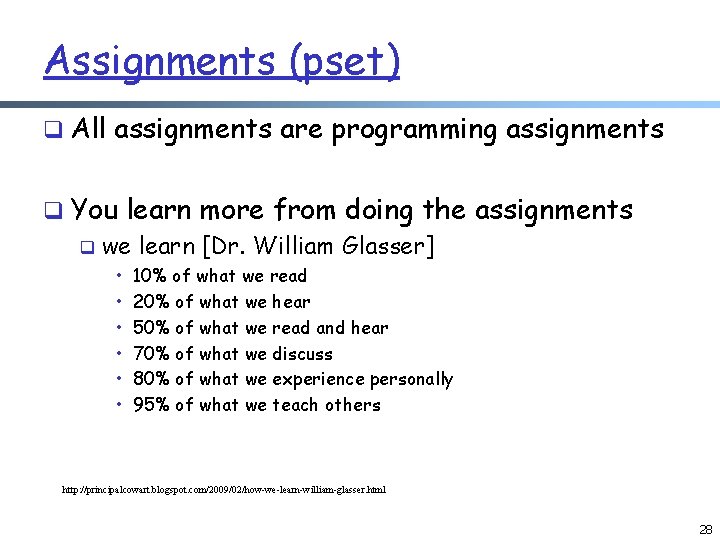
Assignments (pset) q All assignments are programming assignments q You learn more from doing the assignments q we learn [Dr. William Glasser] • • • 10% of what we read 20% of what we hear 50% of what we read and hear 70% of what we discuss 80% of what we experience personally 95% of what we teach others http: //principalcowart. blogspot. com/2009/02/how-we-learn-william-glasser. html 28
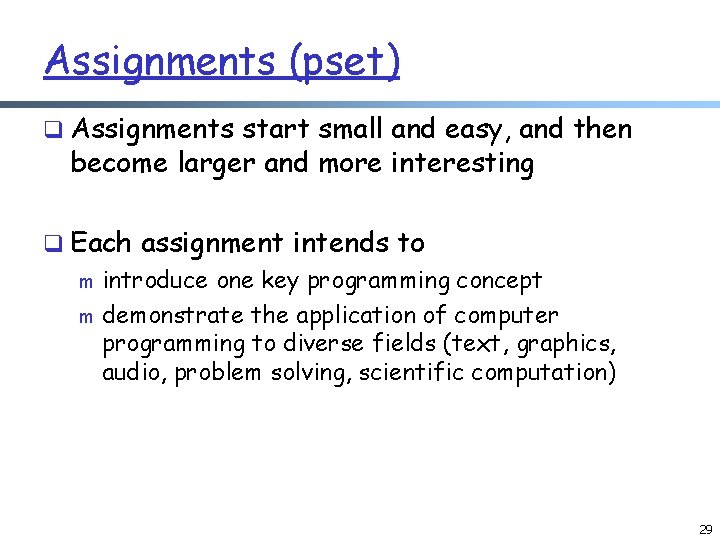
Assignments (pset) q Assignments start small and easy, and then become larger and more interesting q Each assignment intends to m introduce one key programming concept m demonstrate the application of computer programming to diverse fields (text, graphics, audio, problem solving, scientific computation) 29
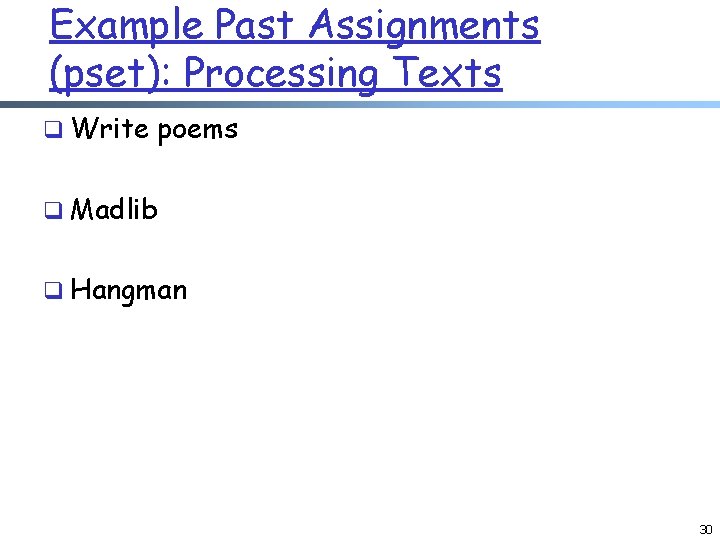
Example Past Assignments (pset): Processing Texts q Write poems q Madlib q Hangman 30
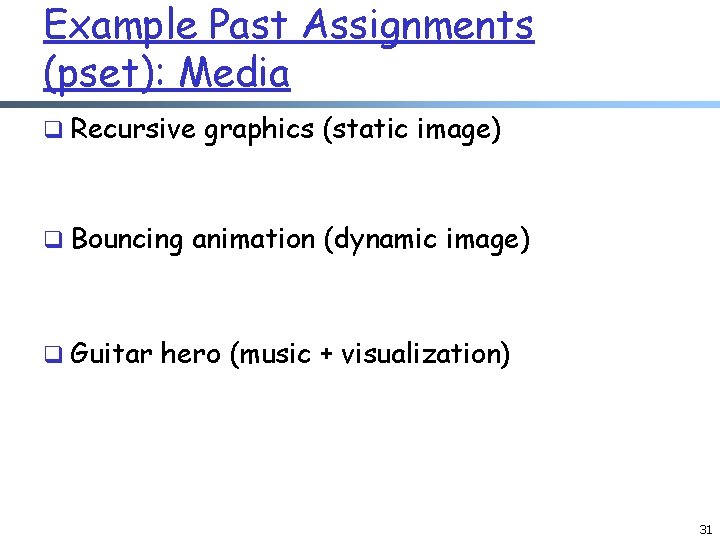
Example Past Assignments (pset): Media q Recursive graphics (static image) q Bouncing animation (dynamic image) q Guitar hero (music + visualization) 31
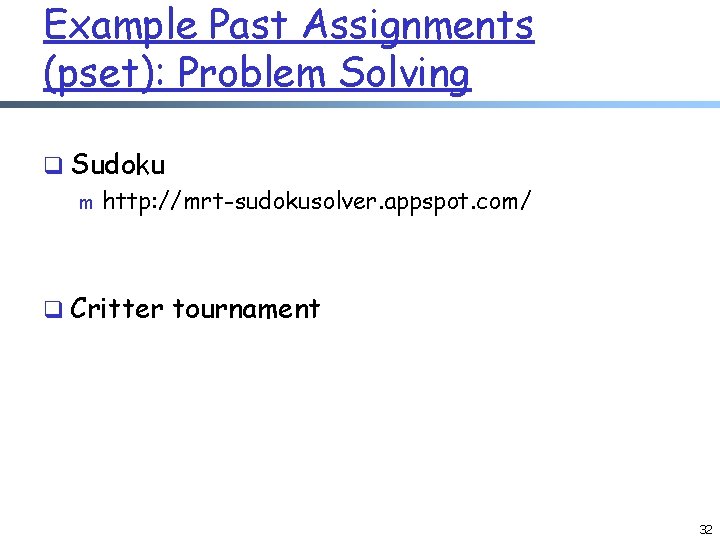
Example Past Assignments (pset): Problem Solving q Sudoku m http: //mrt-sudokusolver. appspot. com/ q Critter tournament 32
Example Past Assignments (pset): Scientific Computation q N-body 33
Assignments this Semester q We are still finalizing the programming assignments for this semester: expect both overlapping and new assignments 34
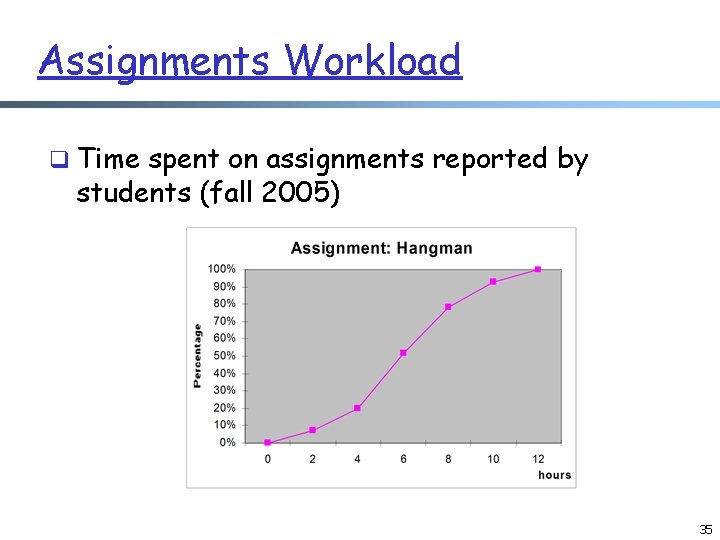
Assignments Workload q Time spent on assignments reported by students (fall 2005) 35
Comment on Course Eval q “[The problem sets] often take 6 -7 hours to complete (especially a few towards the end of the semester). The final project […] took me at least 12 hours to get right, but the feeling of accomplishment after making a working program is like none other. ”
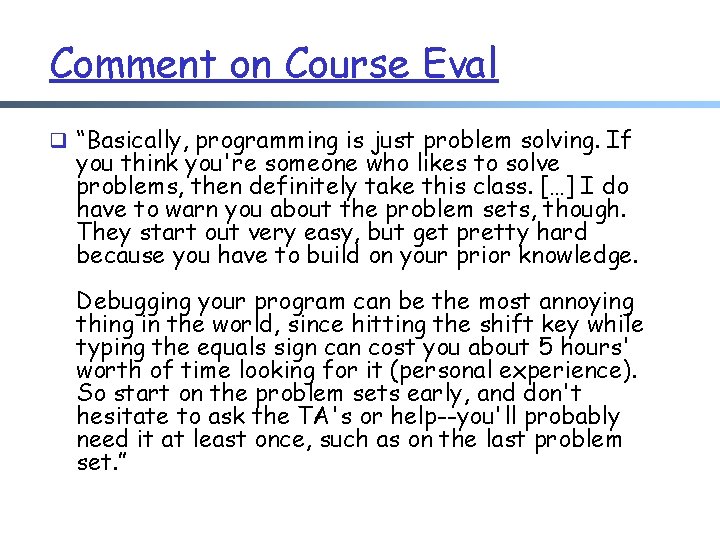
Comment on Course Eval q “Basically, programming is just problem solving. If you think you're someone who likes to solve problems, then definitely take this class. […] I do have to warn you about the problem sets, though. They start out very easy, but get pretty hard because you have to build on your prior knowledge. Debugging your program can be the most annoying thing in the world, since hitting the shift key while typing the equals sign can cost you about 5 hours' worth of time looking for it (personal experience). So start on the problem sets early, and don't hesitate to ask the TA's or help--you'll probably need it at least once, such as on the last problem set. ”
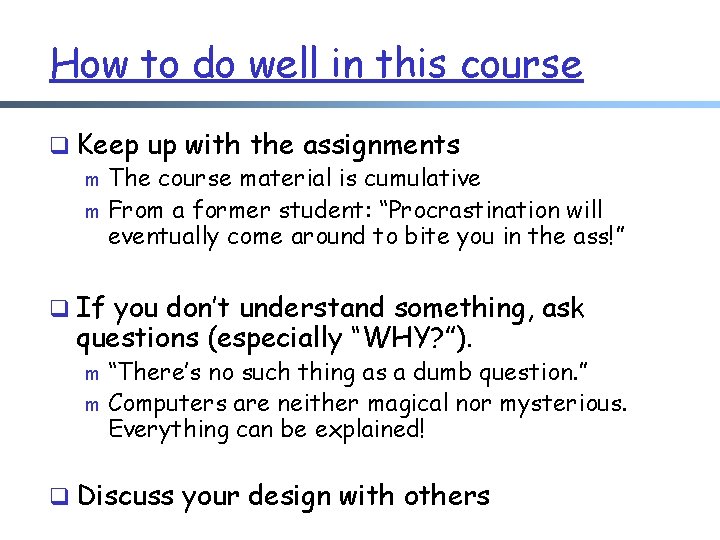
How to do well in this course q Keep up with the assignments m The course material is cumulative m From a former student: “Procrastination will eventually come around to bite you in the ass!” q If you don’t understand something, ask questions (especially “WHY? ”). “There’s no such thing as a dumb question. ” m Computers are neither magical nor mysterious. Everything can be explained! m q Discuss your design with others
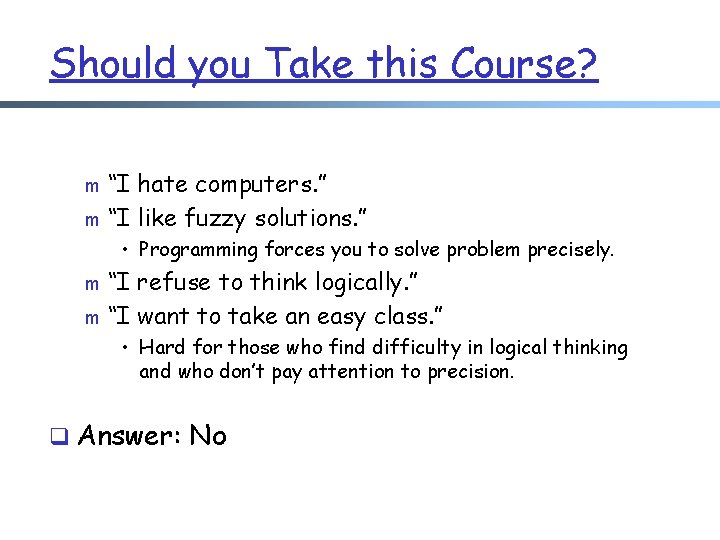
Should you Take this Course? “I hate computers. ” m “I like fuzzy solutions. ” m • Programming forces you to solve problem precisely. “I refuse to think logically. ” m “I want to take an easy class. ” m • Hard for those who find difficulty in logical thinking and who don’t pay attention to precision. q Answer: No
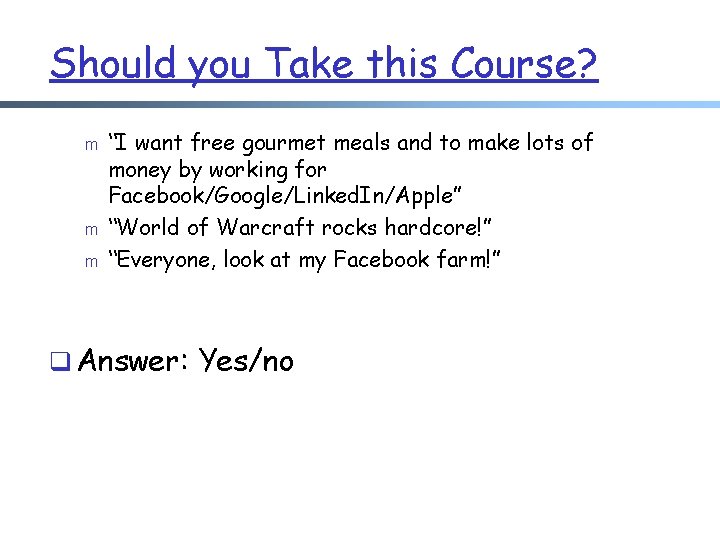
Should you Take this Course? m m m “I want free gourmet meals and to make lots of money by working for Facebook/Google/Linked. In/Apple” “World of Warcraft rocks hardcore!” “Everyone, look at my Facebook farm!” q Answer: Yes/no
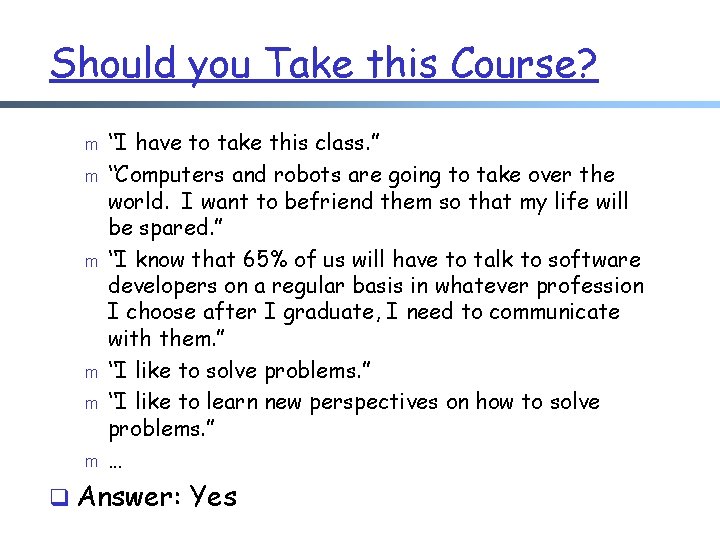
Should you Take this Course? m m m “I have to take this class. ” “Computers and robots are going to take over the world. I want to befriend them so that my life will be spared. ” “I know that 65% of us will have to talk to software developers on a regular basis in whatever profession I choose after I graduate, I need to communicate with them. ” “I like to solve problems. ” “I like to learn new perspectives on how to solve problems. ” … q Answer: Yes
Questions?