
CS 107 Lecture 17 Floating Point reading BO
CS 107 Lecture 17 Floating Point reading: B&O 2. 4 Slides by Jerry Cain and Lisa Yan, who leveraged prior work by Nick Troccoli, Julie Zelenski, Marty Stepp, Cynthia Lee, Chris Gregg, and others. 1
How can a computer represent real numbers? 2
Learning Goals Understand the design and compromises of the floating point representation, including: • Fixed point vs. floating point • How a floating point number is represented in binary • Issues with floating point imprecision • Other potential pitfalls using floating point numbers in programs 3
Plan For Today • Representing real numbers and (thought experiment) fixed point • Floating Point: Normalized values • Joke Break • Floating Point: Special/denormalized values • Floating Point Arithmetic cp -r /afs/ir/class/cs 107/samples/lectures/lect 10. 4
Plan For Today • Representing real numbers and (thought experiment) fixed point • Floating Point: Normalized values • Joke Break • Floating Point: Special/denormalized values • Number representations in C • Floating point arithmetic 5

Base 2 conversion Convert the following number/fractions to base 10 (decimal) and base 2. 1. 2. 3. 4. 5. Number/fraction 1/2 5 9/8 1/3 1/10 (bonus) Base 10 0. 5 Base 2 0. 1 � 6
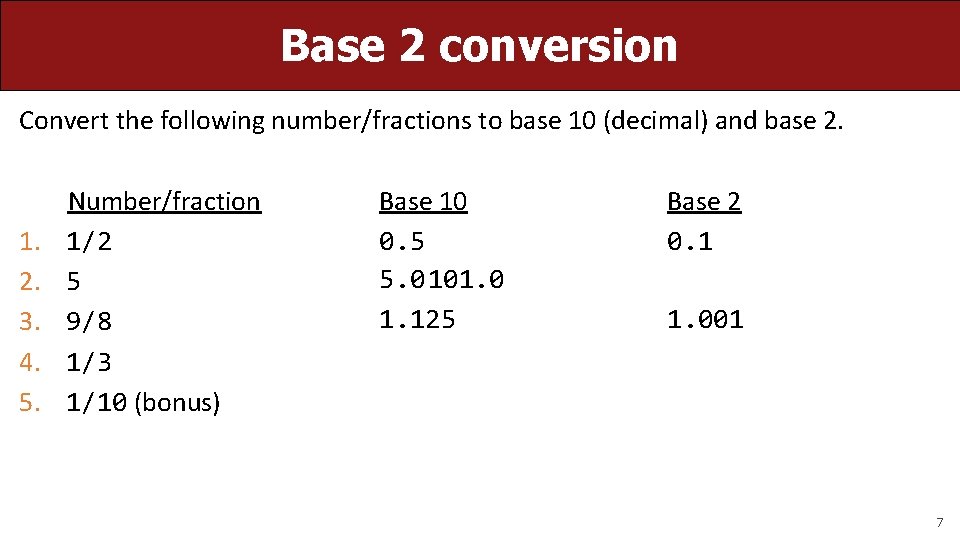
Base 2 conversion Convert the following number/fractions to base 10 (decimal) and base 2. 1. 2. 3. 4. 5. Number/fraction 1/2 5 9/8 1/3 1/10 (bonus) Base 10 0. 5 5. 0101. 0 1. 125 Base 2 0. 1 1. 001 7
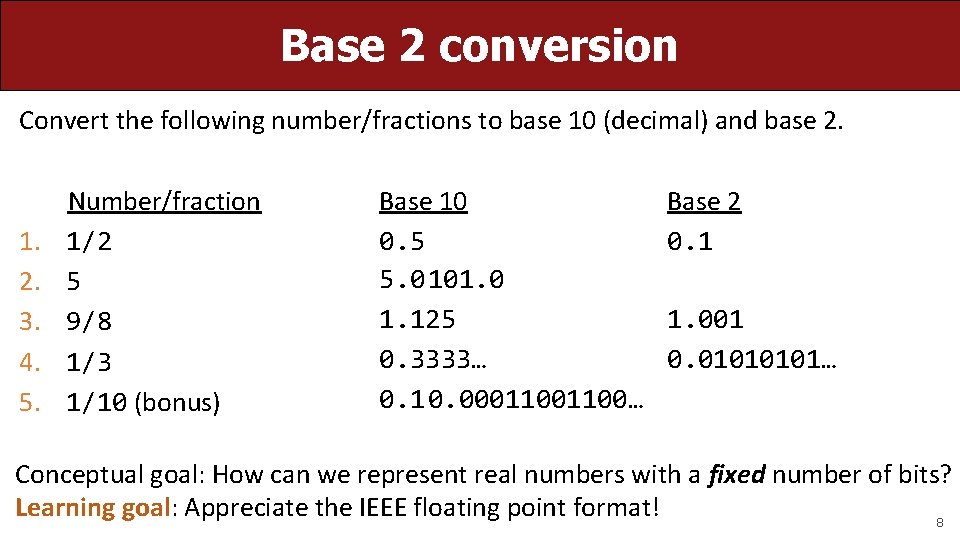
Base 2 conversion Convert the following number/fractions to base 10 (decimal) and base 2. 1. 2. 3. 4. 5. Number/fraction 1/2 5 9/8 1/3 1/10 (bonus) Base 10 0. 5 5. 0101. 0 1. 125 0. 3333… 0. 10. 0001100… Base 2 0. 1 1. 001 0. 0101… Conceptual goal: How can we represent real numbers with a fixed number of bits? Learning goal: Appreciate the IEEE floating point format! 8
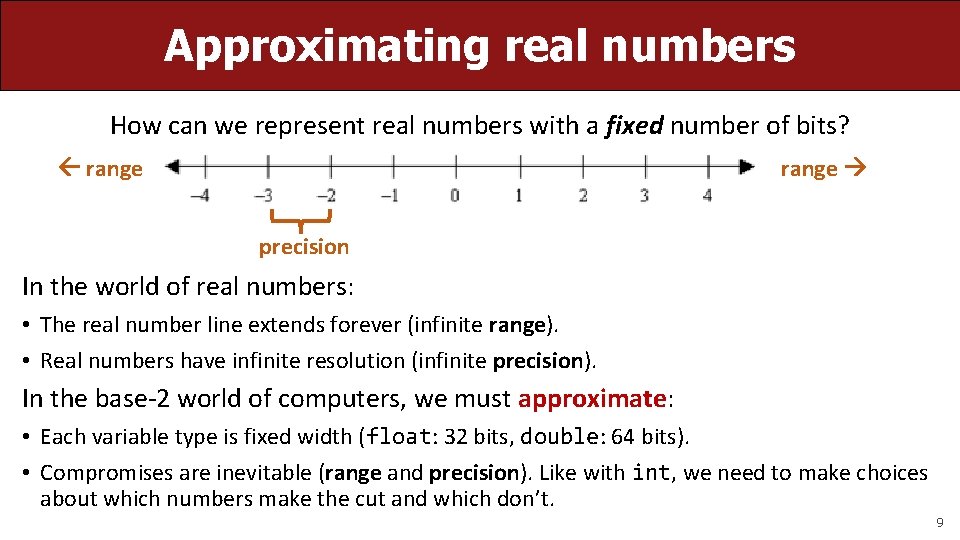
Approximating real numbers How can we represent real numbers with a fixed number of bits? range precision In the world of real numbers: • The real number line extends forever (infinite range). • Real numbers have infinite resolution (infinite precision). In the base-2 world of computers, we must approximate: • Each variable type is fixed width (float: 32 bits, double: 64 bits). • Compromises are inevitable (range and precision). Like with int, we need to make choices about which numbers make the cut and which don’t. 9
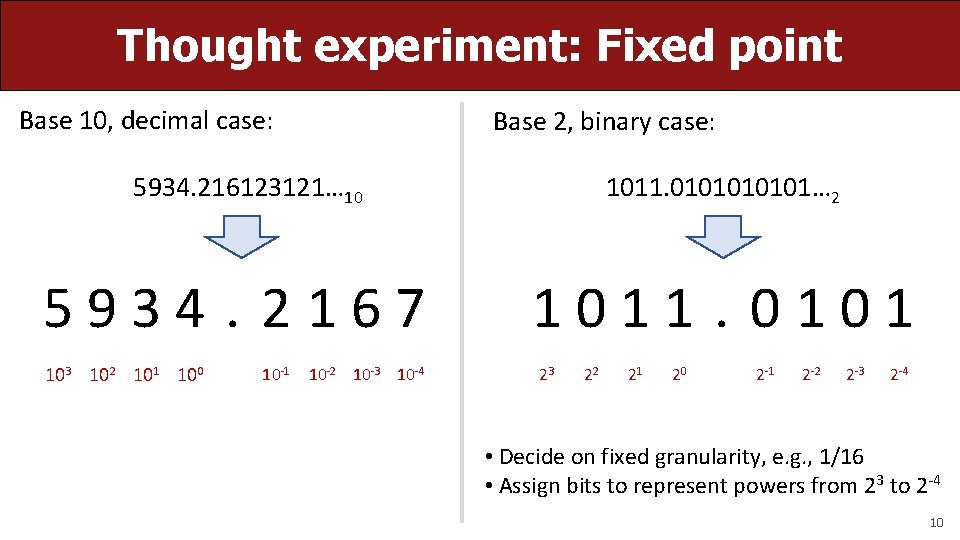
Thought experiment: Fixed point Base 10, decimal case: Base 2, binary case: 5934. 216123121… 10 5934. 2167 103 102 101 100 10 -1 10 -2 10 -3 10 -4 1011. 010101… 2 1011. 0101 23 22 21 20 2 -1 2 -2 2 -3 2 -4 • Decide on fixed granularity, e. g. , 1/16 • Assign bits to represent powers from 23 to 2 -4 10
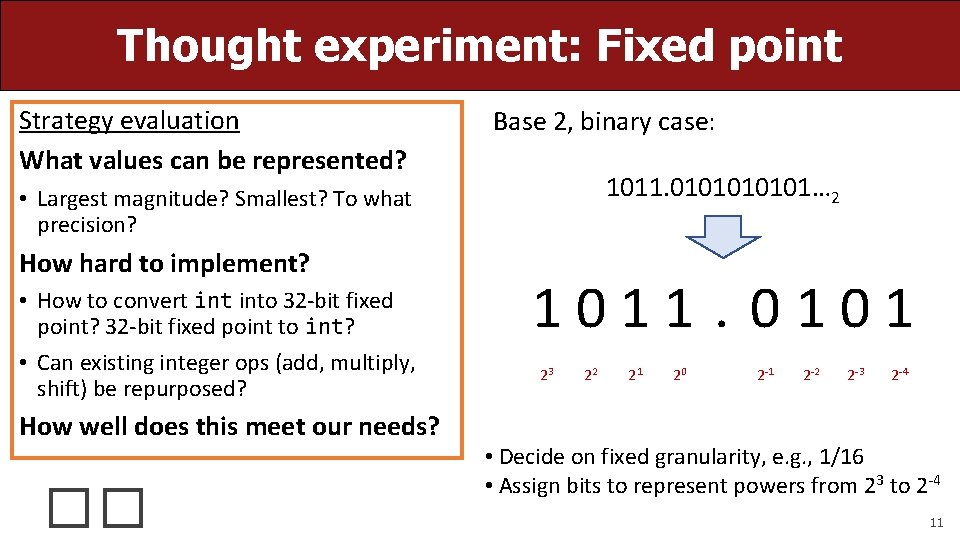
Thought experiment: Fixed point Strategy evaluation What values can be represented? Base 2, binary case: 1011. 010101… 2 • Largest magnitude? Smallest? To what precision? How hard to implement? • How to convert into 32 -bit fixed point? 32 -bit fixed point to int? • Can existing integer ops (add, multiply, shift) be repurposed? How well does this meet our needs? �� 1011. 0101 23 22 21 20 2 -1 2 -2 2 -3 2 -4 • Decide on fixed granularity, e. g. , 1/16 • Assign bits to represent powers from 23 to 2 -4 11
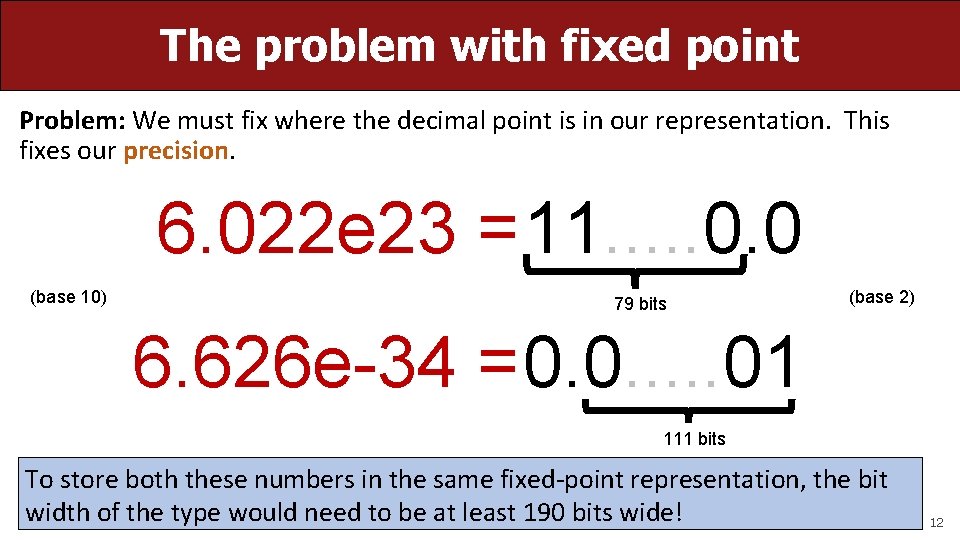
The problem with fixed point Problem: We must fix where the decimal point is in our representation. This fixes our precision. 6. 022 e 23 = 11. . . 0. 0 (base 10) 79 bits (base 2) 6. 626 e-34 = 0. 0. . . 01 111 bits To store both these numbers in the same fixed-point representation, the bit width of the type would need to be at least 190 bits wide! 12
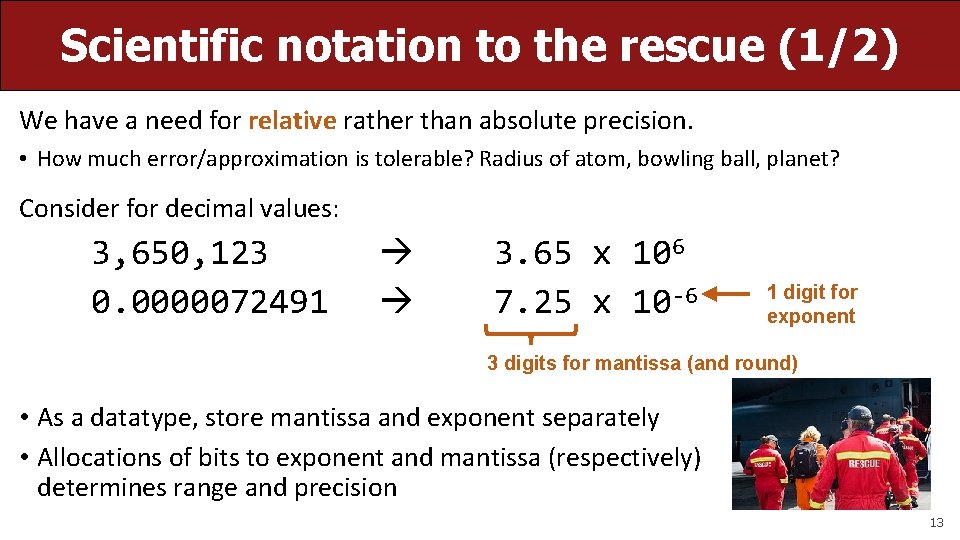
Scientific notation to the rescue (1/2) We have a need for relative rather than absolute precision. • How much error/approximation is tolerable? Radius of atom, bowling ball, planet? Consider for decimal values: 3, 650, 123 0. 0000072491 3. 65 x 106 7. 25 x 10 -6 1 digit for exponent 3 digits for mantissa (and round) • As a datatype, store mantissa and exponent separately • Allocations of bits to exponent and mantissa (respectively) determines range and precision 13
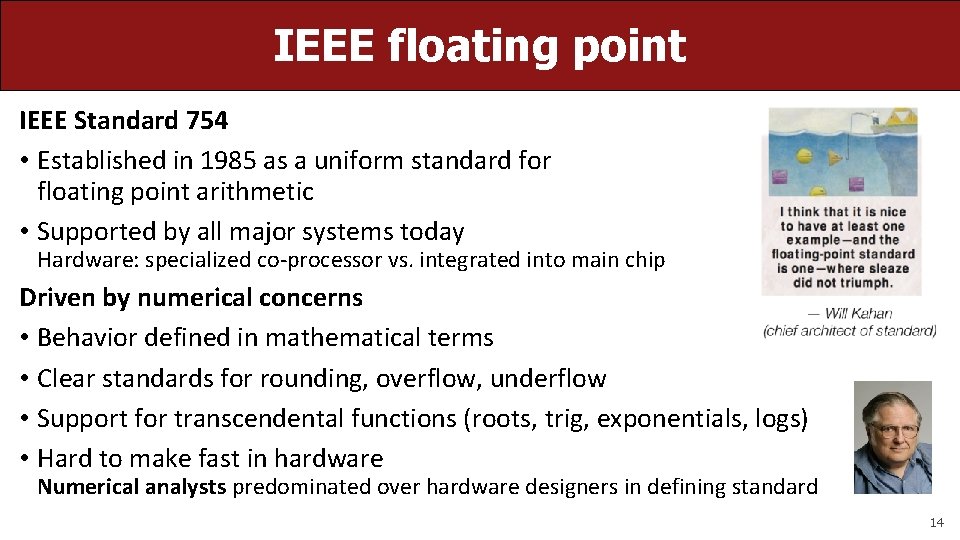
IEEE floating point IEEE Standard 754 • Established in 1985 as a uniform standard for floating point arithmetic • Supported by all major systems today Hardware: specialized co-processor vs. integrated into main chip Driven by numerical concerns • Behavior defined in mathematical terms • Clear standards for rounding, overflow, underflow • Support for transcendental functions (roots, trig, exponentials, logs) • Hard to make fast in hardware Numerical analysts predominated over hardware designers in defining standard 14

Plan For Today • Representing real numbers and fixed point • Floating Point: Normalized values • Joke Break • Floating Point: Special/denormalized values • Number representations in C • Floating point arithmetic 15
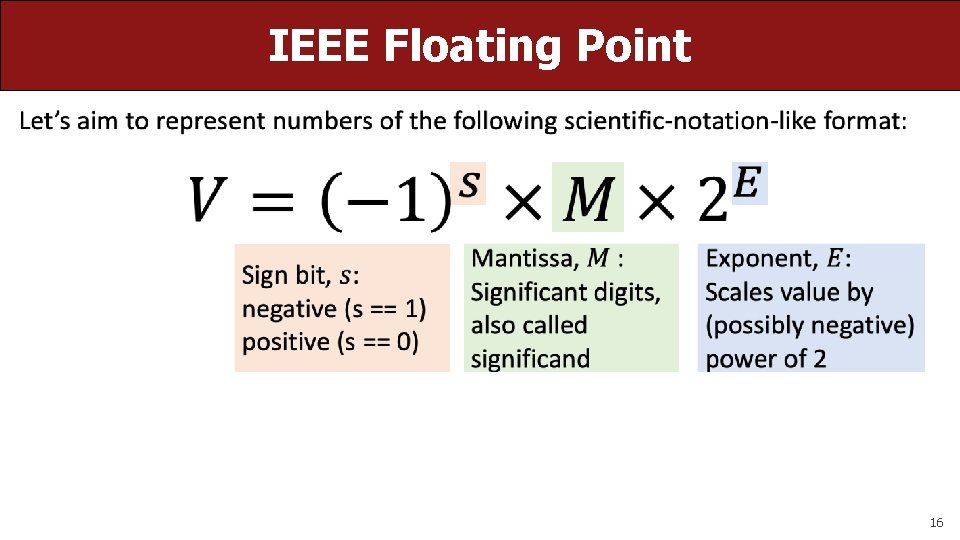
IEEE Floating Point • 16
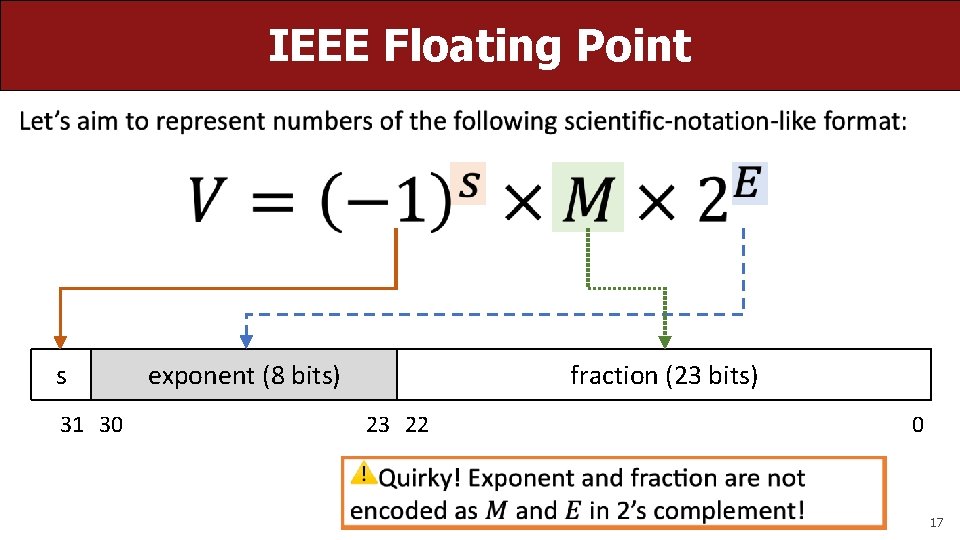
IEEE Floating Point • s 31 30 exponent (8 bits) fraction (23 bits) 23 22 0 17
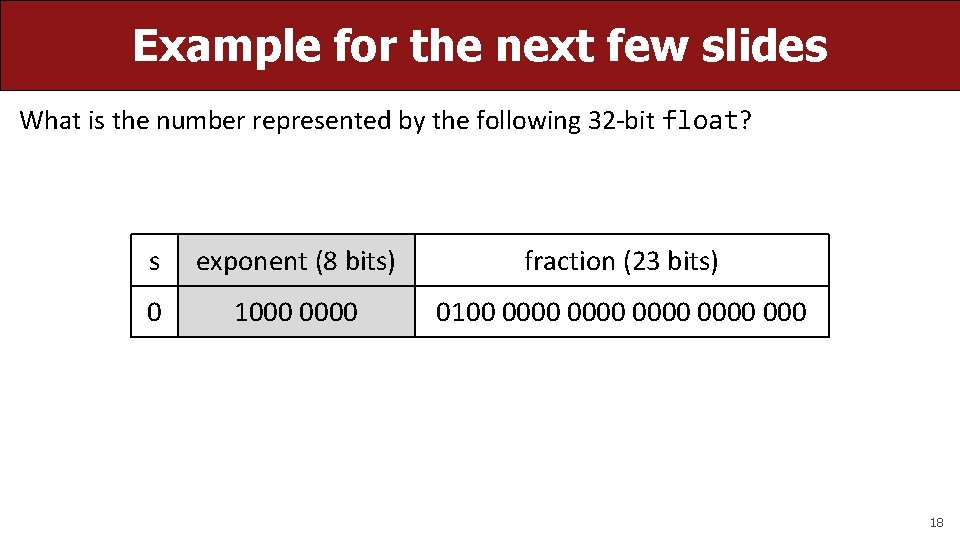
Example for the next few slides What is the number represented by the following 32 -bit float? s exponent (8 bits) fraction (23 bits) 0 1000 0100 0000 000 18
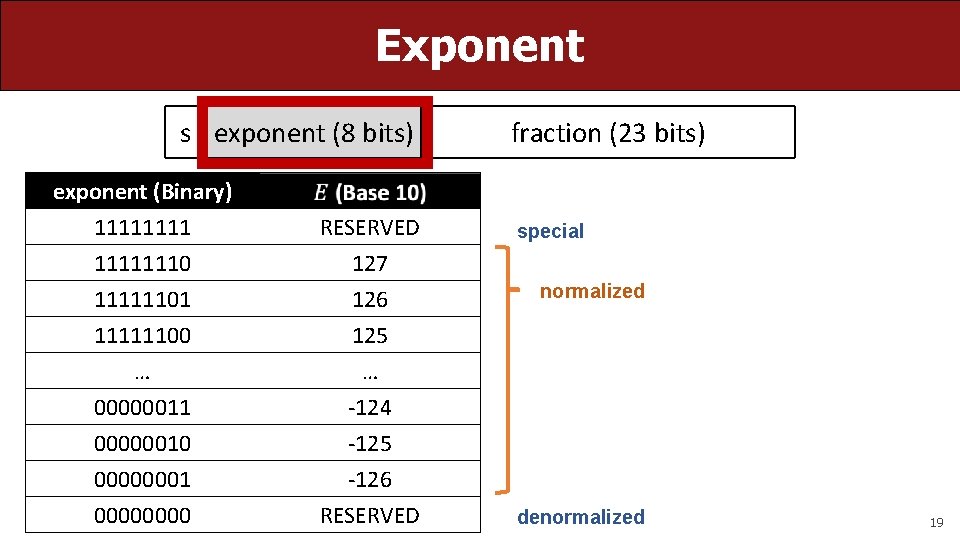
Exponent s exponent (8 bits) exponent (Binary) 11111110 11111101 RESERVED 127 126 11111100 … 00000011 00000010 00000001 125 … -124 -125 -126 0000 RESERVED fraction (23 bits) special normalized denormalized 19
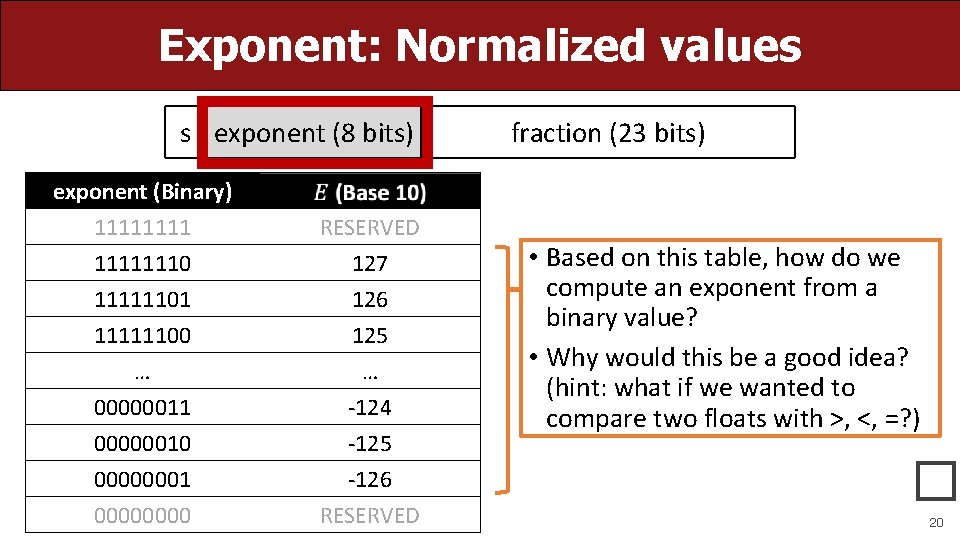
Exponent: Normalized values s exponent (8 bits) exponent (Binary) 11111110 11111101 RESERVED 127 126 11111100 … 00000011 00000010 00000001 125 … -124 -125 -126 0000 RESERVED fraction (23 bits) • Based on this table, how do we compute an exponent from a binary value? • Why would this be a good idea? (hint: what if we wanted to compare two floats with >, <, =? ) � 20
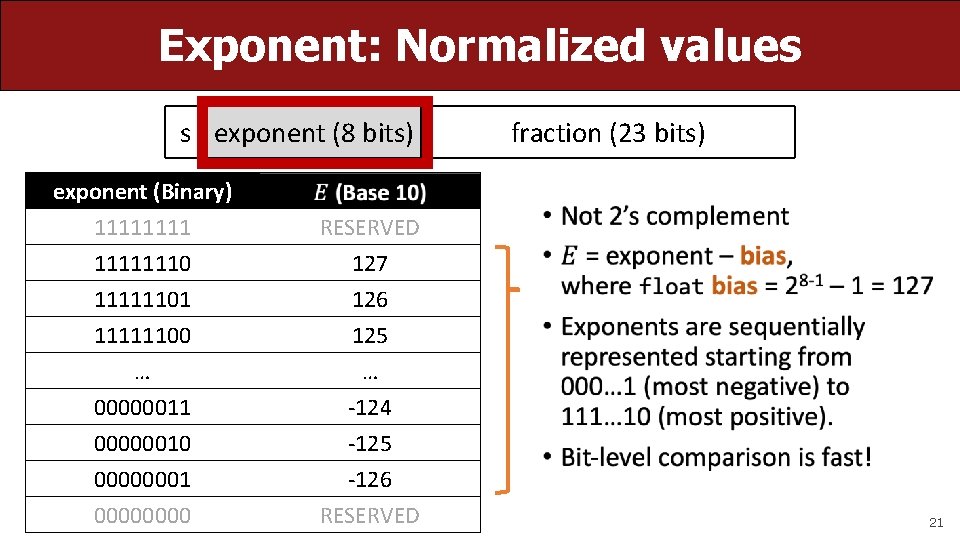
Exponent: Normalized values s exponent (8 bits) exponent (Binary) 11111110 11111101 RESERVED 127 126 11111100 … 00000011 00000010 00000001 125 … -124 -125 -126 0000 RESERVED fraction (23 bits) • 21
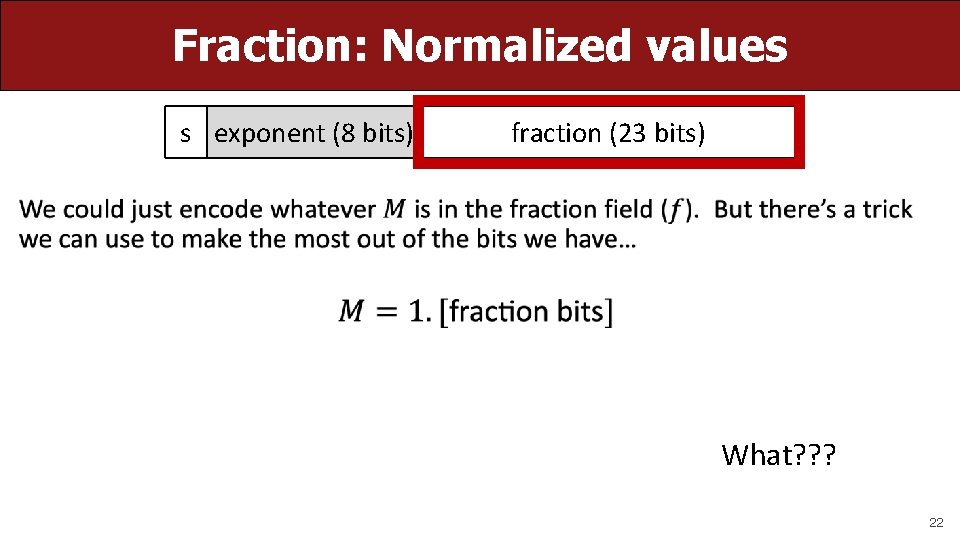
Fraction: Normalized values s exponent (8 bits) fraction (23 bits) • What? ? ? 22
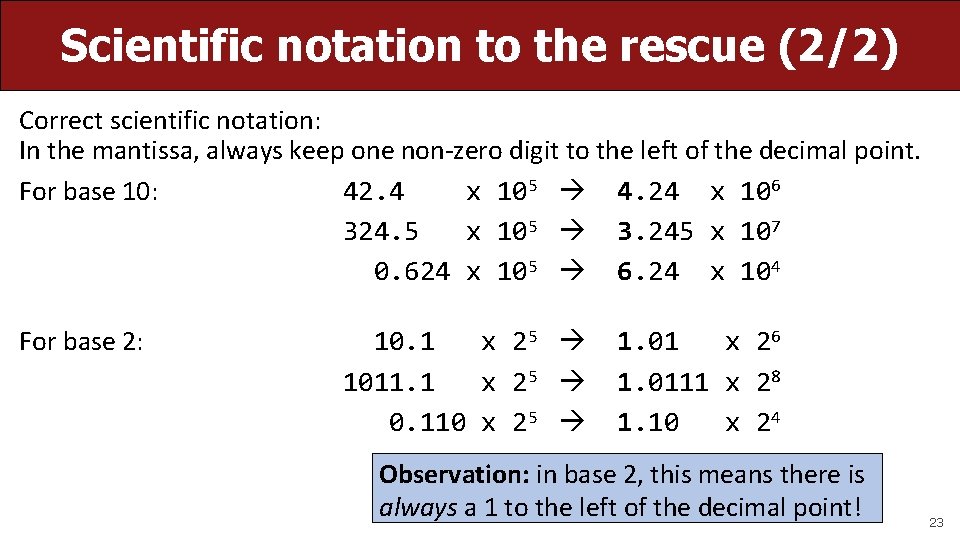
Scientific notation to the rescue (2/2) Correct scientific notation: In the mantissa, always keep one non-zero digit to the left of the decimal point. For base 10: 42. 4 x 10⁵ 4. 24 x 106 324. 5 x 10⁵ 3. 245 x 107 0. 624 x 105 6. 24 x 104 For base 2: 10. 1 x 25 1011. 1 x 25 0. 110 x 25 1. 01 x 26 1. 0111 x 28 1. 10 x 24 Observation: in base 2, this means there is always a 1 to the left of the decimal point! 23
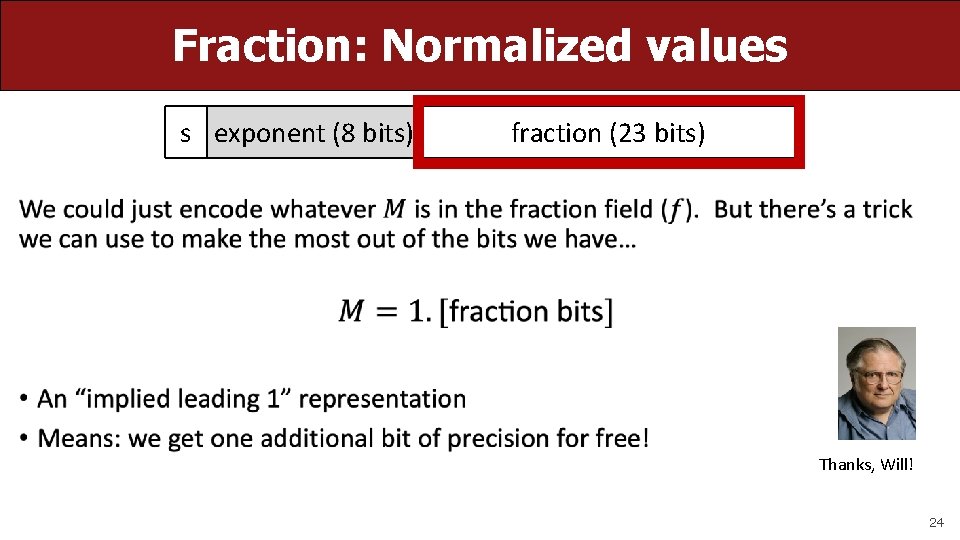
Fraction: Normalized values s exponent (8 bits) fraction (23 bits) • Thanks, Will! 24
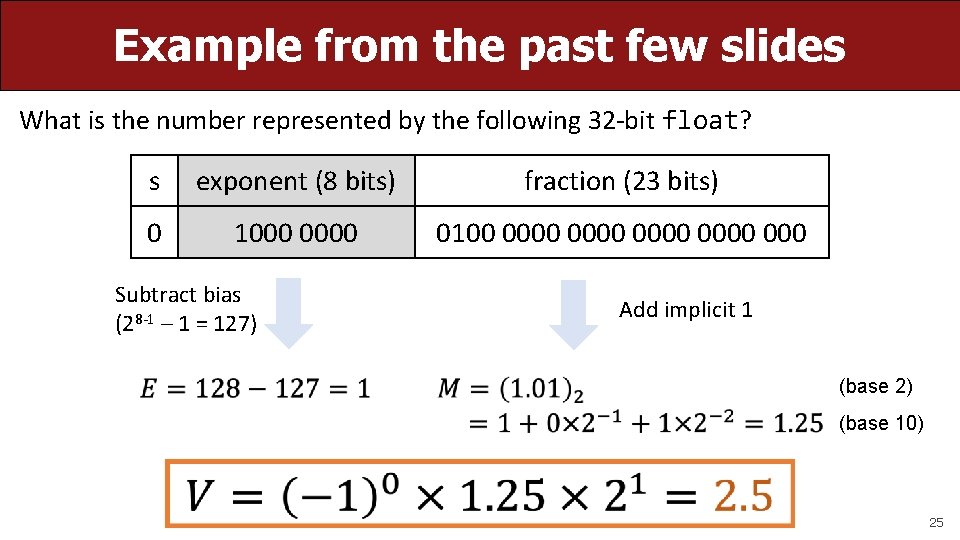
Example from the past few slides What is the number represented by the following 32 -bit float? s exponent (8 bits) fraction (23 bits) 0 1000 0100 0000 000 Subtract bias (28 -1 – 1 = 127) Add implicit 1 (base 2) (base 10) 25
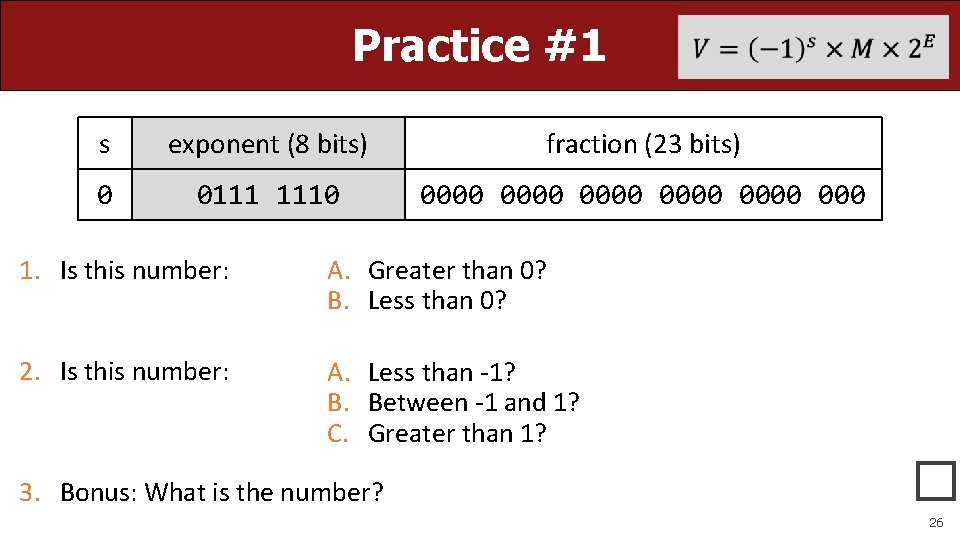
Practice #1 s exponent (8 bits) fraction (23 bits) 0 0111 1110 0000 000 1. Is this number: A. Greater than 0? B. Less than 0? 2. Is this number: A. Less than -1? B. Between -1 and 1? C. Greater than 1? 3. Bonus: What is the number? � 26
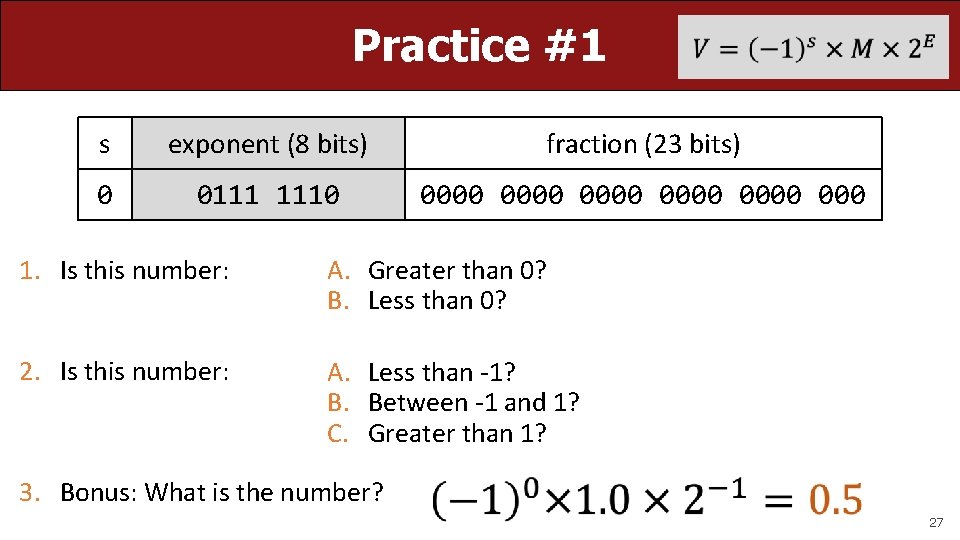
Practice #1 s exponent (8 bits) fraction (23 bits) 0 0111 1110 0000 000 1. Is this number: A. Greater than 0? B. Less than 0? 2. Is this number: A. Less than -1? B. Between -1 and 1? C. Greater than 1? 3. Bonus: What is the number? 27
Plan For Today • Representing real numbers and fixed point • Floating Point: Normalized values • Joke Break • Floating Point: Special/denormalized values • Number representations in C • Floating point arithmetic 28
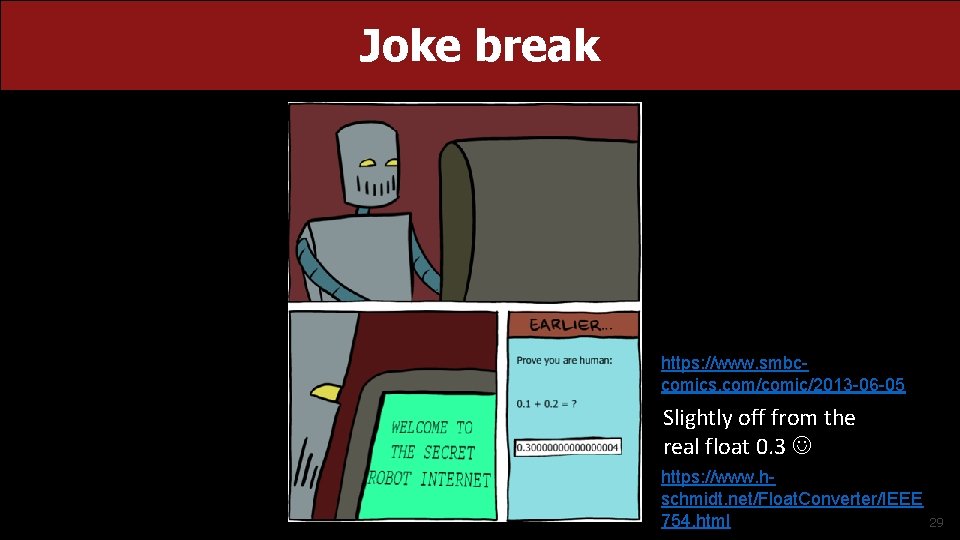
Joke break https: //www. smbccomics. com/comic/2013 -06 -05 Slightly off from the real float 0. 3 https: //www. hschmidt. net/Float. Converter/IEEE 754. html 29
Plan For Today • Representing real numbers and fixed point • Floating Point: Normalized values • Joke Break • Floating Point: Special/denormalized values • Number representations in C • Floating point arithmetic 30
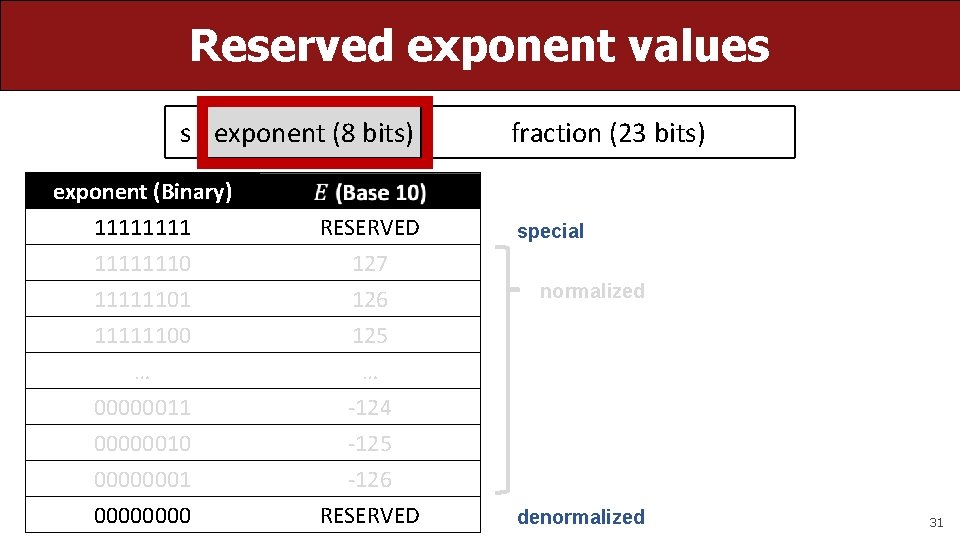
Reserved exponent values s exponent (8 bits) exponent (Binary) 11111110 11111101 RESERVED 127 126 11111100 … 00000011 00000010 00000001 125 … -124 -125 -126 0000 RESERVED fraction (23 bits) special normalized denormalized 31
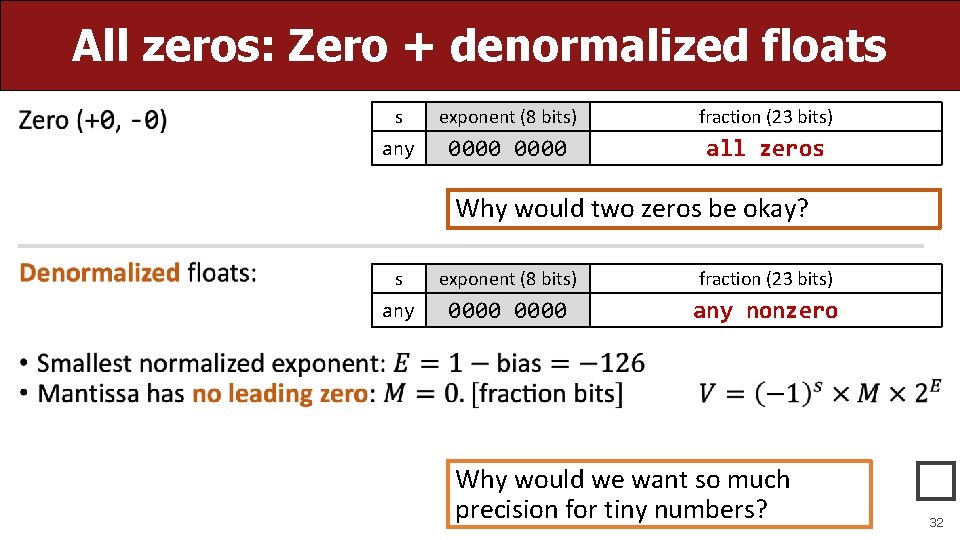
All zeros: Zero + denormalized floats • s exponent (8 bits) fraction (23 bits) any 0000 all zeros Why would two zeros be okay? s exponent (8 bits) fraction (23 bits) any 0000 any nonzero Why would we want so much precision for tiny numbers? � 32
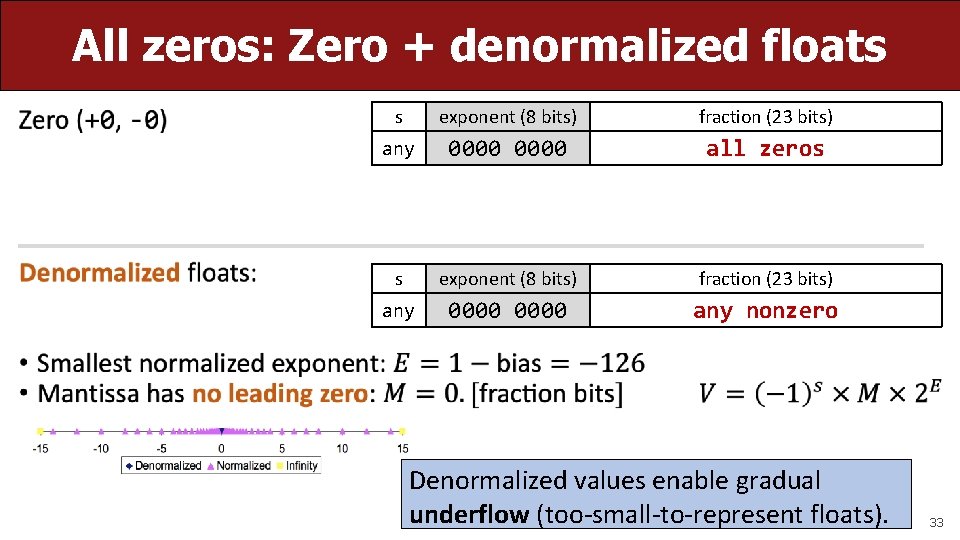
All zeros: Zero + denormalized floats • s exponent (8 bits) fraction (23 bits) any 0000 all zeros s exponent (8 bits) fraction (23 bits) any 0000 any nonzero Denormalized values enable gradual underflow (too-small-to-represent floats). 33
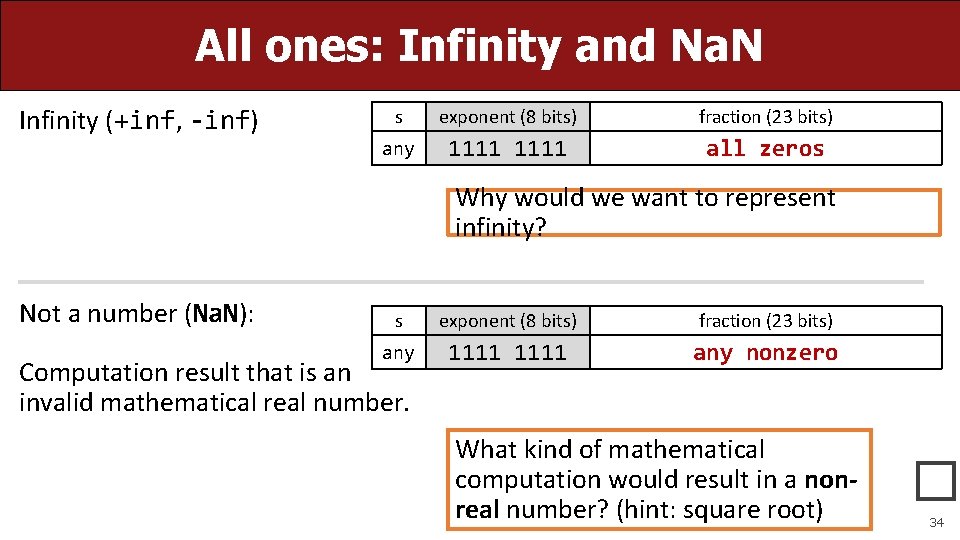
All ones: Infinity and Na. N Infinity (+inf, -inf) s exponent (8 bits) fraction (23 bits) any 1111 all zeros Why would we want to represent infinity? Not a number (Na. N): s exponent (8 bits) fraction (23 bits) any 1111 any nonzero Computation result that is an invalid mathematical real number. What kind of mathematical computation would result in a nonreal number? (hint: square root) � 34
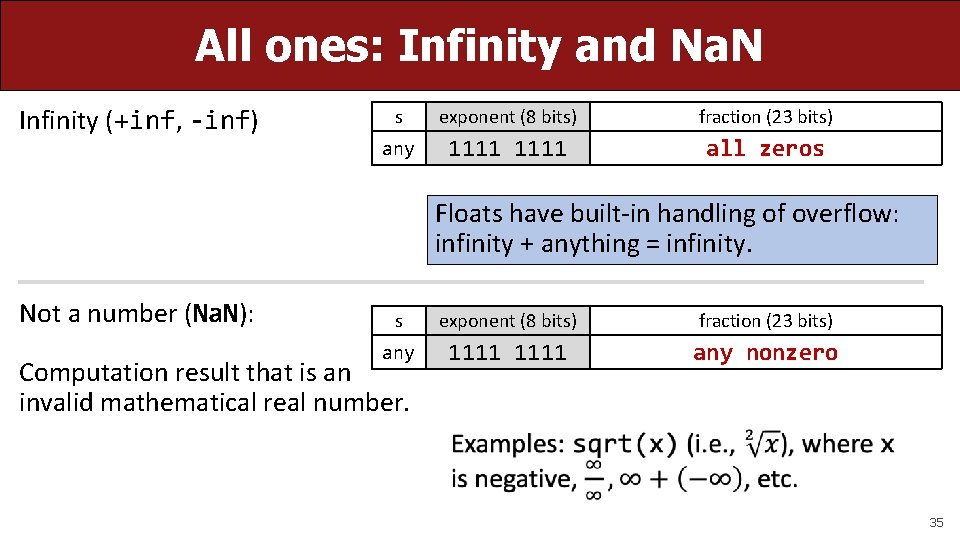
All ones: Infinity and Na. N Infinity (+inf, -inf) s exponent (8 bits) fraction (23 bits) any 1111 all zeros Floats have built-in handling of overflow: infinity + anything = infinity. Not a number (Na. N): s exponent (8 bits) fraction (23 bits) any 1111 any nonzero Computation result that is an invalid mathematical real number. What kind of mathematical computation would result in a nonreal number? (hint: square root) 35

Questions? 36
Plan For Today • Representing real numbers and fixed point • Floating Point: Normalized values • Joke Break • Floating Point: Special/denormalized values • Number representations in C • Floating point arithmetic 37
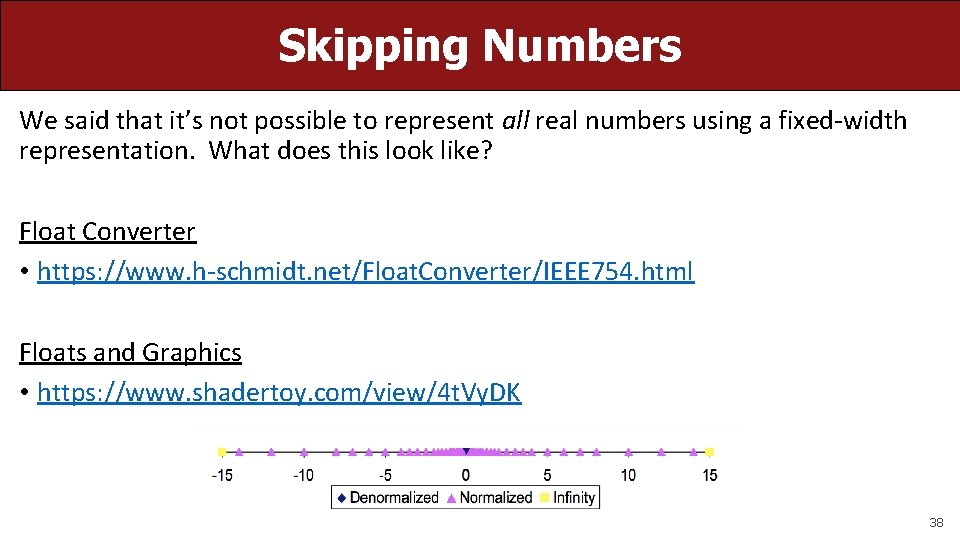
Skipping Numbers We said that it’s not possible to represent all real numbers using a fixed-width representation. What does this look like? Float Converter • https: //www. h-schmidt. net/Float. Converter/IEEE 754. html Floats and Graphics • https: //www. shadertoy. com/view/4 t. Vy. DK 38
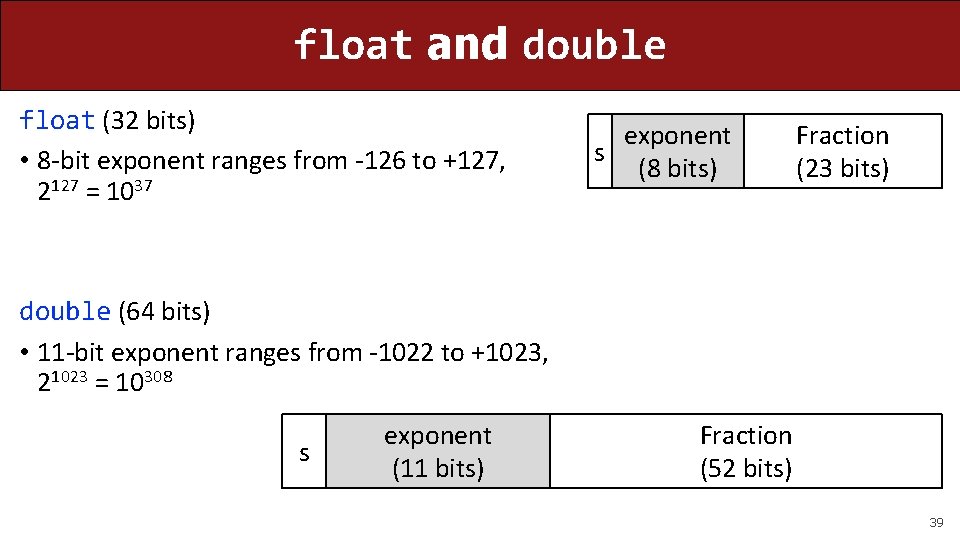
float and double float (32 bits) • 8 -bit exponent ranges from -126 to +127, 2127 = 1037 exponent s (8 bits) Fraction (23 bits) double (64 bits) • 11 -bit exponent ranges from -1022 to +1023, 21023 = 10308 s exponent (11 bits) Fraction (52 bits) 39
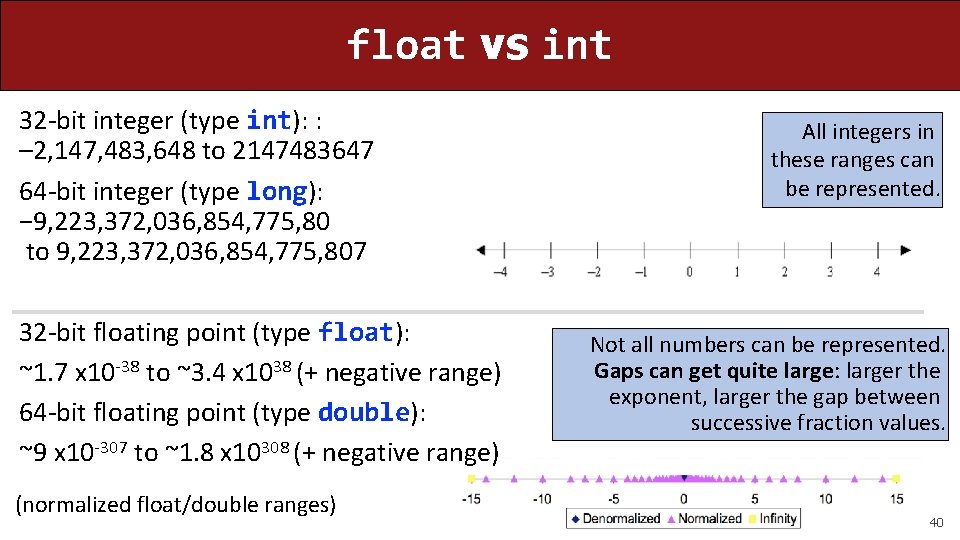
float vs int 32 -bit integer (type int): : – 2, 147, 483, 648 to 2147483647 64 -bit integer (type long): − 9, 223, 372, 036, 854, 775, 80 to 9, 223, 372, 036, 854, 775, 807 32 -bit floating point (type float): ~1. 7 x 10 -38 to ~3. 4 x 1038 (+ negative range) 64 -bit floating point (type double): ~9 x 10 -307 to ~1. 8 x 10308 (+ negative range) (normalized float/double ranges) All integers in these ranges can be represented. Not all numbers can be represented. Gaps can get quite large: larger the exponent, larger the gap between successive fraction values. 40
Plan For Today • Representing real numbers and fixed point • Floating Point: Normalized values • Joke Break • Floating Point: Special/denormalized values • Number representations in C • Floating point arithmetic 41
Key (floating) points Approximation and rounding is inevitable. Single operations are commutative, but sequence is not associative. (a + b) equals (b + a) But (a + b) + c may not equal a + (b + c) Equality comparison operations are often unwise. 42
Key (floating) points Approximation and rounding is inevitable. Single operations are commutative, but sequence is not associative. (a + b) equals (b + a) But (a + b) + c may not equal a + (b + c) Equality comparison operations are often unwise. 43
Lisa’s Official Guide To Making Money FAST! It’s easy ! You can lose money, too! 44
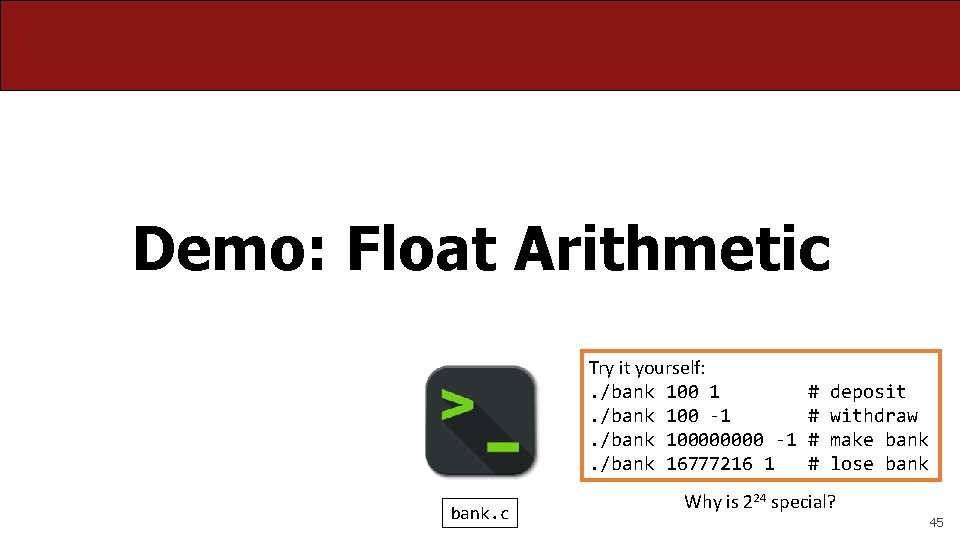
Demo: Float Arithmetic Try it yourself: . /bank 100 1. /bank 100 -1. /bank 10000 -1. /bank 16777216 1 bank. c # # deposit withdraw make bank lose bank Why is 224 special? 45
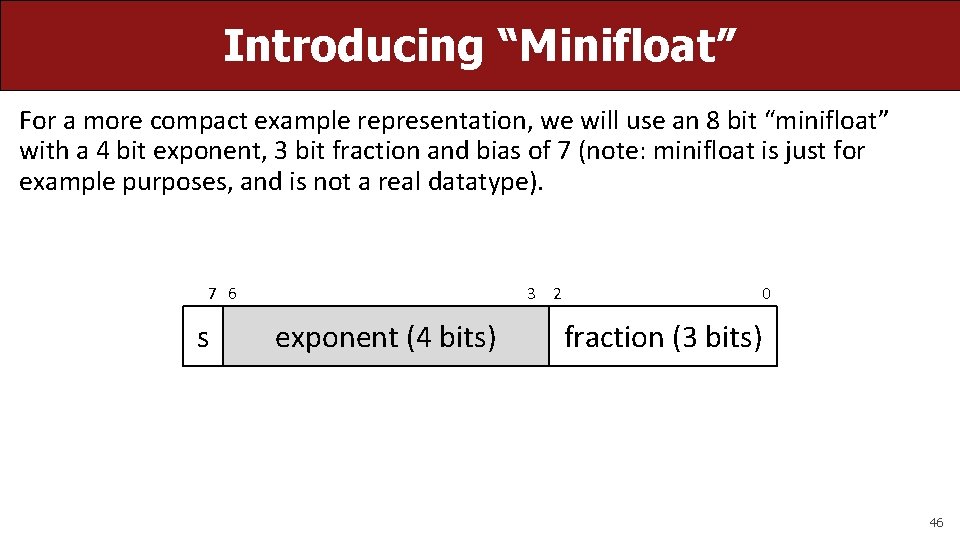
Introducing “Minifloat” For a more compact example representation, we will use an 8 bit “minifloat” with a 4 bit exponent, 3 bit fraction and bias of 7 (note: minifloat is just for example purposes, and is not a real datatype). 7 6 s 3 2 exponent (4 bits) 0 fraction (3 bits) 46
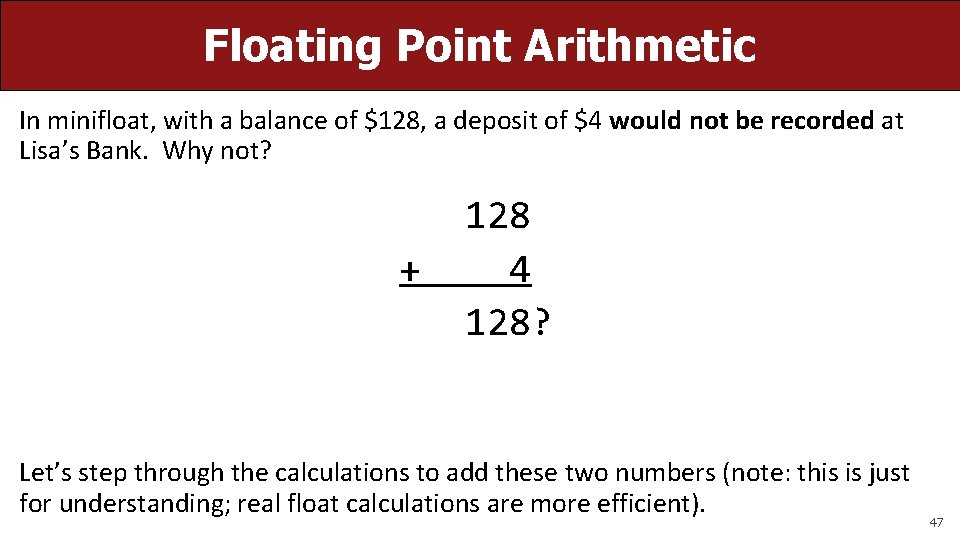
Floating Point Arithmetic In minifloat, with a balance of $128, a deposit of $4 would not be recorded at Lisa’s Bank. Why not? + 128 4 128? Let’s step through the calculations to add these two numbers (note: this is just for understanding; real float calculations are more efficient). 47
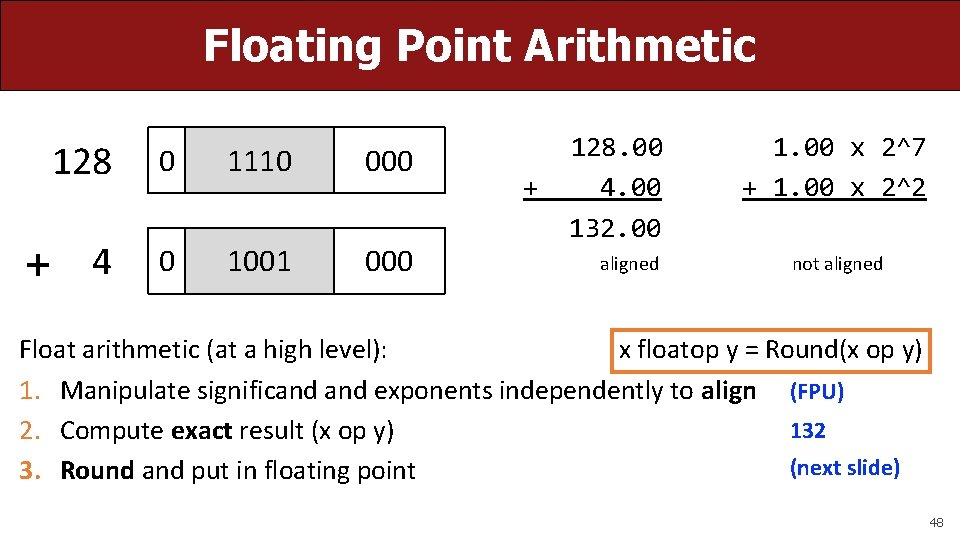
Floating Point Arithmetic 128 0 1110 000 + 4 0 1001 000 + 128. 00 4. 00 132. 00 aligned 1. 00 x 2^7 + 1. 00 x 2^2 not aligned Float arithmetic (at a high level): x floatop y = Round(x op y) 1. Manipulate significand exponents independently to align (FPU) 132 2. Compute exact result (x op y) (next slide) 3. Round and put in floating point 48
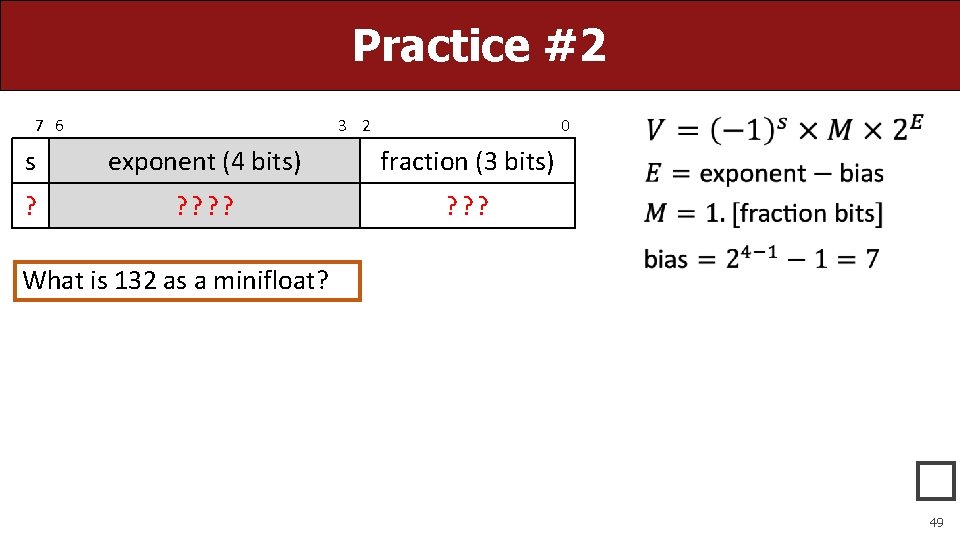
Practice #2 7 6 3 2 0 s exponent (4 bits) fraction (3 bits) ? ? ? ? What is 132 as a minifloat? � 49
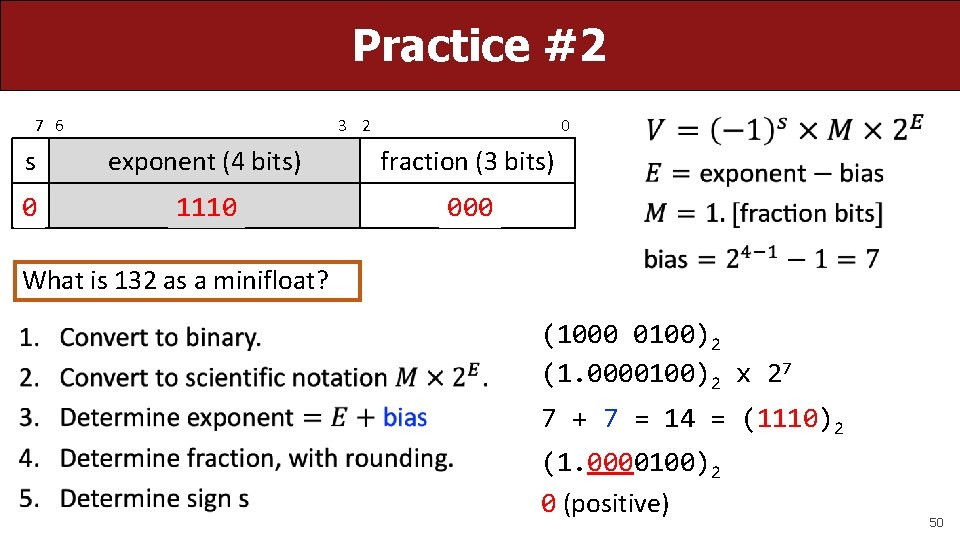
Practice #2 7 6 3 2 0 s exponent (4 bits) fraction (3 bits) ? 0 ? ? 1110 ? ? ? 000 What is 132 as a minifloat? • (1000 0100)2 (1. 0000100)2 x 27 7 + 7 = 14 = (1110)2 (1. 0000100)2 0 (positive) 50
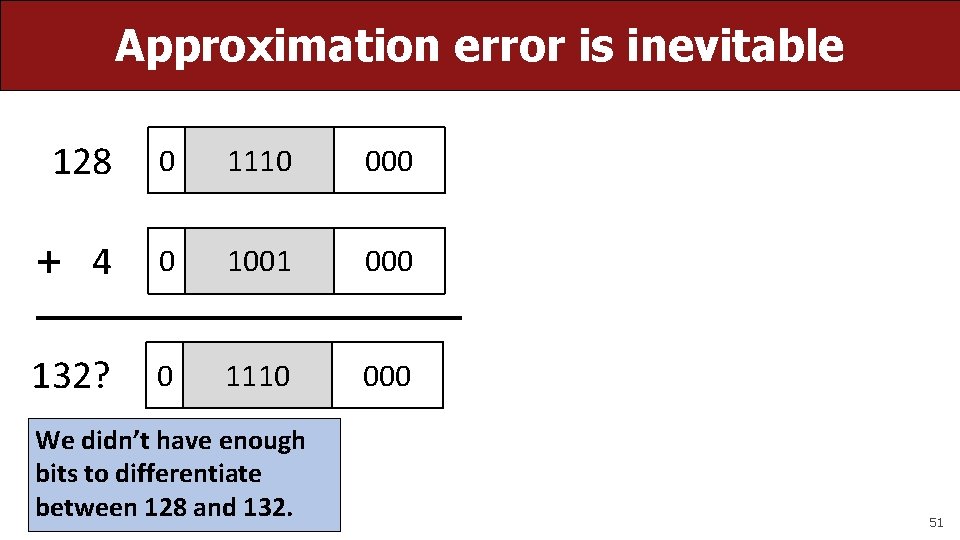
Approximation error is inevitable 128 0 1110 000 + 4 0 1001 000 132? 0 1110 000 We didn’t have enough bits to differentiate between 128 and 132. 51
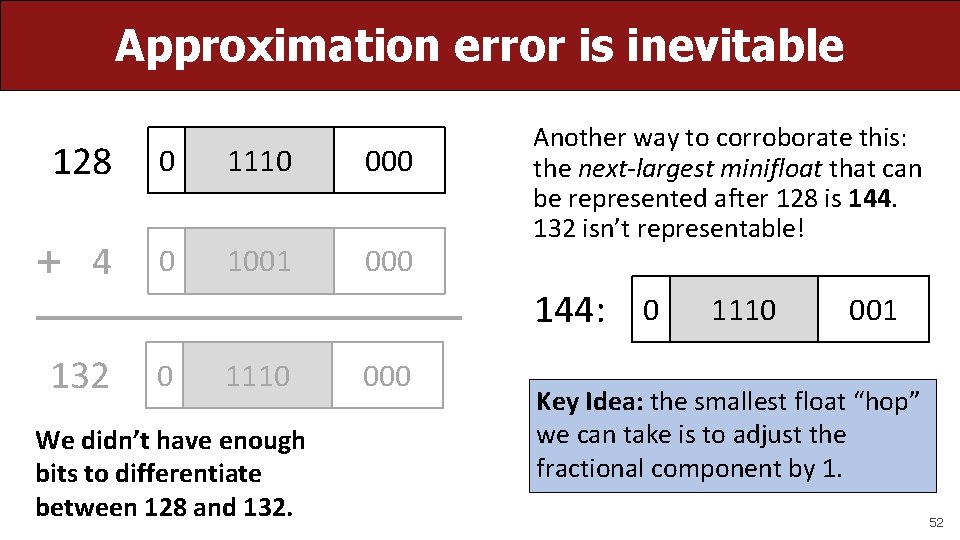
Approximation error is inevitable 128 0 1110 000 + 4 0 1001 000 132 Another way to corroborate this: the next-largest minifloat that can be represented after 128 is 144. 132 isn’t representable! 144: 0 1110 We didn’t have enough bits to differentiate between 128 and 132. 000 0 1110 001 Key Idea: the smallest float “hop” we can take is to adjust the fractional component by 1. 52
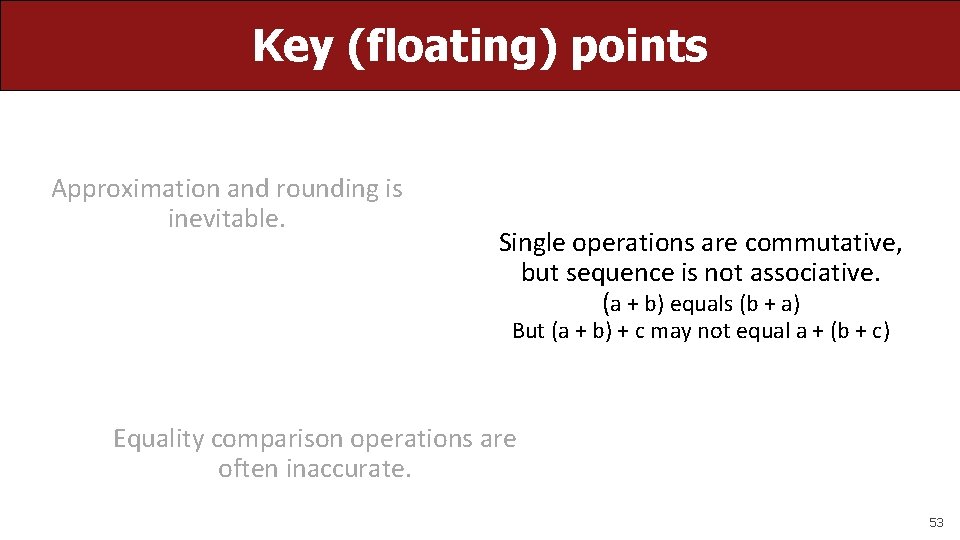
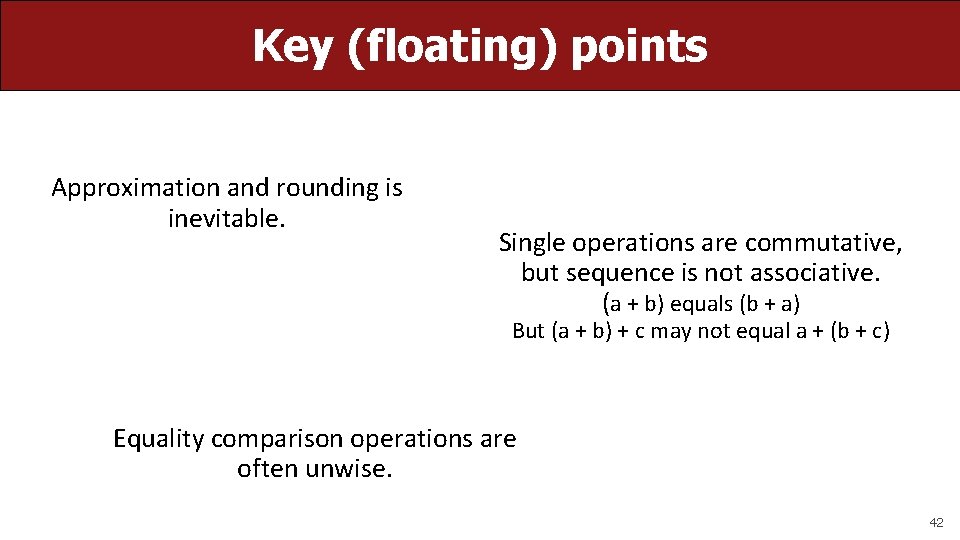
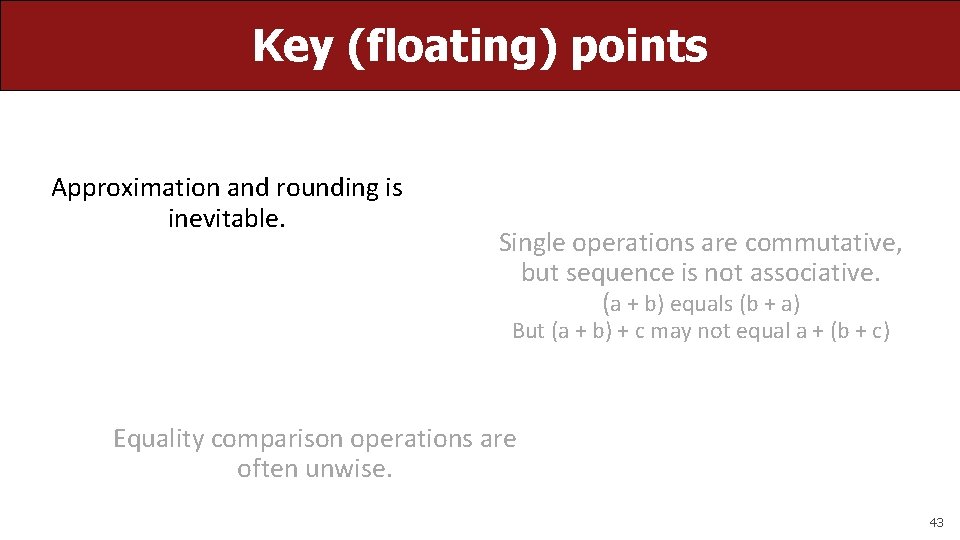
Key (floating) points Approximation and rounding is inevitable. Single operations are commutative, but sequence is not associative. (a + b) equals (b + a) But (a + b) + c may not equal a + (b + c) Equality comparison operations are often inaccurate. 53
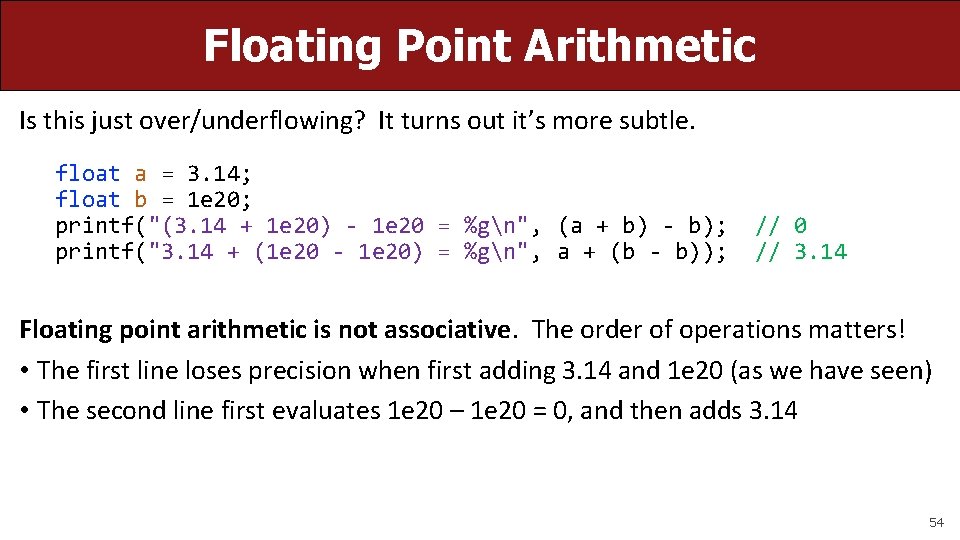
Floating Point Arithmetic Is this just over/underflowing? It turns out it’s more subtle. float a = 3. 14; float b = 1 e 20; printf("(3. 14 + 1 e 20) - 1 e 20 = %gn", (a + b) - b); printf("3. 14 + (1 e 20 - 1 e 20) = %gn", a + (b - b)); // 0 // 3. 14 Floating point arithmetic is not associative. The order of operations matters! • The first line loses precision when first adding 3. 14 and 1 e 20 (as we have seen) • The second line first evaluates 1 e 20 – 1 e 20 = 0, and then adds 3. 14 54
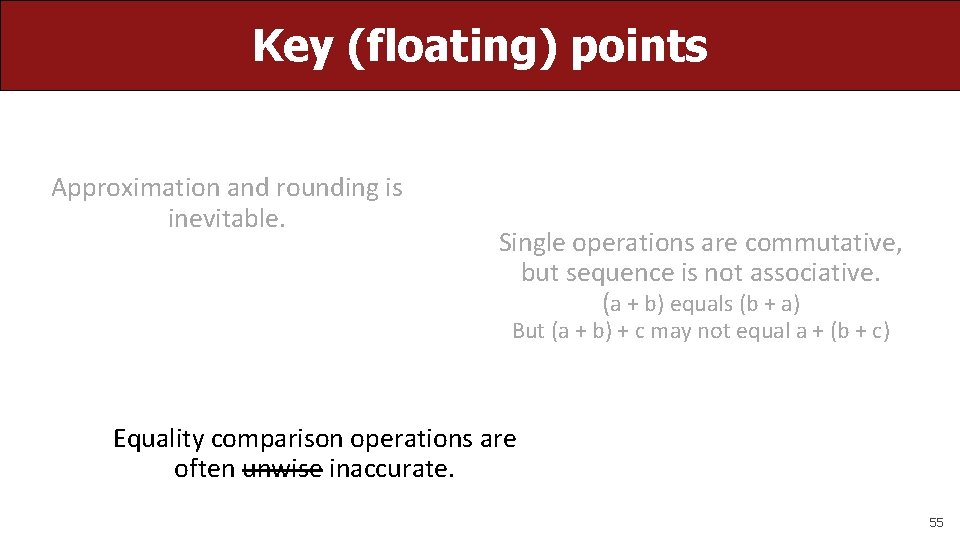
Key (floating) points Approximation and rounding is inevitable. Single operations are commutative, but sequence is not associative. (a + b) equals (b + a) But (a + b) + c may not equal a + (b + c) Equality comparison operations are often unwise inaccurate. 55

Demo: Float Equality float_equality. c 56
Floating point in other languages Float arithmetic is an issue with most languages, not just C! • http: //geocar. sdf 1. org/numbers. html 57
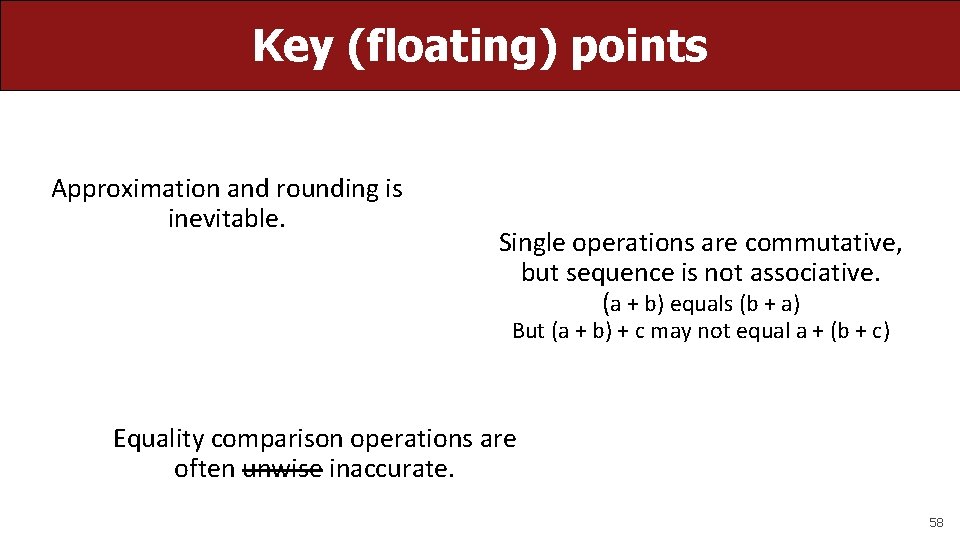
Key (floating) points Approximation and rounding is inevitable. Single operations are commutative, but sequence is not associative. (a + b) equals (b + a) But (a + b) + c may not equal a + (b + c) Equality comparison operations are often unwise inaccurate. 58
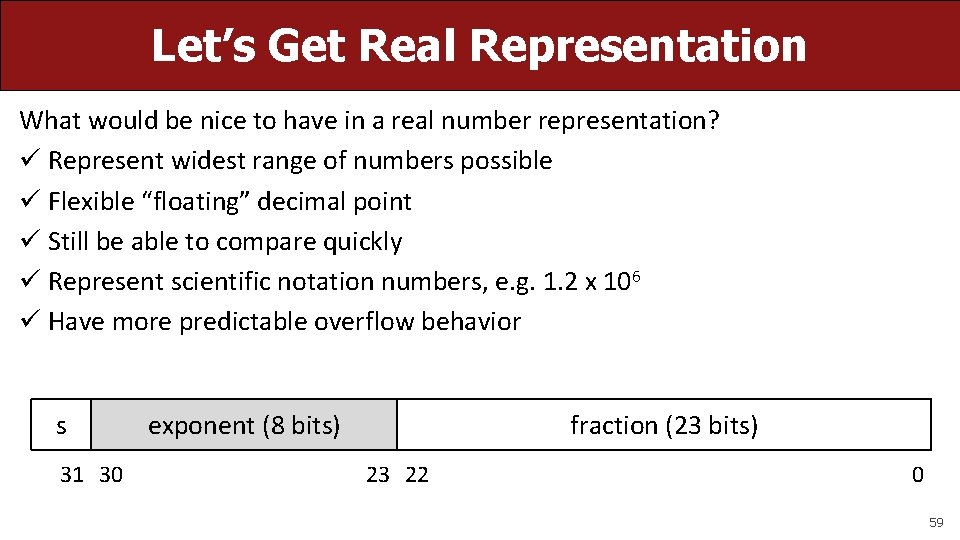
Let’s Get Real Representation What would be nice to have in a real number representation? ü Represent widest range of numbers possible ü Flexible “floating” decimal point ü Still be able to compare quickly ü Represent scientific notation numbers, e. g. 1. 2 x 10⁶ ü Have more predictable overflow behavior s 31 30 exponent (8 bits) fraction (23 bits) 23 22 0 59
- Slides: 59