
CS 106 B Lecture 27 Inheritance and Polymorphism
CS 106 B Lecture 27: Inheritance and Polymorphism in C++ Monday, June 4, 2018 Programming Abstractions Spring 2018 Stanford University Computer Science Department Lecturer: Chris Gregg reading: Programming Abstractions in C++, Chapter 19
Today's Topics • Logistics • Final Exam prep online: http: //web. stanford. edu/class/cs 106 b/handouts/final. html • Final Review Session: Wednesday, June 6 th, 7: 30 -9 pm, STLC-111. • Peer office hours: Thursday 1 -3 pm, STLC-118. • If you are expecting an alternate exam, you should have received an email over the weekend. • Final exam is on Friday, June 8 th at 8: 30 am. • Hash Map Example • Inheritance and Polymorphism in C++ • PDF for code: http: //web. stanford. edu/class/cs 106 b//lectures/27 Inheritance/code/Inheritance. Polymorphism. Examples. pdf

Hash Map Example Let's simulate the behavior of a hash map that hashes ints (keys) to chars (values). We will assume that the hash table starts with a capacity of 5 elements, and that it uses linked list chaining to resolve collisions. We will also assume that the key/value pairs are inserted at the head of each linked list. We will use a hash / compression function defined as follows: int hash(int key, int num. Buckets) { return key % 7 % num. Buckets; } We will rehash when the load factor (number of keys / number of buckets) is greater than or equal to 0. 8.
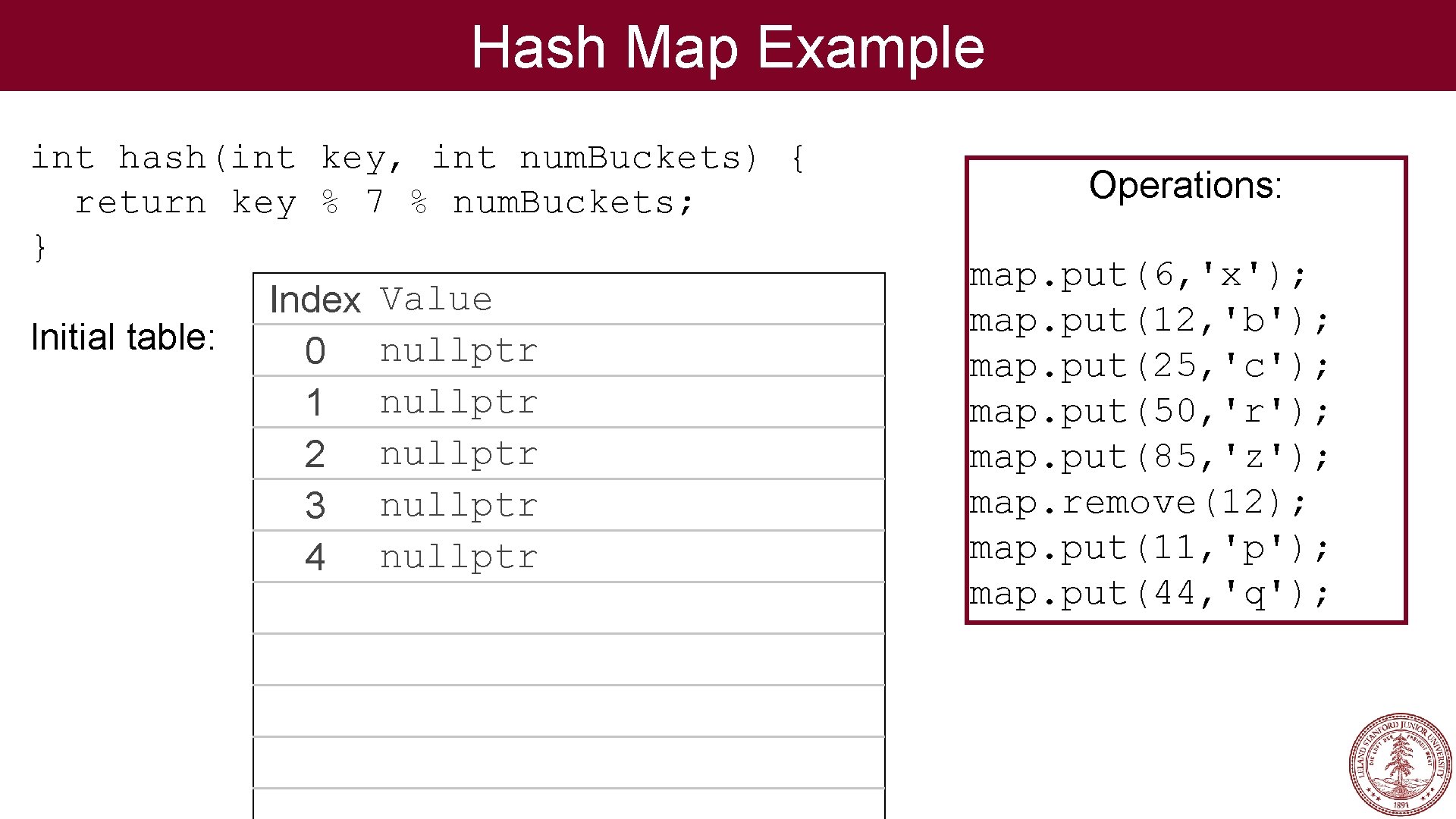
Hash Map Example int hash(int key, int num. Buckets) { return key % 7 % num. Buckets; } Index Value Initial table: 0 nullptr 1 nullptr 2 nullptr 3 nullptr 4 nullptr Operations: map. put(6, 'x'); map. put(12, 'b'); map. put(25, 'c'); map. put(50, 'r'); map. put(85, 'z'); map. remove(12); map. put(11, 'p'); map. put(44, 'q');
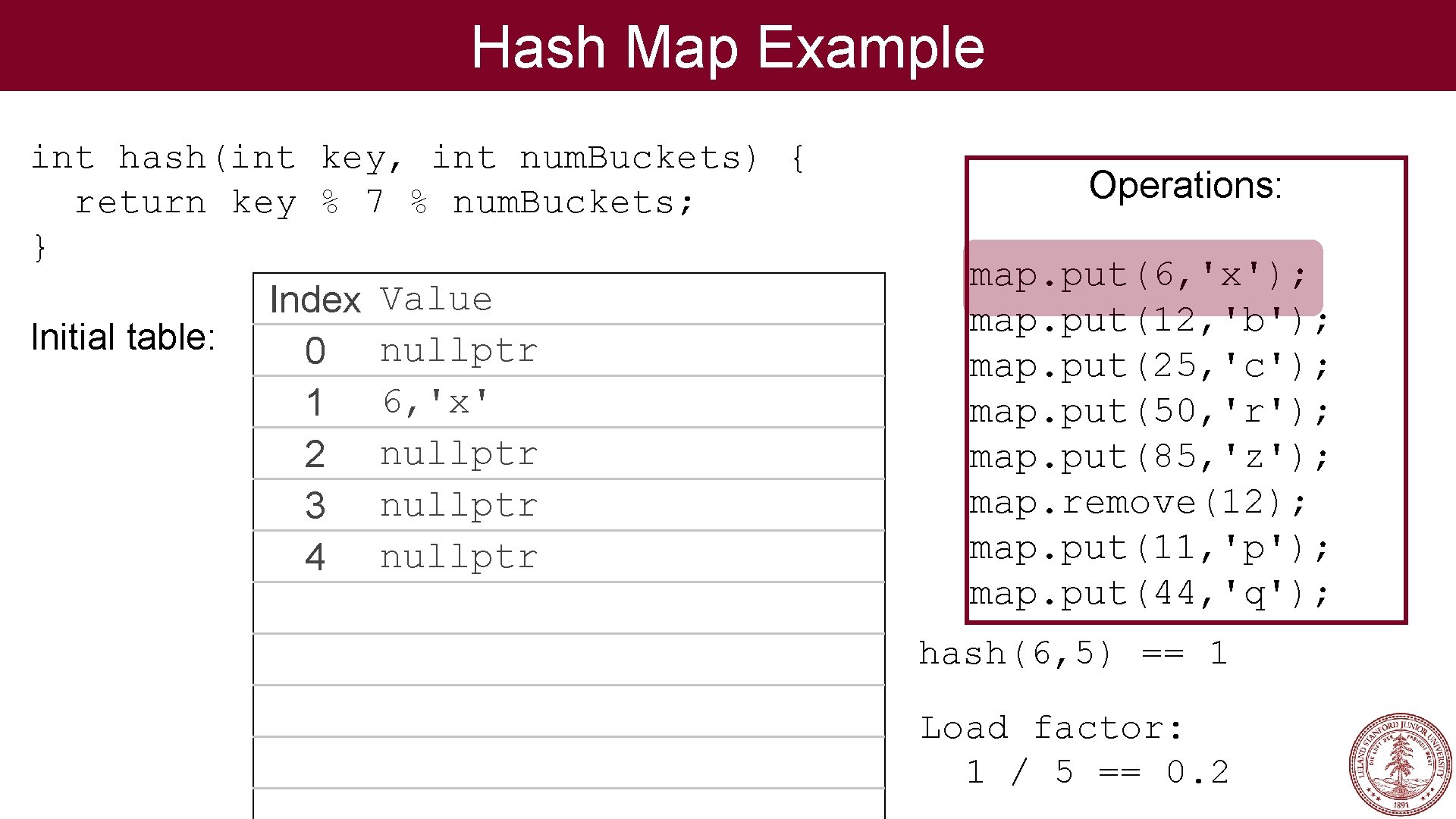
Hash Map Example int hash(int key, int num. Buckets) { return key % 7 % num. Buckets; } Index Value Initial table: 0 nullptr 1 6, 'x' 2 nullptr 3 nullptr 4 nullptr Operations: map. put(6, 'x'); map. put(12, 'b'); map. put(25, 'c'); map. put(50, 'r'); map. put(85, 'z'); map. remove(12); map. put(11, 'p'); map. put(44, 'q'); hash(6, 5) == 1 Load factor: 1 / 5 == 0. 2

Hash Map Example int hash(int key, int num. Buckets) { return key % 7 % num. Buckets; } Index Value Initial table: 0 12, 'b' 1 6, 'x' 2 nullptr 3 nullptr 4 nullptr Operations: map. put(6, 'x'); map. put(12, 'b'); map. put(25, 'c'); map. put(50, 'r'); map. put(85, 'z'); map. remove(12); map. put(11, 'p'); map. put(44, 'q'); hash(12, 5) == 0 Load factor: 2 / 5 == 0. 4
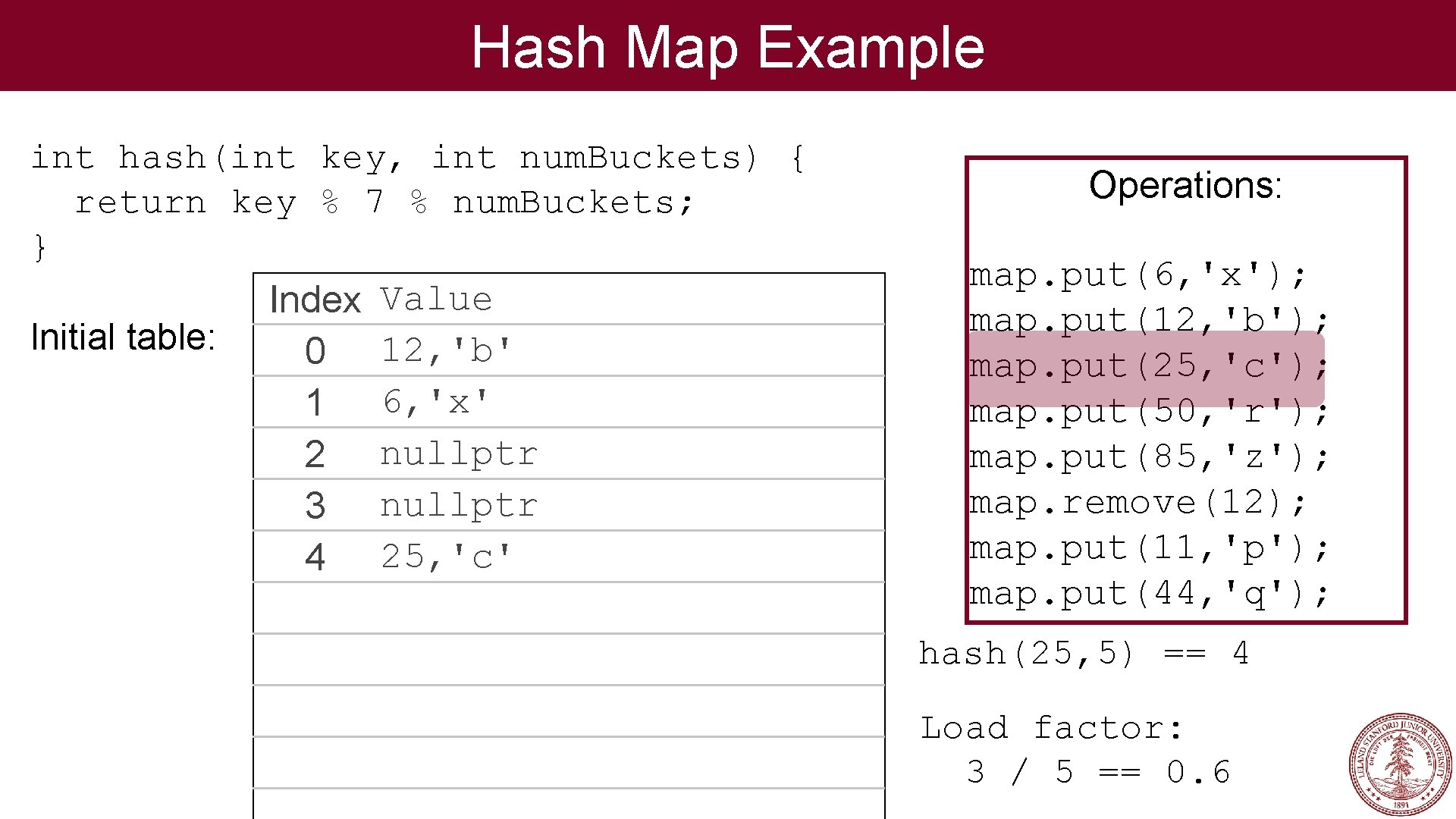
Hash Map Example int hash(int key, int num. Buckets) { return key % 7 % num. Buckets; } Index Value Initial table: 0 12, 'b' 1 6, 'x' 2 nullptr 3 nullptr 4 25, 'c' Operations: map. put(6, 'x'); map. put(12, 'b'); map. put(25, 'c'); map. put(50, 'r'); map. put(85, 'z'); map. remove(12); map. put(11, 'p'); map. put(44, 'q'); hash(25, 5) == 4 Load factor: 3 / 5 == 0. 6
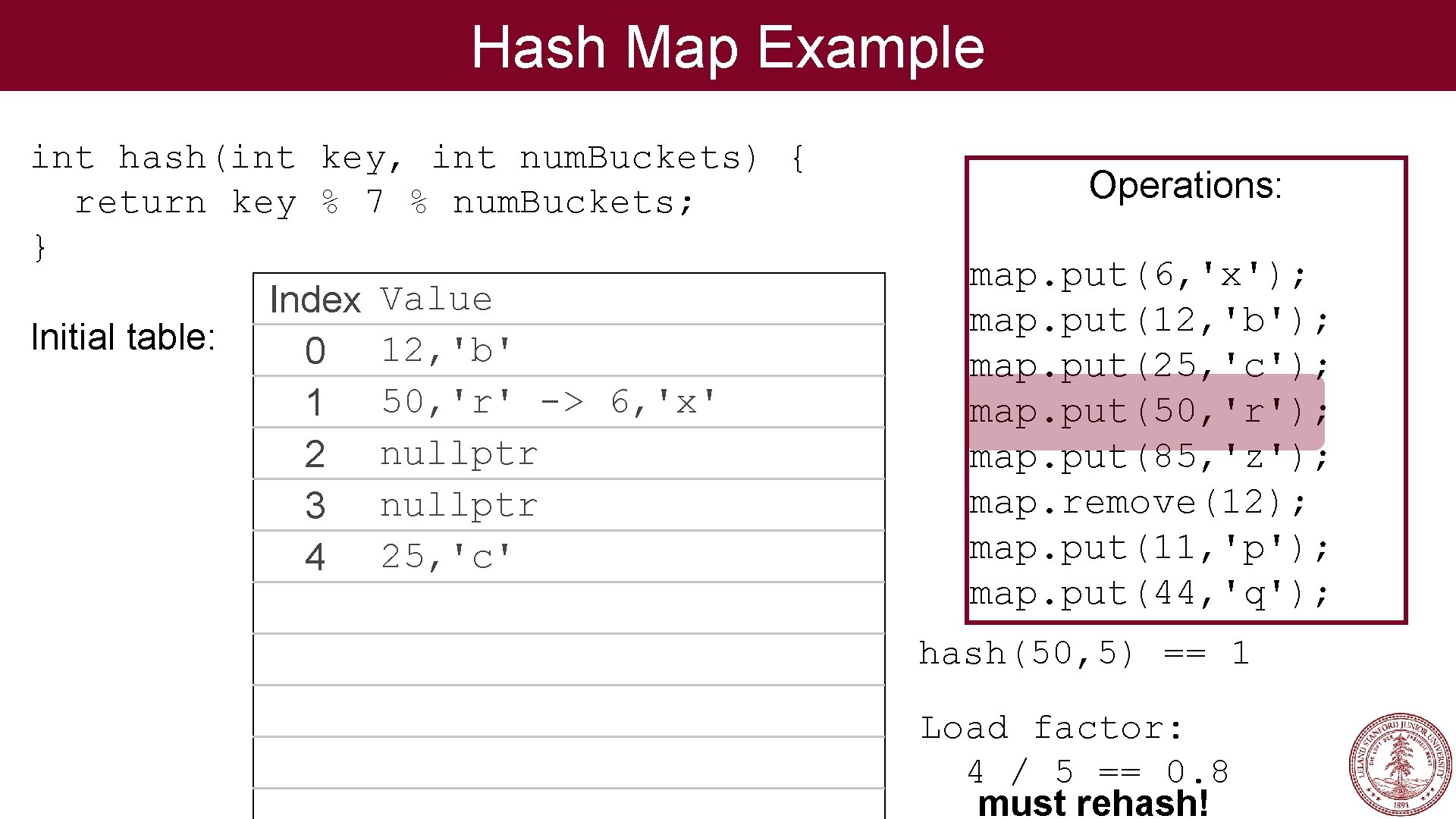
Hash Map Example int hash(int key, int num. Buckets) { return key % 7 % num. Buckets; } Index Value Initial table: 0 12, 'b' 1 50, 'r' -> 6, 'x' 2 nullptr 3 nullptr 4 25, 'c' Operations: map. put(6, 'x'); map. put(12, 'b'); map. put(25, 'c'); map. put(50, 'r'); map. put(85, 'z'); map. remove(12); map. put(11, 'p'); map. put(44, 'q'); hash(50, 5) == 1 Load factor: 4 / 5 == 0. 8 must rehash!
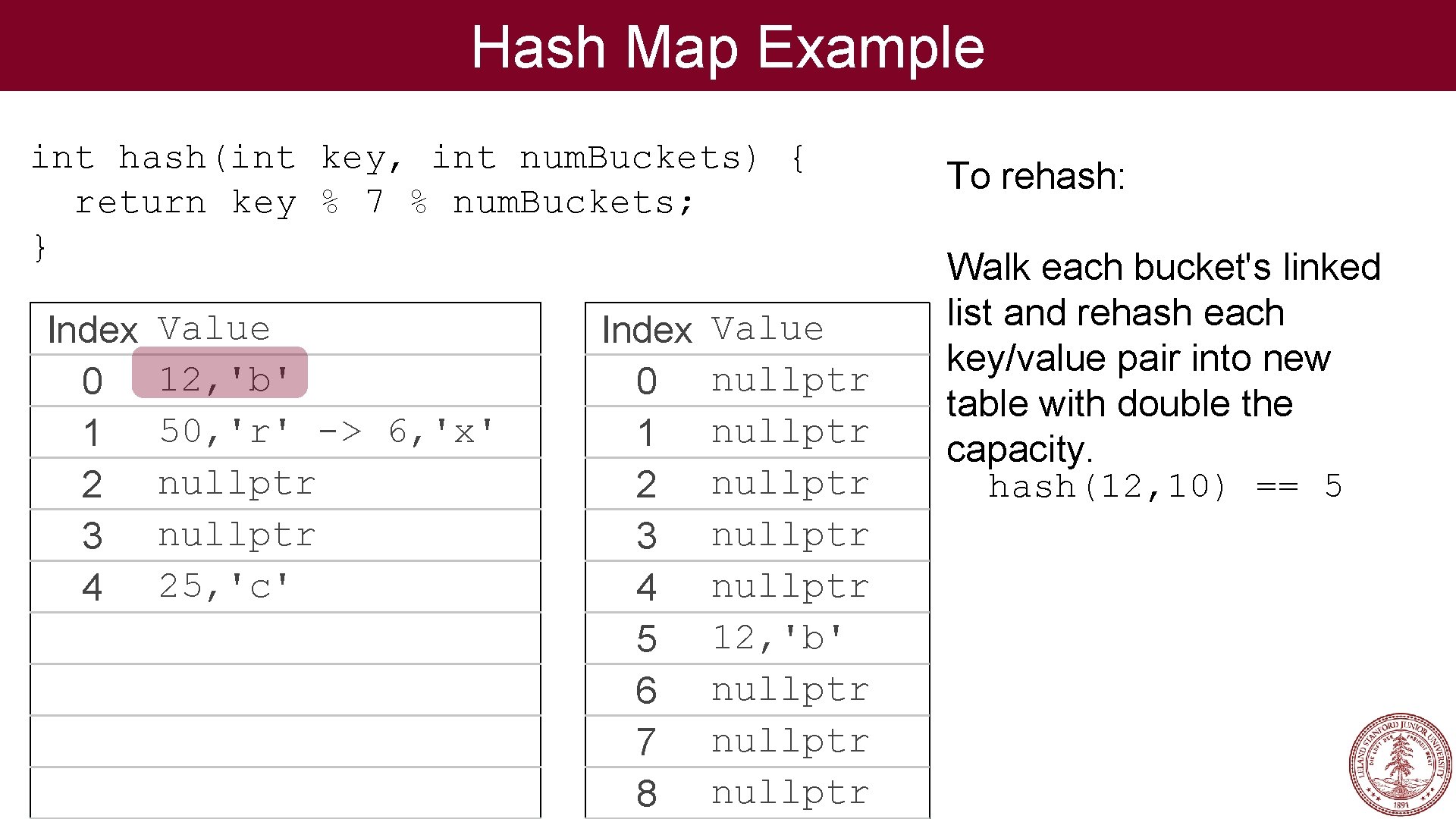
Hash Map Example int hash(int key, int num. Buckets) { return key % 7 % num. Buckets; } Index 0 1 2 3 4 Value 12, 'b' 50, 'r' -> 6, 'x' nullptr 25, 'c' Index 0 1 2 3 4 5 6 7 8 Value nullptr nullptr 12, 'b' nullptr To rehash: Walk each bucket's linked list and rehash each key/value pair into new table with double the capacity. hash(12, 10) == 5
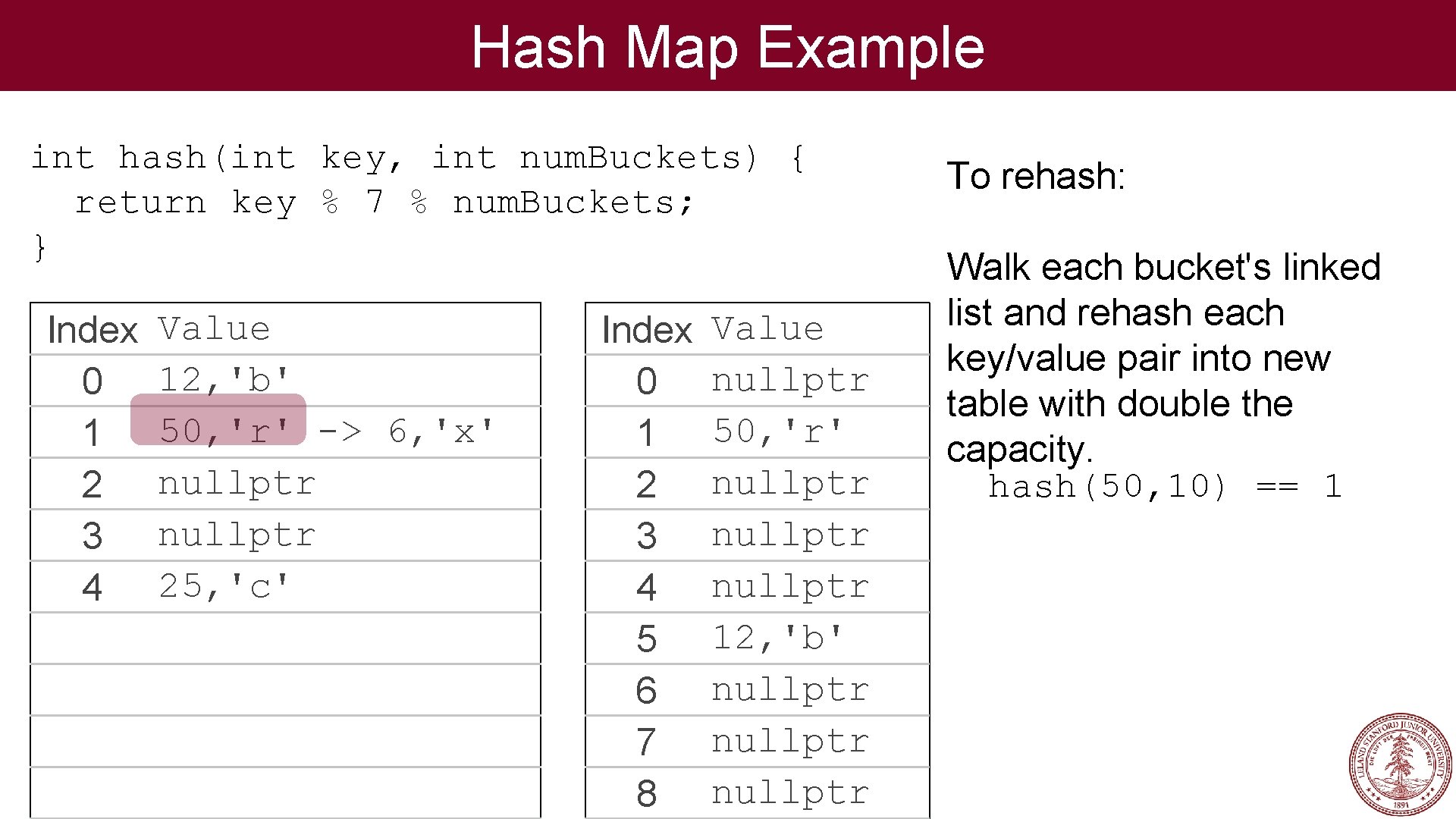
Hash Map Example int hash(int key, int num. Buckets) { return key % 7 % num. Buckets; } Index 0 1 2 3 4 Value 12, 'b' 50, 'r' -> 6, 'x' nullptr 25, 'c' Index 0 1 2 3 4 5 6 7 8 Value nullptr 50, 'r' nullptr 12, 'b' nullptr To rehash: Walk each bucket's linked list and rehash each key/value pair into new table with double the capacity. hash(50, 10) == 1
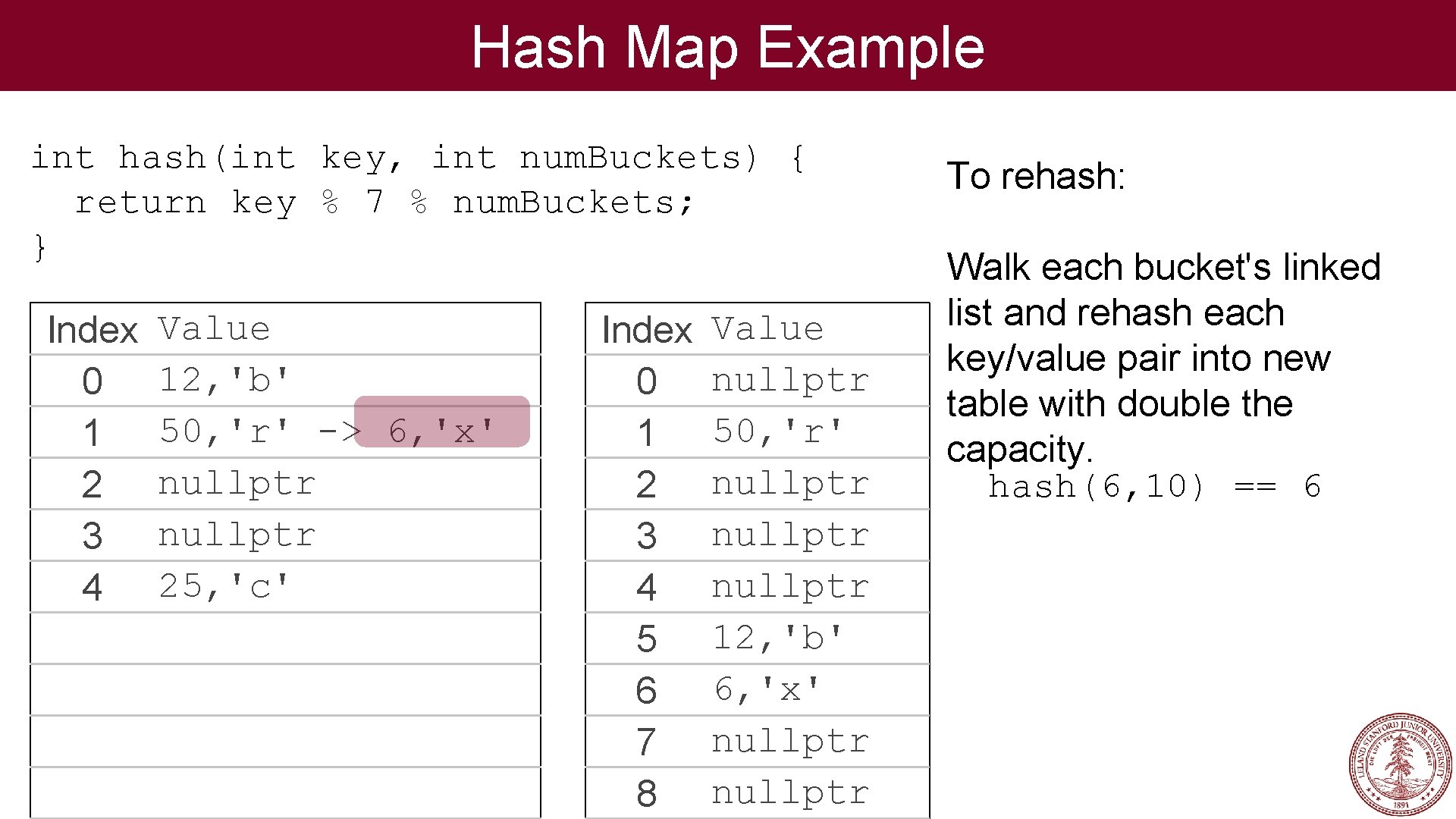
Hash Map Example int hash(int key, int num. Buckets) { return key % 7 % num. Buckets; } Index 0 1 2 3 4 Value 12, 'b' 50, 'r' -> 6, 'x' nullptr 25, 'c' Index 0 1 2 3 4 5 6 7 8 Value nullptr 50, 'r' nullptr 12, 'b' 6, 'x' nullptr To rehash: Walk each bucket's linked list and rehash each key/value pair into new table with double the capacity. hash(6, 10) == 6
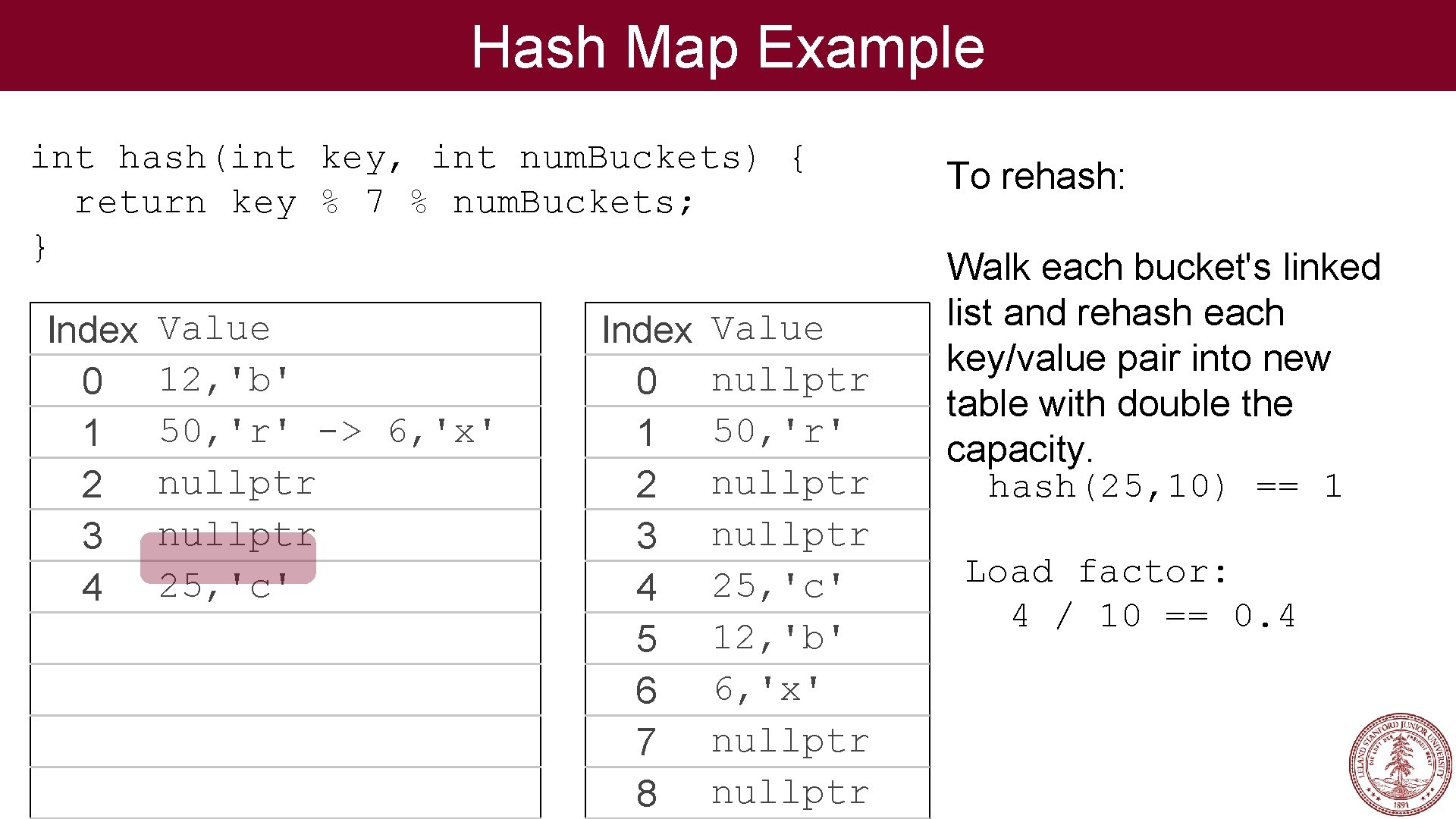
Hash Map Example int hash(int key, int num. Buckets) { return key % 7 % num. Buckets; } Index 0 1 2 3 4 Value 12, 'b' 50, 'r' -> 6, 'x' nullptr 25, 'c' Index 0 1 2 3 4 5 6 7 8 Value nullptr 50, 'r' nullptr 25, 'c' 12, 'b' 6, 'x' nullptr To rehash: Walk each bucket's linked list and rehash each key/value pair into new table with double the capacity. hash(25, 10) == 1 Load factor: 4 / 10 == 0. 4
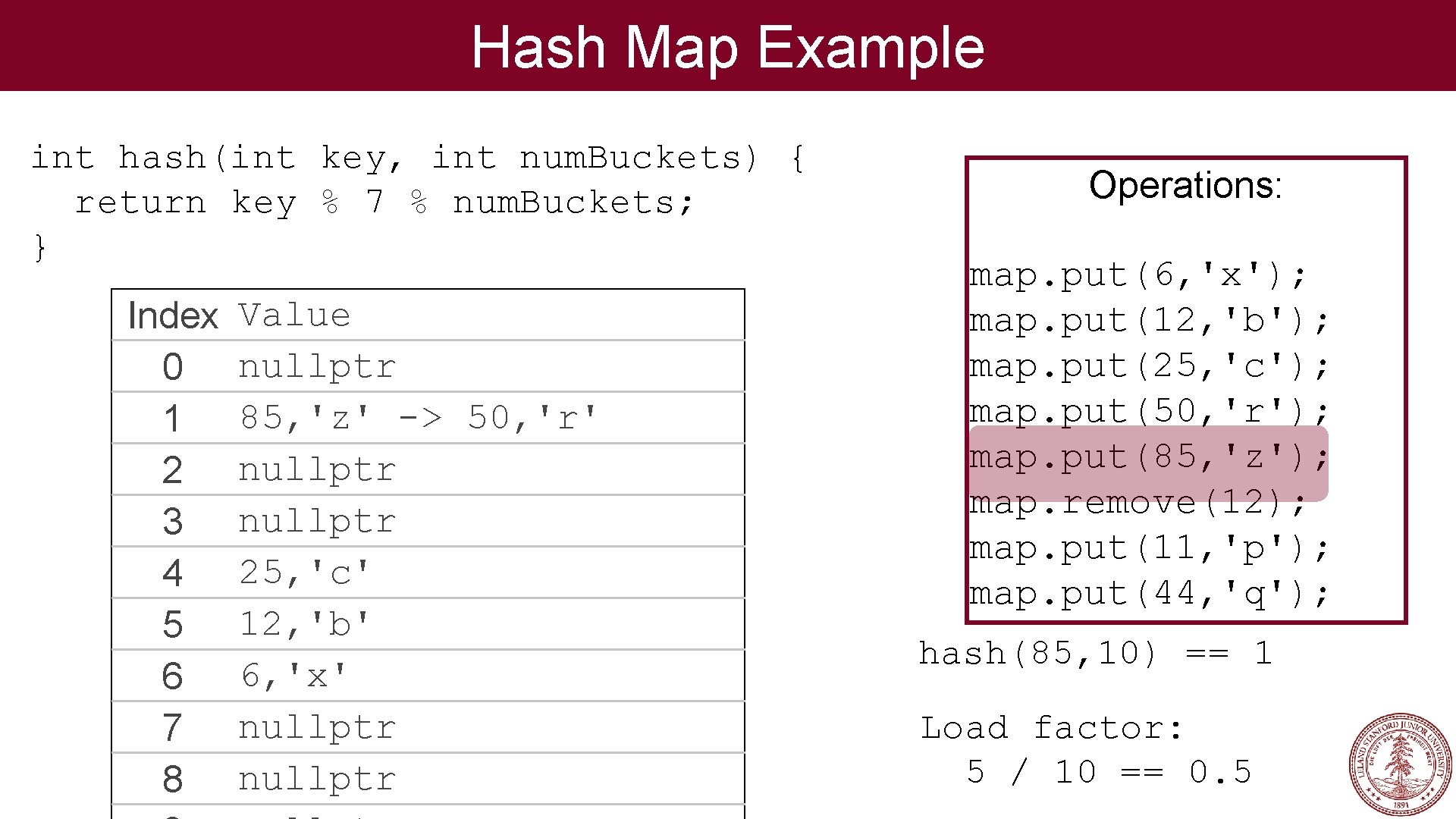
Hash Map Example int hash(int key, int num. Buckets) { return key % 7 % num. Buckets; } Index 0 1 2 3 4 5 6 7 8 Value nullptr 85, 'z' -> 50, 'r' nullptr 25, 'c' 12, 'b' 6, 'x' nullptr Operations: map. put(6, 'x'); map. put(12, 'b'); map. put(25, 'c'); map. put(50, 'r'); map. put(85, 'z'); map. remove(12); map. put(11, 'p'); map. put(44, 'q'); hash(85, 10) == 1 Load factor: 5 / 10 == 0. 5
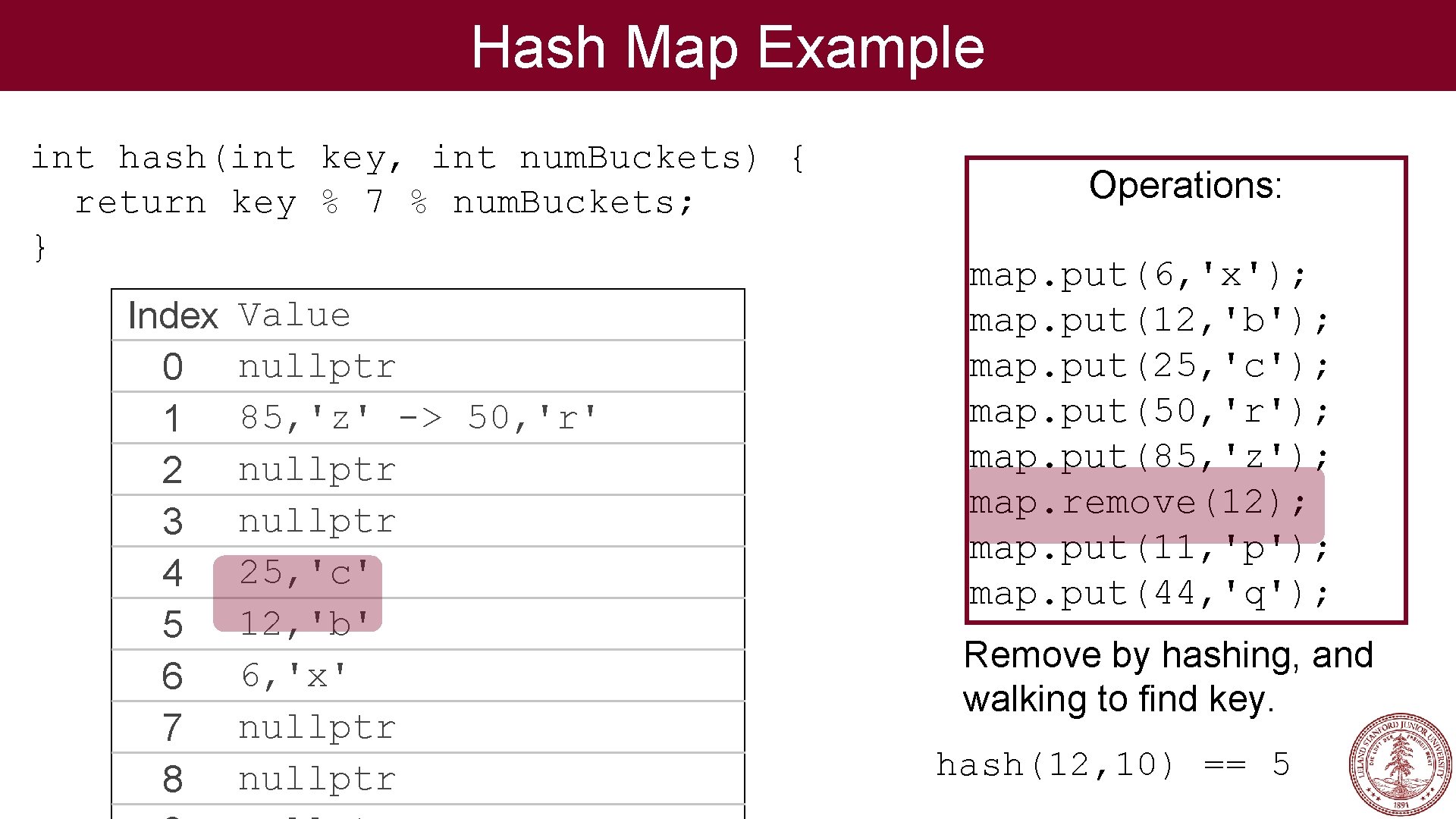
Hash Map Example int hash(int key, int num. Buckets) { return key % 7 % num. Buckets; } Index 0 1 2 3 4 5 6 7 8 Value nullptr 85, 'z' -> 50, 'r' nullptr 25, 'c' 12, 'b' 6, 'x' nullptr Operations: map. put(6, 'x'); map. put(12, 'b'); map. put(25, 'c'); map. put(50, 'r'); map. put(85, 'z'); map. remove(12); map. put(11, 'p'); map. put(44, 'q'); Remove by hashing, and walking to find key. hash(12, 10) == 5
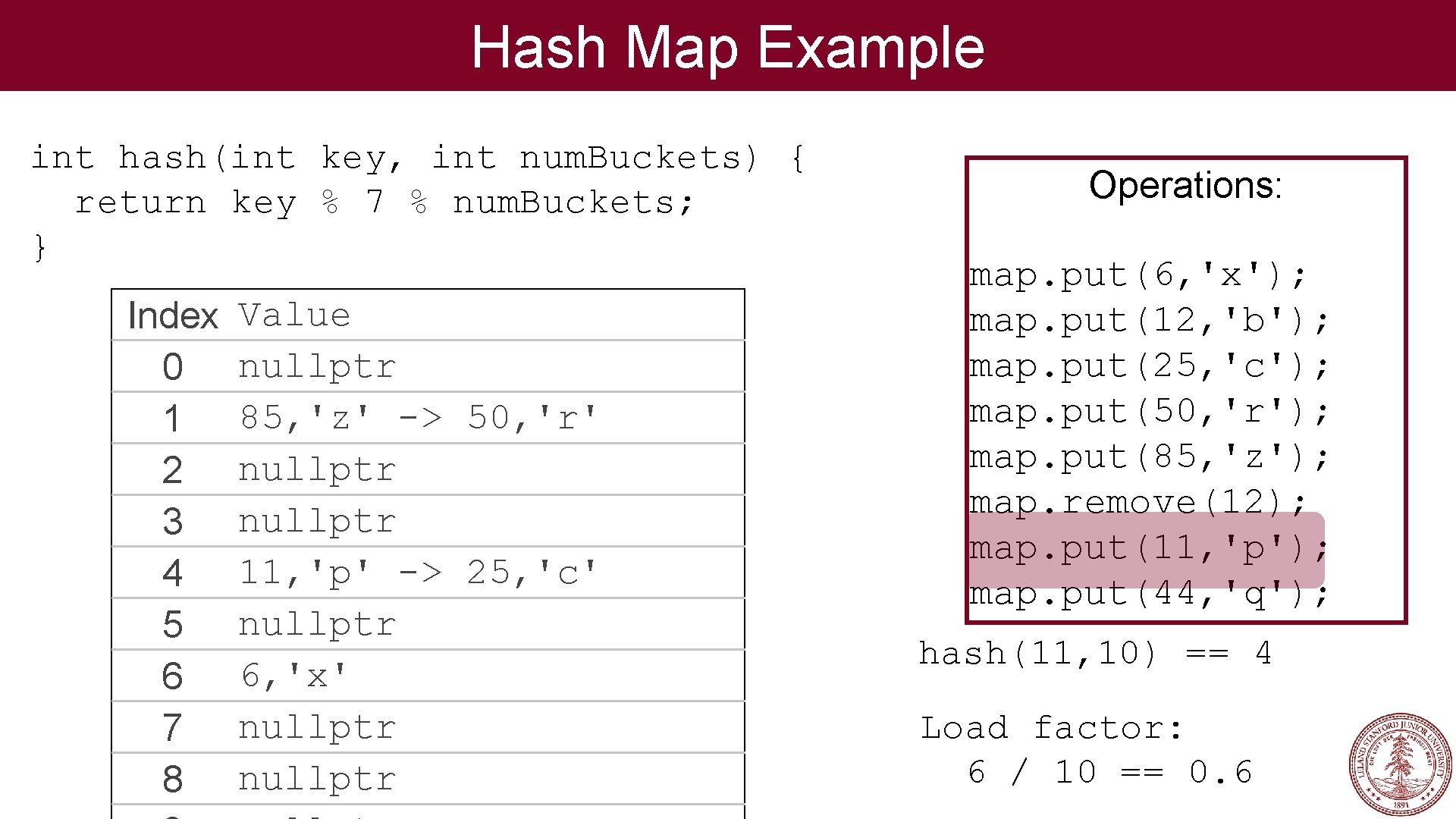
Hash Map Example int hash(int key, int num. Buckets) { return key % 7 % num. Buckets; } Index 0 1 2 3 4 5 6 7 8 Value nullptr 85, 'z' -> 50, 'r' nullptr 11, 'p' -> 25, 'c' nullptr 6, 'x' nullptr Operations: map. put(6, 'x'); map. put(12, 'b'); map. put(25, 'c'); map. put(50, 'r'); map. put(85, 'z'); map. remove(12); map. put(11, 'p'); map. put(44, 'q'); hash(11, 10) == 4 Load factor: 6 / 10 == 0. 6
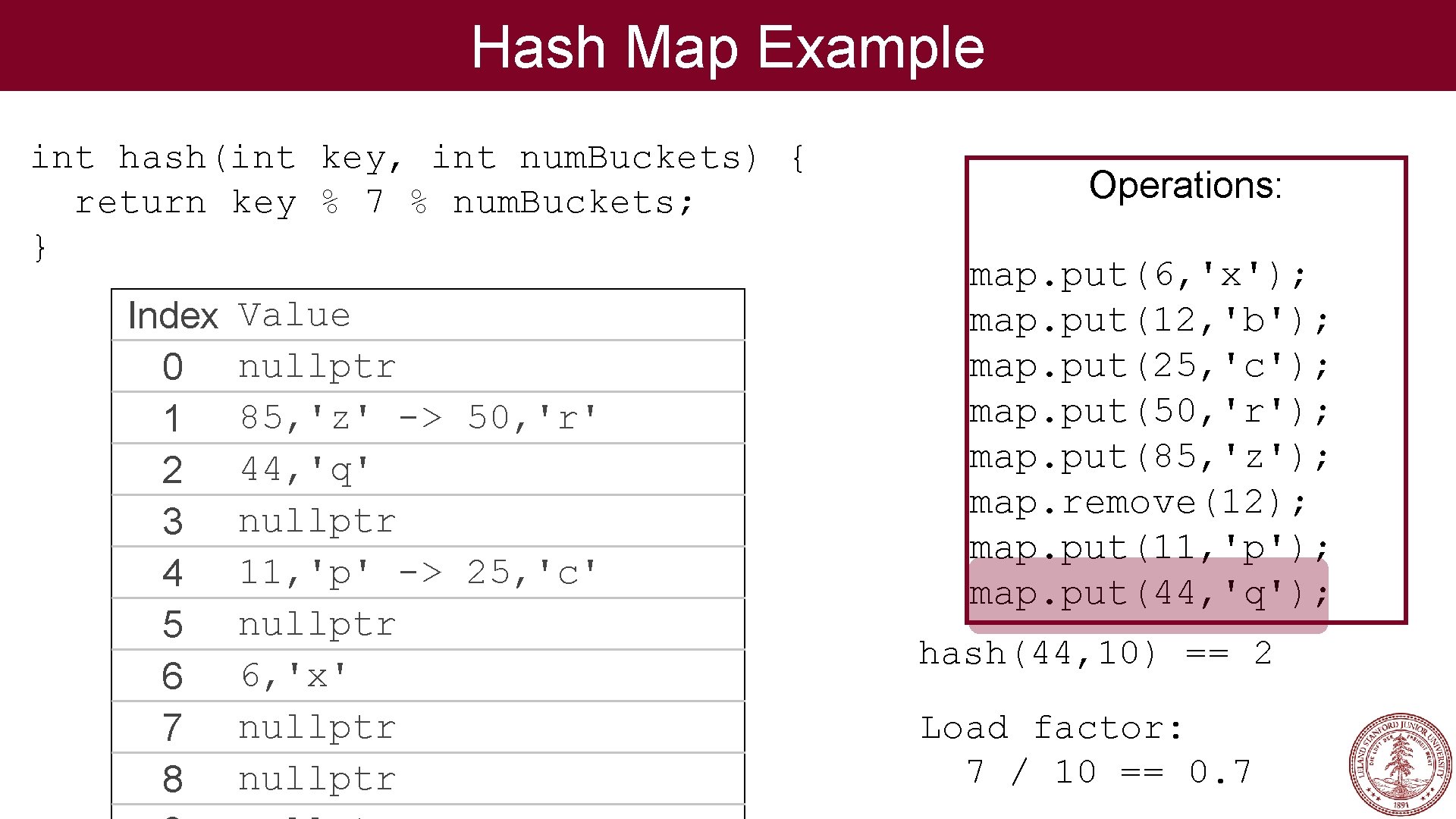
Hash Map Example int hash(int key, int num. Buckets) { return key % 7 % num. Buckets; } Index 0 1 2 3 4 5 6 7 8 Value nullptr 85, 'z' -> 50, 'r' 44, 'q' nullptr 11, 'p' -> 25, 'c' nullptr 6, 'x' nullptr Operations: map. put(6, 'x'); map. put(12, 'b'); map. put(25, 'c'); map. put(50, 'r'); map. put(85, 'z'); map. remove(12); map. put(11, 'p'); map. put(44, 'q'); hash(44, 10) == 2 Load factor: 7 / 10 == 0. 7
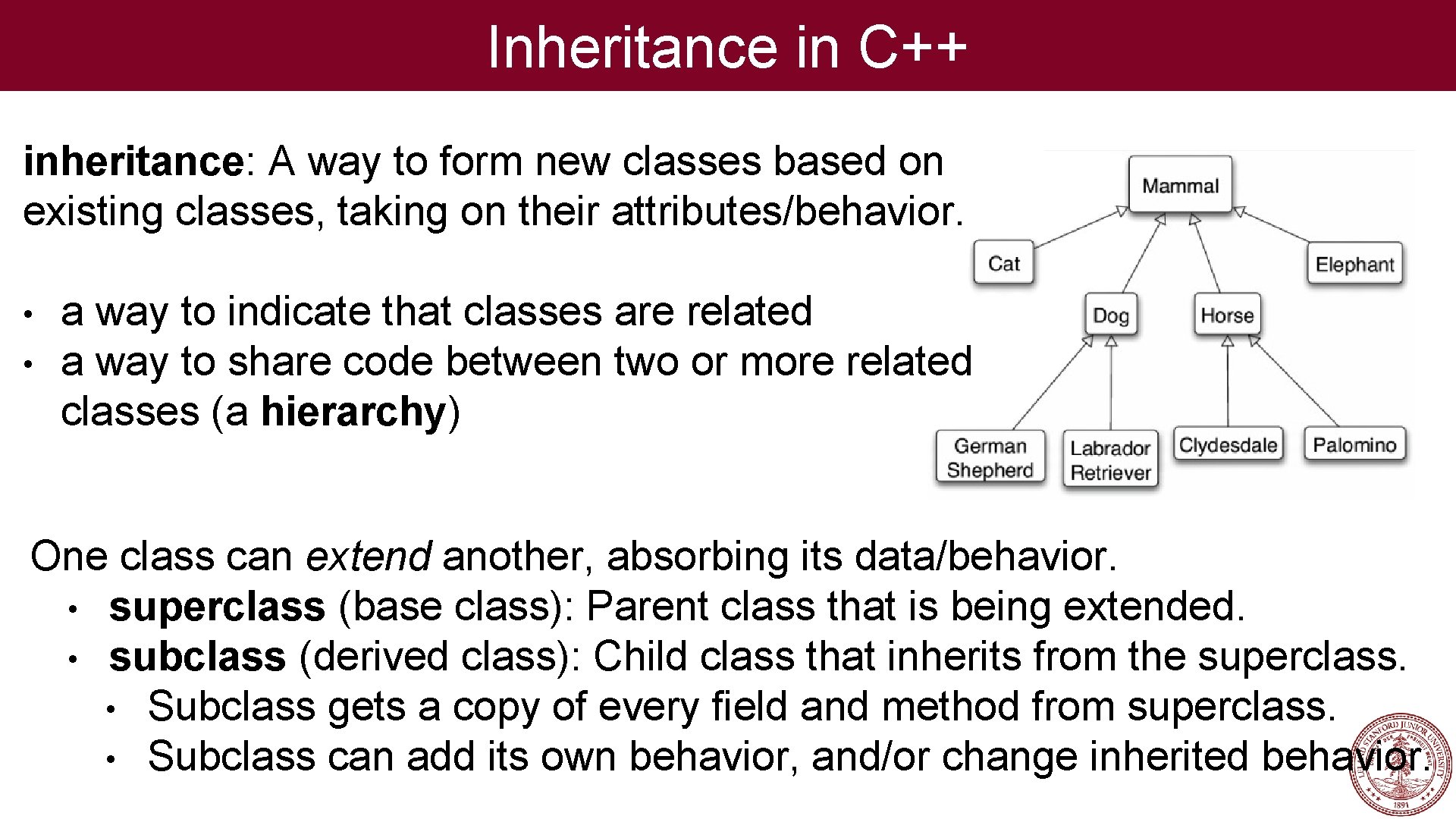
Inheritance in C++ inheritance: A way to form new classes based on existing classes, taking on their attributes/behavior. • • a way to indicate that classes are related a way to share code between two or more related classes (a hierarchy) One class can extend another, absorbing its data/behavior. • superclass (base class): Parent class that is being extended. • subclass (derived class): Child class that inherits from the superclass. • Subclass gets a copy of every field and method from superclass. • Subclass can add its own behavior, and/or change inherited behavior.
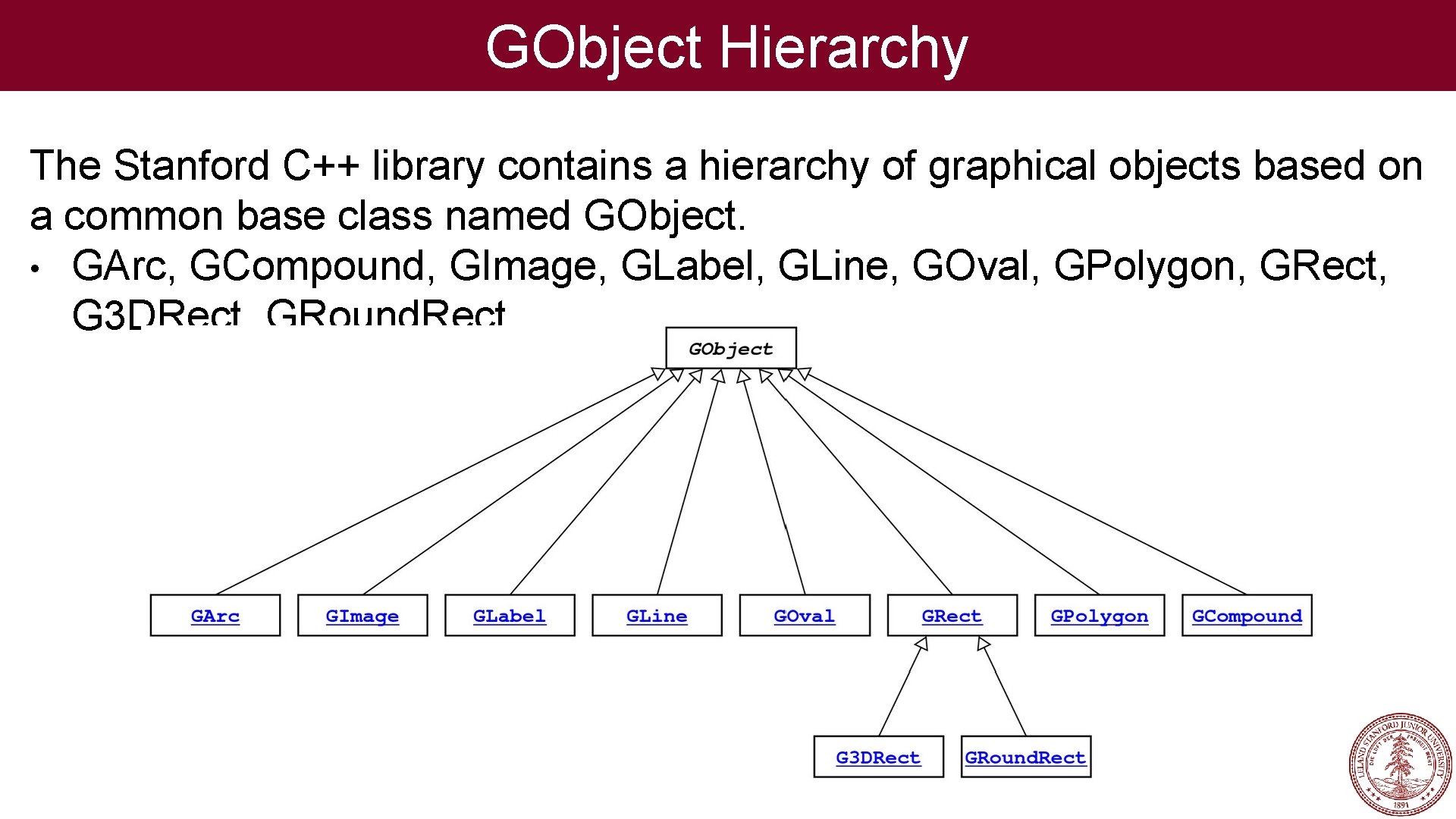
GObject Hierarchy The Stanford C++ library contains a hierarchy of graphical objects based on a common base class named GObject. • GArc, GCompound, GImage, GLabel, GLine, GOval, GPolygon, GRect, G 3 DRect, GRound. Rect, . . .
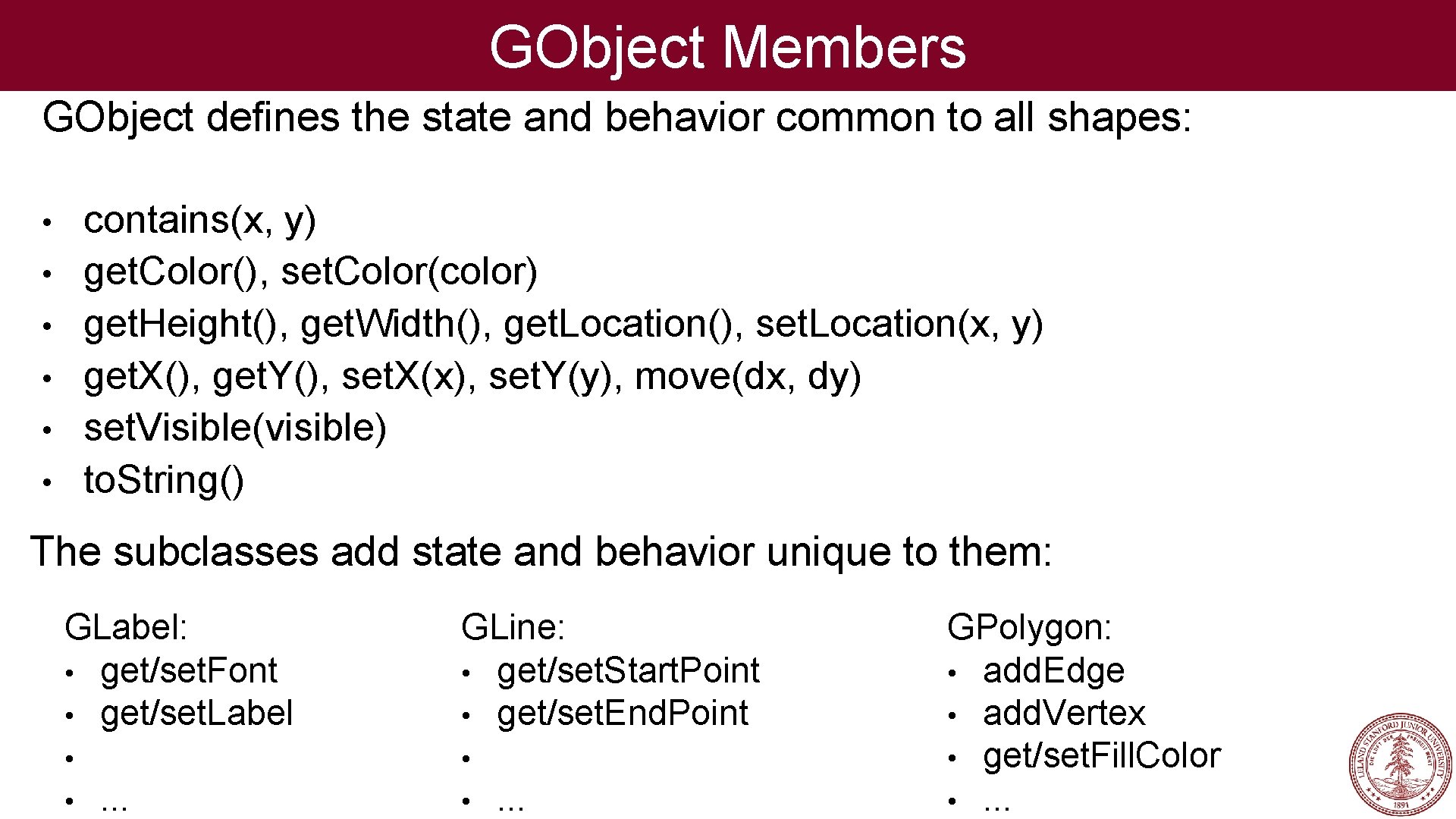
GObject Members GObject defines the state and behavior common to all shapes: contains(x, y) get. Color(), set. Color(color) get. Height(), get. Width(), get. Location(), set. Location(x, y) get. X(), get. Y(), set. X(x), set. Y(y), move(dx, dy) set. Visible(visible) to. String() • • • The subclasses add state and behavior unique to them: GLabel: • get/set. Font • get/set. Label GLine: • get/set. Start. Point • get/set. End. Point • • • . . . GPolygon: • add. Edge • add. Vertex • get/set. Fill. Color • . . .
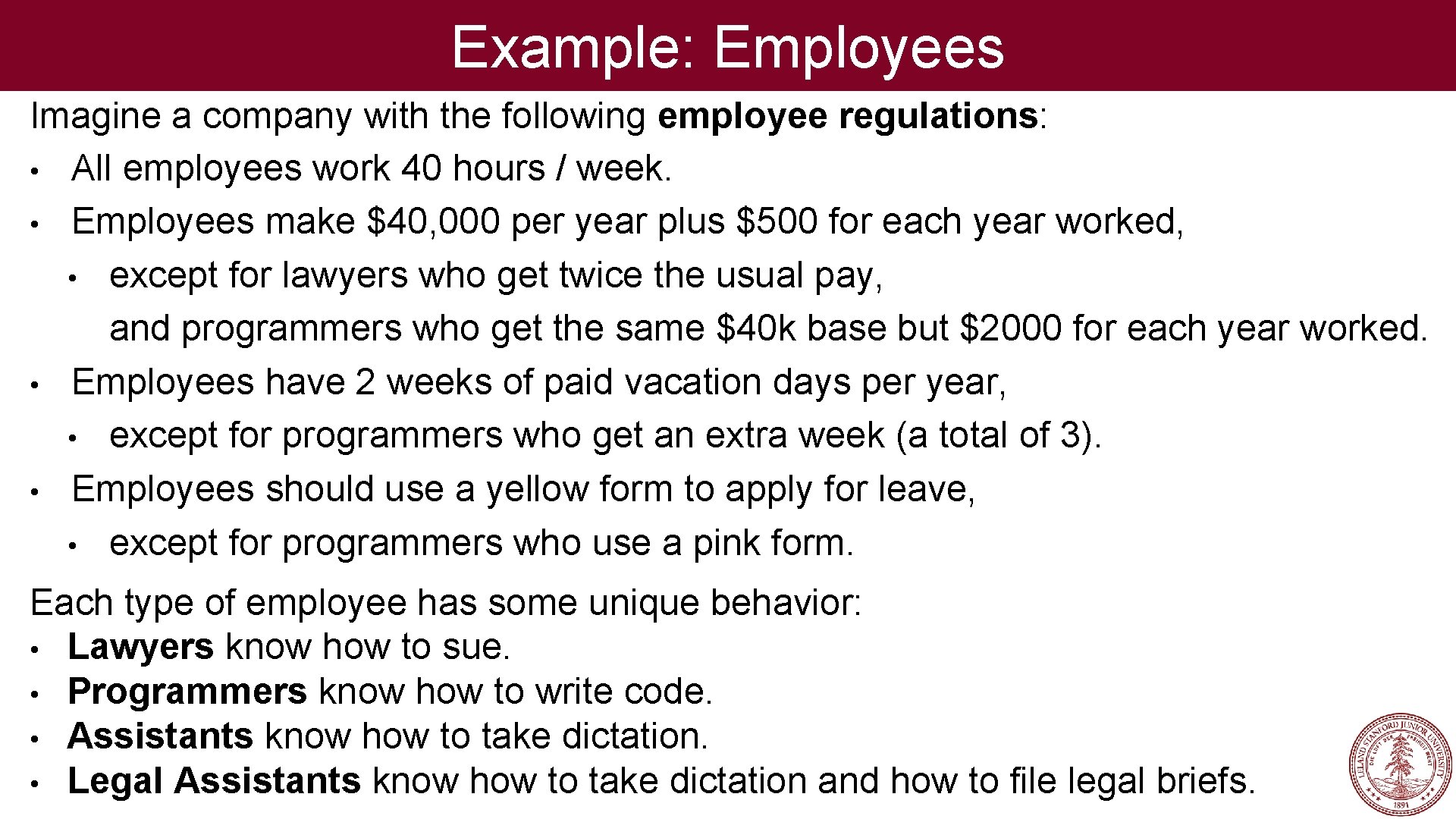
Example: Employees Imagine a company with the following employee regulations: • All employees work 40 hours / week. • Employees make $40, 000 per year plus $500 for each year worked, • except for lawyers who get twice the usual pay, and programmers who get the same $40 k base but $2000 for each year worked. • Employees have 2 weeks of paid vacation days per year, • except for programmers who get an extra week (a total of 3). • Employees should use a yellow form to apply for leave, • except for programmers who use a pink form. Each type of employee has some unique behavior: • Lawyers know how to sue. • Programmers know how to write code. • Assistants know how to take dictation. • Legal Assistants know how to take dictation and how to file legal briefs.
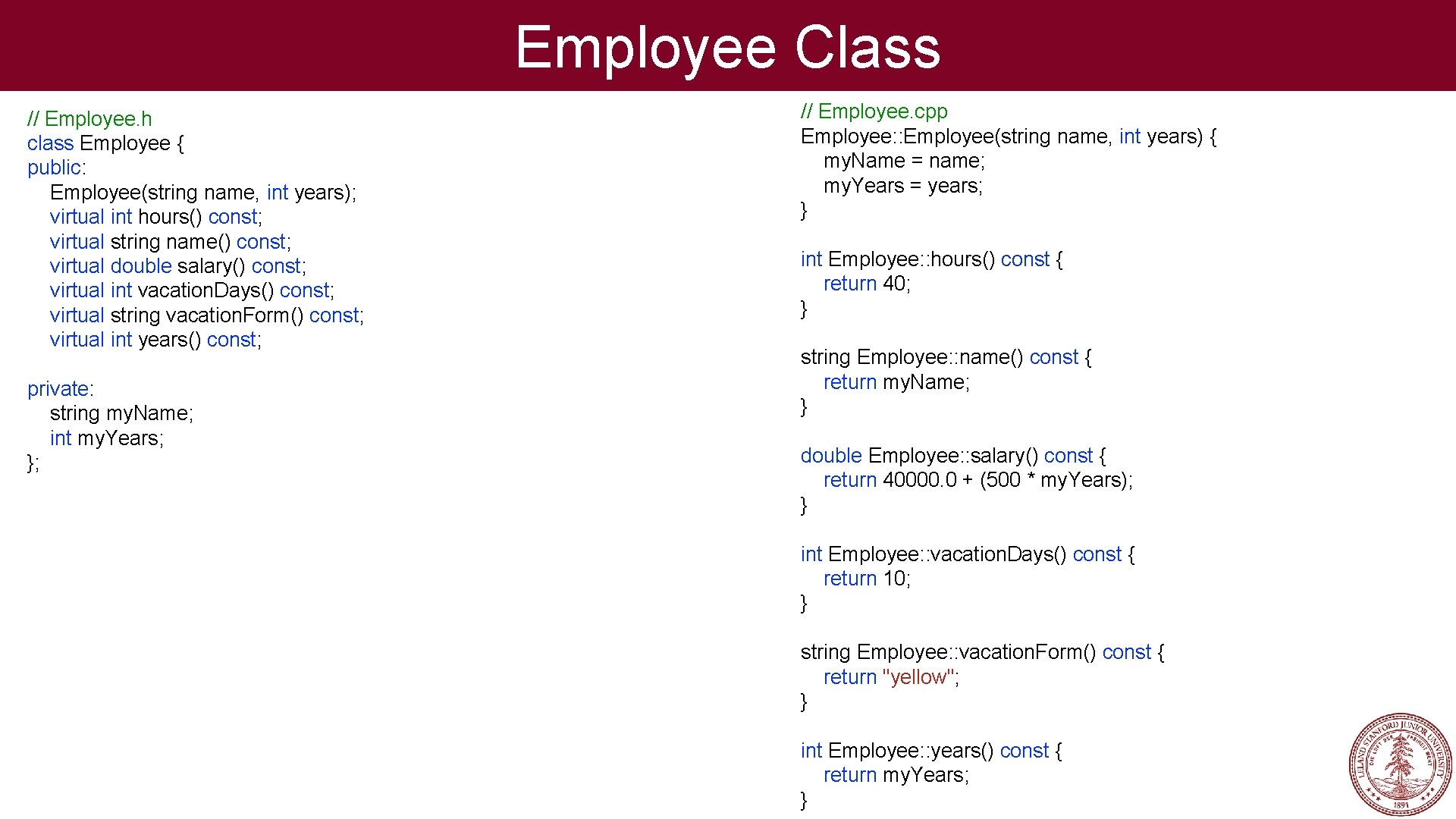
Employee Class // Employee. h class Employee { public: Employee(string name, int years); virtual int hours() const; virtual string name() const; virtual double salary() const; virtual int vacation. Days() const; virtual string vacation. Form() const; virtual int years() const; private: string my. Name; int my. Years; }; // Employee. cpp Employee: : Employee(string name, int years) { my. Name = name; my. Years = years; } int Employee: : hours() const { return 40; } string Employee: : name() const { return my. Name; } double Employee: : salary() const { return 40000. 0 + (500 * my. Years); } int Employee: : vacation. Days() const { return 10; } string Employee: : vacation. Form() const { return "yellow"; } int Employee: : years() const { return my. Years; }
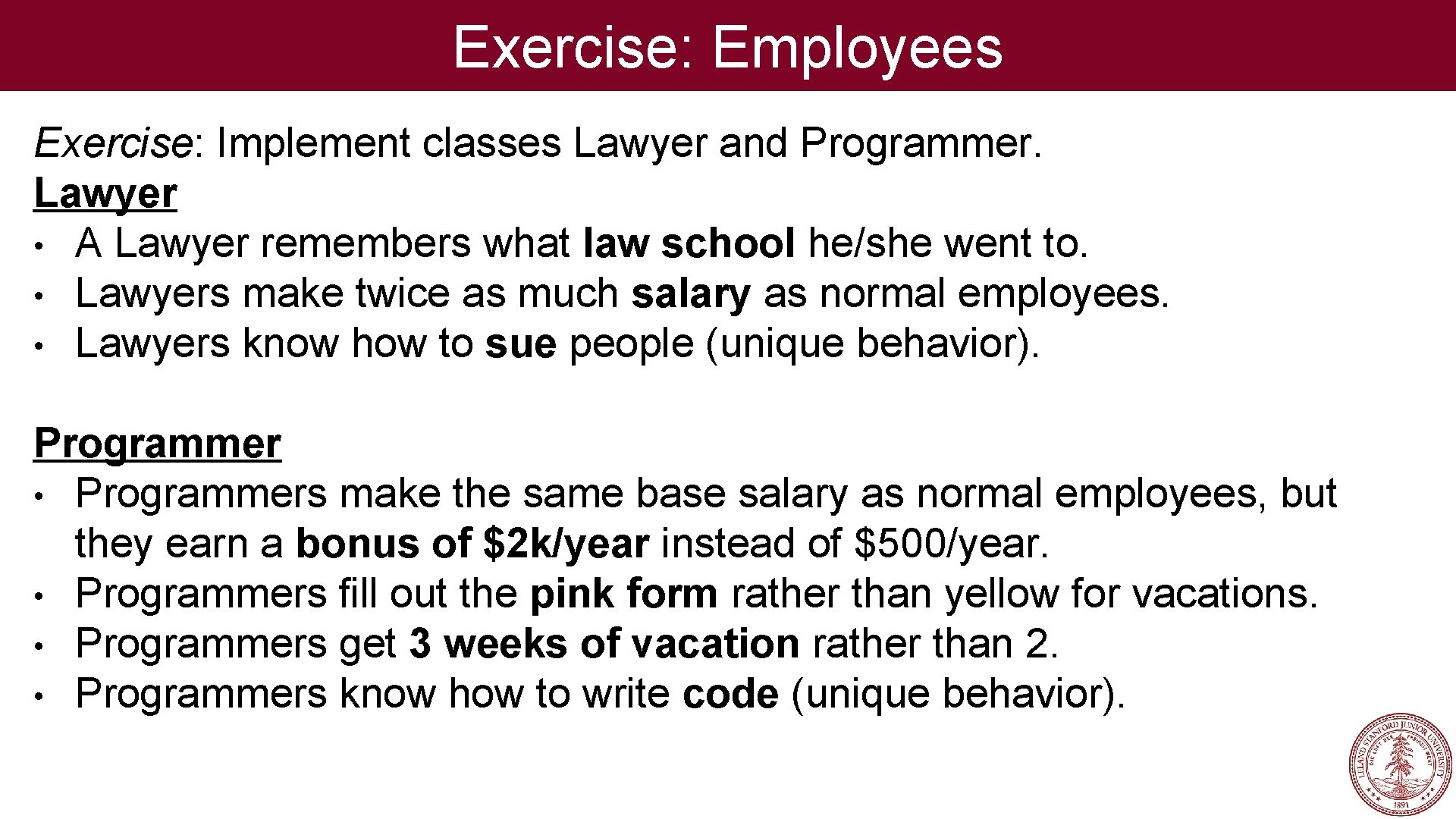
Exercise: Employees Exercise: Implement classes Lawyer and Programmer. Lawyer • A Lawyer remembers what law school he/she went to. • Lawyers make twice as much salary as normal employees. • Lawyers know how to sue people (unique behavior). Programmer • Programmers make the same base salary as normal employees, but they earn a bonus of $2 k/year instead of $500/year. • Programmers fill out the pink form rather than yellow for vacations. • Programmers get 3 weeks of vacation rather than 2. • Programmers know how to write code (unique behavior).
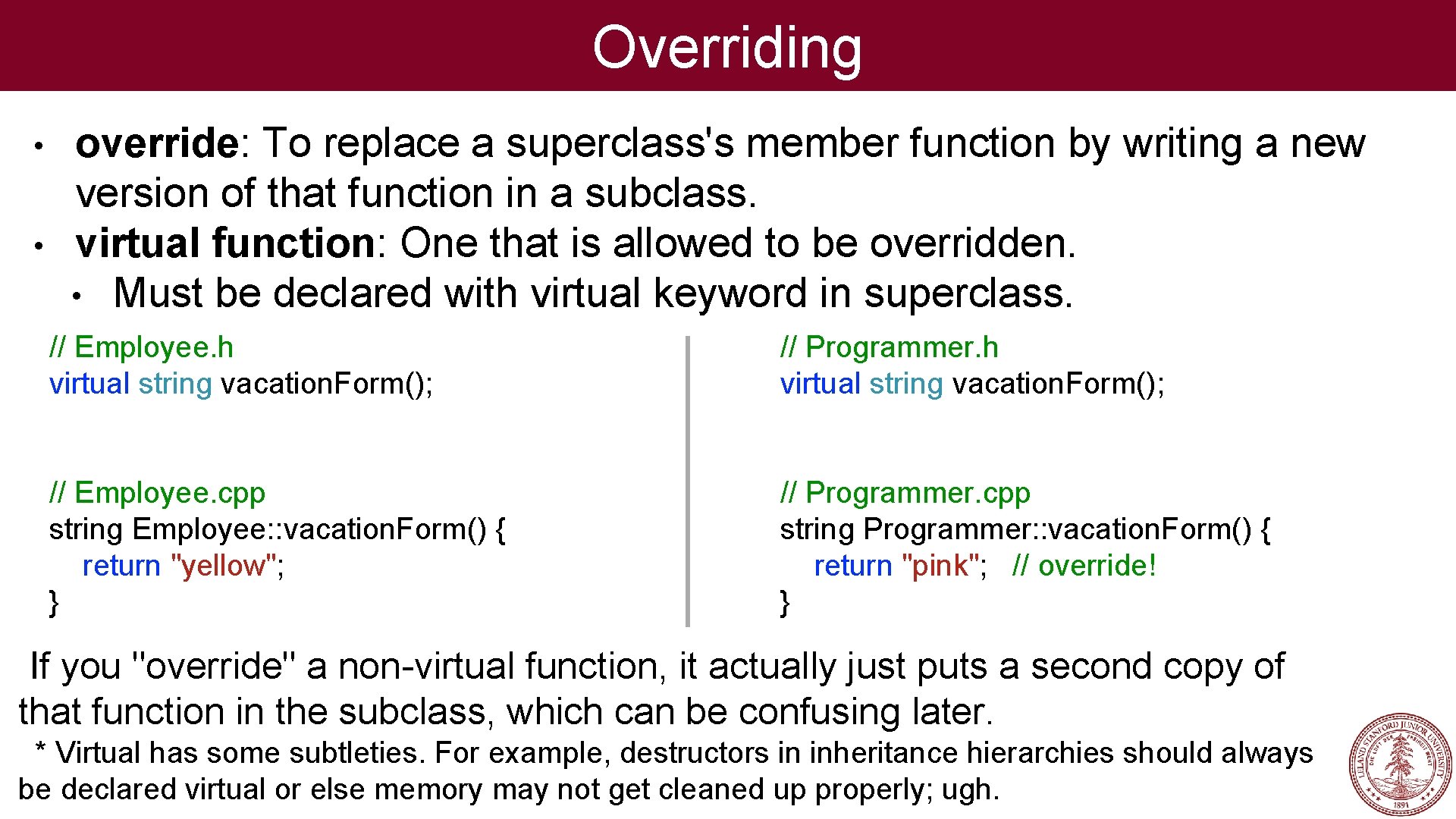
Overriding • • override: To replace a superclass's member function by writing a new version of that function in a subclass. virtual function: One that is allowed to be overridden. • Must be declared with virtual keyword in superclass. // Employee. h virtual string vacation. Form(); // Programmer. h virtual string vacation. Form(); // Employee. cpp string Employee: : vacation. Form() { return "yellow"; } // Programmer. cpp string Programmer: : vacation. Form() { return "pink"; // override! } If you "override" a non-virtual function, it actually just puts a second copy of that function in the subclass, which can be confusing later. * Virtual has some subtleties. For example, destructors in inheritance hierarchies should always be declared virtual or else memory may not get cleaned up properly; ugh.
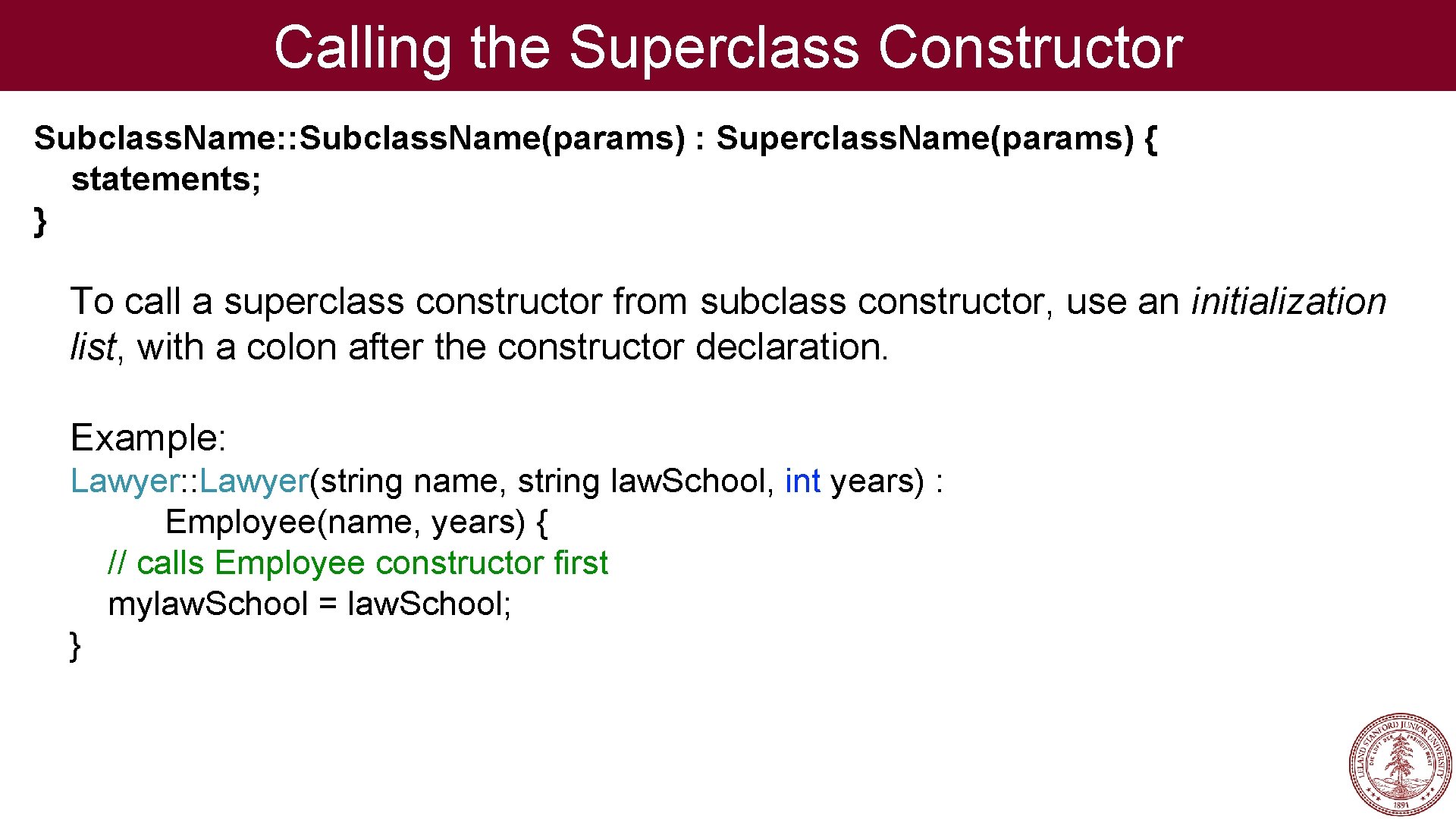
Calling the Superclass Constructor Subclass. Name: : Subclass. Name(params) : Superclass. Name(params) { statements; } To call a superclass constructor from subclass constructor, use an initialization list, with a colon after the constructor declaration. Example: Lawyer: : Lawyer(string name, string law. School, int years) : Employee(name, years) { // calls Employee constructor first mylaw. School = law. School; }
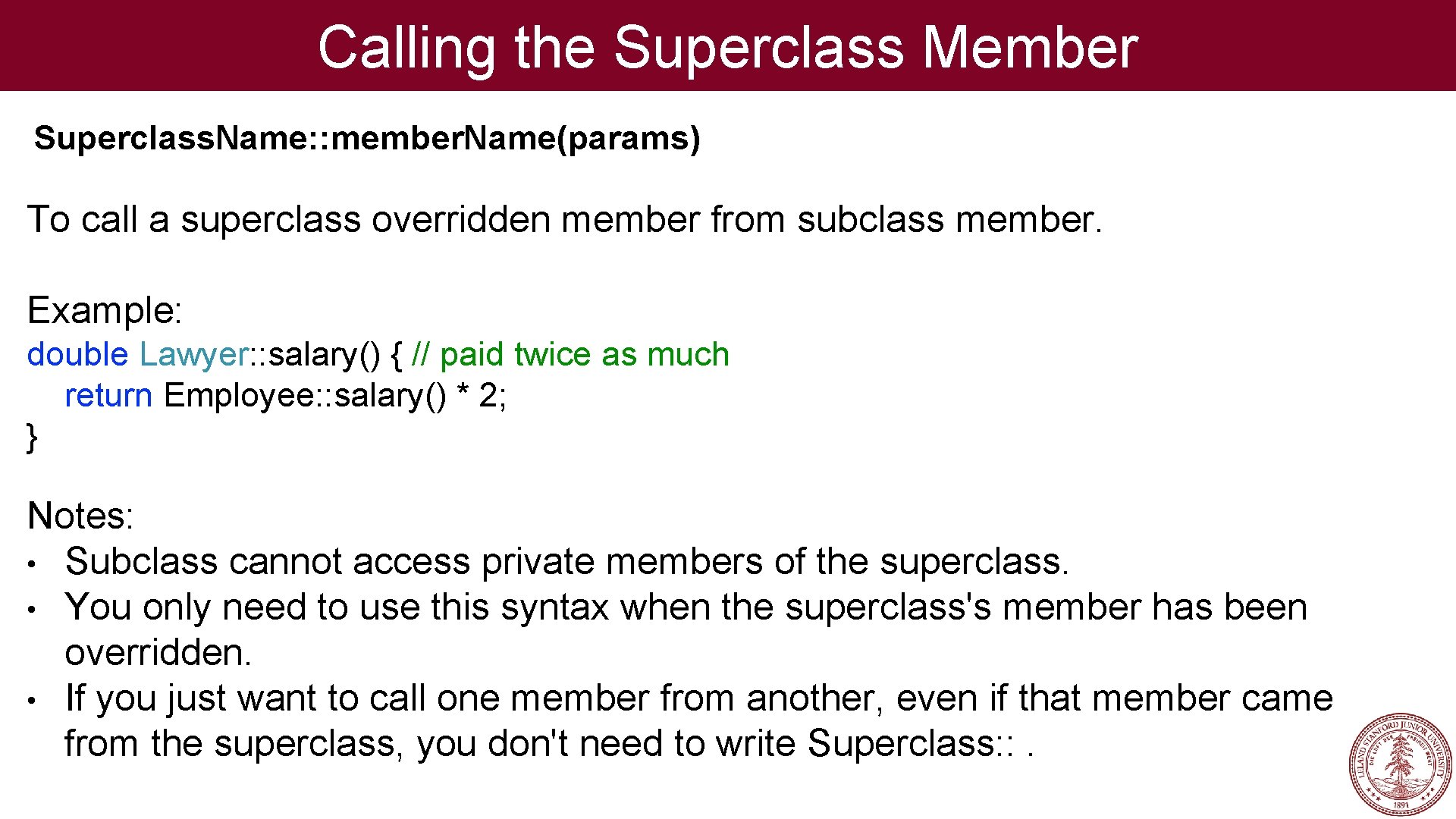
Calling the Superclass Member Superclass. Name: : member. Name(params) To call a superclass overridden member from subclass member. Example: double Lawyer: : salary() { // paid twice as much return Employee: : salary() * 2; } Notes: • Subclass cannot access private members of the superclass. • You only need to use this syntax when the superclass's member has been overridden. • If you just want to call one member from another, even if that member came from the superclass, you don't need to write Superclass: : .
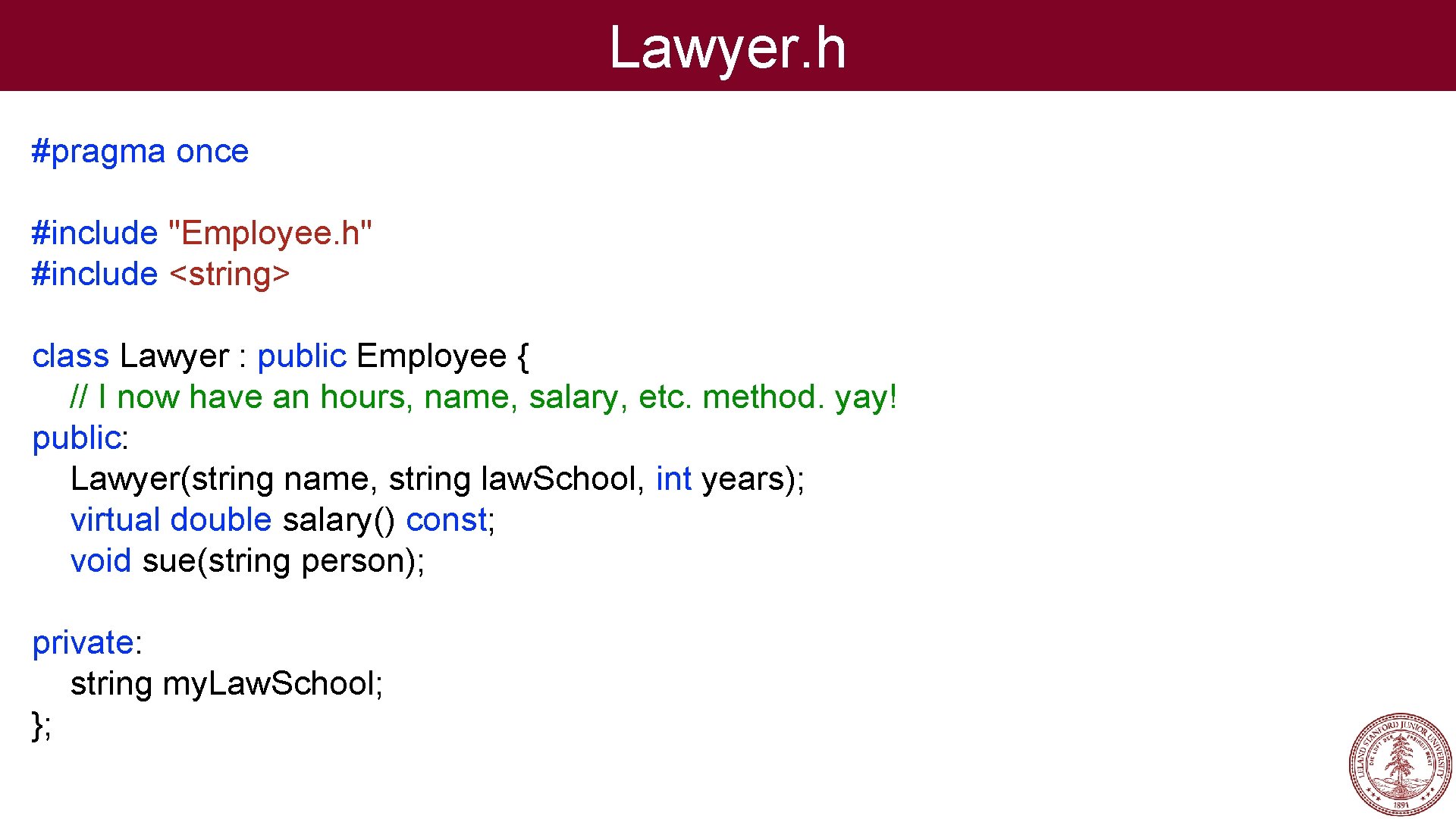
Lawyer. h #pragma once #include "Employee. h" #include <string> class Lawyer : public Employee { // I now have an hours, name, salary, etc. method. yay! public: Lawyer(string name, string law. School, int years); virtual double salary() const; void sue(string person); private: string my. Law. School; };
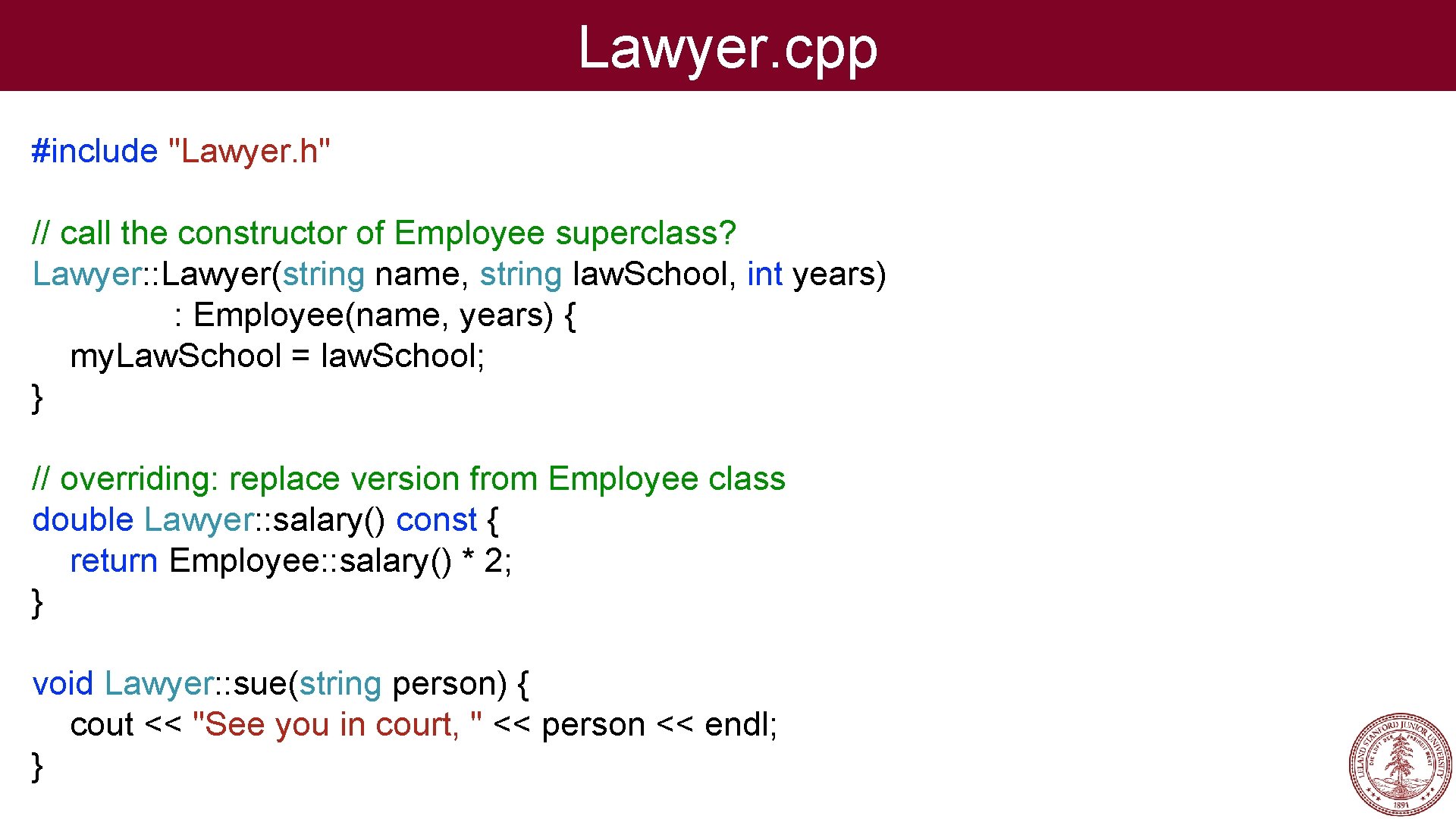
Lawyer. cpp #include "Lawyer. h" // call the constructor of Employee superclass? Lawyer: : Lawyer(string name, string law. School, int years) : Employee(name, years) { my. Law. School = law. School; } // overriding: replace version from Employee class double Lawyer: : salary() const { return Employee: : salary() * 2; } void Lawyer: : sue(string person) { cout << "See you in court, " << person << endl; }
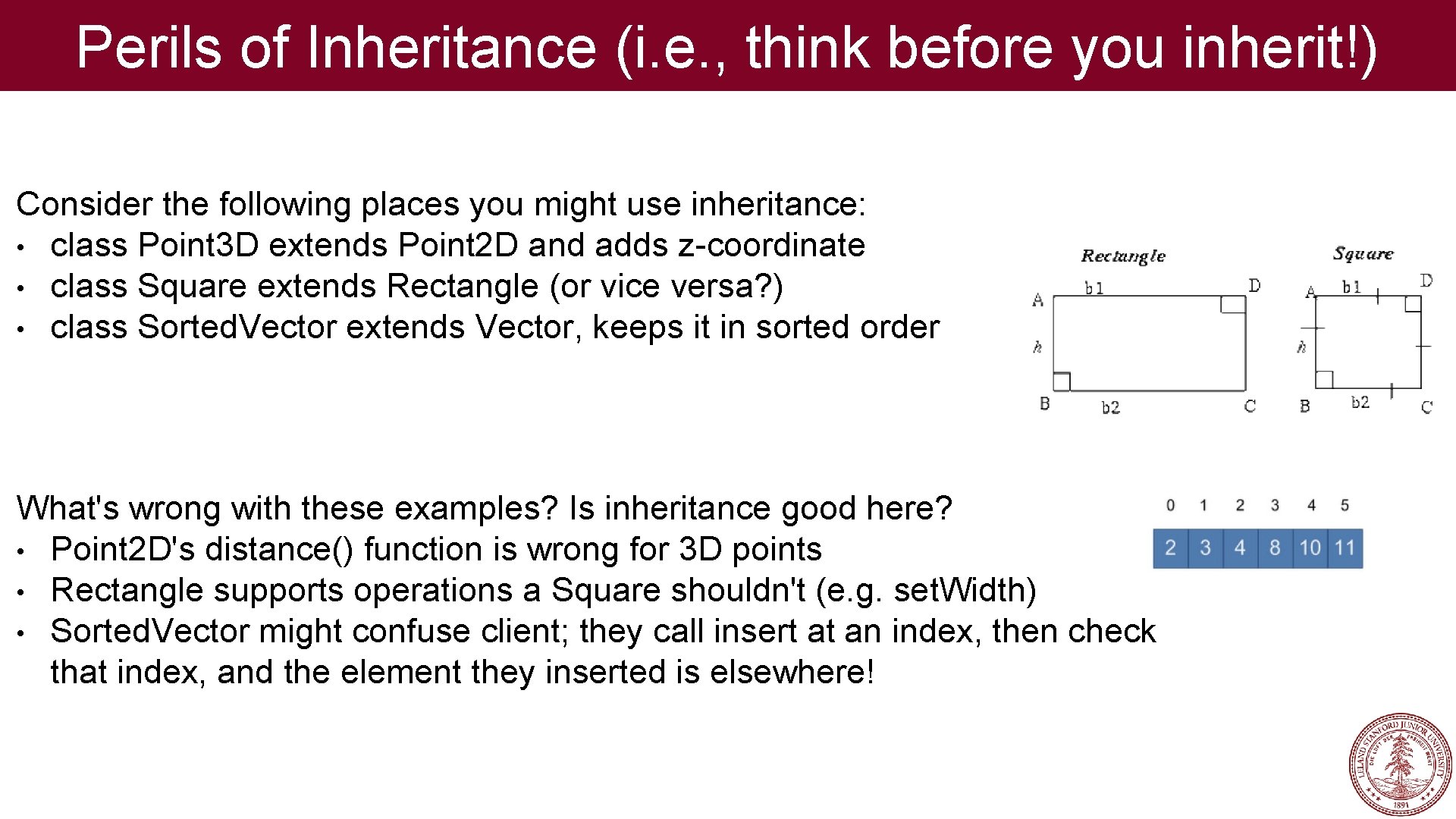
Perils of Inheritance (i. e. , think before you inherit!) Consider the following places you might use inheritance: • class Point 3 D extends Point 2 D and adds z-coordinate • class Square extends Rectangle (or vice versa? ) • class Sorted. Vector extends Vector, keeps it in sorted order What's wrong with these examples? Is inheritance good here? • Point 2 D's distance() function is wrong for 3 D points • Rectangle supports operations a Square shouldn't (e. g. set. Width) • Sorted. Vector might confuse client; they call insert at an index, then check that index, and the element they inserted is elsewhere!
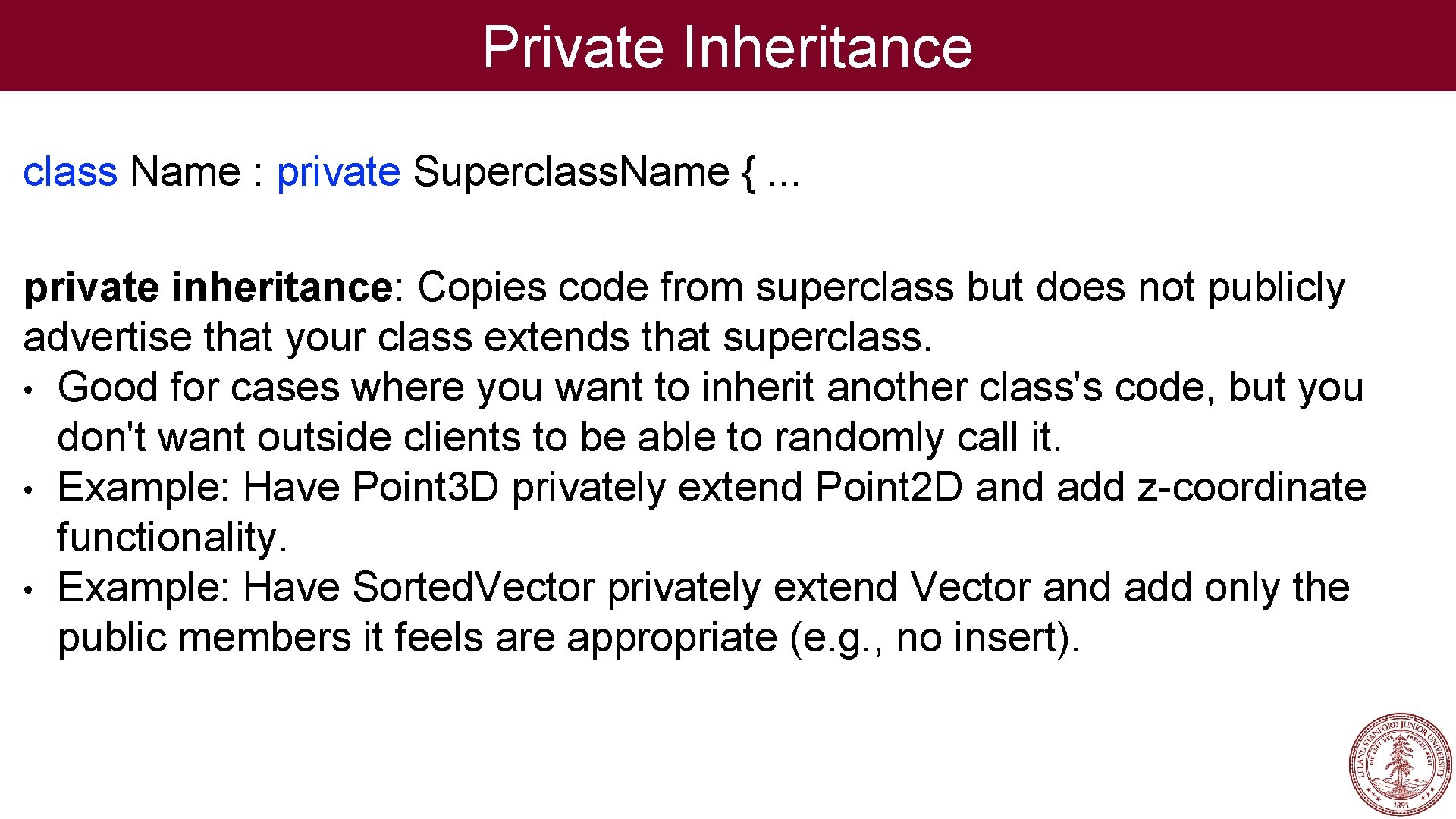
Private Inheritance class Name : private Superclass. Name {. . . private inheritance: Copies code from superclass but does not publicly advertise that your class extends that superclass. • Good for cases where you want to inherit another class's code, but you don't want outside clients to be able to randomly call it. • Example: Have Point 3 D privately extend Point 2 D and add z-coordinate functionality. • Example: Have Sorted. Vector privately extend Vector and add only the public members it feels are appropriate (e. g. , no insert).
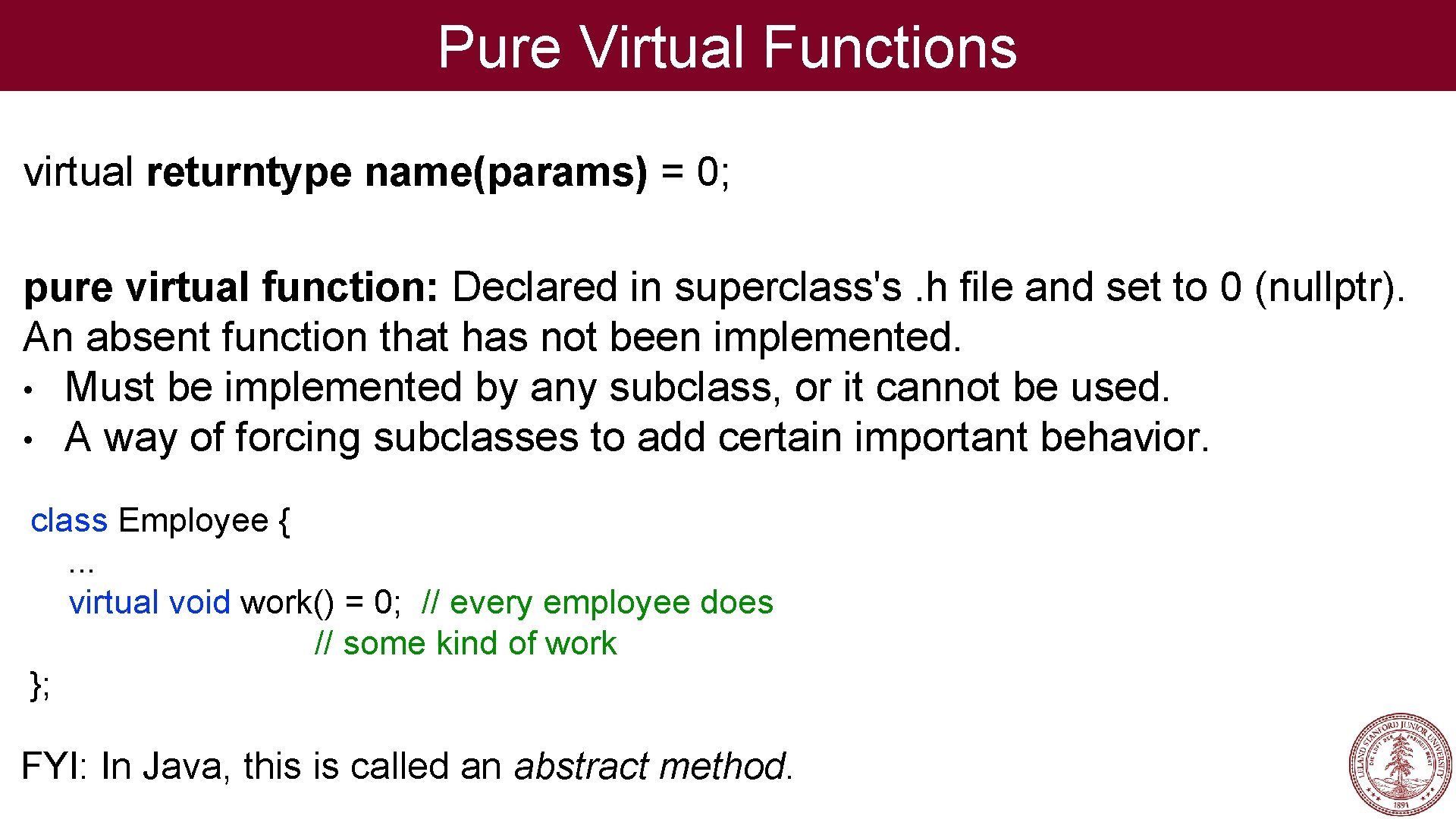
Pure Virtual Functions virtual returntype name(params) = 0; pure virtual function: Declared in superclass's. h file and set to 0 (nullptr). An absent function that has not been implemented. • Must be implemented by any subclass, or it cannot be used. • A way of forcing subclasses to add certain important behavior. class Employee {. . . virtual void work() = 0; // every employee does // some kind of work }; FYI: In Java, this is called an abstract method.
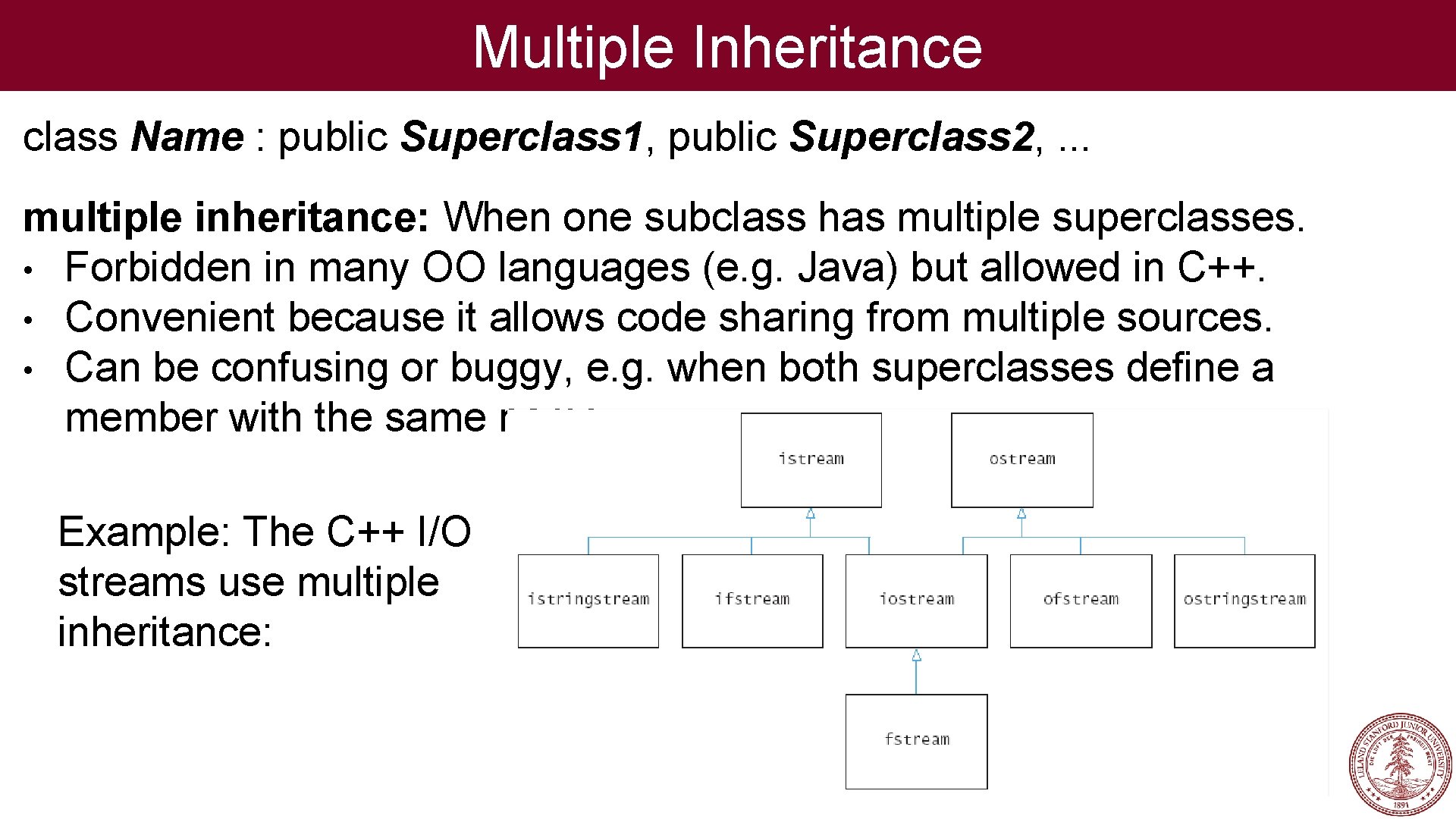
Multiple Inheritance class Name : public Superclass 1, public Superclass 2, . . . multiple inheritance: When one subclass has multiple superclasses. • Forbidden in many OO languages (e. g. Java) but allowed in C++. • Convenient because it allows code sharing from multiple sources. • Can be confusing or buggy, e. g. when both superclasses define a member with the same name. Example: The C++ I/O streams use multiple inheritance:
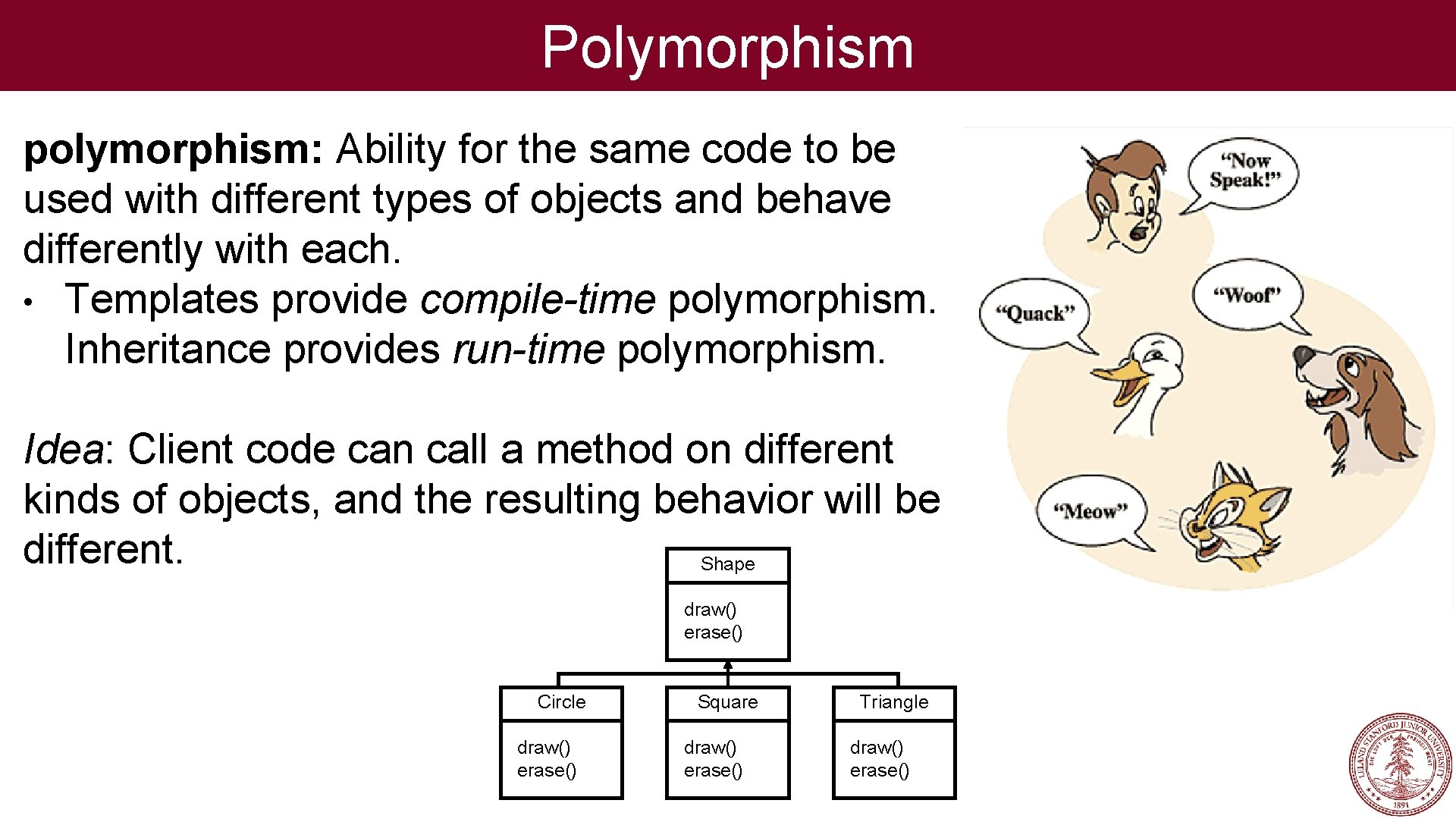
Polymorphism polymorphism: Ability for the same code to be used with different types of objects and behave differently with each. • Templates provide compile-time polymorphism. Inheritance provides run-time polymorphism. Idea: Client code can call a method on different kinds of objects, and the resulting behavior will be different. Shape draw() erase() Circle draw() erase() Square draw() erase() Triangle draw() erase()
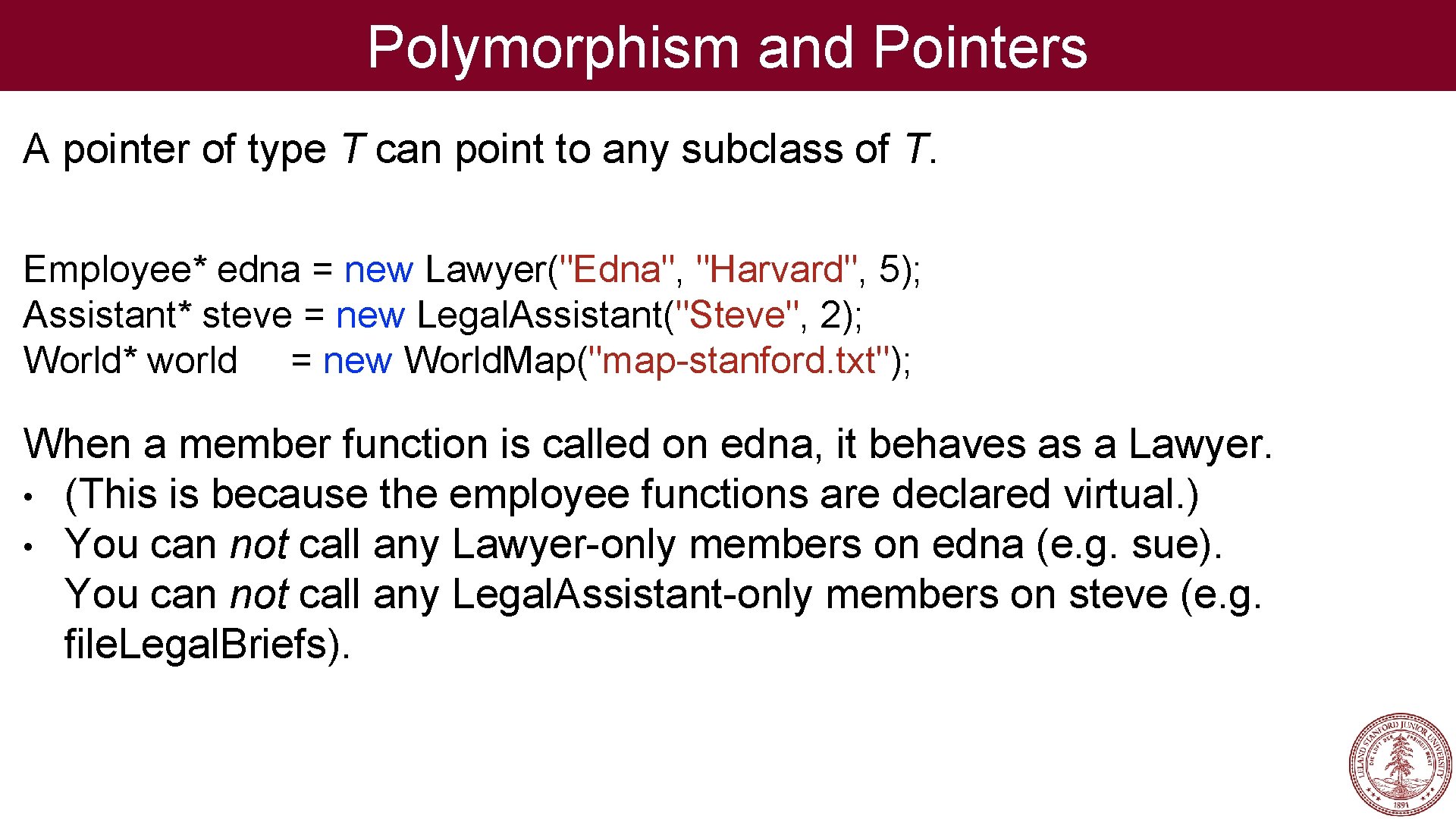
Polymorphism and Pointers A pointer of type T can point to any subclass of T. Employee* edna = new Lawyer("Edna", "Harvard", 5); Assistant* steve = new Legal. Assistant("Steve", 2); World* world = new World. Map("map-stanford. txt"); When a member function is called on edna, it behaves as a Lawyer. • (This is because the employee functions are declared virtual. ) • You can not call any Lawyer-only members on edna (e. g. sue). You can not call any Legal. Assistant-only members on steve (e. g. file. Legal. Briefs).
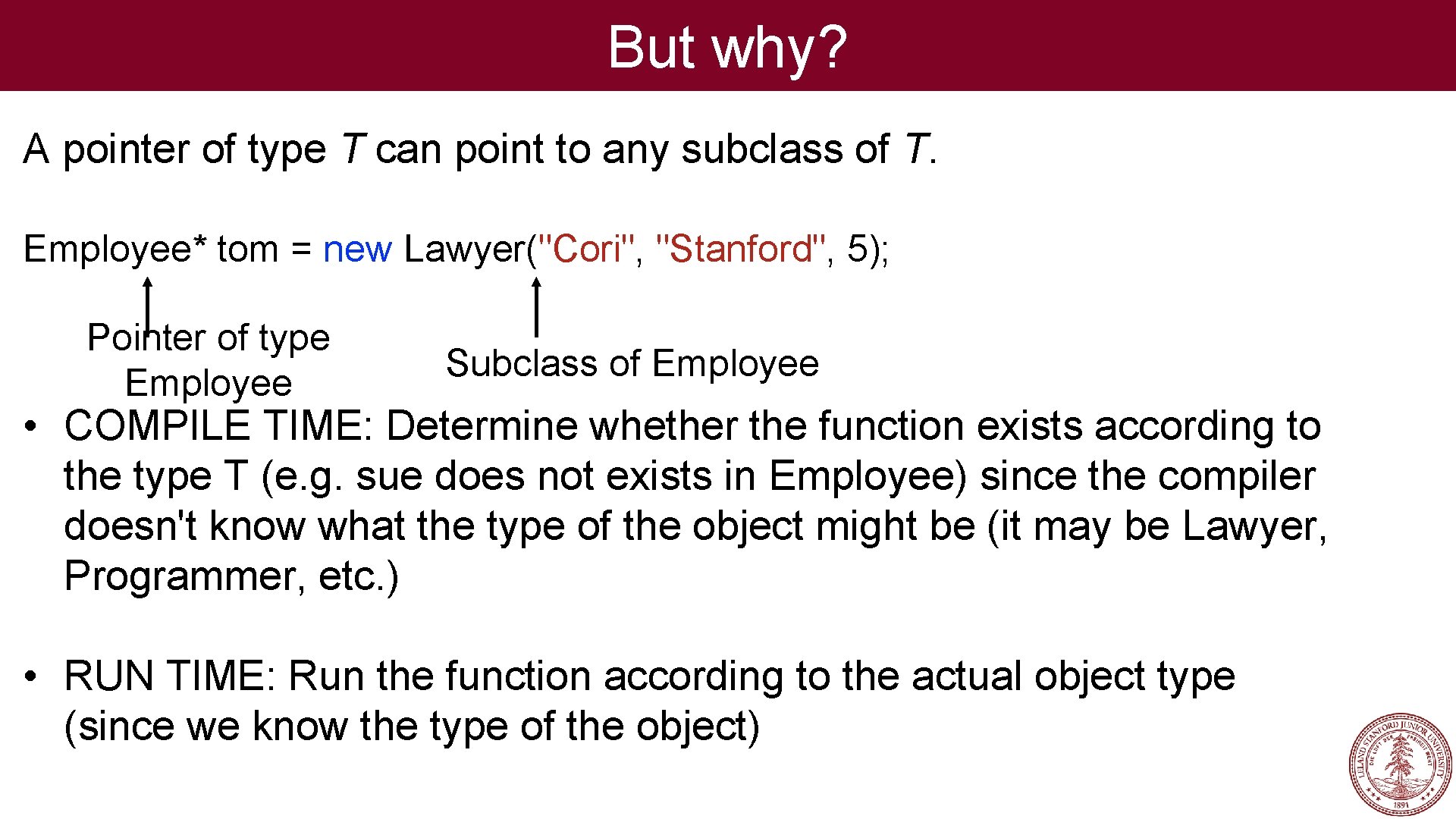
But why? A pointer of type T can point to any subclass of T. Employee* tom = new Lawyer("Cori", "Stanford", 5); Pointer of type Employee Subclass of Employee • COMPILE TIME: Determine whether the function exists according to the type T (e. g. sue does not exists in Employee) since the compiler doesn't know what the type of the object might be (it may be Lawyer, Programmer, etc. ) • RUN TIME: Run the function according to the actual object type (since we know the type of the object)
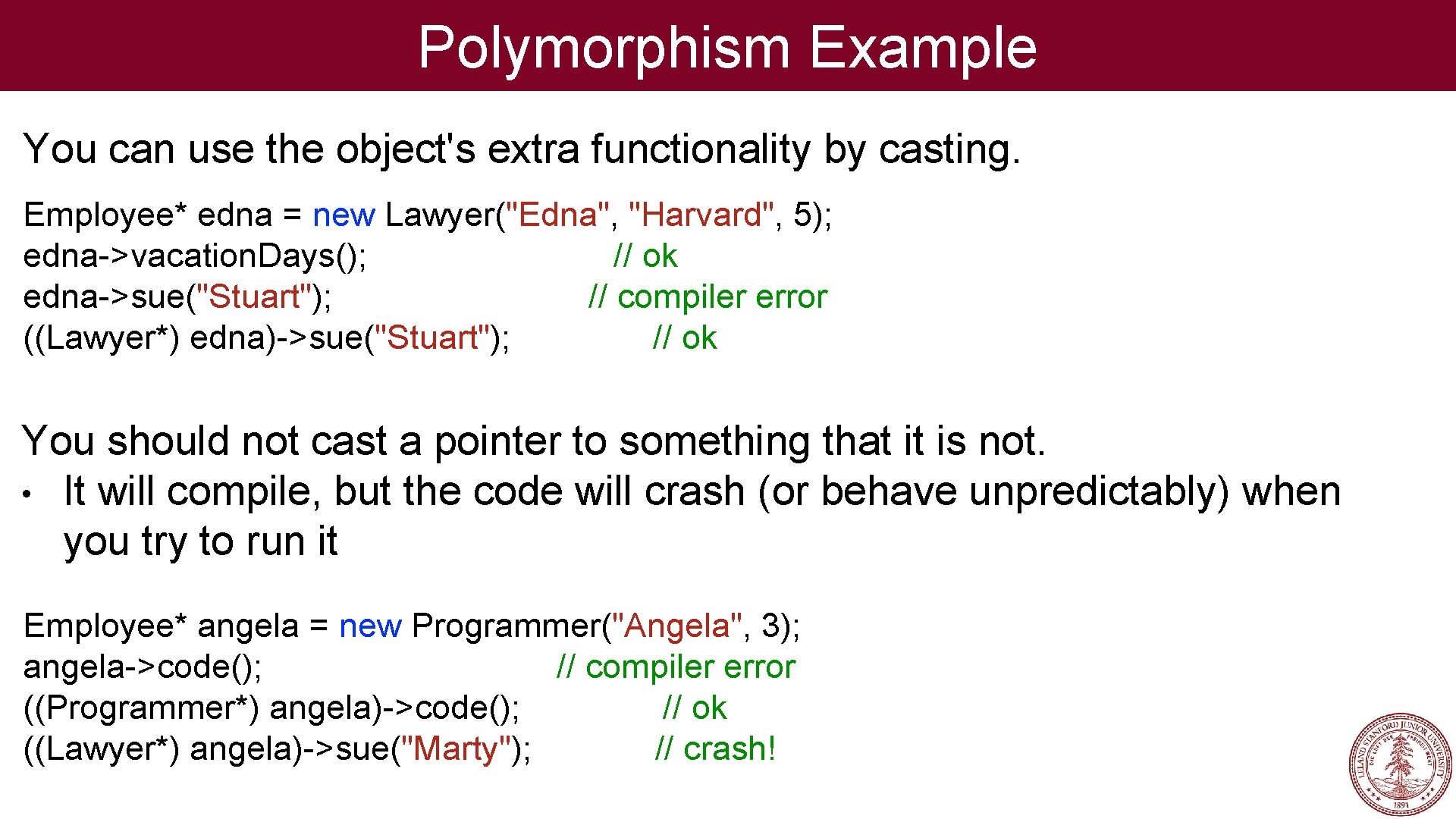
Polymorphism Example You can use the object's extra functionality by casting. Employee* edna = new Lawyer("Edna", "Harvard", 5); edna->vacation. Days(); // ok edna->sue("Stuart"); // compiler error ((Lawyer*) edna)->sue("Stuart"); // ok You should not cast a pointer to something that it is not. • It will compile, but the code will crash (or behave unpredictably) when you try to run it Employee* angela = new Programmer("Angela", 3); angela->code(); // compiler error ((Programmer*) angela)->code(); // ok ((Lawyer*) angela)->sue("Marty"); // crash!
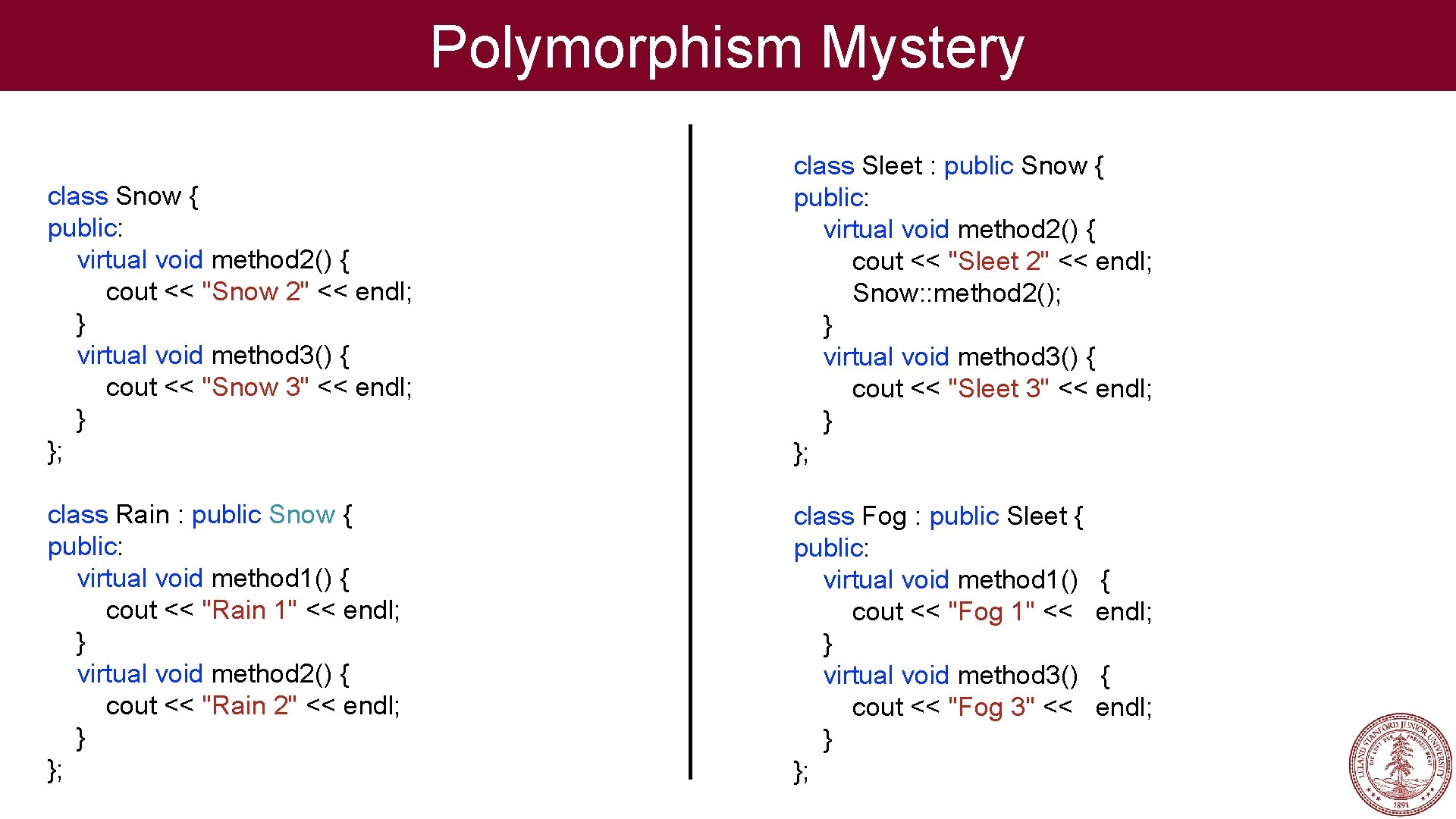
Polymorphism Mystery class Snow { public: virtual void method 2() { cout << "Snow 2" << endl; } virtual void method 3() { cout << "Snow 3" << endl; } }; class Sleet : public Snow { public: virtual void method 2() { cout << "Sleet 2" << endl; Snow: : method 2(); } virtual void method 3() { cout << "Sleet 3" << endl; } }; class Rain : public Snow { public: virtual void method 1() { cout << "Rain 1" << endl; } virtual void method 2() { cout << "Rain 2" << endl; } }; class Fog : public Sleet { public: virtual void method 1() cout << "Fog 1" << } virtual void method 3() cout << "Fog 3" << } }; { endl;
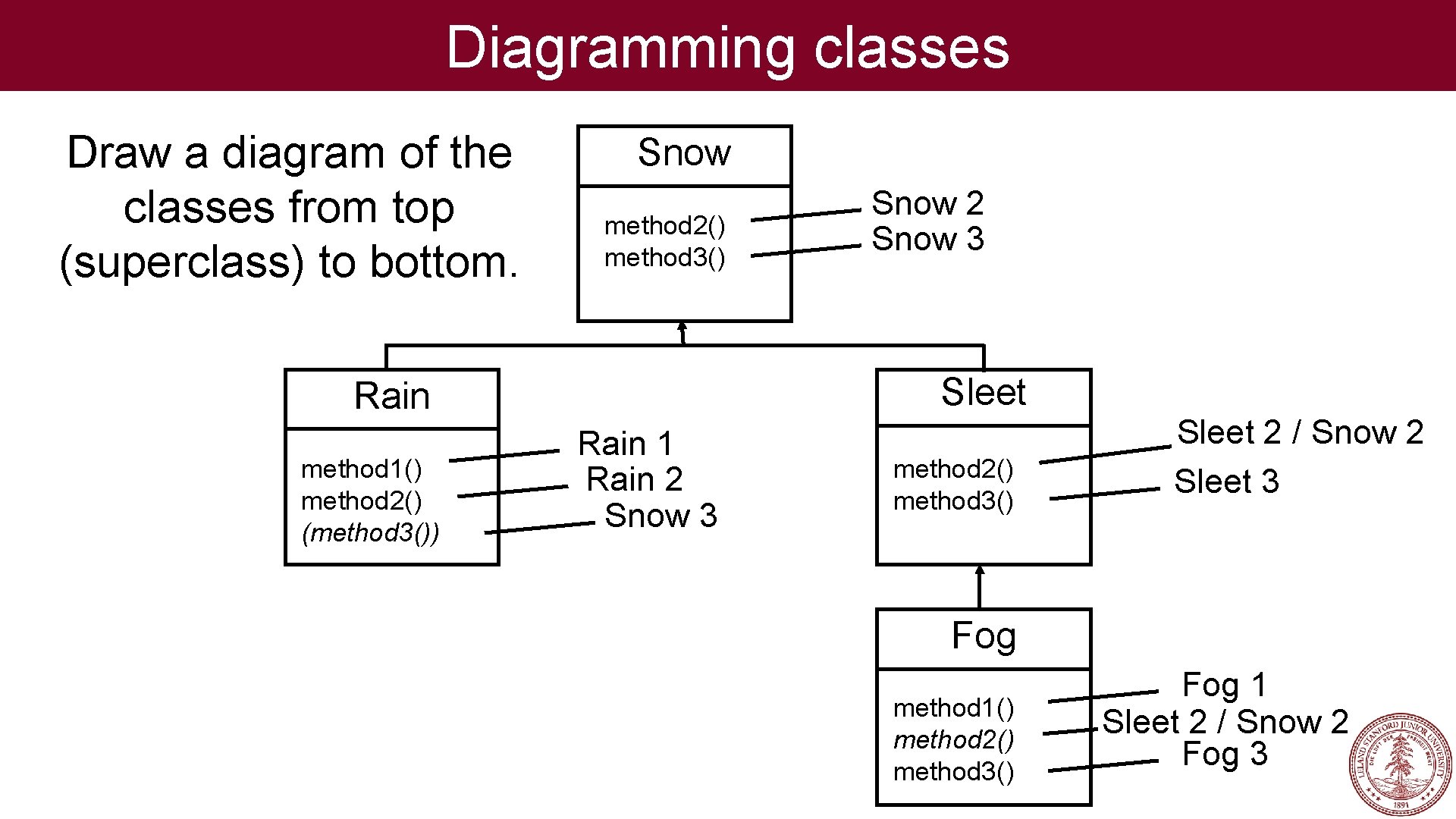
Diagramming classes Draw a diagram of the classes from top (superclass) to bottom. Snow method 2() method 3() Sleet Rain method 1() method 2() (method 3()) Snow 2 Snow 3 Rain 1 Rain 2 Snow 3 method 2() method 3() Sleet 2 / Snow 2 Sleet 3 Fog method 1() method 2() method 3() Fog 1 Sleet 2 / Snow 2 Fog 3
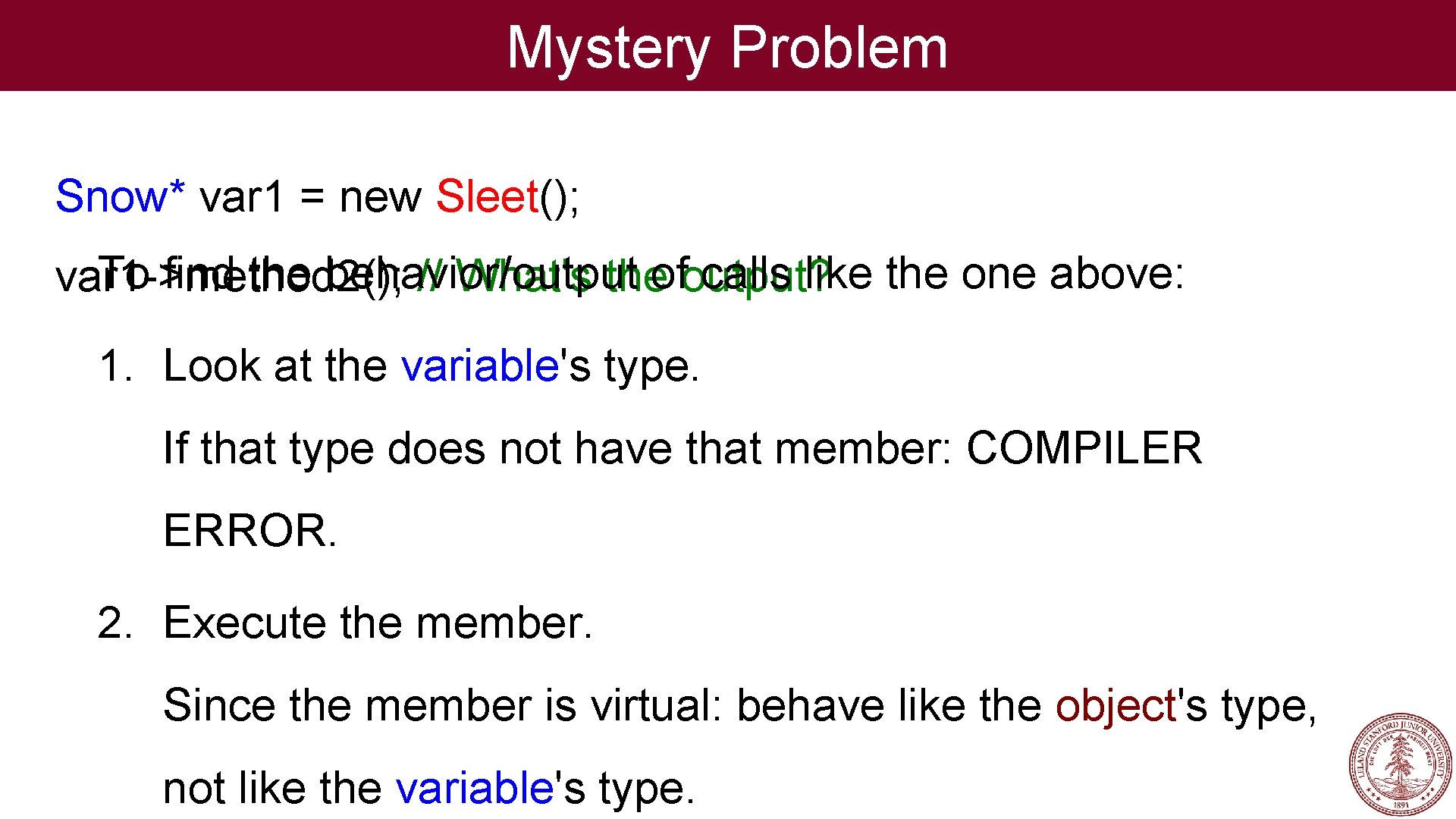
Mystery Problem Snow* var 1 = new Sleet(); To find the behavior/output calls like the one above: var 1 ->method 2(); // What's theofoutput? 1. Look at the variable's type. If that type does not have that member: COMPILER ERROR. 2. Execute the member. Since the member is virtual: behave like the object's type, not like the variable's type.
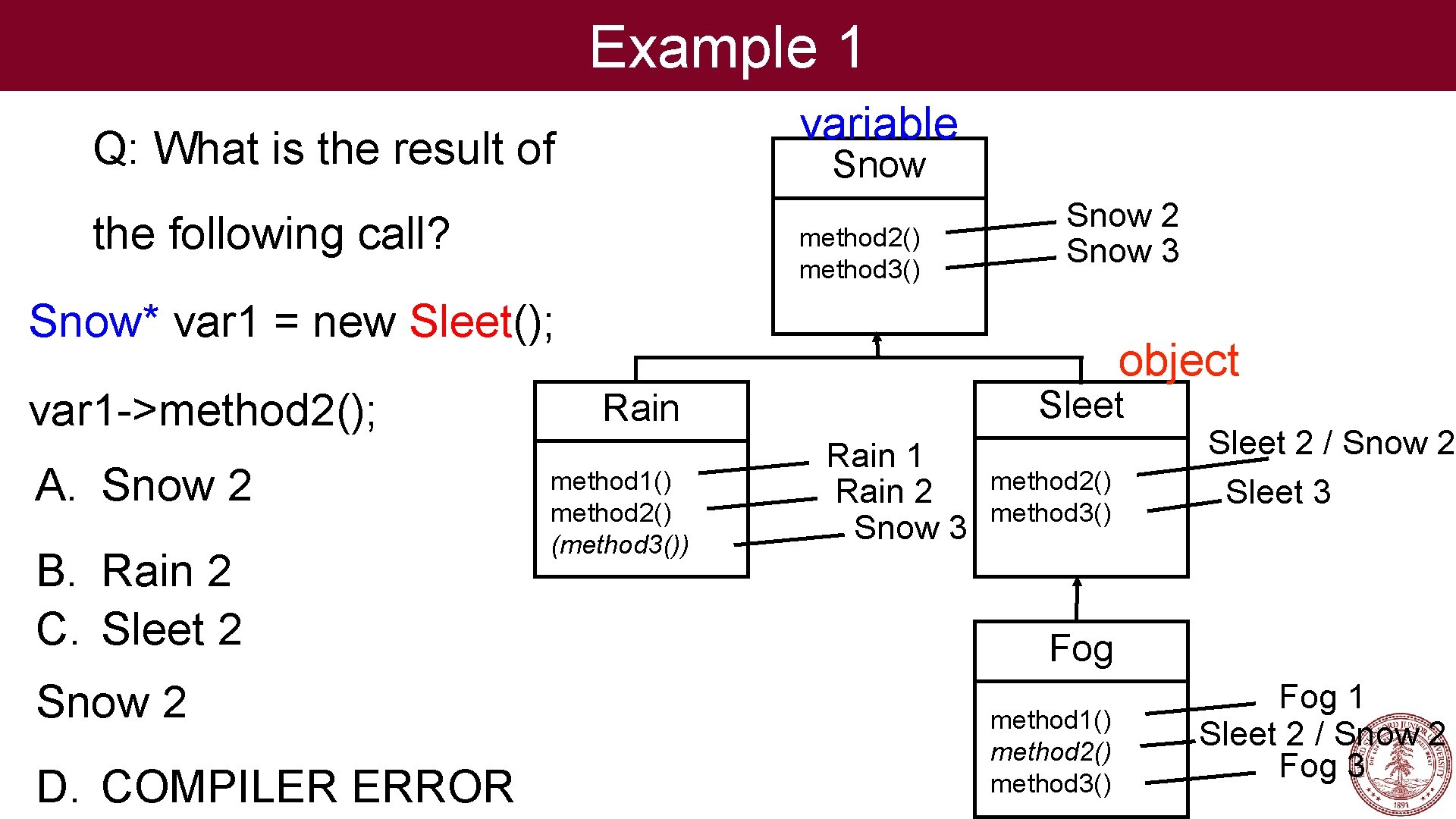
Example 1 variable Q: What is the result of Snow the following call? method 2() method 3() Snow 2 Snow 3 Snow* var 1 = new Sleet(); var 1 ->method 2(); A. Snow 2 B. Rain 2 C. Sleet 2 Snow 2 D. COMPILER ERROR object Sleet Rain method 1() method 2() (method 3()) Rain 1 Rain 2 Snow 3 method 2() method 3() Sleet 2 / Snow 2 Sleet 3 Fog method 1() method 2() method 3() Fog 1 Sleet 2 / Snow 2 Fog 3
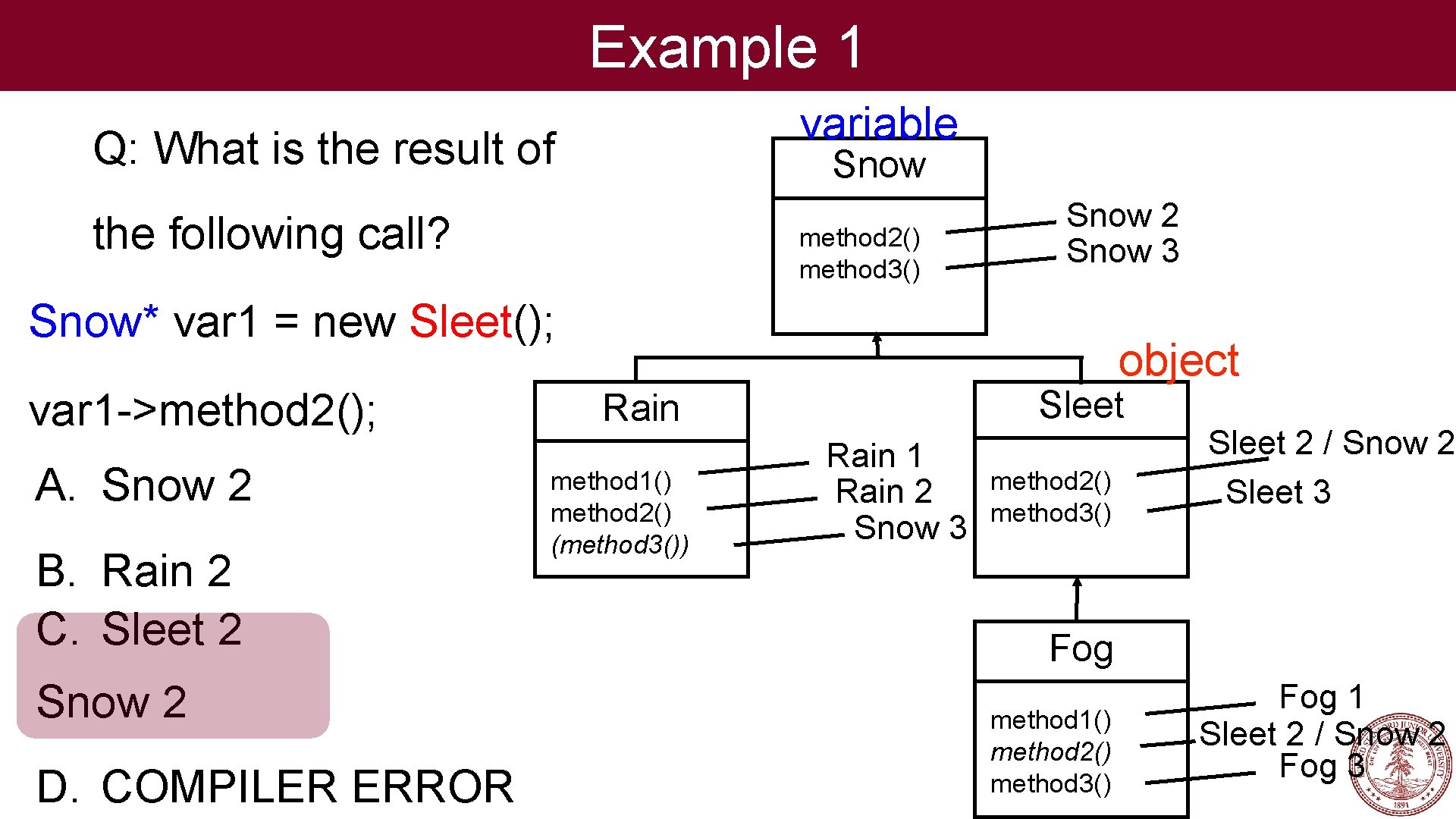
Example 1 variable Q: What is the result of Snow the following call? method 2() method 3() Snow 2 Snow 3 Snow* var 1 = new Sleet(); var 1 ->method 2(); A. Snow 2 B. Rain 2 C. Sleet 2 Snow 2 D. COMPILER ERROR object Sleet Rain method 1() method 2() (method 3()) Rain 1 Rain 2 Snow 3 method 2() method 3() Sleet 2 / Snow 2 Sleet 3 Fog method 1() method 2() method 3() Fog 1 Sleet 2 / Snow 2 Fog 3
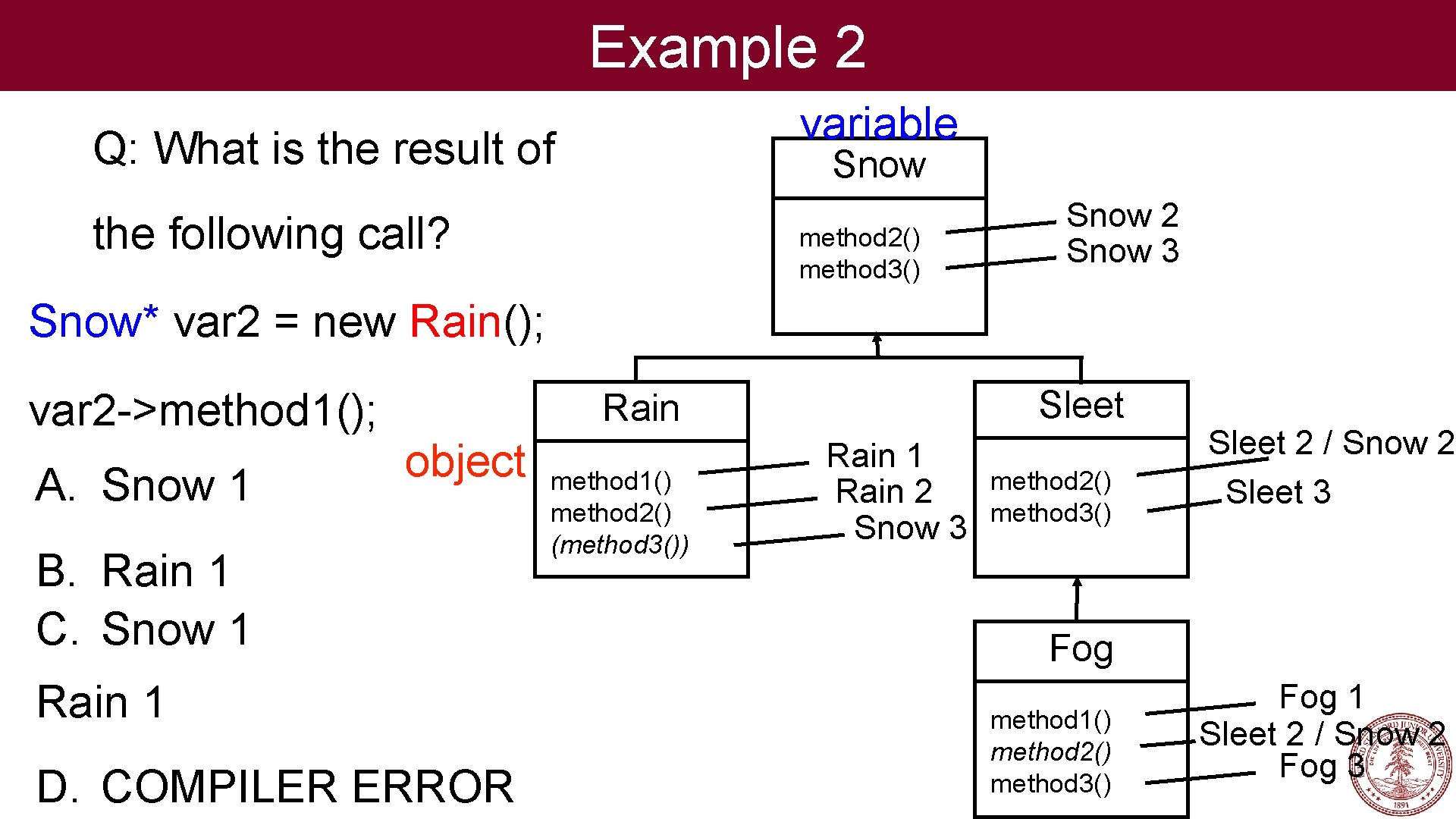
Example 2 variable Q: What is the result of Snow the following call? method 2() method 3() Snow 2 Snow 3 Snow* var 2 = new Rain(); var 2 ->method 1(); A. Snow 1 Sleet Rain object B. Rain 1 C. Snow 1 Rain 1 D. COMPILER ERROR method 1() method 2() (method 3()) Rain 1 Rain 2 Snow 3 method 2() method 3() Sleet 2 / Snow 2 Sleet 3 Fog method 1() method 2() method 3() Fog 1 Sleet 2 / Snow 2 Fog 3
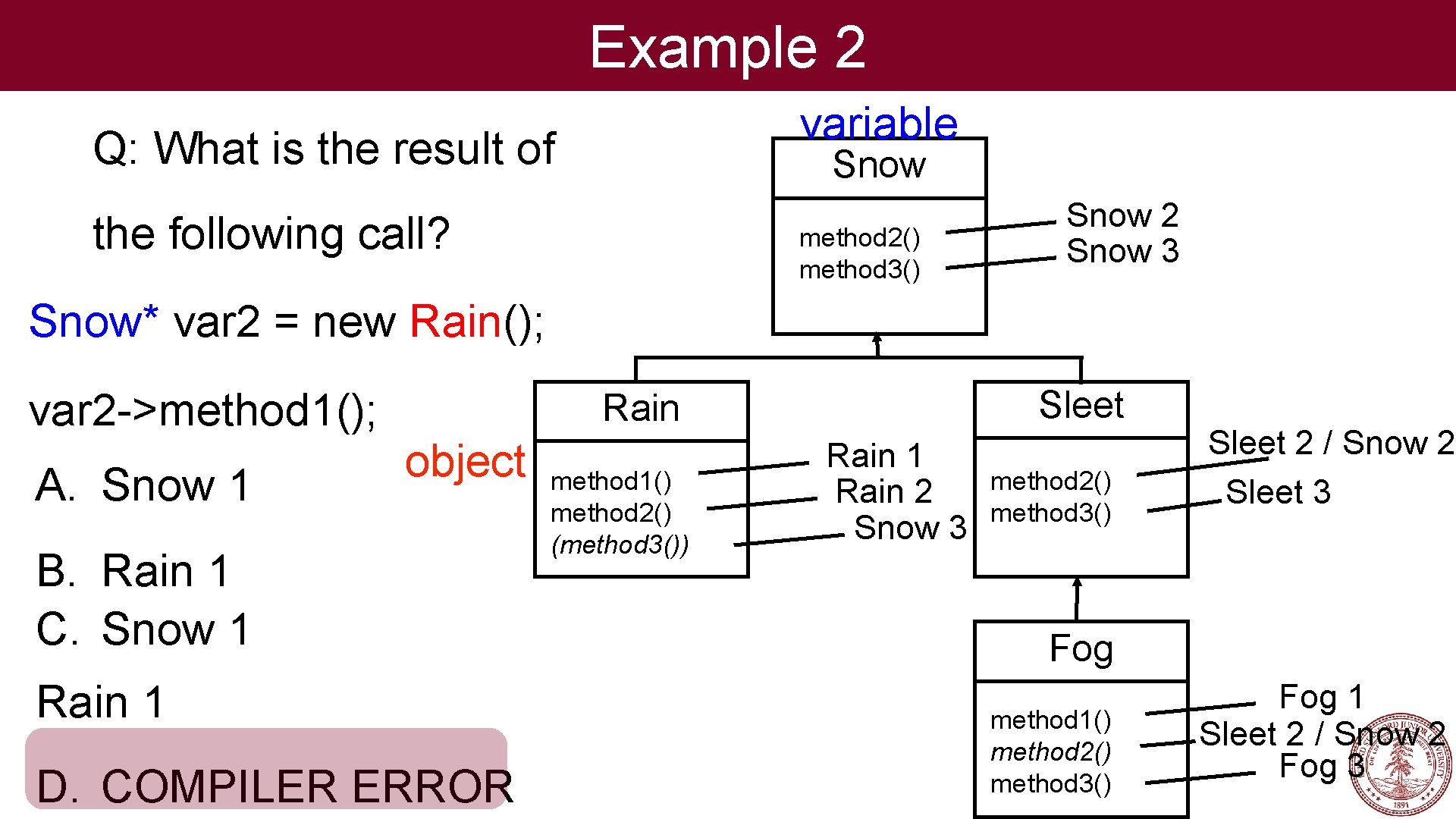
Example 2 variable Q: What is the result of Snow the following call? method 2() method 3() Snow 2 Snow 3 Snow* var 2 = new Rain(); var 2 ->method 1(); A. Snow 1 Sleet Rain object B. Rain 1 C. Snow 1 Rain 1 D. COMPILER ERROR method 1() method 2() (method 3()) Rain 1 Rain 2 Snow 3 method 2() method 3() Sleet 2 / Snow 2 Sleet 3 Fog method 1() method 2() method 3() Fog 1 Sleet 2 / Snow 2 Fog 3
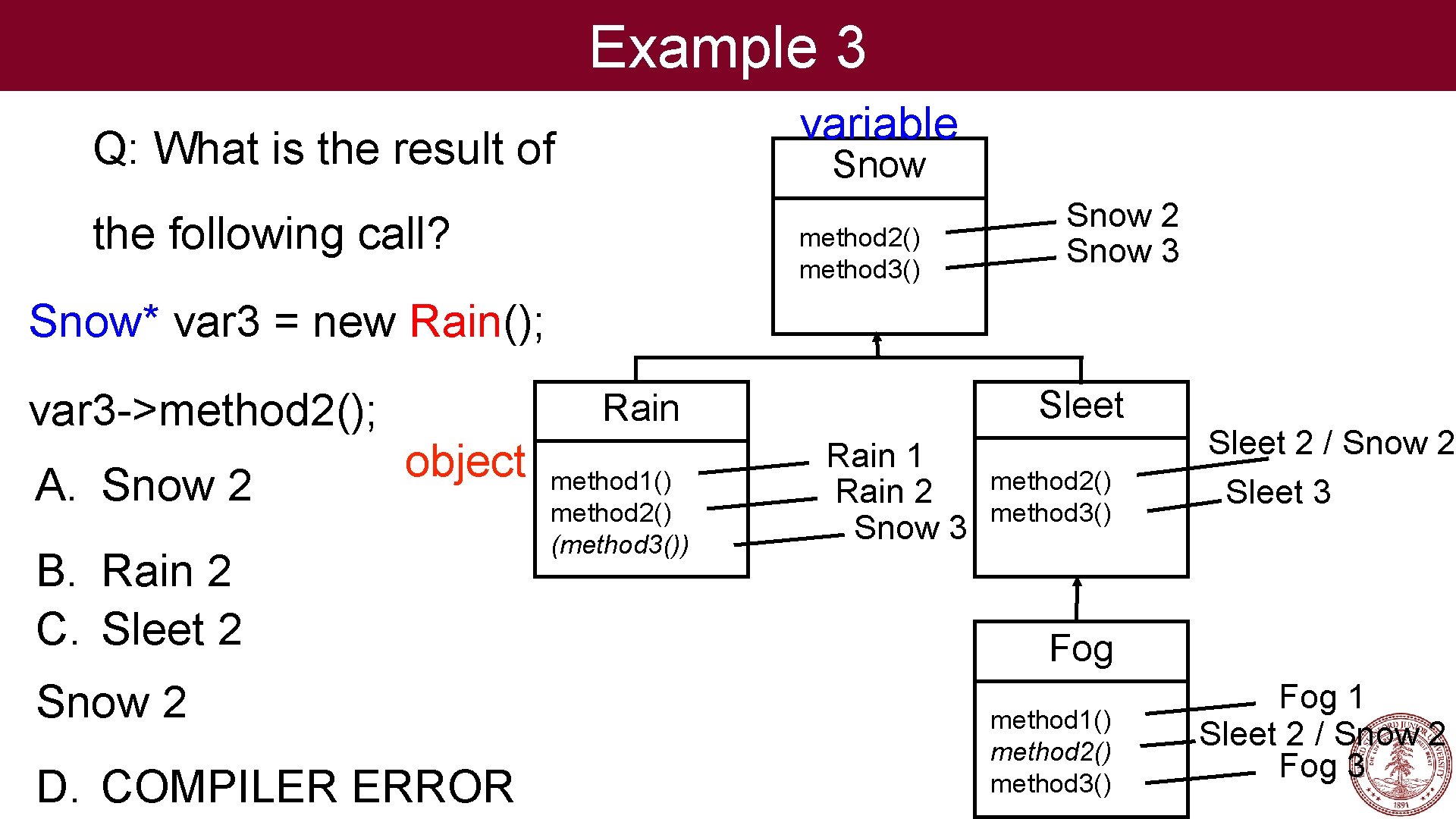
Example 3 variable Q: What is the result of Snow the following call? method 2() method 3() Snow 2 Snow 3 Snow* var 3 = new Rain(); var 3 ->method 2(); A. Snow 2 Sleet Rain object B. Rain 2 C. Sleet 2 Snow 2 D. COMPILER ERROR method 1() method 2() (method 3()) Rain 1 Rain 2 Snow 3 method 2() method 3() Sleet 2 / Snow 2 Sleet 3 Fog method 1() method 2() method 3() Fog 1 Sleet 2 / Snow 2 Fog 3
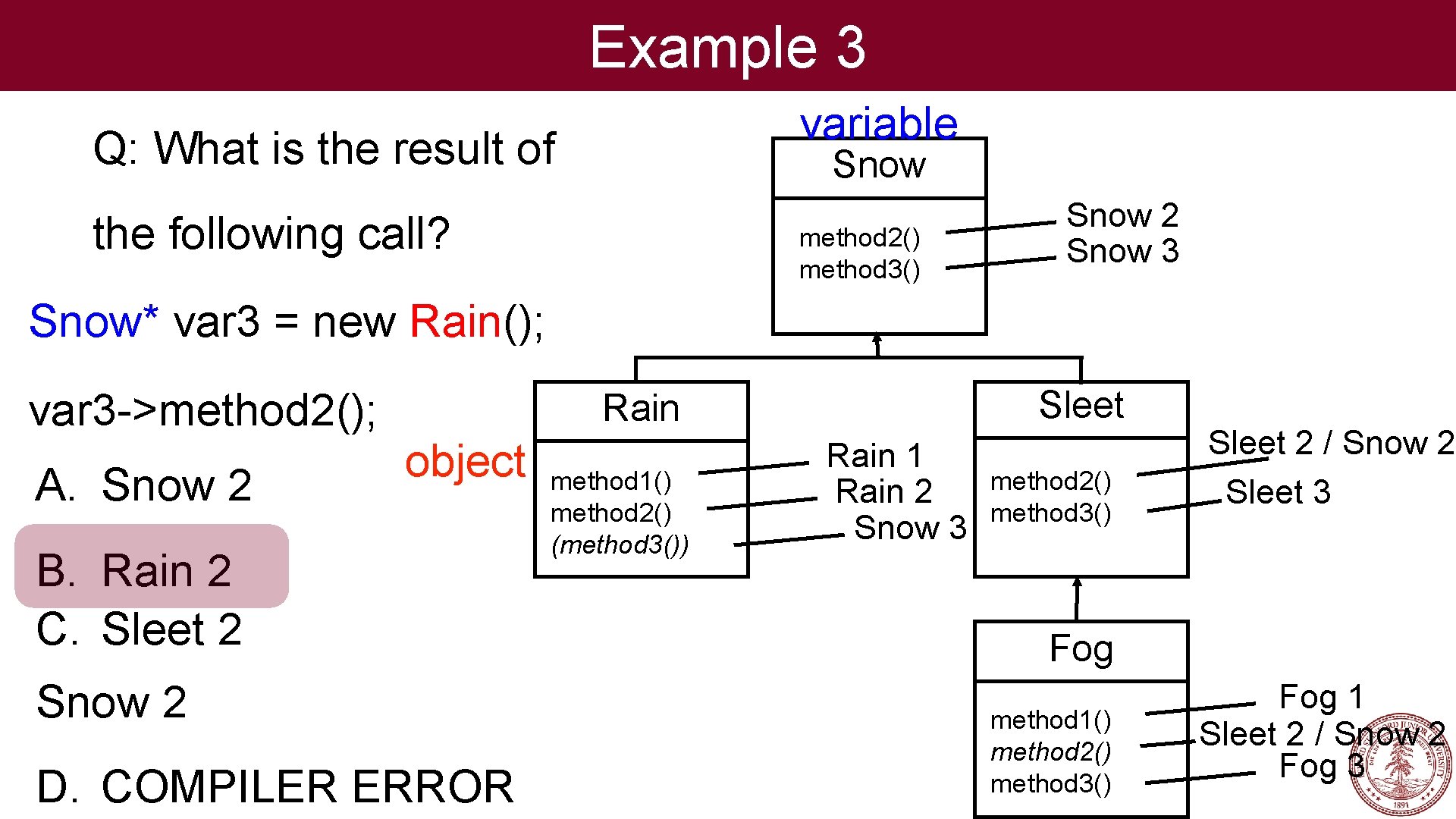
Example 3 variable Q: What is the result of Snow the following call? method 2() method 3() Snow 2 Snow 3 Snow* var 3 = new Rain(); var 3 ->method 2(); A. Snow 2 Sleet Rain object B. Rain 2 C. Sleet 2 Snow 2 D. COMPILER ERROR method 1() method 2() (method 3()) Rain 1 Rain 2 Snow 3 method 2() method 3() Sleet 2 / Snow 2 Sleet 3 Fog method 1() method 2() method 3() Fog 1 Sleet 2 / Snow 2 Fog 3
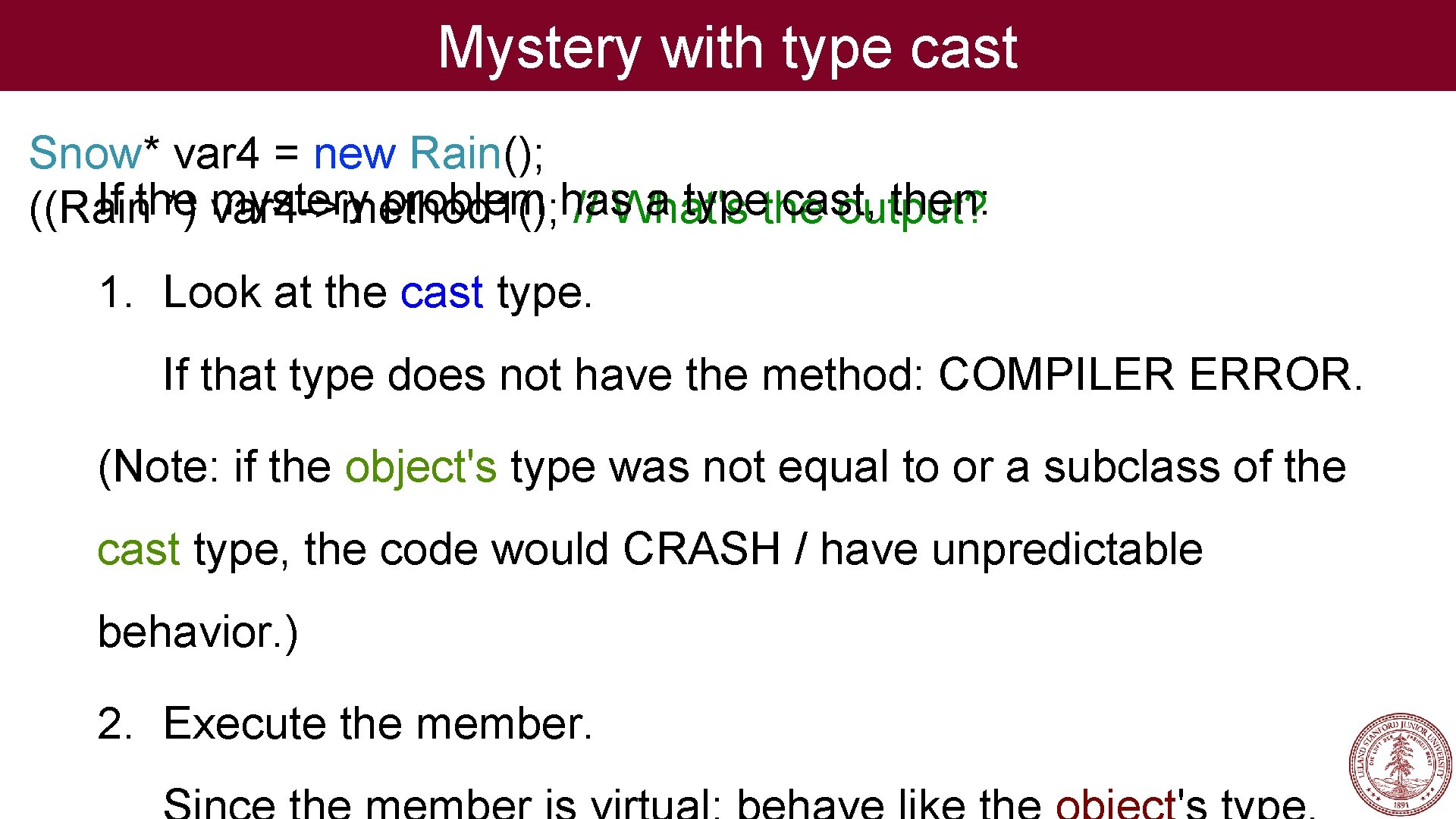
Mystery with type cast Snow* var 4 = new Rain(); If the mystery problem has a typethe cast, then: ((Rain *) var 4 ->method 1(); // What's output? 1. Look at the cast type. If that type does not have the method: COMPILER ERROR. (Note: if the object's type was not equal to or a subclass of the cast type, the code would CRASH / have unpredictable behavior. ) 2. Execute the member.
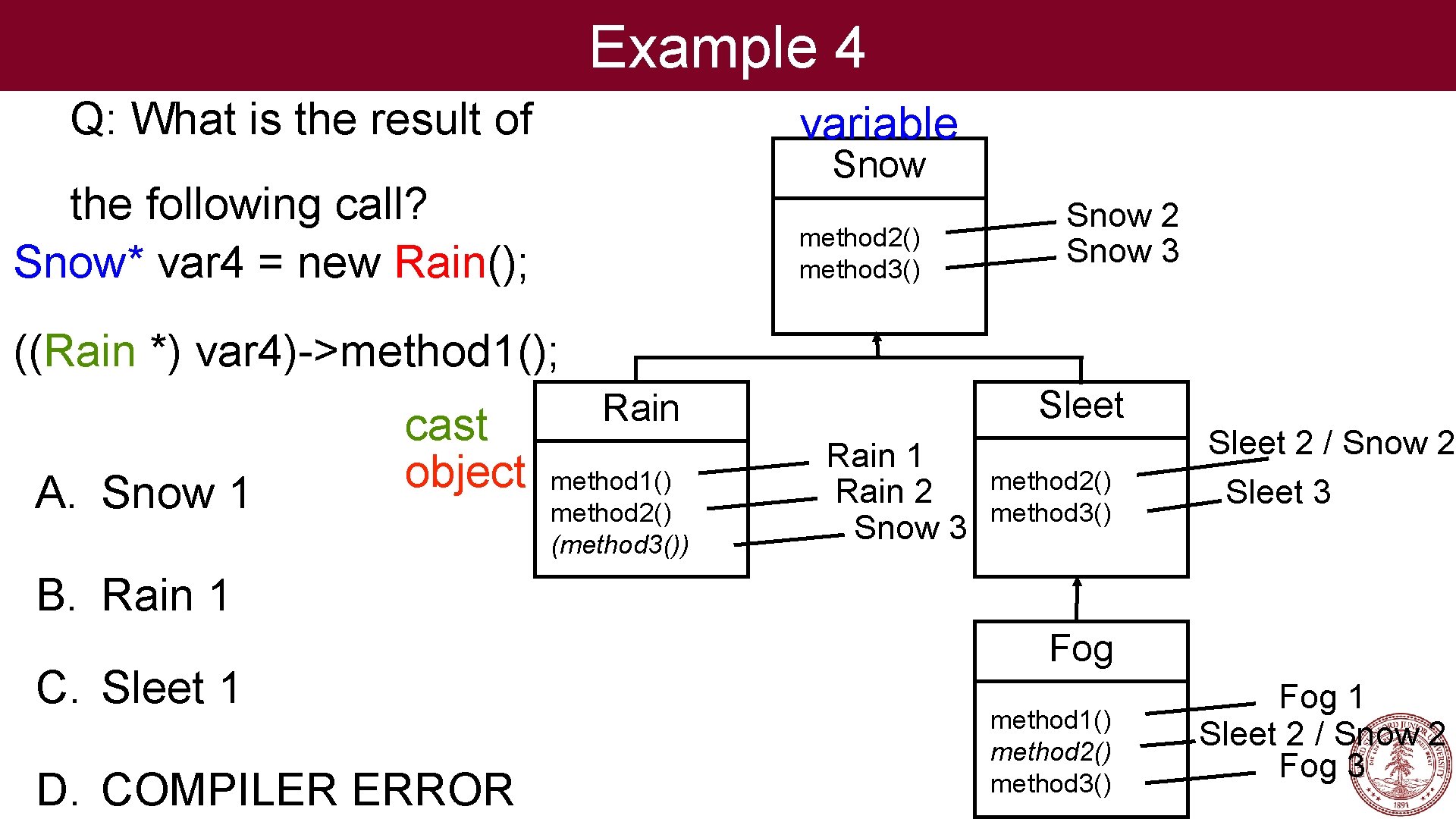
Example 4 Q: What is the result of variable Snow the following call? Snow* var 4 = new Rain(); method 2() method 3() Snow 2 Snow 3 ((Rain *) var 4)->method 1(); A. Snow 1 cast object Sleet Rain method 1() method 2() (method 3()) Rain 1 Rain 2 Snow 3 method 2() method 3() Sleet 2 / Snow 2 Sleet 3 B. Rain 1 C. Sleet 1 D. COMPILER ERROR Fog method 1() method 2() method 3() Fog 1 Sleet 2 / Snow 2 Fog 3
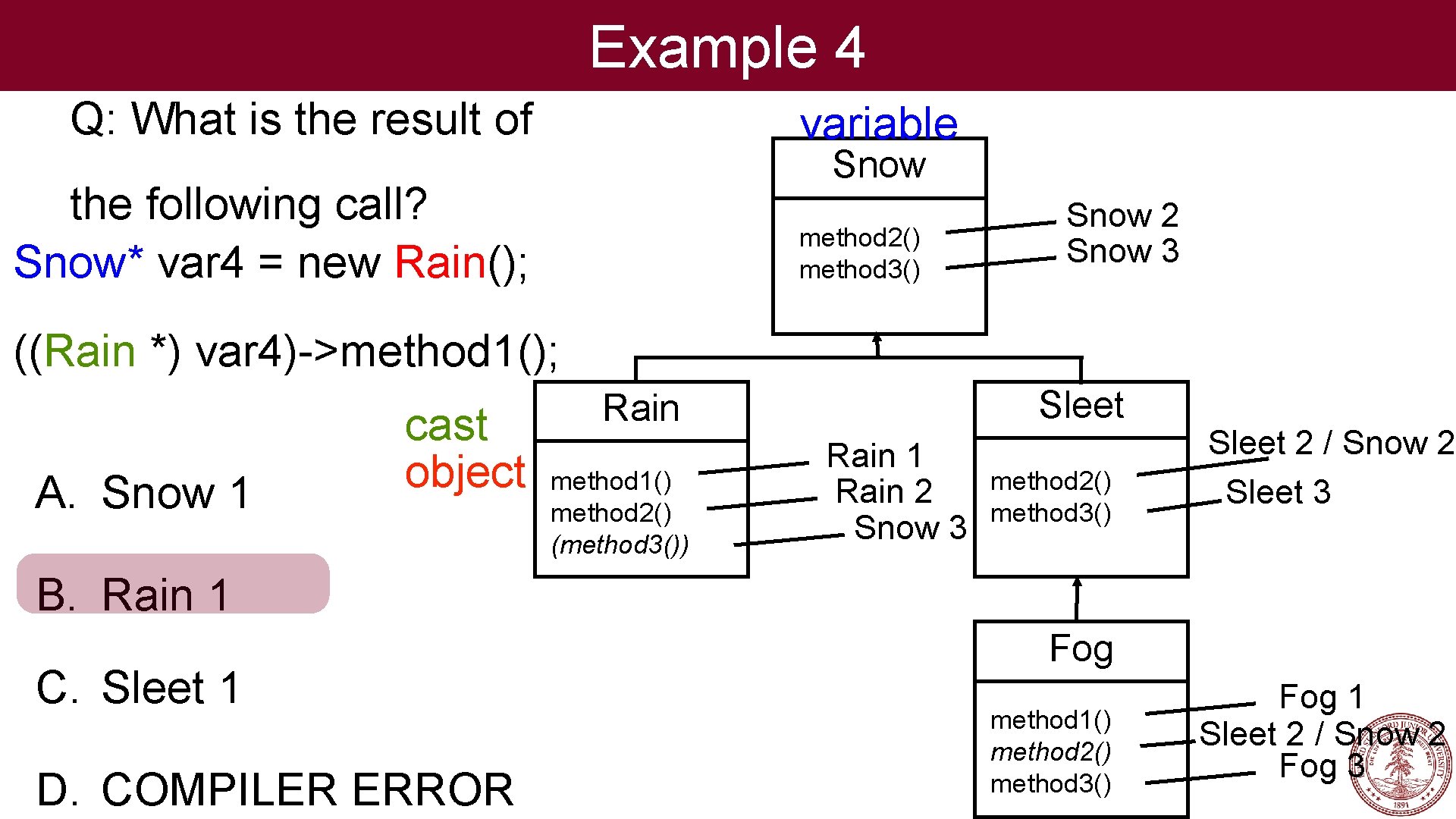
Example 4 Q: What is the result of variable Snow the following call? Snow* var 4 = new Rain(); method 2() method 3() Snow 2 Snow 3 ((Rain *) var 4)->method 1(); A. Snow 1 cast object Sleet Rain method 1() method 2() (method 3()) Rain 1 Rain 2 Snow 3 method 2() method 3() Sleet 2 / Snow 2 Sleet 3 B. Rain 1 C. Sleet 1 D. COMPILER ERROR Fog method 1() method 2() method 3() Fog 1 Sleet 2 / Snow 2 Fog 3
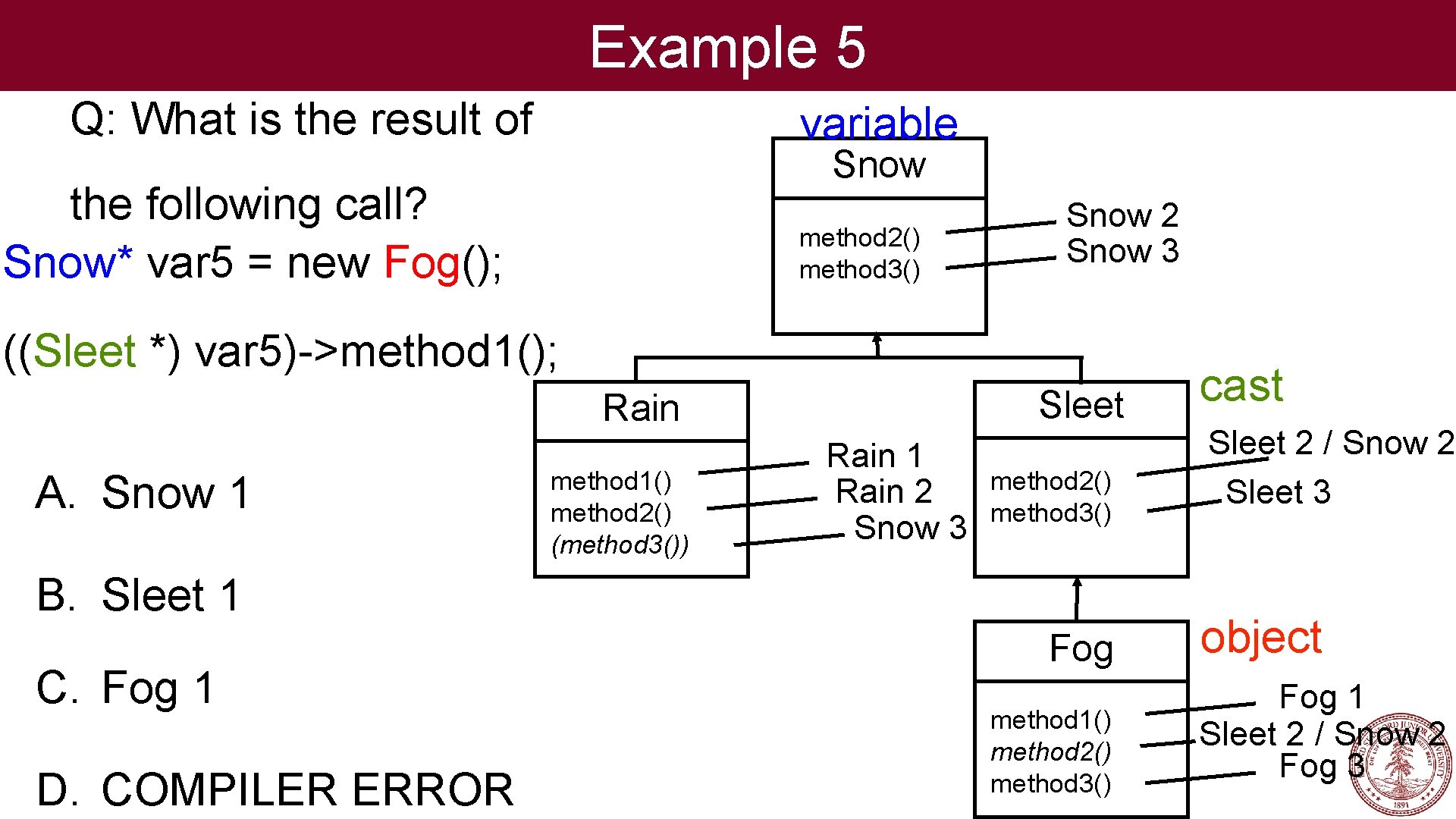
Example 5 Q: What is the result of variable Snow the following call? Snow* var 5 = new Fog(); method 2() method 3() Snow 2 Snow 3 ((Sleet *) var 5)->method 1(); Sleet Rain A. Snow 1 method 1() method 2() (method 3()) Rain 1 Rain 2 Snow 3 method 2() method 3() B. Sleet 1 C. Fog 1 D. COMPILER ERROR Fog method 1() method 2() method 3() cast Sleet 2 / Snow 2 Sleet 3 object Fog 1 Sleet 2 / Snow 2 Fog 3
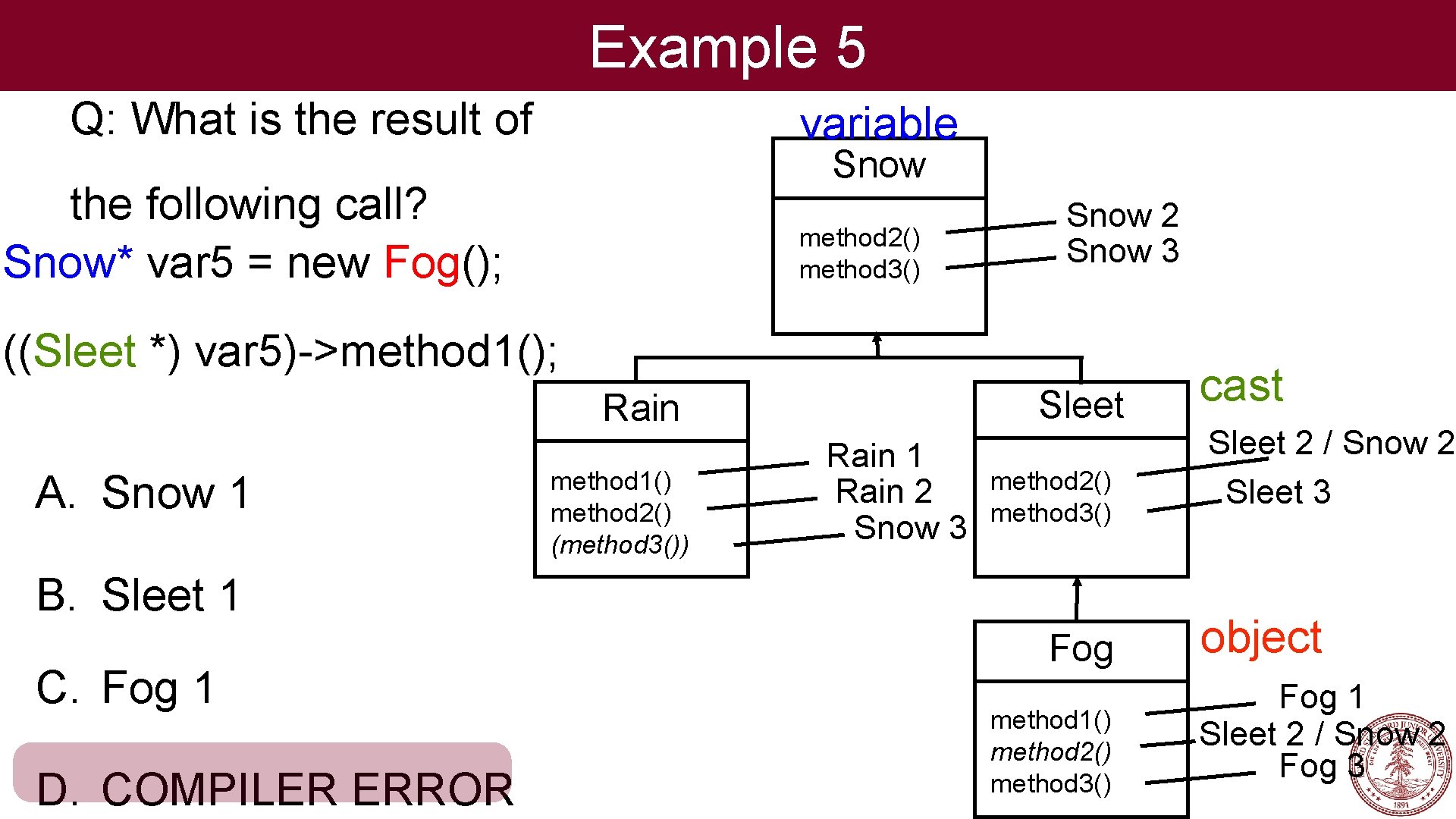
Example 5 Q: What is the result of variable Snow the following call? Snow* var 5 = new Fog(); method 2() method 3() Snow 2 Snow 3 ((Sleet *) var 5)->method 1(); Sleet Rain A. Snow 1 method 1() method 2() (method 3()) Rain 1 Rain 2 Snow 3 method 2() method 3() B. Sleet 1 C. Fog 1 D. COMPILER ERROR Fog method 1() method 2() method 3() cast Sleet 2 / Snow 2 Sleet 3 object Fog 1 Sleet 2 / Snow 2 Fog 3
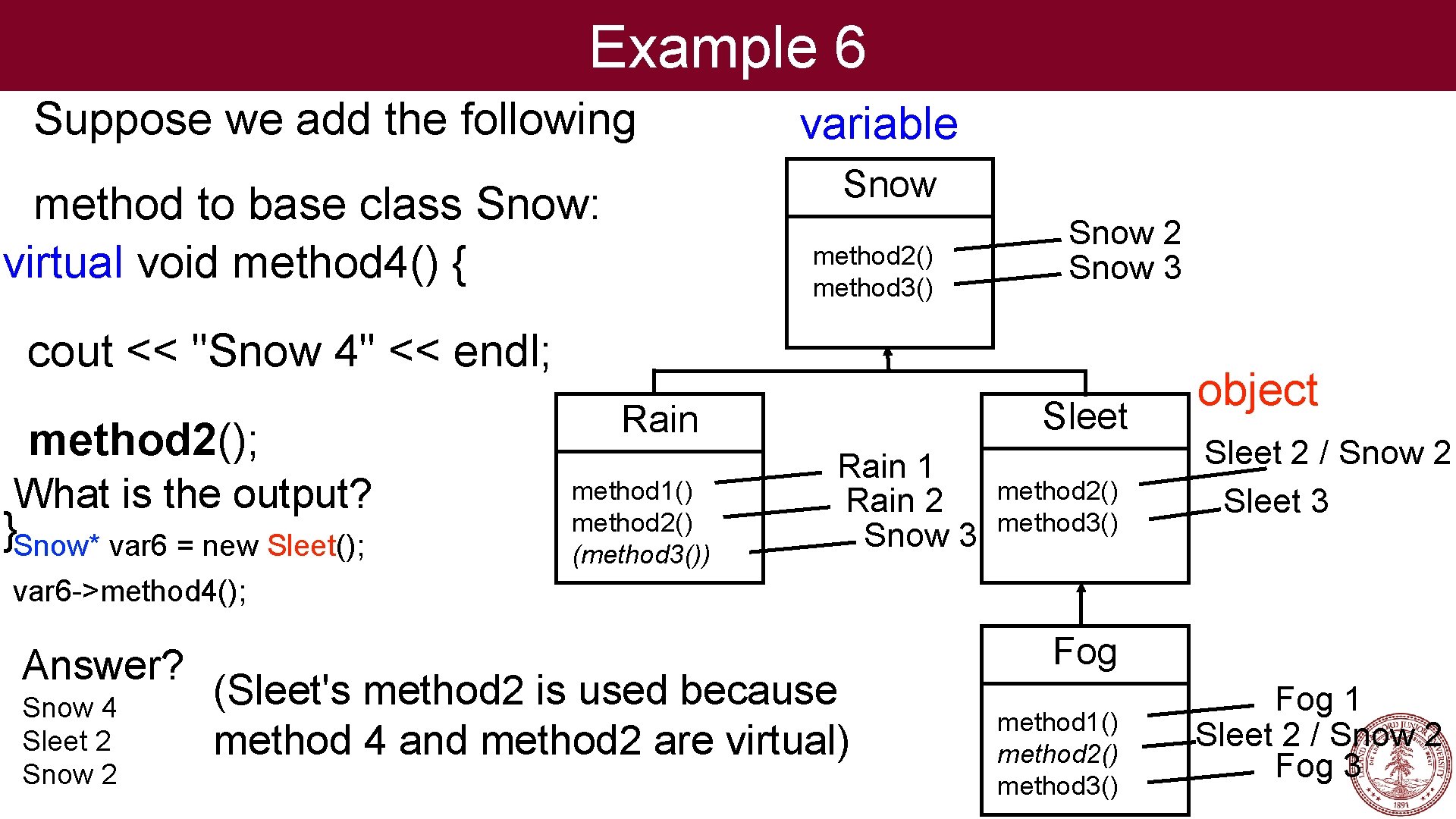
Example 6 Suppose we add the following variable Snow method to base class Snow: virtual void method 4() { method 2() method 3() Snow 2 Snow 3 cout << "Snow 4" << endl; method 2(); What is the output? }Snow* var 6 = new Sleet(); Sleet Rain method 1() method 2() (method 3()) Rain 1 Rain 2 Snow 3 method 2() method 3() object Sleet 2 / Snow 2 Sleet 3 var 6 ->method 4(); Answer? Snow 4 Sleet 2 Snow 2 (Sleet's method 2 is used because method 4 and method 2 are virtual) Fog method 1() method 2() method 3() Fog 1 Sleet 2 / Snow 2 Fog 3
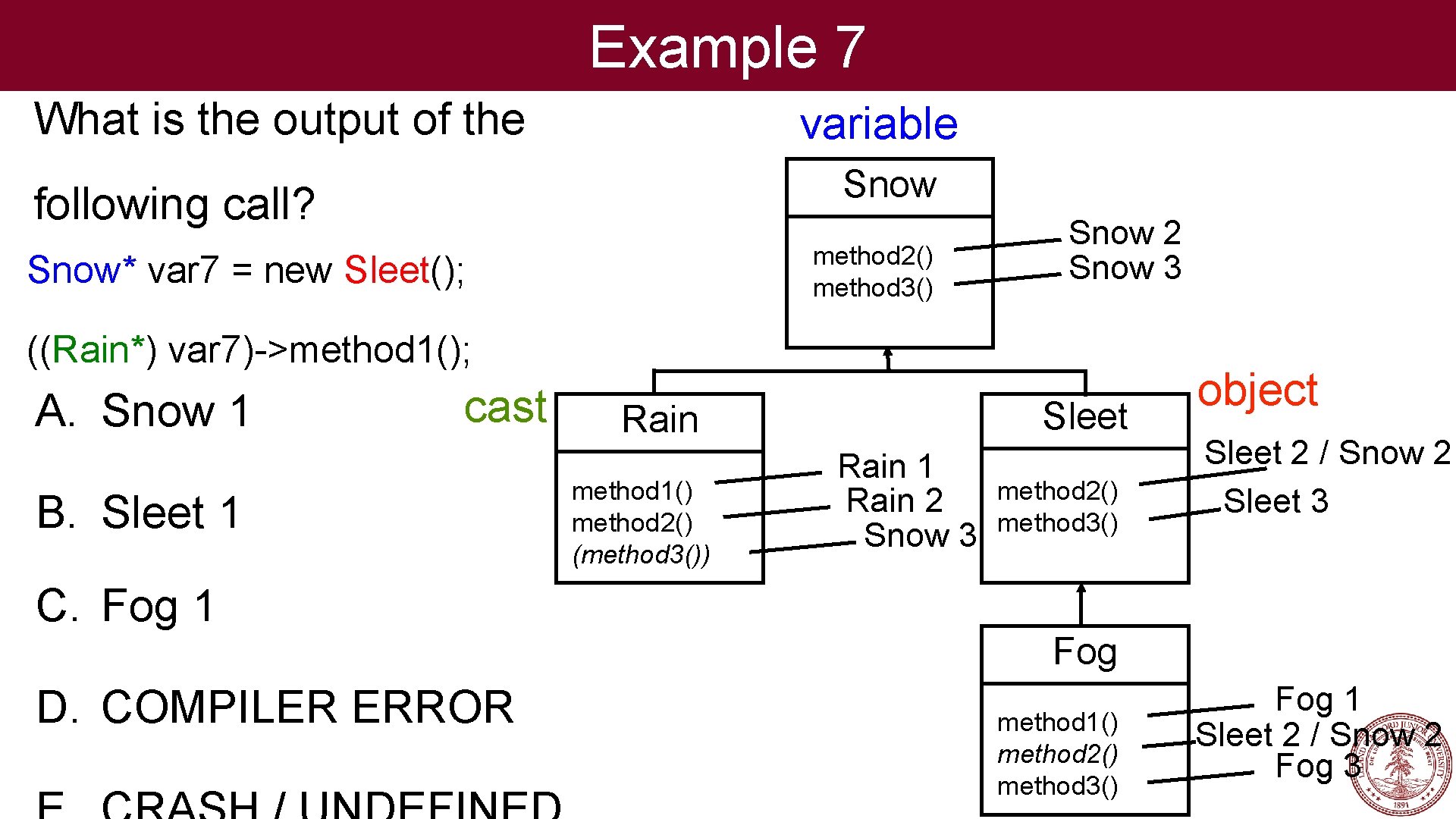
Example 7 What is the output of the variable Snow following call? method 2() method 3() Snow* var 7 = new Sleet(); Snow 2 Snow 3 ((Rain*) var 7)->method 1(); A. Snow 1 cast B. Sleet 1 C. Fog 1 D. COMPILER ERROR Sleet Rain method 1() method 2() (method 3()) Rain 1 Rain 2 Snow 3 method 2() method 3() object Sleet 2 / Snow 2 Sleet 3 Fog method 1() method 2() method 3() Fog 1 Sleet 2 / Snow 2 Fog 3
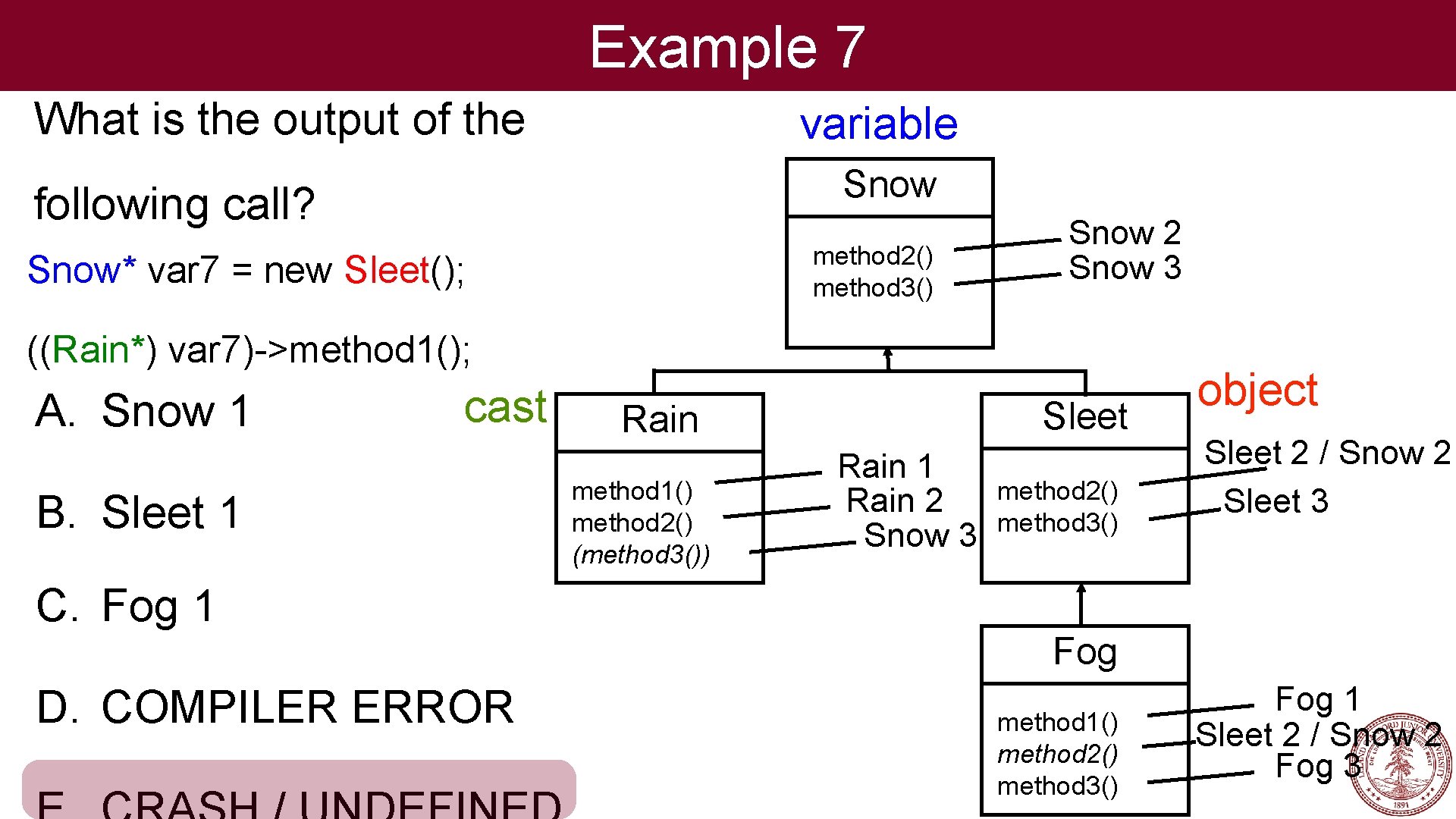
Example 7 What is the output of the variable Snow following call? method 2() method 3() Snow* var 7 = new Sleet(); Snow 2 Snow 3 ((Rain*) var 7)->method 1(); A. Snow 1 cast B. Sleet 1 C. Fog 1 D. COMPILER ERROR Sleet Rain method 1() method 2() (method 3()) Rain 1 Rain 2 Snow 3 method 2() method 3() object Sleet 2 / Snow 2 Sleet 3 Fog method 1() method 2() method 3() Fog 1 Sleet 2 / Snow 2 Fog 3
References and Advanced Reading • References: • C++ Inheritance: https: //www. tutorialspoint. com/cplus/cpp_inheritance. htm • C++ Polymorphism: https: //www. tutorialspoint. com/cplus/cpp_polymorphism. htm • Advanced Reading: • http: //stackoverflow. com/questions/5854581/polymorphism-in-c • https: //www. codingunit. com/cplus-tutorial-polymorphism-and-abstract-base-class
- Slides: 53