
CS 106 B Lecture 10 Recursive Backtracking 2

CS 106 B Lecture 10: Recursive Backtracking 2: Common Problem Types Wednesday, July 12, 2017 Programming Abstractions Summer 2017 Stanford University Computer Science Department Lecturer: Chris Gregg reading: Programming Abstractions in C++, Chapter 8. 2 -8. 3
Today's Topics • Logistics: • Due date for Assignment 3 (Recursion): Tuesday, Noon • Practice midterm materials: http: //web. stanford. edu/class/cs 106 b/handouts/midterm. html • Midterm will be on laptops! You must let me and Jason know if you don't have a workable laptop or need other accommodations. • Today's handout: http: //web. stanford. edu/class/cs 106 b//lectures/10 Recursive. Backtracking 2/code/handout. pdf • Common Problem Types for Recursive Backtracking • Partitionable (determine whether a solution exists) • Knapsack Problem (find the best solution) • Maze Solving (find a solution) • Clumsy Thumbsy (find all solutions)
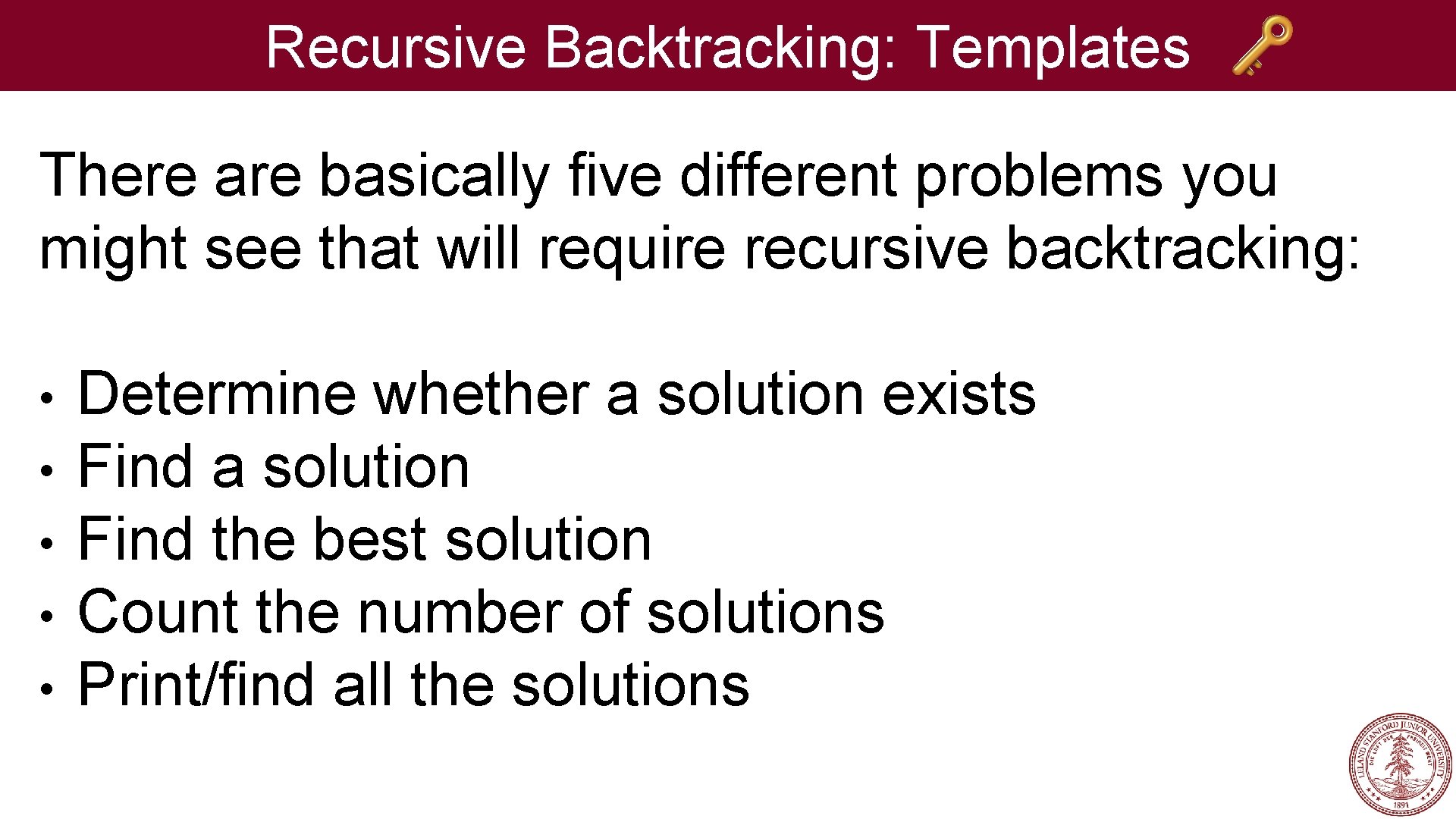
Recursive Backtracking: Templates There are basically five different problems you might see that will require recursive backtracking: • • • Determine whether a solution exists Find a solution Find the best solution Count the number of solutions Print/find all the solutions
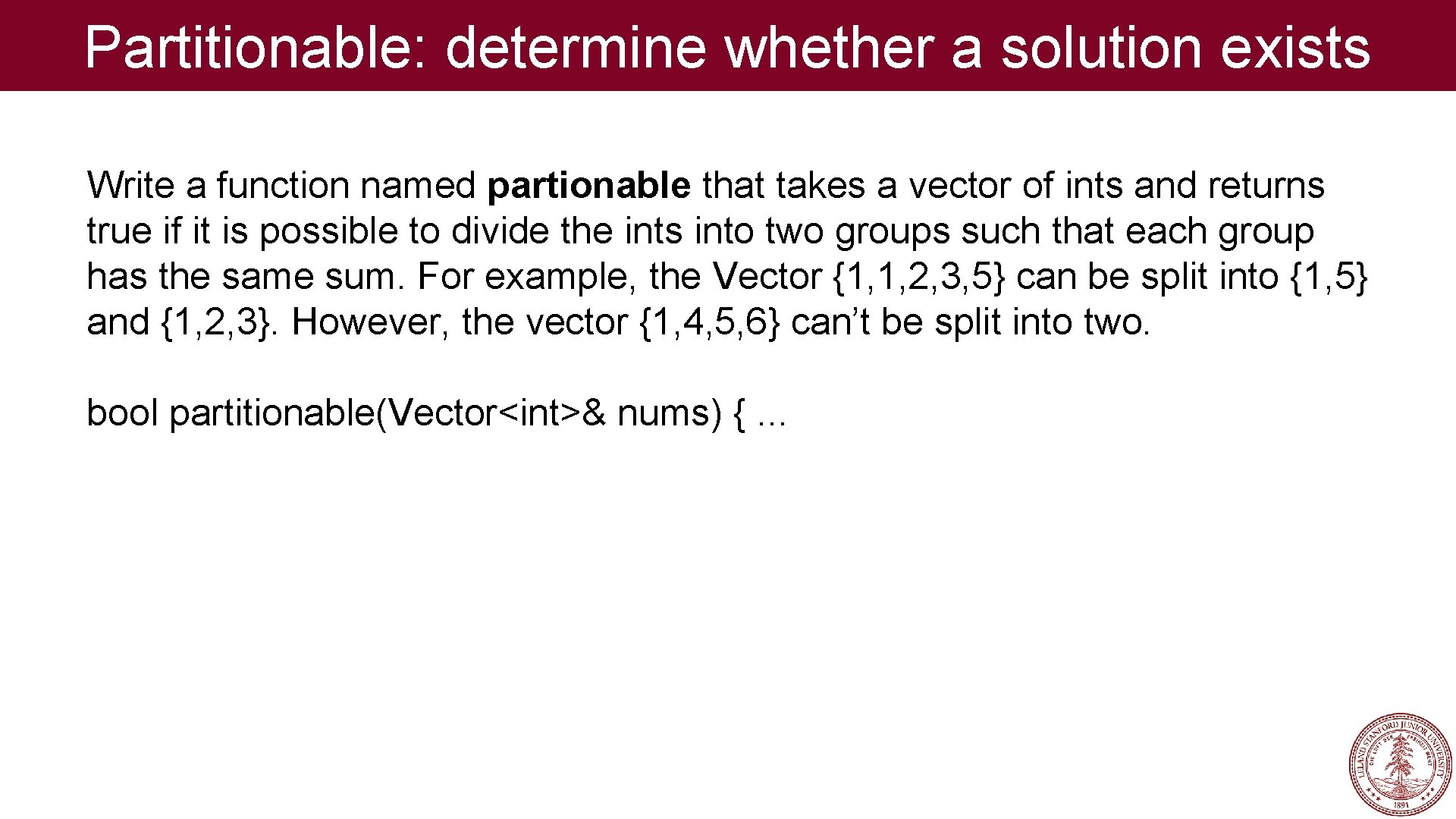
Partitionable: determine whether a solution exists Write a function named partionable that takes a vector of ints and returns true if it is possible to divide the ints into two groups such that each group has the same sum. For example, the Vector {1, 1, 2, 3, 5} can be split into {1, 5} and {1, 2, 3}. However, the vector {1, 4, 5, 6} can’t be split into two. bool partitionable(Vector<int>& nums) {. . .
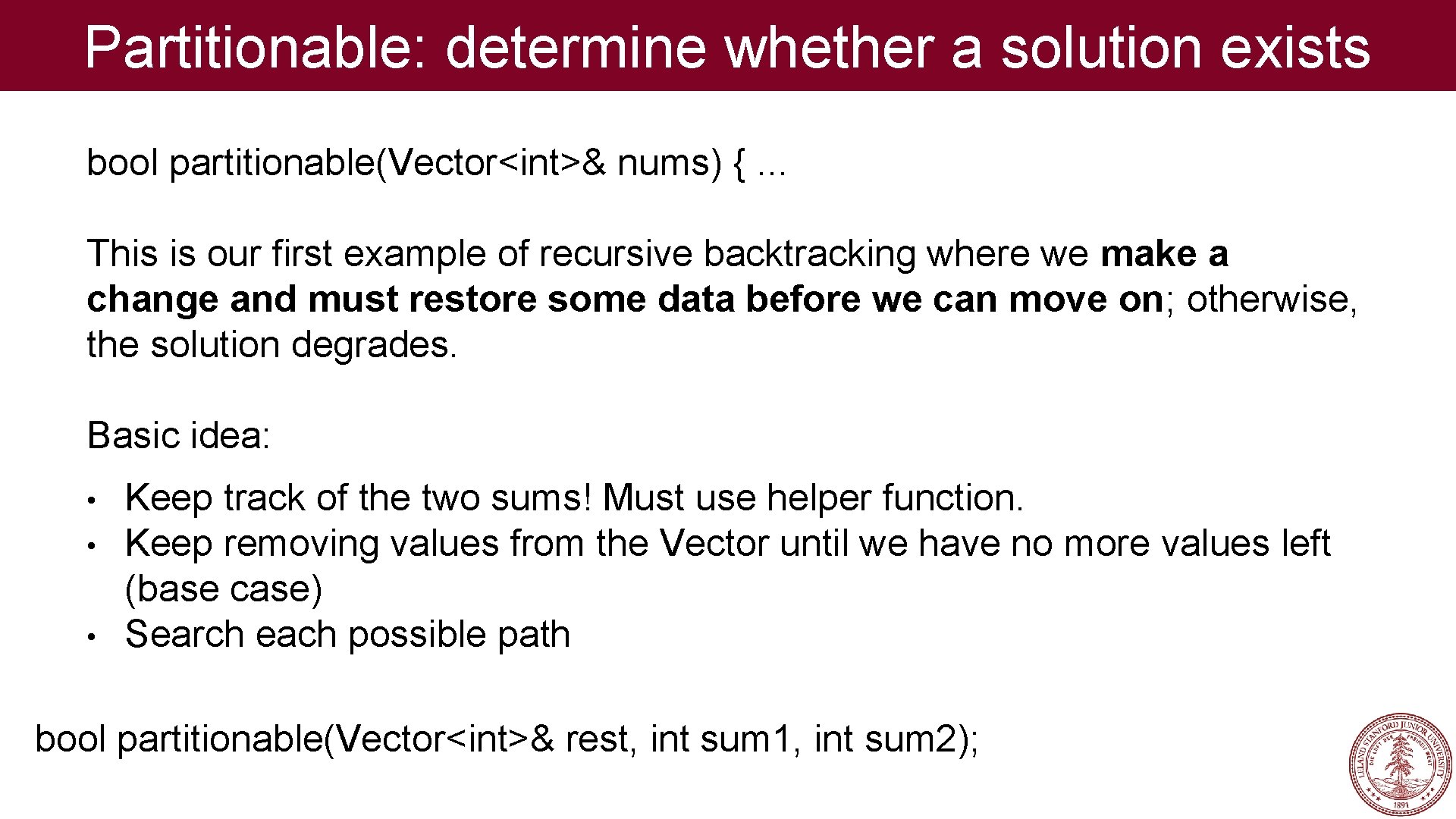
Partitionable: determine whether a solution exists bool partitionable(Vector<int>& nums) {. . . This is our first example of recursive backtracking where we make a change and must restore some data before we can move on; otherwise, the solution degrades. Basic idea: • • • Keep track of the two sums! Must use helper function. Keep removing values from the Vector until we have no more values left (base case) Search each possible path bool partitionable(Vector<int>& rest, int sum 1, int sum 2);

Partitionable: determine whether a solution exists bool partitionable(Vector<int>& nums) { return partitionable(nums, 0, 0); // no sums yet } bool partitionable(Vector<int>& rest, int sum 1, int sum 2) { }
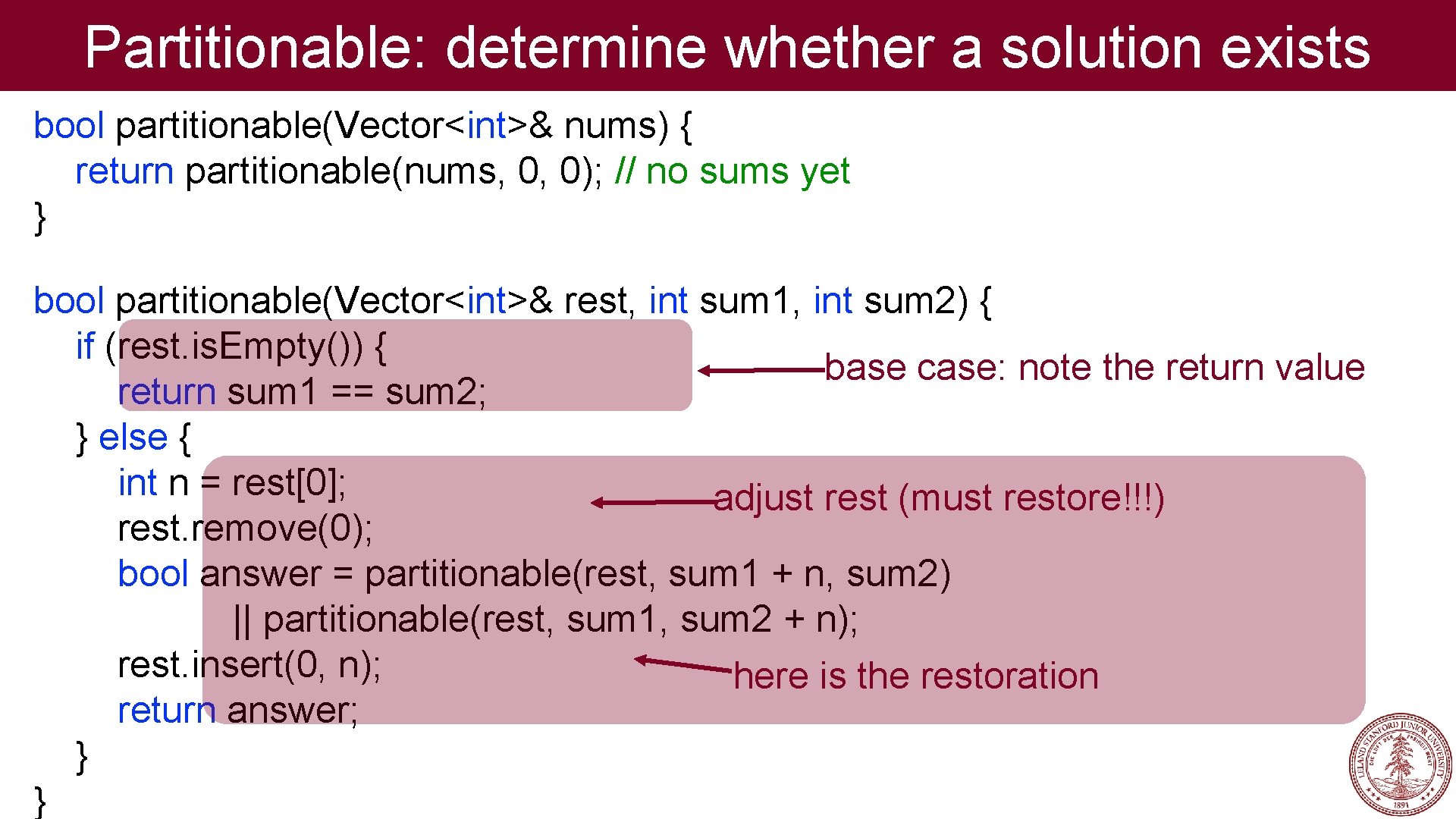
Partitionable: determine whether a solution exists bool partitionable(Vector<int>& nums) { return partitionable(nums, 0, 0); // no sums yet } bool partitionable(Vector<int>& rest, int sum 1, int sum 2) { if (rest. is. Empty()) { base case: note the return value return sum 1 == sum 2; } else { int n = rest[0]; adjust rest (must restore!!!) rest. remove(0); bool answer = partitionable(rest, sum 1 + n, sum 2) || partitionable(rest, sum 1, sum 2 + n); rest. insert(0, n); here is the restoration return answer; } }
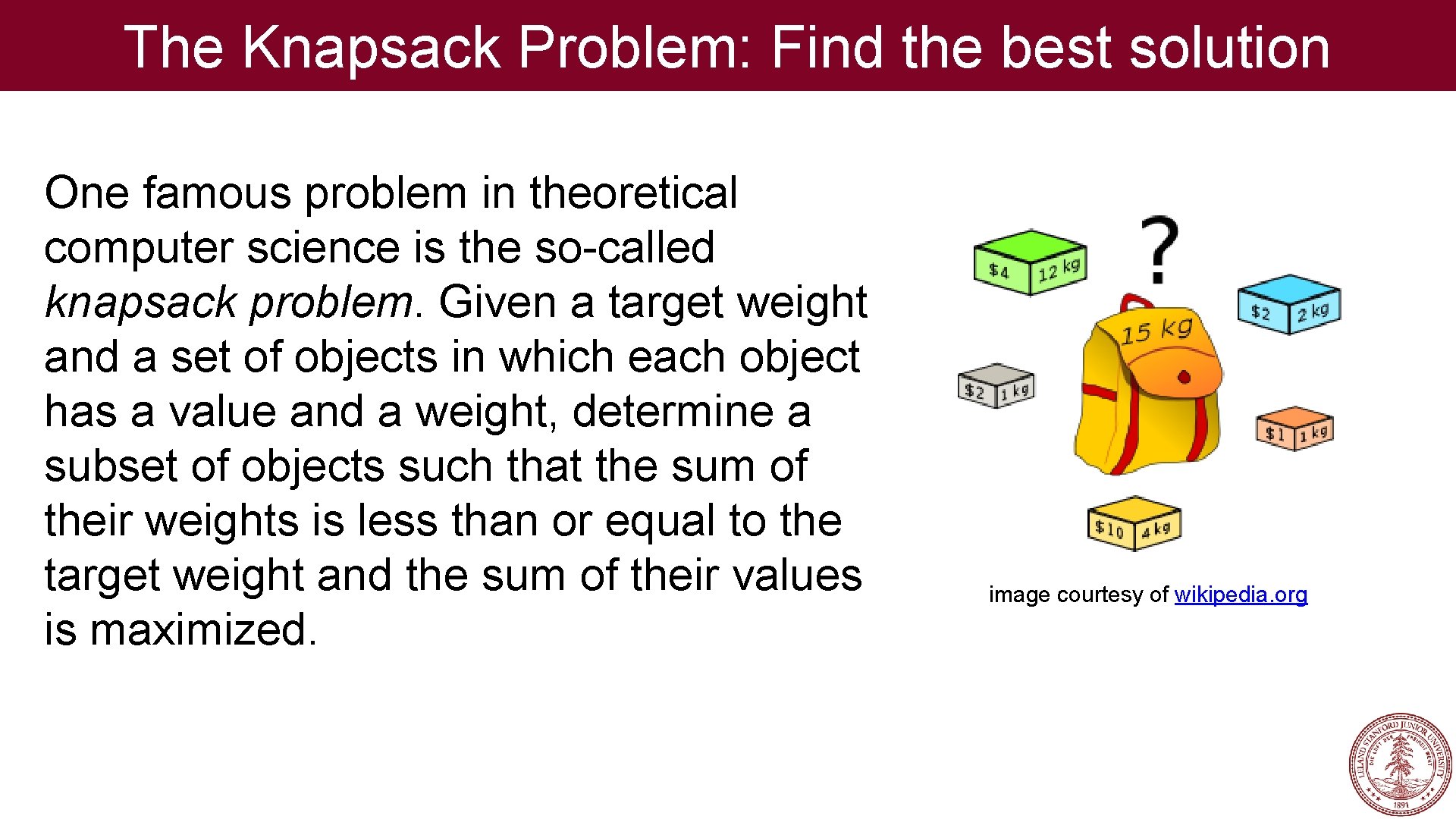
The Knapsack Problem: Find the best solution One famous problem in theoretical computer science is the so-called knapsack problem. Given a target weight and a set of objects in which each object has a value and a weight, determine a subset of objects such that the sum of their weights is less than or equal to the target weight and the sum of their values is maximized. image courtesy of wikipedia. org

The Knapsack Problem: Find the best solution For this problem we will represent an object with the following struct: struct object. T { int weight; //You may assume this is greater than or equal to 0 int value; //You may assume this is greater than or equal to 0 }; Let's write the function: int fill. Knapsack(Vector<object. T> &objects, int target. Weight) that considers all possible combinations of object. T from objects (such that the sum of their weights is less than or equal to target. Weight) and returns the maximum possible sum of object values.
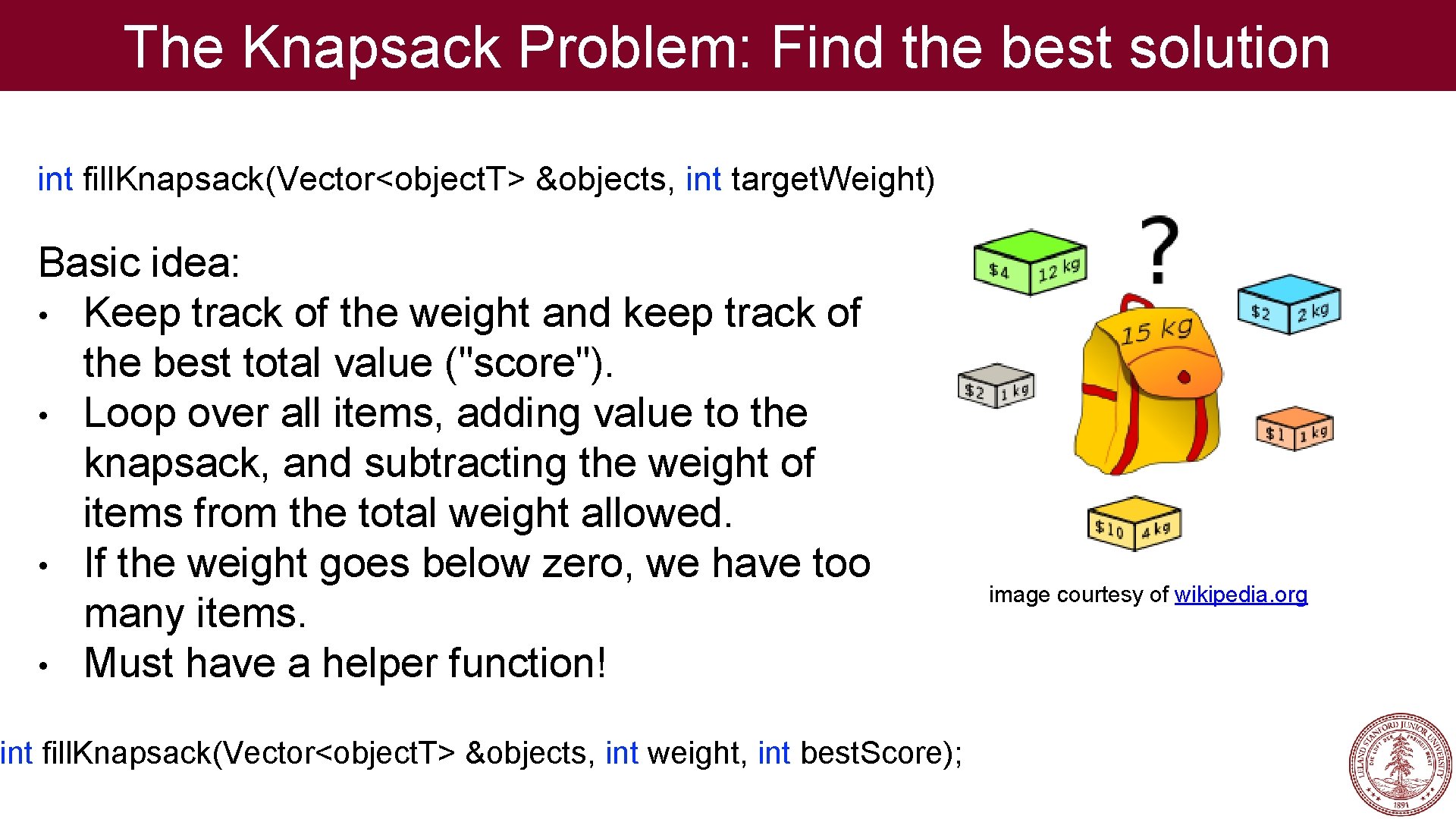
The Knapsack Problem: Find the best solution int fill. Knapsack(Vector<object. T> &objects, int target. Weight) Basic idea: • Keep track of the weight and keep track of the best total value ("score"). • Loop over all items, adding value to the knapsack, and subtracting the weight of items from the total weight allowed. • If the weight goes below zero, we have too many items. • Must have a helper function! int fill. Knapsack(Vector<object. T> &objects, int weight, int best. Score); image courtesy of wikipedia. org
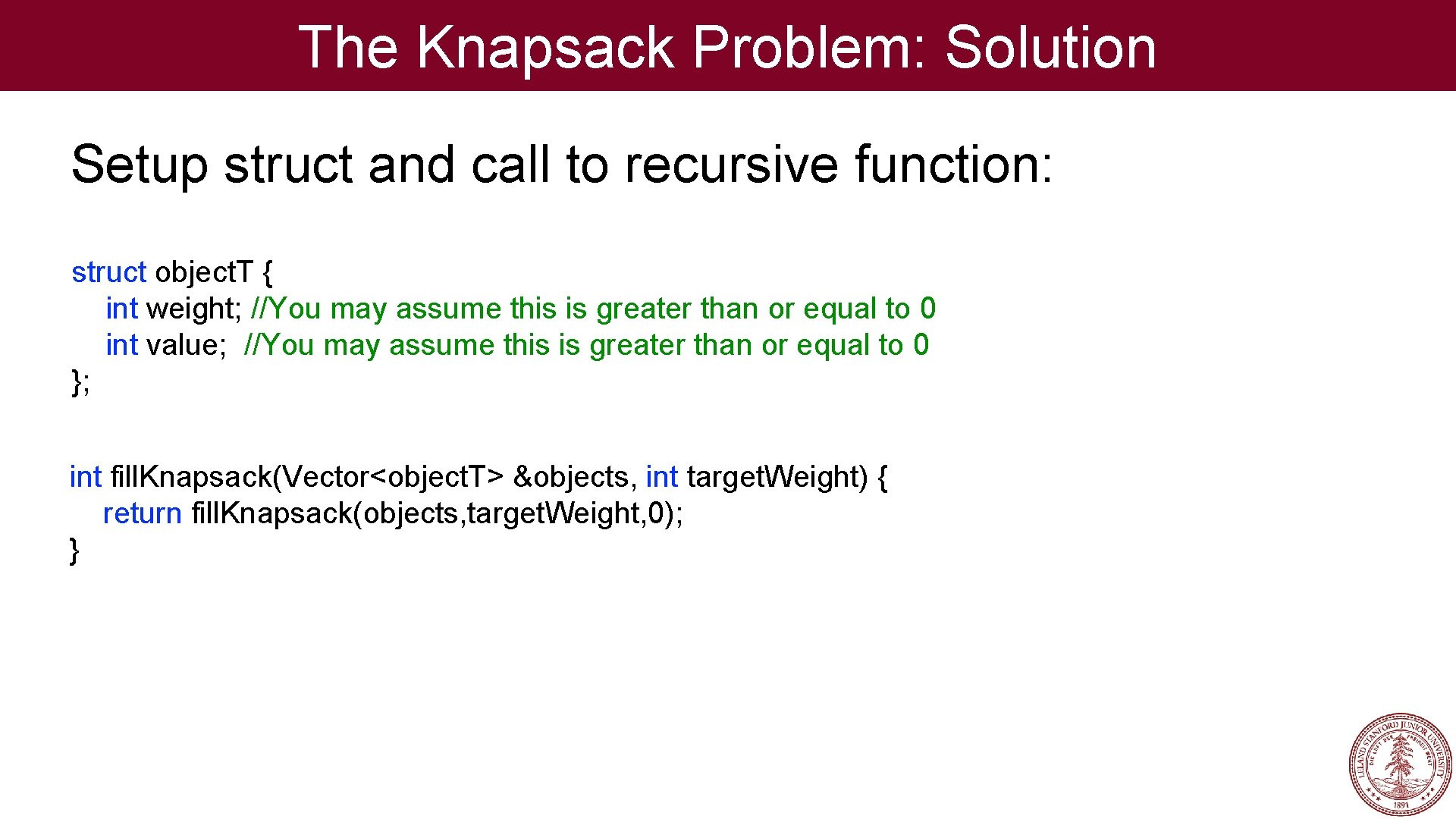
The Knapsack Problem: Solution Setup struct and call to recursive function: struct object. T { int weight; //You may assume this is greater than or equal to 0 int value; //You may assume this is greater than or equal to 0 }; int fill. Knapsack(Vector<object. T> &objects, int target. Weight) { return fill. Knapsack(objects, target. Weight, 0); }
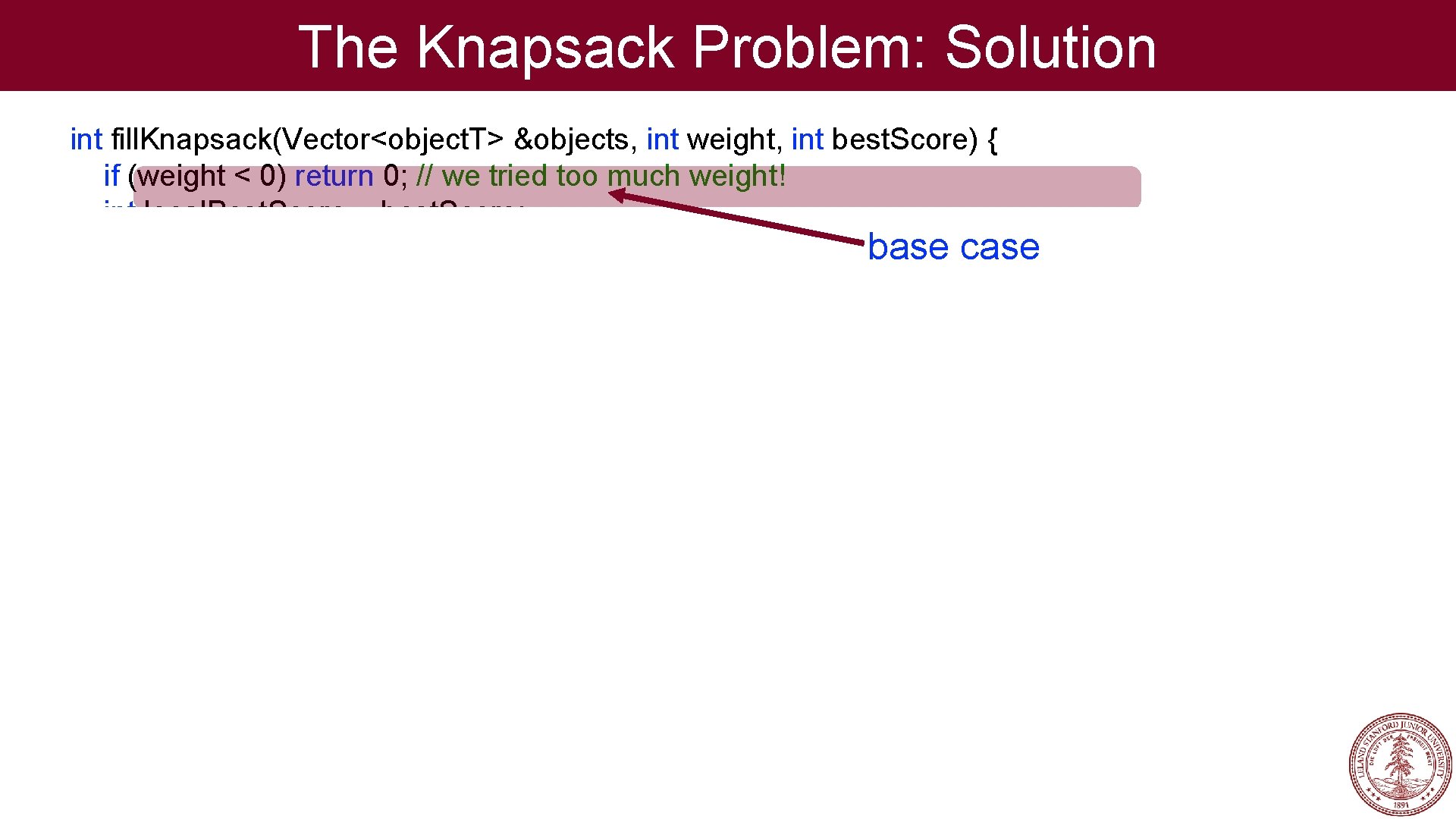
The Knapsack Problem: Solution int fill. Knapsack(Vector<object. T> &objects, int weight, int best. Score) { if (weight < 0) return 0; // we tried too much weight! int local. Best. Score = best. Score; int ob. Size = objects. size(); base case for (int i = 0; i < ob. Size; i++) { object. T original. Object = objects[i]; int curr. Value = best. Score + original. Object. value; int curr. Weight = weight - original. Object. weight; // remove object for recursion objects. remove(i); curr. Value = fill. Knapsack(objects, curr. Weight, curr. Value); if (local. Best. Score < curr. Value) { local. Best. Score = curr. Value; } // replace objects. insert(i, original. Object); } return local. Best. Score; }
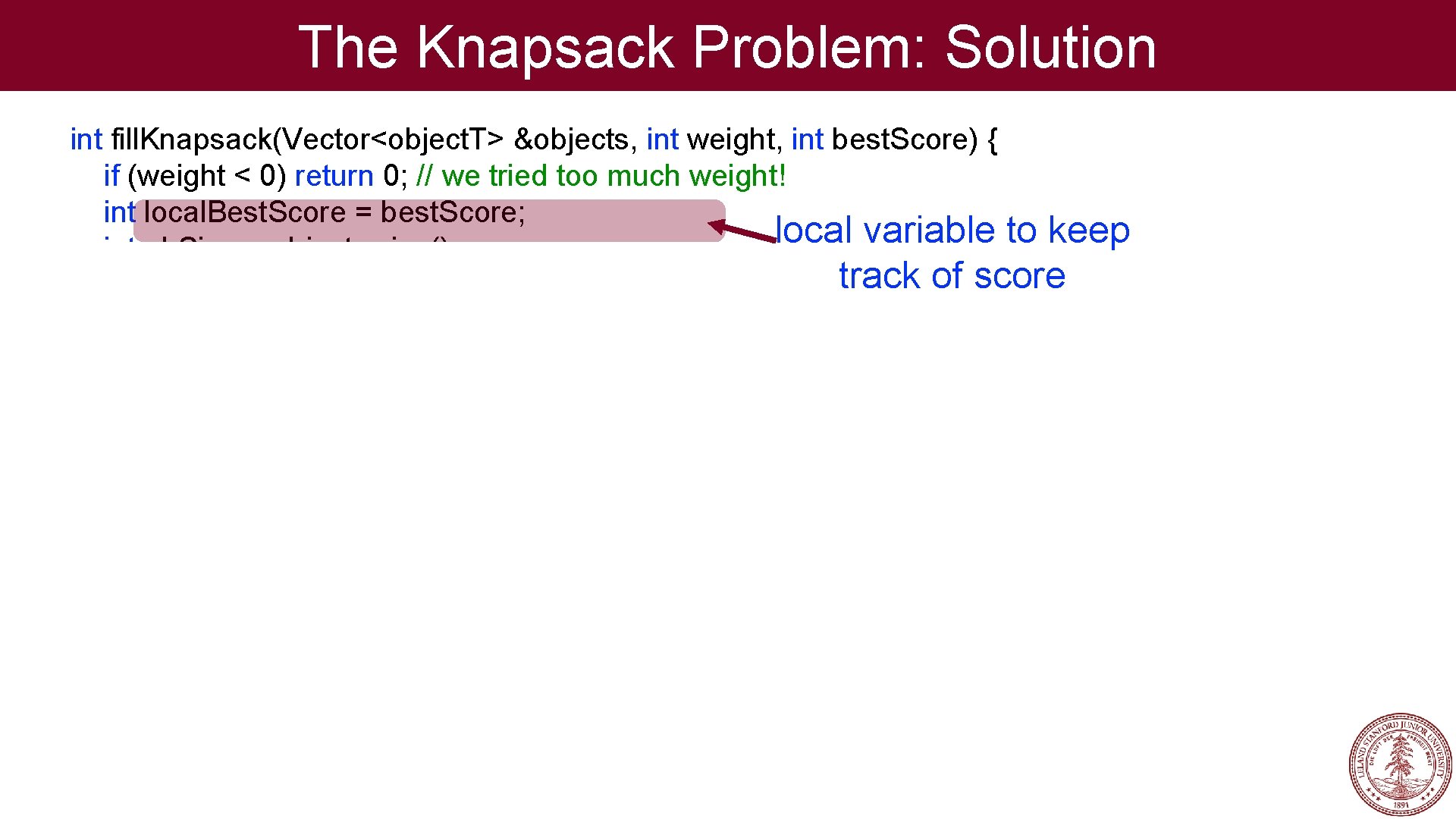
The Knapsack Problem: Solution int fill. Knapsack(Vector<object. T> &objects, int weight, int best. Score) { if (weight < 0) return 0; // we tried too much weight! int local. Best. Score = best. Score; local variable to keep int ob. Size = objects. size(); track of score for (int i = 0; i < ob. Size; i++) { object. T original. Object = objects[i]; int curr. Value = best. Score + original. Object. value; int curr. Weight = weight - original. Object. weight; // remove object for recursion objects. remove(i); curr. Value = fill. Knapsack(objects, curr. Weight, curr. Value); if (local. Best. Score < curr. Value) { local. Best. Score = curr. Value; } // replace objects. insert(i, original. Object); } return local. Best. Score; }
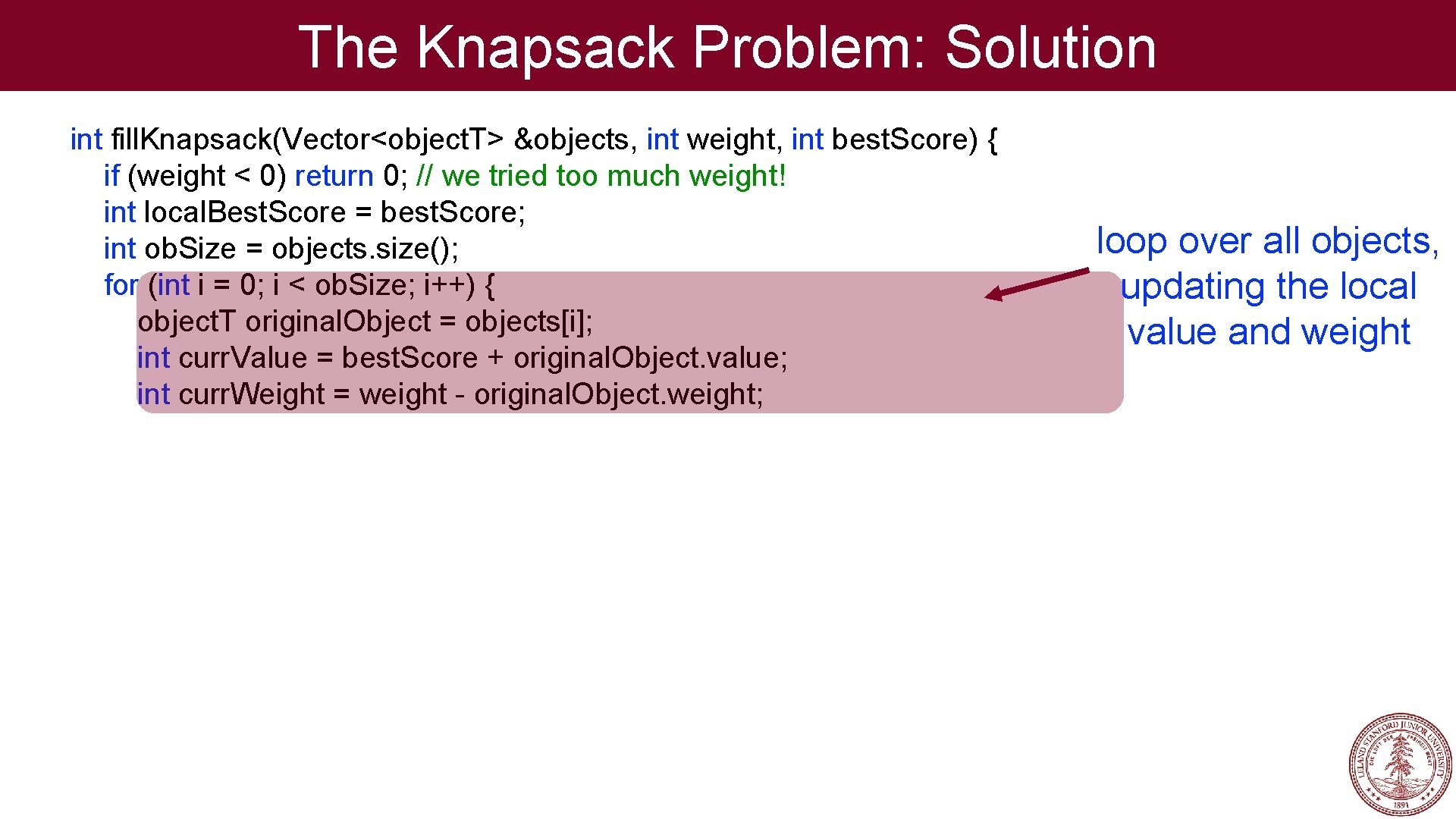
The Knapsack Problem: Solution int fill. Knapsack(Vector<object. T> &objects, int weight, int best. Score) { if (weight < 0) return 0; // we tried too much weight! int local. Best. Score = best. Score; int ob. Size = objects. size(); for (int i = 0; i < ob. Size; i++) { object. T original. Object = objects[i]; int curr. Value = best. Score + original. Object. value; int curr. Weight = weight - original. Object. weight; // remove object for recursion objects. remove(i); curr. Value = fill. Knapsack(objects, curr. Weight, curr. Value); if (local. Best. Score < curr. Value) { local. Best. Score = curr. Value; } // replace objects. insert(i, original. Object); } return local. Best. Score; } loop over all objects, updating the local value and weight
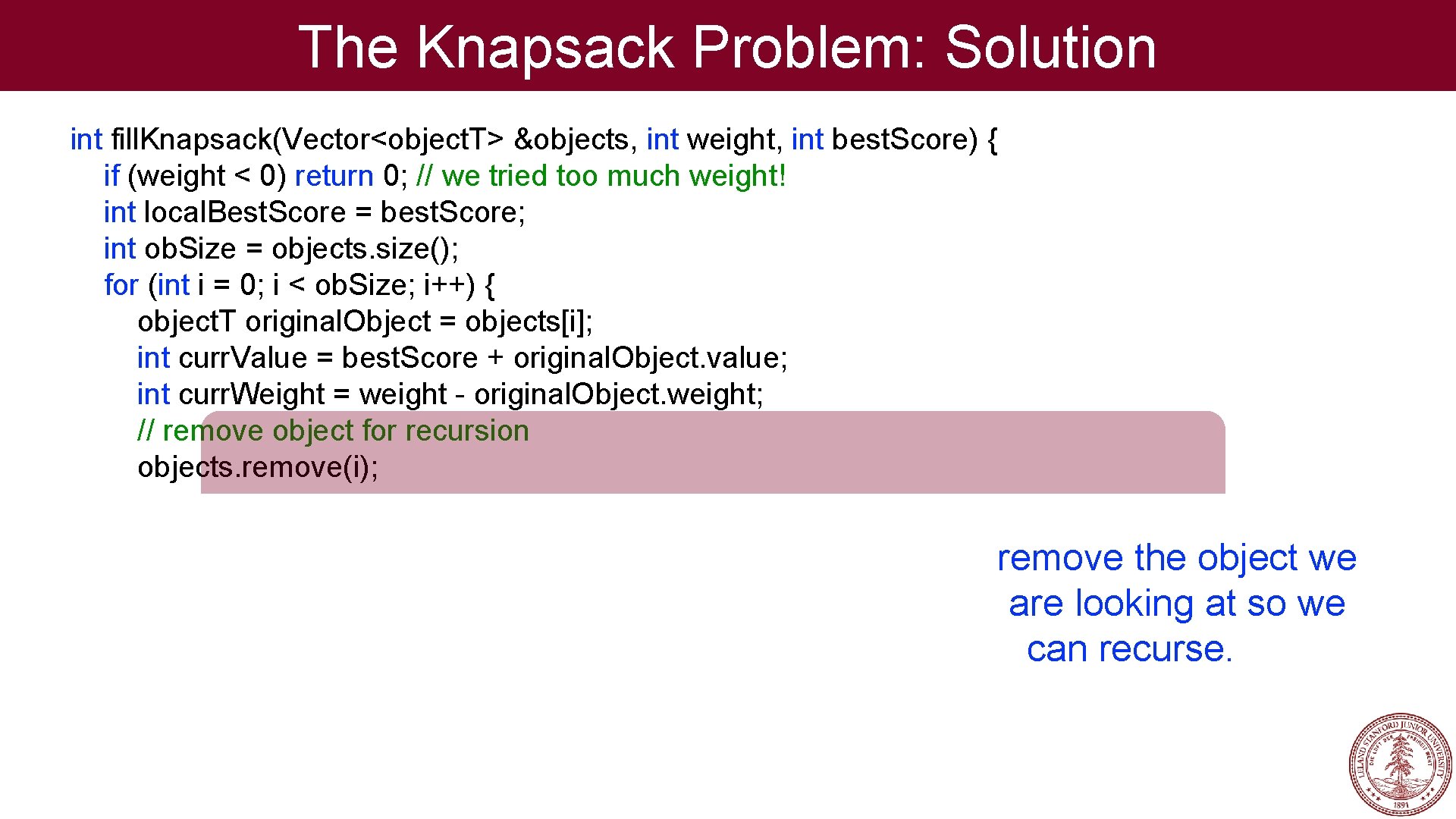
The Knapsack Problem: Solution int fill. Knapsack(Vector<object. T> &objects, int weight, int best. Score) { if (weight < 0) return 0; // we tried too much weight! int local. Best. Score = best. Score; int ob. Size = objects. size(); for (int i = 0; i < ob. Size; i++) { object. T original. Object = objects[i]; int curr. Value = best. Score + original. Object. value; int curr. Weight = weight - original. Object. weight; // remove object for recursion objects. remove(i); curr. Value = fill. Knapsack(objects, curr. Weight, curr. Value); if (local. Best. Score < curr. Value) { remove the object we local. Best. Score = curr. Value; are looking at so we } // replace can recurse. Must objects. insert(i, original. Object); remember to replace it! } return local. Best. Score; }
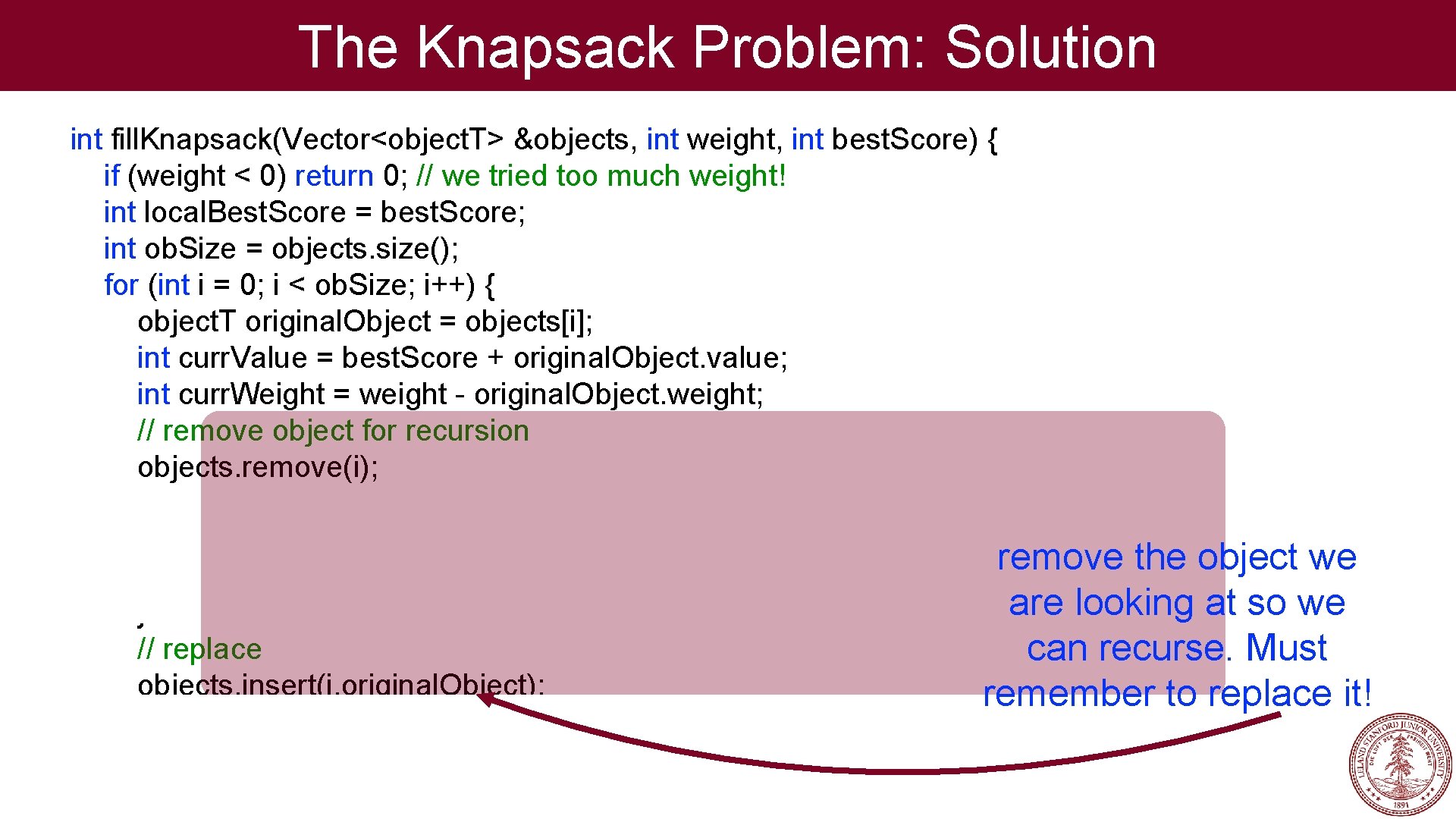
The Knapsack Problem: Solution int fill. Knapsack(Vector<object. T> &objects, int weight, int best. Score) { if (weight < 0) return 0; // we tried too much weight! int local. Best. Score = best. Score; int ob. Size = objects. size(); for (int i = 0; i < ob. Size; i++) { object. T original. Object = objects[i]; int curr. Value = best. Score + original. Object. value; int curr. Weight = weight - original. Object. weight; // remove object for recursion objects. remove(i); curr. Value = fill. Knapsack(objects, curr. Weight, curr. Value); if (local. Best. Score < curr. Value) { remove the object we local. Best. Score = curr. Value; are looking at so we } // replace can recurse. Must objects. insert(i, original. Object); remember to replace it! } return local. Best. Score; }
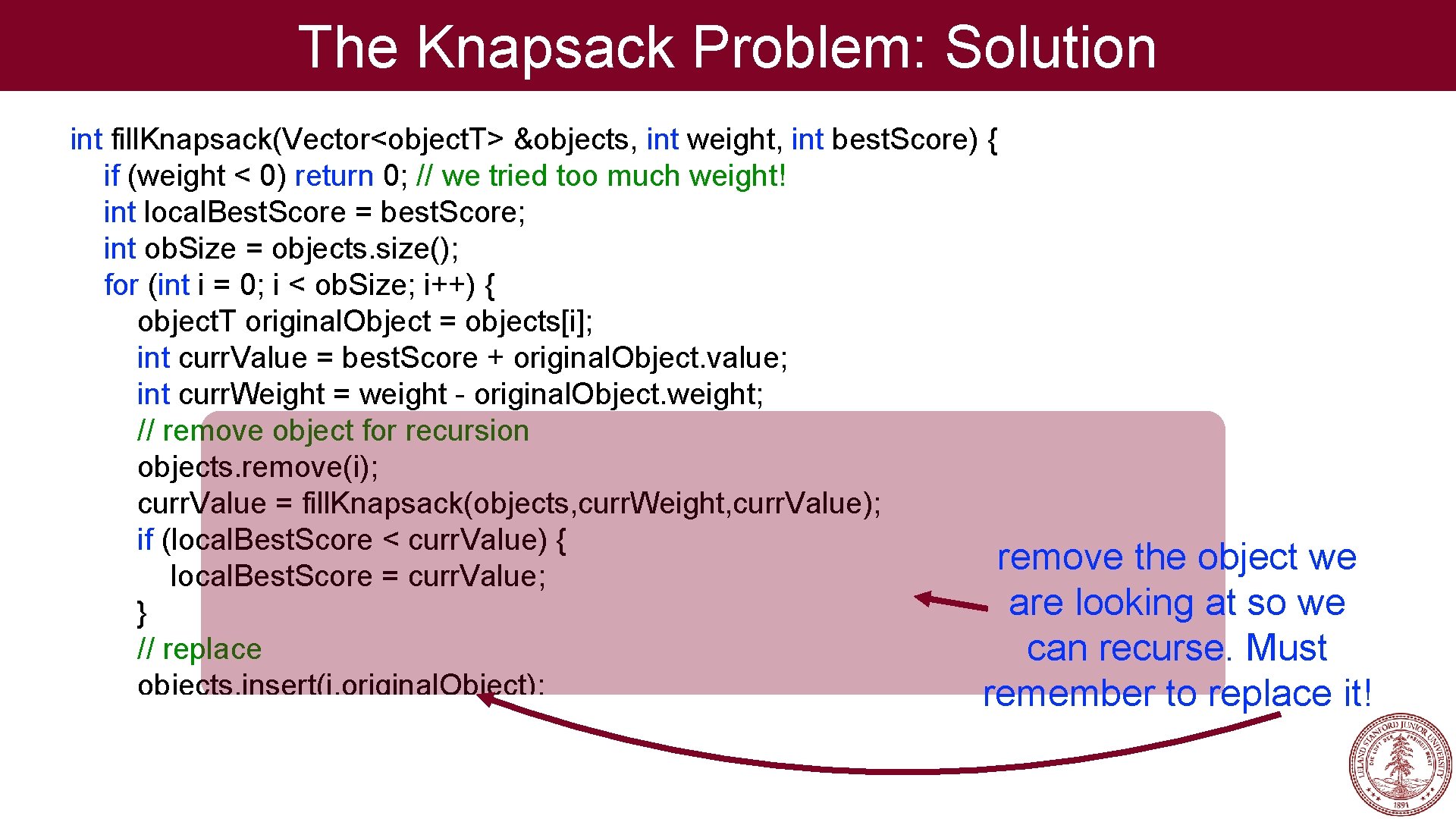
The Knapsack Problem: Solution int fill. Knapsack(Vector<object. T> &objects, int weight, int best. Score) { if (weight < 0) return 0; // we tried too much weight! int local. Best. Score = best. Score; int ob. Size = objects. size(); for (int i = 0; i < ob. Size; i++) { object. T original. Object = objects[i]; int curr. Value = best. Score + original. Object. value; int curr. Weight = weight - original. Object. weight; // remove object for recursion objects. remove(i); curr. Value = fill. Knapsack(objects, curr. Weight, curr. Value); if (local. Best. Score < curr. Value) { remove the object we local. Best. Score = curr. Value; are looking at so we } // replace can recurse. Must objects. insert(i, original. Object); remember to replace it! } return local. Best. Score; }
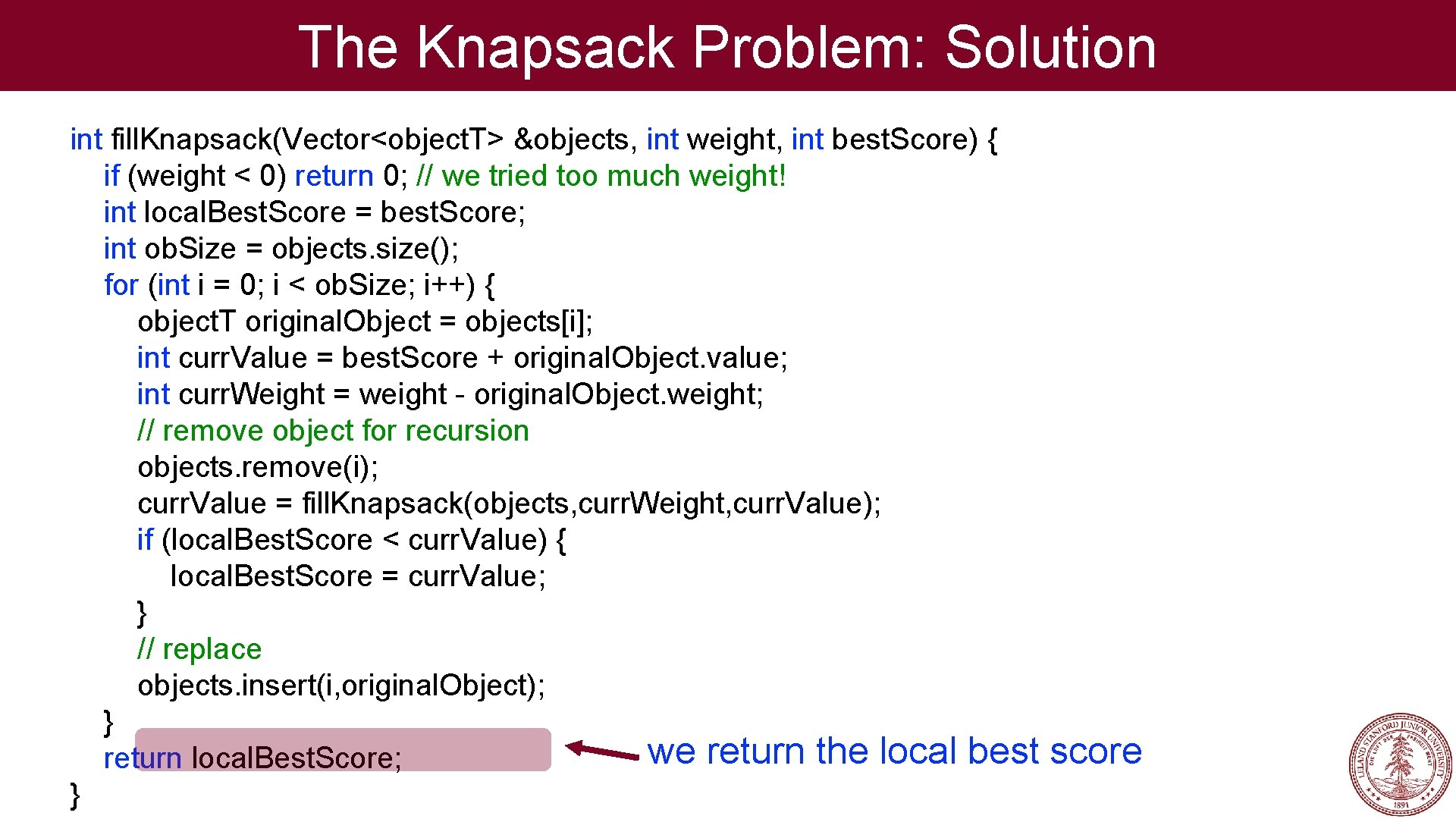
The Knapsack Problem: Solution int fill. Knapsack(Vector<object. T> &objects, int weight, int best. Score) { if (weight < 0) return 0; // we tried too much weight! int local. Best. Score = best. Score; int ob. Size = objects. size(); for (int i = 0; i < ob. Size; i++) { object. T original. Object = objects[i]; int curr. Value = best. Score + original. Object. value; int curr. Weight = weight - original. Object. weight; // remove object for recursion objects. remove(i); curr. Value = fill. Knapsack(objects, curr. Weight, curr. Value); if (local. Best. Score < curr. Value) { local. Best. Score = curr. Value; } // replace objects. insert(i, original. Object); } we return the local best return local. Best. Score; } score
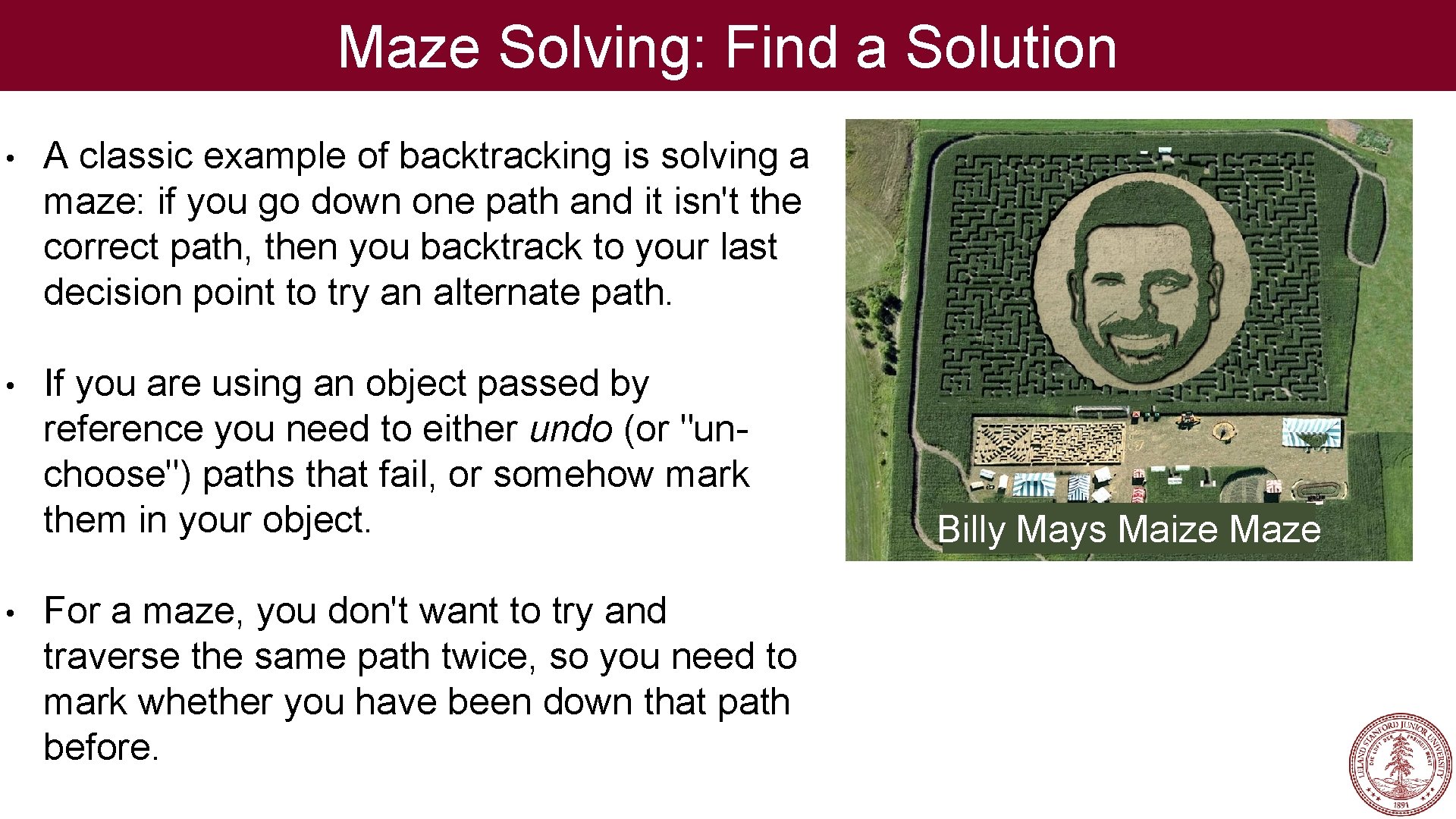
Maze Solving: Find a Solution • A classic example of backtracking is solving a maze: if you go down one path and it isn't the correct path, then you backtrack to your last decision point to try an alternate path. • If you are using an object passed by reference you need to either undo (or "unchoose") paths that fail, or somehow mark them in your object. • For a maze, you don't want to try and traverse the same path twice, so you need to mark whether you have been down that path before. Billy Mays Maize Maze
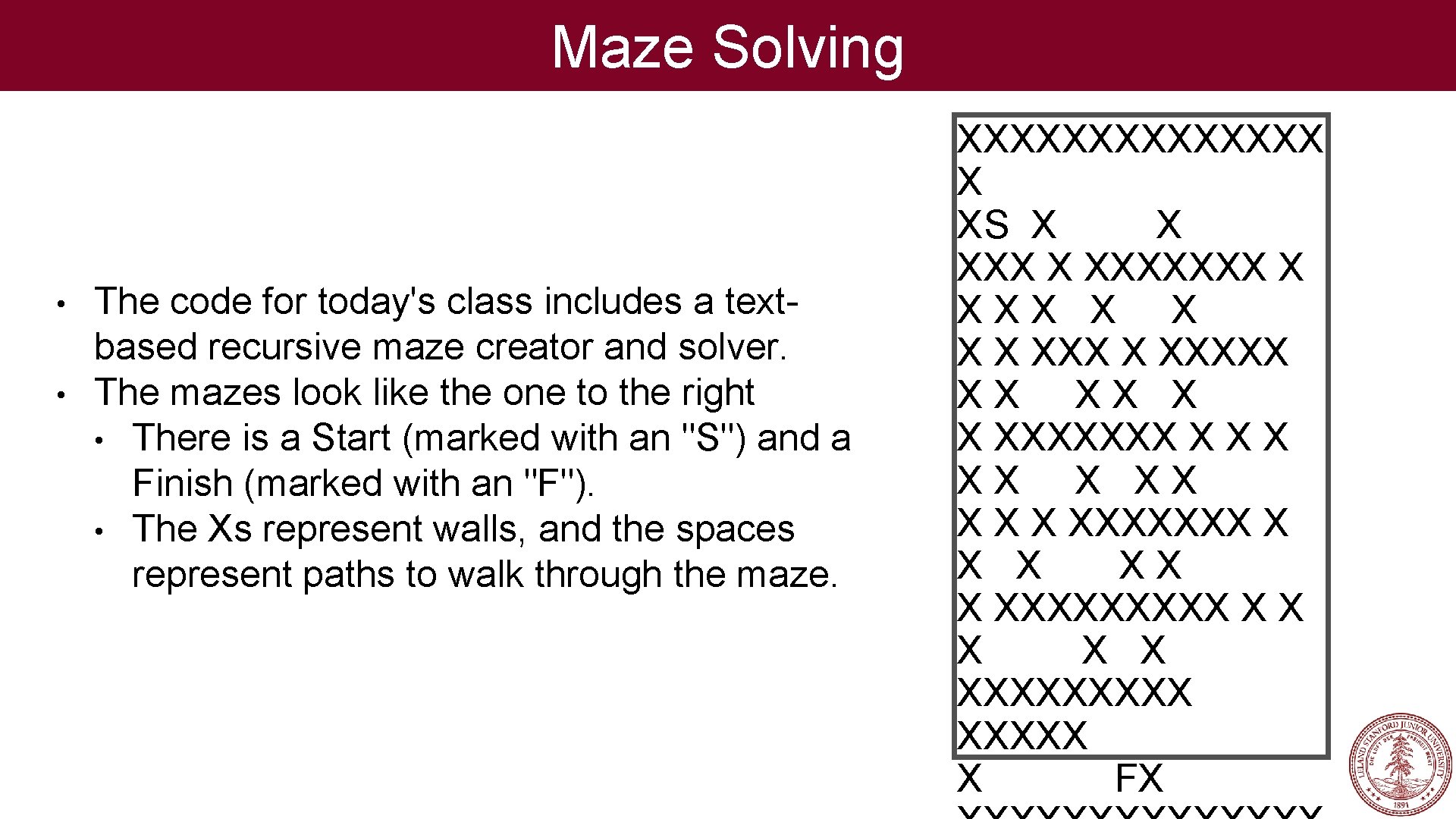
Maze Solving • • The code for today's class includes a textbased recursive maze creator and solver. The mazes look like the one to the right • There is a Start (marked with an "S") and a Finish (marked with an "F"). • The Xs represent walls, and the spaces represent paths to walk through the maze. XXXXXXX X XS X X XXXXXXX X XXXXX XX XX X X XXXXXXX X XX X XXXXX XXXXX X FX
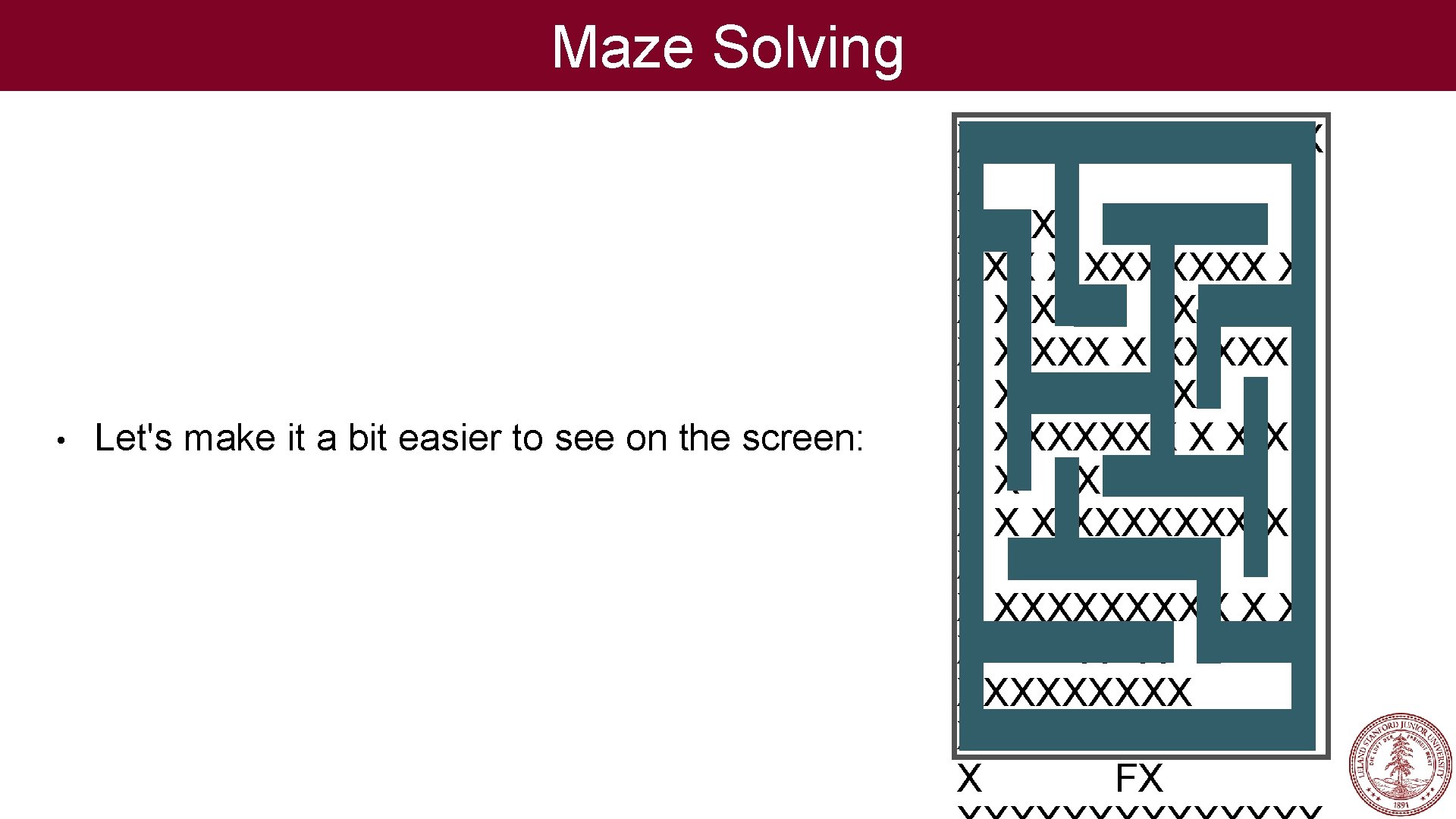
Maze Solving • Let's make it a bit easier to see on the screen: XXXXXXX X XS X X XXXXXXX X XXXXX XX XX X X XXXXXXX X XX X XXXXX XXXXX X FX
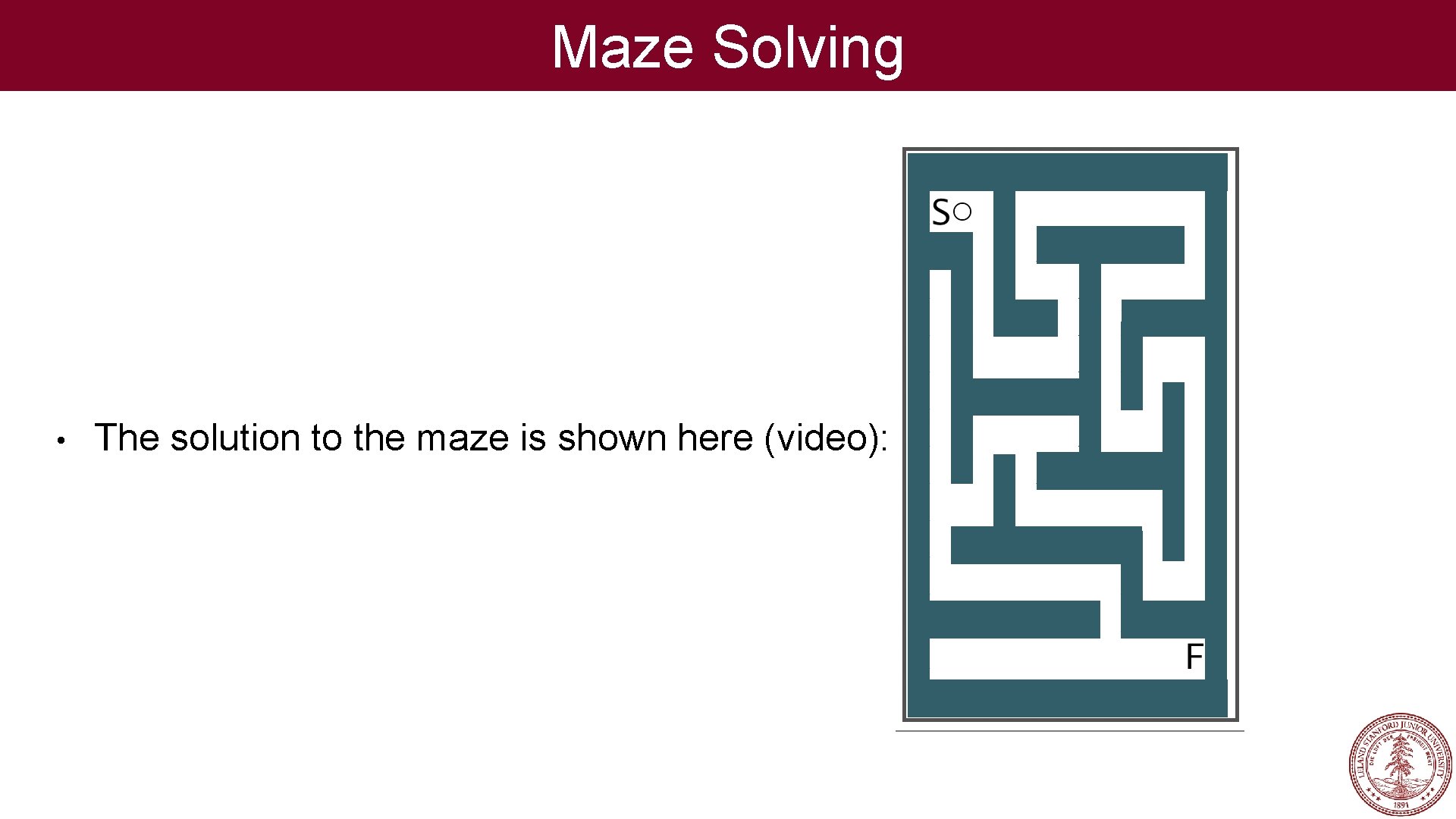
Maze Solving • The solution to the maze is shown here (video):
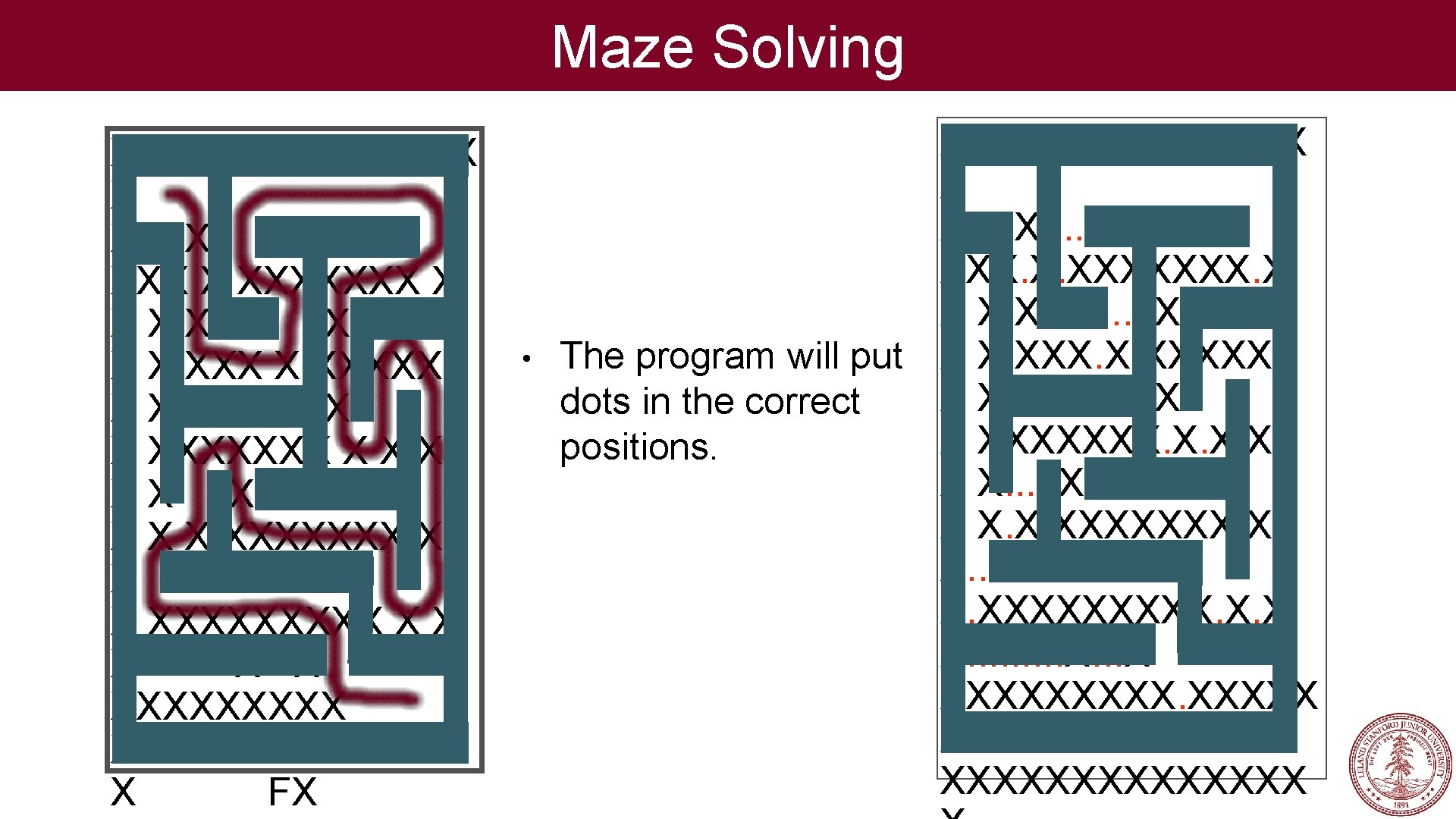
Maze Solving XXXXXXX X XS X X XXXXXXX X XXXXX XX XX X X XXXXXXX X XX X XXXXX XXXXX X FX • XXXXXXX X XS. . X XXX. X. XXXXXXX. X X X. X. . X The program will put X X. XXXXX X X. . . X dots in the correct X XXXXXXX. X positions. X X. . . X. X X X. X. XXXXXXX. X X. XXXXX. X. X X. . . X XXXXX X. . FX XXXXXXX
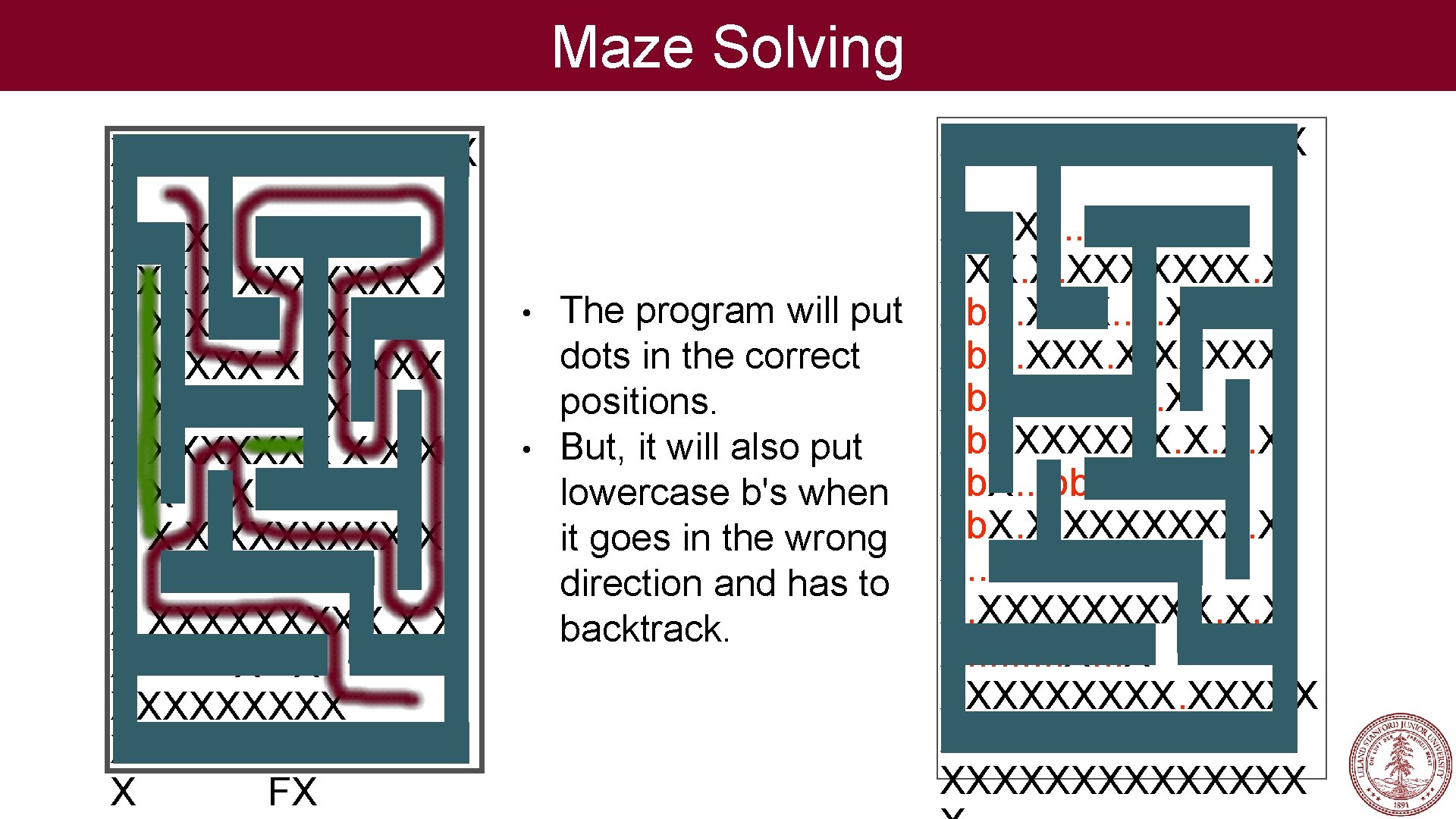
Maze Solving XXXXXXX X XS X X XXXXXXX X XXXXX XX XX X X XXXXXXX X XX X XXXXX XXXXX X FX • • XXXXXXX X XS. . X XXX. X. XXXXXXX. X The program will put Xb. X. X. . X Xb. X. XXXXX dots in the correct Xb. X. X. . . X positions. Xb. XXXXXXX. X But, it will also put lowercase b's when Xb. X. . . bb. X. X Xb. X. X. XXXXXXX. X it goes in the wrong X. X direction and has to X. XXXXX. X. X backtrack. X. . . X XXXXX X. . FX XXXXXXX
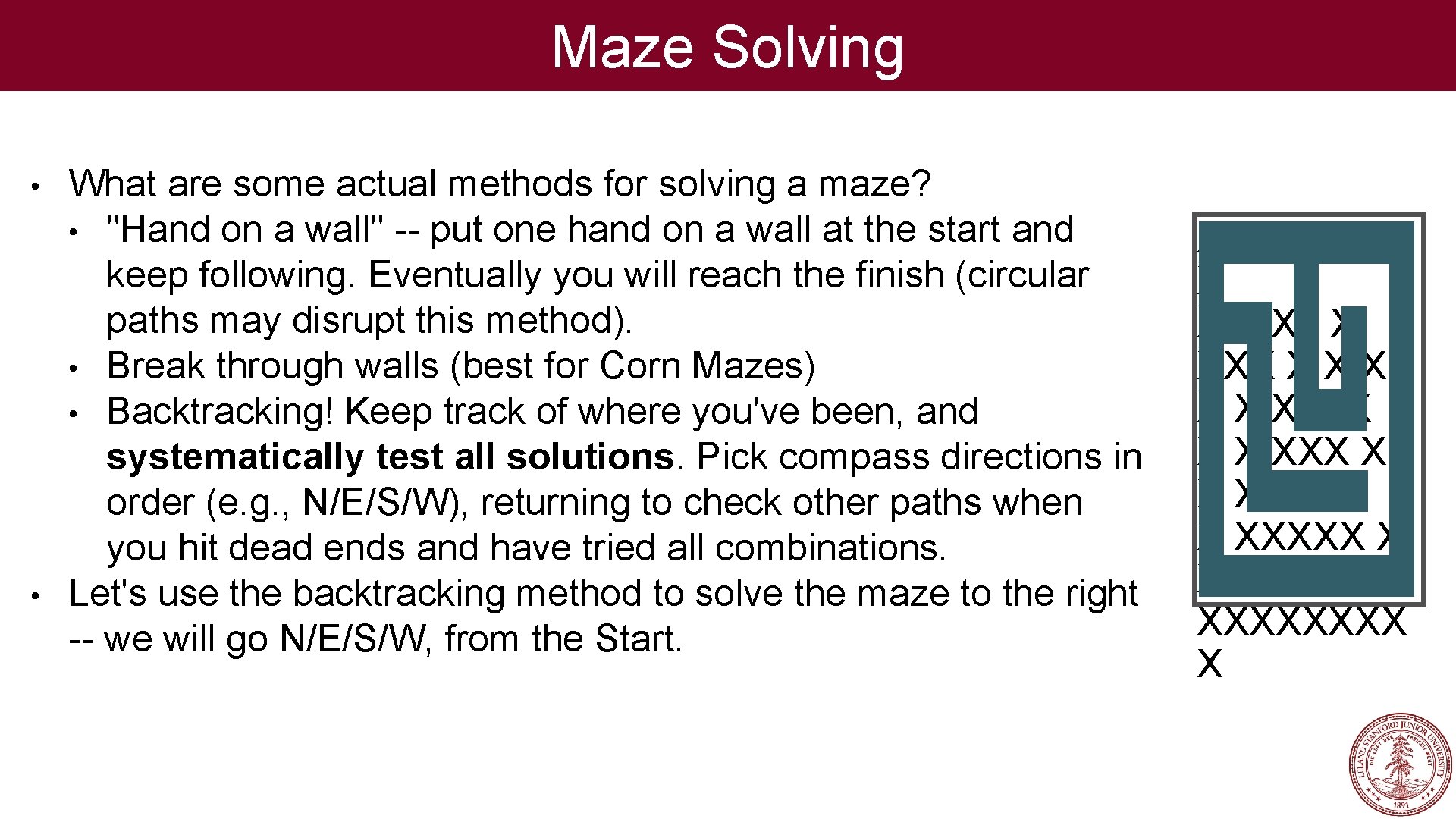
Maze Solving • • What are some actual methods for solving a maze? • "Hand on a wall" -- put one hand on a wall at the start and keep following. Eventually you will reach the finish (circular paths may disrupt this method). • Break through walls (best for Corn Mazes) • Backtracking! Keep track of where you've been, and systematically test all solutions. Pick compass directions in order (e. g. , N/E/S/W), returning to check other paths when you hit dead ends and have tried all combinations. Let's use the backtracking method to solve the maze to the right -- we will go N/E/S/W, from the Start. XXXX X XS X X XXXXX X X XXXXX X X FX XXXX X
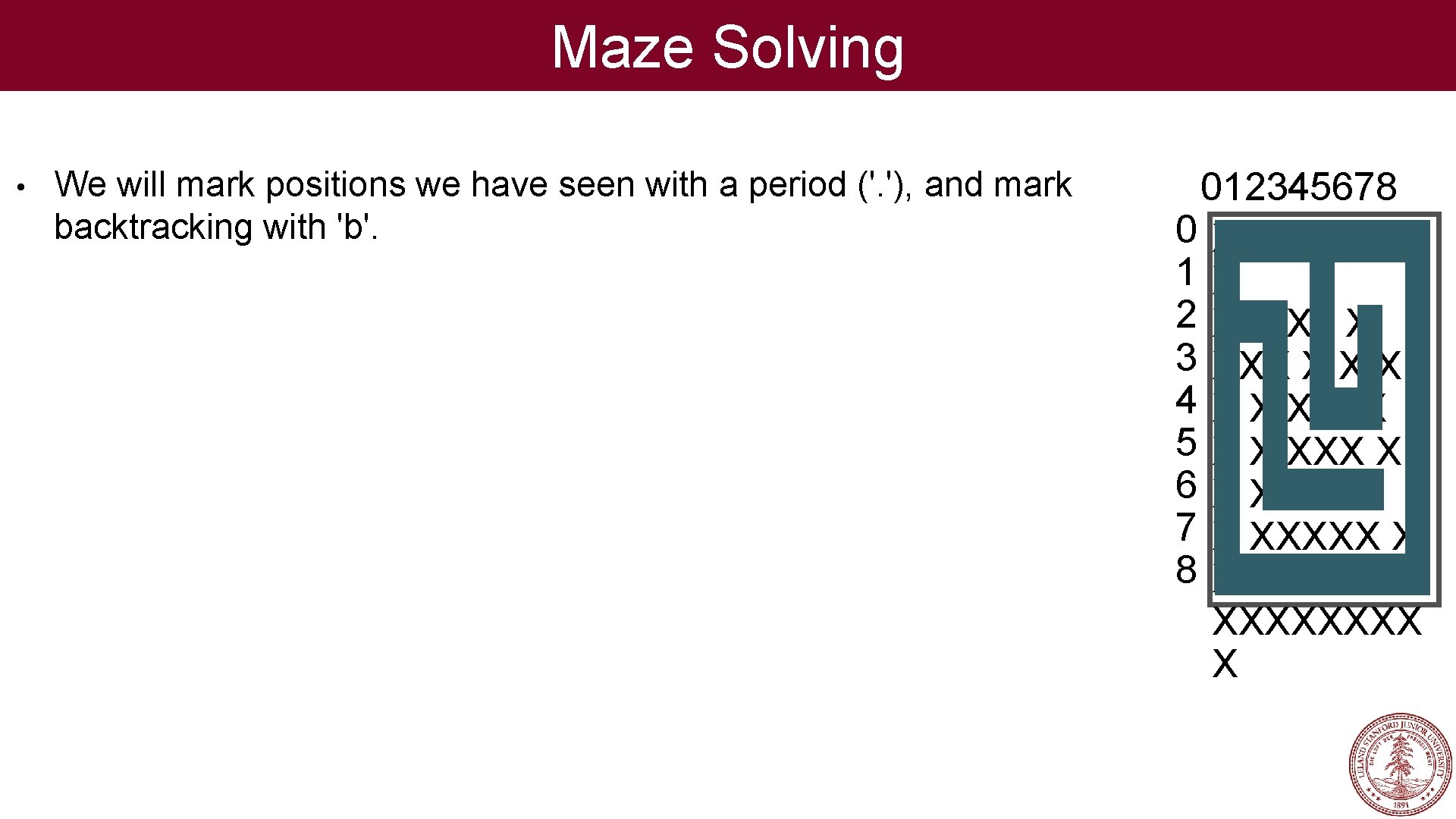
Maze Solving • We will mark positions we have seen with a period ('. '), and mark backtracking with 'b'. 012345678 0 XXXX 1 X 2 XS X X 3 XXX X 4 XXXXX 5 X X XXX X 6 XX X 7 X XXXXX X 8 X FX XXXX X
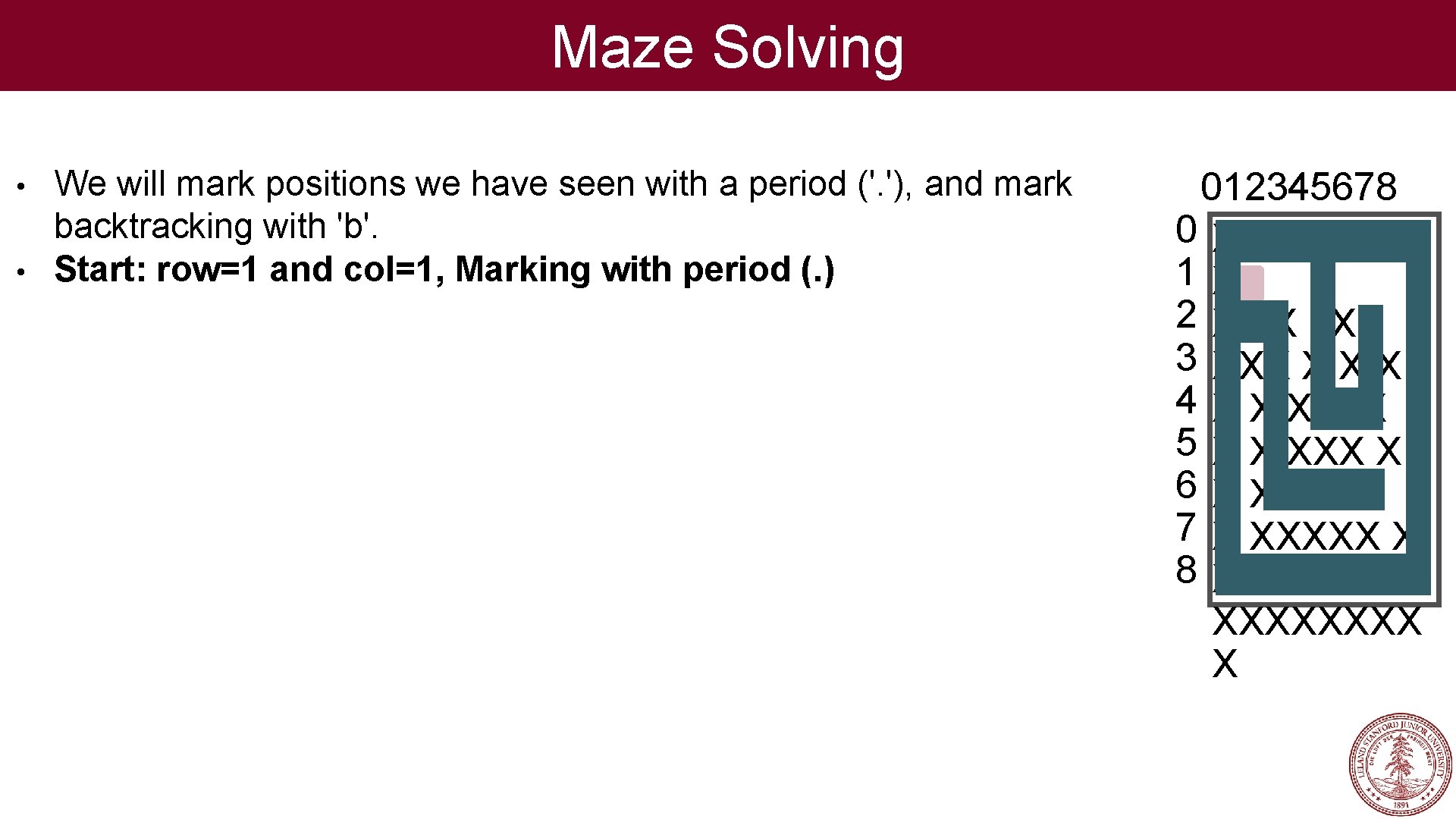
Maze Solving • • We will mark positions we have seen with a period ('. '), and mark backtracking with 'b'. Start: row=1 and col=1, Marking with period (. ) 012345678 0 XXXX 1 X 2 X. X X 3 XXX X 4 XXXXX 5 X X XXX X 6 XX X 7 X XXXXX X 8 X FX XXXX X
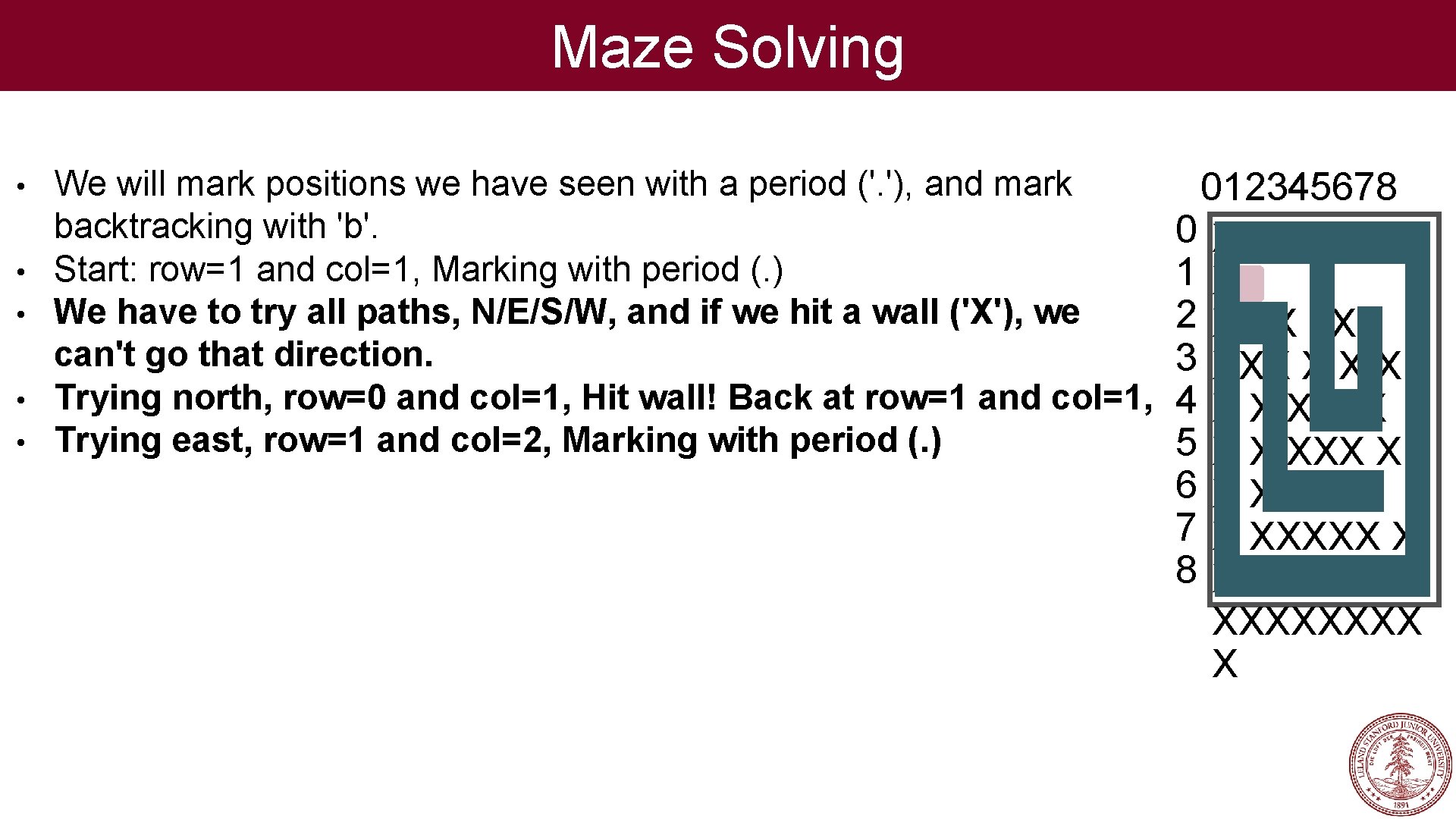
Maze Solving • • • We will mark positions we have seen with a period ('. '), and mark backtracking with 'b'. Start: row=1 and col=1, Marking with period (. ) We have to try all paths, N/E/S/W, and if we hit a wall ('X'), we can't go that direction. Trying north, row=0 and col=1, Hit wall! Back at row=1 and col=1, Trying east, row=1 and col=2, Marking with period (. ) 012345678 0 XXXX 1 X 2 X. X X 3 XXX X 4 XXXXX 5 X X XXX X 6 XX X 7 X XXXXX X 8 X FX XXXX X
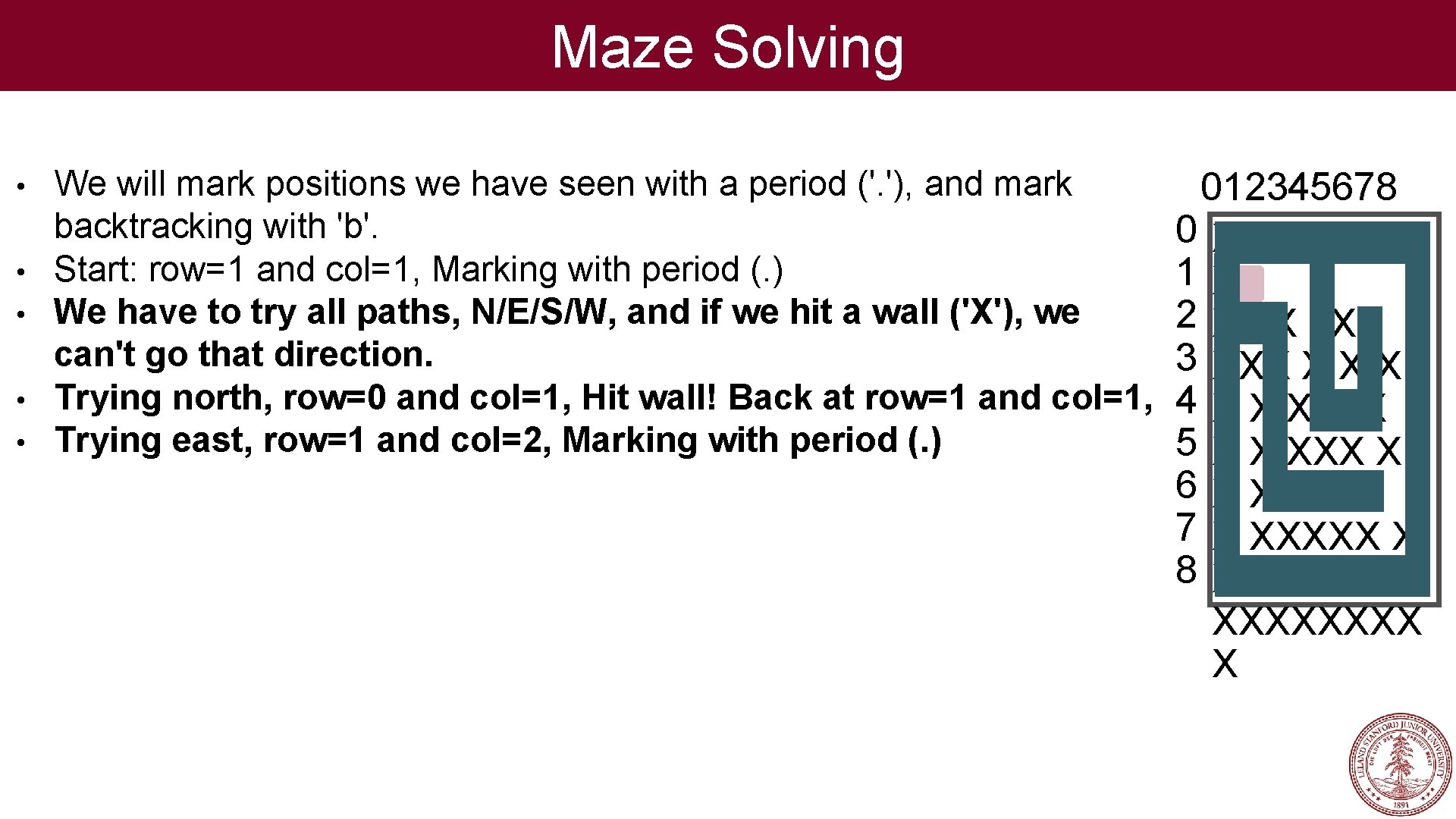
Maze Solving • • • We will mark positions we have seen with a period ('. '), and mark backtracking with 'b'. Start: row=1 and col=1, Marking with period (. ) We have to try all paths, N/E/S/W, and if we hit a wall ('X'), we can't go that direction. Trying north, row=0 and col=1, Hit wall! Back at row=1 and col=1, Trying east, row=1 and col=2, Marking with period (. ) 012345678 0 XXXX 1 X 2 X. . X X 3 XXX X 4 XXXXX 5 X X XXX X 6 XX X 7 X XXXXX X 8 X FX XXXX X
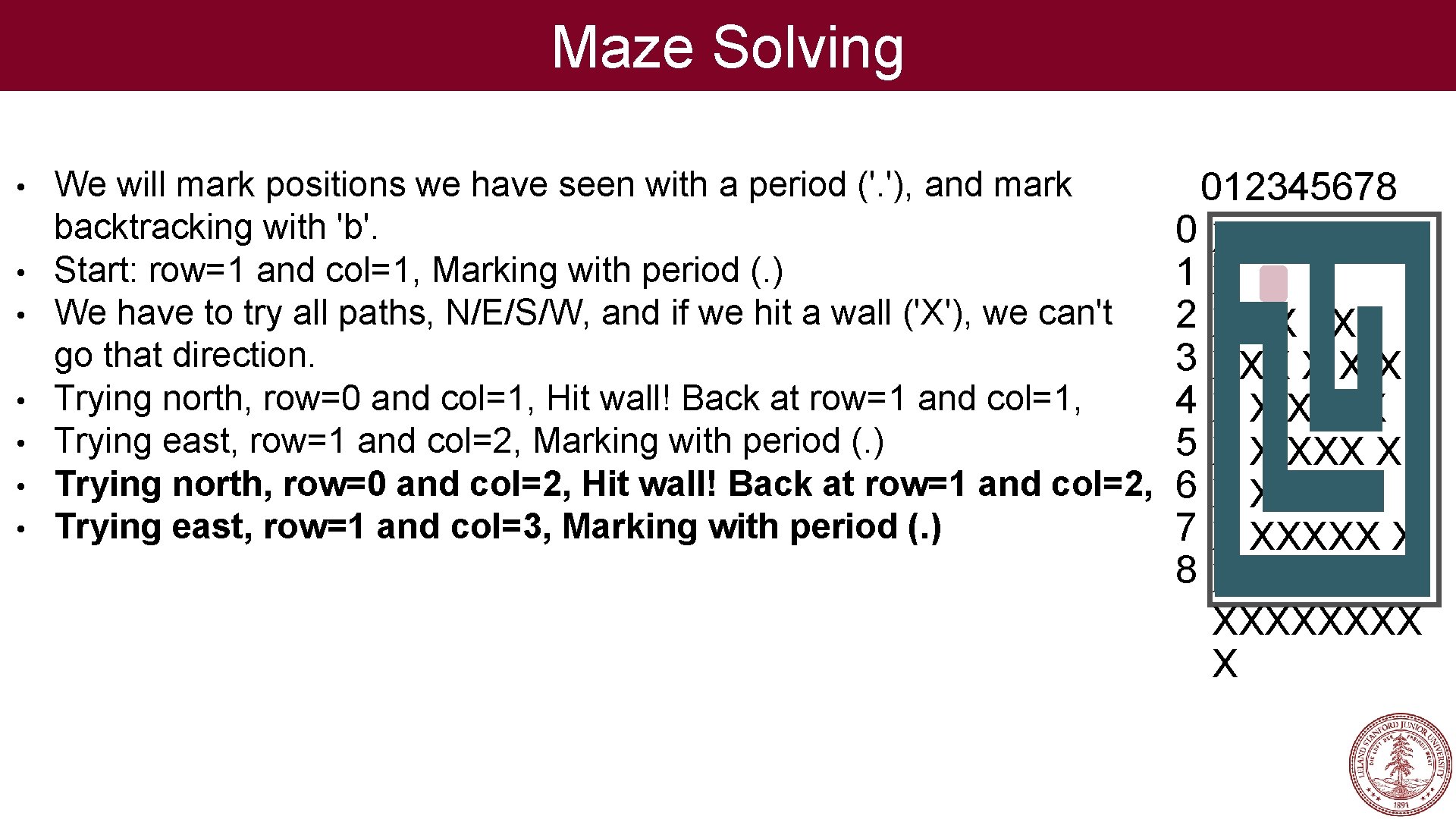
Maze Solving • • We will mark positions we have seen with a period ('. '), and mark backtracking with 'b'. Start: row=1 and col=1, Marking with period (. ) We have to try all paths, N/E/S/W, and if we hit a wall ('X'), we can't go that direction. Trying north, row=0 and col=1, Hit wall! Back at row=1 and col=1, Trying east, row=1 and col=2, Marking with period (. ) Trying north, row=0 and col=2, Hit wall! Back at row=1 and col=2, Trying east, row=1 and col=3, Marking with period (. ) 012345678 0 XXXX 1 X 2 X. . X X 3 XXX X 4 XXXXX 5 X X XXX X 6 XX X 7 X XXXXX X 8 X FX XXXX X
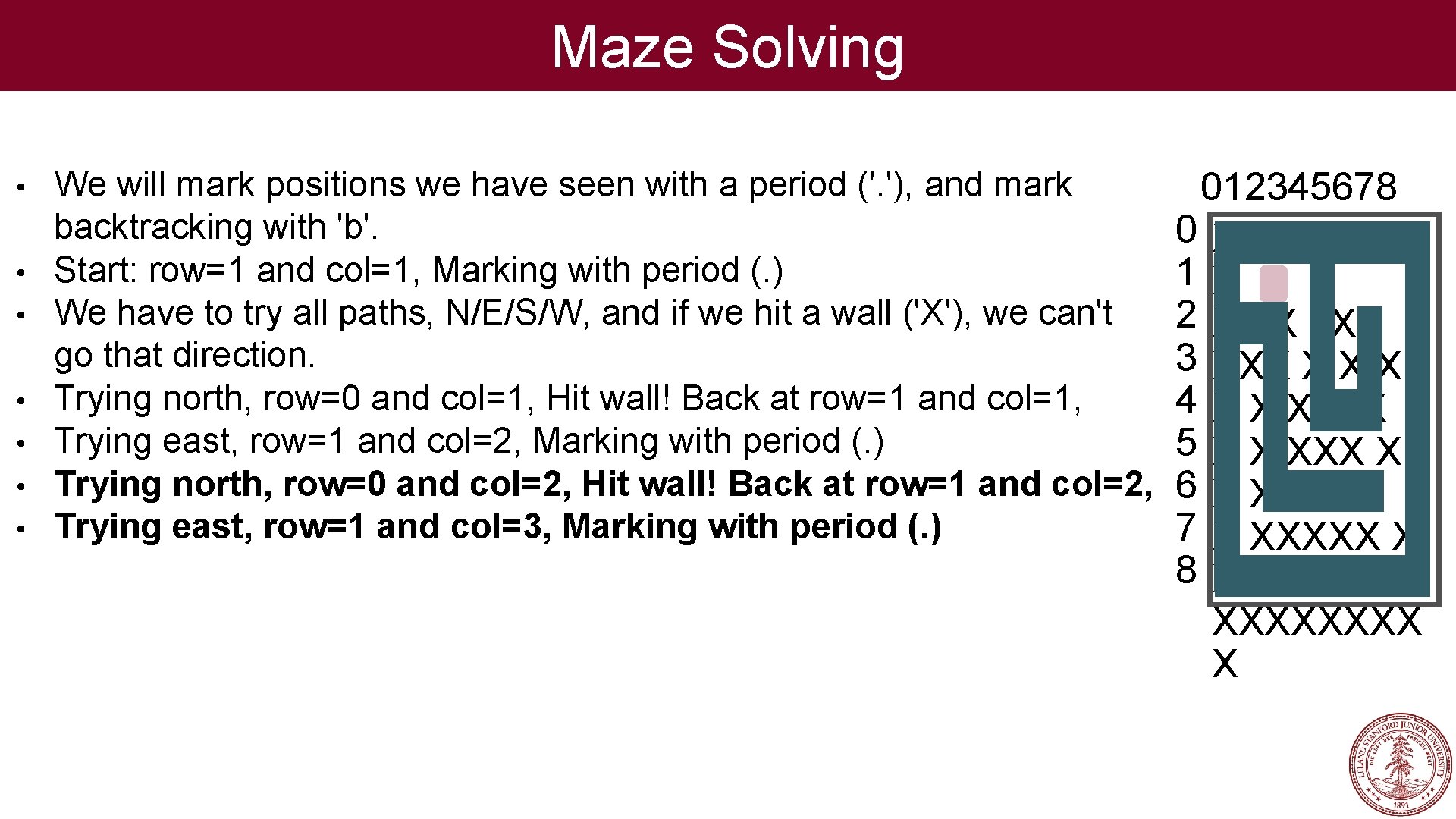
Maze Solving • • We will mark positions we have seen with a period ('. '), and mark backtracking with 'b'. Start: row=1 and col=1, Marking with period (. ) We have to try all paths, N/E/S/W, and if we hit a wall ('X'), we can't go that direction. Trying north, row=0 and col=1, Hit wall! Back at row=1 and col=1, Trying east, row=1 and col=2, Marking with period (. ) Trying north, row=0 and col=2, Hit wall! Back at row=1 and col=2, Trying east, row=1 and col=3, Marking with period (. ) 012345678 0 XXXX 1 X 2 X. . . X X 3 XXX X 4 XXXXX 5 X X XXX X 6 XX X 7 X XXXXX X 8 X FX XXXX X
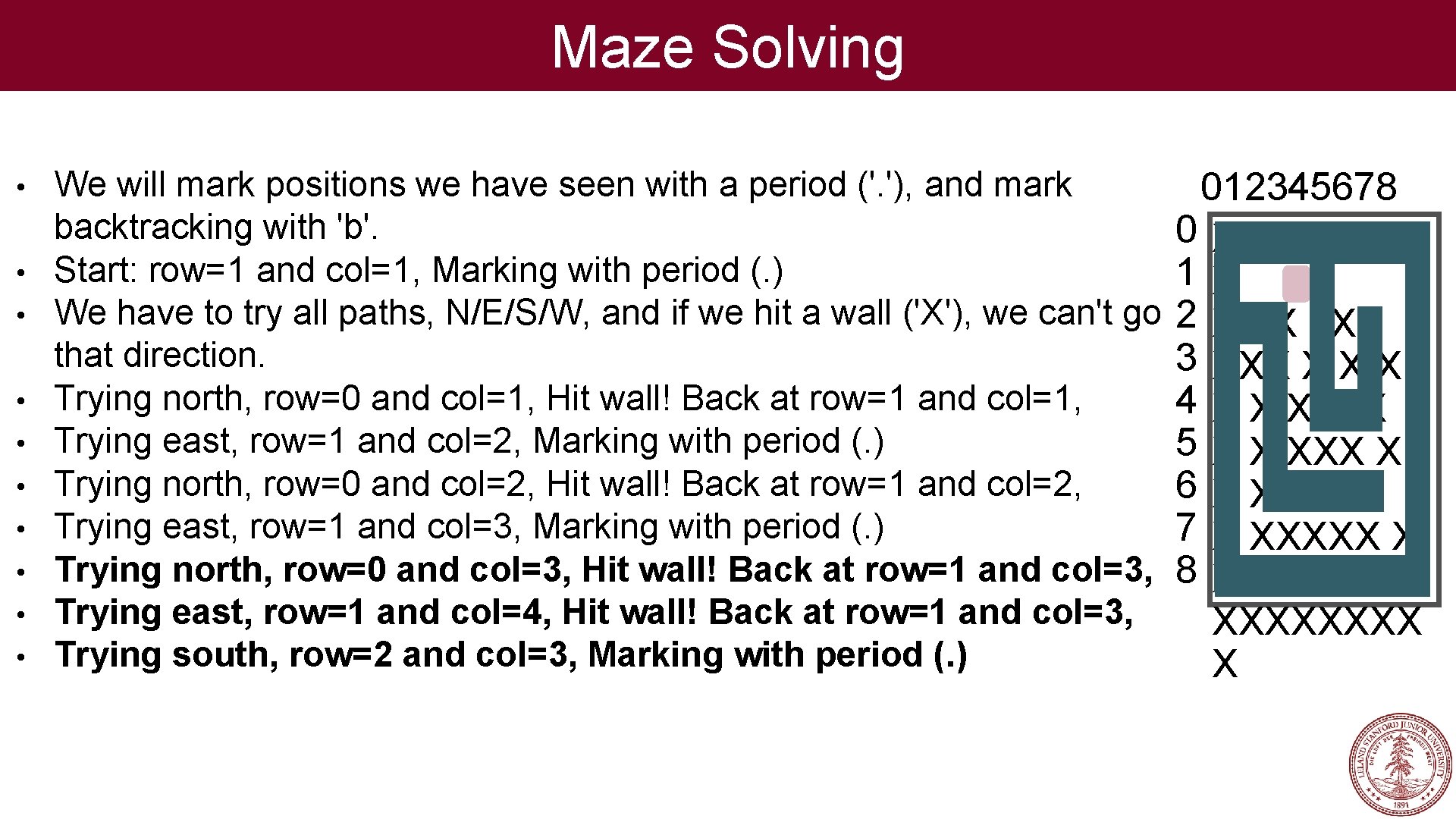
Maze Solving • • • We will mark positions we have seen with a period ('. '), and mark backtracking with 'b'. Start: row=1 and col=1, Marking with period (. ) We have to try all paths, N/E/S/W, and if we hit a wall ('X'), we can't go that direction. Trying north, row=0 and col=1, Hit wall! Back at row=1 and col=1, Trying east, row=1 and col=2, Marking with period (. ) Trying north, row=0 and col=2, Hit wall! Back at row=1 and col=2, Trying east, row=1 and col=3, Marking with period (. ) Trying north, row=0 and col=3, Hit wall! Back at row=1 and col=3, Trying east, row=1 and col=4, Hit wall! Back at row=1 and col=3, Trying south, row=2 and col=3, Marking with period (. ) 012345678 0 XXXX 1 X 2 X. . . X X 3 XXX X 4 XXXXX 5 X X XXX X 6 XX X 7 X XXXXX X 8 X FX XXXX X

Maze Solving • • • We will mark positions we have seen with a period ('. '), and mark backtracking with 'b'. Start: row=1 and col=1, Marking with period (. ) We have to try all paths, N/E/S/W, and if we hit a wall ('X'), we can't go that direction. Trying north, row=0 and col=1, Hit wall! Back at row=1 and col=1, Trying east, row=1 and col=2, Marking with period (. ) Trying north, row=0 and col=2, Hit wall! Back at row=1 and col=2, Trying east, row=1 and col=3, Marking with period (. ) Trying north, row=0 and col=3, Hit wall! Back at row=1 and col=3, Trying east, row=1 and col=4, Hit wall! Back at row=1 and col=3, Trying south, row=2 and col=3, Marking with period (. ) 012345678 0 XXXX 1 X 2 X. . . X X 3 XXX. X X X 4 XXXXX 5 X X XXX X 6 XX X 7 X XXXXX X 8 X FX XXXX X
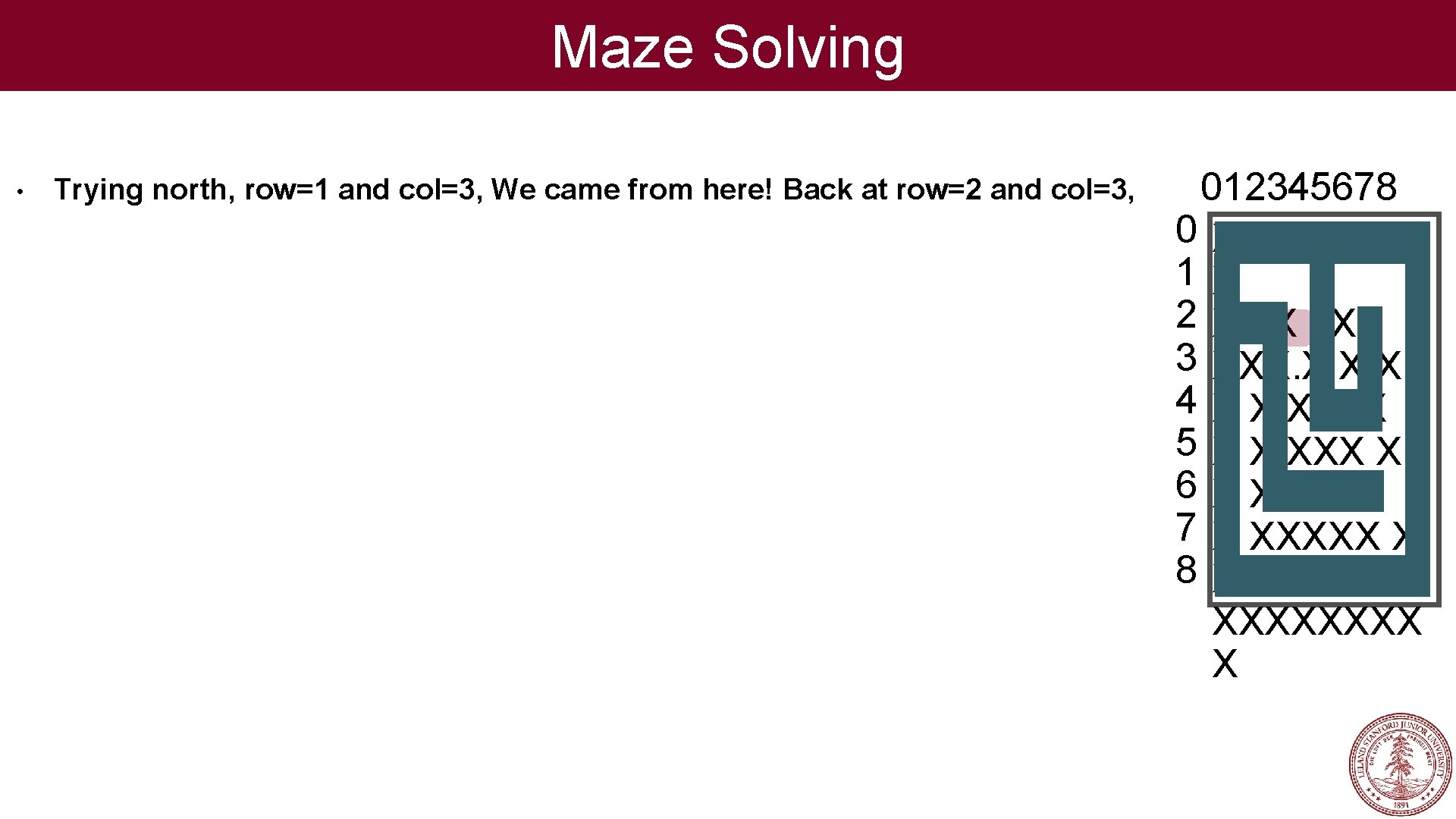
Maze Solving • Trying north, row=1 and col=3, We came from here! Back at row=2 and col=3, 012345678 0 XXXX 1 X 2 X. . . X X 3 XXX. X X X 4 XXXXX 5 X X XXX X 6 XX X 7 X XXXXX X 8 X FX XXXX X

Maze Solving • • • Trying north, row=1 and col=3, We came from here! Back at row=2 and col=3, Trying east, row=2 and col=4, Hit wall! Back at row=2 and col=3, Trying south, row=3 and col=3, Marking with period (. ) 012345678 0 XXXX 1 X 2 X. . . X X 3 XXX. X X X 4 XXXXX 5 X X XXX X 6 XX X 7 X XXXXX X 8 X FX XXXX X
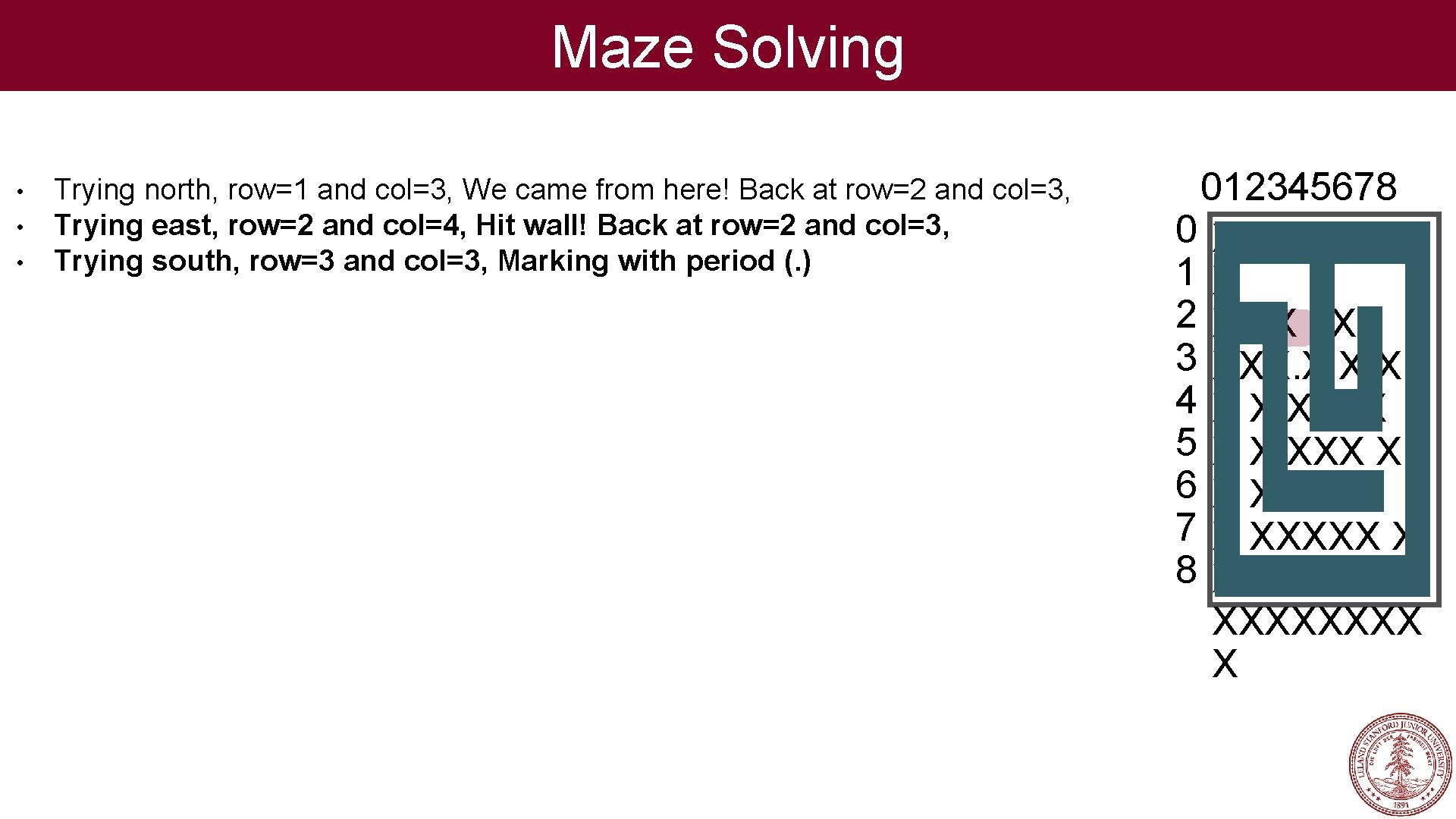
Maze Solving • • • Trying north, row=1 and col=3, We came from here! Back at row=2 and col=3, Trying east, row=2 and col=4, Hit wall! Back at row=2 and col=3, Trying south, row=3 and col=3, Marking with period (. ) 012345678 0 XXXX 1 X 2 X. . . X X 3 XXX. X X X 4 X X X 5 X X XXX X 6 XX X 7 X XXXXX X 8 X FX XXXX X
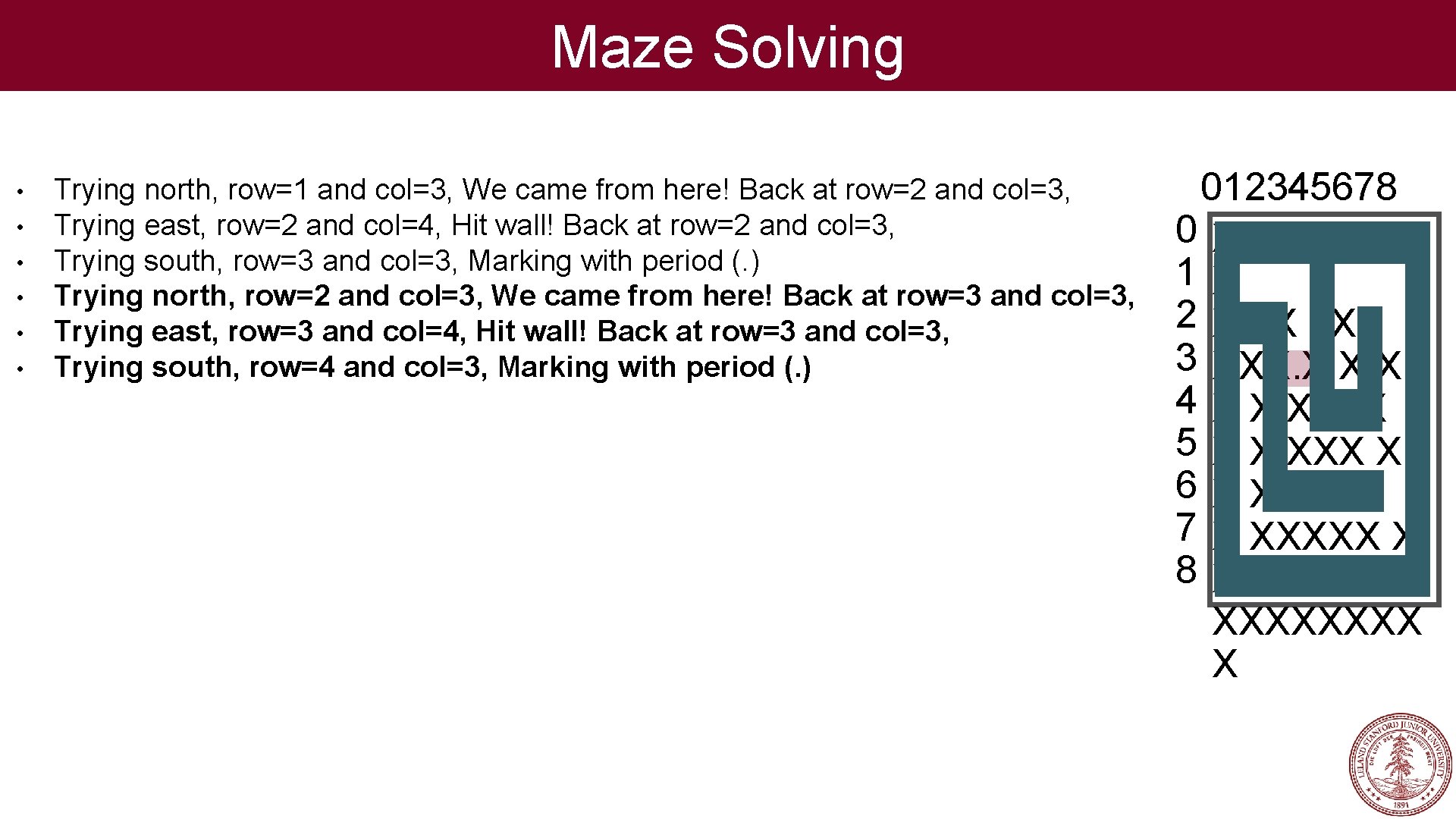
Maze Solving • • • Trying north, row=1 and col=3, We came from here! Back at row=2 and col=3, Trying east, row=2 and col=4, Hit wall! Back at row=2 and col=3, Trying south, row=3 and col=3, Marking with period (. ) Trying north, row=2 and col=3, We came from here! Back at row=3 and col=3, Trying east, row=3 and col=4, Hit wall! Back at row=3 and col=3, Trying south, row=4 and col=3, Marking with period (. ) 012345678 0 XXXX 1 X 2 X. . . X X 3 XXX. X X X 4 X X X 5 X X XXX X 6 XX X 7 X XXXXX X 8 X FX XXXX X
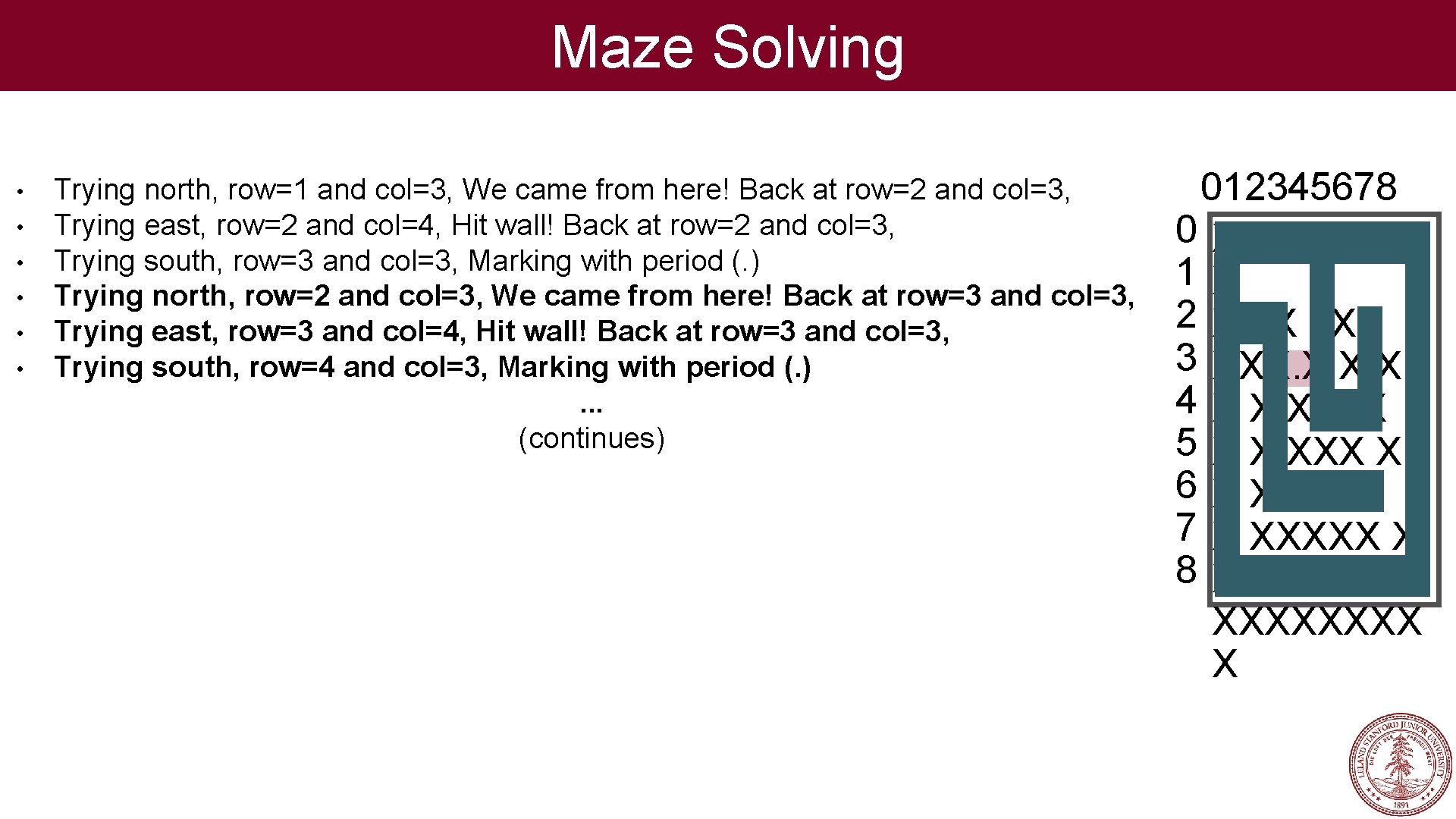
Maze Solving • • • Trying north, row=1 and col=3, We came from here! Back at row=2 and col=3, Trying east, row=2 and col=4, Hit wall! Back at row=2 and col=3, Trying south, row=3 and col=3, Marking with period (. ) Trying north, row=2 and col=3, We came from here! Back at row=3 and col=3, Trying east, row=3 and col=4, Hit wall! Back at row=3 and col=3, Trying south, row=4 and col=3, Marking with period (. ). . . (continues) 012345678 0 XXXX 1 X 2 X. . . X X 3 XXX. X X X 4 X X X 5 X X. XXX X 6 XX X 7 X XXXXX X 8 X FX XXXX X
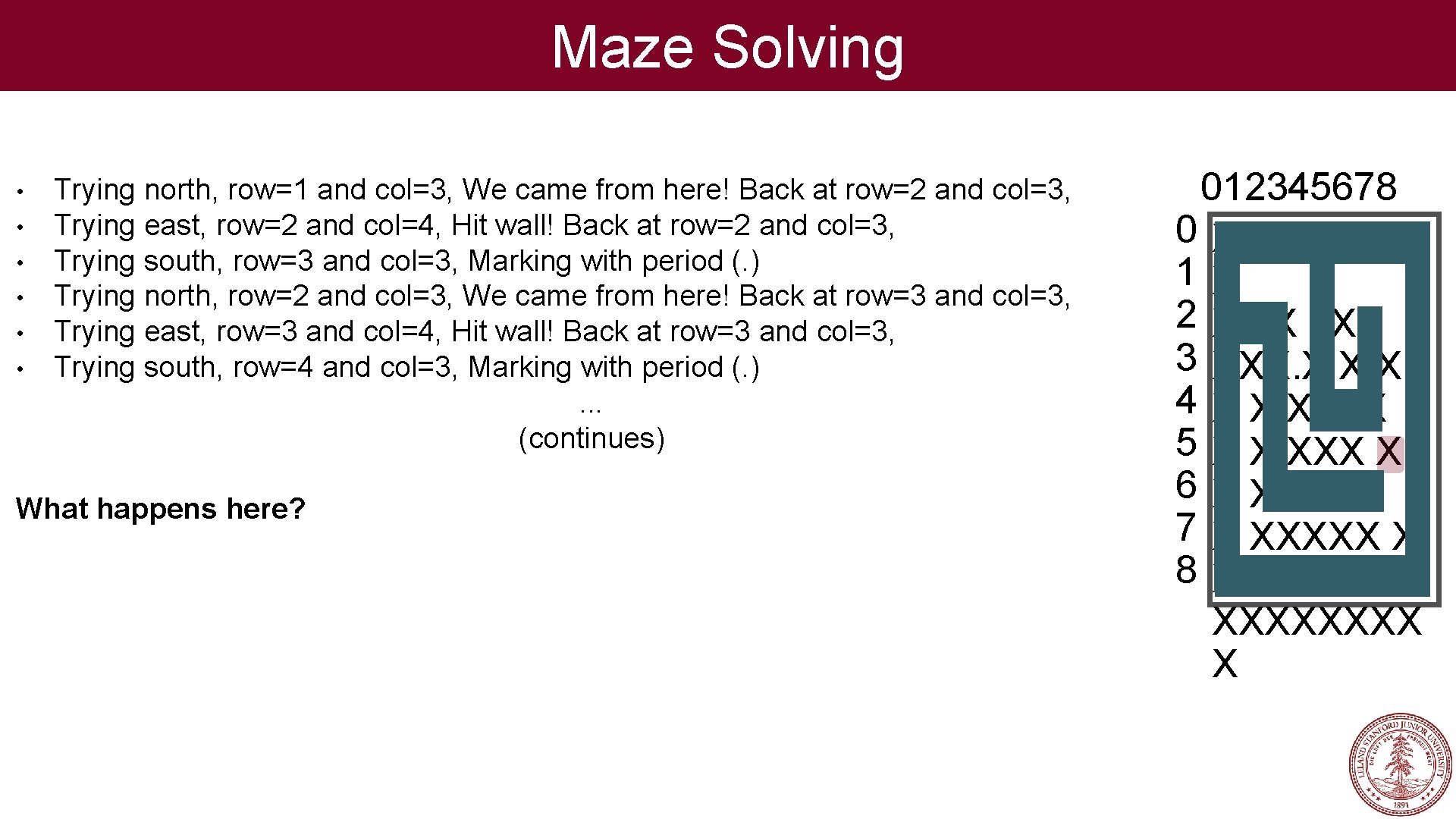
Maze Solving • • • Trying north, row=1 and col=3, We came from here! Back at row=2 and col=3, Trying east, row=2 and col=4, Hit wall! Back at row=2 and col=3, Trying south, row=3 and col=3, Marking with period (. ) Trying north, row=2 and col=3, We came from here! Back at row=3 and col=3, Trying east, row=3 and col=4, Hit wall! Back at row=3 and col=3, Trying south, row=4 and col=3, Marking with period (. ). . . (continues) What happens here? 012345678 0 XXXX 1 X 2 X. . . X X 3 XXX. X X X 4 X X X 5 X X. XXX X 6 X X. . . X 7 X XXXXX X 8 X FX XXXX X

Maze Solving • • • Trying north, row=1 and col=3, We came from here! Back at row=2 and col=3, Trying east, row=2 and col=4, Hit wall! Back at row=2 and col=3, Trying south, row=3 and col=3, Marking with period (. ) Trying north, row=2 and col=3, We came from here! Back at row=3 and col=3, Trying east, row=3 and col=4, Hit wall! Back at row=3 and col=3, Trying south, row=4 and col=3, Marking with period (. ). . . (continues) What happens here? Bummer. We check North first, so we start going up. 012345678 0 XXXX 1 X 2 X. . . X X 3 XXX. X X X 4 X X X 5 X X. XXX. X 6 X X. . . X 7 X XXXXX X 8 X FX XXXX X
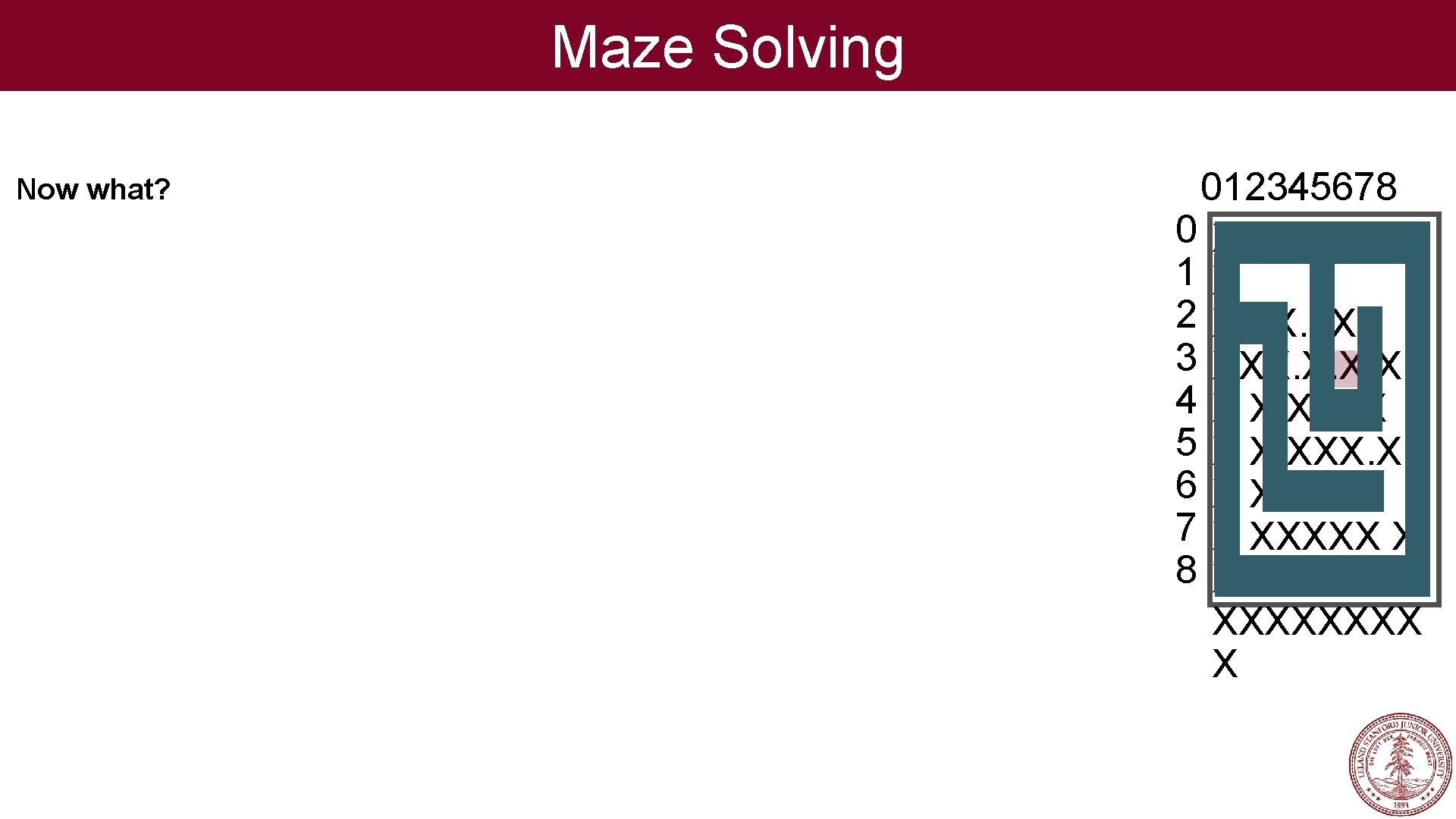
Maze Solving Now what? 012345678 0 XXXX 1 X 2 X. . . X 3 XXX. X 4 X X. X 5 X X. XXX. X 6 X X. . . X 7 X XXXXX X 8 X FX XXXX X
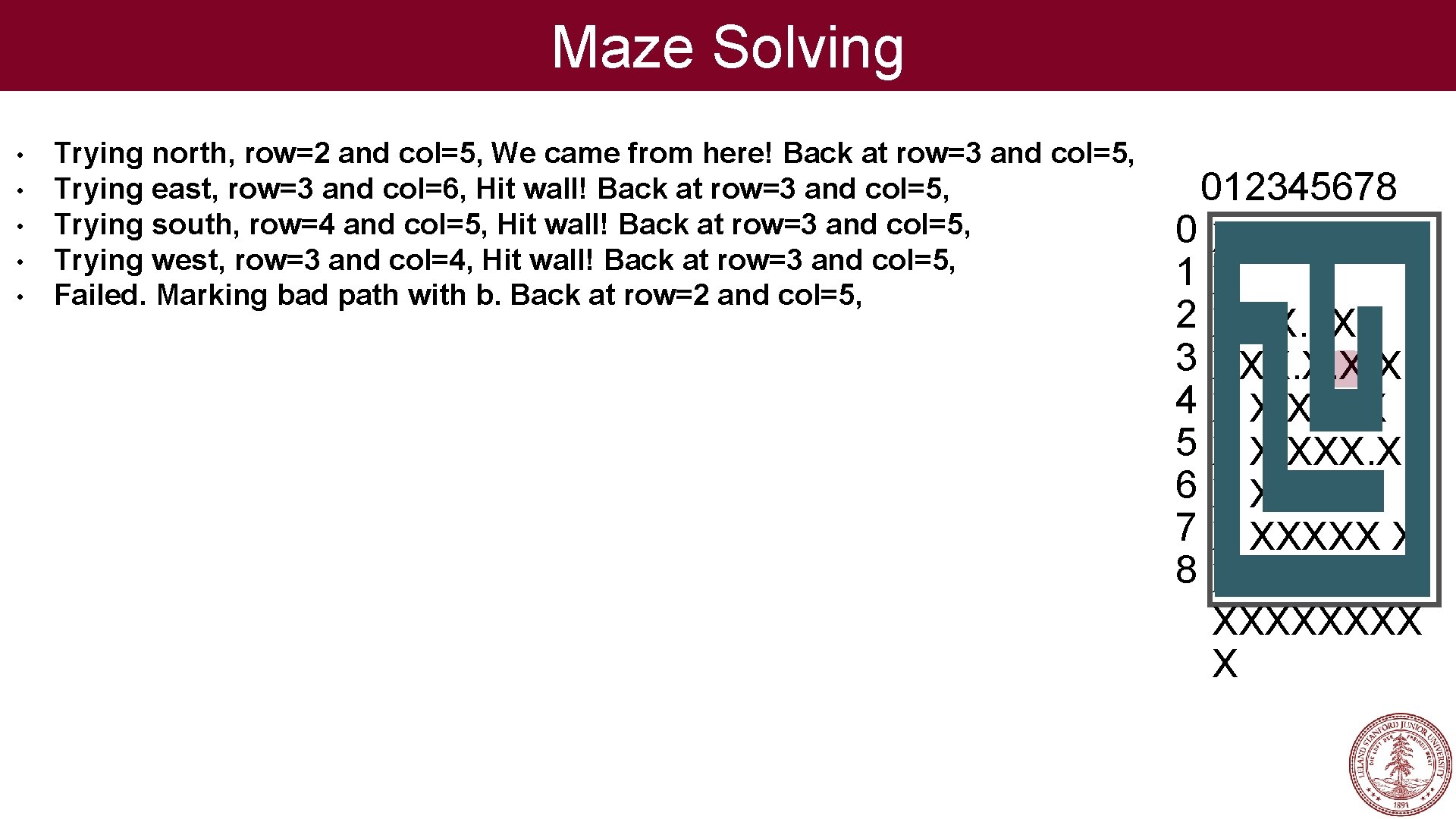
Maze Solving • • • Trying north, row=2 and col=5, We came from here! Back at row=3 and col=5, Trying east, row=3 and col=6, Hit wall! Back at row=3 and col=5, Trying south, row=4 and col=5, Hit wall! Back at row=3 and col=5, Trying west, row=3 and col=4, Hit wall! Back at row=3 and col=5, Failed. Marking bad path with b. Back at row=2 and col=5, 012345678 0 XXXX 1 X 2 X. . . X 3 XXX. X 4 X X. X 5 X X. XXX. X 6 X X. . . X 7 X XXXXX X 8 X FX XXXX X
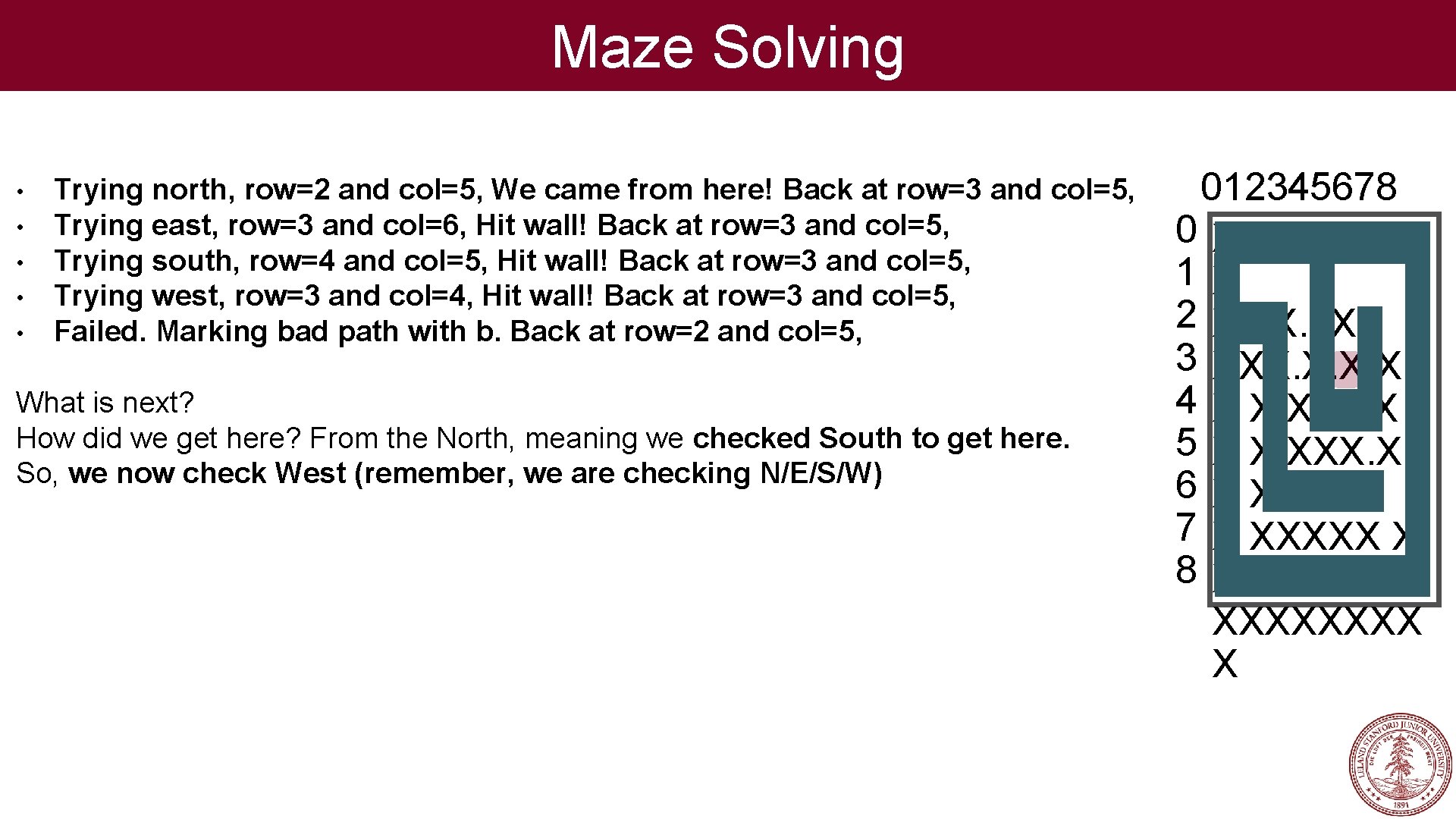
Maze Solving • • • Trying north, row=2 and col=5, We came from here! Back at row=3 and col=5, Trying east, row=3 and col=6, Hit wall! Back at row=3 and col=5, Trying south, row=4 and col=5, Hit wall! Back at row=3 and col=5, Trying west, row=3 and col=4, Hit wall! Back at row=3 and col=5, Failed. Marking bad path with b. Back at row=2 and col=5, What is next? How did we get here? From the North, meaning we checked South to get here. So, we now check West (remember, we are checking N/E/S/W) 012345678 0 XXXX 1 X 2 X. . . X 3 XXX. X 4 X X. Xb. X. X 5 X X. XXX. X 6 X X. . . X 7 X XXXXX X 8 X FX XXXX X
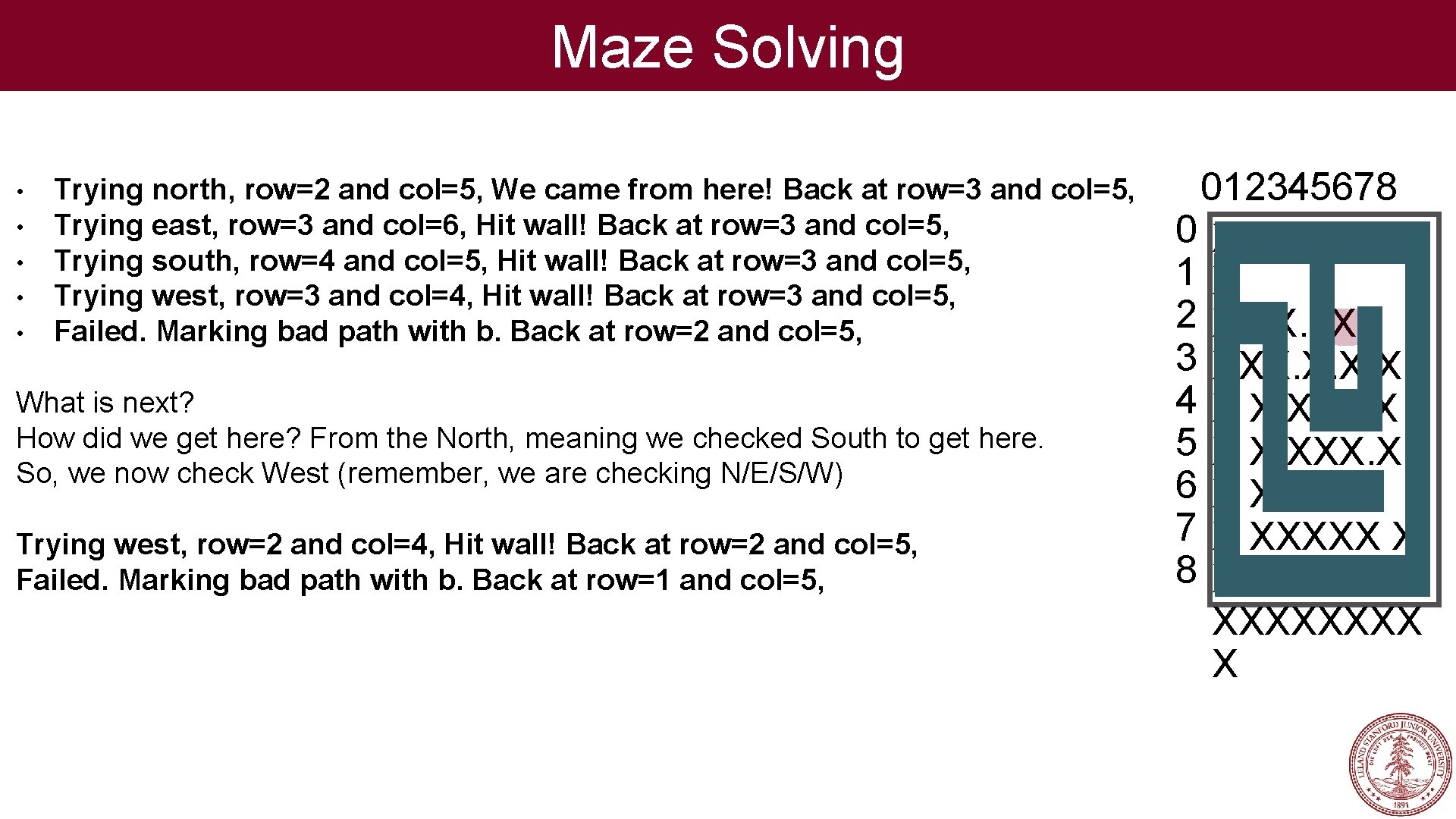
Maze Solving • • • Trying north, row=2 and col=5, We came from here! Back at row=3 and col=5, Trying east, row=3 and col=6, Hit wall! Back at row=3 and col=5, Trying south, row=4 and col=5, Hit wall! Back at row=3 and col=5, Trying west, row=3 and col=4, Hit wall! Back at row=3 and col=5, Failed. Marking bad path with b. Back at row=2 and col=5, What is next? How did we get here? From the North, meaning we checked South to get here. So, we now check West (remember, we are checking N/E/S/W) Trying west, row=2 and col=4, Hit wall! Back at row=2 and col=5, Failed. Marking bad path with b. Back at row=1 and col=5, 012345678 0 XXXX 1 X 2 X. . . X 3 XXX. X 4 X X. Xb. X. X 5 X X. XXX. X 6 X X. . . X 7 X XXXXX X 8 X FX XXXX X
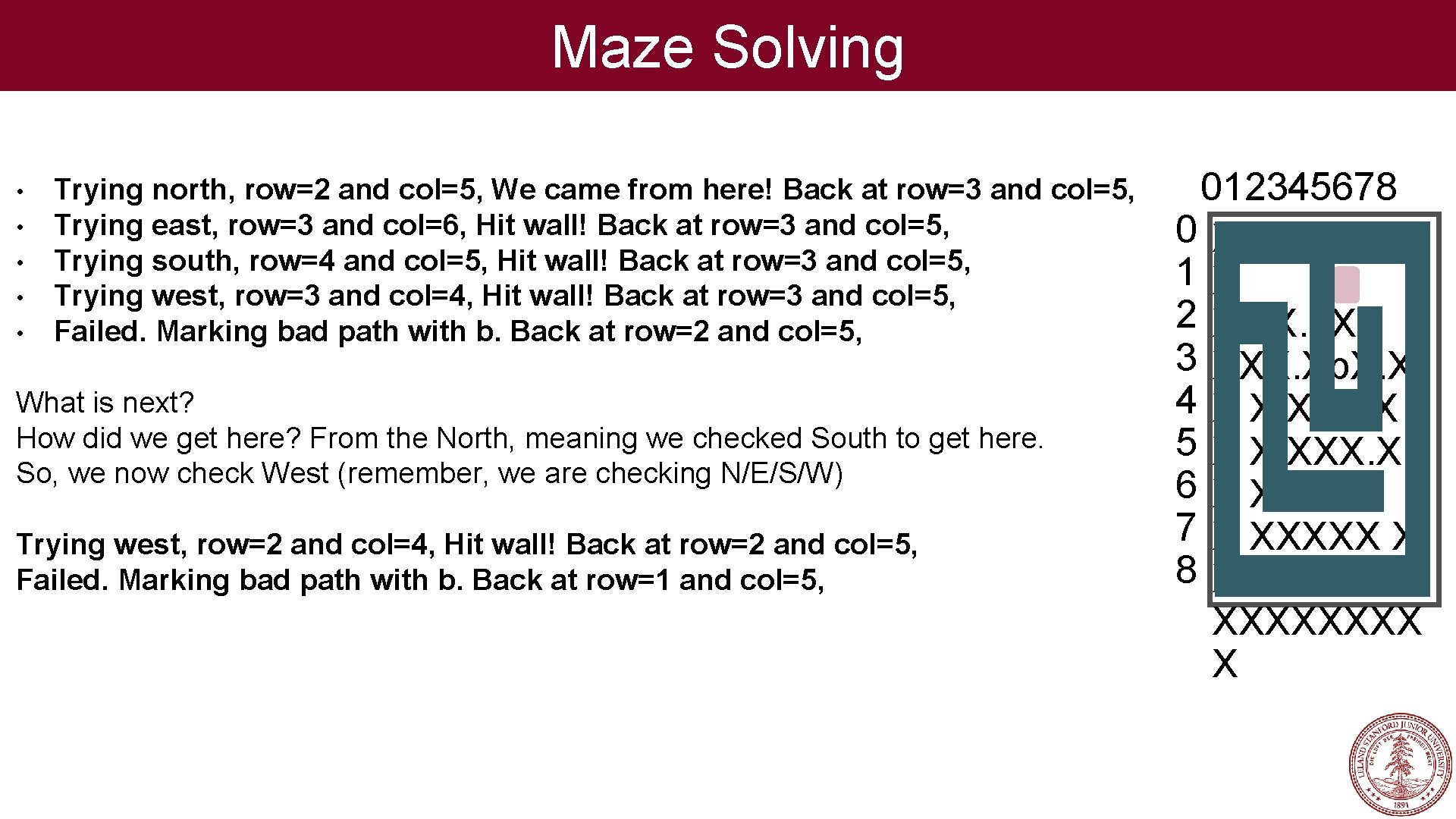
Maze Solving • • • Trying north, row=2 and col=5, We came from here! Back at row=3 and col=5, Trying east, row=3 and col=6, Hit wall! Back at row=3 and col=5, Trying south, row=4 and col=5, Hit wall! Back at row=3 and col=5, Trying west, row=3 and col=4, Hit wall! Back at row=3 and col=5, Failed. Marking bad path with b. Back at row=2 and col=5, What is next? How did we get here? From the North, meaning we checked South to get here. So, we now check West (remember, we are checking N/E/S/W) Trying west, row=2 and col=4, Hit wall! Back at row=2 and col=5, Failed. Marking bad path with b. Back at row=1 and col=5, 012345678 0 XXXX 1 X 2 X. . . X 3 XXX. Xb. X. X 4 X X. Xb. X. X 5 X X. XXX. X 6 X X. . . X 7 X XXXXX X 8 X FX XXXX X
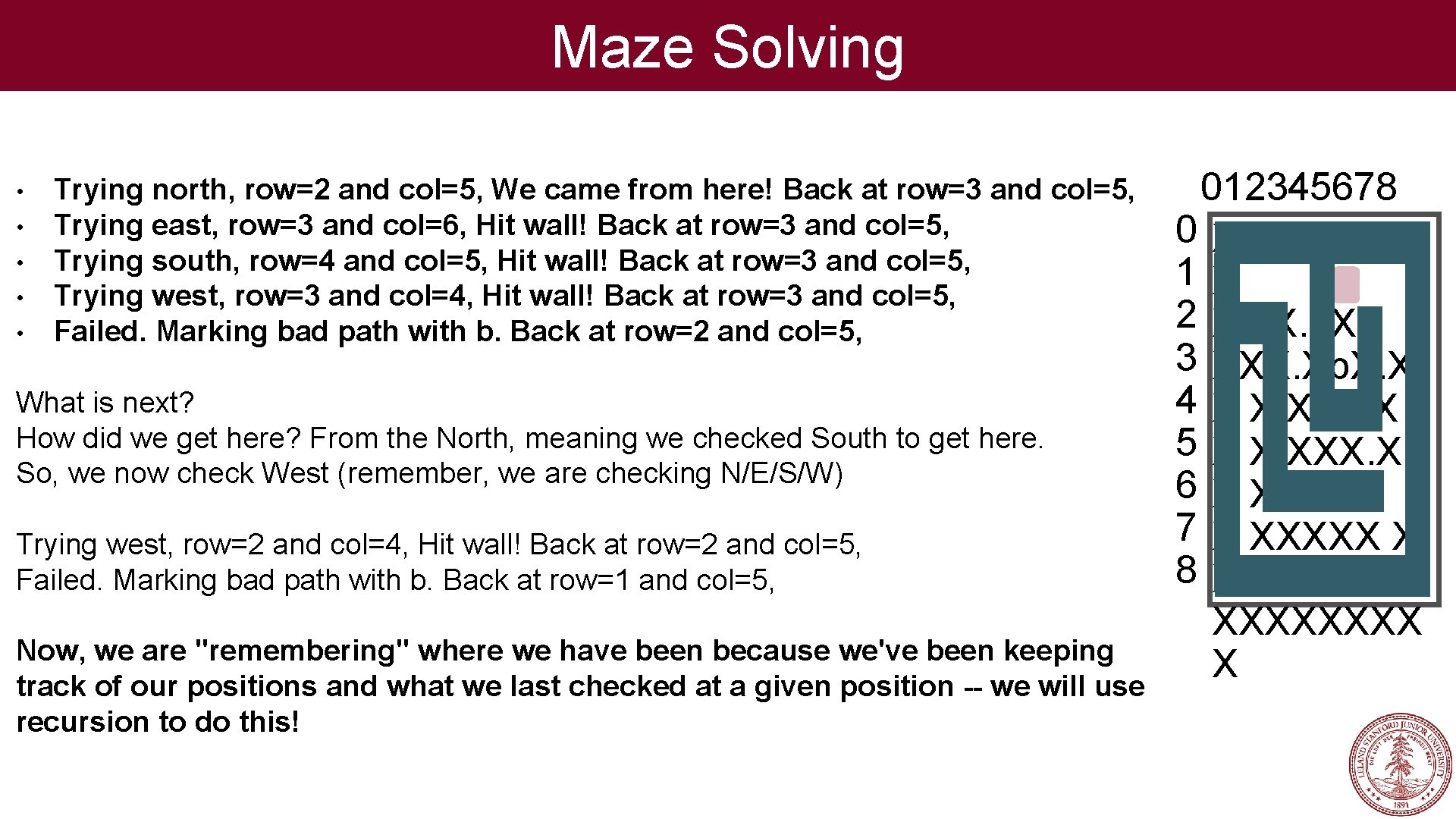
Maze Solving • • • Trying north, row=2 and col=5, We came from here! Back at row=3 and col=5, Trying east, row=3 and col=6, Hit wall! Back at row=3 and col=5, Trying south, row=4 and col=5, Hit wall! Back at row=3 and col=5, Trying west, row=3 and col=4, Hit wall! Back at row=3 and col=5, Failed. Marking bad path with b. Back at row=2 and col=5, What is next? How did we get here? From the North, meaning we checked South to get here. So, we now check West (remember, we are checking N/E/S/W) Trying west, row=2 and col=4, Hit wall! Back at row=2 and col=5, Failed. Marking bad path with b. Back at row=1 and col=5, Now, we are "remembering" where we have been because we've been keeping track of our positions and what we last checked at a given position -- we will use recursion to do this! 012345678 0 XXXX 1 X 2 X. . . X 3 XXX. Xb. X. X 4 X X. Xb. X. X 5 X X. XXX. X 6 X X. . . X 7 X XXXXX X 8 X FX XXXX X
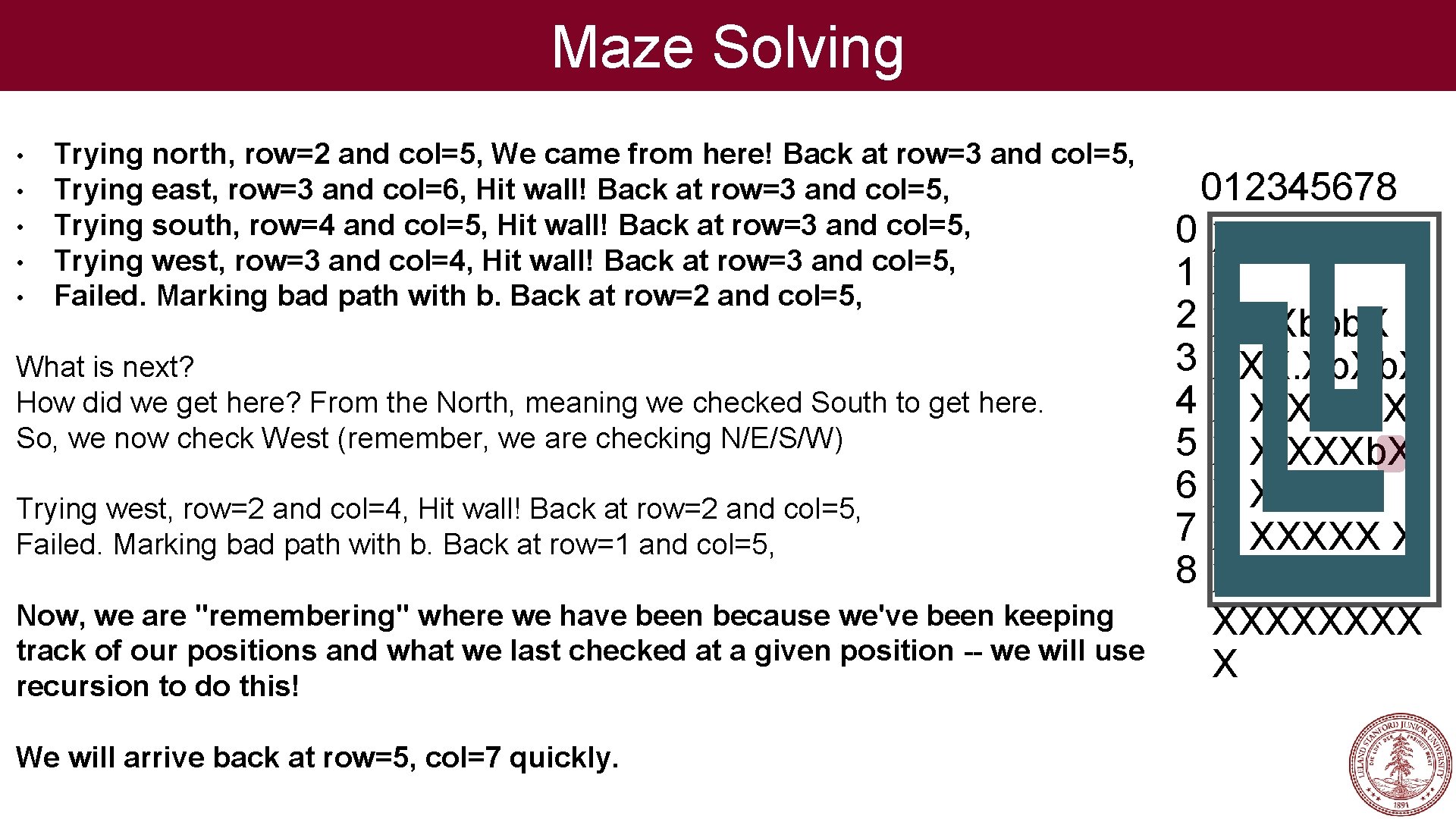
Maze Solving • • • Trying north, row=2 and col=5, We came from here! Back at row=3 and col=5, Trying east, row=3 and col=6, Hit wall! Back at row=3 and col=5, Trying south, row=4 and col=5, Hit wall! Back at row=3 and col=5, Trying west, row=3 and col=4, Hit wall! Back at row=3 and col=5, Failed. Marking bad path with b. Back at row=2 and col=5, What is next? How did we get here? From the North, meaning we checked South to get here. So, we now check West (remember, we are checking N/E/S/W) Trying west, row=2 and col=4, Hit wall! Back at row=2 and col=5, Failed. Marking bad path with b. Back at row=1 and col=5, Now, we are "remembering" where we have been because we've been keeping track of our positions and what we last checked at a given position -- we will use recursion to do this! We will arrive back at row=5, col=7 quickly. 012345678 0 XXXX 1 X 2 X. . . Xbbb. X 3 XXX. Xb. X 4 X X. Xb. X 5 X X. XXXb. X 6 X X. . . X 7 X XXXXX X 8 X FX XXXX X
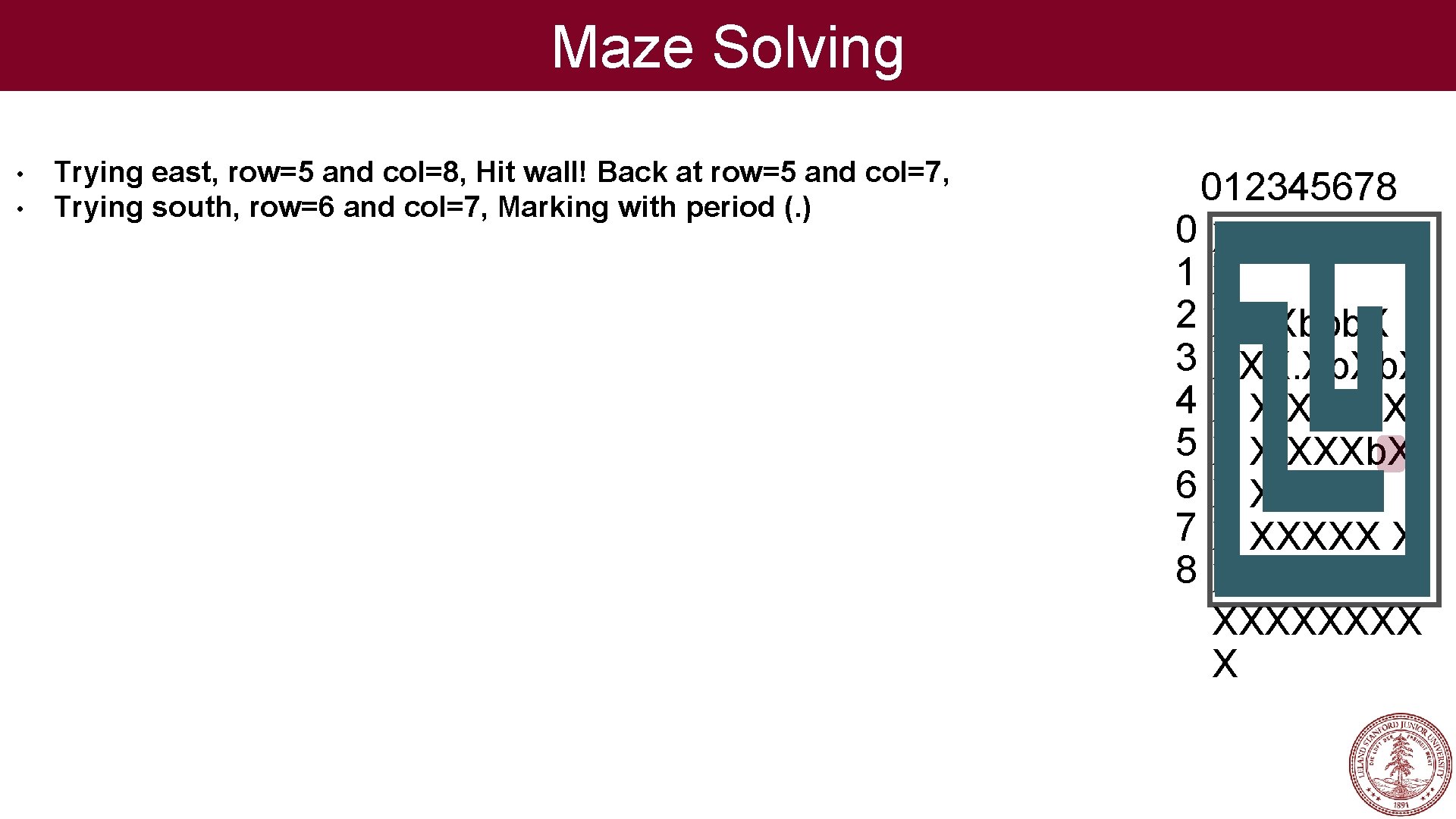
Maze Solving • • Trying east, row=5 and col=8, Hit wall! Back at row=5 and col=7, Trying south, row=6 and col=7, Marking with period (. ) 012345678 0 XXXX 1 X 2 X. . . Xbbb. X 3 XXX. Xb. X 4 X X. Xb. X 5 X X. XXXb. X 6 X X. . . X 7 X XXXXX X 8 X FX XXXX X
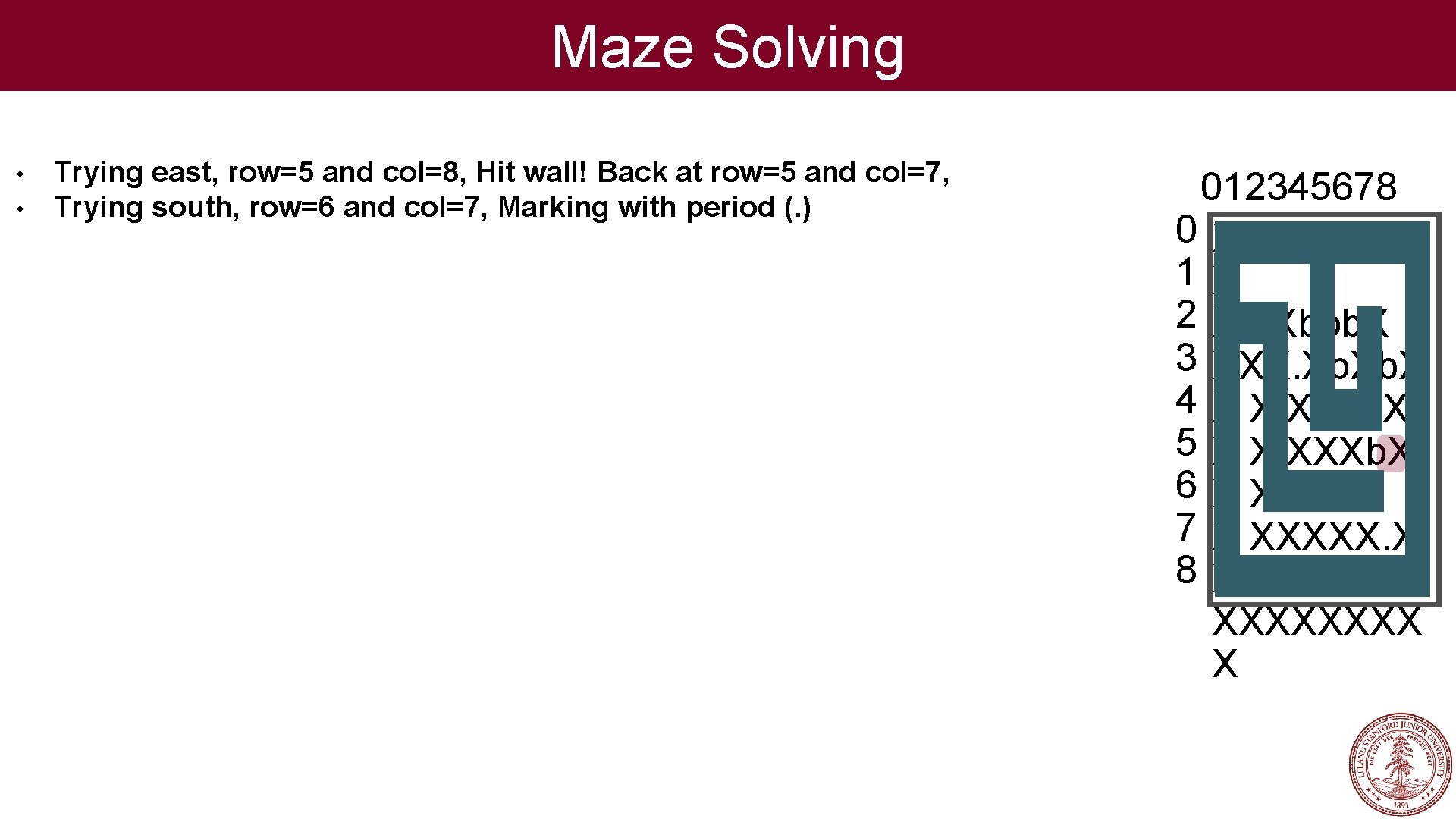
Maze Solving • • Trying east, row=5 and col=8, Hit wall! Back at row=5 and col=7, Trying south, row=6 and col=7, Marking with period (. ) 012345678 0 XXXX 1 X 2 X. . . Xbbb. X 3 XXX. Xb. X 4 X X. Xb. X 5 X X. XXXb. X 6 X X. . . X 7 X XXXXX. X 8 X FX XXXX X
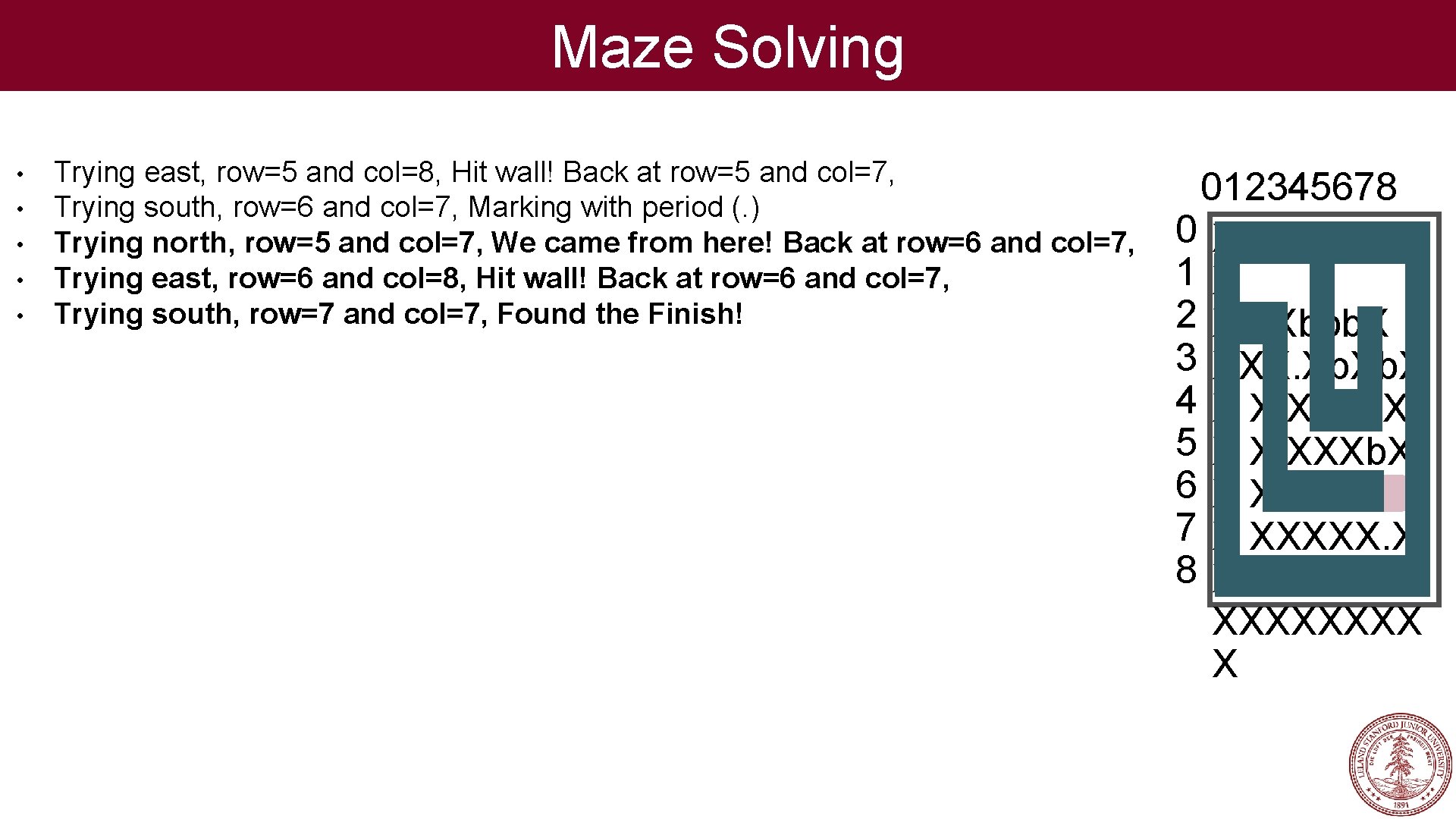
Maze Solving • • • Trying east, row=5 and col=8, Hit wall! Back at row=5 and col=7, Trying south, row=6 and col=7, Marking with period (. ) Trying north, row=5 and col=7, We came from here! Back at row=6 and col=7, Trying east, row=6 and col=8, Hit wall! Back at row=6 and col=7, Trying south, row=7 and col=7, Found the Finish! 012345678 0 XXXX 1 X 2 X. . . Xbbb. X 3 XXX. Xb. X 4 X X. Xb. X 5 X X. XXXb. X 6 X X. . . X 7 X XXXXX. X 8 X FX XXXX X
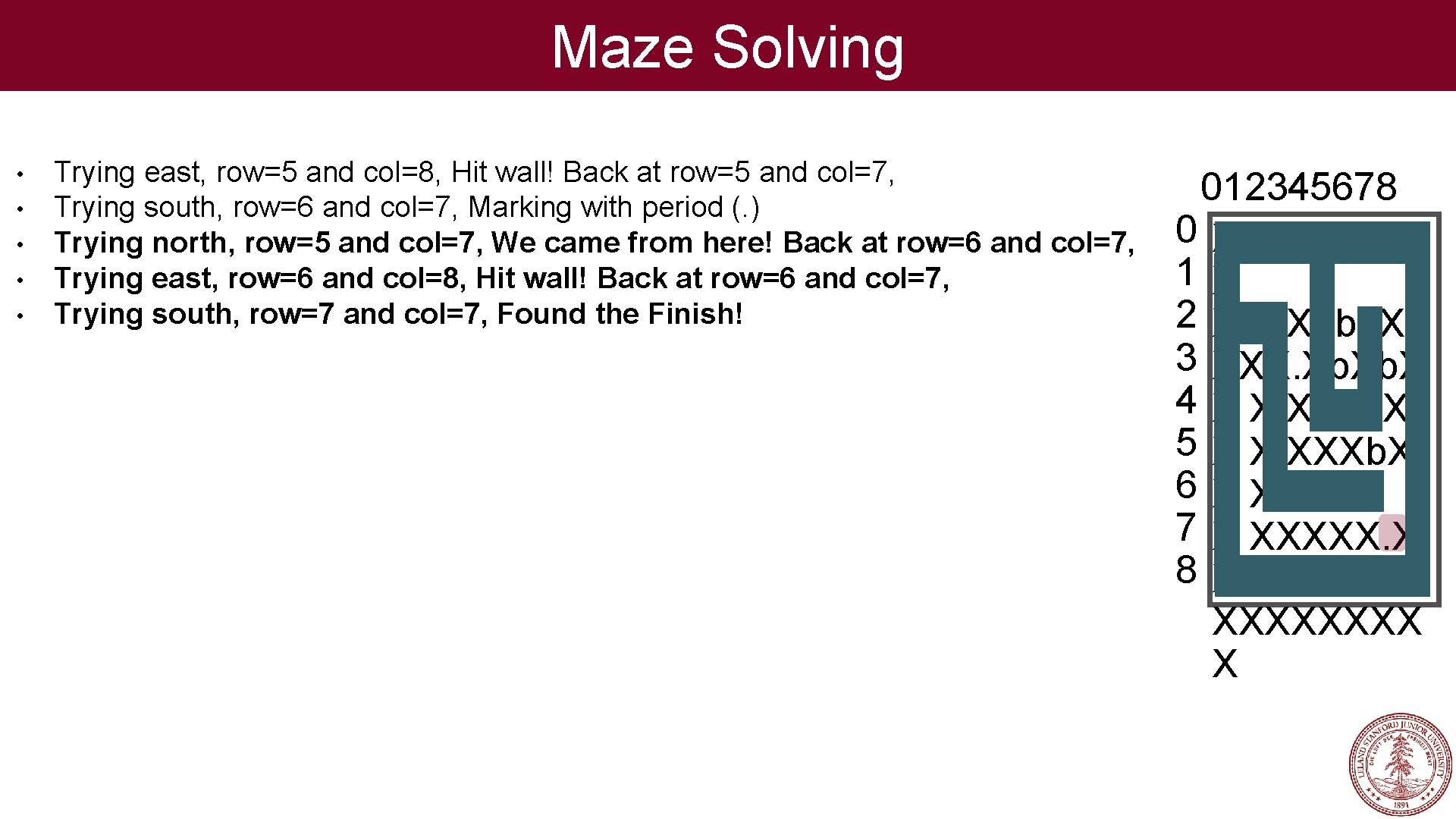
Maze Solving • • • Trying east, row=5 and col=8, Hit wall! Back at row=5 and col=7, Trying south, row=6 and col=7, Marking with period (. ) Trying north, row=5 and col=7, We came from here! Back at row=6 and col=7, Trying east, row=6 and col=8, Hit wall! Back at row=6 and col=7, Trying south, row=7 and col=7, Found the Finish! 012345678 0 XXXX 1 X 2 XS. . Xbbb. X 3 XXX. Xb. X 4 X X. Xb. X 5 X X. XXXb. X 6 X X. . . X 7 X XXXXX. X 8 X FX XXXX X
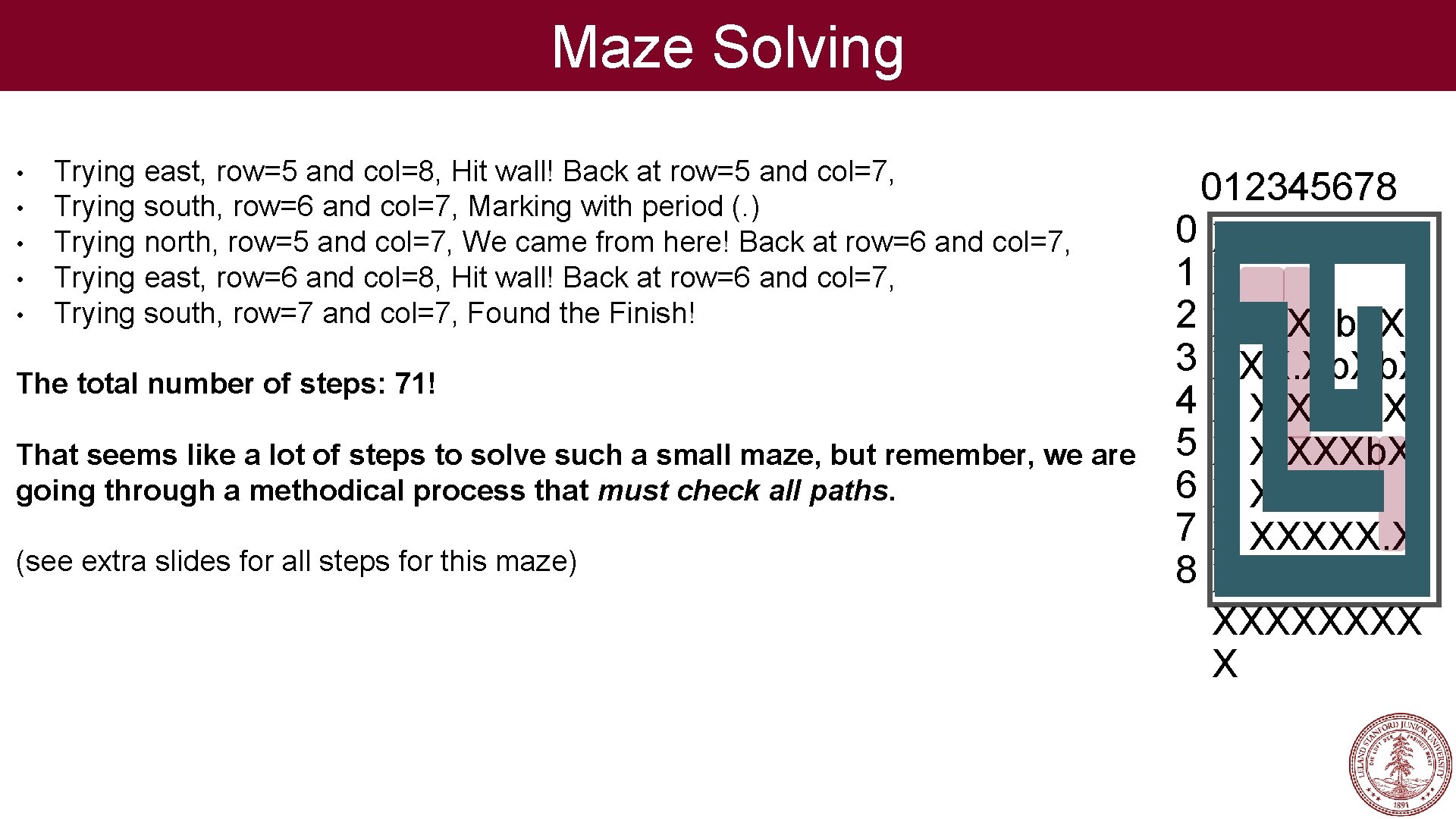
Maze Solving • • • Trying east, row=5 and col=8, Hit wall! Back at row=5 and col=7, Trying south, row=6 and col=7, Marking with period (. ) Trying north, row=5 and col=7, We came from here! Back at row=6 and col=7, Trying east, row=6 and col=8, Hit wall! Back at row=6 and col=7, Trying south, row=7 and col=7, Found the Finish! The total number of steps: 71! That seems like a lot of steps to solve such a small maze, but remember, we are going through a methodical process that must check all paths. (see extra slides for all steps for this maze) 012345678 0 XXXX 1 X 2 XS. . Xbbb. X 3 XXX. Xb. X 4 X X. Xb. X 5 X X. XXXb. X 6 X X. . . X 7 X XXXXX. X 8 X FX XXXX X
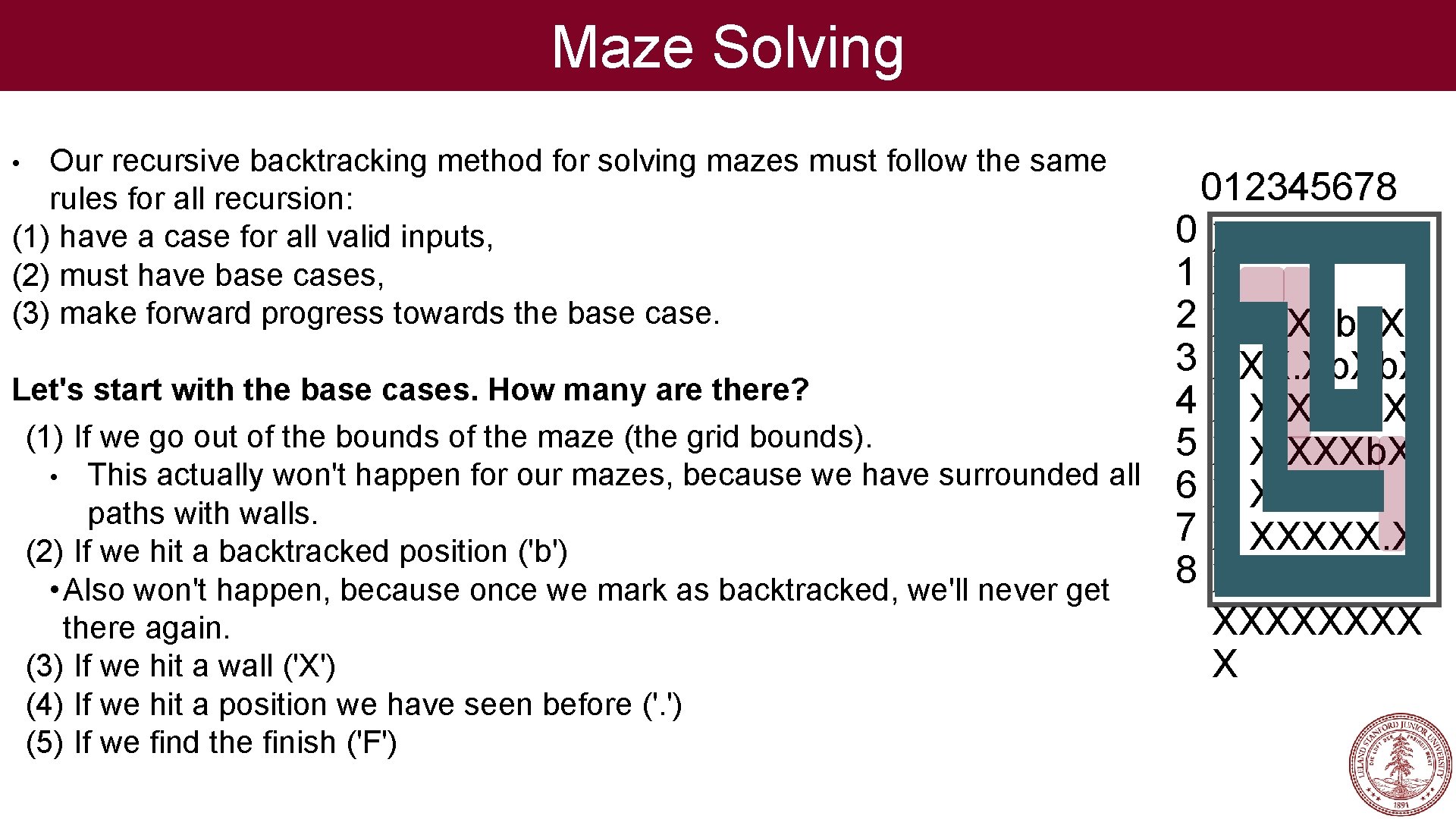
Maze Solving Our recursive backtracking method for solving mazes must follow the same rules for all recursion: (1) have a case for all valid inputs, (2) must have base cases, (3) make forward progress towards the base case. • 012345678 0 XXXX 1 X 2 XS. . Xbbb. X 3 XXX. Xb. X Let's start with the base cases. How many are there? 4 X X. Xb. X (1) If we go out of the bounds of the maze (the grid bounds). 5 X X. XXXb. X • This actually won't happen for our mazes, because we have surrounded all 6 X X. . . X paths with walls. 7 X XXXXX. X (2) If we hit a backtracked position ('b') 8 X FX • Also won't happen, because once we mark as backtracked, we'll never get XXXX there again. (3) If we hit a wall ('X') X (4) If we hit a position we have seen before ('. ') (5) If we find the finish ('F')
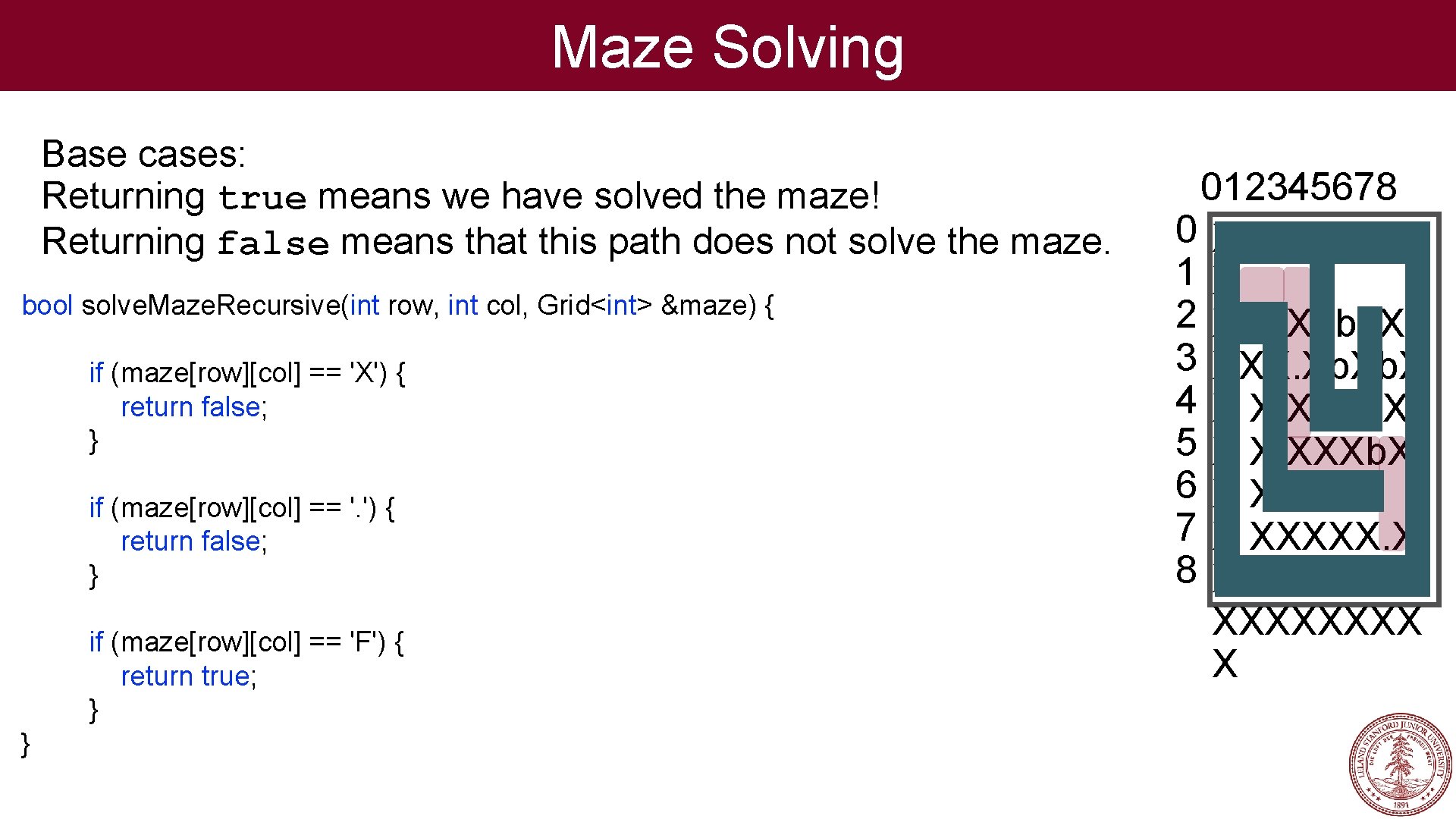
Maze Solving Base cases: Returning true means we have solved the maze! Returning false means that this path does not solve the maze. bool solve. Maze. Recursive(int row, int col, Grid<int> &maze) { if (maze[row][col] == 'X') { return false; } if (maze[row][col] == 'F') { return true; } } 012345678 0 XXXX 1 X 2 XS. . Xbbb. X 3 XXX. Xb. X 4 X X. Xb. X 5 X X. XXXb. X 6 X X. . . X 7 X XXXXX. X 8 X FX XXXX X
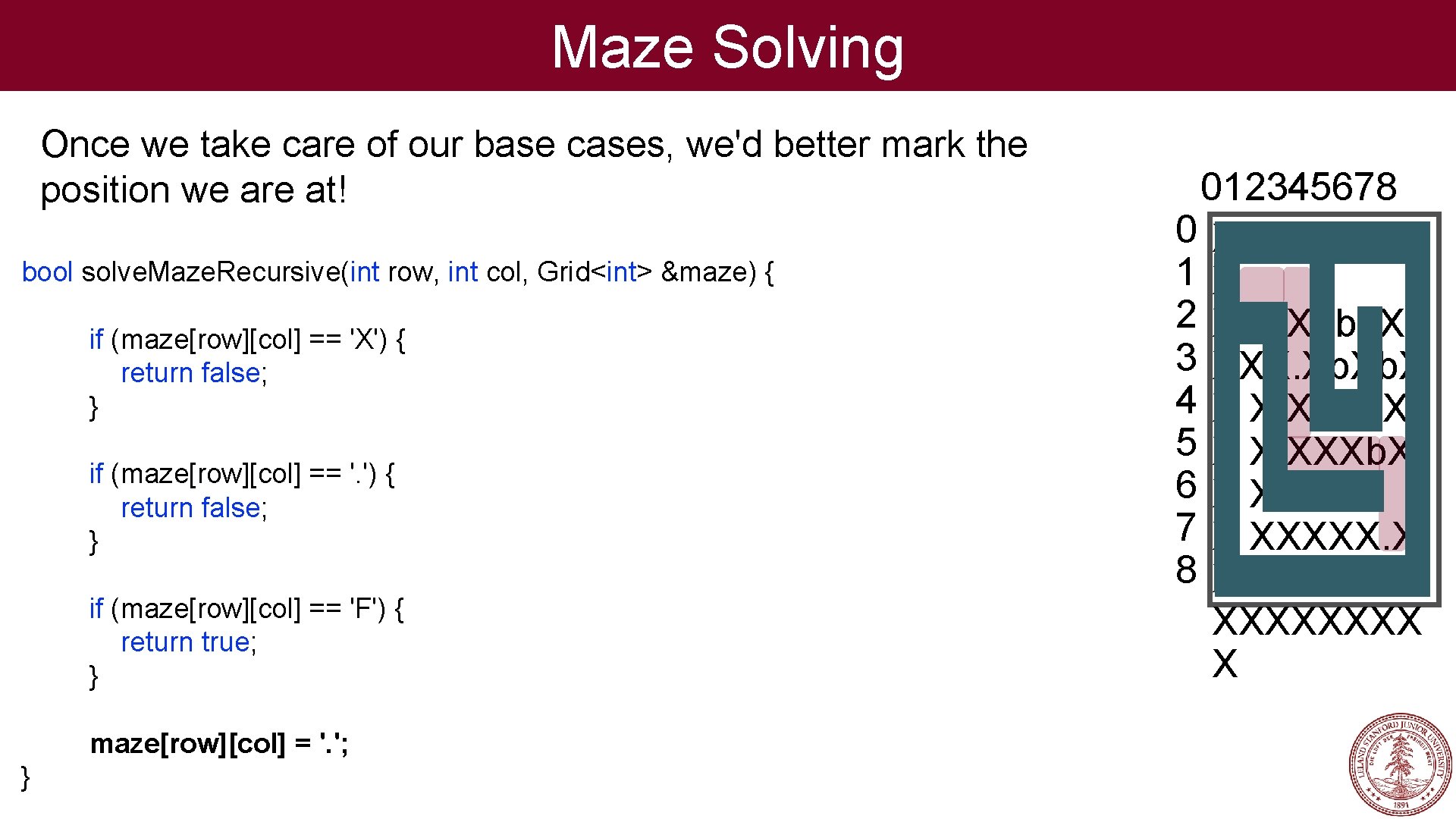
Maze Solving Once we take care of our base cases, we'd better mark the position we are at! bool solve. Maze. Recursive(int row, int col, Grid<int> &maze) { if (maze[row][col] == 'X') { return false; } if (maze[row][col] == 'F') { return true; } maze[row][col] = '. '; } 012345678 0 XXXX 1 X 2 XS. . Xbbb. X 3 XXX. Xb. X 4 X X. Xb. X 5 X X. XXXb. X 6 X X. . . X 7 X XXXXX. X 8 X FX XXXX X
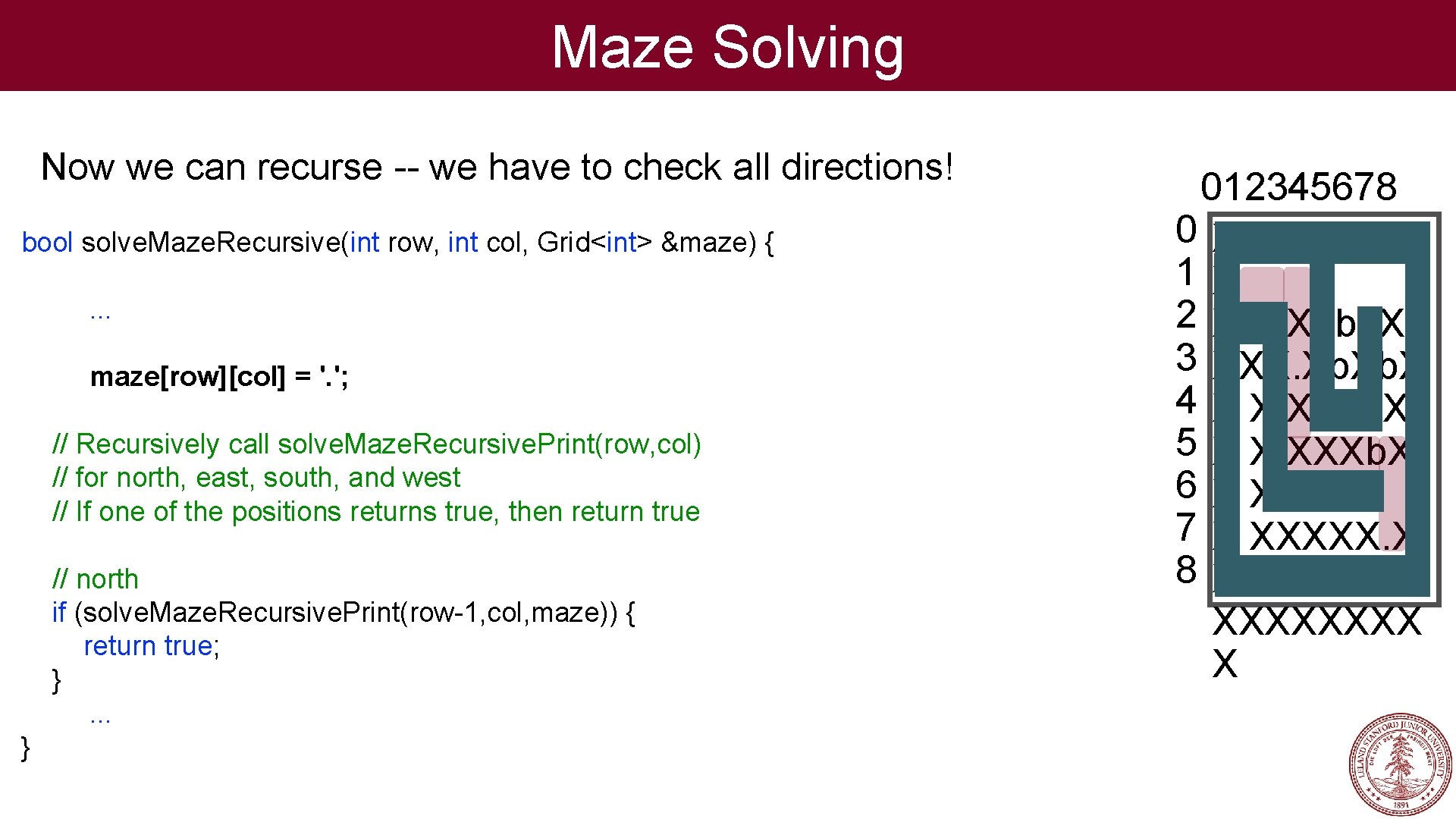
Maze Solving Now we can recurse -- we have to check all directions! bool solve. Maze. Recursive(int row, int col, Grid<int> &maze) {. . . maze[row][col] = '. '; // Recursively call solve. Maze. Recursive. Print(row, col) // for north, east, south, and west // If one of the positions returns true, then return true // north if (solve. Maze. Recursive. Print(row-1, col, maze)) { return true; }. . . } 012345678 0 XXXX 1 X 2 XS. . Xbbb. X 3 XXX. Xb. X 4 X X. Xb. X 5 X X. XXXb. X 6 X X. . . X 7 X XXXXX. X 8 X FX XXXX X
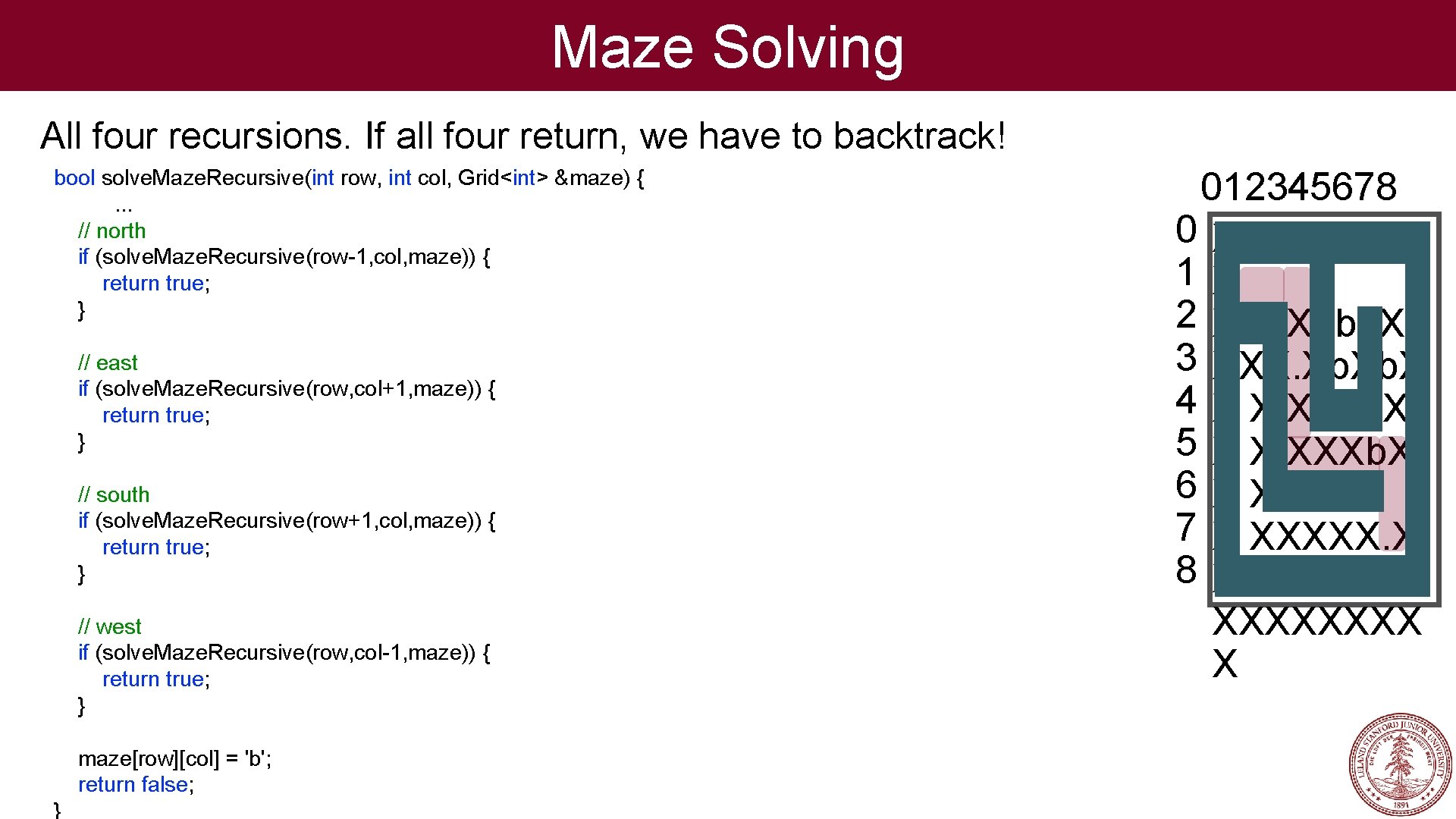
Maze Solving All four recursions. If all four return, we have to backtrack! bool solve. Maze. Recursive(int row, int col, Grid<int> &maze) {. . . // north if (solve. Maze. Recursive(row-1, col, maze)) { return true; } // east if (solve. Maze. Recursive(row, col+1, maze)) { return true; } // south if (solve. Maze. Recursive(row+1, col, maze)) { return true; } // west if (solve. Maze. Recursive(row, col-1, maze)) { return true; } maze[row][col] = 'b'; return false; } 012345678 0 XXXX 1 X 2 XS. . Xbbb. X 3 XXX. Xb. X 4 X X. Xb. X 5 X X. XXXb. X 6 X X. . . X 7 X XXXXX. X 8 X FX XXXX X
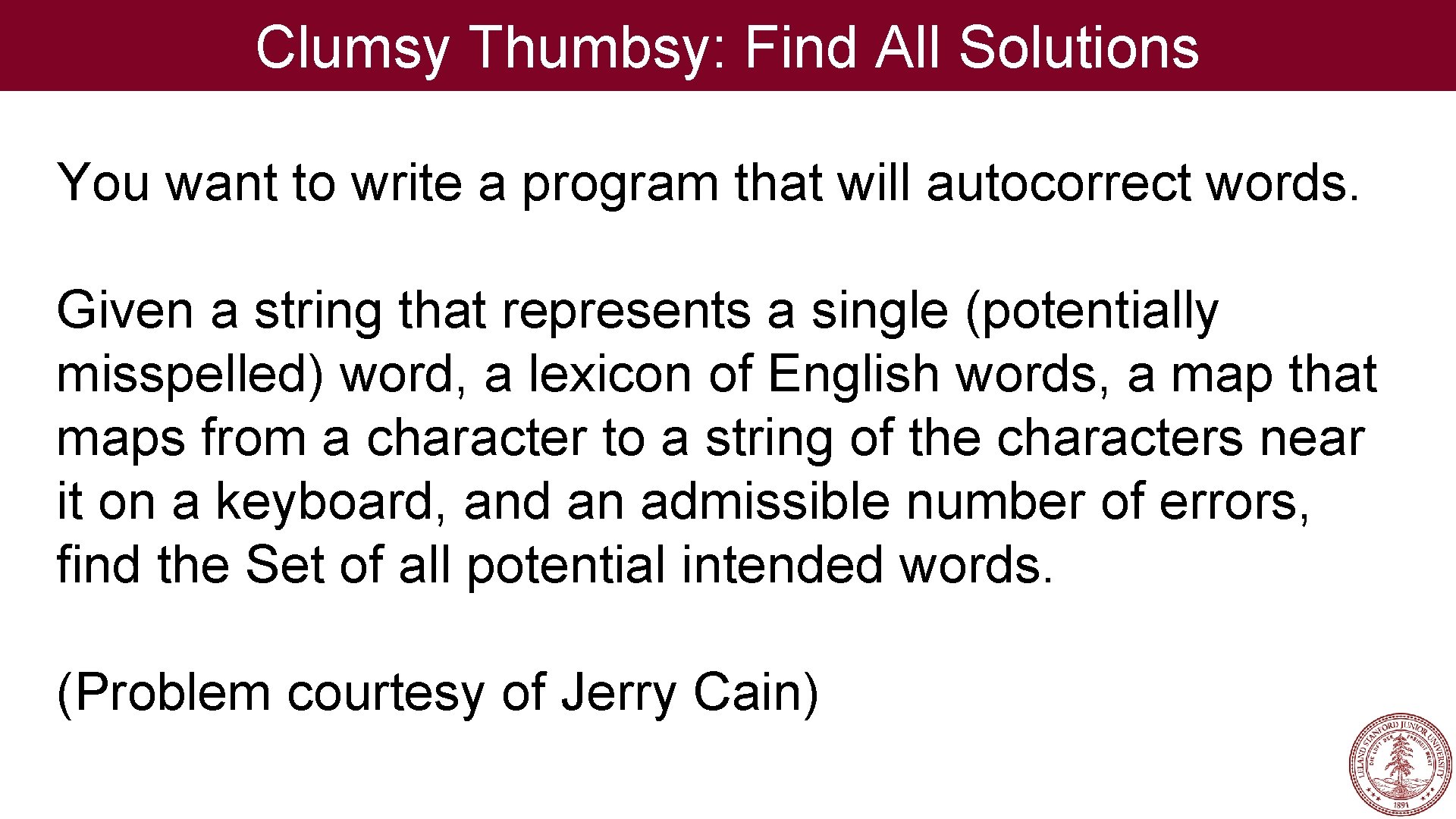
Clumsy Thumbsy: Find All Solutions You want to write a program that will autocorrect words. Given a string that represents a single (potentially misspelled) word, a lexicon of English words, a map that maps from a character to a string of the characters near it on a keyboard, and an admissible number of errors, find the Set of all potential intended words. (Problem courtesy of Jerry Cain)
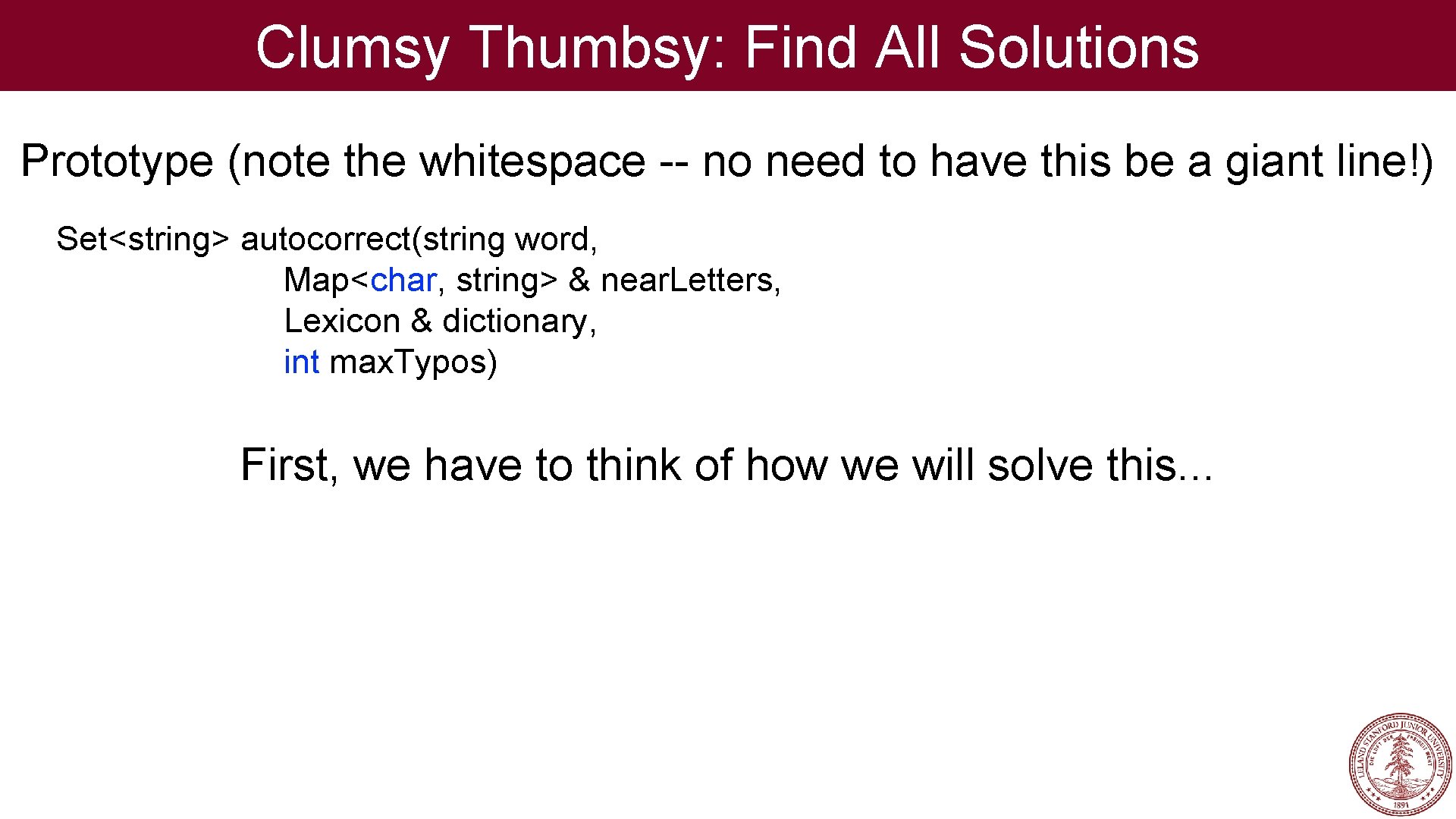
Clumsy Thumbsy: Find All Solutions Prototype (note the whitespace -- no need to have this be a giant line!) Set<string> autocorrect(string word, Map<char, string> & near. Letters, Lexicon & dictionary, int max. Typos) First, we have to think of how we will solve this. . .
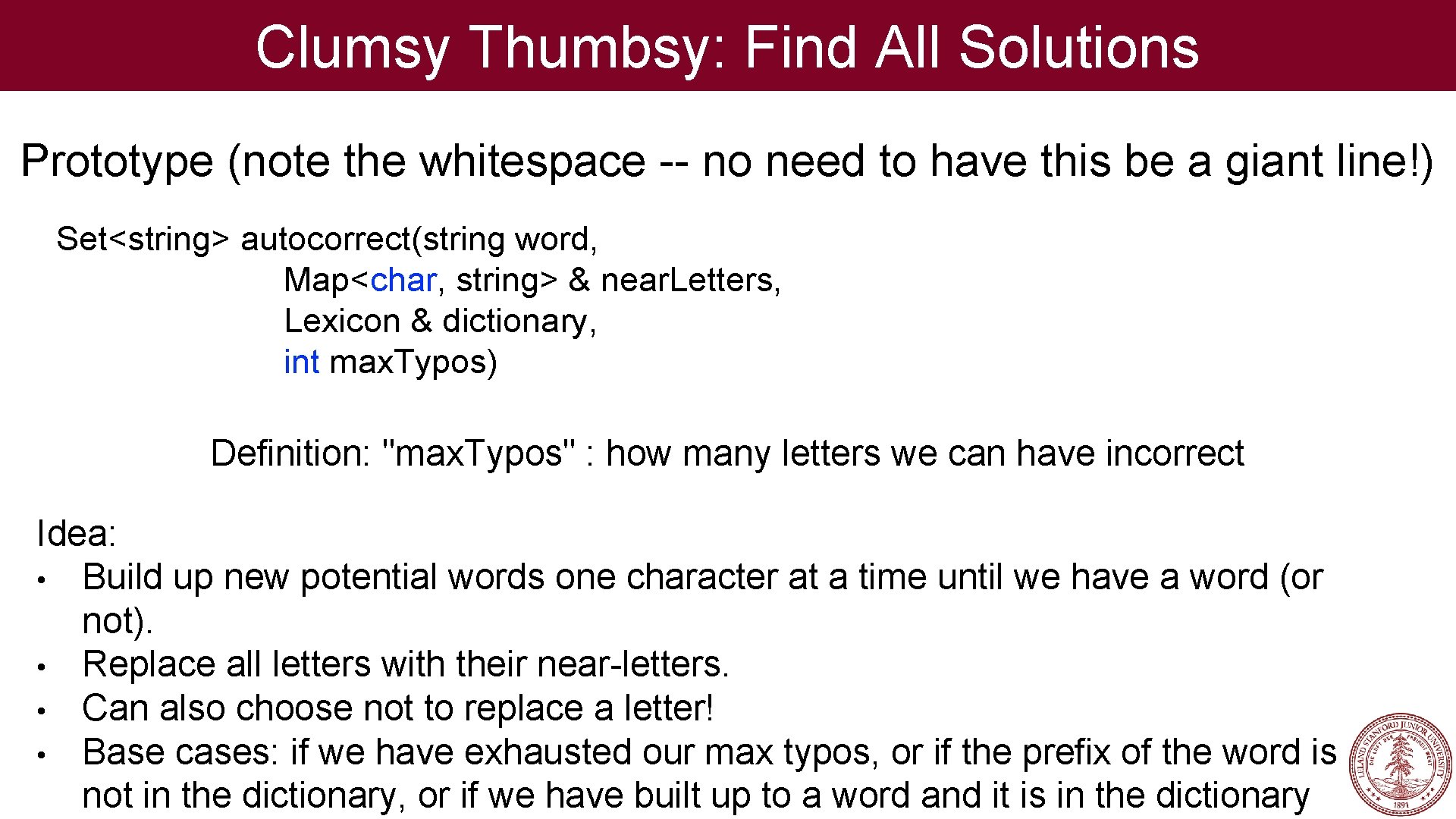
Clumsy Thumbsy: Find All Solutions Prototype (note the whitespace -- no need to have this be a giant line!) Set<string> autocorrect(string word, Map<char, string> & near. Letters, Lexicon & dictionary, int max. Typos) Definition: "max. Typos" : how many letters we can have incorrect Idea: • Build up new potential words one character at a time until we have a word (or not). • Replace all letters with their near-letters. • Can also choose not to replace a letter! • Base cases: if we have exhausted our max typos, or if the prefix of the word is not in the dictionary, or if we have built up to a word and it is in the dictionary
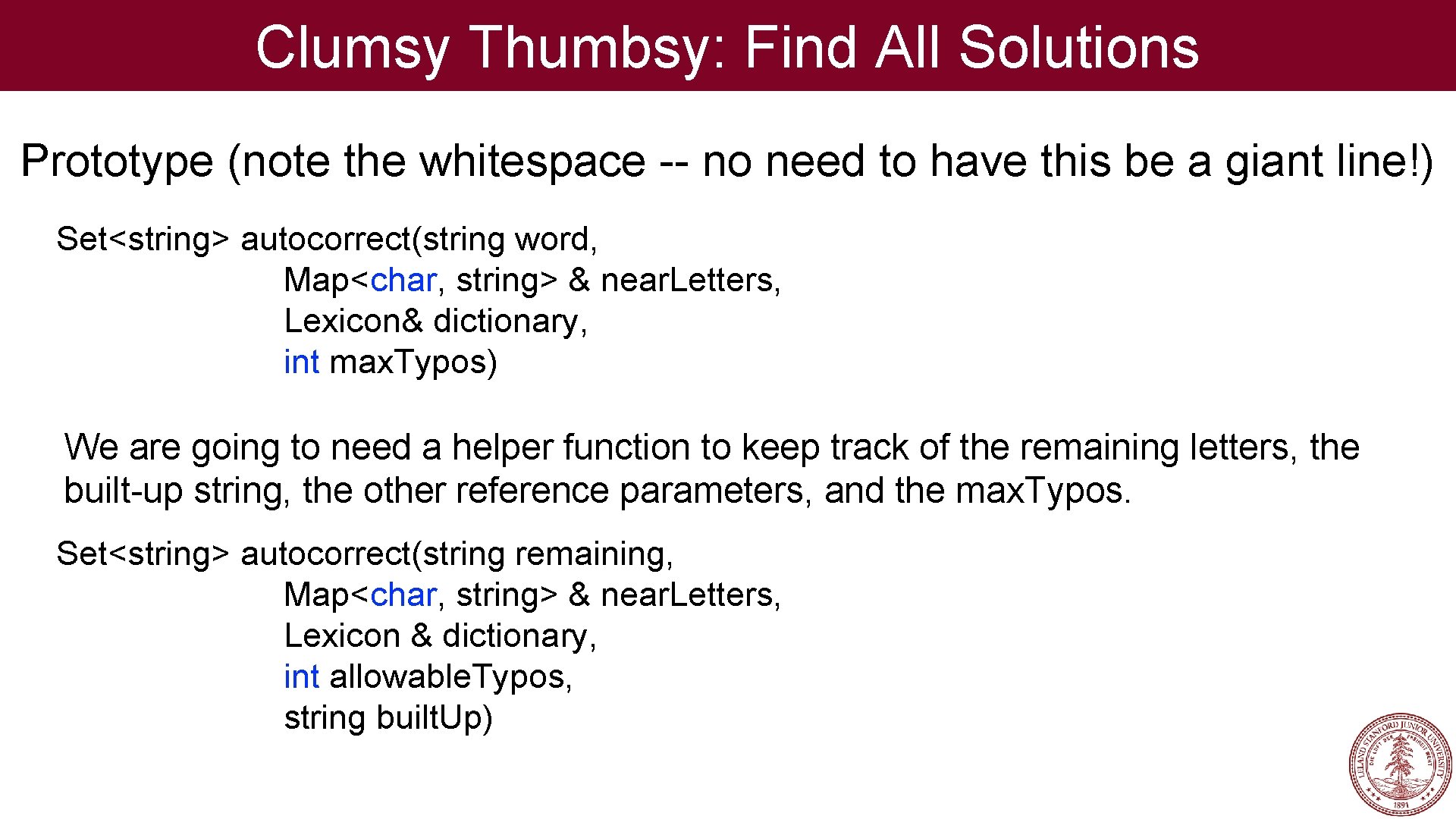
Clumsy Thumbsy: Find All Solutions Prototype (note the whitespace -- no need to have this be a giant line!) Set<string> autocorrect(string word, Map<char, string> & near. Letters, Lexicon& dictionary, int max. Typos) We are going to need a helper function to keep track of the remaining letters, the built-up string, the other reference parameters, and the max. Typos. Set<string> autocorrect(string remaining, Map<char, string> & near. Letters, Lexicon & dictionary, int allowable. Typos, string built. Up)
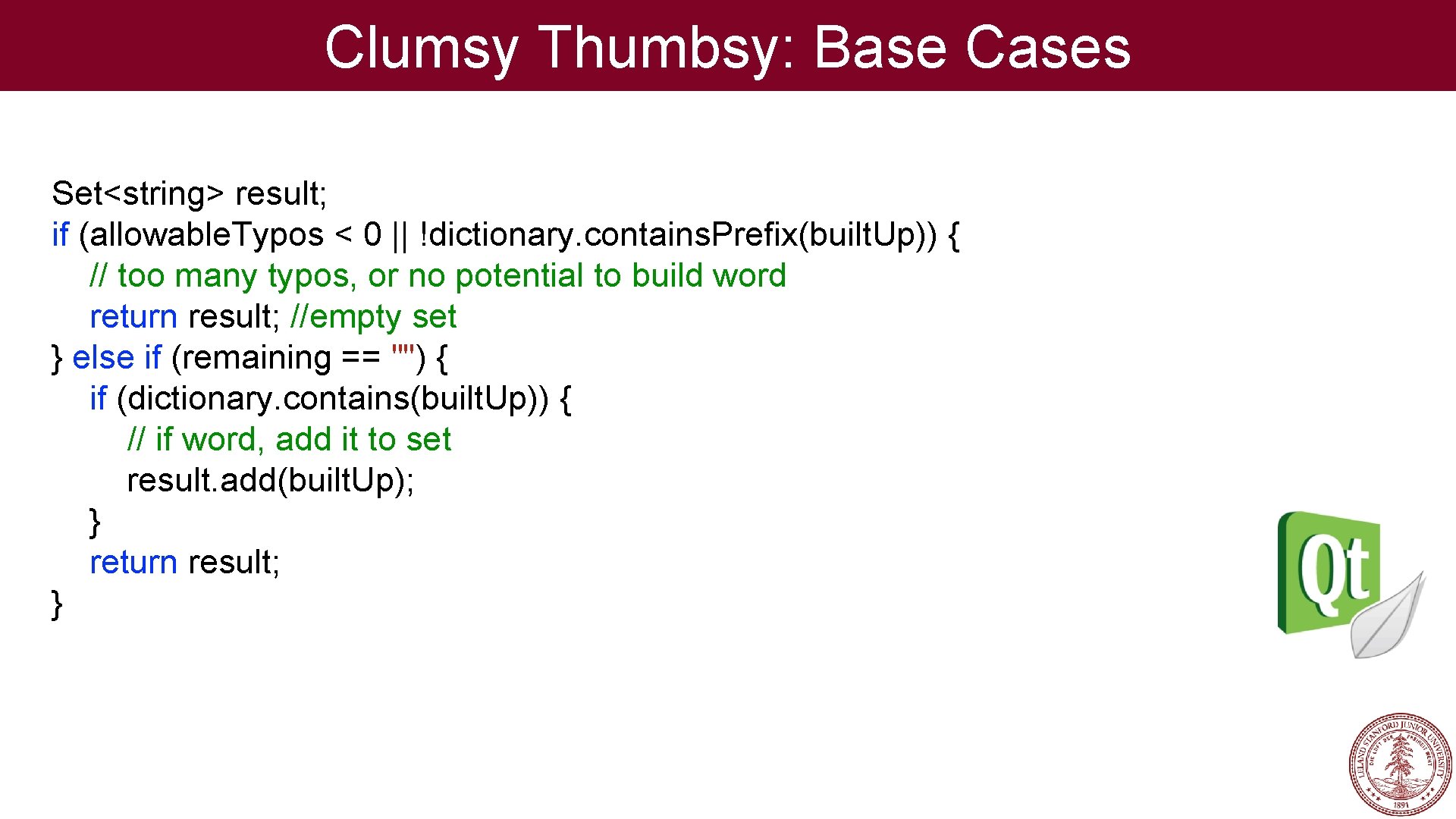
Clumsy Thumbsy: Base Cases Set<string> result; if (allowable. Typos < 0 || !dictionary. contains. Prefix(built. Up)) { // too many typos, or no potential to build word return result; //empty set } else if (remaining == "") { if (dictionary. contains(built. Up)) { // if word, add it to set result. add(built. Up); } return result; }
![Clumsy Thumbsy: Recursive Cases char curr = remaining[0]; string rest = remaining. substr(1); for](http://slidetodoc.com/presentation_image_h2/c4efcccdf6a2f767ebaa590a16a5f607/image-63.jpg "Clumsy Thumbsy: Recursive Cases char curr = remaining[0]; string rest = remaining. substr(1); for")
Clumsy Thumbsy: Recursive Cases char curr = remaining[0]; string rest = remaining. substr(1); for (int i = 0; i < (int)near. Letters[curr]. length(); i++) { result += autocorrect(rest, near. Letters, dictionary, allowable. Typos - 1, built. Up + near. Letters[curr][i]); } //can also choose not to change character result += autocorrect(rest, near. Letters, dictionary, allowable. Typos, built. Up + curr); return result;

References and Advanced Reading • References: • Understanding permutations: http: //stackoverflow. com/questions/7537791/understanding-recursion-to-generatepermutations • Maze algorithms: https: //en. wikipedia. org/wiki/Maze_solving_algorithm • Advanced Reading: • Exhaustive recursive backtracking: https: //see. stanford. edu/materials/icspacs 106 b/h 19 -recbacktrackexamples. pdf • Backtracking: https: //en. wikipedia. org/wiki/Backtracking
Extra Slides
- Slides: 65