
CS 105 Tour of the Black Holes of
CS 105 “Tour of the Black Holes of Computing!” Network Programming Topics n n n Programmer’s view of the Internet (review) Sockets interface Writing clients and servers
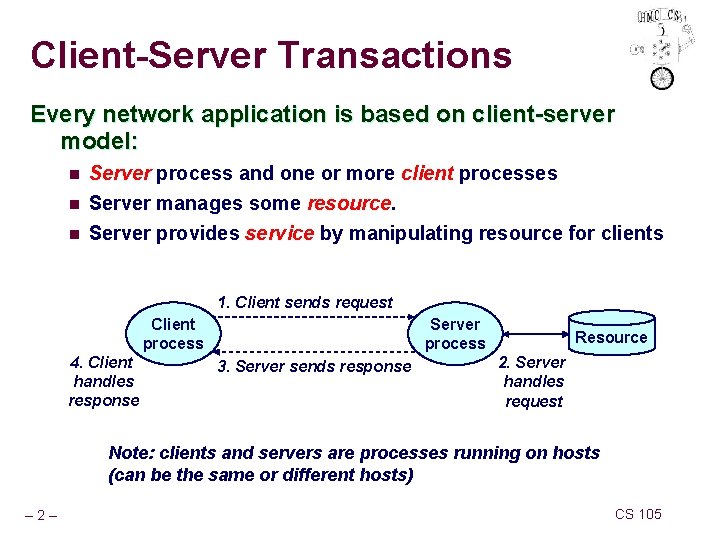
Client-Server Transactions Every network application is based on client-server model: n n n Server process and one or more client processes Server manages some resource. Server provides service by manipulating resource for clients 1. Client sends request Client process 4. Client handles response Server process 3. Server sends response Resource 2. Server handles request Note: clients and servers are processes running on hosts (can be the same or different hosts) – 2– CS 105
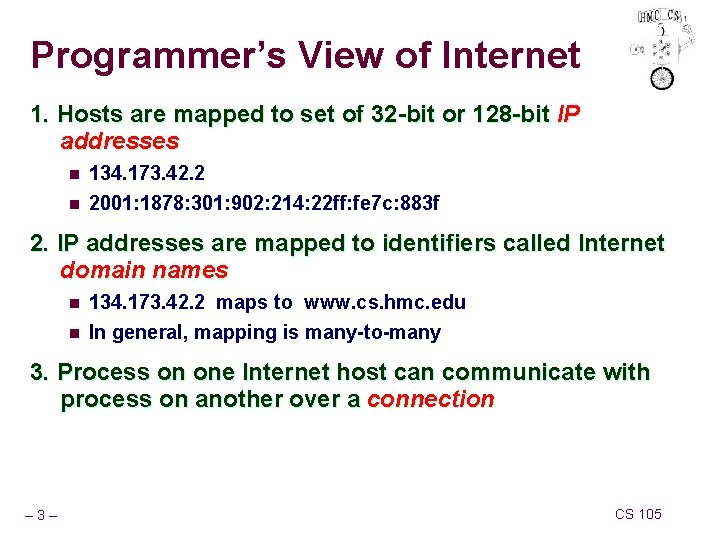
Programmer’s View of Internet 1. Hosts are mapped to set of 32 -bit or 128 -bit IP addresses n n 134. 173. 42. 2 2001: 1878: 301: 902: 214: 22 ff: fe 7 c: 883 f 2. IP addresses are mapped to identifiers called Internet domain names n n 134. 173. 42. 2 maps to www. cs. hmc. edu In general, mapping is many-to-many 3. Process on one Internet host can communicate with process on another over a connection – 3– CS 105
1. IP Addresses Computers are identified by IP addresses Two flavors: IPv 4 (old) and IPv 6 (new) Both are stored in an IP address struct of appropriate type n n in_addr for IPv 4 in 6_addr for IPv 6 Details don’t matter; library functions usually hide them – 4– CS 105
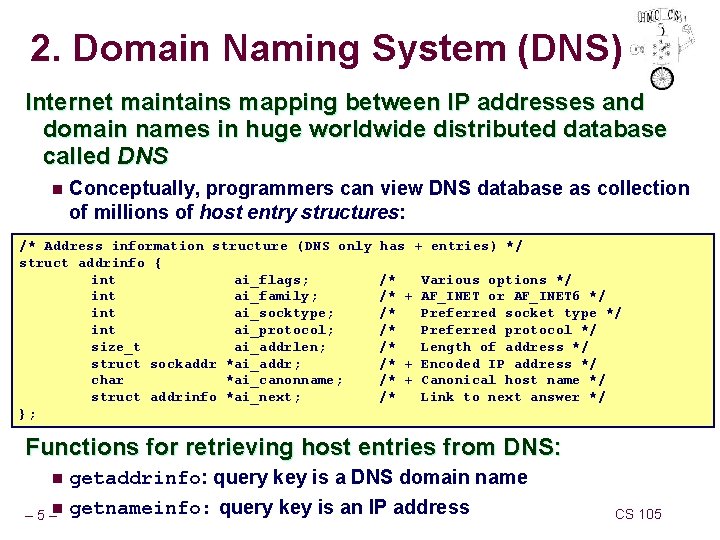
2. Domain Naming System (DNS) Internet maintains mapping between IP addresses and domain names in huge worldwide distributed database called DNS n Conceptually, programmers can view DNS database as collection of millions of host entry structures: /* Address information structure (DNS only struct addrinfo { int ai_flags; int ai_family; int ai_socktype; int ai_protocol; size_t ai_addrlen; struct sockaddr *ai_addr; char *ai_canonname; struct addrinfo *ai_next; }; has + entries) */ /* Various options */ /* + AF_INET or AF_INET 6 */ /* Preferred socket type */ /* Preferred protocol */ /* Length of address */ /* + Encoded IP address */ /* + Canonical host name */ /* Link to next answer */ Functions for retrieving host entries from DNS: getaddrinfo: query key is a DNS domain name – 5 –n getnameinfo: query key is an IP address n CS 105
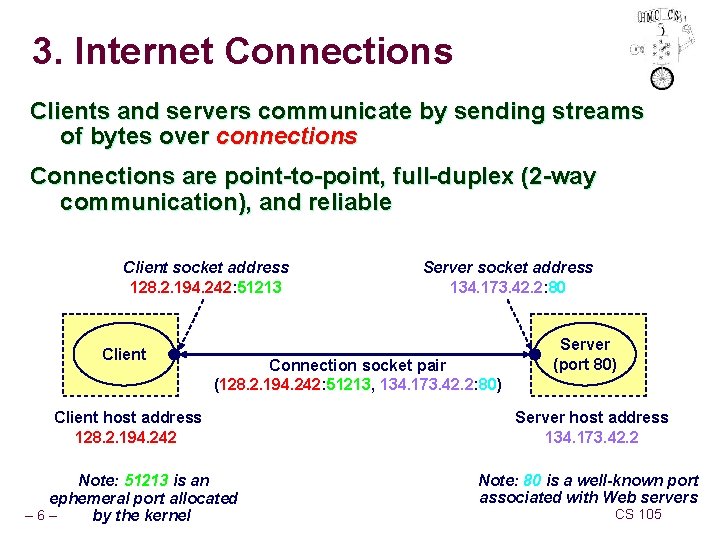
3. Internet Connections Clients and servers communicate by sending streams of bytes over connections Connections are point-to-point, full-duplex (2 -way communication), and reliable Client socket address 128. 2. 194. 242: 51213 Client Server socket address 134. 173. 42. 2: 80 Connection socket pair (128. 2. 194. 242: 51213, 134. 173. 42. 2: 80) Server (port 80) Client host address 128. 2. 194. 242 Server host address 134. 173. 42. 2 Note: 51213 is an ephemeral port allocated – 6– by the kernel Note: 80 is a well-known port associated with Web servers CS 105
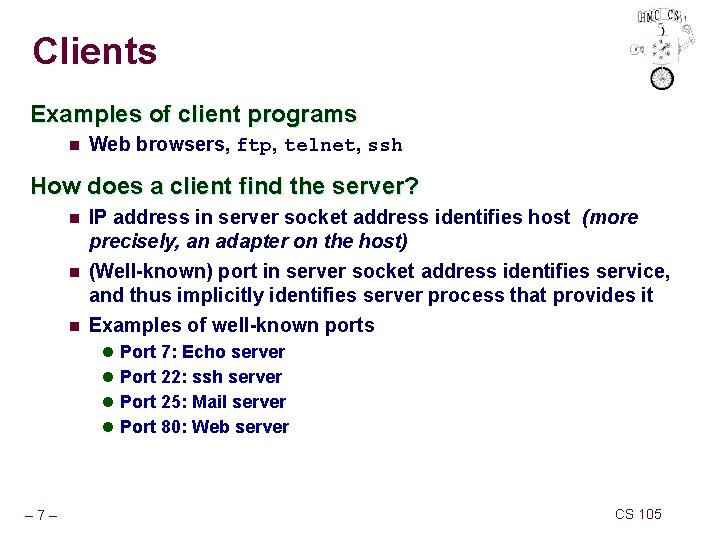
Clients Examples of client programs n Web browsers, ftp, telnet, ssh How does a client find the server? n n n IP address in server socket address identifies host (more precisely, an adapter on the host) (Well-known) port in server socket address identifies service, and thus implicitly identifies server process that provides it Examples of well-known ports l Port 7: Echo server l Port 22: ssh server l Port 25: Mail server l Port 80: Web server – 7– CS 105
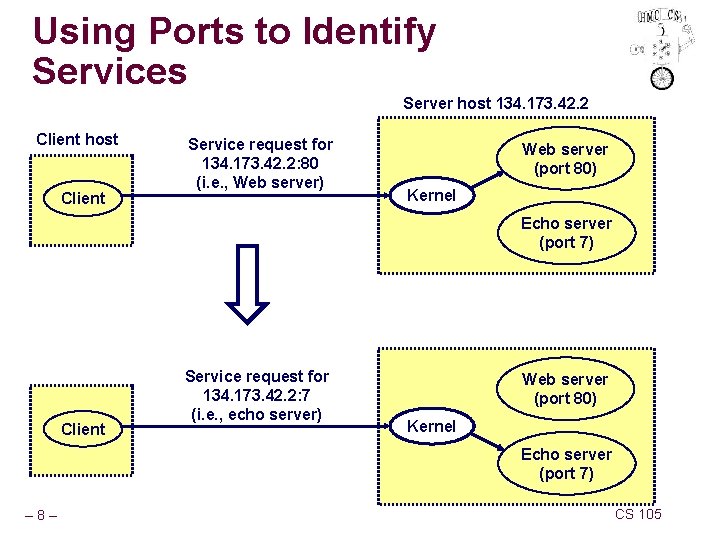
Using Ports to Identify Services Server host 134. 173. 42. 2 Client host Client Service request for 134. 173. 42. 2: 80 (i. e. , Web server) Web server (port 80) Kernel Echo server (port 7) Client Service request for 134. 173. 42. 2: 7 (i. e. , echo server) Web server (port 80) Kernel Echo server (port 7) – 8– CS 105
Servers are long-running processes (daemons). n Created at boot time (typically) by init process (process 1) n Run continuously until machine is turned off Or spawned by inetd in response to connection to port n Each server waits for requests to arrive on well-known port associated with that particular service n n Port 7: echo server Port 22: ssh server Port 25: mail server Port 80: HTTP server Machine that runs a server process is also often referred to as a “server” – 9– CS 105
Server Examples Web server (port 80) n n Resource: files/compute cycles (CGI programs) Service: retrieves files and runs CGI programs on behalf of the client FTP server (20, 21) n n Resource: files Service: stores and retrieve files ssh server (22) n n See /etc/services for a comprehensive list of the services (potentially) available on a Linux machine. Resource: terminal Service: proxies a terminal on the server machine Mail server (25) n n – 10 – Resource: email “spool” file Service: stores mail messages in spool file CS 105
Sockets Interface Created in the early 80’s as part of original Berkeley distribution of Unix that contained an early version of the Internet protocols Designed for “any” network protocol Provides a programmatic interface to the network Underlying basis for all Internet applications Based on client/server programming model – 11 – CS 105
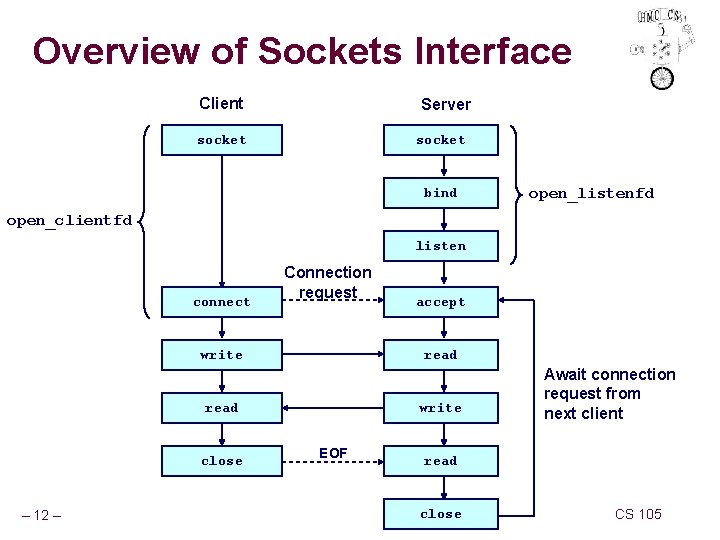
Overview of Sockets Interface Client Server socket bind open_listenfd open_clientfd listen connect Connection request write read close – 12 – accept write EOF Await connection request from next client read close CS 105
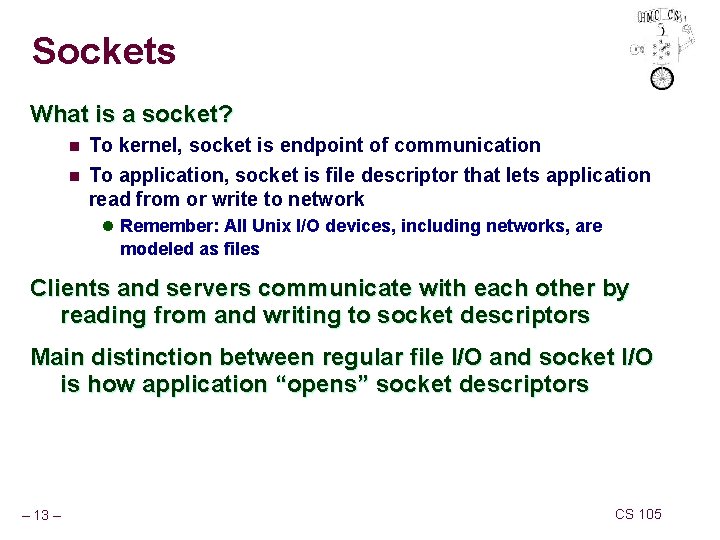
Sockets What is a socket? n To kernel, socket is endpoint of communication n To application, socket is file descriptor that lets application read from or write to network l Remember: All Unix I/O devices, including networks, are modeled as files Clients and servers communicate with each other by reading from and writing to socket descriptors Main distinction between regular file I/O and socket I/O is how application “opens” socket descriptors – 13 – CS 105
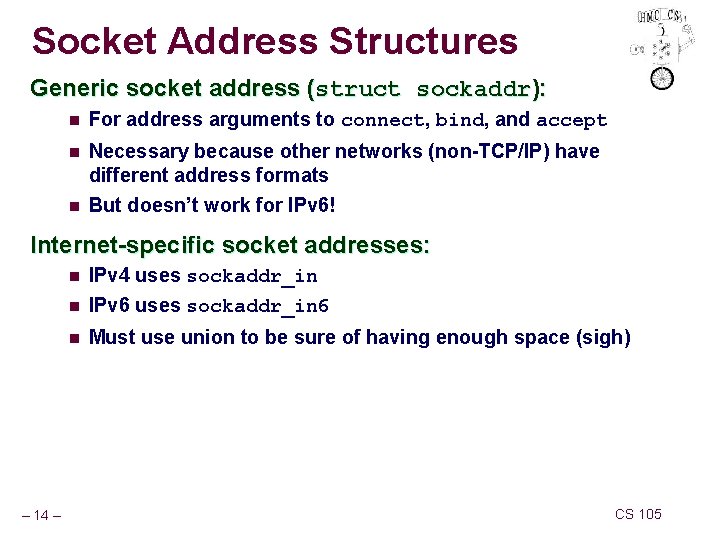
Socket Address Structures Generic socket address (struct sockaddr): n For address arguments to connect, bind, and accept n Necessary because other networks (non-TCP/IP) have different address formats n But doesn’t work for IPv 6! Internet-specific socket addresses: n IPv 4 uses sockaddr_in IPv 6 uses sockaddr_in 6 n Must use union to be sure of having enough space (sigh) n – 14 – CS 105
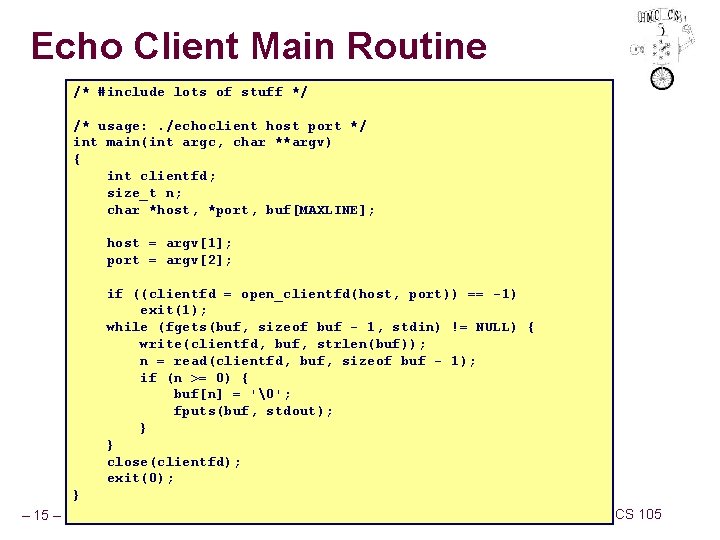
Echo Client Main Routine /* #include lots of stuff */ /* usage: . /echoclient host port */ int main(int argc, char **argv) { int clientfd; size_t n; char *host, *port, buf[MAXLINE]; host = argv[1]; port = argv[2]; if ((clientfd = open_clientfd(host, port)) == -1) exit(1); while (fgets(buf, sizeof buf - 1, stdin) != NULL) { write(clientfd, buf, strlen(buf)); n = read(clientfd, buf, sizeof buf - 1); if (n >= 0) { buf[n] = ''; fputs(buf, stdout); } } close(clientfd); exit(0); } – 15 – CS 105
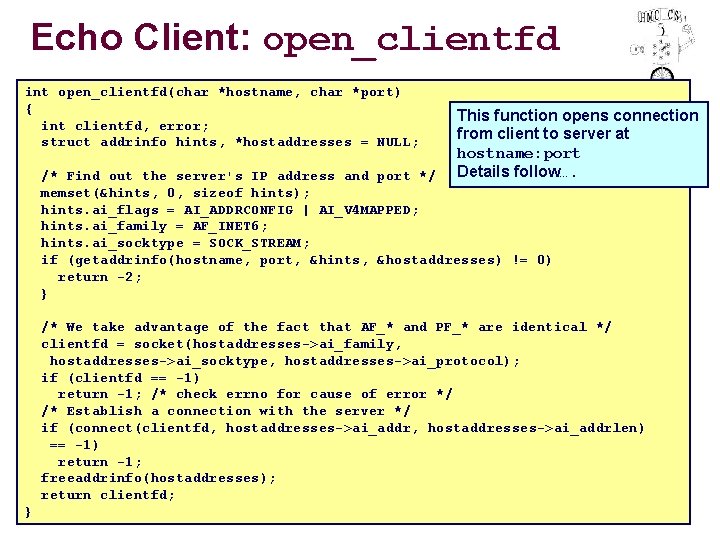
Echo Client: open_clientfd int open_clientfd(char *hostname, char *port) { int clientfd, error; struct addrinfo hints, *hostaddresses = NULL; This function opens connection from client to server at hostname: port Details follow…. /* Find out the server's IP address and port */ memset(&hints, 0, sizeof hints); hints. ai_flags = AI_ADDRCONFIG | AI_V 4 MAPPED; hints. ai_family = AF_INET 6; hints. ai_socktype = SOCK_STREAM; if (getaddrinfo(hostname, port, &hints, &hostaddresses) != 0) return -2; } /* We take advantage of the fact that AF_* and PF_* are identical */ clientfd = socket(hostaddresses->ai_family, hostaddresses->ai_socktype, hostaddresses->ai_protocol); if (clientfd == -1) return -1; /* check errno for cause of error */ /* Establish a connection with the server */ if (connect(clientfd, hostaddresses->ai_addrlen) == -1) return -1; freeaddrinfo(hostaddresses); return clientfd; CS 105 –}16 –
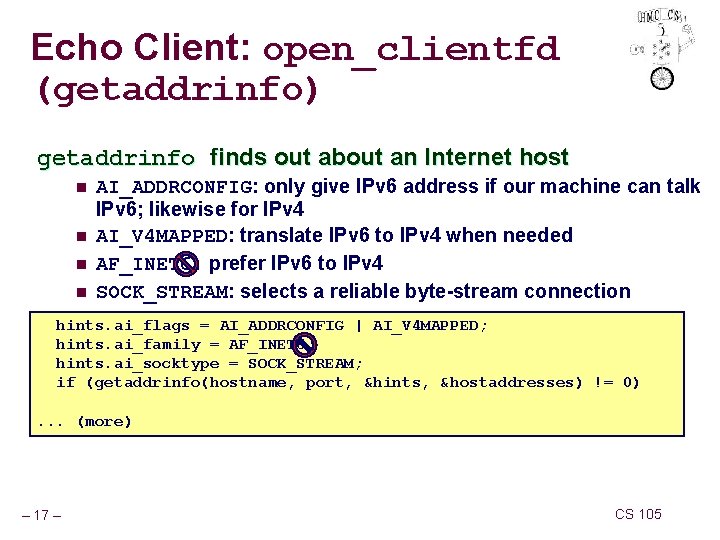
Echo Client: open_clientfd (getaddrinfo) getaddrinfo finds out about an Internet host n n AI_ADDRCONFIG: only give IPv 6 address if our machine can talk IPv 6; likewise for IPv 4 AI_V 4 MAPPED: translate IPv 6 to IPv 4 when needed AF_INET 6: prefer IPv 6 to IPv 4 SOCK_STREAM: selects a reliable byte-stream connection hints. ai_flags = AI_ADDRCONFIG | AI_V 4 MAPPED; hints. ai_family = AF_INET 6; hints. ai_socktype = SOCK_STREAM; if (getaddrinfo(hostname, port, &hints, &hostaddresses) != 0). . . (more) – 17 – CS 105
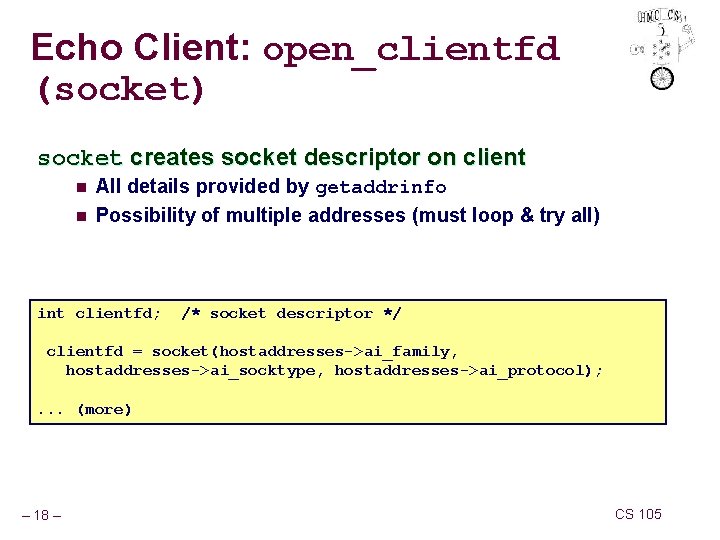
Echo Client: open_clientfd (socket) socket creates socket descriptor on client n n All details provided by getaddrinfo Possibility of multiple addresses (must loop & try all) int clientfd; /* socket descriptor */ clientfd = socket(hostaddresses->ai_family, hostaddresses->ai_socktype, hostaddresses->ai_protocol); . . . (more) – 18 – CS 105
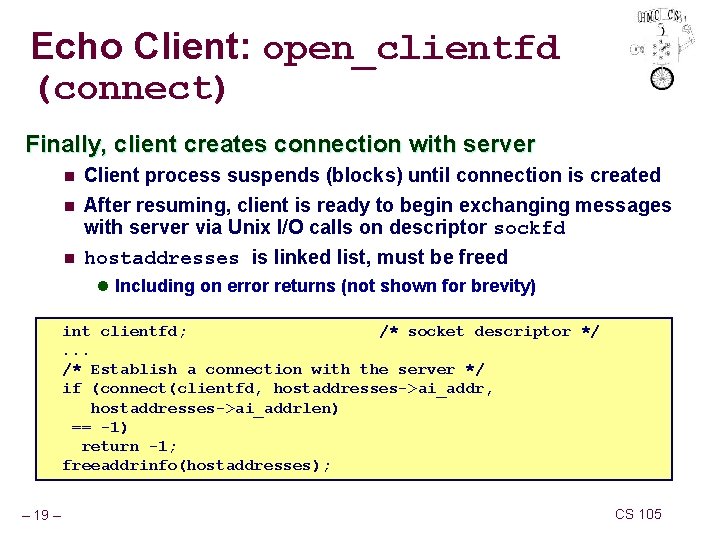
Echo Client: open_clientfd (connect) Finally, client creates connection with server n Client process suspends (blocks) until connection is created n After resuming, client is ready to begin exchanging messages with server via Unix I/O calls on descriptor sockfd hostaddresses is linked list, must be freed n l Including on error returns (not shown for brevity) int clientfd; /* socket descriptor */. . . /* Establish a connection with the server */ if (connect(clientfd, hostaddresses->ai_addrlen) == -1) return -1; freeaddrinfo(hostaddresses); – 19 – CS 105
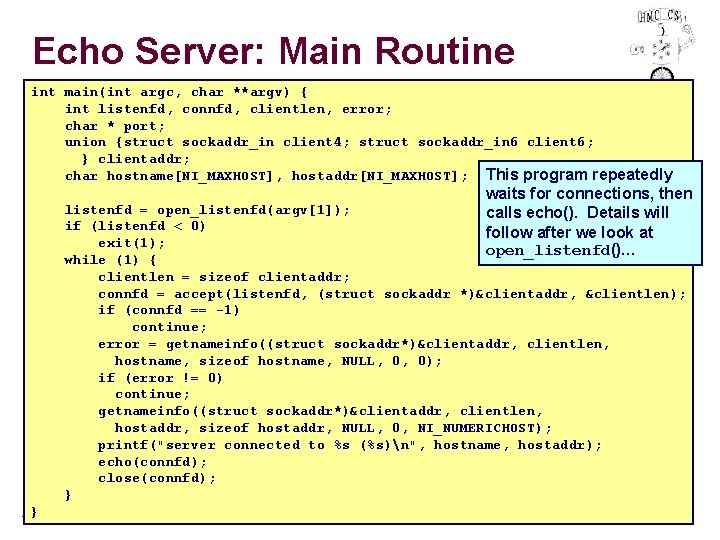
Echo Server: Main Routine int main(int argc, char **argv) { int listenfd, connfd, clientlen, error; char * port; union {struct sockaddr_in client 4; struct sockaddr_in 6 client 6; } clientaddr; char hostname[NI_MAXHOST], hostaddr[NI_MAXHOST]; This program repeatedly waits for connections, then calls echo(). Details will follow after we look at open_listenfd()… listenfd = open_listenfd(argv[1]); if (listenfd < 0) exit(1); while (1) { clientlen = sizeof clientaddr; connfd = accept(listenfd, (struct sockaddr *)&clientaddr, &clientlen); if (connfd == -1) continue; error = getnameinfo((struct sockaddr*)&clientaddr, clientlen, hostname, sizeof hostname, NULL, 0, 0); if (error != 0) continue; getnameinfo((struct sockaddr*)&clientaddr, clientlen, hostaddr, sizeof hostaddr, NULL, 0, NI_NUMERICHOST); printf("server connected to %s (%s)n", hostname, hostaddr); echo(connfd); close(connfd); } CS 105 – }20 –
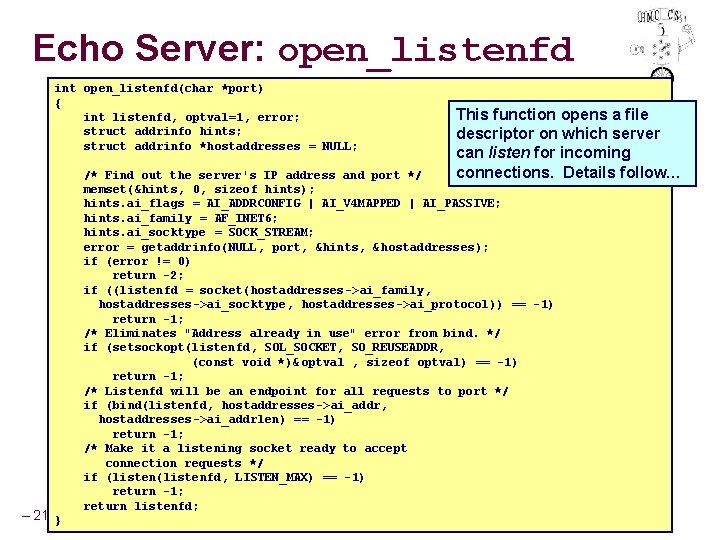
Echo Server: open_listenfd int open_listenfd(char *port) { int listenfd, optval=1, error; struct addrinfo hints; struct addrinfo *hostaddresses = NULL; – 21 –} This function opens a file descriptor on which server can listen for incoming connections. Details follow… /* Find out the server's IP address and port */ memset(&hints, 0, sizeof hints); hints. ai_flags = AI_ADDRCONFIG | AI_V 4 MAPPED | AI_PASSIVE; hints. ai_family = AF_INET 6; hints. ai_socktype = SOCK_STREAM; error = getaddrinfo(NULL, port, &hints, &hostaddresses); if (error != 0) return -2; if ((listenfd = socket(hostaddresses->ai_family, hostaddresses->ai_socktype, hostaddresses->ai_protocol)) == -1) return -1; /* Eliminates "Address already in use" error from bind. */ if (setsockopt(listenfd, SOL_SOCKET, SO_REUSEADDR, (const void *)& optval , sizeof optval) == -1) return -1; /* Listenfd will be an endpoint for all requests to port */ if (bind(listenfd, hostaddresses->ai_addrlen) == -1) return -1; /* Make it a listening socket ready to accept connection requests */ if (listenfd, LISTEN_MAX) == -1) return -1; return listenfd; CS 105
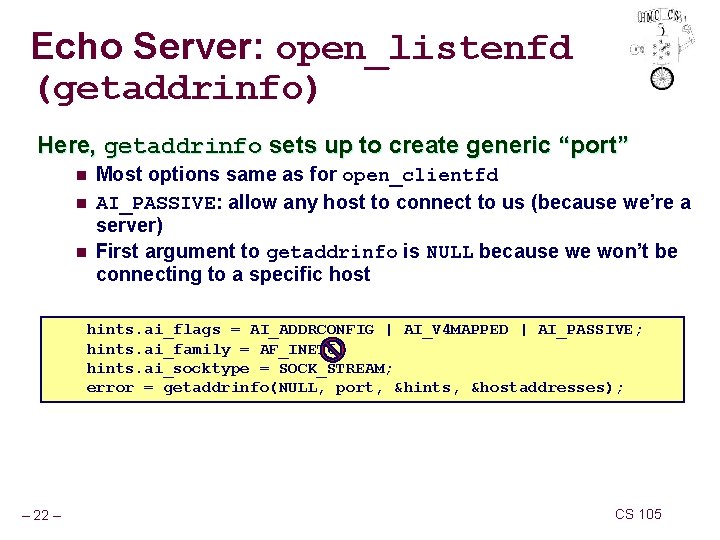
Echo Server: open_listenfd (getaddrinfo) Here, getaddrinfo sets up to create generic “port” n n n Most options same as for open_clientfd AI_PASSIVE: allow any host to connect to us (because we’re a server) First argument to getaddrinfo is NULL because we won’t be connecting to a specific host hints. ai_flags = AI_ADDRCONFIG | AI_V 4 MAPPED | AI_PASSIVE; hints. ai_family = AF_INET 6; hints. ai_socktype = SOCK_STREAM; error = getaddrinfo(NULL, port, &hints, &hostaddresses); – 22 – CS 105
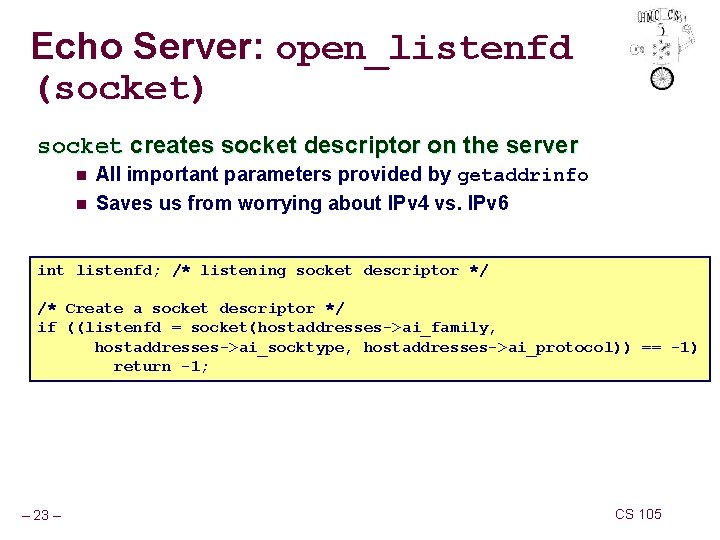
Echo Server: open_listenfd (socket) socket creates socket descriptor on the server n n All important parameters provided by getaddrinfo Saves us from worrying about IPv 4 vs. IPv 6 int listenfd; /* listening socket descriptor */ /* Create a socket descriptor */ if ((listenfd = socket(hostaddresses->ai_family, hostaddresses->ai_socktype, hostaddresses->ai_protocol)) == -1) return -1; – 23 – CS 105
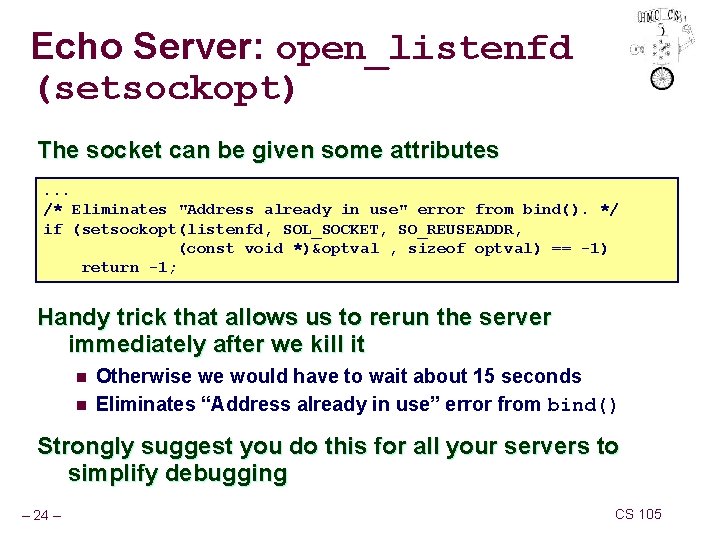
Echo Server: open_listenfd (setsockopt) The socket can be given some attributes. . . /* Eliminates "Address already in use" error from bind(). */ if (setsockopt(listenfd, SOL_SOCKET, SO_REUSEADDR, (const void *)&optval , sizeof optval) == -1) return -1; Handy trick that allows us to rerun the server immediately after we kill it n n Otherwise we would have to wait about 15 seconds Eliminates “Address already in use” error from bind() Strongly suggest you do this for all your servers to simplify debugging – 24 – CS 105
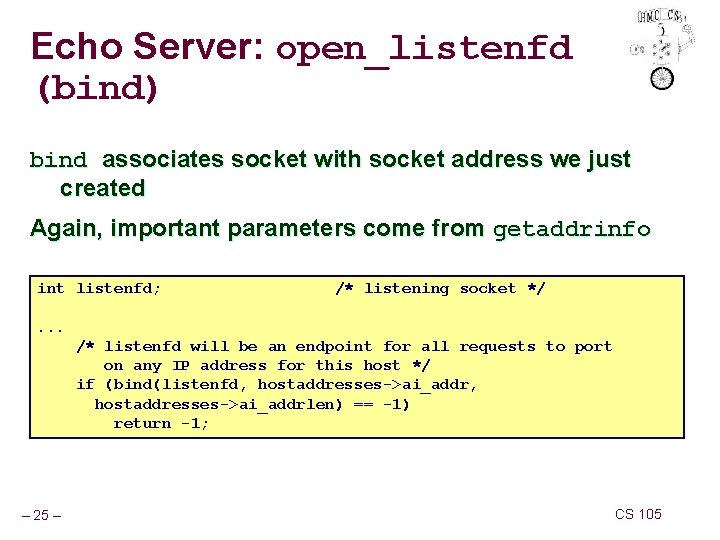
Echo Server: open_listenfd (bind) bind associates socket with socket address we just created Again, important parameters come from getaddrinfo int listenfd; /* listening socket */ . . . /* listenfd will be an endpoint for all requests to port on any IP address for this host */ if (bind(listenfd, hostaddresses->ai_addrlen) == -1) return -1; – 25 – CS 105
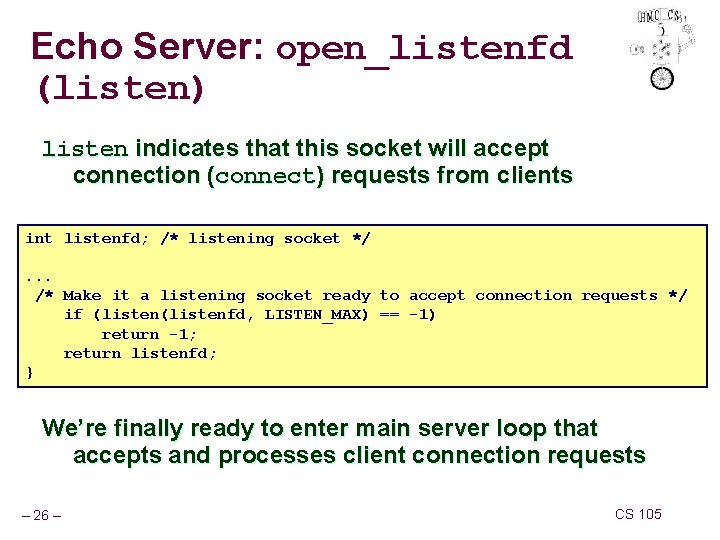
Echo Server: open_listenfd (listen) listen indicates that this socket will accept connection (connect) requests from clients int listenfd; /* listening socket */. . . /* Make it a listening socket ready to accept connection requests */ if (listenfd, LISTEN_MAX) == -1) return -1; return listenfd; } We’re finally ready to enter main server loop that accepts and processes client connection requests – 26 – CS 105
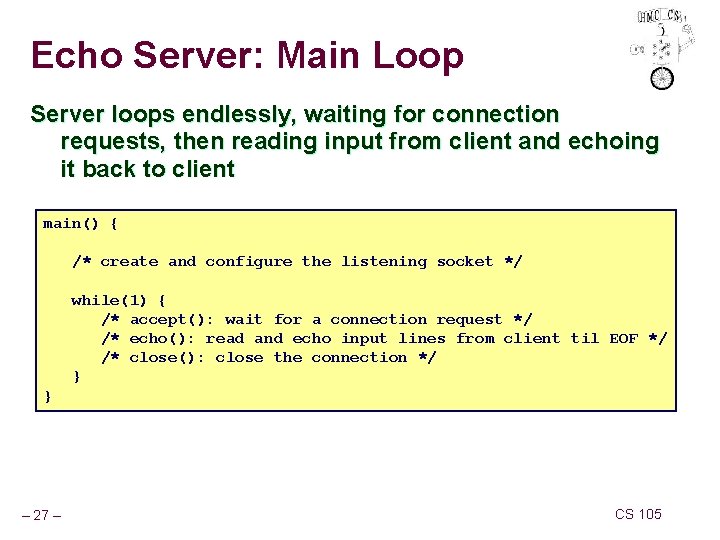
Echo Server: Main Loop Server loops endlessly, waiting for connection requests, then reading input from client and echoing it back to client main() { /* create and configure the listening socket */ while(1) { /* accept(): wait for a connection request */ /* echo(): read and echo input lines from client til EOF */ /* close(): close the connection */ } } – 27 – CS 105
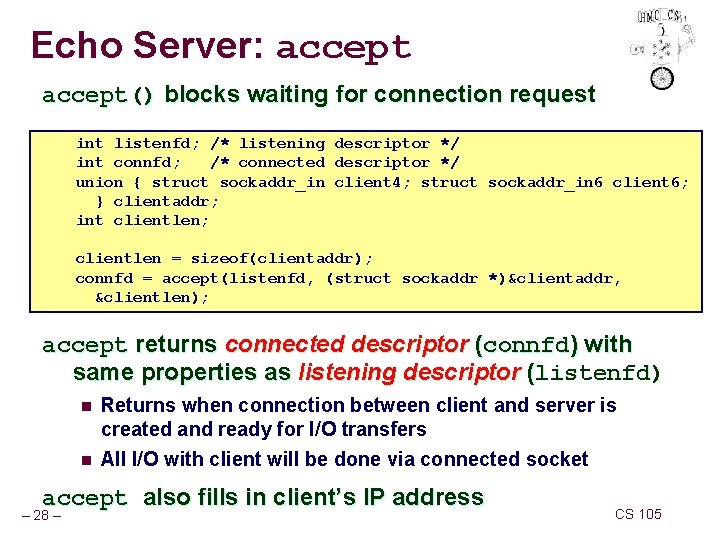
Echo Server: accept() blocks waiting for connection request int listenfd; /* listening descriptor */ int connfd; /* connected descriptor */ union { struct sockaddr_in client 4; struct sockaddr_in 6 client 6; } clientaddr; int clientlen; clientlen = sizeof(clientaddr); connfd = accept(listenfd, (struct sockaddr *)&clientaddr, &clientlen); accept returns connected descriptor (connfd) with same properties as listening descriptor (listenfd) n n Returns when connection between client and server is created and ready for I/O transfers All I/O with client will be done via connected socket accept also fills in client’s IP address – 28 – CS 105
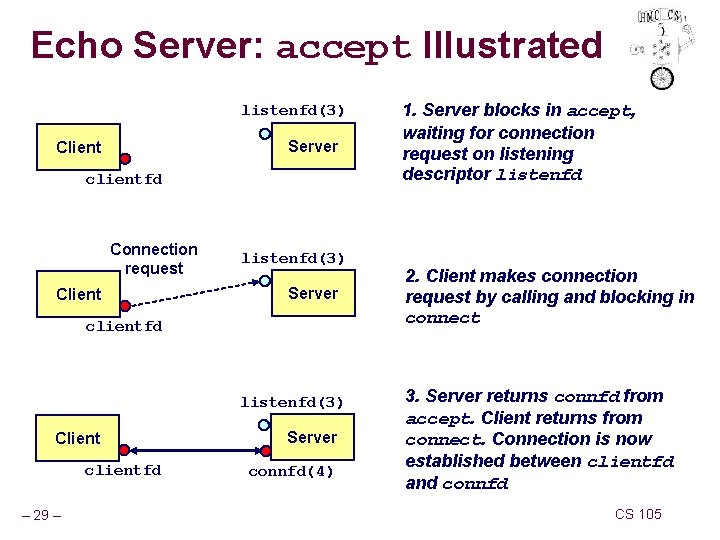
Echo Server: accept Illustrated listenfd(3) Server Client clientfd Connection request Client listenfd(3) Server clientfd listenfd(3) Client clientfd – 29 – Server connfd(4) 1. Server blocks in accept, waiting for connection request on listening descriptor listenfd 2. Client makes connection request by calling and blocking in connect 3. Server returns connfd from accept. Client returns from connect. Connection is now established between clientfd and connfd CS 105
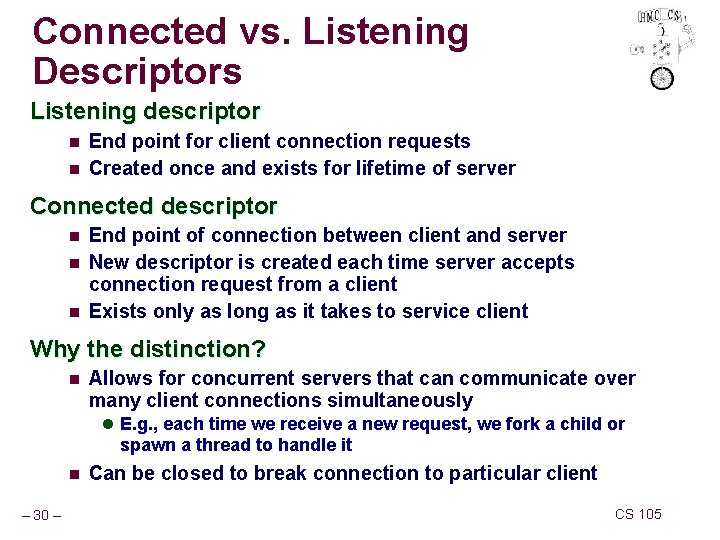
Connected vs. Listening Descriptors Listening descriptor n n End point for client connection requests Created once and exists for lifetime of server Connected descriptor n n n End point of connection between client and server New descriptor is created each time server accepts connection request from a client Exists only as long as it takes to service client Why the distinction? n Allows for concurrent servers that can communicate over many client connections simultaneously l E. g. , each time we receive a new request, we fork a child or spawn a thread to handle it n – 30 – Can be closed to break connection to particular client CS 105
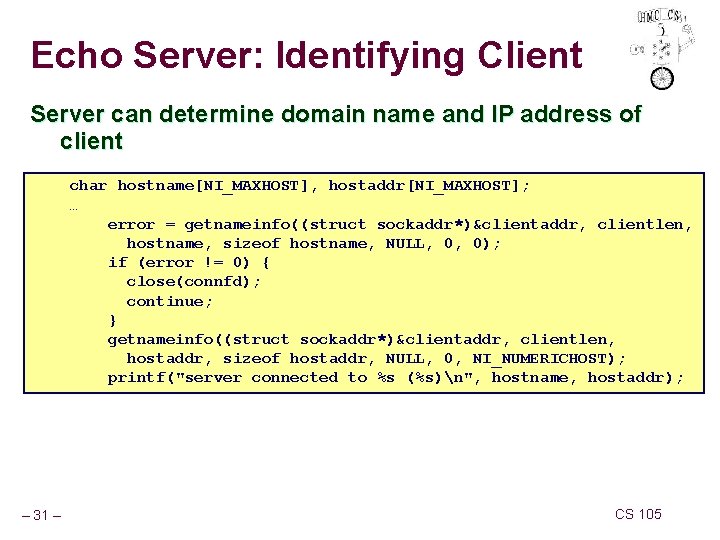
Echo Server: Identifying Client Server can determine domain name and IP address of client char hostname[NI_MAXHOST], hostaddr[NI_MAXHOST]; … error = getnameinfo((struct sockaddr*)&clientaddr, clientlen, hostname, sizeof hostname, NULL, 0, 0); if (error != 0) { close(connfd); continue; } getnameinfo((struct sockaddr*)&clientaddr, clientlen, hostaddr, sizeof hostaddr, NULL, 0, NI_NUMERICHOST); printf("server connected to %s (%s)n", hostname, hostaddr); – 31 – CS 105
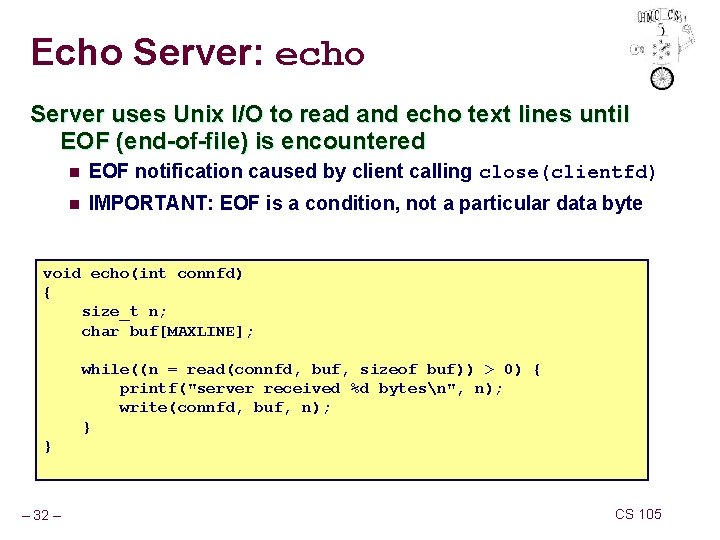
Echo Server: echo Server uses Unix I/O to read and echo text lines until EOF (end-of-file) is encountered n EOF notification caused by client calling close(clientfd) n IMPORTANT: EOF is a condition, not a particular data byte void echo(int connfd) { size_t n; char buf[MAXLINE]; while((n = read(connfd, buf, sizeof buf)) > 0) { printf("server received %d bytesn", n); write(connfd, buf, n); } } – 32 – CS 105
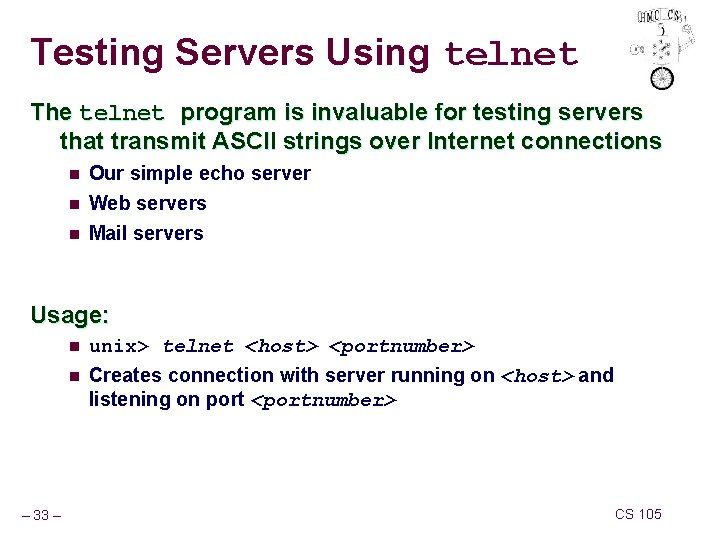
Testing Servers Using telnet The telnet program is invaluable for testing servers that transmit ASCII strings over Internet connections n n n Our simple echo server Web servers Mail servers Usage: – 33 – n unix> telnet <host> <portnumber> n Creates connection with server running on <host> and listening on port <portnumber> CS 105
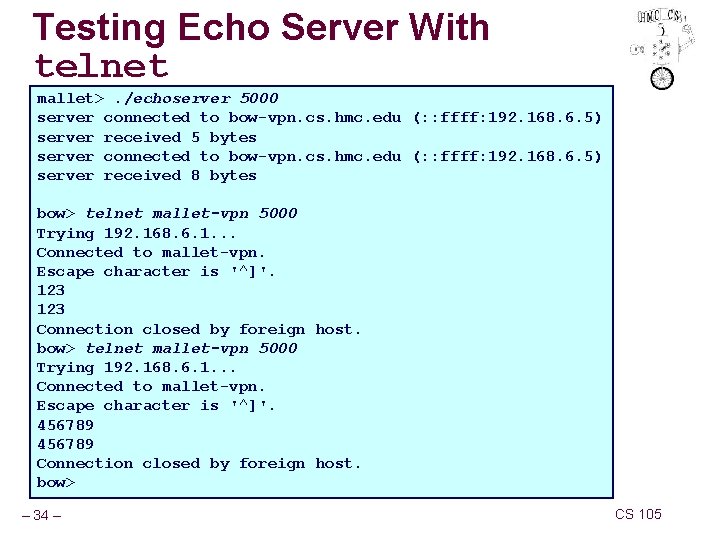
Testing Echo Server With telnet mallet>. /echoserver 5000 server connected to bow-vpn. cs. hmc. edu (: : ffff: 192. 168. 6. 5) server received 5 bytes server connected to bow-vpn. cs. hmc. edu (: : ffff: 192. 168. 6. 5) server received 8 bytes bow> telnet mallet-vpn 5000 Trying 192. 168. 6. 1. . . Connected to mallet-vpn. Escape character is '^]'. 123 Connection closed by foreign host. bow> telnet mallet-vpn 5000 Trying 192. 168. 6. 1. . . Connected to mallet-vpn. Escape character is '^]'. 456789 Connection closed by foreign host. bow> – 34 – CS 105
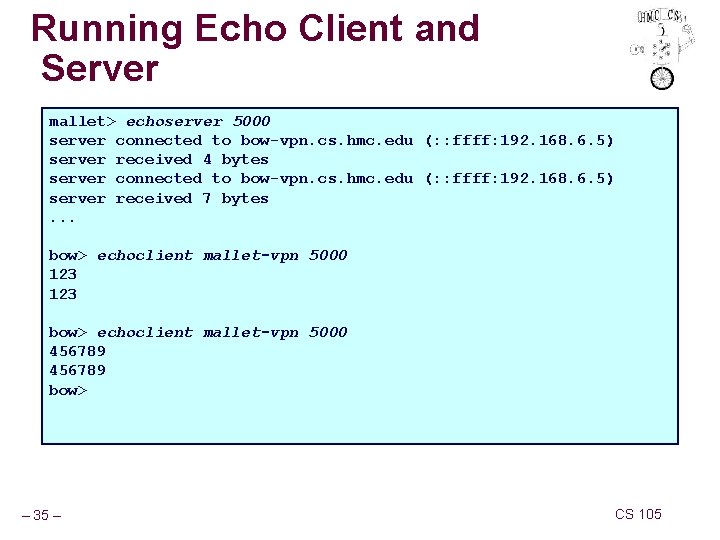
Running Echo Client and Server mallet> echoserver 5000 server connected to bow-vpn. cs. hmc. edu (: : ffff: 192. 168. 6. 5) server received 4 bytes server connected to bow-vpn. cs. hmc. edu (: : ffff: 192. 168. 6. 5) server received 7 bytes. . . bow> echoclient mallet-vpn 5000 123 bow> echoclient mallet-vpn 5000 456789 bow> – 35 – CS 105
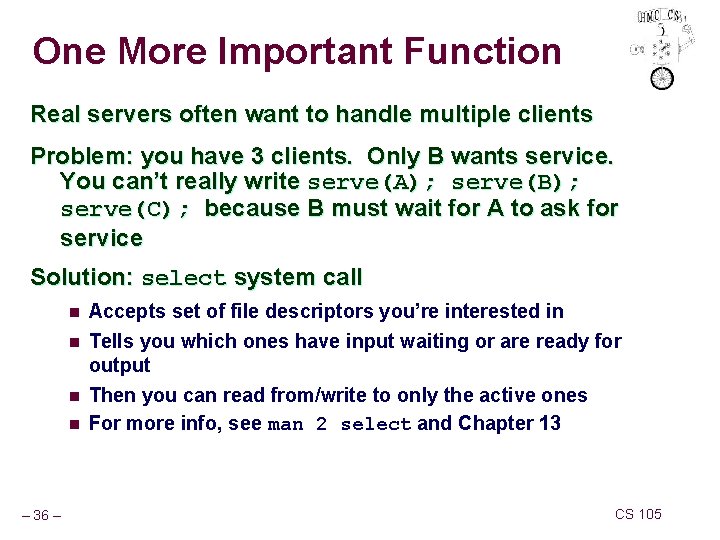
One More Important Function Real servers often want to handle multiple clients Problem: you have 3 clients. Only B wants service. You can’t really write serve(A); serve(B); serve(C); because B must wait for A to ask for service Solution: select system call n n – 36 – Accepts set of file descriptors you’re interested in Tells you which ones have input waiting or are ready for output Then you can read from/write to only the active ones For more info, see man 2 select and Chapter 13 CS 105
For More Information W. Richard Stevens, “Unix Network Programming: Networking APIs: Sockets and XTI”, Volume 1, Second Edition, Prentice Hall, 1998 n THE network programming bible Complete versions of the echo client and server (for IPV 4 only) are developed in the text n – 37 – IPV 6 versions (from these slides) are available from class web page CS 105
- Slides: 37