
CS 105 Tour of the Black Holes of
CS 105 “Tour of the Black Holes of Computing” Integers Topics n Numeric Encodings l Unsigned & Two’s complement n Programming Implications l C promotion rules n Basic operations l Addition, negation, multiplication n Programming Implications l Consequences of overflow l Using shifts to perform power-of-2 multiply/divide ints. ppt CS 105
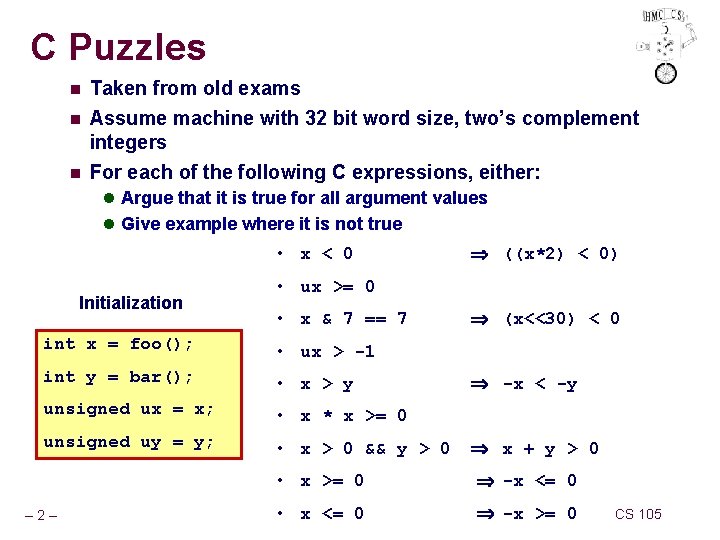
C Puzzles n n n Taken from old exams Assume machine with 32 bit word size, two’s complement integers For each of the following C expressions, either: l Argue that it is true for all argument values l Give example where it is not true • x < 0 Initialization ((x*2) < 0) • ux >= 0 • x & 7 == 7 (x<<30) < 0 int x = foo(); • ux > -1 int y = bar(); • x > y unsigned ux = x; • x * x >= 0 unsigned uy = y; • x > 0 && y > 0 x + y > 0 – 2– -x < -y • x >= 0 -x <= 0 • x <= 0 -x >= 0 CS 105
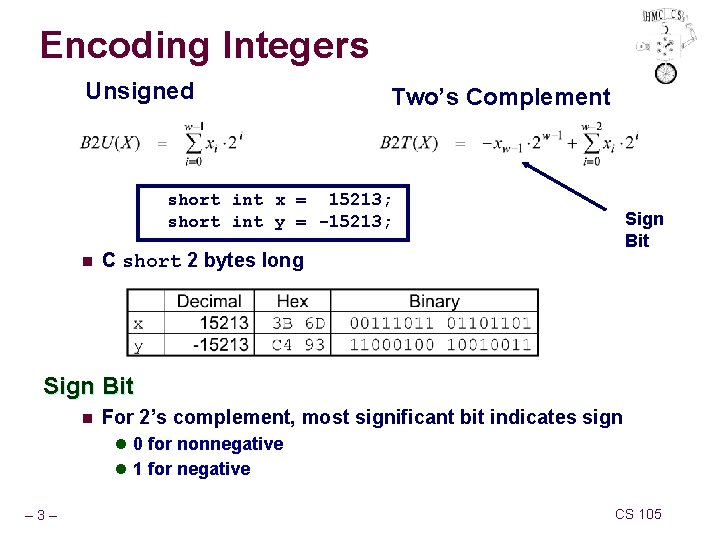
Encoding Integers Unsigned Two’s Complement short int x = 15213; short int y = -15213; n Sign Bit C short 2 bytes long Sign Bit n For 2’s complement, most significant bit indicates sign l 0 for nonnegative l 1 for negative – 3– CS 105
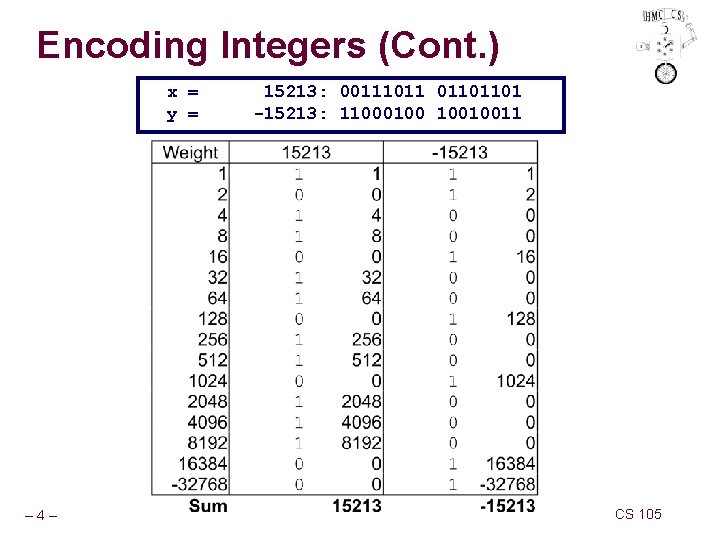
Encoding Integers (Cont. ) x = y = – 4– 15213: 00111011 01101101 -15213: 11000100 10010011 CS 105
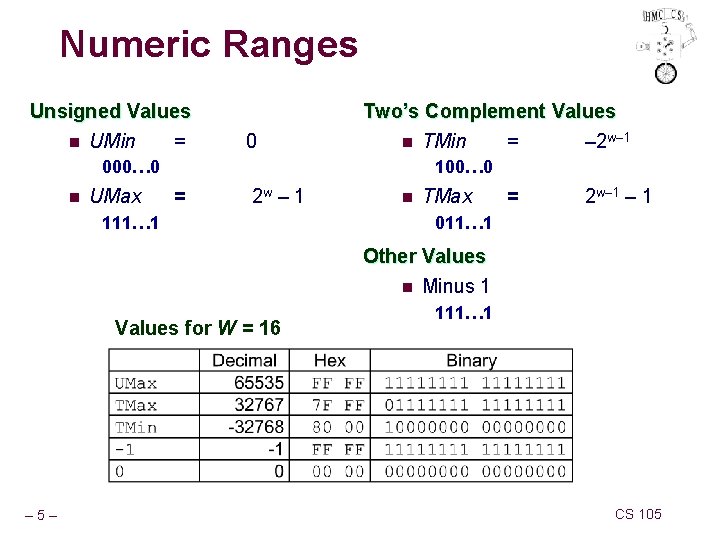
Numeric Ranges Unsigned Values n UMin = 0 Two’s Complement Values n TMin = – 2 w– 1 000… 0 n UMax 100… 0 = 2 w – 1 111… 1 n TMax = 2 w– 1 011… 1 Other Values n Minus 1 Values for W = 16 – 5– 111… 1 CS 105
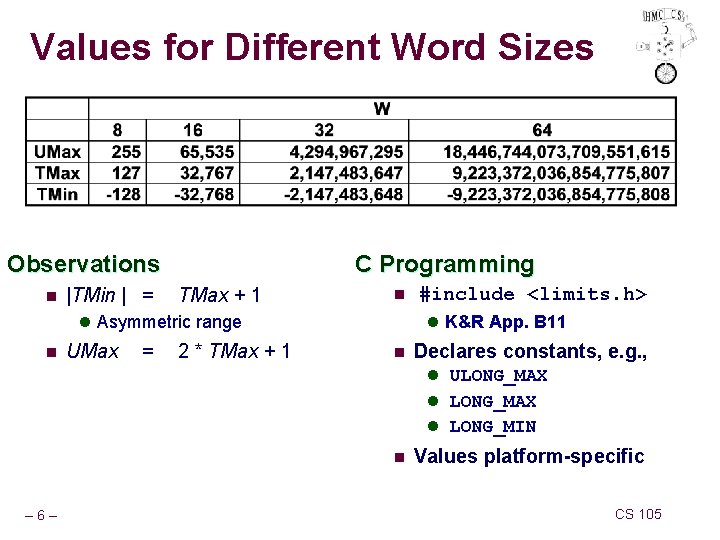
Values for Different Word Sizes Observations n |TMin | = C Programming TMax + 1 n l Asymmetric range n UMax = 2 * TMax + 1 #include <limits. h> l K&R App. B 11 n Declares constants, e. g. , l ULONG_MAX l LONG_MIN n – 6– Values platform-specific CS 105
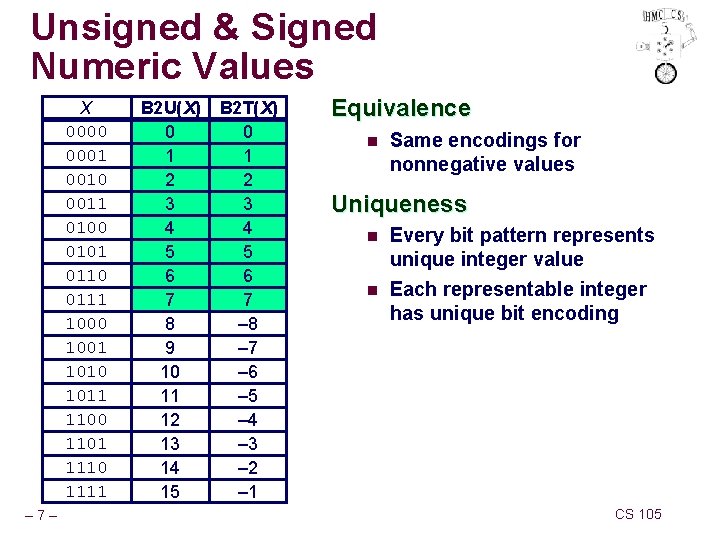
Unsigned & Signed Numeric Values X 0000 0001 0010 0011 0100 0101 0110 0111 1000 1001 1010 1011 1100 1101 1110 1111 – 7– B 2 U(X) 0 1 2 3 4 5 6 7 8 9 10 11 12 13 14 15 B 2 T(X) 0 1 2 3 4 5 6 7 – 8 – 7 – 6 – 5 – 4 – 3 – 2 – 1 Equivalence n Same encodings for nonnegative values Uniqueness n n Every bit pattern represents unique integer value Each representable integer has unique bit encoding CS 105

Casting Signed to Unsigned C Allows Conversions from Signed to Unsigned short int x = 15213; unsigned short int ux = (unsigned short) x; short int y = -15213; unsigned short int uy = (unsigned short) y; Resulting Value n n No change in bit representation Nonnegative values unchanged l ux = 15213 n Negative values change into (large) positive values l uy = 50323 – 8– CS 105
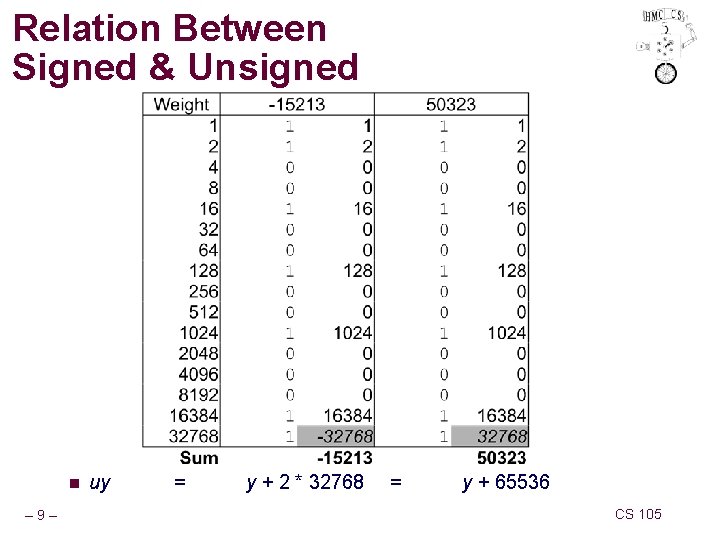
Relation Between Signed & Unsigned n – 9– uy = y + 2 * 32768 = y + 65536 CS 105
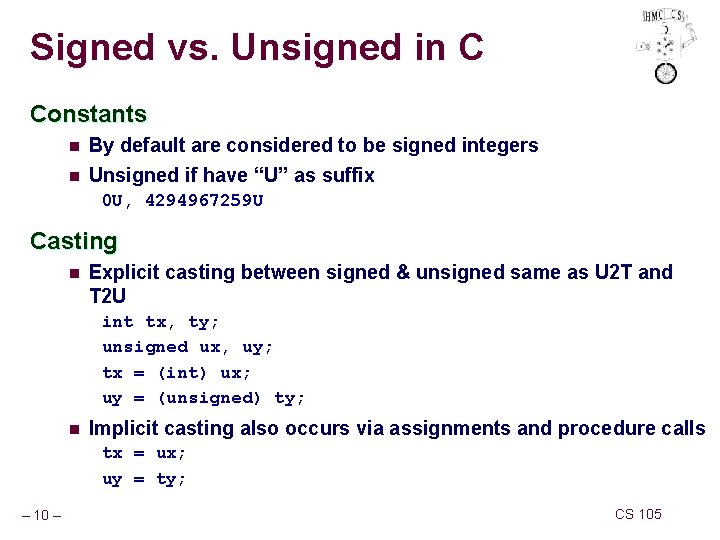
Signed vs. Unsigned in C Constants n By default are considered to be signed integers n Unsigned if have “U” as suffix 0 U, 4294967259 U Casting n Explicit casting between signed & unsigned same as U 2 T and T 2 U int tx, ty; unsigned ux, uy; tx = (int) ux; uy = (unsigned) ty; n Implicit casting also occurs via assignments and procedure calls tx = ux; uy = ty; – 10 – CS 105
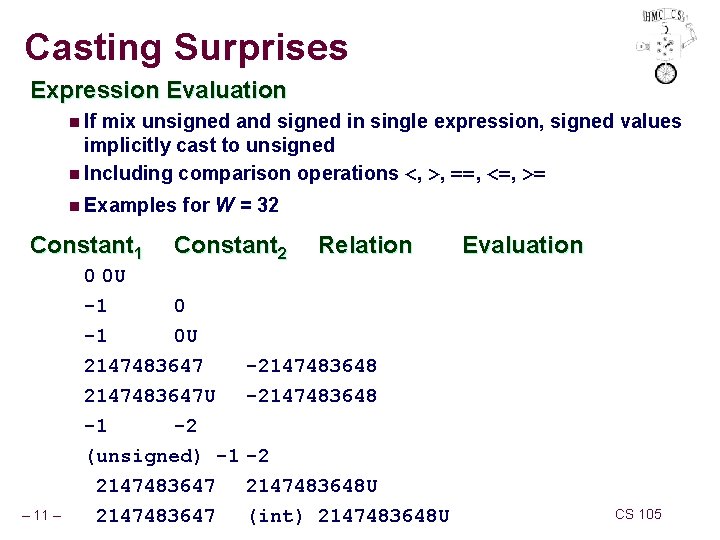
Casting Surprises Expression Evaluation n If mix unsigned and signed in single expression, signed values implicitly cast to unsigned n Including comparison operations <, >, ==, <=, >= n Examples Constant 1 – 11 – for W = 32 Constant 2 Relation 0 0 U -1 0 U 2147483647 -2147483648 2147483647 U -2147483648 -1 -2 (unsigned) -1 -2 2147483647 2147483648 U 2147483647 (int) 2147483648 U Evaluation CS 105
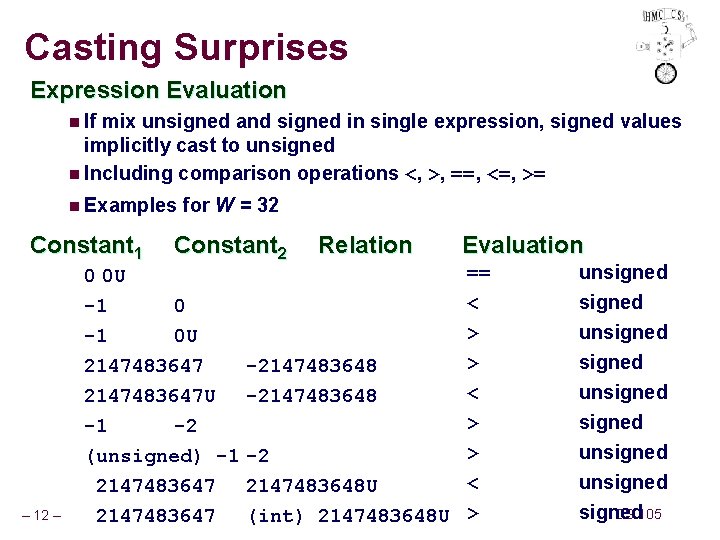
Casting Surprises Expression Evaluation n If mix unsigned and signed in single expression, signed values implicitly cast to unsigned n Including comparison operations <, >, ==, <=, >= n Examples Constant 1 for W = 32 Constant 2 0 0 U -1 0 U 2147483647 – 12 – Relation 0 U 0 0 U -2147483648 2147483647 U -2147483648 -1 -2 -2 (unsigned) -1 -2 -2 2147483647 2147483648 U 2147483647 (int) 2147483648 U Evaluation == < > > unsigned < > > < > unsigned CS 105 signed
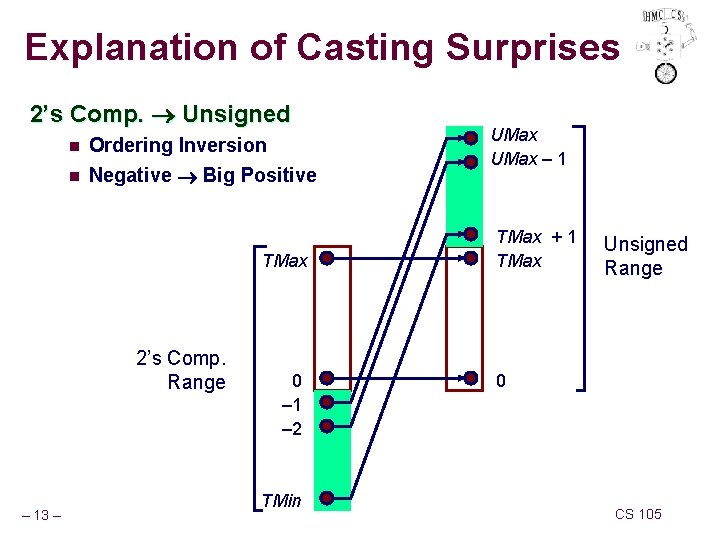
Explanation of Casting Surprises 2’s Comp. Unsigned n Ordering Inversion n Negative Big Positive TMax 2’s Comp. Range – 13 – 0 – 1 – 2 TMin UMax – 1 TMax + 1 TMax Unsigned Range 0 CS 105
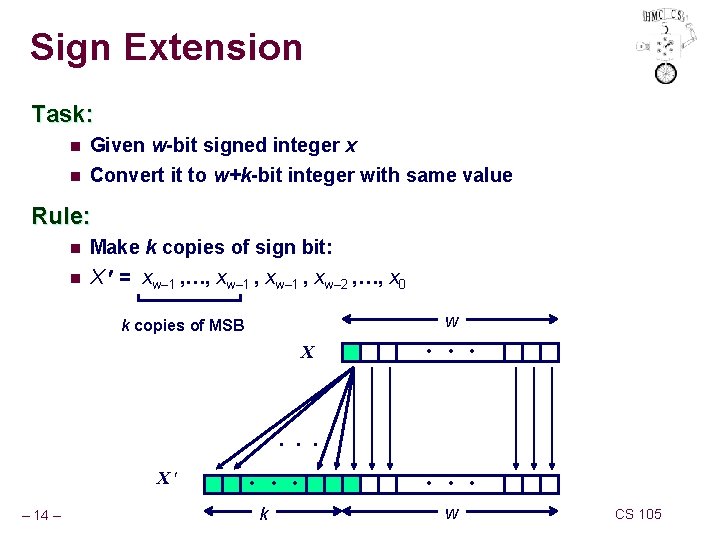
Sign Extension Task: n Given w-bit signed integer x n Convert it to w+k-bit integer with same value Rule: n n Make k copies of sign bit: X = xw– 1 , …, xw– 1 , xw– 2 , …, x 0 w k copies of MSB X • • • X – 14 – • • • k • • • w CS 105
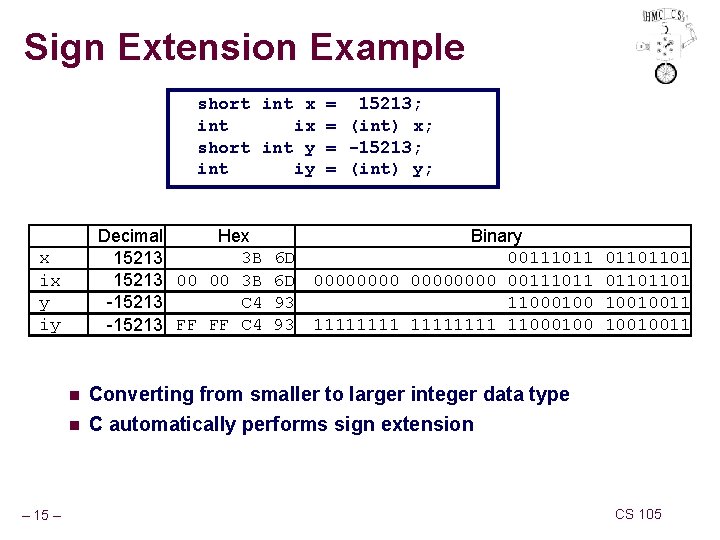
Sign Extension Example short int x = 15213; int ix = (int) x; short int y = -15213; int iy = (int) y; Decimal Hex 3 B 15213 00 00 3 B C 4 -15213 FF FF C 4 x ix y iy n n – 15 – Binary 6 D 00111011 6 D 00000000 00111011 93 11000100 93 11111111 11000100 01101101 10010011 Converting from smaller to larger integer data type C automatically performs sign extension CS 105
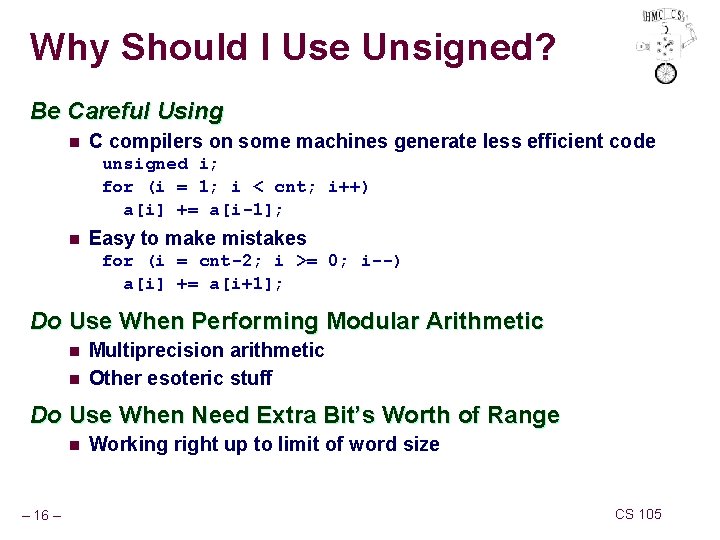
Why Should I Use Unsigned? Be Careful Using n C compilers on some machines generate less efficient code unsigned i; for (i = 1; i < cnt; i++) a[i] += a[i-1]; n Easy to make mistakes for (i = cnt-2; i >= 0; i--) a[i] += a[i+1]; Do Use When Performing Modular Arithmetic n n Multiprecision arithmetic Other esoteric stuff Do Use When Need Extra Bit’s Worth of Range n – 16 – Working right up to limit of word size CS 105
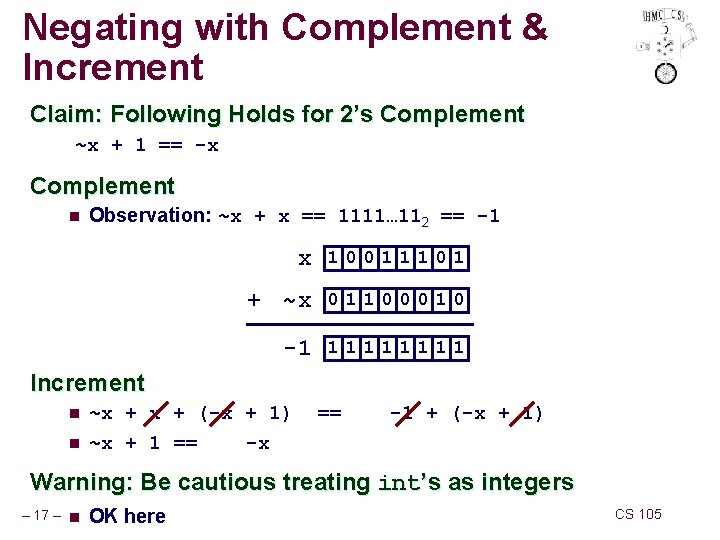
Negating with Complement & Increment Claim: Following Holds for 2’s Complement ~x + 1 == -x Complement n Observation: ~x + x == 1111… 112 == -1 x 1001 110 1 + ~x 0110 001 0 -1 111 1 Increment n n ~x + (-x + 1) ~x + 1 == -x == -1 + (-x + 1) Warning: Be cautious treating int’s as integers – 17 – n OK here CS 105
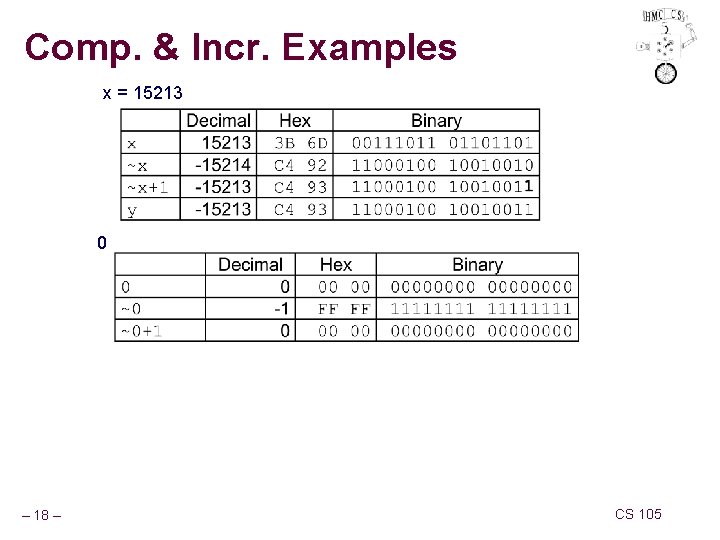
Comp. & Incr. Examples x = 15213 0 – 18 – CS 105
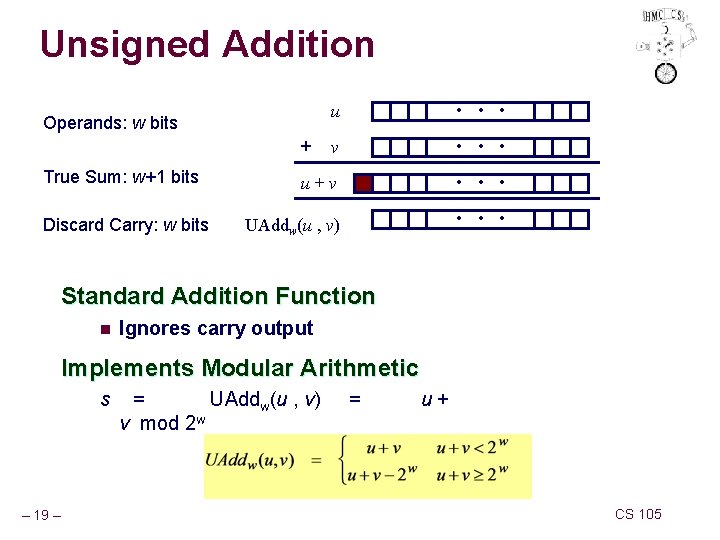
Unsigned Addition u • • • v • • • u+v • • • UAddw(u , v) • • • Operands: w bits + True Sum: w+1 bits Discard Carry: w bits Standard Addition Function n Ignores carry output Implements Modular Arithmetic s – 19 – = UAddw(u , v) v mod 2 w = u+ CS 105
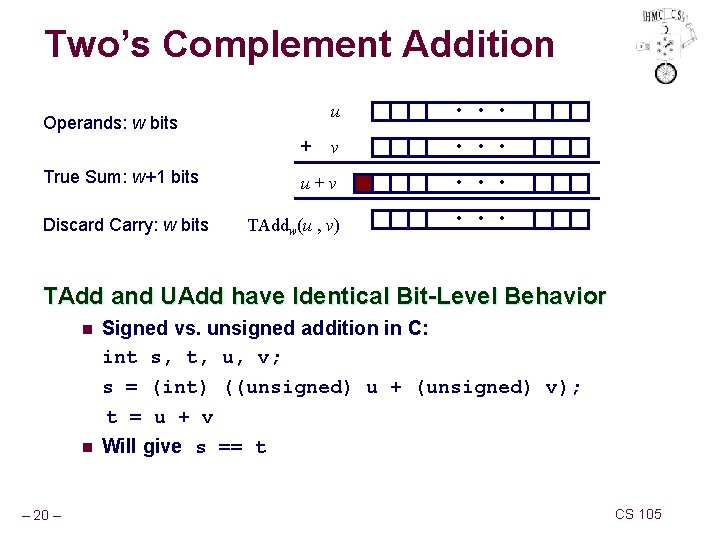
Two’s Complement Addition u • • • v • • • u+v • • • TAddw(u , v) • • • Operands: w bits + True Sum: w+1 bits Discard Carry: w bits TAdd and UAdd have Identical Bit-Level Behavior n n – 20 – Signed vs. unsigned addition in C: int s, t, u, v; s = (int) ((unsigned) u + (unsigned) v); t = u + v Will give s == t CS 105
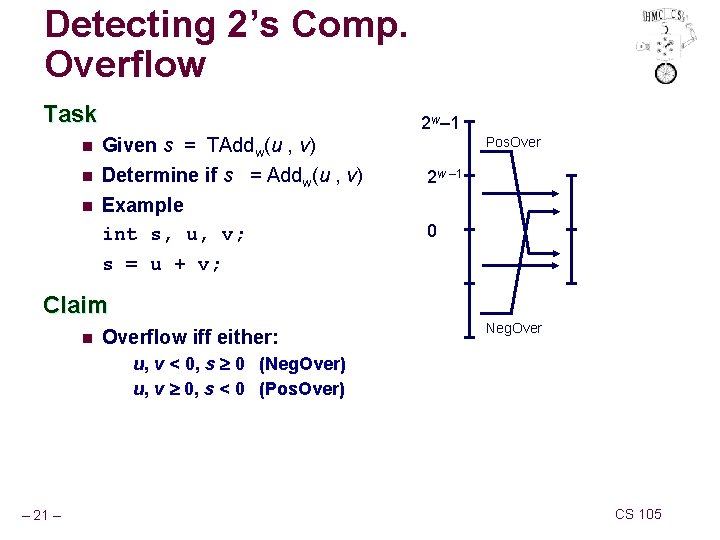
Detecting 2’s Comp. Overflow Task 2 w– 1 n Given s = TAddw(u , v) n Determine if s = Addw(u , v) Example int s, u, v; s = u + v; n Pos. Over 2 w – 1 0 Claim n Overflow iff either: Neg. Over u, v < 0, s 0 (Neg. Over) u, v 0, s < 0 (Pos. Over) – 21 – CS 105
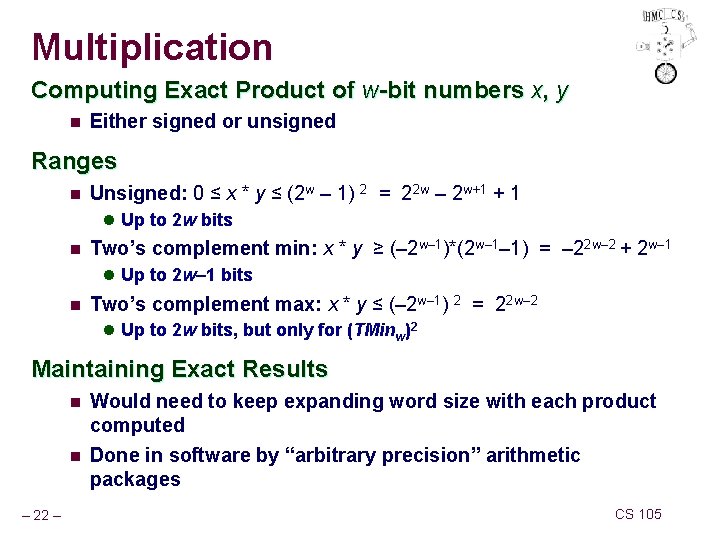
Multiplication Computing Exact Product of w-bit numbers x, y n Either signed or unsigned Ranges n Unsigned: 0 ≤ x * y ≤ (2 w – 1) 2 = 22 w – 2 w+1 + 1 l Up to 2 w bits n Two’s complement min: x * y ≥ (– 2 w– 1)*(2 w– 1– 1) = – 22 w– 2 + 2 w– 1 l Up to 2 w– 1 bits n Two’s complement max: x * y ≤ (– 2 w– 1) 2 = 22 w– 2 l Up to 2 w bits, but only for (TMinw)2 Maintaining Exact Results n n – 22 – Would need to keep expanding word size with each product computed Done in software by “arbitrary precision” arithmetic packages CS 105
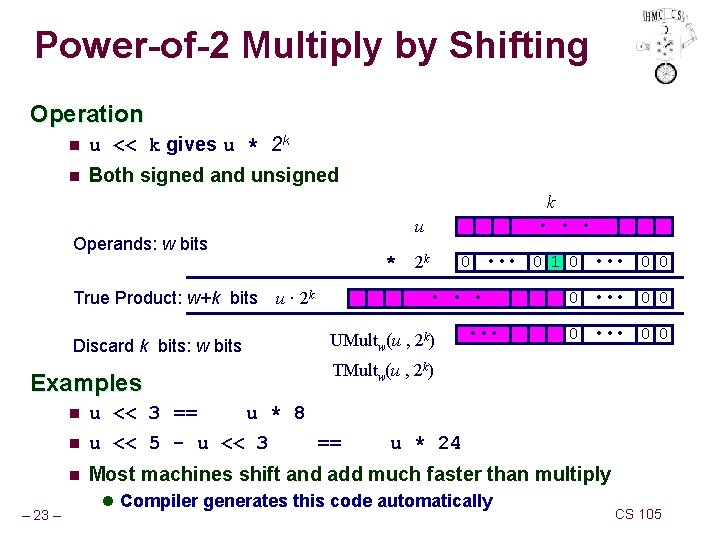
Power-of-2 Multiply by Shifting Operation n u << k gives u * 2 k n Both signed and unsigned Operands: w bits True Product: w+k bits Discard k bits: w bits Examples u · 2 k 2 k 0 • • • 0 1 0 • • • 0 0 • • • UMultw(u , 2 k) • • • 0 • • • 0 0 TMultw(u , 2 k) n u << 3 == u * 8 u << 5 - u << 3 == n Most machines shift and add much faster than multiply n – 23 – * u k • • • u * 24 l Compiler generates this code automatically CS 105
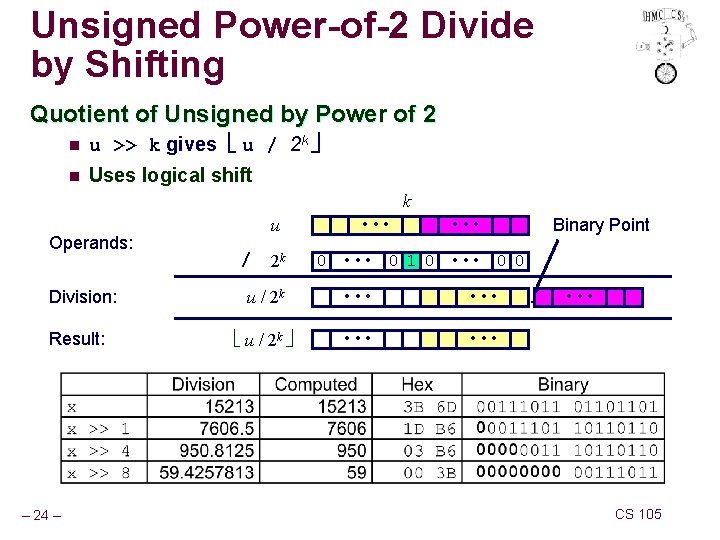
Unsigned Power-of-2 Divide by Shifting Quotient of Unsigned by Power of 2 n u >> k gives u / 2 k n Uses logical shift k Operands: Division: Result: – 24 – u / 2 k • • • Binary Point • • • 0 • • • 0 1 0 • • • 0 0 u / 2 k 0 • • • u / 2 k 0 • • • CS 105
- Slides: 24