
CS 105 Tour of the Black Holes of
CS 105 “Tour of the Black Holes of Computing!” Exceptional Control Flow Part II Topics n n n except 2. ppt Process Hierarchy Shells Signals
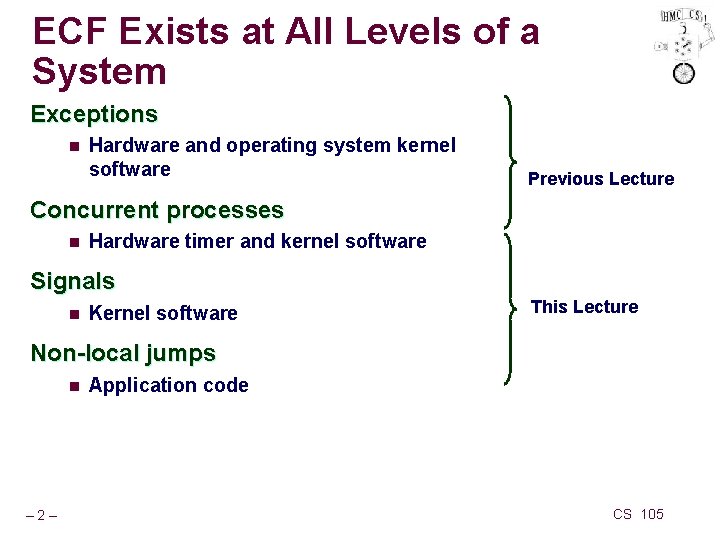
ECF Exists at All Levels of a System Exceptions n Hardware and operating system kernel software Previous Lecture Concurrent processes n Hardware timer and kernel software Signals n Kernel software This Lecture Non-local jumps n – 2– Application code CS 105

The World of Multitasking System Runs Many Processes Concurrently n Process: executing program l State consists of memory image + register values + program counter n Continually switches from one process to another l Suspend process when it needs I/O resource or when timer event occurs l Resume process when I/O available or given scheduling priority n Appears to user(s) as if all processes executing simultaneously l Even though most systems can only execute one process at a time l Except possibly with lower performance than if running alone – 3– CS 105
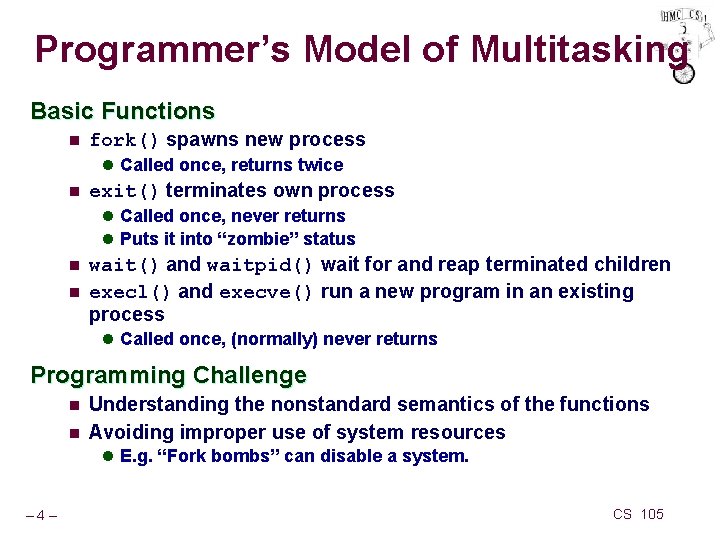
Programmer’s Model of Multitasking Basic Functions n fork() spawns new process l Called once, returns twice n exit() terminates own process l Called once, never returns l Puts it into “zombie” status n n wait() and waitpid() wait for and reap terminated children execl() and execve() run a new program in an existing process l Called once, (normally) never returns Programming Challenge n n Understanding the nonstandard semantics of the functions Avoiding improper use of system resources l E. g. “Fork bombs” can disable a system. – 4– CS 105
![Unix Process Hierarchy [0] init [1] Daemon e. g. httpd Login shell Child Grandchild](http://slidetodoc.com/presentation_image_h2/7c7282f671a4eb2a9ef2447d17cbdddd/image-5.jpg "Unix Process Hierarchy [0] init [1] Daemon e. g. httpd Login shell Child Grandchild")
Unix Process Hierarchy [0] init [1] Daemon e. g. httpd Login shell Child Grandchild – 5– Child Grandchild CS 105
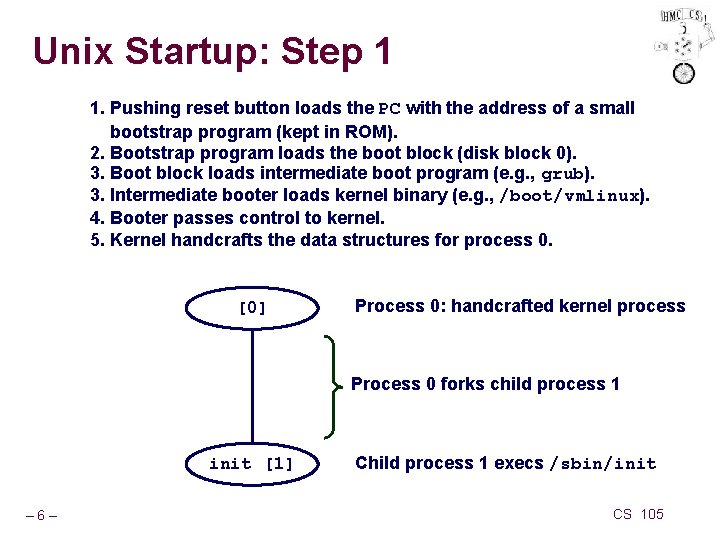
Unix Startup: Step 1 1. Pushing reset button loads the PC with the address of a small bootstrap program (kept in ROM). 2. Bootstrap program loads the boot block (disk block 0). 3. Boot block loads intermediate boot program (e. g. , grub). 3. Intermediate booter loads kernel binary (e. g. , /boot/vmlinux). 4. Booter passes control to kernel. 5. Kernel handcrafts the data structures for process 0. [0] Process 0: handcrafted kernel process Process 0 forks child process 1 init [1] – 6– Child process 1 execs /sbin/init CS 105
![Unix Startup: Step 2 [0] /etc/inittab Daemons e. g. ftpd, httpd – 7– init](http://slidetodoc.com/presentation_image_h2/7c7282f671a4eb2a9ef2447d17cbdddd/image-7.jpg "Unix Startup: Step 2 [0] /etc/inittab Daemons e. g. ftpd, httpd – 7– init")
Unix Startup: Step 2 [0] /etc/inittab Daemons e. g. ftpd, httpd – 7– init [1] getty init forks and execs daemons per /etc/inittab, and forks and execs a getty program for the console CS 105
![Unix Startup: Step 3 [0] init [1] login – 8– The getty process execs](http://slidetodoc.com/presentation_image_h2/7c7282f671a4eb2a9ef2447d17cbdddd/image-8.jpg "Unix Startup: Step 3 [0] init [1] login – 8– The getty process execs")
Unix Startup: Step 3 [0] init [1] login – 8– The getty process execs a login program CS 105
![Unix Startup: Step 4 [0] init [1] tcsh – 9– login reads login and](http://slidetodoc.com/presentation_image_h2/7c7282f671a4eb2a9ef2447d17cbdddd/image-9.jpg "Unix Startup: Step 4 [0] init [1] tcsh – 9– login reads login and")
Unix Startup: Step 4 [0] init [1] tcsh – 9– login reads login and passwd. if OK, it execs a shell. if not OK, it execs another getty CS 105
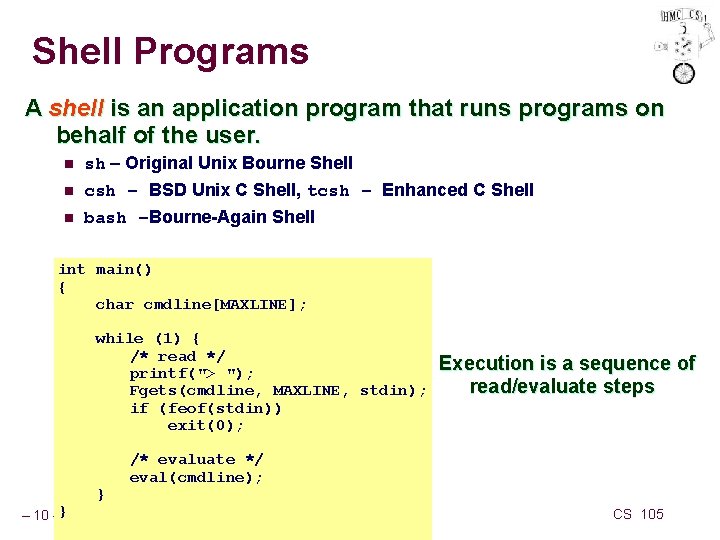
Shell Programs A shell is an application program that runs programs on behalf of the user. n n n sh – Original Unix Bourne Shell csh – BSD Unix C Shell, tcsh – Enhanced C Shell bash –Bourne-Again Shell int main() { char cmdline[MAXLINE]; while (1) { /* read */ printf("> "); Fgets(cmdline, MAXLINE, stdin); if (feof(stdin)) exit(0); – 10 –} } Execution is a sequence of read/evaluate steps /* evaluate */ eval(cmdline); CS 105
![Simple Shell eval Function void eval(char *cmdline) { char *argv[MAXARGS]; /* argv for execve()](http://slidetodoc.com/presentation_image_h2/7c7282f671a4eb2a9ef2447d17cbdddd/image-11.jpg "Simple Shell eval Function void eval(char *cmdline) { char *argv[MAXARGS]; /* argv for execve()")
Simple Shell eval Function void eval(char *cmdline) { char *argv[MAXARGS]; /* argv for execve() */ int bg; /* should the job run in bg or fg? */ pid_t pid; /* process id */ bg = parseline(cmdline, argv); if (!builtin_command(argv)) { if ((pid = Fork()) == 0) { /* child runs user job */ execve(argv[0], argv, environ); printf("%s: Command not found. n", argv[0]); exit(0); } } – 11 – } if (!bg) { /* parent waits for fg job to terminate */ int status; if (waitpid(pid, &status, 0) < 0) unix_error("waitfg: waitpid error"); } else /* otherwise, don’t wait for bg job */ printf("%d %s", pid, cmdline); CS 105
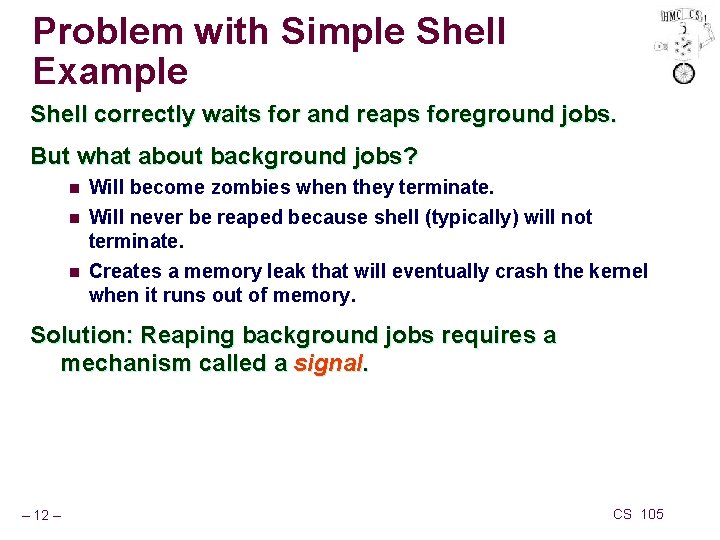
Problem with Simple Shell Example Shell correctly waits for and reaps foreground jobs. But what about background jobs? n n n Will become zombies when they terminate. Will never be reaped because shell (typically) will not terminate. Creates a memory leak that will eventually crash the kernel when it runs out of memory. Solution: Reaping background jobs requires a mechanism called a signal. – 12 – CS 105
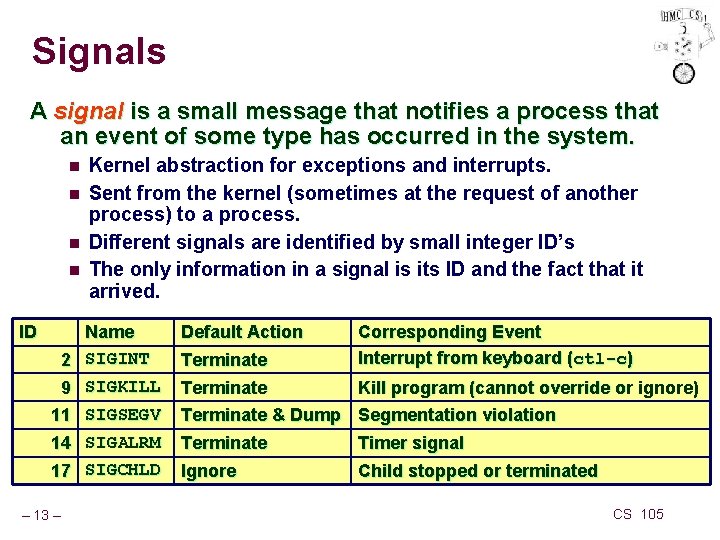
Signals A signal is a small message that notifies a process that an event of some type has occurred in the system. n n ID Kernel abstraction for exceptions and interrupts. Sent from the kernel (sometimes at the request of another process) to a process. Different signals are identified by small integer ID’s The only information in a signal is its ID and the fact that it arrived. Name 2 SIGINT 9 SIGKILL 11 SIGSEGV 14 SIGALRM Default Action Terminate 17 SIGCHLD Ignore – 13 – Corresponding Event Interrupt from keyboard (ctl-c) Terminate Kill program (cannot override or ignore) Terminate & Dump Segmentation violation Terminate Timer signal Child stopped or terminated CS 105
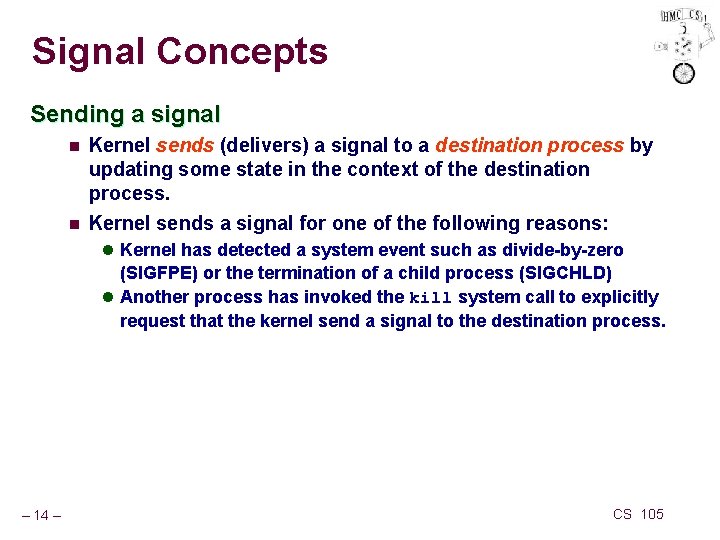
Signal Concepts Sending a signal n n Kernel sends (delivers) a signal to a destination process by updating some state in the context of the destination process. Kernel sends a signal for one of the following reasons: l Kernel has detected a system event such as divide-by-zero (SIGFPE) or the termination of a child process (SIGCHLD) l Another process has invoked the kill system call to explicitly request that the kernel send a signal to the destination process. – 14 – CS 105
Signal Concepts (cont. ) Receiving a signal n n A destination process receives a signal when it is forced by the kernel to react in some way to the delivery of the signal. Five possible ways to react: l Ignore the signal (do nothing) l Terminate the process. l Stop the process from running l Continue a stopped process (let it run again) l Catch the signal by executing a user-level function called a signal handler. » Akin to a hardware exception handler being called in response to an asynchronous interrupt. – 15 – CS 105
Signal Concepts (cont. ) A signal is pending if it has been sent but not yet received. n n There can be at most one pending signal of any particular type. Important: Signals are not queued l If a process has a pending signal of type k, then subsequent signals of type k that are sent to that process are discarded. A process can block the receipt of certain signals. n Blocked signals can be delivered, but will not be received until the signal is unblocked. A pending signal is received at most once. – 16 – CS 105
Signal Concepts Kernel maintains pending and blocked bit vectors in the context of each process. n pending – represents the set of pending signals l Kernel sets bit k in pending whenever a signal of type k is delivered. l Kernel clears bit k in pending whenever a signal of type k is received. n blocked – represents the set of blocked signals l Can be set and cleared by the application using the sigprocmask function. – 17 – CS 105
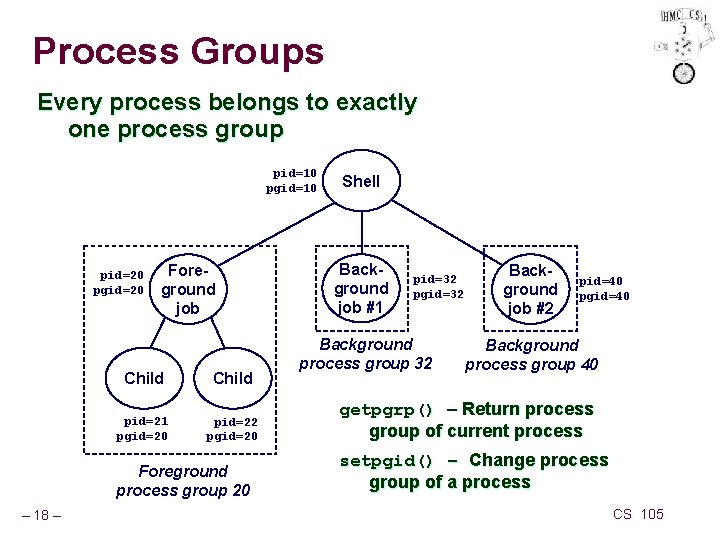
Process Groups Every process belongs to exactly one process group pid=10 pgid=10 pid=20 pgid=20 Foreground job Child pid=21 pgid=20 pid=22 pgid=20 Foreground process group 20 – 18 – Shell Background job #1 pid=32 pgid=32 Background process group 32 Background job #2 pid=40 pgid=40 Background process group 40 getpgrp() – Return process group of current process setpgid() – Change process group of a process CS 105
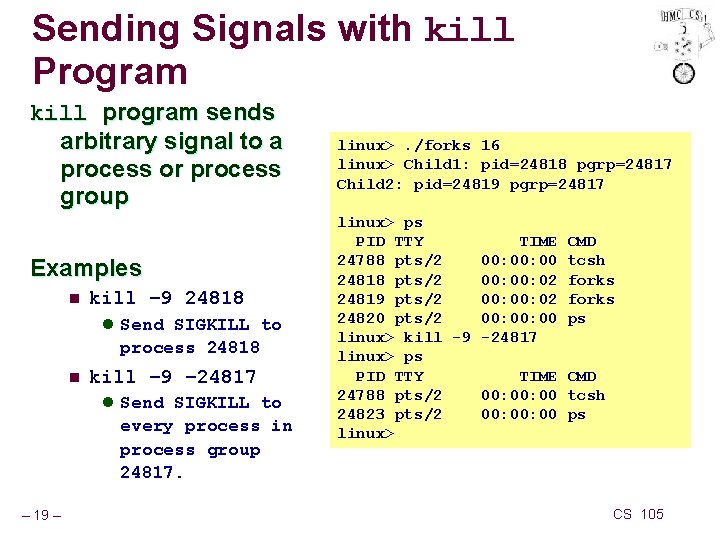
Sending Signals with kill Program kill program sends arbitrary signal to a process or process group Examples n kill – 9 24818 l Send SIGKILL to process 24818 n kill – 9 – 24817 l Send SIGKILL to every process in process group 24817. – 19 – linux>. /forks 16 linux> Child 1: pid=24818 pgrp=24817 Child 2: pid=24819 pgrp=24817 linux> ps PID TTY TIME CMD 24788 pts/2 00: 00 tcsh 24818 pts/2 00: 02 forks 24819 pts/2 00: 02 forks 24820 pts/2 00: 00 ps linux> kill -9 -24817 linux> ps PID TTY TIME CMD 24788 pts/2 00: 00 tcsh 24823 pts/2 00: 00 ps linux> CS 105
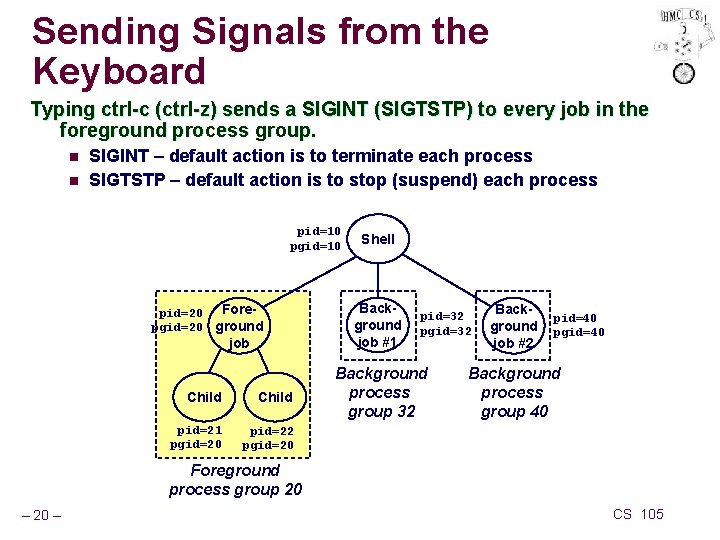
Sending Signals from the Keyboard Typing ctrl-c (ctrl-z) sends a SIGINT (SIGTSTP) to every job in the foreground process group. n n SIGINT – default action is to terminate each process SIGTSTP – default action is to stop (suspend) each process pid=10 pgid=10 pid=20 pgid=20 Foreground job Child pid=21 pgid=20 pid=22 pgid=20 Shell Background job #1 pid=32 pgid=32 Background process group 32 Background job #2 pid=40 pgid=40 Background process group 40 Foreground process group 20 – CS 105
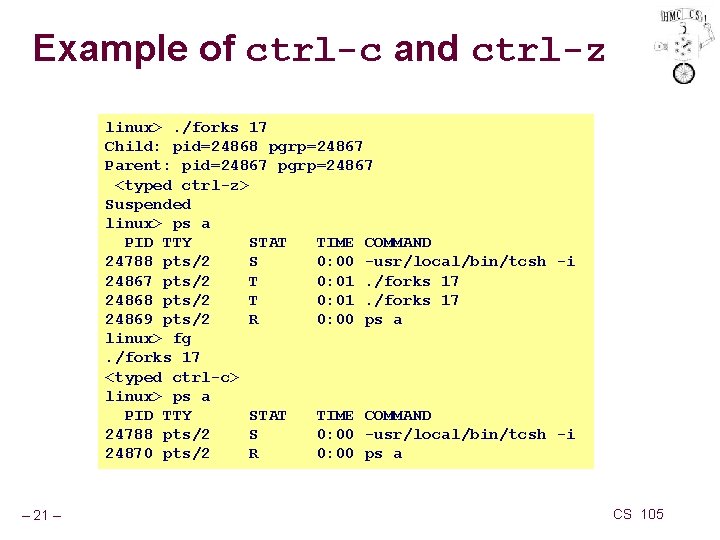
Example of ctrl-c and ctrl-z linux>. /forks 17 Child: pid=24868 pgrp=24867 Parent: pid=24867 pgrp=24867 <typed ctrl-z> Suspended linux> ps a PID TTY STAT TIME COMMAND 24788 pts/2 S 0: 00 -usr/local/bin/tcsh -i 24867 pts/2 T 0: 01. /forks 17 24868 pts/2 T 0: 01. /forks 17 24869 pts/2 R 0: 00 ps a linux> fg. /forks 17 <typed ctrl-c> linux> ps a PID TTY STAT TIME COMMAND 24788 pts/2 S 0: 00 -usr/local/bin/tcsh -i 24870 pts/2 R 0: 00 ps a – 21 – CS 105
![Sending Signals with kill Function void fork 12() { pid_t pid[N]; int i, child_status;](http://slidetodoc.com/presentation_image_h2/7c7282f671a4eb2a9ef2447d17cbdddd/image-22.jpg "Sending Signals with kill Function void fork 12() { pid_t pid[N]; int i, child_status;")
Sending Signals with kill Function void fork 12() { pid_t pid[N]; int i, child_status; for (i = 0; i < N; i++) if ((pid[i] = fork()) == 0) while(1); /* Child infinite loop */ /* Parent terminates the child processes */ for (i = 0; i < N; i++) { printf("Killing process %dn", pid[i]); kill(pid[i], SIGINT); } /* Parent reaps terminated children */ for (i = 0; i < N; i++) { pid_t wpid = wait(&child_status); if (WIFEXITED(child_status)) printf("Child %d terminated with exit status %dn", wpid, WEXITSTATUS(child_status)); else printf("Child %d terminated abnormallyn", wpid); } } – 22 – CS 105
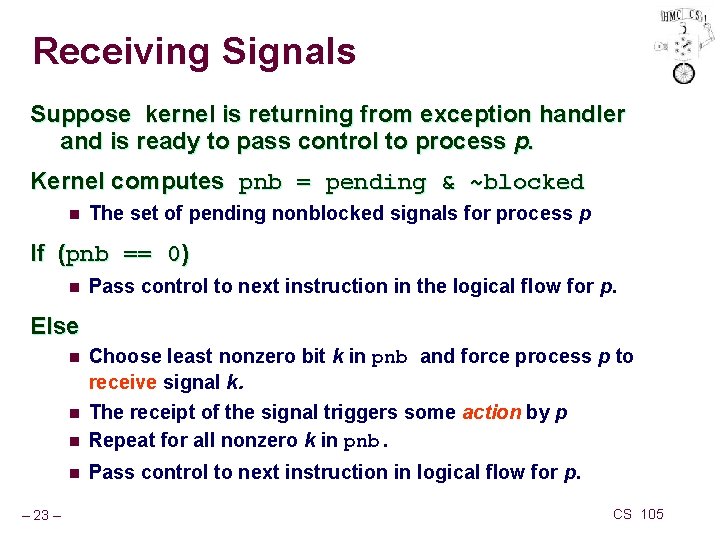
Receiving Signals Suppose kernel is returning from exception handler and is ready to pass control to process p. Kernel computes pnb = pending & ~blocked n The set of pending nonblocked signals for process p If (pnb == 0) n Pass control to next instruction in the logical flow for p. Else n Choose least nonzero bit k in pnb and force process p to receive signal k. The receipt of the signal triggers some action by p Repeat for all nonzero k in pnb. n Pass control to next instruction in logical flow for p. n n – 23 – CS 105
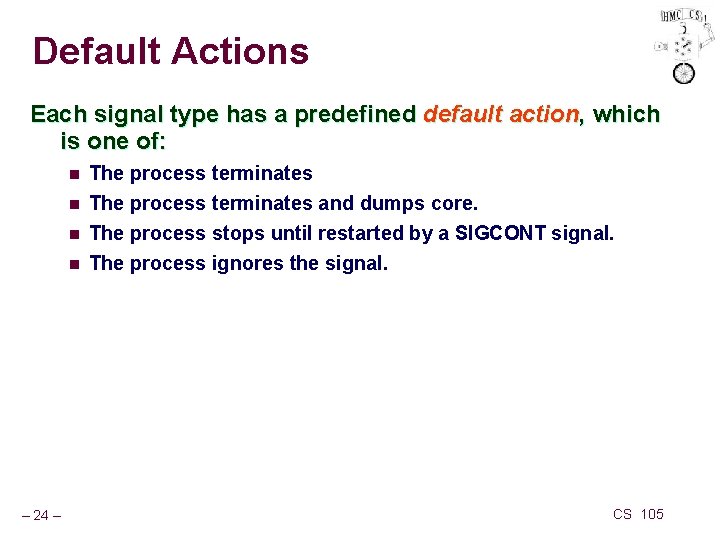
Default Actions Each signal type has a predefined default action, which is one of: n n – 24 – The process terminates and dumps core. The process stops until restarted by a SIGCONT signal. The process ignores the signal. CS 105
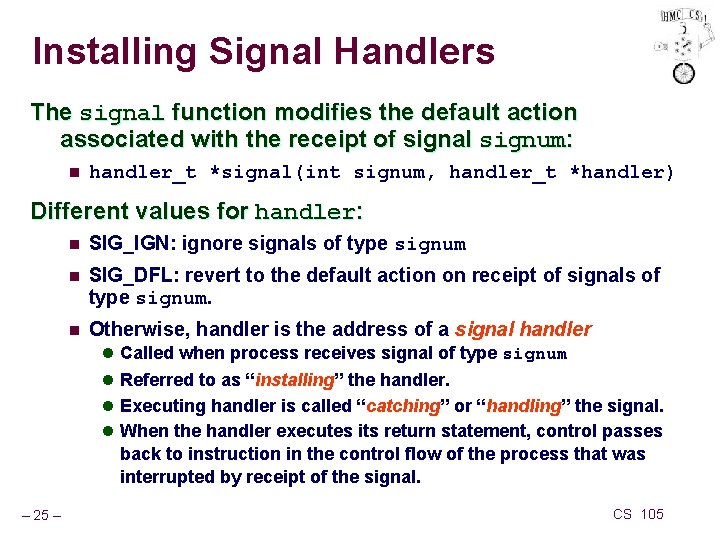
Installing Signal Handlers The signal function modifies the default action associated with the receipt of signal signum: n handler_t *signal(int signum, handler_t *handler) Different values for handler: n SIG_IGN: ignore signals of type signum n SIG_DFL: revert to the default action on receipt of signals of type signum. n Otherwise, handler is the address of a signal handler l Called when process receives signal of type signum l Referred to as “installing” the handler. l Executing handler is called “catching” or “handling” the signal. l When the handler executes its return statement, control passes back to instruction in the control flow of the process that was interrupted by receipt of the signal. – 25 – CS 105
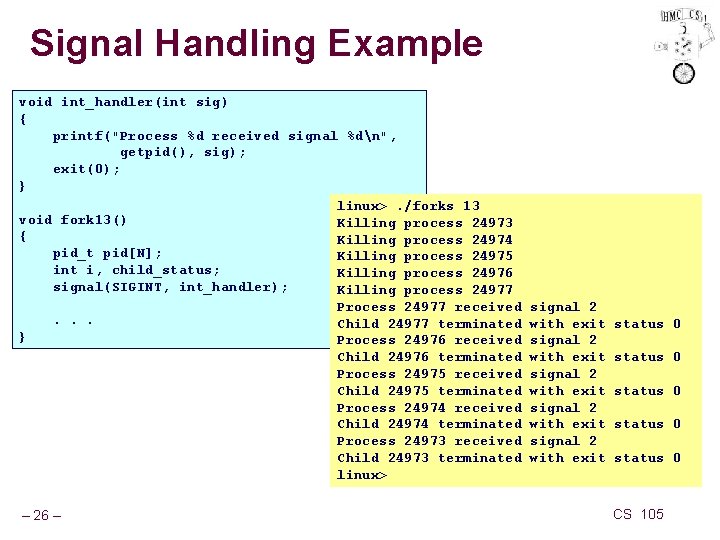
Signal Handling Example void int_handler(int sig) { printf("Process %d received signal %dn", getpid(), sig); exit(0); } linux>. /forks 13 void fork 13() Killing process 24973 { Killing process 24974 pid_t pid[N]; Killing process 24975 int i, child_status; Killing process 24976 signal(SIGINT, int_handler); Killing process 24977 Process 24977 received. . . Child 24977 terminated } Process 24976 received Child 24976 terminated Process 24975 received Child 24975 terminated Process 24974 received Child 24974 terminated Process 24973 received Child 24973 terminated linux> – 26 – signal 2 with exit signal 2 with exit status 0 status 0 CS 105
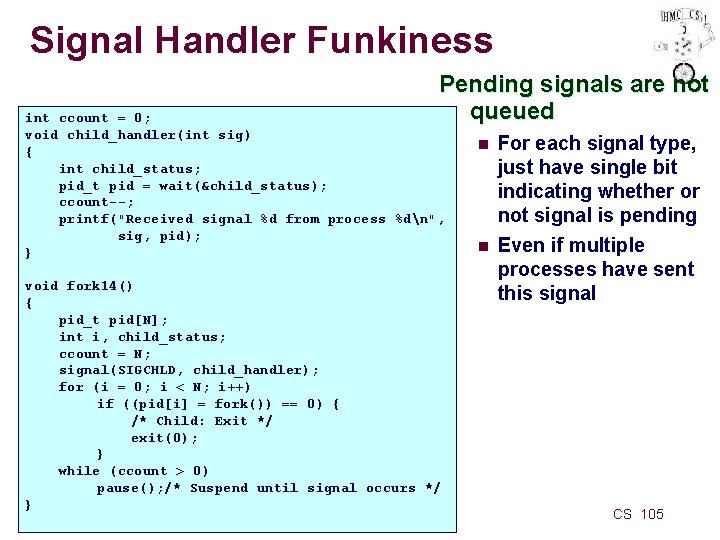
Signal Handler Funkiness Pending signals are not queued int ccount = 0; void child_handler(int sig) { int child_status; pid_t pid = wait(&child_status); ccount--; printf("Received signal %d from process %dn", sig, pid); } void fork 14() { pid_t pid[N]; int i, child_status; ccount = N; signal(SIGCHLD, child_handler); for (i = 0; i < N; i++) if ((pid[i] = fork()) == 0) { /* Child: Exit */ exit(0); } while (ccount > 0) pause(); /* Suspend until signal occurs */ } – 27 – n n For each signal type, just have single bit indicating whether or not signal is pending Even if multiple processes have sent this signal CS 105
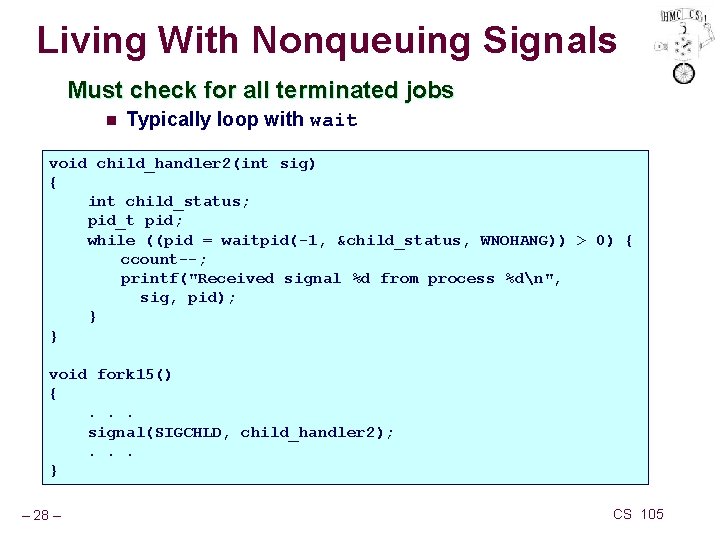
Living With Nonqueuing Signals Must check for all terminated jobs n Typically loop with wait void child_handler 2(int sig) { int child_status; pid_t pid; while ((pid = waitpid(-1, &child_status, WNOHANG)) > 0) { ccount--; printf("Received signal %d from process %dn", sig, pid); } } void fork 15() {. . . signal(SIGCHLD, child_handler 2); . . . } – 28 – CS 105
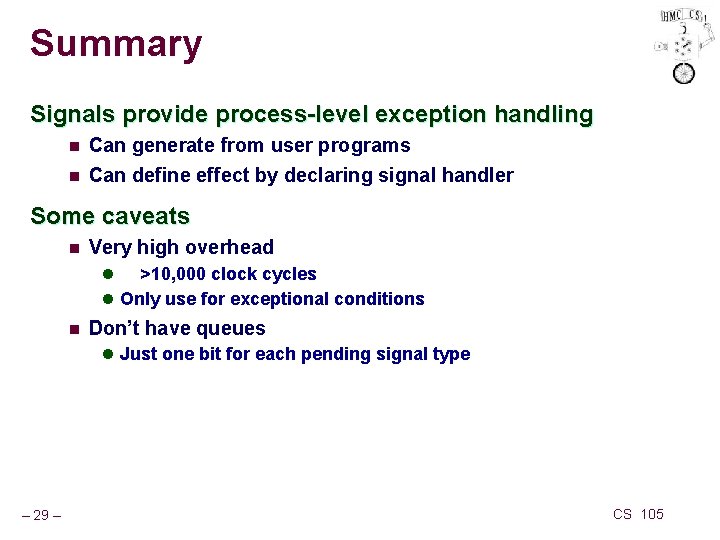
Summary Signals provide process-level exception handling n Can generate from user programs n Can define effect by declaring signal handler Some caveats n Very high overhead >10, 000 clock cycles l Only use for exceptional conditions l n Don’t have queues l Just one bit for each pending signal type – 29 – CS 105
- Slides: 29