
CS 100 J 23 September 2003 More on
CS 100 J 23 September 2003 More on Methods. Scope of parameters. Functions versus procedures. The return statement in a function. Static vs nonstatic methods. Top-down design. Read section 2. 3. Paradoxes. Is this sentence true or false: This sentence is false. In a small town, a barber cuts (only) the hair of all people who don’t cut their own hair. Who cuts the barber’s hair? If you try to fail and succeed, have you failed? Consider the set S of all sets that do not contain themselves. Does S contain itself?
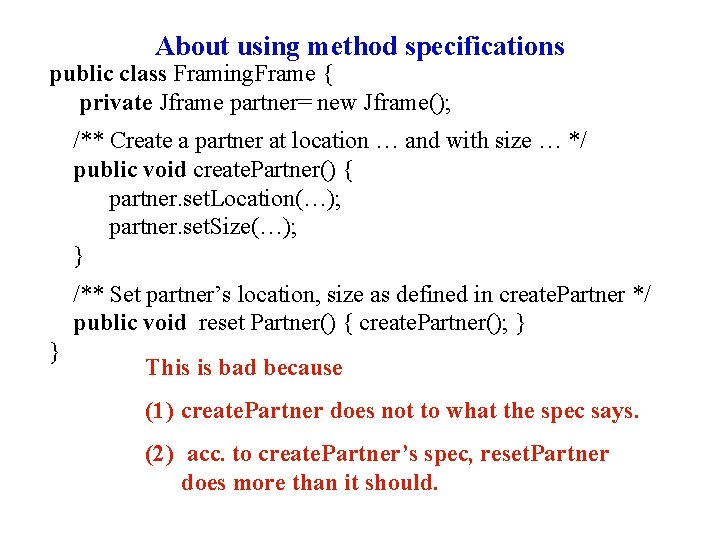
About using method specifications public class Framing. Frame { private Jframe partner= new Jframe(); /** Create a partner at location … and with size … */ public void create. Partner() { partner. set. Location(…); partner. set. Size(…); } /** Set partner’s location, size as defined in create. Partner */ public void reset Partner() { create. Partner(); } } This is bad because (1) create. Partner does not to what the spec says. (2) acc. to create. Partner’s spec, reset. Partner does more than it should.
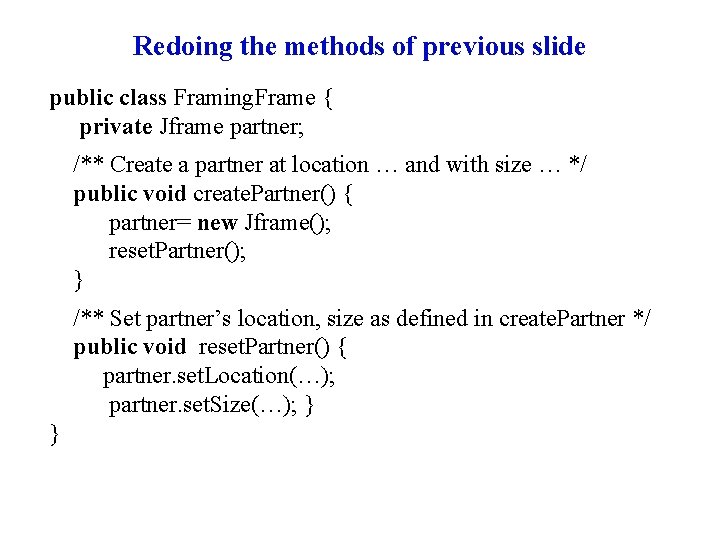
Redoing the methods of previous slide public class Framing. Frame { private Jframe partner; /** Create a partner at location … and with size … */ public void create. Partner() { partner= new Jframe(); reset. Partner(); } /** Set partner’s location, size as defined in create. Partner */ public void reset. Partner() { partner. set. Location(…); partner. set. Size(…); } }
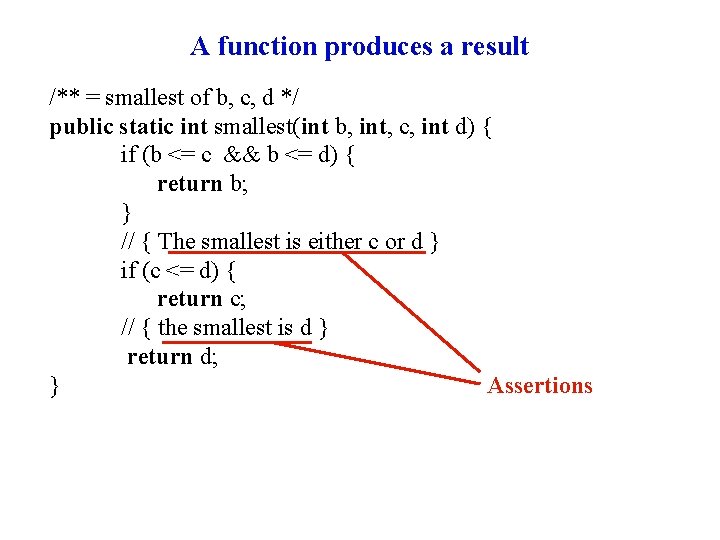
A function produces a result /** = smallest of b, c, d */ public static int smallest(int b, int, c, int d) { if (b <= c && b <= d) { return b; } // { The smallest is either c or d } if (c <= d) { return c; // { the smallest is d } return d; } Assertions
Top-down programming, stepwise refinement We developed a method to anglicize numbers (e. g. from 25 produce “twenty five”). using stepwise refinement. Pleae study section 2. 5 on stepwise refinement.
- Slides: 5