
Crystallographic reconstruction methods to study phase transformations by

Crystallographic reconstruction methods to study phase transformations by EBSD Cyril CAYRON CEA-Grenoble, Laboratory of Innovation for New Energy Technologies and Nanomaterials, France EBSD 2010, St Etienne, C. Cayron

• Introduction: Phase transitions, EBSD. • Theory 1: Crystallography of phase transitions, groups and beyond. • Application 1: Reconstruction of parent grains in titanium, steels and zirconia. New theory of fcc-bcc martensitic transformation. • Theory 2: Crystallography of multiple twinning, fractals, strings. • Application 2: Reconstruction of twin related domains • Conclusions and perspectives EBSD 2010, St Etienne, C. Cayron

MATHEMATICS Phase transitions Cosmology, Elementary particles Experiments Theory Crystallography Microstrutural Characterization Structural Phase transformations • 1 st order, 2 d order • Displacive, Order-Disorder, Reconstructive • Diffusive, diffusionless RX, Neutrons, TEM, Kossel, EBSD AF Gourgues, Int. Mater. Rev. 52 (2007) 65. Raman, AFM, Calorimetry, Dilatometry … Thermodynamics Physical properties Ferromagnetism, Ferroelectricity, Multiferroics Strength, Conductivity ’ precipitates in Al. Mg. Si. Cu alloy, C. Cayron, Thesis EPFL, Switzerland Widmanstatten in Ti alloy, JP Blank Ohio State, USA EBSD 2010, St Etienne, C. Cayron
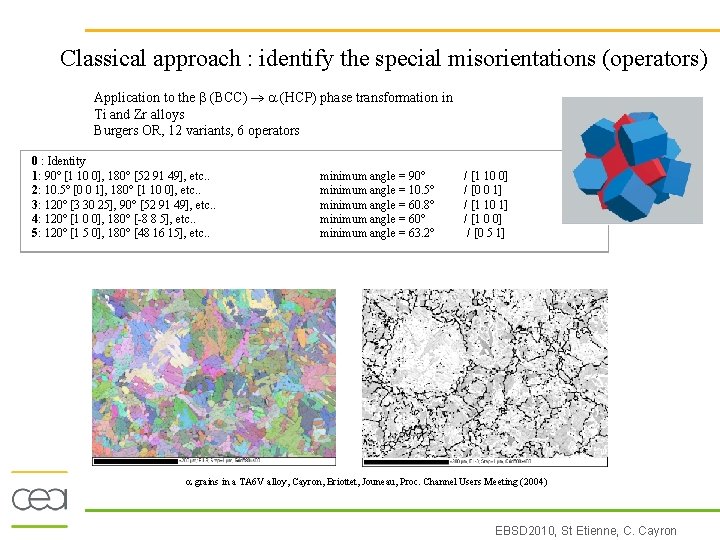
Classical approach : identify the special misorientations (operators) Application to the (BCC) (HCP) phase transformation in Ti and Zr alloys Burgers OR, 12 variants, 6 operators 0 : Identity 1: 90° [1 10 0], 180° [52 91 49], etc. . 2: 10. 5° [0 0 1], 180° [1 10 0], etc. . 3: 120° [3 30 25], 90° [52 91 49], etc. . 4: 120° [1 0 0], 180° [-8 8 5], etc. . 5: 120° [1 5 0], 180° [48 16 15], etc. . minimum angle = 90° minimum angle = 10. 5° minimum angle = 60. 8° minimum angle = 60° minimum angle = 63. 2° / [1 10 0] / [0 0 1] / [1 10 1] / [1 0 0] / [0 5 1] grains in a TA 6 V alloy, Cayron, Briottet, Jouneau, Proc. Channel Users Meeting (2004) EBSD 2010, St Etienne, C. Cayron
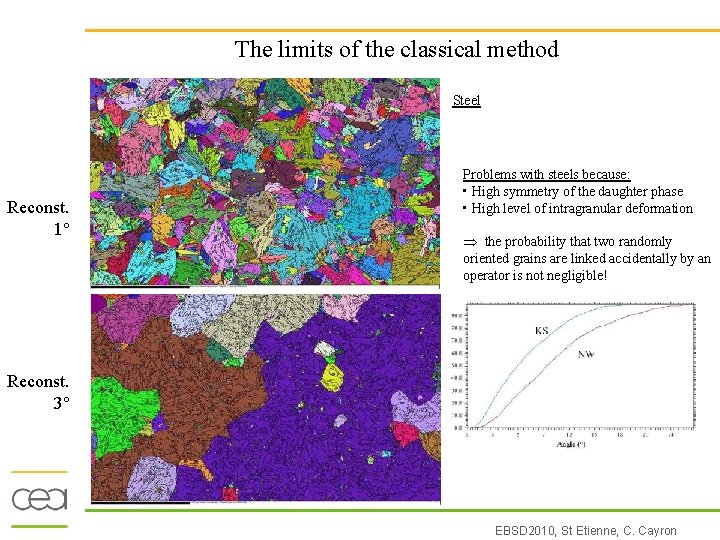
The limits of the classical method Steel Reconst. 1° Problems with steels because: • High symmetry of the daughter phase • High level of intragranular deformation Þ the probability that two randomly oriented grains are linked accidentally by an operator is not negligible! Reconst. 3° EBSD 2010, St Etienne, C. Cayron
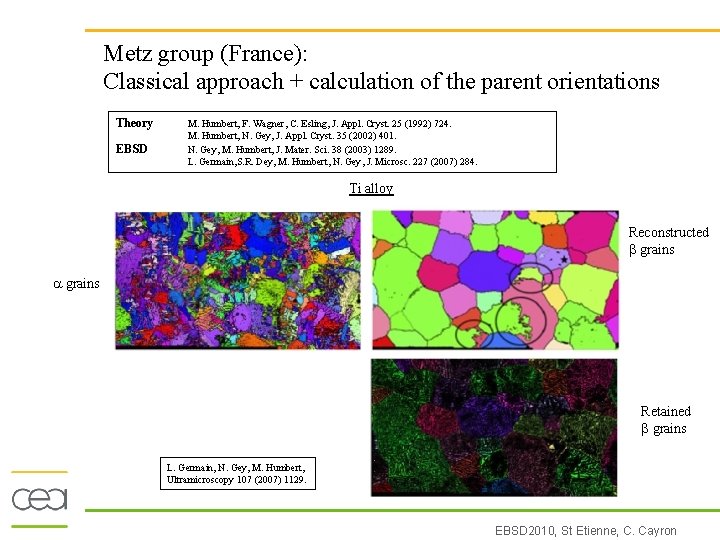
Metz group (France): Classical approach + calculation of the parent orientations Theory EBSD M. Humbert, F. Wagner, C. Esling, J. Appl. Cryst. 25 (1992) 724. M. Humbert, N. Gey, J. Appl. Cryst. 35 (2002) 401. N. Gey, M. Humbert, J. Mater. Sci. 38 (2003) 1289. L. Germain, S. R. Dey, M. Humbert, N. Gey, J. Microsc. 227 (2007) 284. Ti alloy Reconstructed grains Retained grains L. Germain, N. Gey, M. Humbert, Ultramicroscopy 107 (2007) 1129. EBSD 2010, St Etienne, C. Cayron

THEORY 1: Groupoids of orientational variants = Variants = Cosets Operators = Class of misorientation between variants = Double-Cosets V. Janovec, Czech. J. Phys B 22 (1972) 974. U. Dahmen, Phase Transformations, Encyclopedia of Physical Science and Technology, 1987, pp. 319 -354. T. Hahn, V. Janovec, H. Klapper, Ferroelectrics 222 (1999) 11. C. Cayron, Acta Cryst. A 62 (2006) 21. EBSD 2010, St Etienne, C. Cayron
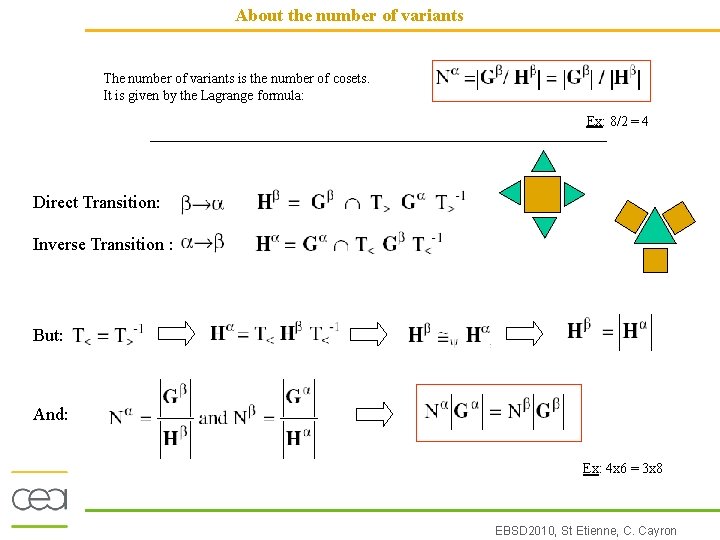
About the number of variants The number of variants is the number of cosets. It is given by the Lagrange formula: Ex: 8/2 = 4 Direct Transition: Inverse Transition : But: And: Ex: 4 x 6 = 3 x 8 EBSD 2010, St Etienne, C. Cayron
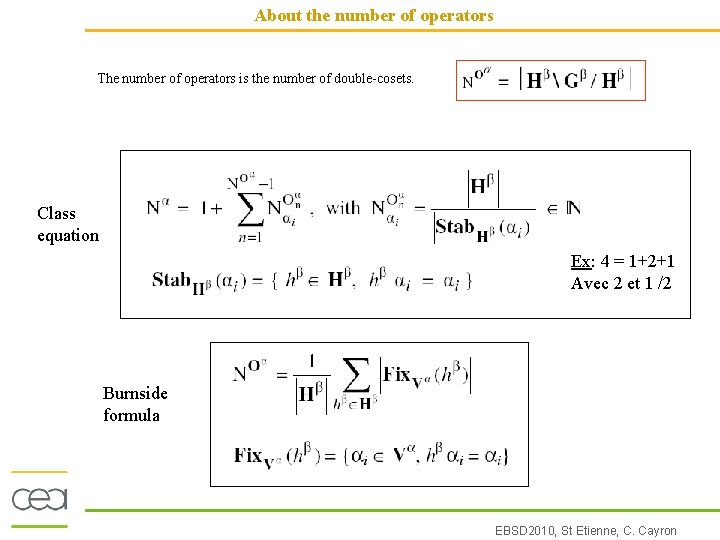
About the number of operators The number of operators is the number of double-cosets. Class equation Ex: 4 = 1+2+1 Avec 2 et 1 /2 Burnside formula EBSD 2010, St Etienne, C. Cayron
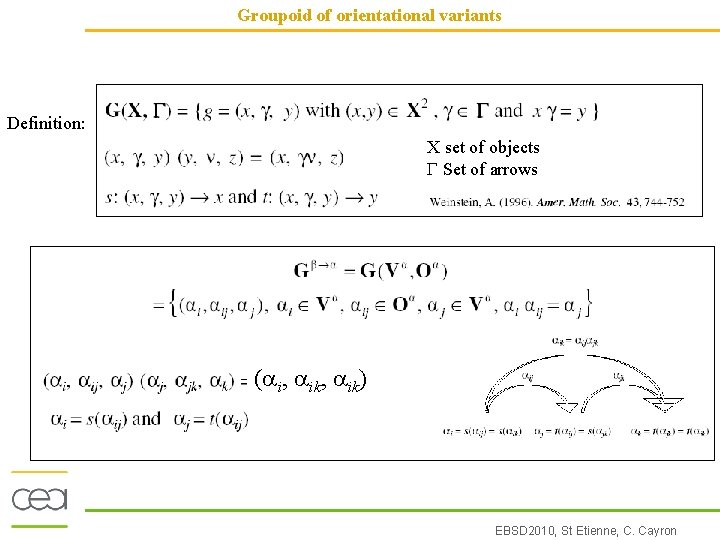
Groupoid of orientational variants Definition: X set of objects Set of arrows ( i, ik) EBSD 2010, St Etienne, C. Cayron
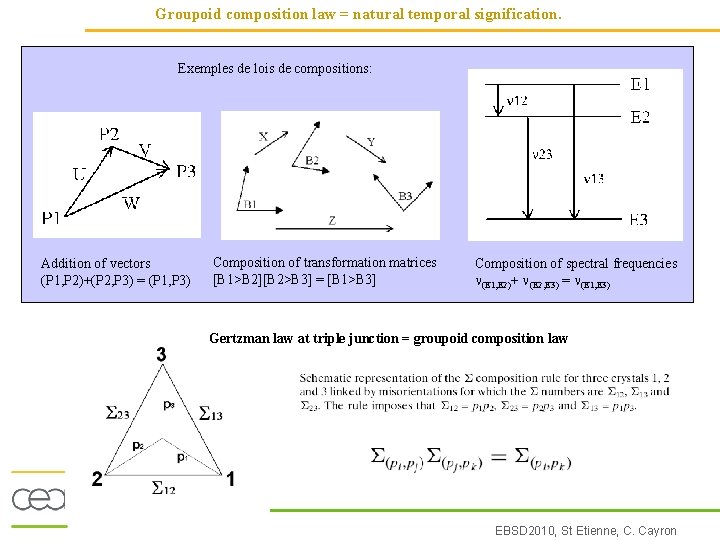
Groupoid composition law = natural temporal signification. Exemples de lois de compositions: Addition of vectors (P 1, P 2)+(P 2, P 3) = (P 1, P 3) Composition of transformation matrices [B 1>B 2][B 2>B 3] = [B 1>B 3] Composition of spectral frequencies (E 1, E 2)+ (E 2, E 3) = (E 1, E 3) Gertzman law at triple junction = groupoid composition law EBSD 2010, St Etienne, C. Cayron

Groupoid composition table The operators can be expressed by set of variants / 1 Groupoid Composition Table (Oi)-1. Oj = multivalued!! EBSD 2010, St Etienne, C. Cayron
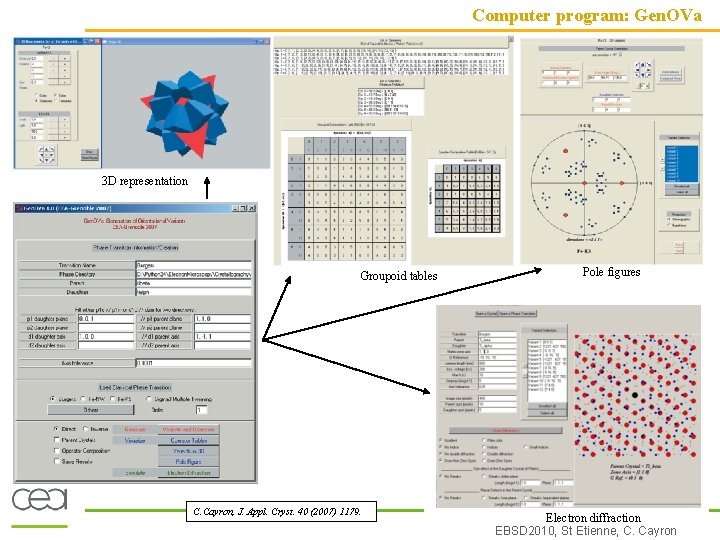
Computer program: Gen. OVa 3 D representation Groupoid tables C. Cayron, J. Appl. Cryst. 40 (2007) 1179. Pole figures Electron diffraction EBSD 2010, St Etienne, C. Cayron
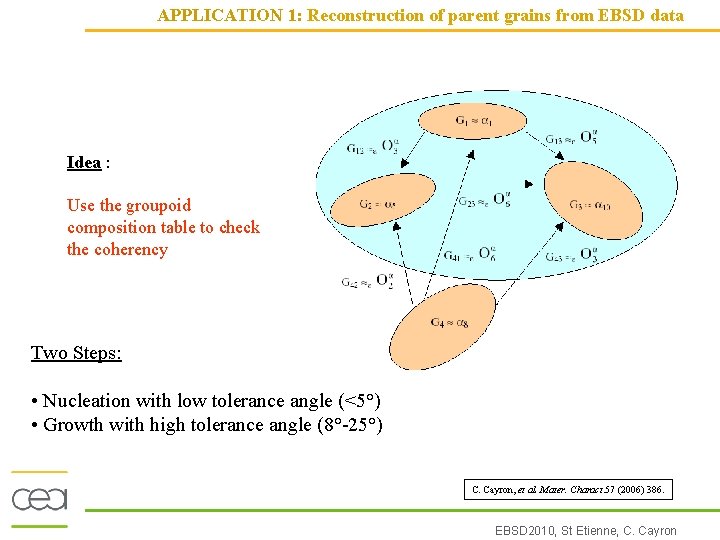
APPLICATION 1: Reconstruction of parent grains from EBSD data Idea : Use the groupoid composition table to check the coherency Two Steps: • Nucleation with low tolerance angle (<5°) • Growth with high tolerance angle (8°-25°) C. Cayron, et al. Mater. Charact. 57 (2006) 386. EBSD 2010, St Etienne, C. Cayron
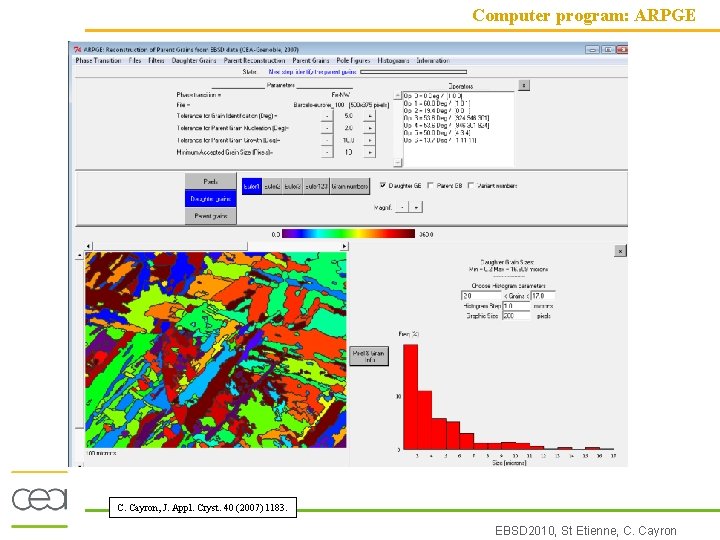
Computer program: ARPGE C. Cayron, J. Appl. Cryst. 40 (2007) 1183. EBSD 2010, St Etienne, C. Cayron
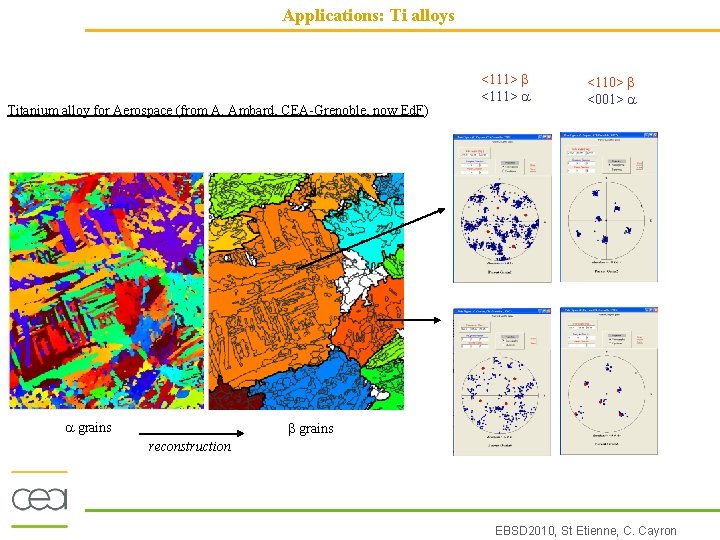
Applications: Ti alloys Titanium alloy for Aerospace (from A. Ambard, CEA-Grenoble, now Ed. F) grains <111> <110> <001> grains reconstruction EBSD 2010, St Etienne, C. Cayron
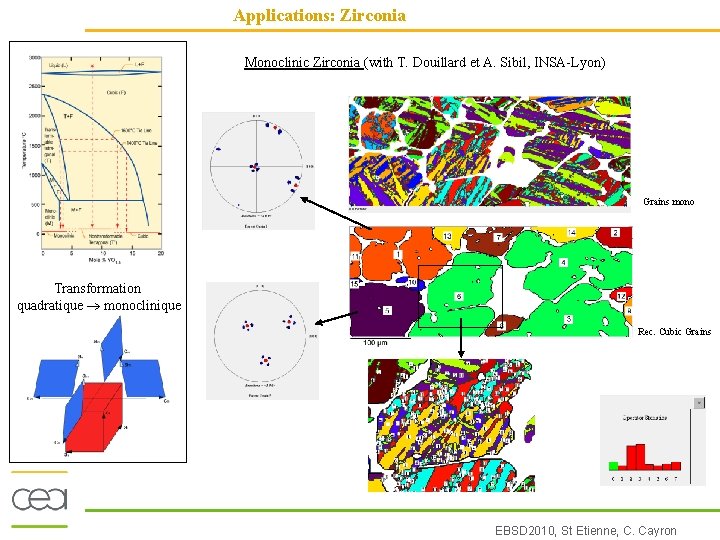
Applications: Zirconia Monoclinic Zirconia (with T. Douillard et A. Sibil, INSA-Lyon) Grains mono Transformation quadratique monoclinique Rec. Cubic Grains EBSD 2010, St Etienne, C. Cayron
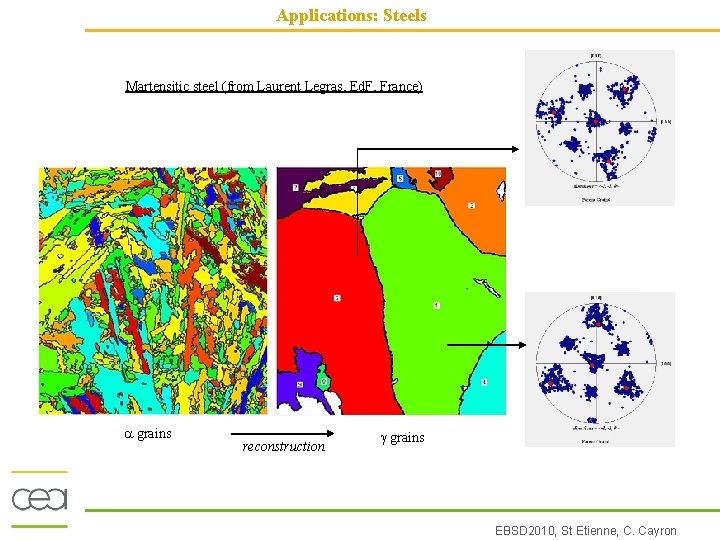
Applications: Steels Martensitic steel (from Laurent Legras, Ed. F, France) grains reconstruction grains EBSD 2010, St Etienne, C. Cayron
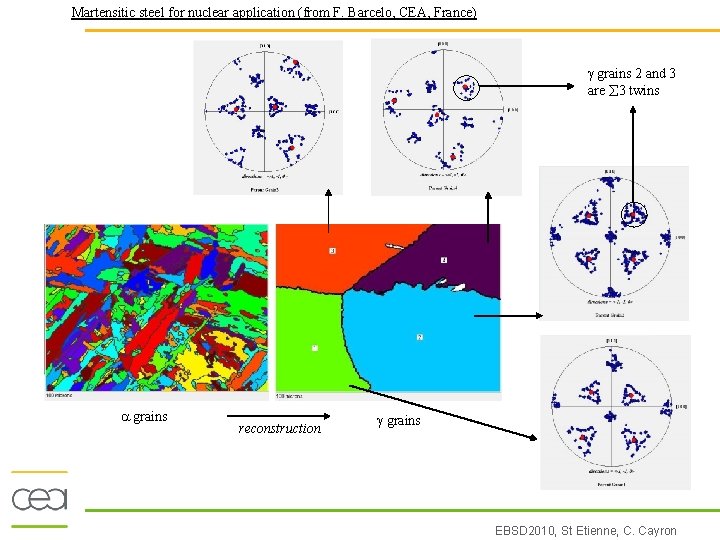
Martensitic steel for nuclear application (from F. Barcelo, CEA, France) grains 2 and 3 are 3 twins grains reconstruction grains EBSD 2010, St Etienne, C. Cayron
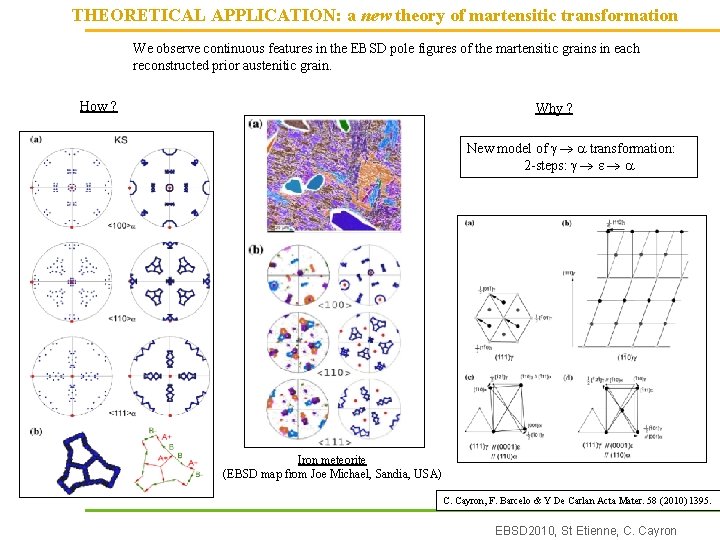
THEORETICAL APPLICATION: a new theory of martensitic transformation We observe continuous features in the EBSD pole figures of the martensitic grains in each reconstructed prior austenitic grain. How ? Why ? New model of transformation: 2 -steps: Iron meteorite (EBSD map from Joe Michael, Sandia, USA) C. Cayron, F. Barcelo & Y De Carlan Acta Mater. 58 (2010) 1395. EBSD 2010, St Etienne, C. Cayron
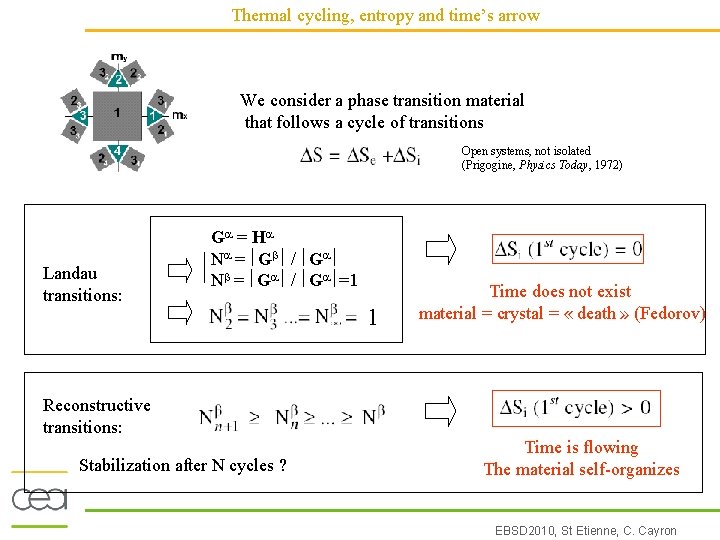
Thermal cycling, entropy and time’s arrow We consider a phase transition material that follows a cycle of transitions Open systems, not isolated (Prigogine, Physics Today, 1972) Landau transitions: G = H N = G / G =1 1 Time does not exist material = crystal = « death » (Fedorov) Reconstructive transitions: Stabilization after N cycles ? Time is flowing The material self-organizes EBSD 2010, St Etienne, C. Cayron
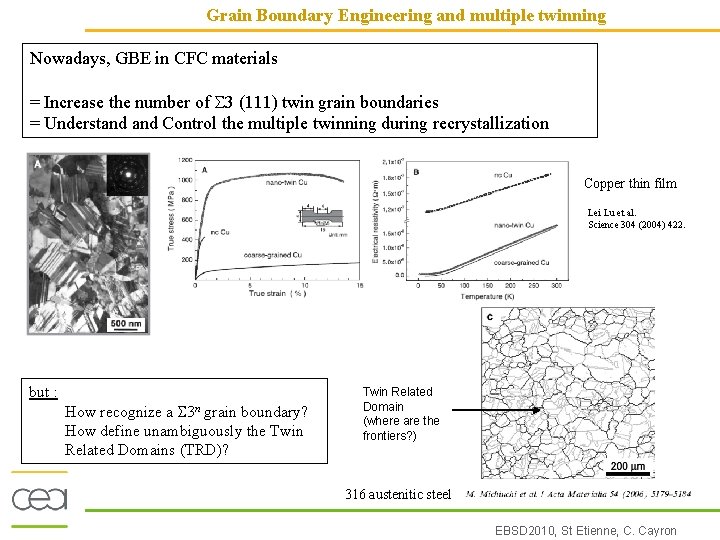
Grain Boundary Engineering and multiple twinning Nowadays, GBE in CFC materials = Increase the number of 3 (111) twin grain boundaries = Understand Control the multiple twinning during recrystallization Copper thin film Lei Lu et al. Science 304 (2004) 422. but : How recognize a 3 n grain boundary? How define unambiguously the Twin Related Domains (TRD)? Twin Related Domain (where are the frontiers? ) 316 austenitic steel EBSD 2010, St Etienne, C. Cayron
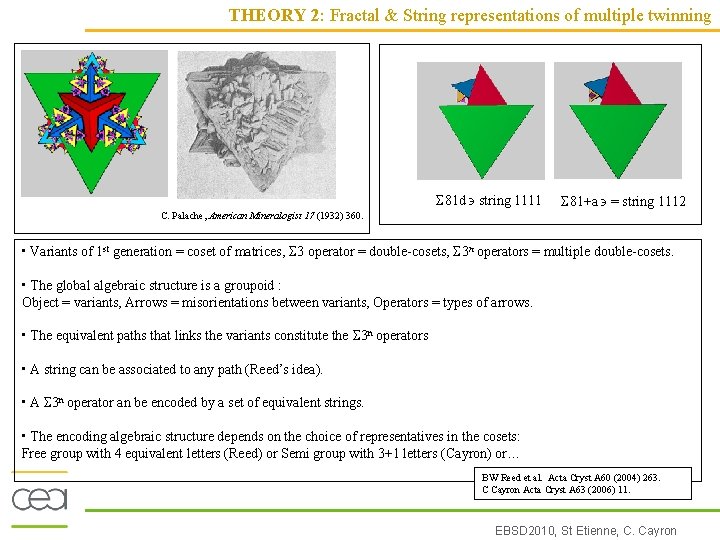
THEORY 2: Fractal & String representations of multiple twinning 81 d string 1111 81+a = string 1112 C. Palache, American Mineralogist 17 (1932) 360. • Variants of 1 st generation = coset of matrices, 3 operator = double-cosets, 3 n operators = multiple double-cosets. • The global algebraic structure is a groupoid : Object = variants, Arrows = misorientations between variants, Operators = types of arrows. • The equivalent paths that links the variants constitute the 3 n operators • A string can be associated to any path (Reed’s idea). • A 3 n operator an be encoded by a set of equivalent strings. • The encoding algebraic structure depends on the choice of representatives in the cosets: Free group with 4 equivalent letters (Reed) or Semi group with 3+1 letters (Cayron) or… BW Reed et al. Acta Cryst A 60 (2004) 263. C Cayron Acta Cryst A 63 (2006) 11. EBSD 2010, St Etienne, C. Cayron
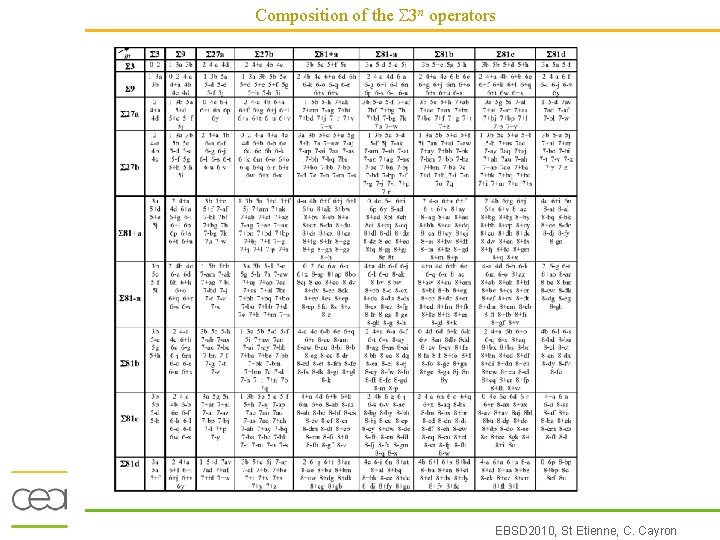
Composition of the 3 n operators EBSD 2010, St Etienne, C. Cayron
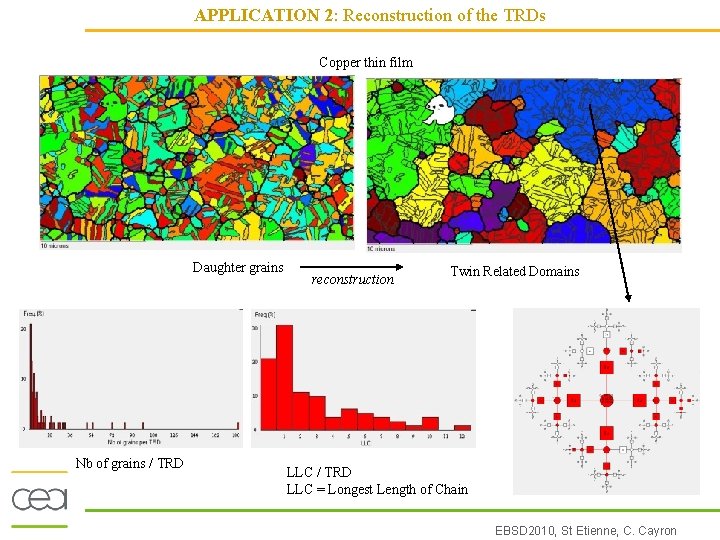
APPLICATION 2: Reconstruction of the TRDs Copper thin film Daughter grains Nb of grains / TRD reconstruction Twin Related Domains LLC / TRD LLC = Longest Length of Chain EBSD 2010, St Etienne, C. Cayron
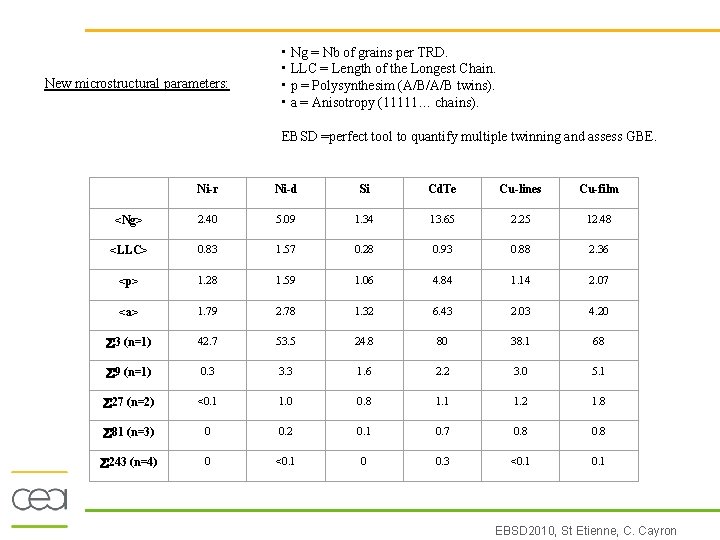
New microstructural parameters: • Ng = Nb of grains per TRD. • LLC = Length of the Longest Chain. • p = Polysynthesim (A/B/A/B twins). • a = Anisotropy (11111… chains). EBSD =perfect tool to quantify multiple twinning and assess GBE. Ni-r Ni-d Si Cd. Te Cu-lines Cu-film <Ng> 2. 40 5. 09 1. 34 13. 65 2. 25 12. 48 <LLC> 0. 83 1. 57 0. 28 0. 93 0. 88 2. 36 <p> 1. 28 1. 59 1. 06 4. 84 1. 14 2. 07 <a> 1. 79 2. 78 1. 32 6. 43 2. 03 4. 20 3 (n=1) 42. 7 53. 5 24. 8 80 38. 1 68 9 (n=1) 0. 3 3. 3 1. 6 2. 2 3. 0 5. 1 27 (n=2) <0. 1 1. 0 0. 8 1. 1 1. 2 1. 8 81 (n=3) 0 0. 2 0. 1 0. 7 0. 8 243 (n=4) 0 <0. 1 0 0. 3 <0. 1 EBSD 2010, St Etienne, C. Cayron
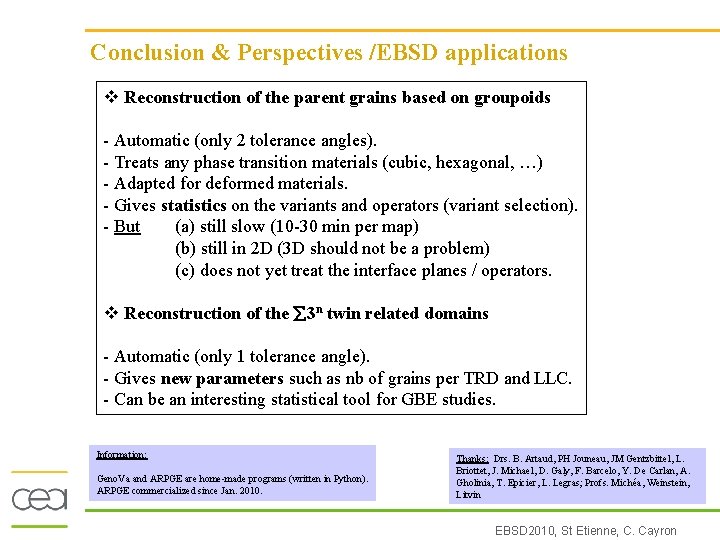
Conclusion & Perspectives /EBSD applications v Reconstruction of the parent grains based on groupoids - Automatic (only 2 tolerance angles). - Treats any phase transition materials (cubic, hexagonal, …) - Adapted for deformed materials. - Gives statistics on the variants and operators (variant selection). - But (a) still slow (10 -30 min per map) (b) still in 2 D (3 D should not be a problem) (c) does not yet treat the interface planes / operators. v Reconstruction of the 3 n twin related domains - Automatic (only 1 tolerance angle). - Gives new parameters such as nb of grains per TRD and LLC. - Can be an interesting statistical tool for GBE studies. Information: Geno. Va and ARPGE are home-made programs (written in Python). ARPGE commercialized since Jan. 2010. Thanks: Drs. B. Artaud, PH Jouneau, JM Gentzbittel, L. Briottet, J. Michael, D. Galy, F. Barcelo, Y. De Carlan, A. Gholinia, T. Epicier, L. Legras; Profs. Michéa, Weinstein, Litvin EBSD 2010, St Etienne, C. Cayron
- Slides: 27