
Crystallographic Point Groups Elizabeth Mojarro Senior Colloquium April
Crystallographic Point Groups Elizabeth Mojarro Senior Colloquium April 8, 2010 1
Outline n Group Theory – Definitions – Examples n n n Isometries Lattices Crystalline Restriction Theorem Bravais Lattices Point Groups – Hexagonal Lattice Examples n We will be considering all of the above in R 2 and R 3 2
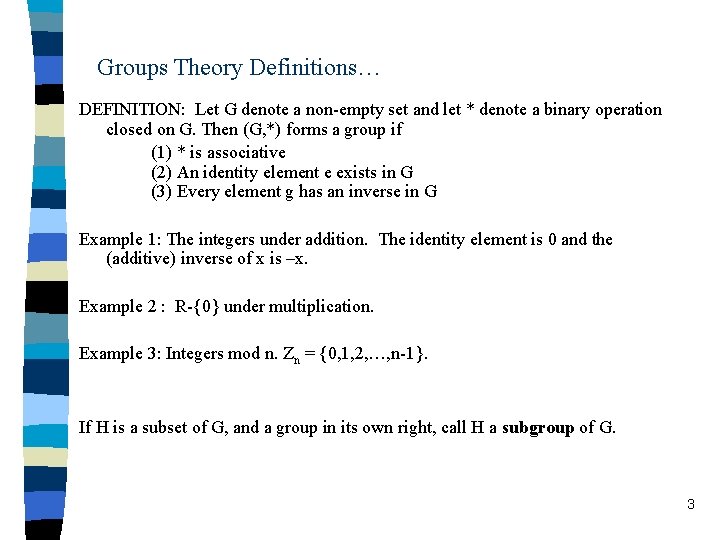
Groups Theory Definitions… DEFINITION: Let G denote a non-empty set and let * denote a binary operation closed on G. Then (G, *) forms a group if (1) * is associative (2) An identity element e exists in G (3) Every element g has an inverse in G Example 1: The integers under addition. The identity element is 0 and the (additive) inverse of x is –x. Example 2 : R-{0} under multiplication. Example 3: Integers mod n. Zn = {0, 1, 2, …, n-1}. If H is a subset of G, and a group in its own right, call H a subgroup of G. 3
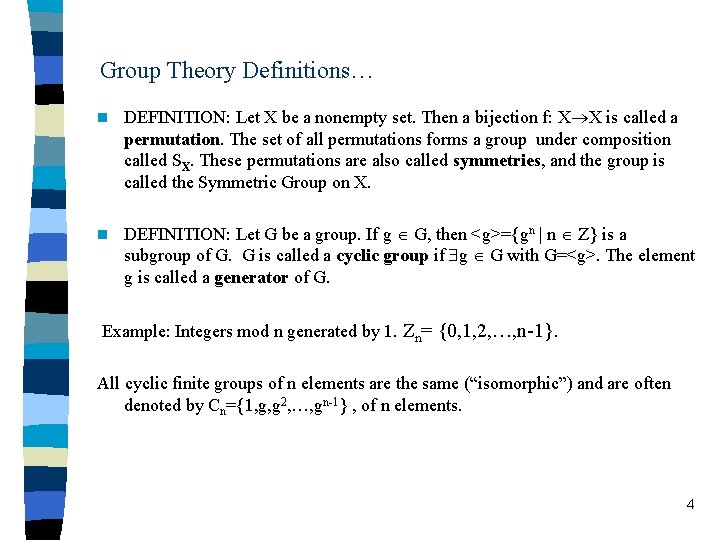
Group Theory Definitions… n DEFINITION: Let X be a nonempty set. Then a bijection f: X X is called a permutation. The set of all permutations forms a group under composition called SX. These permutations are also called symmetries, and the group is called the Symmetric Group on X. n DEFINITION: Let G be a group. If g G, then <g>={gn | n Z} is a subgroup of G. G is called a cyclic group if g G with G=<g>. The element g is called a generator of G. Example: Integers mod n generated by 1. Zn= {0, 1, 2, …, n-1}. All cyclic finite groups of n elements are the same (“isomorphic”) and are often denoted by Cn={1, g, g 2, …, gn-1} , of n elements. 4
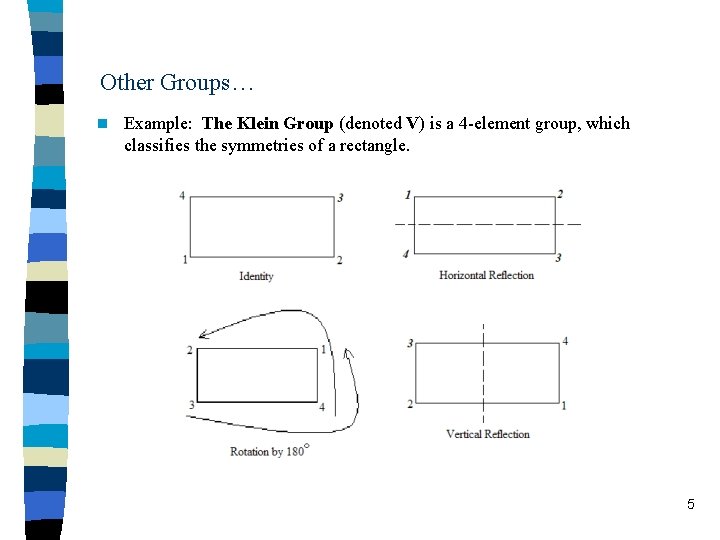
Other Groups… n Example: The Klein Group (denoted V) is a 4 -element group, which classifies the symmetries of a rectangle. 5
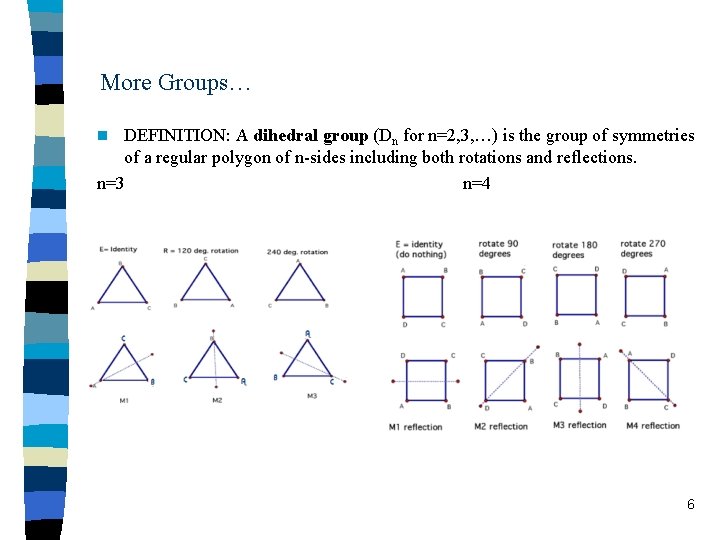
More Groups… DEFINITION: A dihedral group (Dn for n=2, 3, …) is the group of symmetries of a regular polygon of n-sides including both rotations and reflections. n=3 n=4 n 6
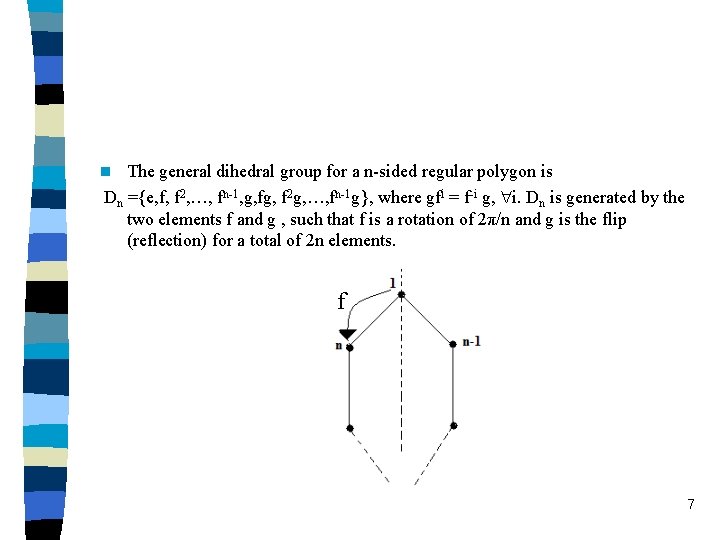
The general dihedral group for a n-sided regular polygon is Dn ={e, f, f 2, …, fn-1, g, f 2 g, …, fn-1 g}, where gfi = f-i g, i. Dn is generated by the two elements f and g , such that f is a rotation of 2π/n and g is the flip (reflection) for a total of 2 n elements. n f 7
Isometries in R 2 n DEFINITION: An isometry is a permutation : R 2 which preserves Euclidean distance: the distance between the points of u and v equals the distance between of (u) and (v). Points that are close together remain close together after . 8
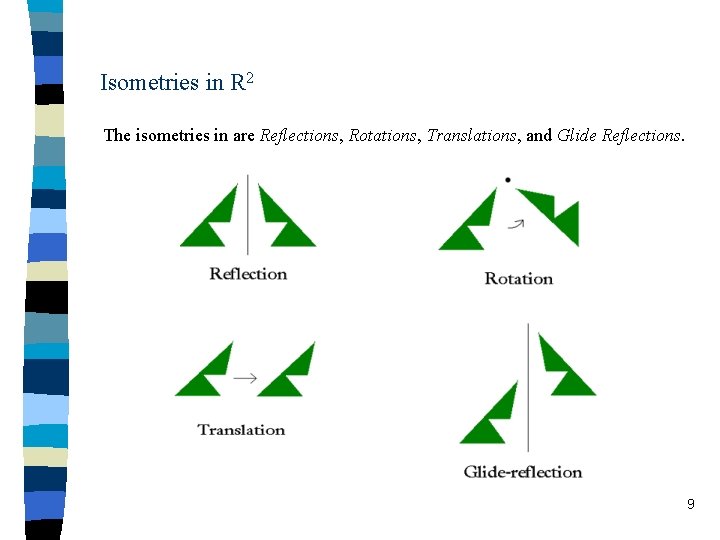
Isometries in R 2 The isometries in are Reflections, Rotations, Translations, and Glide Reflections. 9
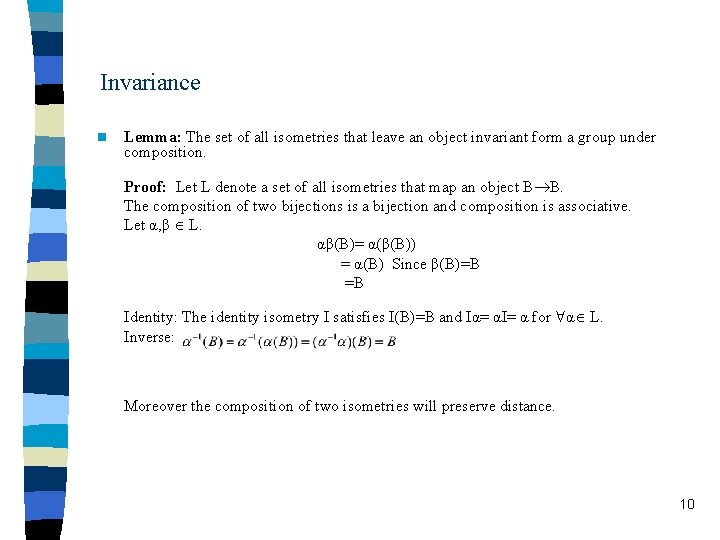
Invariance n Lemma: The set of all isometries that leave an object invariant form a group under composition. Proof: Let L denote a set of all isometries that map an object B B. The composition of two bijections is a bijection and composition is associative. Let α, β L. αβ(B)= α(β(B)) = α(B) Since β(B)=B =B Identity: The identity isometry I satisfies I(B)=B and Iα= αI= α for α L. Inverse: Moreover the composition of two isometries will preserve distance. 10
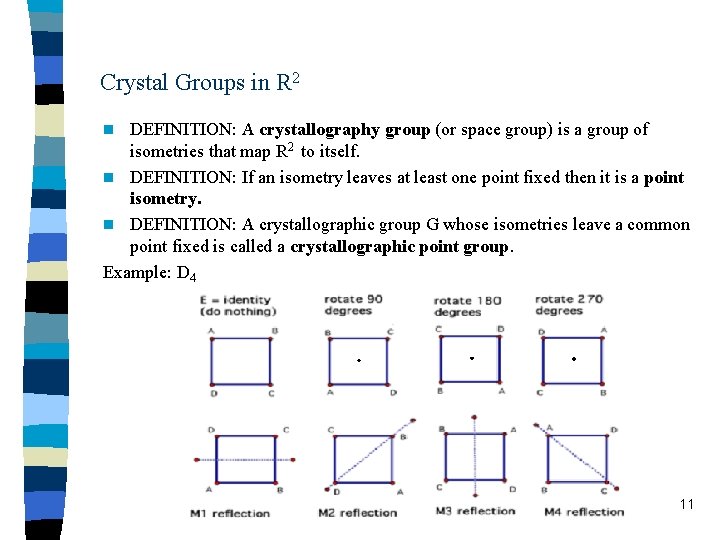
Crystal Groups in R 2 DEFINITION: A crystallography group (or space group) is a group of isometries that map R 2 to itself. n DEFINITION: If an isometry leaves at least one point fixed then it is a point isometry. n DEFINITION: A crystallographic group G whose isometries leave a common point fixed is called a crystallographic point group. Example: D 4 n 11
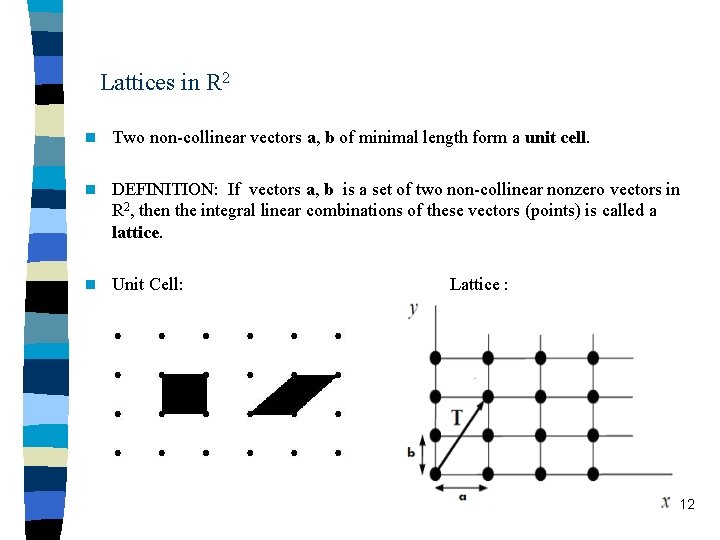
Lattices in R 2 n Two non-collinear vectors a, b of minimal length form a unit cell. n DEFINITION: If vectors a, b is a set of two non-collinear nonzero vectors in R 2, then the integral linear combinations of these vectors (points) is called a lattice. n Unit Cell: Lattice : 12
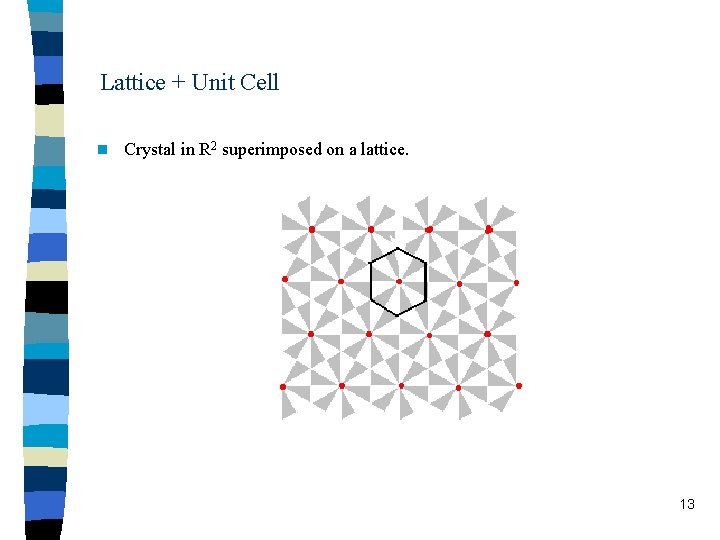
Lattice + Unit Cell n Crystal in R 2 superimposed on a lattice. 13
Crystalline Restriction Theorem in R 2 What are the possible rotations around a fixed point? THEOREM: The only possible rotational symmetries of a lattice are 2 -fold, 3 -fold, 4 -fold, and 6 -fold rotations (i. e. 2π/n where n = 1, 2, 3, 4 or 6). 14
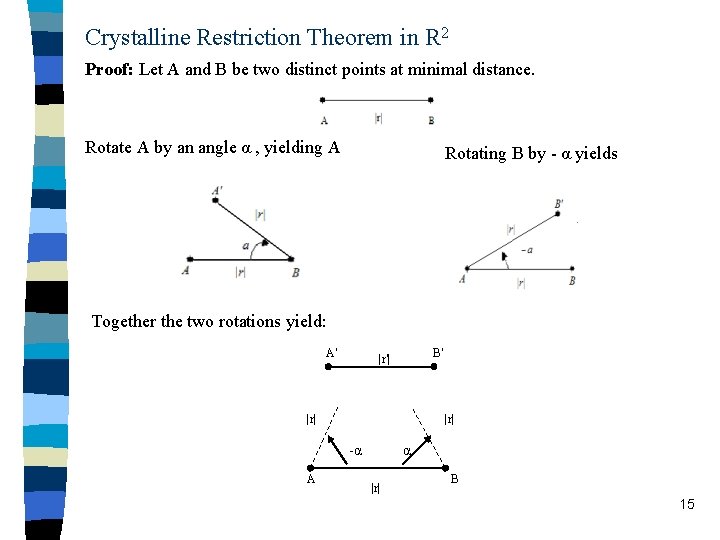
Crystalline Restriction Theorem in R 2 Proof: Let A and B be two distinct points at minimal distance. Rotate A by an angle α , yielding A’ Rotating B by - α yields Together the two rotations yield: A’ B’ |r’| |r| -α A α |r| B 15
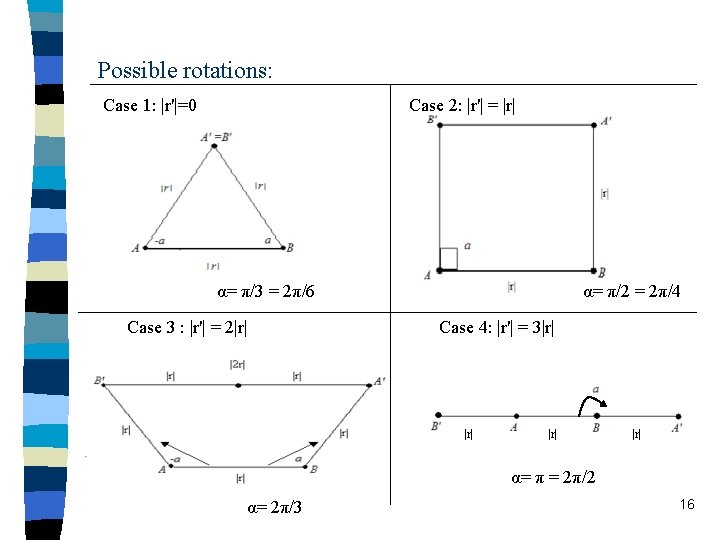
Possible rotations: Case 1: |r'|=0 Case 2: |r'| = |r| α= π/3 = 2π/6 Case 3 : |r'| = 2|r| α= π/2 = 2π/4 Case 4: |r'| = 3|r| |r| α= π = 2π/2 α= 2π/3 16
Bravais Lattices in R 2 n Given the Crystalline Restriction Theorem, Bravais Lattices are the only lattices preserved by translations, and the allowable rotational symmetry. 17
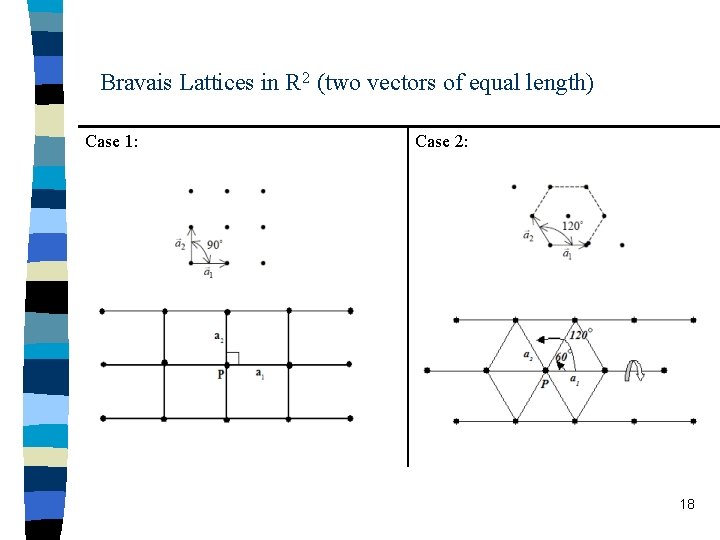
Bravais Lattices in R 2 (two vectors of equal length) Case 1: Case 2: 18
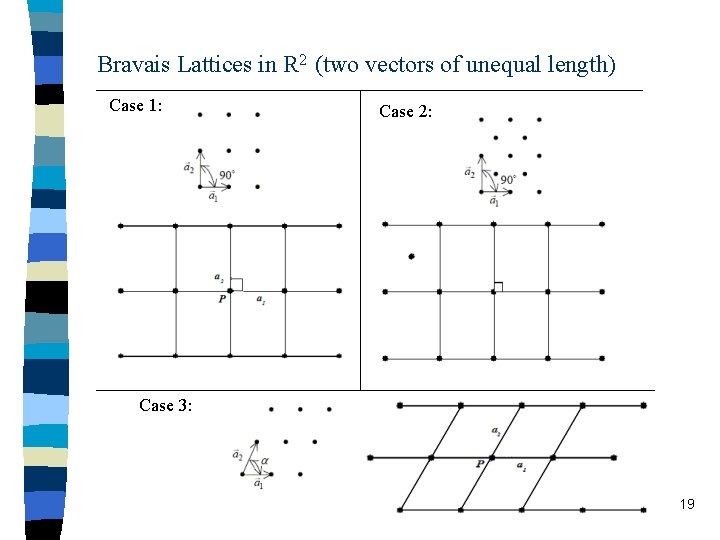
Bravais Lattices in R 2 (two vectors of unequal length) Case 1: Case 2: Case 3: 19
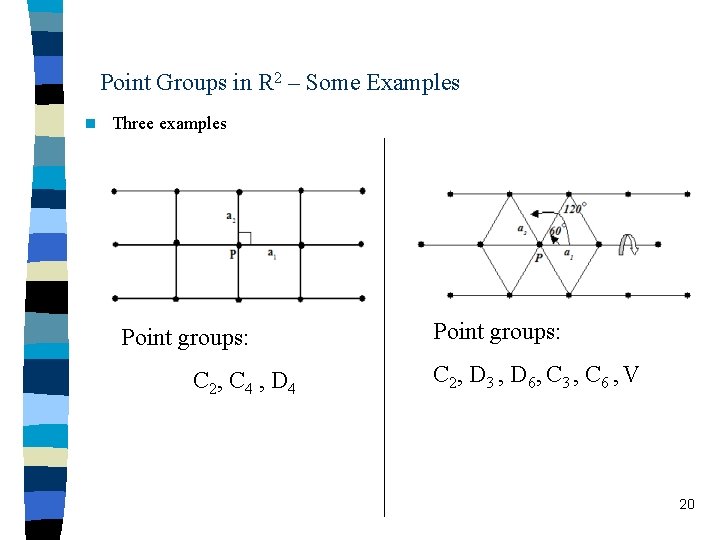
Point Groups in R 2 – Some Examples n Three examples Point groups: C 2, C 4 , D 4 Point groups: C 2, D 3 , D 6, C 3 , C 6 , V 20
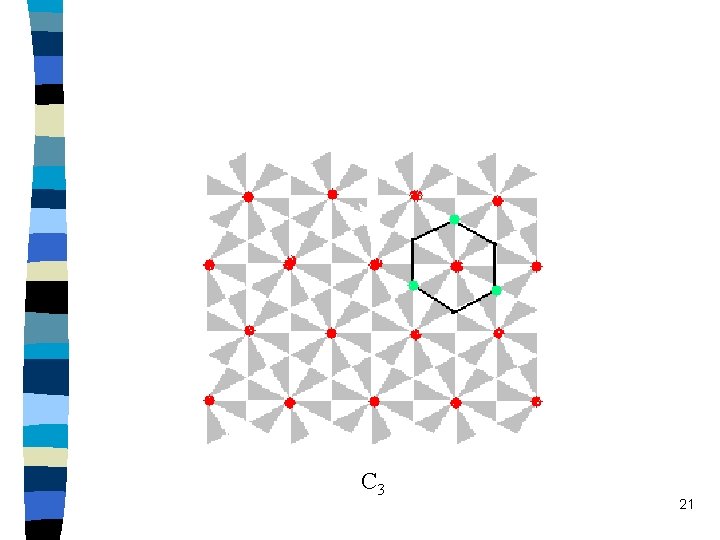
C 3 21
Isometries in R 3 (see handout) n Rotations n Reflections n Improper Rotations n Inverse Operations 22
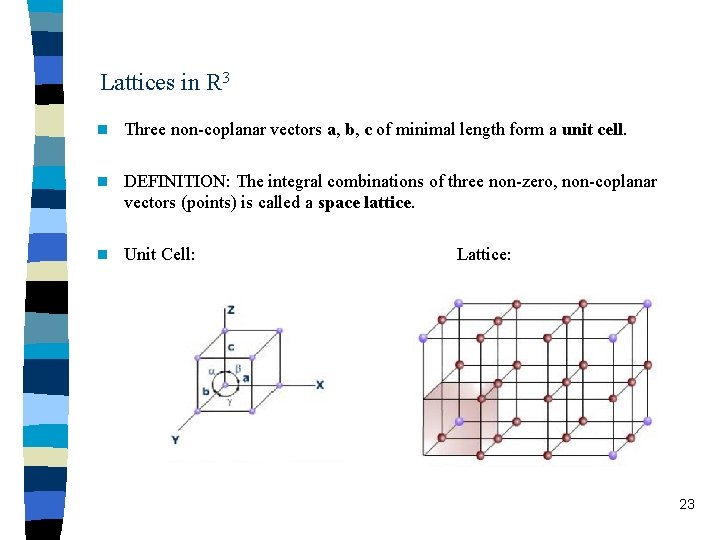
Lattices in R 3 n Three non-coplanar vectors a, b, c of minimal length form a unit cell. n DEFINITION: The integral combinations of three non-zero, non-coplanar vectors (points) is called a space lattice. n Unit Cell: Lattice: 23
Bravais Lattices in R 3 The Crystalline Restriction Theorem in R 3 yields n 14 BRAVAIS LATTICES in n 7 CRYSTAL SYSTEMS n Described by “centerings” on different “facings” of the unit cell 24
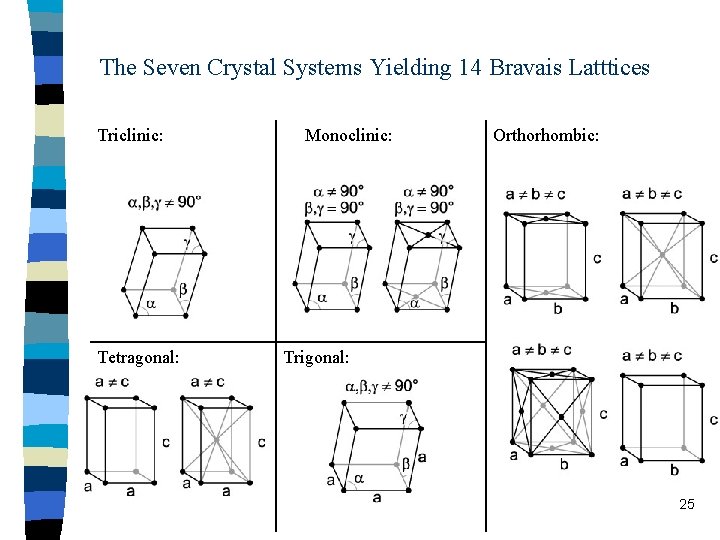
The Seven Crystal Systems Yielding 14 Bravais Latttices Triclinic: Monoclinic: Tetragonal: Trigonal: Orthorhombic: 25
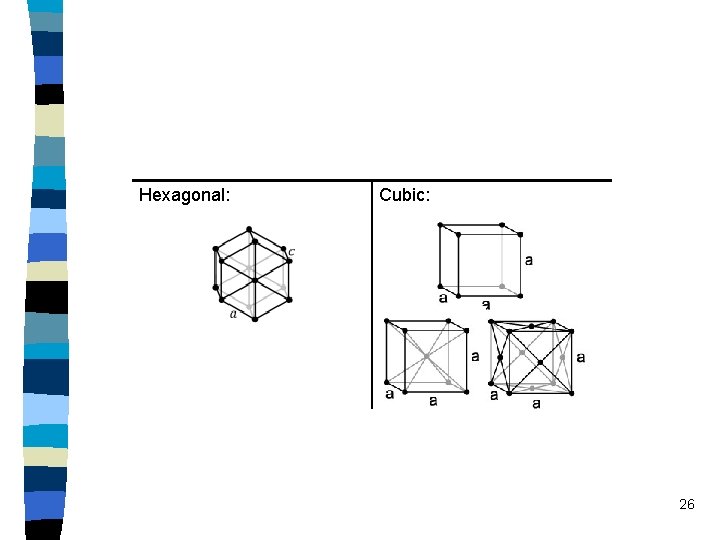
Hexagonal: Cubic: 26
Crystallography Groups and Point Groups in R 3 n Crystallography group (space group) n (Crystallographic) point group n 32 Total Point Groups in R 3 for the 7 Crystal Systems 27
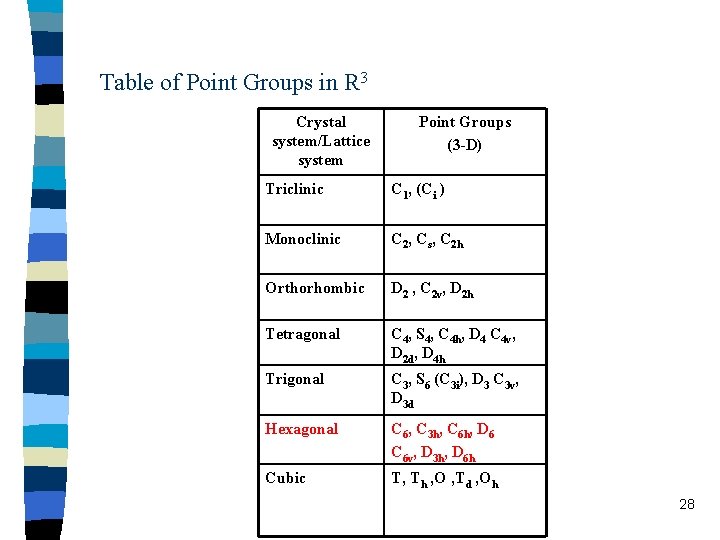
Table of Point Groups in R 3 Crystal system/Lattice system Point Groups (3 -D) Triclinic C 1, (Ci ) Monoclinic C 2, Cs, C 2 h Orthorhombic D 2 , C 2 v, D 2 h Tetragonal C 4, S 4, C 4 h, D 4 C 4 v, D 2 d, D 4 h Trigonal C 3, S 6 (C 3 i), D 3 C 3 v, D 3 d Hexagonal C 6, C 3 h, C 6 h, D 6 C 6 v, D 3 h, D 6 h Cubic T, Th , O , Td , Oh 28
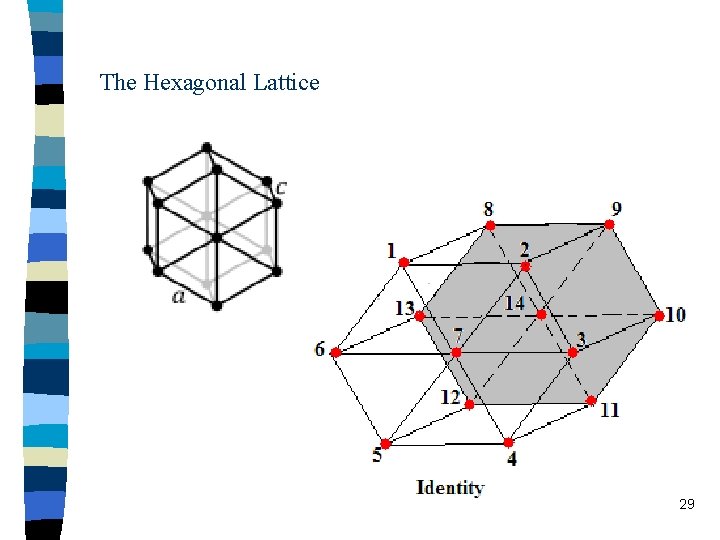
The Hexagonal Lattice 29
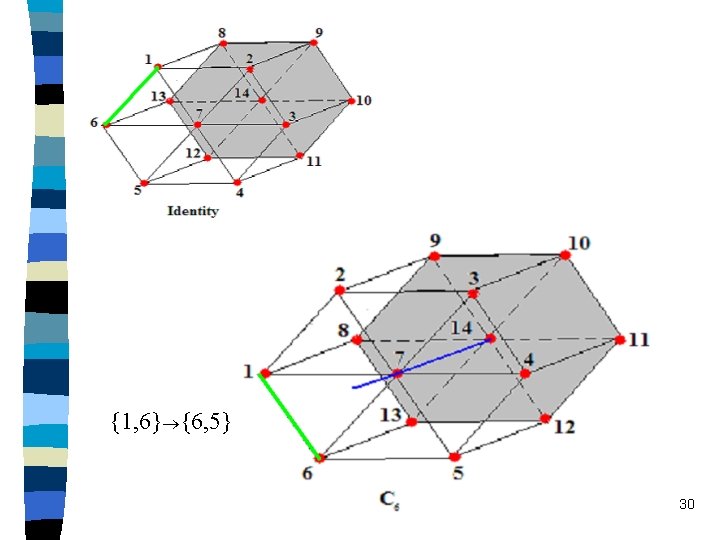
{1, 6} {6, 5} 30
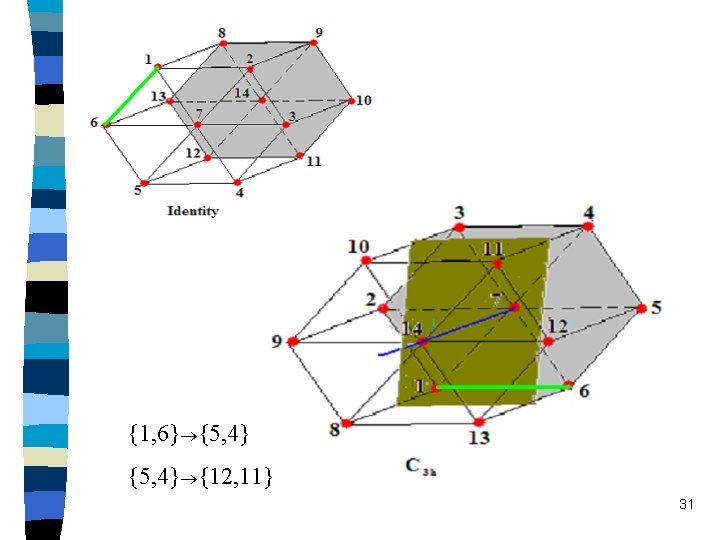
{1, 6} {5, 4} {12, 11} 31
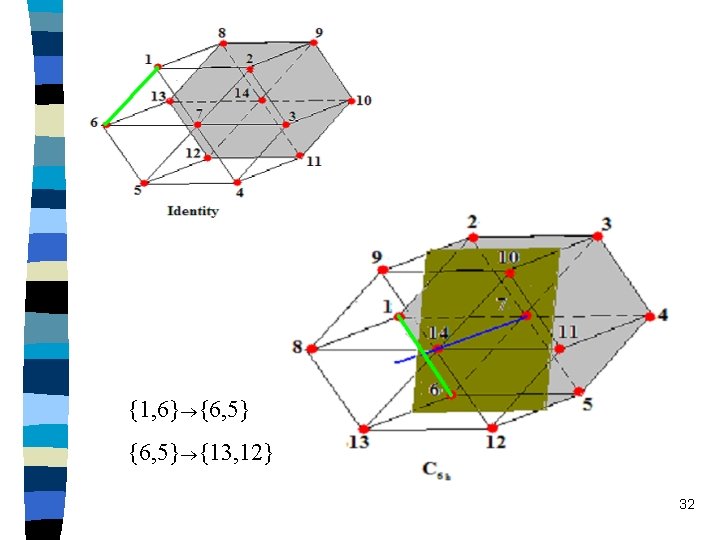
{1, 6} {6, 5} {13, 12} 32
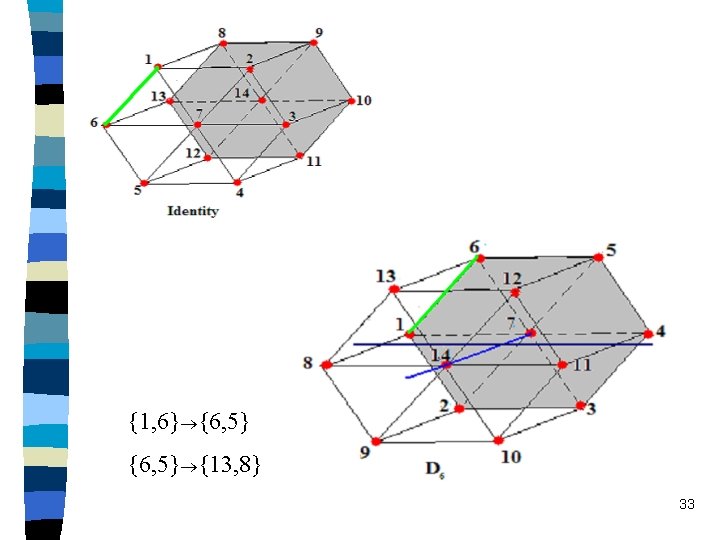
{1, 6} {6, 5} {13, 8} 33
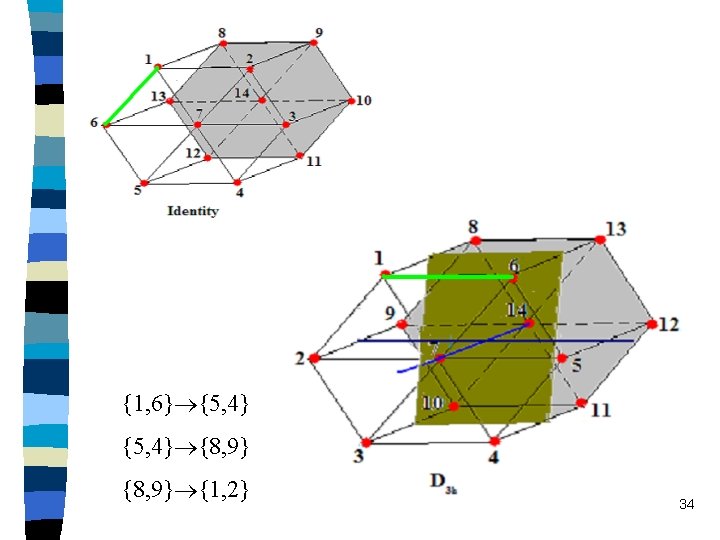
{1, 6} {5, 4} {8, 9} {1, 2} 34
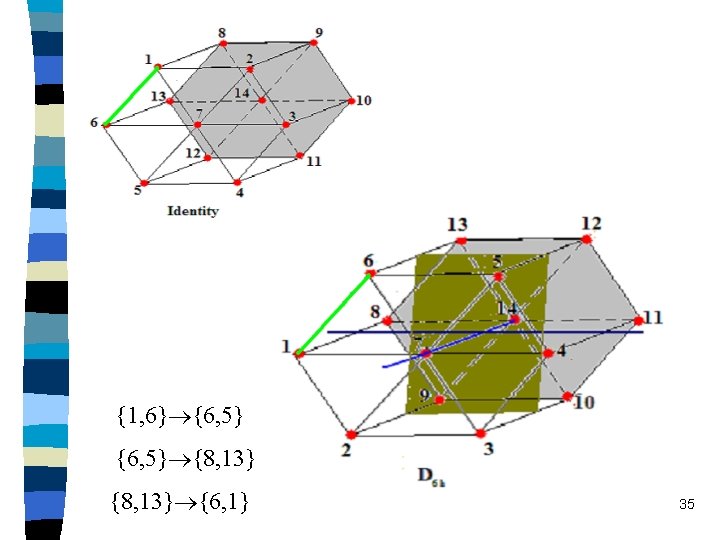
{1, 6} {6, 5} {8, 13} {6, 1} 35
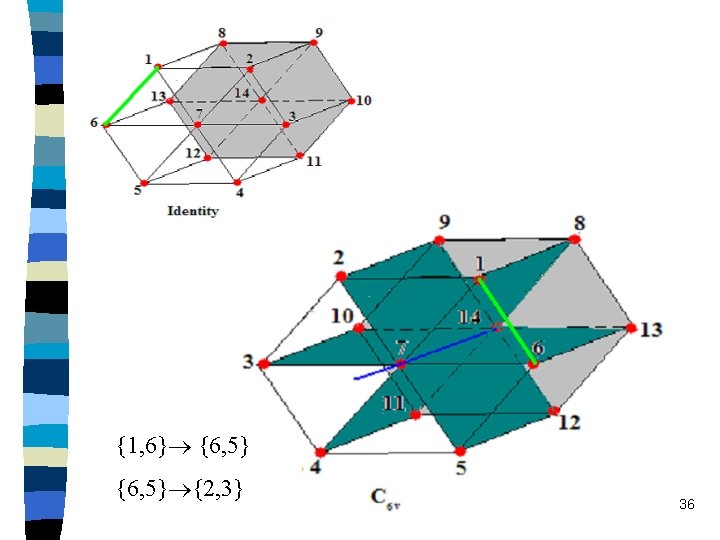
{1, 6} {6, 5} {2, 3} 36
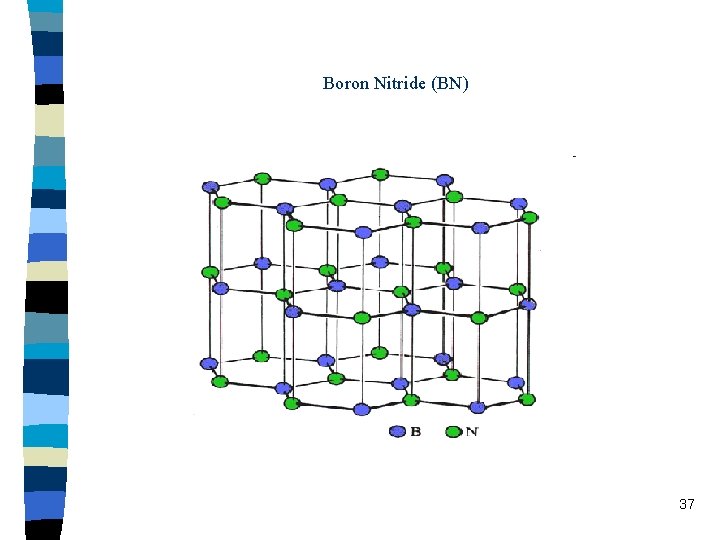
Boron Nitride (BN) 37
Main References n Boisen, M. B. Jr. , Gibbs, G. V. , (1985). Mathematical Crystallography: An Introduction to the Mathematical Foundations of Crystallography. Washington, D. C. : Bookcrafters, Inc. n Crystal System. Wikipedia. Retrieved (2009 November 25) from http: //en. wikipedia. org/wiki/Crystal_system n Evans, J. W. , Davies, G. M. (1924). Elementary Crystallography. London: The Woodbridge Press, LTD. n Rousseau, J. -J. (1998). Basic Crystallography. New York: John Wiley & Sons, Inc. n Sands, D. E (1993). Introduction to Crystallography. New York: Dover Publication, Inc. n Saracino, D. (1992). Abstract Algebra: A First Course. Prospect Heights, IL: Waverland Press, Inc. 38
Special Thank You Prof. Tinberg Prof. Buckmire Prof. Sundberg Prof. Tollisen Math Department Family and Friends 39
- Slides: 39