
CRYSTALLIZATION Presented By Mr L R Zawar HRPIPER
CRYSTALLIZATION Presented By: Mr. L R Zawar HRPIPER, Shirpur. E Mail ID : shwet. zawar@gmail. com
Introduction • Spontaneous arrangement of the particles into a repetitive orderly array i. e. , regular geometric pattern. • The liquids can solidify into crystalline forms, whenever attraction forces between particles are strong enough to overcome the disorderliness. • Crystallization differs from precipitation in that the product is deposited from a supersaturated solution.
Application of Crystallization • • Purification of drugs Better processing characteristics Ease of handling Better chemical stability Improved Physical stability Improved bioavailability Sustained release Miscellaneous
Characteristics of Crystals • Crystal Lattice : Orderly internal arrangement of particles in three-dimensional space. • Space Lattice: Lattice Three dimensional arrangement of particles in a crystal. • Unit cell: cell The smallest geometric portion, which repeats to build up the whole crystal. • Faces: Faces A crystal is bounded by plane surfaces. • Axial angle: angle In the crystal, the angle between the two perpendiculars to the intersecting faces. • Axial length: length the distance between the centers of two atoms.

Characteristics of Crystals • Crystal System or Forms: – A finite number of symmetrical arrangements are possible for a crystal lattice & these may be termed as crystal system or forms. – Depending upon the axial length & axial angle, crystal forms are designated as cubic, hexagonal, tetragonal, orthorhombic, monoclinic & triclinic. – A chemical substance may exist in more than one form i. e. , polymorphism.
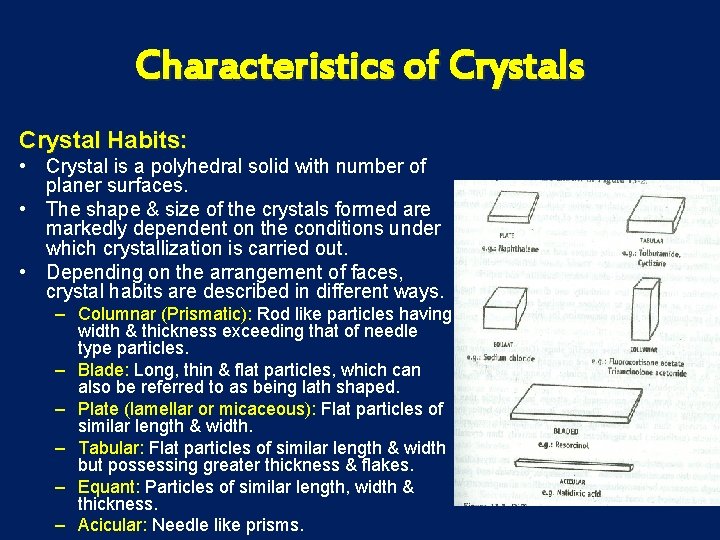
Characteristics of Crystals Crystal Habits: • Crystal is a polyhedral solid with number of planer surfaces. • The shape & size of the crystals formed are markedly dependent on the conditions under which crystallization is carried out. • Depending on the arrangement of faces, crystal habits are described in different ways. – Columnar (Prismatic): Rod like particles having width & thickness exceeding that of needle type particles. – Blade: Long, thin & flat particles, which can also be referred to as being lath shaped. – Plate (lamellar or micaceous): Flat particles of similar length & width. – Tabular: Flat particles of similar length & width but possessing greater thickness & flakes. – Equant: Particles of similar length, width & thickness. – Acicular: Needle like prisms.
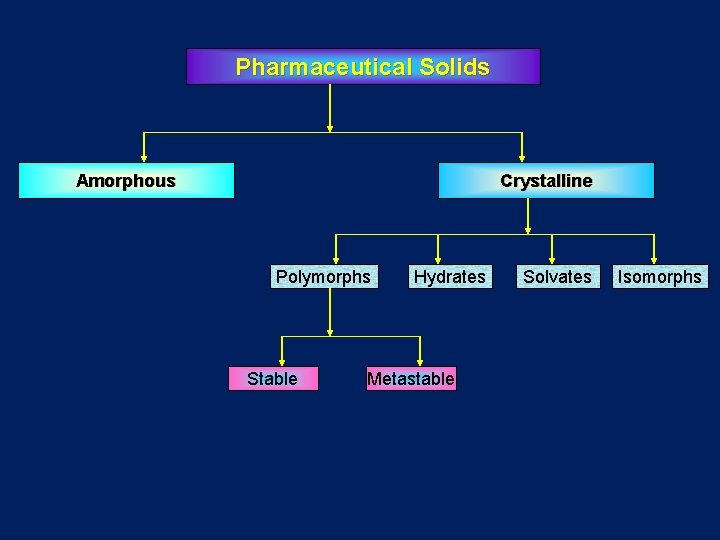
Pharmaceutical Solids Amorphous Crystalline Polymorphs Stable Hydrates Metastable Solvates Isomorphs
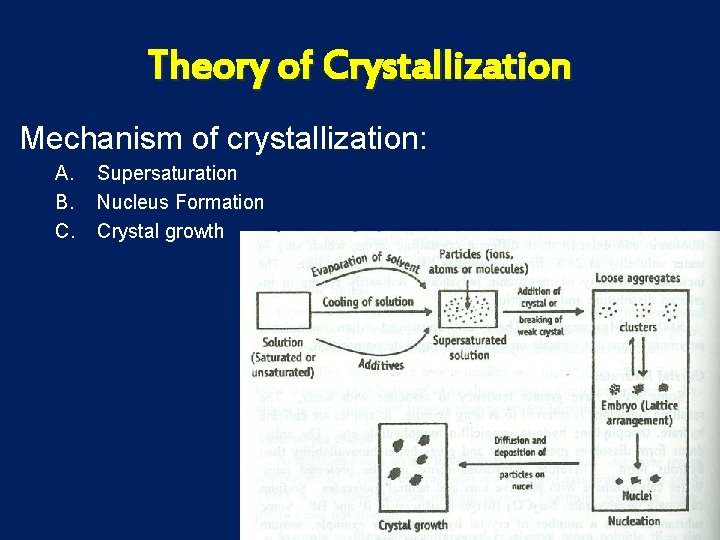
Theory of Crystallization Mechanism of crystallization: A. B. C. Supersaturation Nucleus Formation Crystal growth
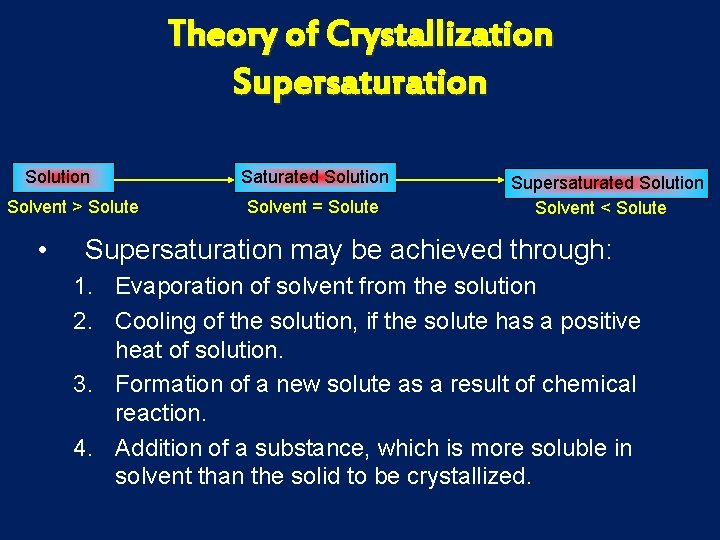
Theory of Crystallization Supersaturation Solution Solvent > Solute • Saturated Solution Solvent = Solute Supersaturated Solution Solvent < Solute Supersaturation may be achieved through: 1. Evaporation of solvent from the solution 2. Cooling of the solution, if the solute has a positive heat of solution. 3. Formation of a new solute as a result of chemical reaction. 4. Addition of a substance, which is more soluble in solvent than the solid to be crystallized.
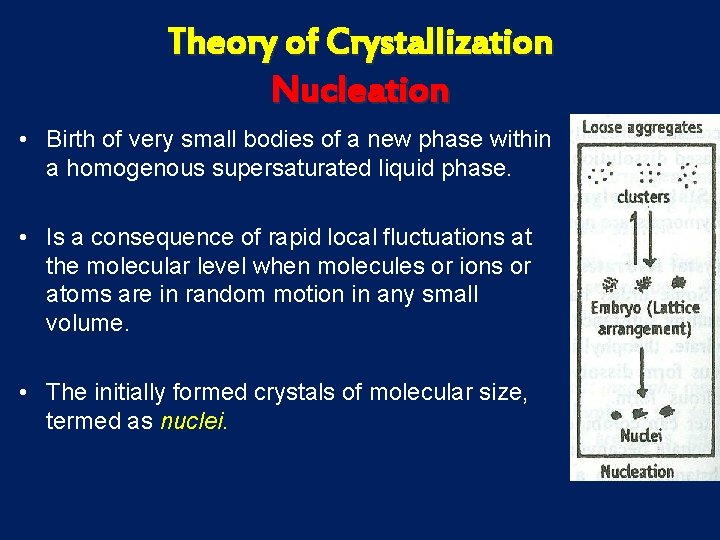
Theory of Crystallization Nucleation • Birth of very small bodies of a new phase within a homogenous supersaturated liquid phase. • Is a consequence of rapid local fluctuations at the molecular level when molecules or ions or atoms are in random motion in any small volume. • The initially formed crystals of molecular size, termed as nuclei.
Theory of Crystallization Nucleation Methods of nucleation: 1. Soft or weak crystals on impact with moving parts in a crystallizer can break into fragments which act as nuclei. 2. Small crystals which are formed in the previous process are added to act as nuclei 3. In a supersaturated solution or under poor mixing, the needle like structures are observed on the ends of crystals. These structures grow faster.
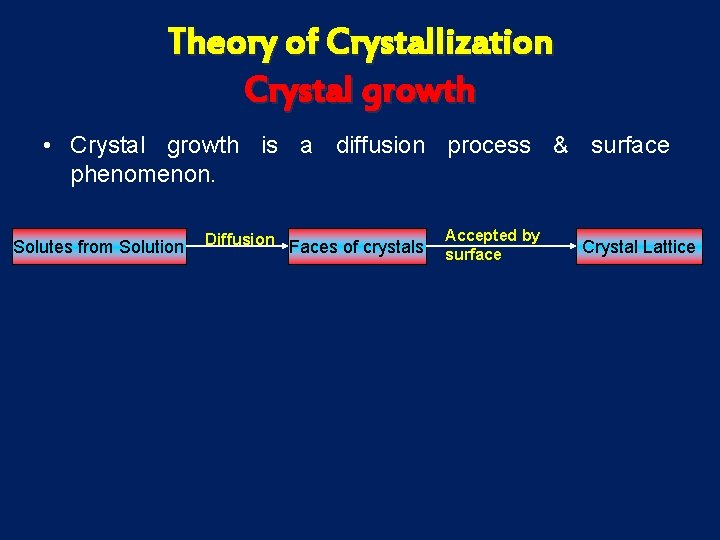
Theory of Crystallization Crystal growth • Crystal growth is a diffusion process & surface phenomenon. Solutes from Solution Diffusion Faces of crystals Accepted by surface Crystal Lattice
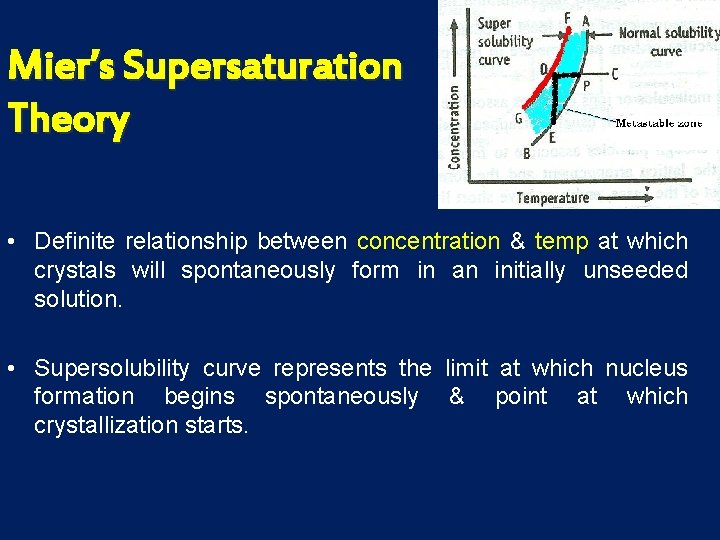
Mier’s Supersaturation Theory • Definite relationship between concentration & temp at which crystals will spontaneously form in an initially unseeded solution. • Supersolubility curve represents the limit at which nucleus formation begins spontaneously & point at which crystallization starts.
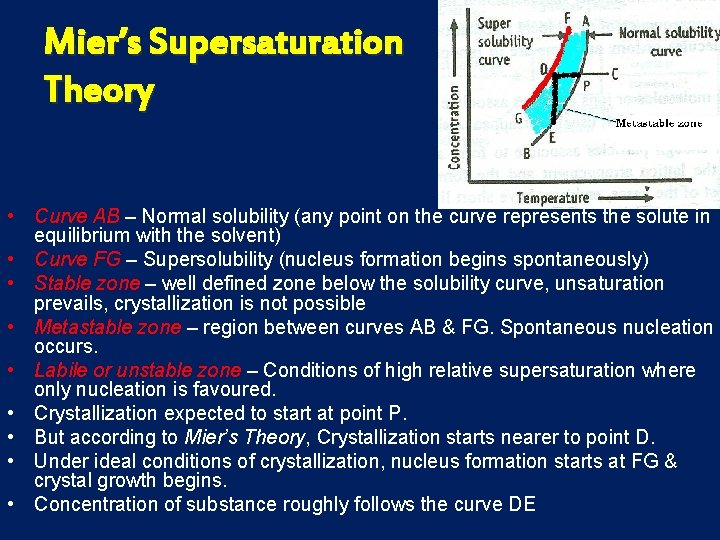
Mier’s Supersaturation Theory • Curve AB – Normal solubility (any point on the curve represents the solute in equilibrium with the solvent) • Curve FG – Supersolubility (nucleus formation begins spontaneously) • Stable zone – well defined zone below the solubility curve, unsaturation prevails, crystallization is not possible • Metastable zone – region between curves AB & FG. Spontaneous nucleation occurs. • Labile or unstable zone – Conditions of high relative supersaturation where only nucleation is favoured. • Crystallization expected to start at point P. • But according to Mier’s Theory, Crystallization starts nearer to point D. • Under ideal conditions of crystallization, nucleus formation starts at FG & crystal growth begins. • Concentration of substance roughly follows the curve DE
Conditions for obeying Mier’s Theory 1. The solute & the solvent must be pure. 2. The solution must be free from solid solute particles. 3. The solution must be free from foreign solid matter. 4. The solution must be protected from entry of any particle. 5. Soft or weak crystals must not form during the process. 6. There should not be any fluctuations in maintaining the temp
Limitations of Mier’s Theory 1. Crystallization starts at supersolubility curve, but crystallization takes place in an area rather than a line. 2. If the solution kept for longer periods, nucleation starts well below the supersolubility curve. 3. If the solution is available in large volume, nucleation starts well below the supersolubility curve (due to collisions of molecules) 4. Applicable when pure solute & pure solvent are used. 5. During storage dust particles can enter that may initiate nucleation.
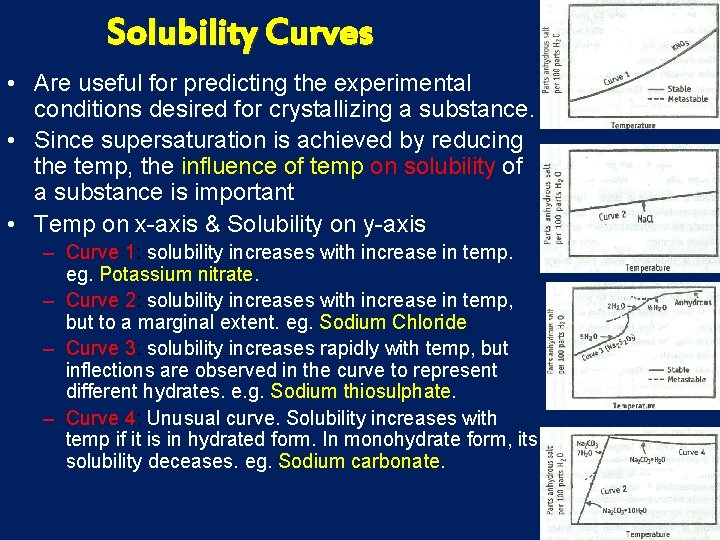
Solubility Curves • Are useful for predicting the experimental conditions desired for crystallizing a substance. • Since supersaturation is achieved by reducing the temp, the influence of temp on solubility of a substance is important • Temp on x-axis & Solubility on y-axis – Curve 1: solubility increases with increase in temp. eg. Potassium nitrate. – Curve 2: solubility increases with increase in temp, but to a marginal extent. eg. Sodium Chloride. – Curve 3: solubility increases rapidly with temp, but inflections are observed in the curve to represent different hydrates. e. g. Sodium thiosulphate. – Curve 4: Unusual curve. Solubility increases with temp if it is in hydrated form. In monohydrate form, its solubility deceases. eg. Sodium carbonate.
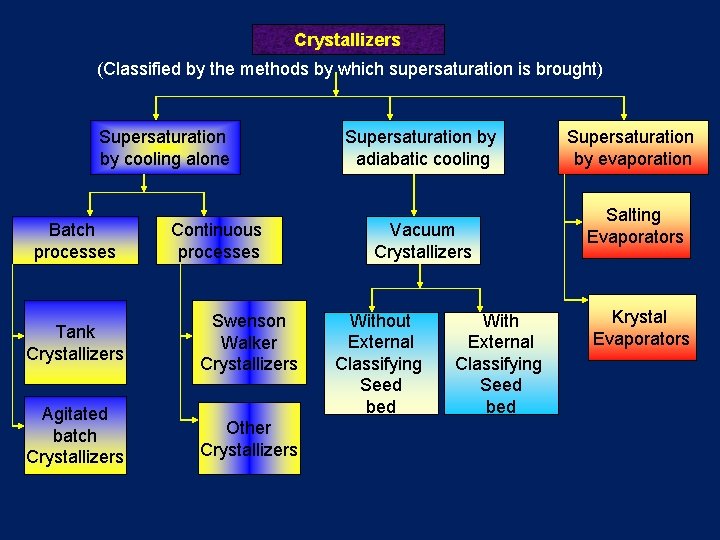
Crystallizers (Classified by the methods by which supersaturation is brought) Supersaturation by cooling alone Batch processes Continuous processes Tank Crystallizers Swenson Walker Crystallizers Agitated batch Crystallizers Other Crystallizers Supersaturation by adiabatic cooling Vacuum Crystallizers Without External Classifying Seed bed With External Classifying Seed bed Supersaturation by evaporation Salting Evaporators Krystal Evaporators
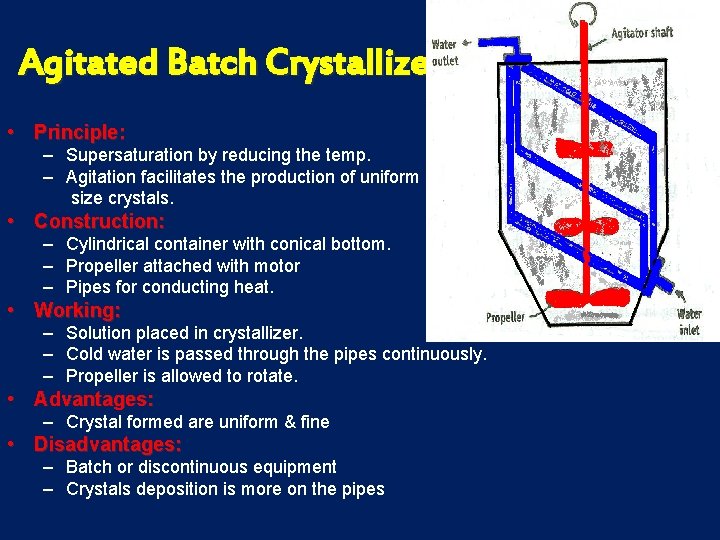
Agitated Batch Crystallizer • Principle: – Supersaturation by reducing the temp. – Agitation facilitates the production of uniform size crystals. • Construction: – Cylindrical container with conical bottom. – Propeller attached with motor – Pipes for conducting heat. • Working: – Solution placed in crystallizer. – Cold water is passed through the pipes continuously. – Propeller is allowed to rotate. • Advantages: – Crystal formed are uniform & fine • Disadvantages: – Batch or discontinuous equipment – Crystals deposition is more on the pipes
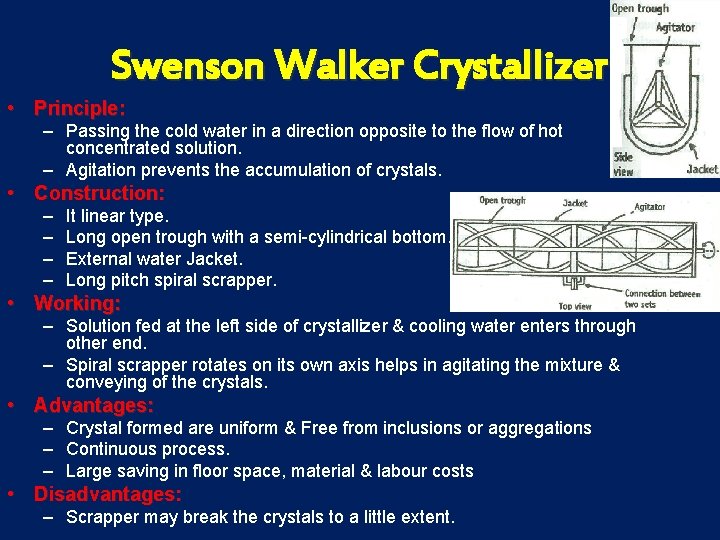
Swenson Walker Crystallizer • Principle: – Passing the cold water in a direction opposite to the flow of hot concentrated solution. – Agitation prevents the accumulation of crystals. • Construction: – – It linear type. Long open trough with a semi-cylindrical bottom. External water Jacket. Long pitch spiral scrapper. • Working: – Solution fed at the left side of crystallizer & cooling water enters through other end. – Spiral scrapper rotates on its own axis helps in agitating the mixture & conveying of the crystals. • Advantages: – Crystal formed are uniform & Free from inclusions or aggregations – Continuous process. – Large saving in floor space, material & labour costs • Disadvantages: – Scrapper may break the crystals to a little extent.
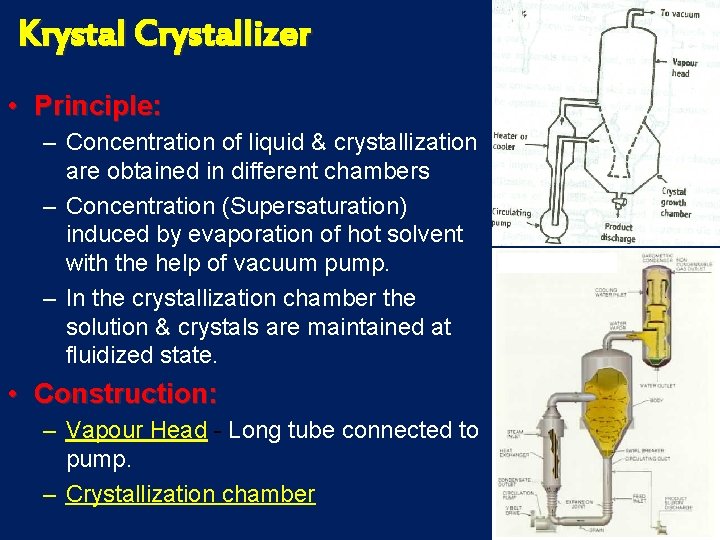
Krystal Crystallizer • Principle: – Concentration of liquid & crystallization are obtained in different chambers – Concentration (Supersaturation) induced by evaporation of hot solvent with the help of vacuum pump. – In the crystallization chamber the solution & crystals are maintained at fluidized state. • Construction: – Vapour Head - Long tube connected to pump. – Crystallization chamber
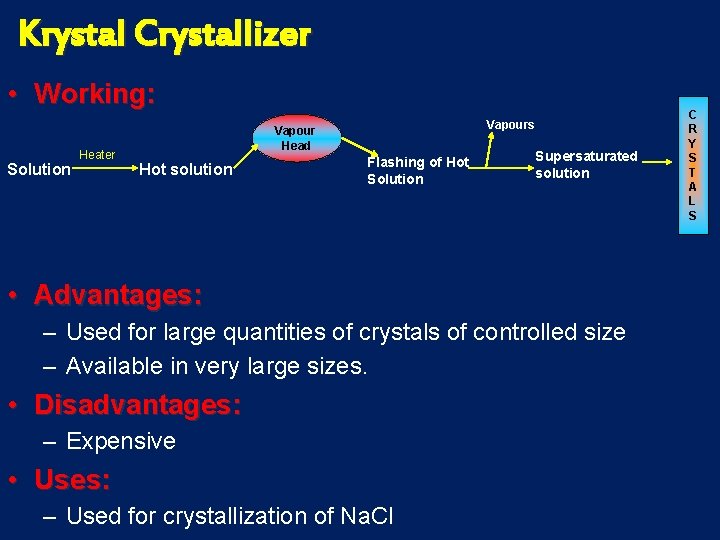
Krystal Crystallizer • Working: Solution Heater Vapours Vapour Head Hot solution Flashing of Hot Solution Supersaturated solution • Advantages: – Used for large quantities of crystals of controlled size – Available in very large sizes. • Disadvantages: – Expensive • Uses: – Used for crystallization of Na. Cl C R Y S T A L S
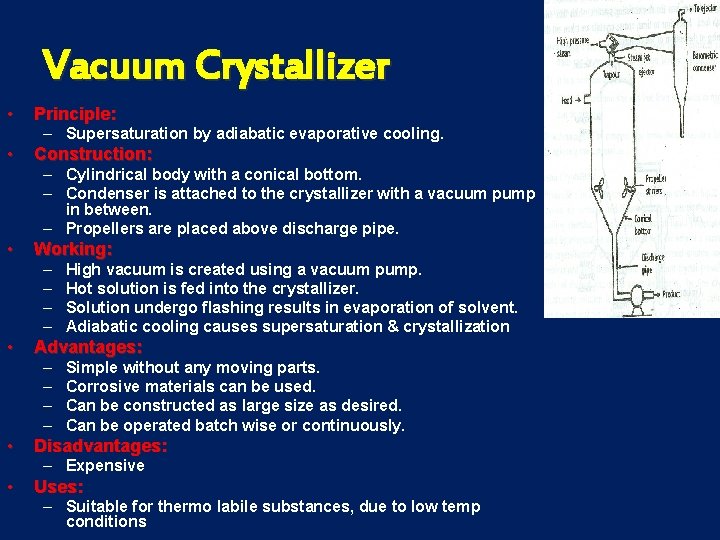
Vacuum Crystallizer • Principle: • Construction: • Working: • – Supersaturation by adiabatic evaporative cooling. – Cylindrical body with a conical bottom. – Condenser is attached to the crystallizer with a vacuum pump in between. – Propellers are placed above discharge pipe. – – High vacuum is created using a vacuum pump. Hot solution is fed into the crystallizer. Solution undergo flashing results in evaporation of solvent. Adiabatic cooling causes supersaturation & crystallization Advantages: – – Simple without any moving parts. Corrosive materials can be used. Can be constructed as large size as desired. Can be operated batch wise or continuously. • Disadvantages: • Uses: – Expensive – Suitable for thermo labile substances, due to low temp conditions

- Slides: 24