
Crystallization Laboratory Putting crystals in perspective Why do
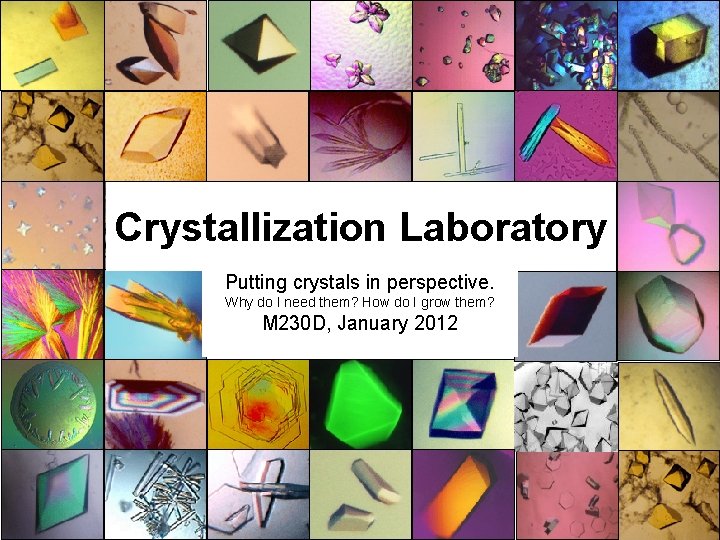
Crystallization Laboratory Putting crystals in perspective. Why do I need them? How do I grow them? M 230 D, January 2012
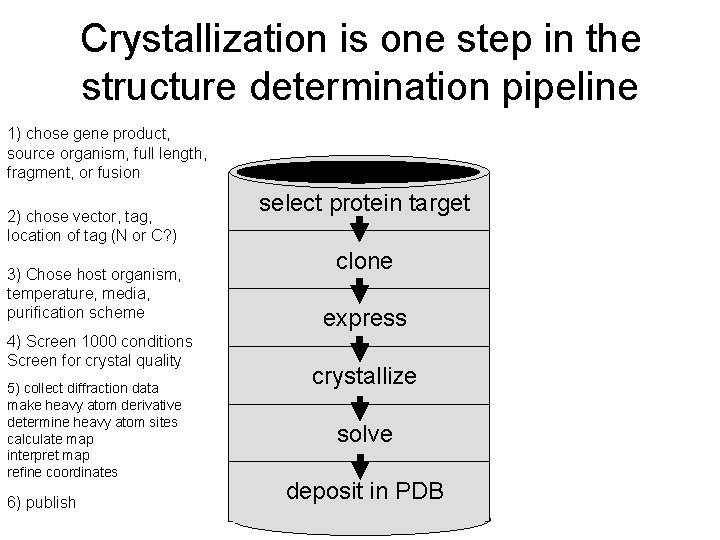
Crystallization is one step in the structure determination pipeline 1) chose gene product, source organism, full length, fragment, or fusion 2) chose vector, tag, location of tag (N or C? ) 3) Chose host organism, temperature, media, purification scheme 4) Screen 1000 conditions Screen for crystal quality 5) collect diffraction data make heavy atom derivative determine heavy atom sites calculate map interpret map refine coordinates 6) publish select protein target clone express crystallize solve deposit in PDB
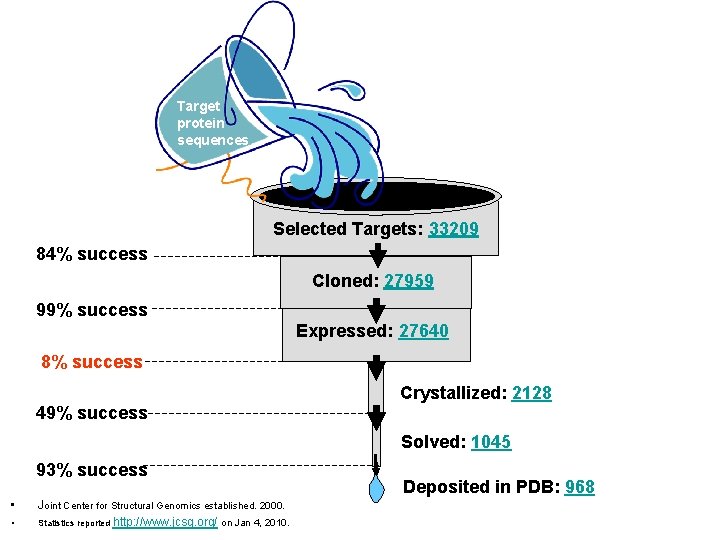
Target protein sequences Selected Targets: 33209 84% success Cloned: 27959 99% success Expressed: 27640 8% success 49% success Crystallized: 2128 Solved: 1045 93% success • • Joint Center for Structural Genomics established. 2000. Statistics reported http: //www. jcsg. org/ on Jan 4, 2010. Deposited in PDB: 968
Growing a suitable crystal is such a hurdle! Why is it necessary to grow crystals?

In a crystal, the diffraction signal is amplified by the large number of repeating units (molecules). A 100 mm 3 crystal contains 1012 unit cells Diffraction from a single molecule is not currently measurable. Diffraction intensity is proportional to the number of unit cells in the crystal (Darwin’s formula, 1914).
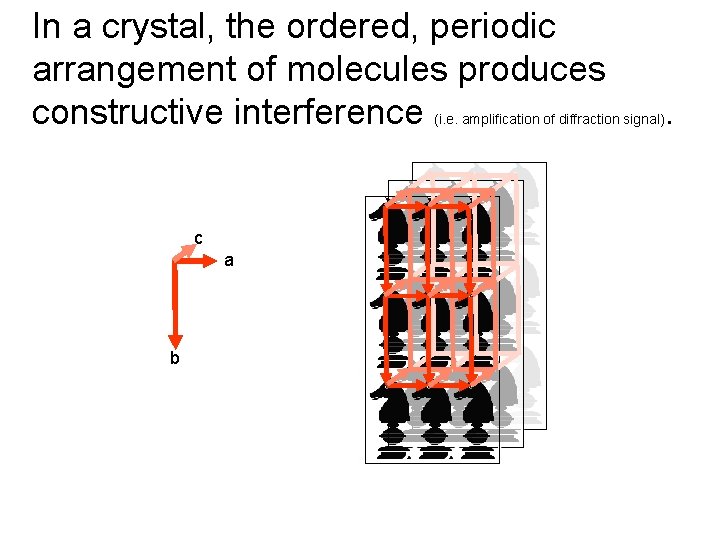
In a crystal, the ordered, periodic arrangement of molecules produces constructive interference (i. e. amplification of diffraction signal) c a b .
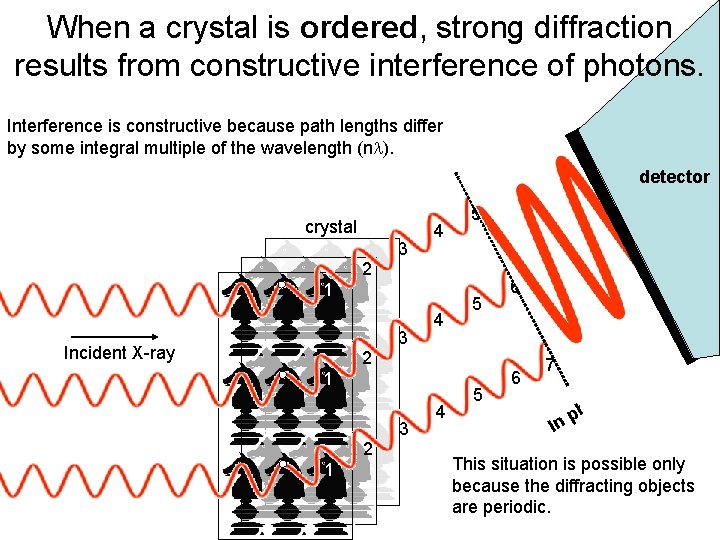
When a crystal is ordered, strong diffraction results from constructive interference of photons. Interference is constructive because path lengths differ by some integral multiple of the wavelength (nl). 6 crystal 2 3 4 1 Incident X-ray 2 3 4 2 1 5 5 6 8 7 8 1 3 detector 7 4 5 6 9 7 In se a h p This situation is possible only because the diffracting objects are periodic.
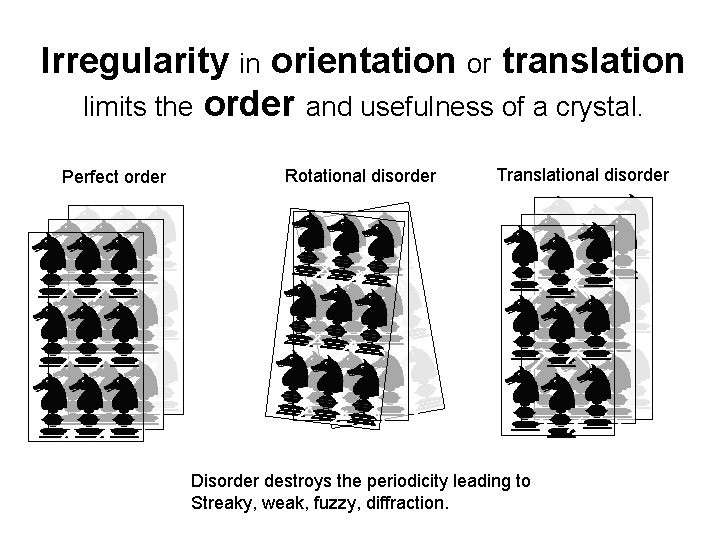
Irregularity in orientation or translation limits the order and usefulness of a crystal. Perfect order Rotational disorder Translational disorder Disorder destroys the periodicity leading to Streaky, weak, fuzzy, diffraction.
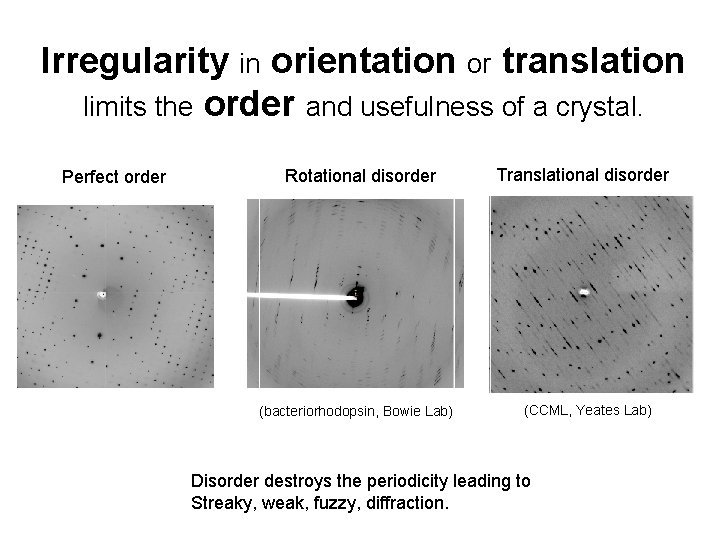
Irregularity in orientation or translation limits the order and usefulness of a crystal. Perfect order Rotational disorder (bacteriorhodopsin, Bowie Lab) Translational disorder (CCML, Yeates Lab) Disorder destroys the periodicity leading to Streaky, weak, fuzzy, diffraction.
What makes crystallization such a difficult challenge?
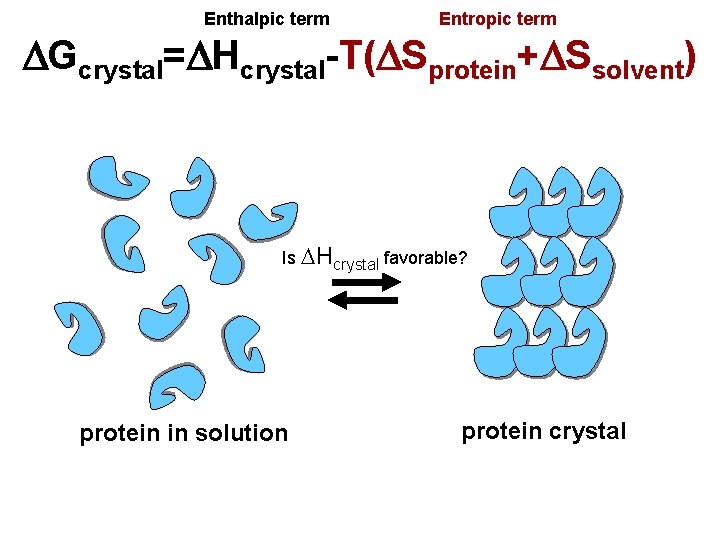
Enthalpic term Entropic term DGcrystal=DHcrystal-T(DSprotein+DSsolvent) Is DHcrystal favorable? protein in solution protein crystal
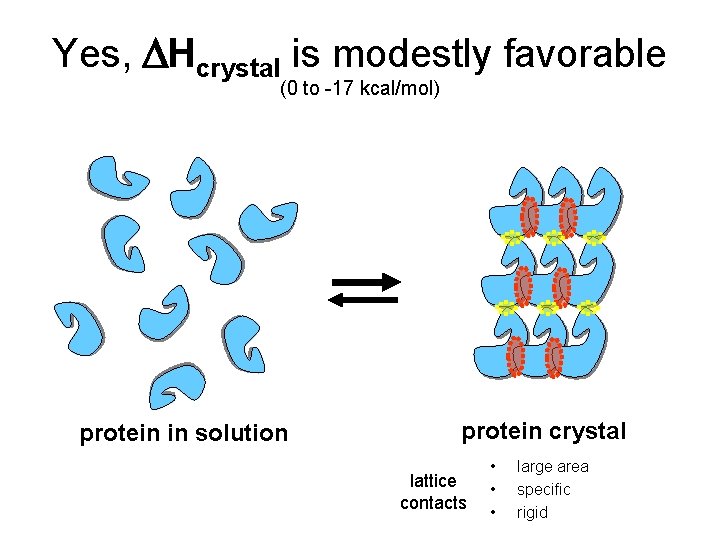
Yes, DHcrystal is modestly favorable (0 to -17 kcal/mol) protein in solution protein crystal lattice contacts • • • large area specific rigid
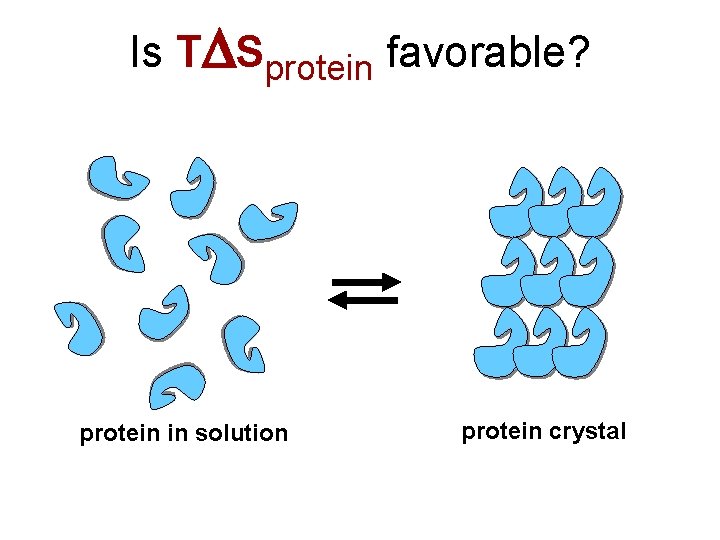
Is TDSprotein favorable? protein in solution protein crystal
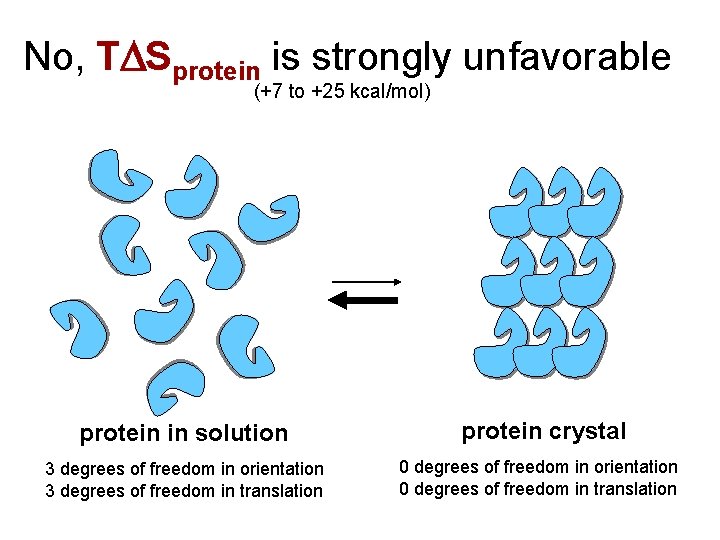
No, TDSprotein is strongly unfavorable (+7 to +25 kcal/mol) protein in solution 3 degrees of freedom in orientation 3 degrees of freedom in translation protein crystal 0 degrees of freedom in orientation 0 degrees of freedom in translation
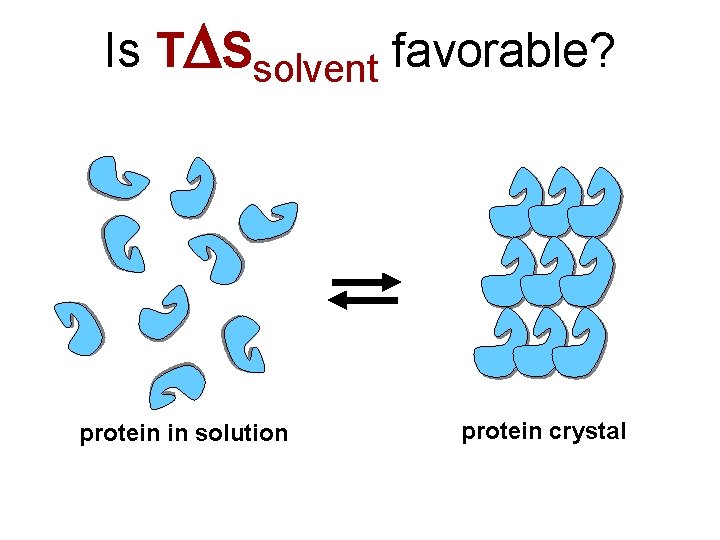
Is TDSsolvent favorable? protein in solution protein crystal
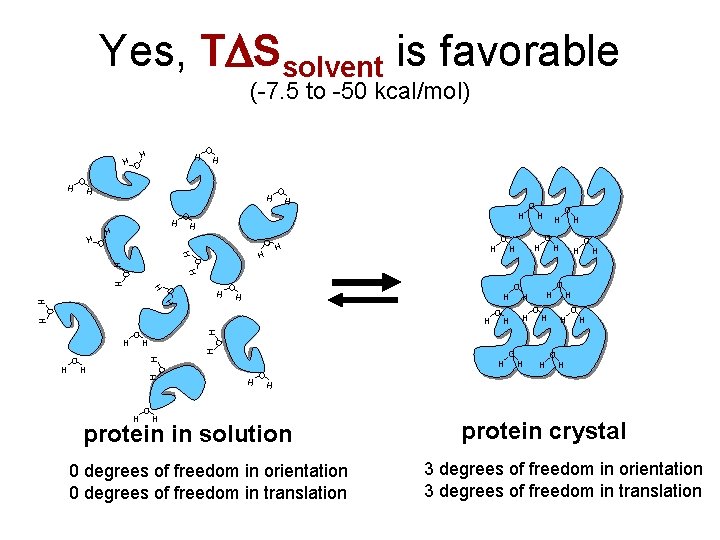
Yes, TDSsolvent is favorable (-7. 5 to -50 kcal/mol) O H H H O O H H H O H H H H O O H H H O O H H H O H O O H H H O O O H H H protein in solution 0 degrees of freedom in orientation 0 degrees of freedom in translation protein crystal 3 degrees of freedom in orientation 3 degrees of freedom in translation
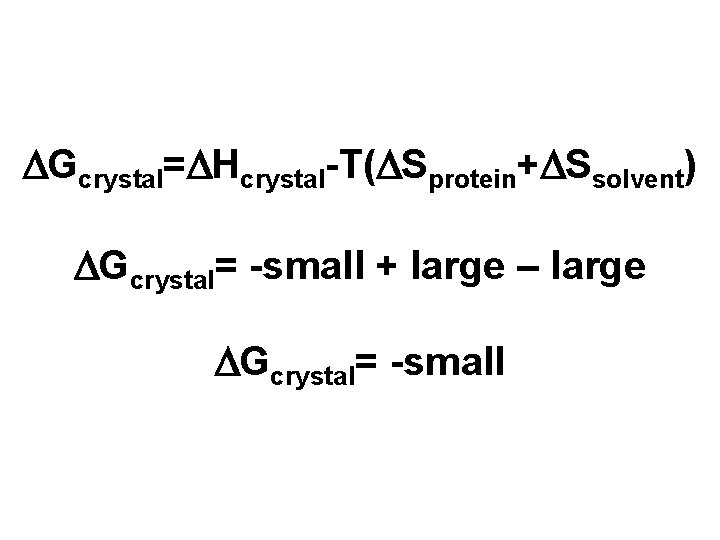
DGcrystal=DHcrystal-T(DSprotein+DSsolvent) DGcrystal= -small + large – large DGcrystal= -small
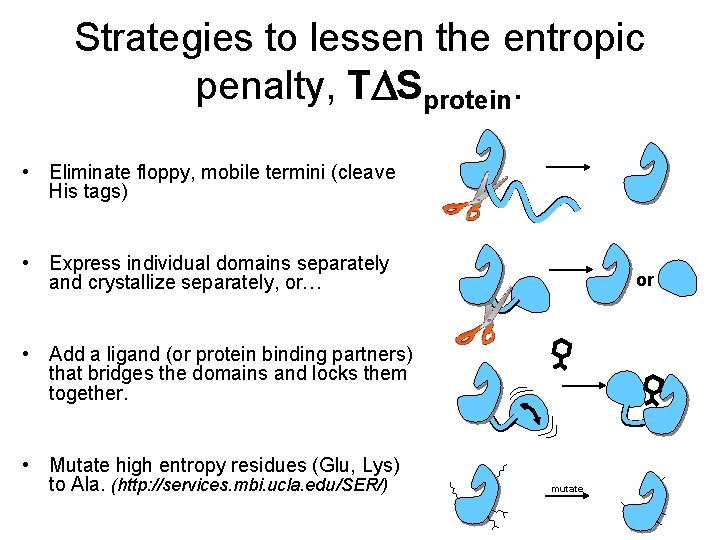
Strategies to lessen the entropic penalty, TDSprotein. • Eliminate floppy, mobile termini (cleave His tags) • Express individual domains separately and crystallize separately, or… or • Add a ligand (or protein binding partners) that bridges the domains and locks them together. • Mutate high entropy residues (Glu, Lys) to Ala. (http: //services. mbi. ucla. edu/SER/) mutate
![Increase [protein] to favor crystallization Increasing the monomer concentration [M] pushes the equilibrium toward](http://slidetodoc.com/presentation_image_h/91cfd3c98162d73d35be748a90753adf/image-19.jpg "Increase [protein] to favor crystallization Increasing the monomer concentration [M] pushes the equilibrium toward")
Increase [protein] to favor crystallization Increasing the monomer concentration [M] pushes the equilibrium toward the product. N soluble lysozyme molecules n. M→Mn DG=DGo+RTln( [Mn]/[M]n ) Lesson: To crystallize a protein, Unstable nucleus 1 crystal (lysozyme)N DG you need to increase its concentration to exceed its solubility (by 3 x). Force the monomer out of solution and into the crystal. Supersaturate! n. M→Mn
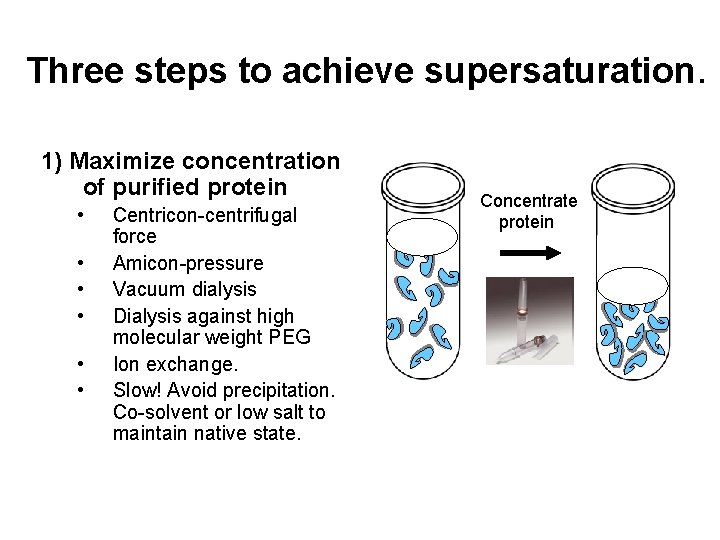
Three steps to achieve supersaturation. 1) Maximize concentration of purified protein • • • Centricon-centrifugal force Amicon-pressure Vacuum dialysis Dialysis against high molecular weight PEG Ion exchange. Slow! Avoid precipitation. Co-solvent or low salt to maintain native state. Concentrate protein
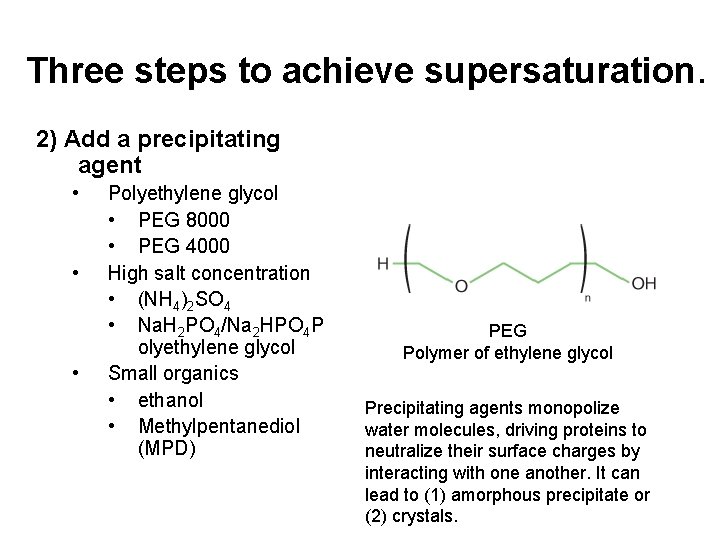
Three steps to achieve supersaturation. 2) Add a precipitating agent • • • Polyethylene glycol • PEG 8000 • PEG 4000 High salt concentration • (NH 4)2 SO 4 • Na. H 2 PO 4/Na 2 HPO 4 P olyethylene glycol Small organics • ethanol • Methylpentanediol (MPD) PEG Polymer of ethylene glycol Precipitating agents monopolize water molecules, driving proteins to neutralize their surface charges by interacting with one another. It can lead to (1) amorphous precipitate or (2) crystals.
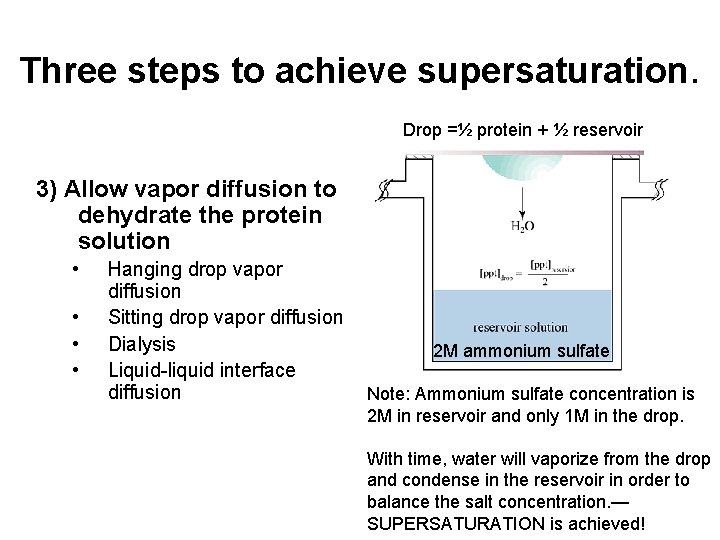
Three steps to achieve supersaturation. Drop =½ protein + ½ reservoir 3) Allow vapor diffusion to dehydrate the protein solution • • Hanging drop vapor diffusion Sitting drop vapor diffusion Dialysis Liquid-liquid interface diffusion 2 M ammonium sulfate Note: Ammonium sulfate concentration is 2 M in reservoir and only 1 M in the drop. With time, water will vaporize from the drop and condense in the reservoir in order to balance the salt concentration. — SUPERSATURATION is achieved!
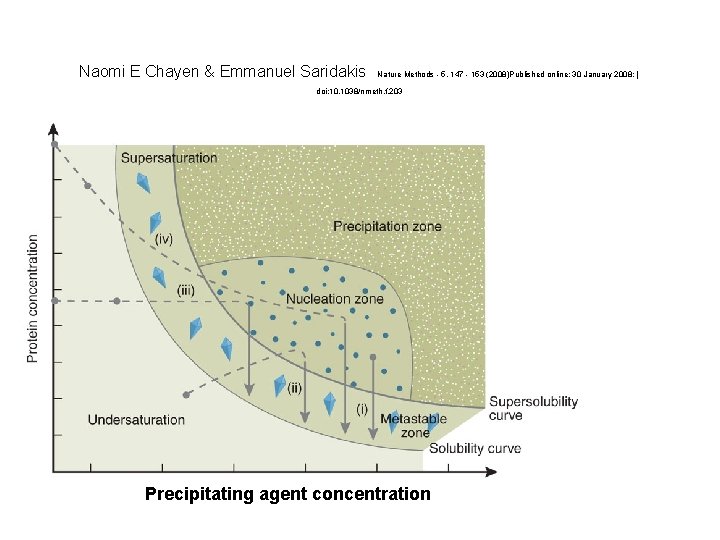
Naomi E Chayen & Emmanuel Saridakis Nature Methods - 5, 147 - 153 (2008)Published online: 30 January 2008; | doi: 10. 1038/nmeth. f. 203 Precipitating agent concentration
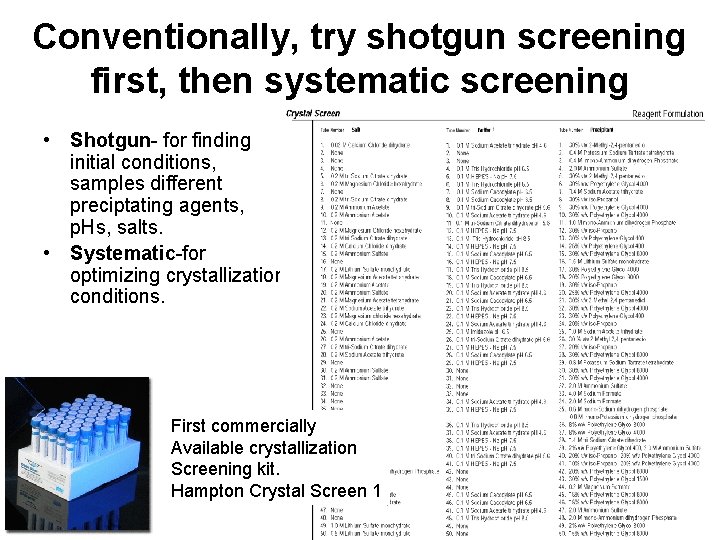
Conventionally, try shotgun screening first, then systematic screening • Shotgun- for finding initial conditions, samples different preciptating agents, p. Hs, salts. • Systematic-for optimizing crystallization conditions. First commercially Available crystallization Screening kit. Hampton Crystal Screen 1

Heavy Atom Gel Shift Assay. Why?
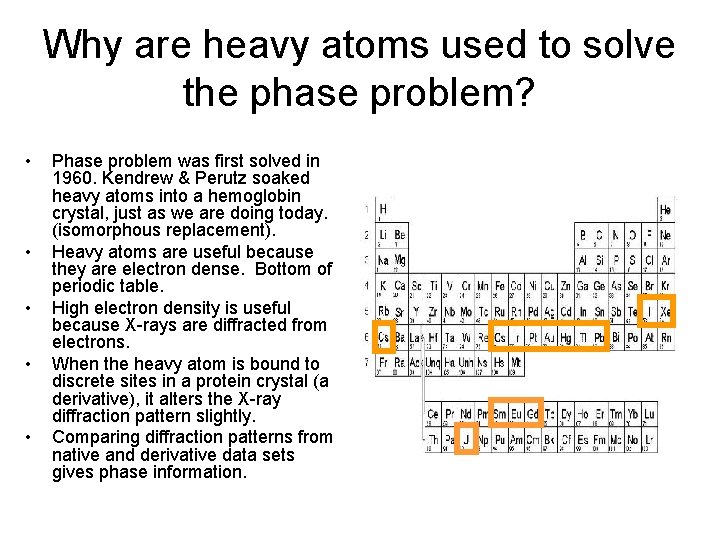
Why are heavy atoms used to solve the phase problem? • • • Phase problem was first solved in 1960. Kendrew & Perutz soaked heavy atoms into a hemoglobin crystal, just as we are doing today. (isomorphous replacement). Heavy atoms are useful because they are electron dense. Bottom of periodic table. High electron density is useful because X-rays are diffracted from electrons. When the heavy atom is bound to discrete sites in a protein crystal (a derivative), it alters the X-ray diffraction pattern slightly. Comparing diffraction patterns from native and derivative data sets gives phase information.
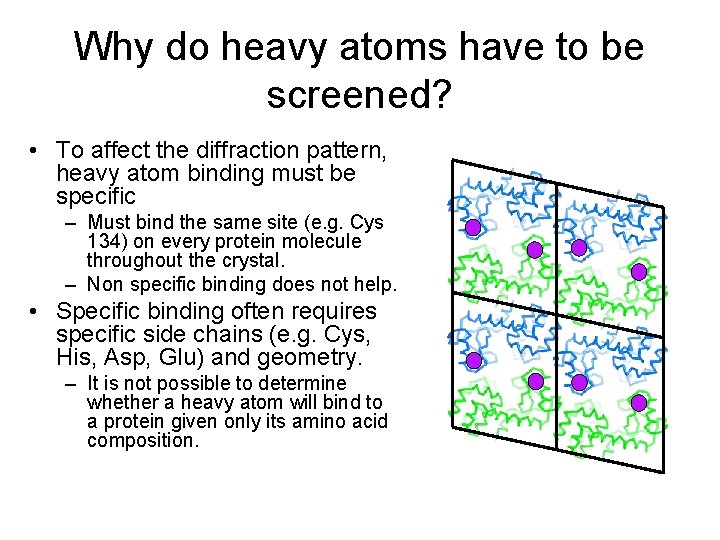
Why do heavy atoms have to be screened? • To affect the diffraction pattern, heavy atom binding must be specific – Must bind the same site (e. g. Cys 134) on every protein molecule throughout the crystal. – Non specific binding does not help. • Specific binding often requires specific side chains (e. g. Cys, His, Asp, Glu) and geometry. – It is not possible to determine whether a heavy atom will bind to a protein given only its amino acid composition.
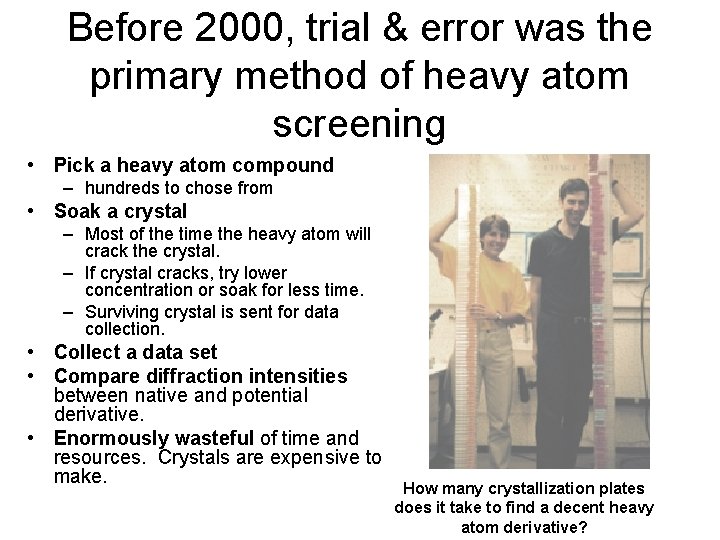
Before 2000, trial & error was the primary method of heavy atom screening • Pick a heavy atom compound – hundreds to chose from • Soak a crystal – Most of the time the heavy atom will crack the crystal. – If crystal cracks, try lower concentration or soak for less time. – Surviving crystal is sent for data collection. • Collect a data set • Compare diffraction intensities between native and potential derivative. • Enormously wasteful of time and resources. Crystals are expensive to make. How many crystallization plates does it take to find a decent heavy atom derivative?
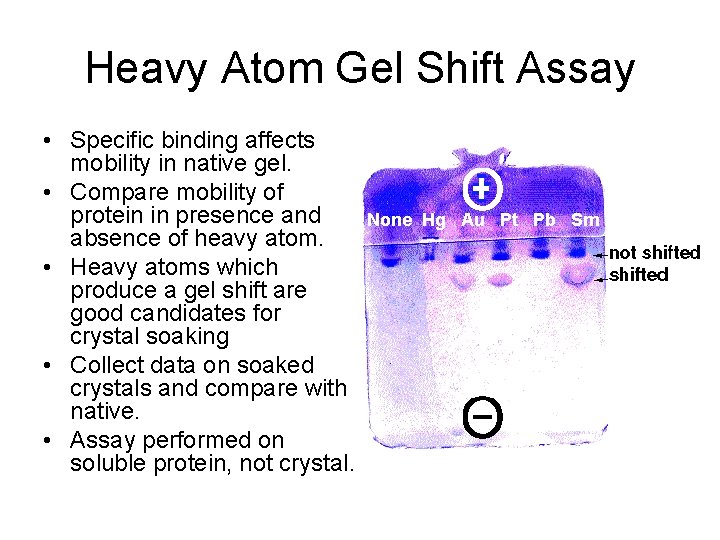
Heavy Atom Gel Shift Assay • Specific binding affects mobility in native gel. • Compare mobility of protein in presence and absence of heavy atom. • Heavy atoms which produce a gel shift are good candidates for crystal soaking • Collect data on soaked crystals and compare with native. • Assay performed on soluble protein, not crystal. None Hg Au Pt Pb Sm
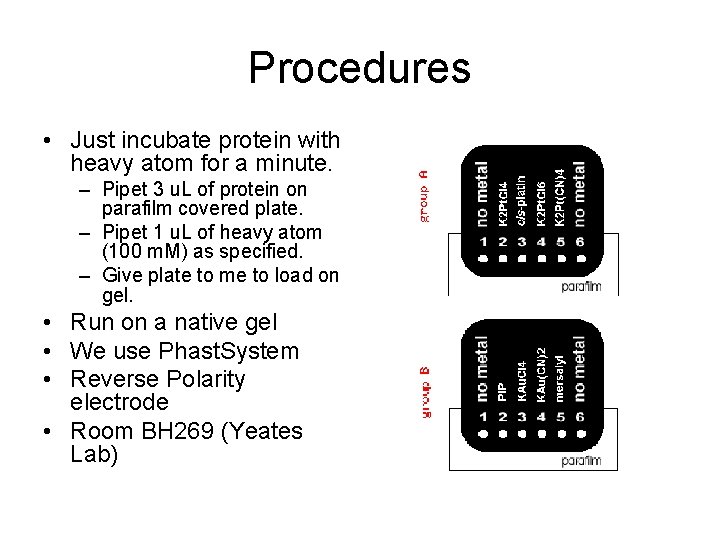
Procedures • Just incubate protein with heavy atom for a minute. – Pipet 3 u. L of protein on parafilm covered plate. – Pipet 1 u. L of heavy atom (100 m. M) as specified. – Give plate to me to load on gel. • Run on a native gel • We use Phast. System • Reverse Polarity electrode • Room BH 269 (Yeates Lab)
The details of the experiment.
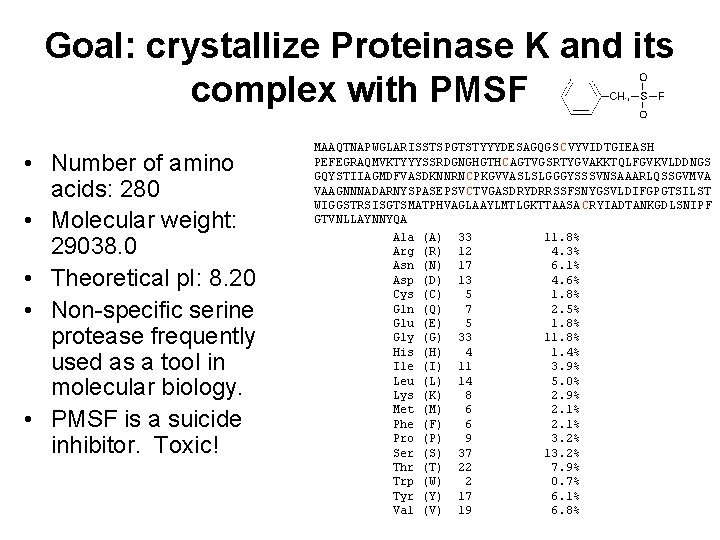
Goal: crystallize Proteinase K and its complex with PMSF • Number of amino acids: 280 • Molecular weight: 29038. 0 • Theoretical p. I: 8. 20 • Non-specific serine protease frequently used as a tool in molecular biology. • PMSF is a suicide inhibitor. Toxic! MAAQTNAPWGLARISSTSPGTSTYYYDESAGQGS CVYVIDTGIEASH PEFEGRAQMVKTYYYSSRDGNGHGTH CAGTVGSRTYGVAKKTQLFGVKVLDDNGS GQYSTIIAGMDFVASDKNNRNCPKGVVASLSLGGGYSSSVNSAAARLQSSGVMVA VAAGNNNADARNYSPASEPSVCTVGASDRYDRRSSFSNYGSVLDIFGPGTSILST WIGGSTRSISGTSMATPHVAGLAAYLMTLGKTTAASA CRYIADTANKGDLSNIPF GTVNLLAYNNYQA Ala (A) 33 11. 8% Arg (R) 12 4. 3% Asn (N) 17 6. 1% Asp (D) 13 4. 6% Cys (C) 5 1. 8% Gln (Q) 7 2. 5% Glu (E) 5 1. 8% Gly (G) 33 11. 8% His (H) 4 1. 4% Ile (I) 11 3. 9% Leu (L) 14 5. 0% Lys (K) 8 2. 9% Met (M) 6 2. 1% Phe (F) 6 2. 1% Pro (P) 9 3. 2% Ser (S) 37 13. 2% Thr (T) 22 7. 9% Trp (W) 2 0. 7% Tyr (Y) 17 6. 1% Val (V) 19 6. 8%
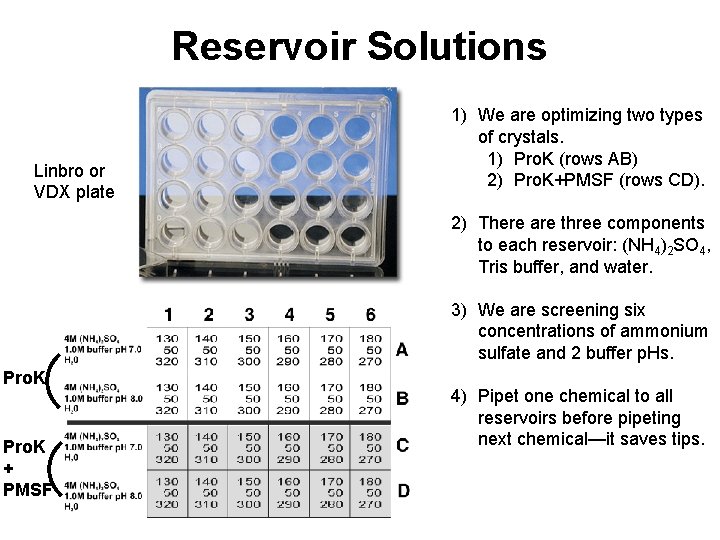
Reservoir Solutions Linbro or VDX plate 1) We are optimizing two types of crystals. 1) Pro. K (rows AB) 2) Pro. K+PMSF (rows CD). 2) There are three components to each reservoir: (NH 4)2 SO 4, Tris buffer, and water. ( ( Pro. K + PMSF 3) We are screening six concentrations of ammonium sulfate and 2 buffer p. Hs. 4) Pipet one chemical to all reservoirs before pipeting next chemical—it saves tips.
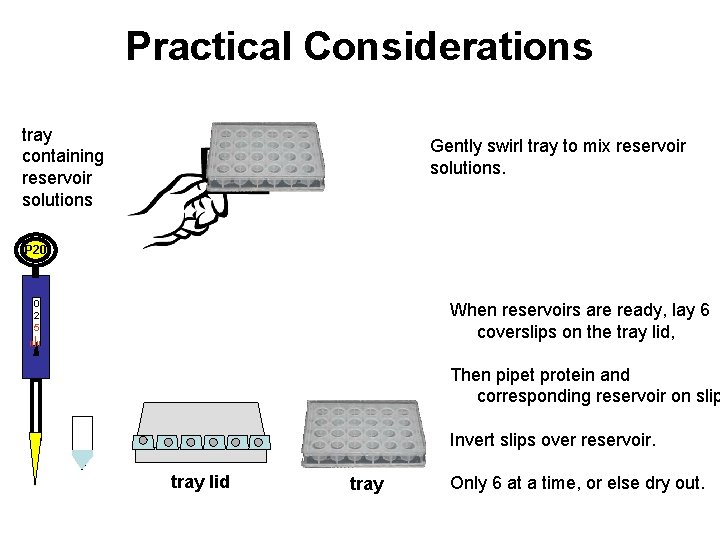
Practical Considerations tray containing reservoir solutions Gently swirl tray to mix reservoir solutions. P 20 0 2 5 When reservoirs are ready, lay 6 coverslips on the tray lid, | || || Then pipet protein and corresponding reservoir on slip Invert slips over reservoir. tray lid tray Only 6 at a time, or else dry out.
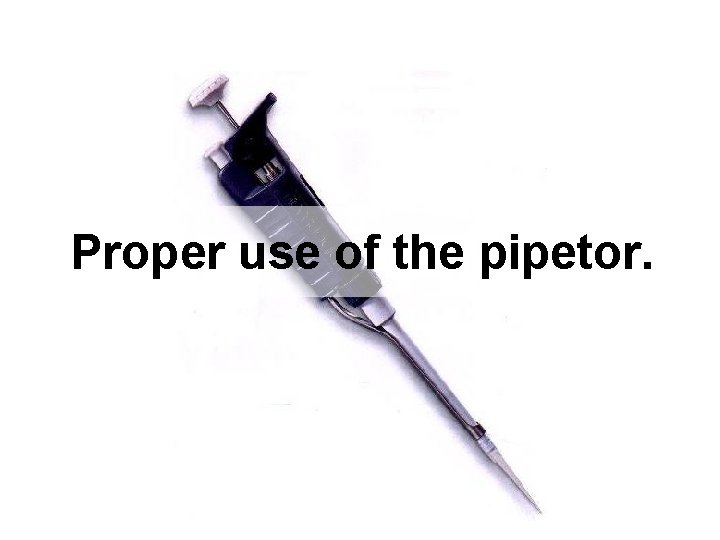
Proper use of the pipetor.
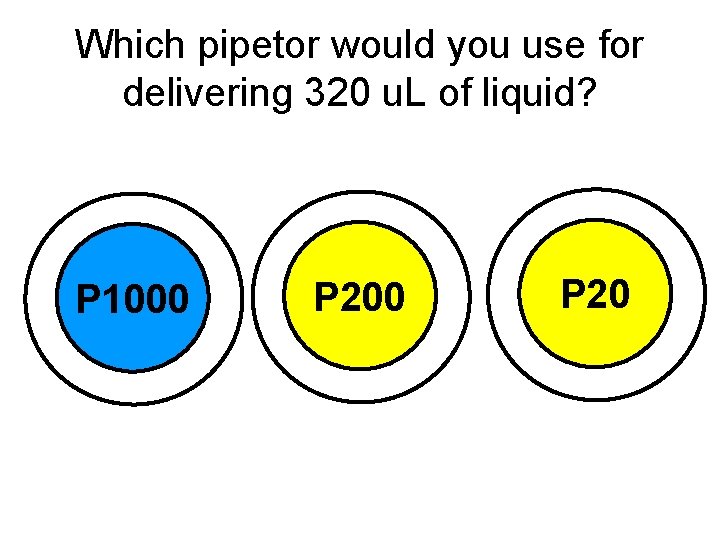
Which pipetor would you use for delivering 320 u. L of liquid? P 1000 P 20
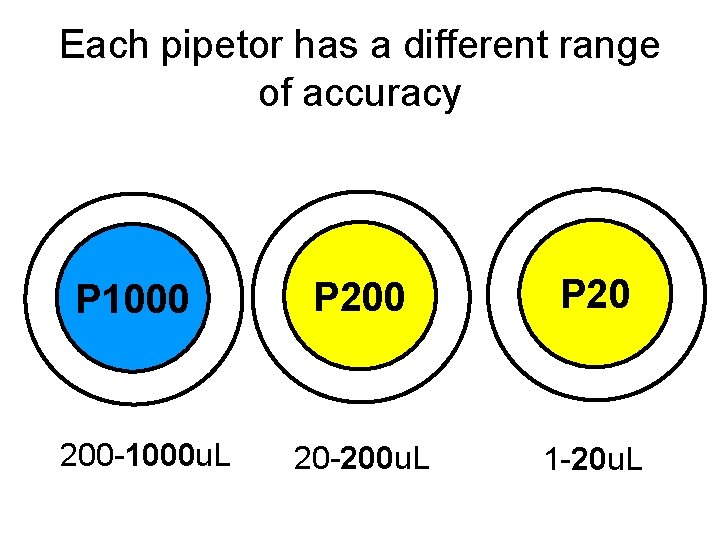
Each pipetor has a different range of accuracy P 1000 200 -1000 u. L P 200 P 20 20 -200 u. L 1 -20 u. L
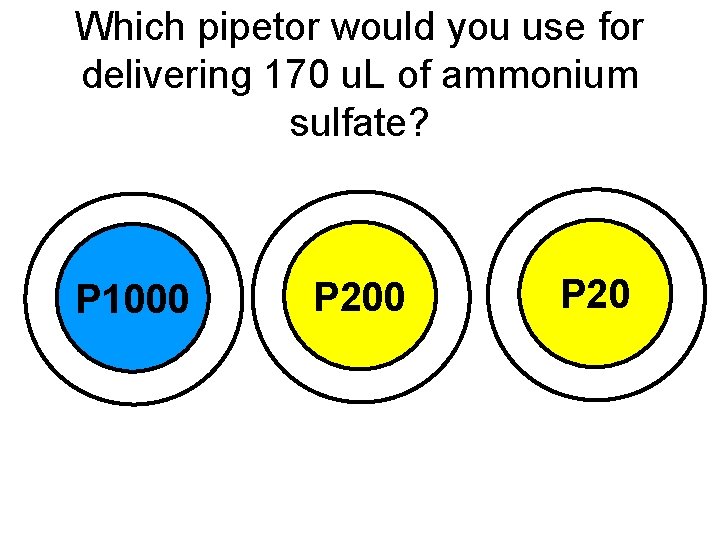
Which pipetor would you use for delivering 170 u. L of ammonium sulfate? P 1000 P 20
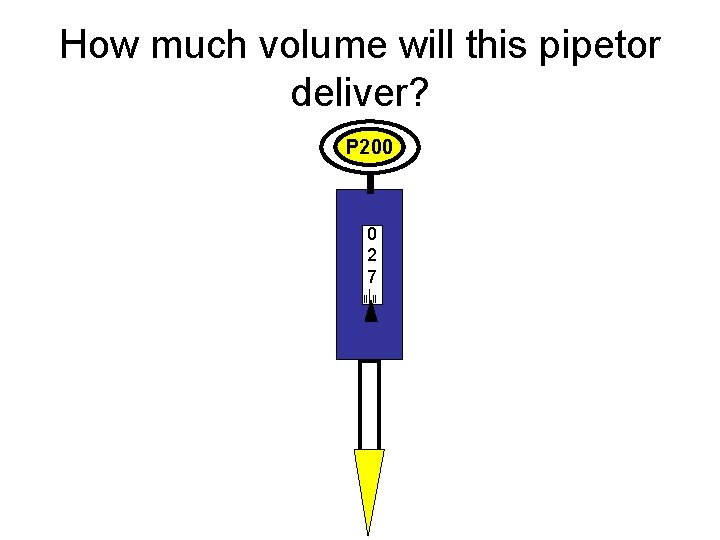
How much volume will this pipetor deliver? P 200 0 2 7 | || ||
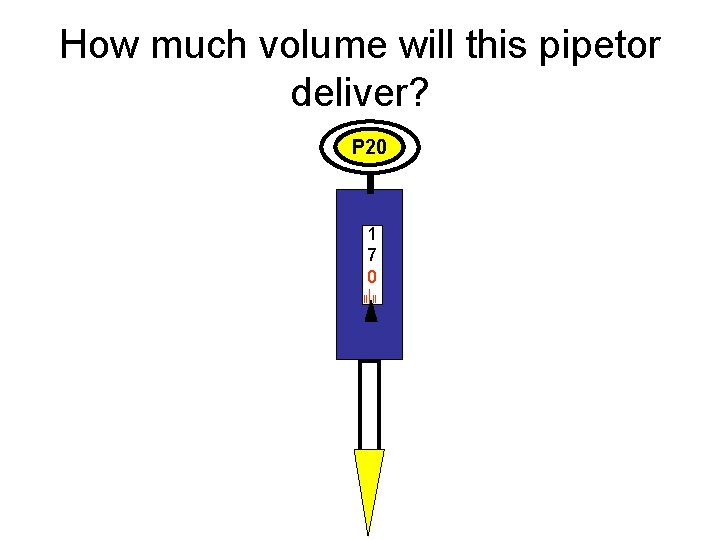
How much volume will this pipetor deliver? P 20 1 7 0 | || ||
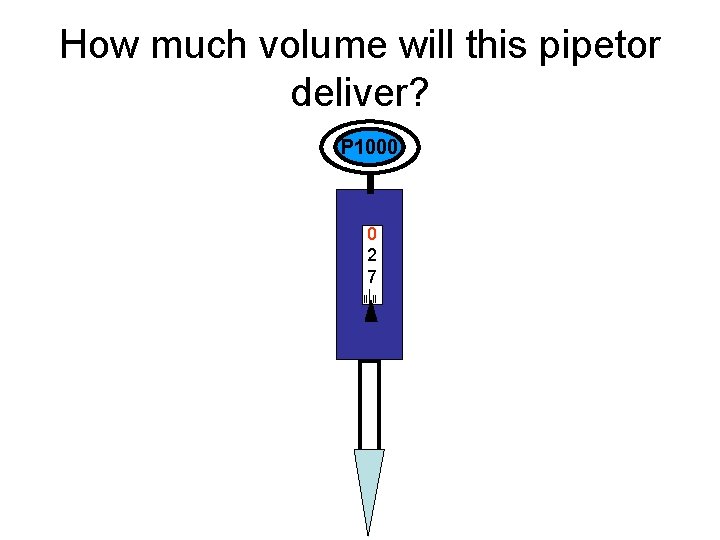
How much volume will this pipetor deliver? P 1000 0 2 7 | || ||
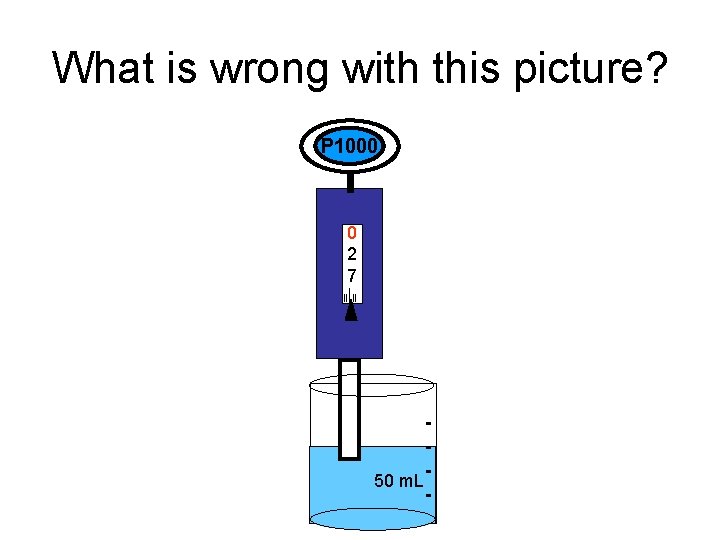
What is wrong with this picture? P 1000 0 2 7 | || || 50 m. L -
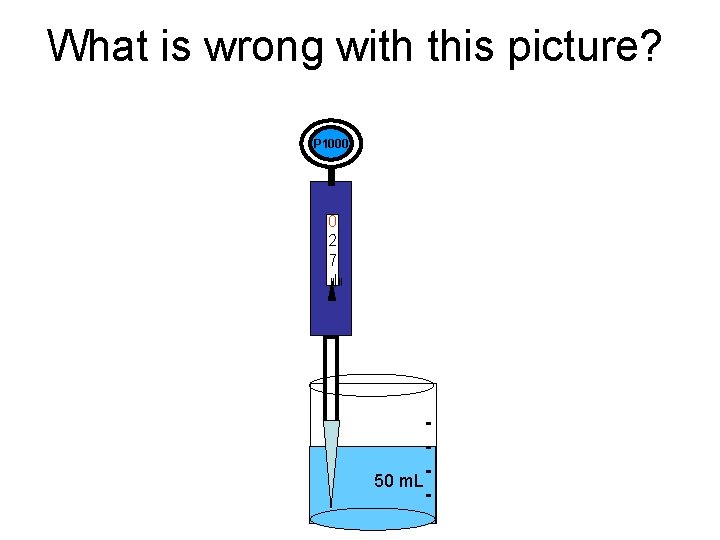
What is wrong with this picture? P 1000 0 2 7 | || || 50 m. L -
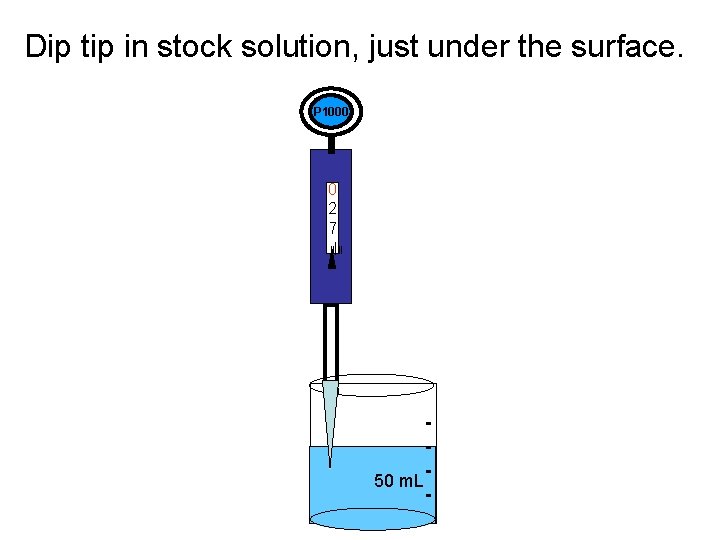
Dip tip in stock solution, just under the surface. P 1000 0 2 7 | || || 50 m. L -
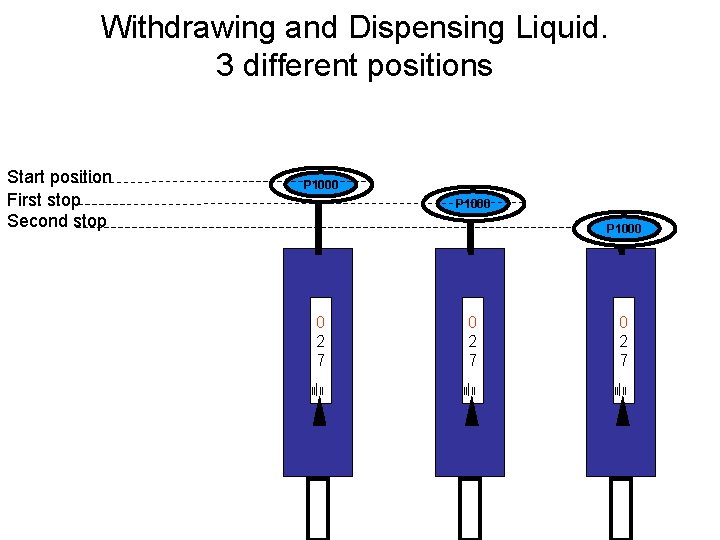
Withdrawing and Dispensing Liquid. 3 different positions Start position First stop Second stop P 1000 0 2 7 | || ||
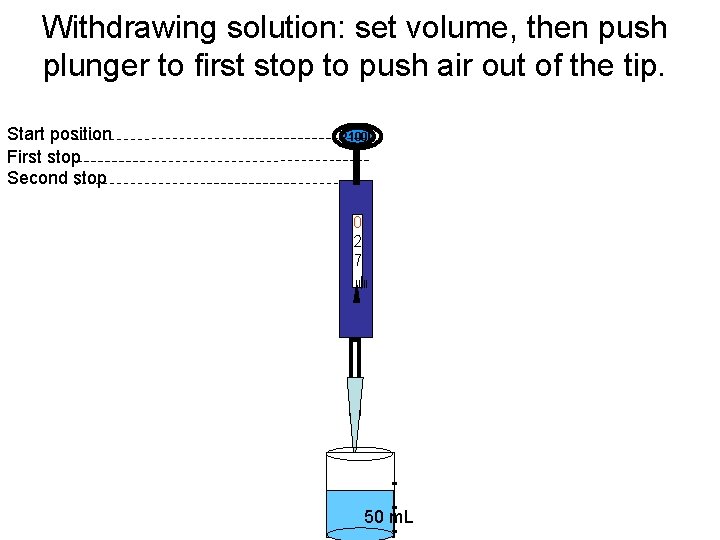
Withdrawing solution: set volume, then push plunger to first stop to push air out of the tip. Start position First stop Second stop P 1000 0 2 7 | || || 50 m. L -
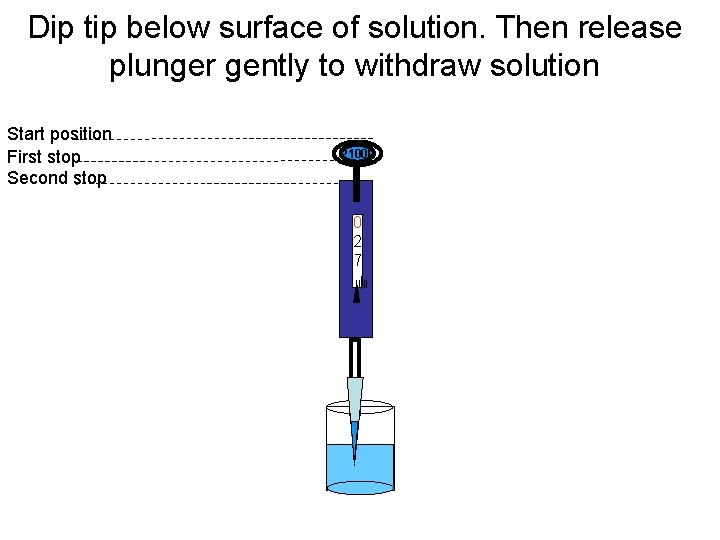
Dip tip below surface of solution. Then release plunger gently to withdraw solution Start position First stop Second stop P 1000 0 2 7 | || ||
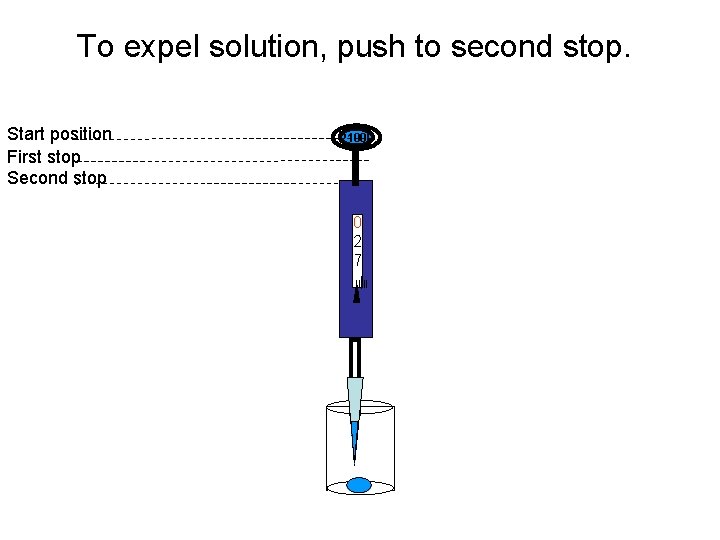
To expel solution, push to second stop. Start position First stop Second stop P 1000 0 2 7 | || ||
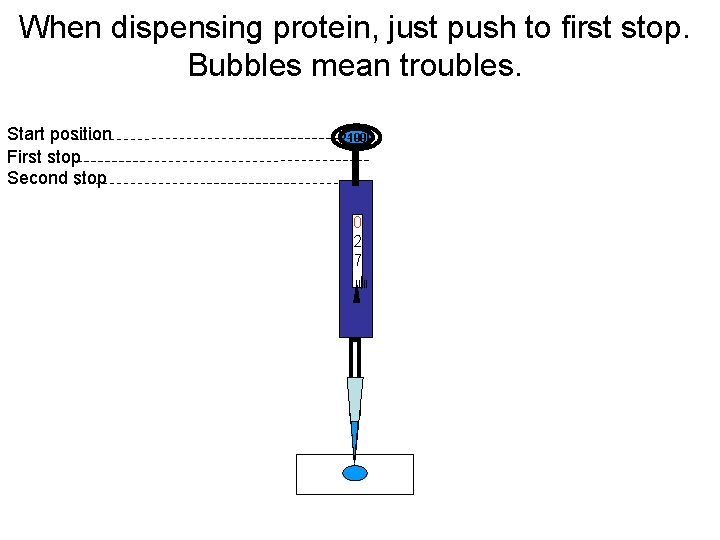
When dispensing protein, just push to first stop. Bubbles mean troubles. Start position First stop Second stop P 1000 0 2 7 | || ||
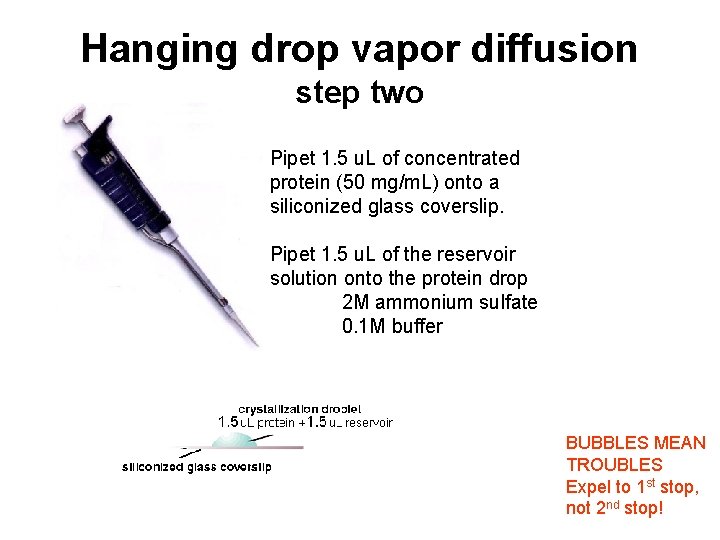
Hanging drop vapor diffusion step two Pipet 1. 5 u. L of concentrated protein (50 mg/m. L) onto a siliconized glass coverslip. Pipet 1. 5 u. L of the reservoir solution onto the protein drop 2 M ammonium sulfate 0. 1 M buffer BUBBLES MEAN TROUBLES Expel to 1 st stop, not 2 nd stop!
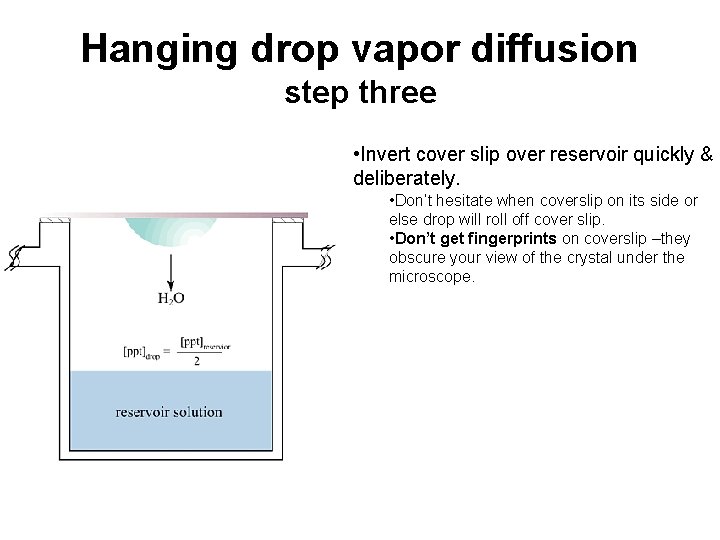
Hanging drop vapor diffusion step three • Invert cover slip over reservoir quickly & deliberately. • Don’t hesitate when coverslip on its side or else drop will roll off cover slip. • Don’t get fingerprints on coverslip –they obscure your view of the crystal under the microscope.
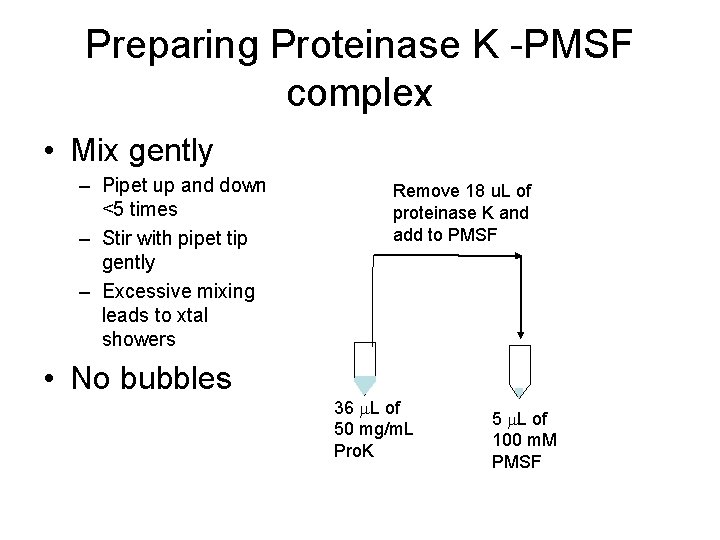
Preparing Proteinase K -PMSF complex • Mix gently – Pipet up and down <5 times – Stir with pipet tip gently – Excessive mixing leads to xtal showers • No bubbles Remove 18 u. L of proteinase K and add to PMSF 36 m. L of 50 mg/m. L Pro. K 5 m. L of 100 m. M PMSF
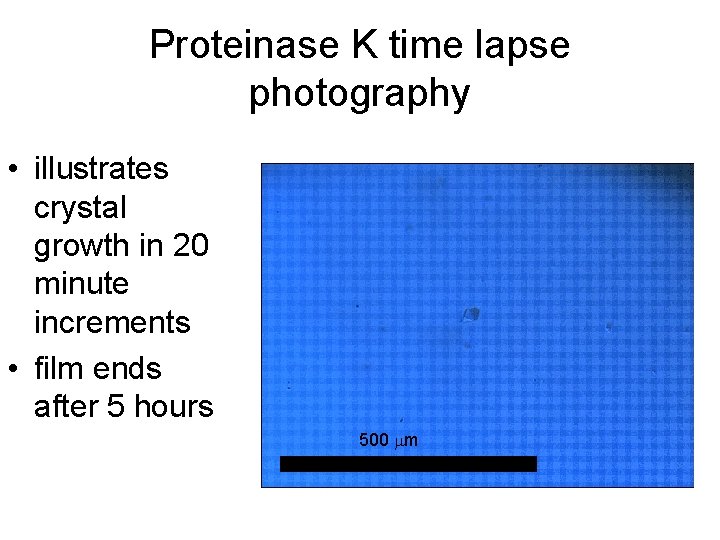
Proteinase K time lapse photography • illustrates crystal growth in 20 minute increments • film ends after 5 hours 500 mm
- Slides: 53