
Crystal SystemBased Twins 1 and 2 Dimensional Order
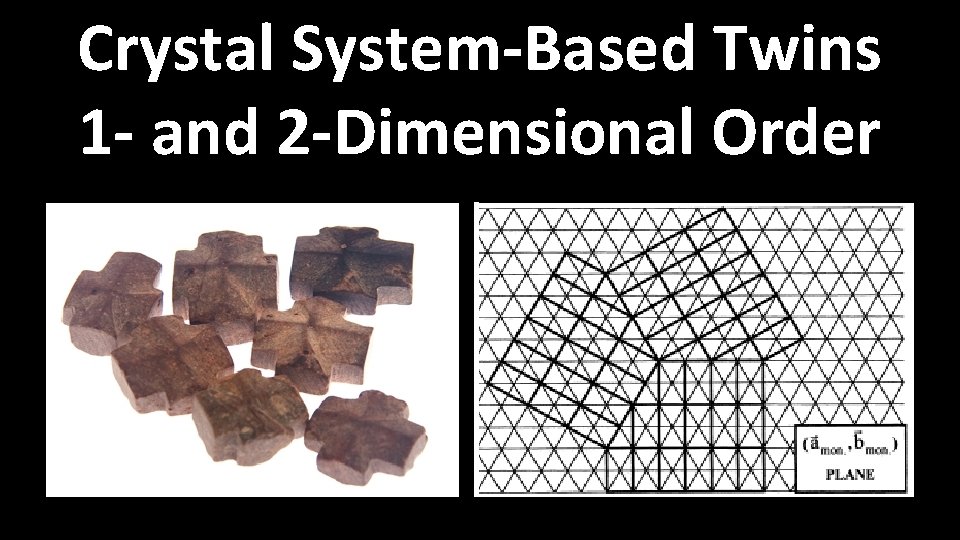
Crystal System-Based Twins 1 - and 2 -Dimensional Order
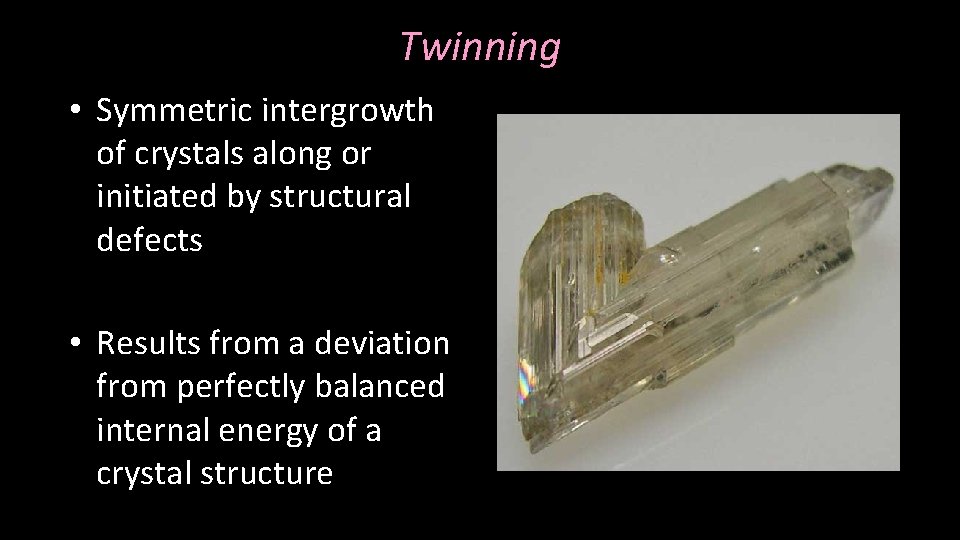
Twinning • Symmetric intergrowth of crystals along or initiated by structural defects • Results from a deviation from perfectly balanced internal energy of a crystal structure
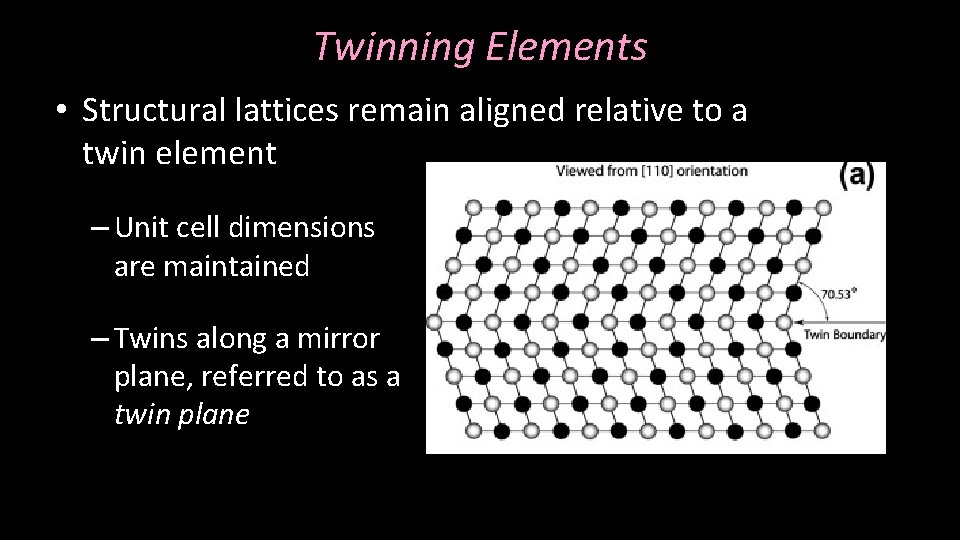
Twinning Elements • Structural lattices remain aligned relative to a twin element – Unit cell dimensions are maintained – Twins along a mirror plane, referred to as a twin plane
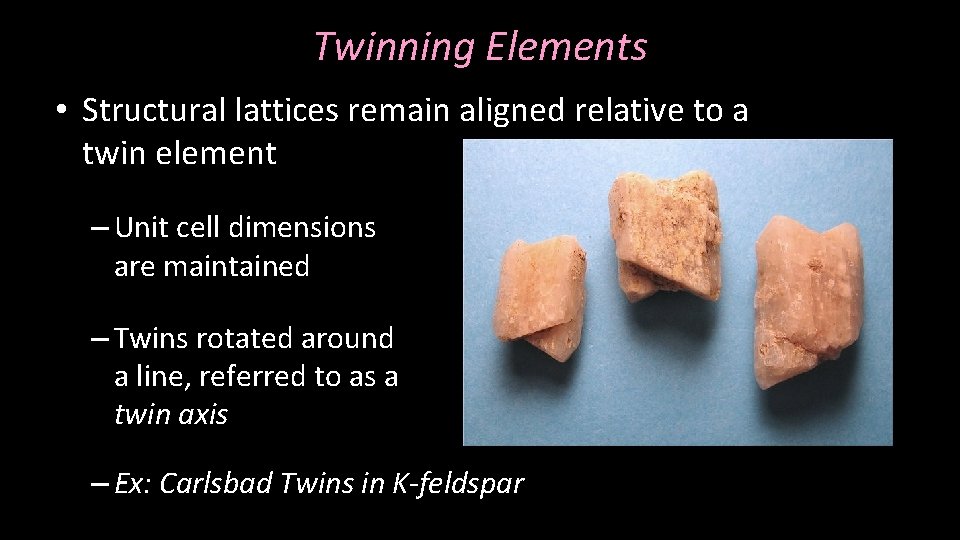
Twinning Elements • Structural lattices remain aligned relative to a twin element – Unit cell dimensions are maintained – Twins rotated around a line, referred to as a twin axis – Ex: Carlsbad Twins in K-feldspar

Twinning Elements • Structural lattices remain aligned relative to a twin element – Unit cell dimensions are maintained – Twins rotated around a point, referred to as a twin center – Ex: Penetration Twins in pyrite
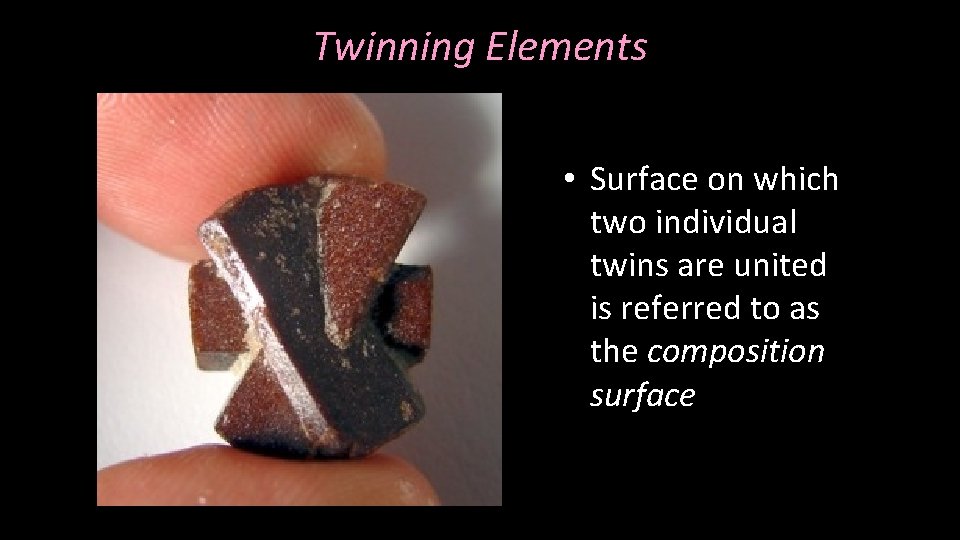
Twinning Elements • Surface on which two individual twins are united is referred to as the composition surface
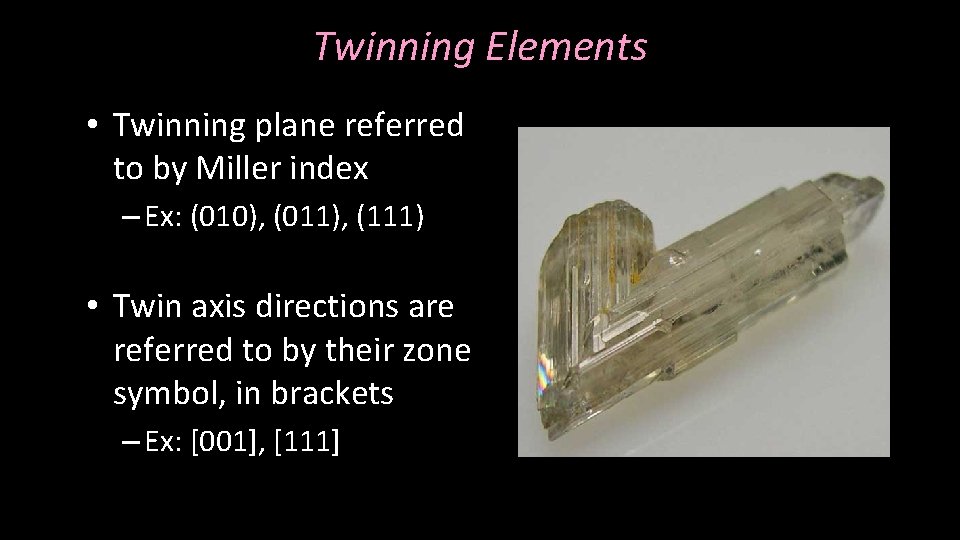
Twinning Elements • Twinning plane referred to by Miller index – Ex: (010), (011), (111) • Twin axis directions are referred to by their zone symbol, in brackets – Ex: [001], [111]
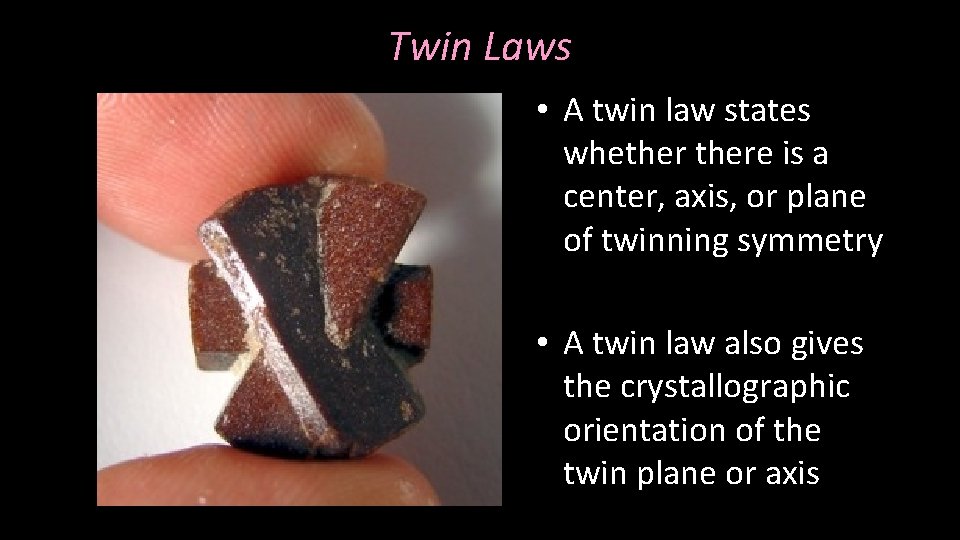
Twin Laws • A twin law states whethere is a center, axis, or plane of twinning symmetry • A twin law also gives the crystallographic orientation of the twin plane or axis
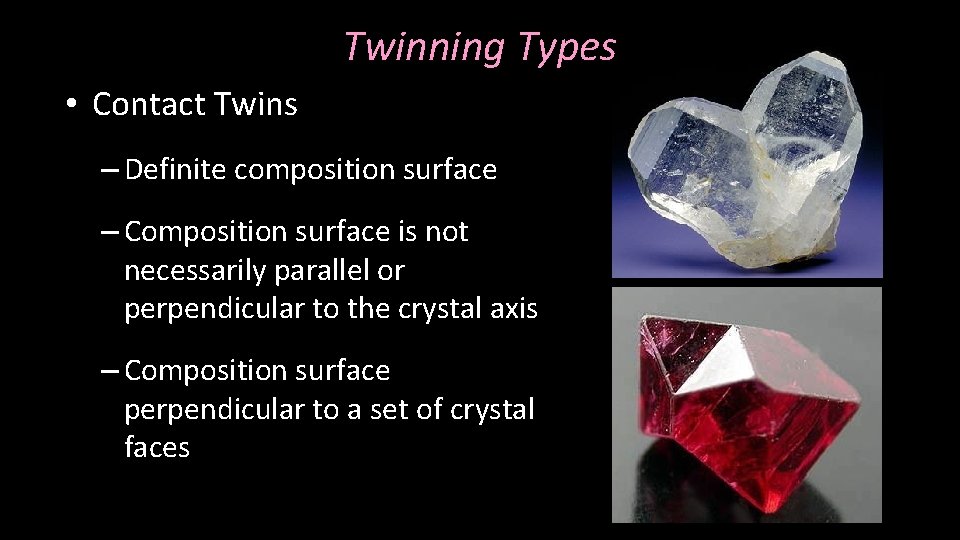
Twinning Types • Contact Twins – Definite composition surface – Composition surface is not necessarily parallel or perpendicular to the crystal axis – Composition surface perpendicular to a set of crystal faces
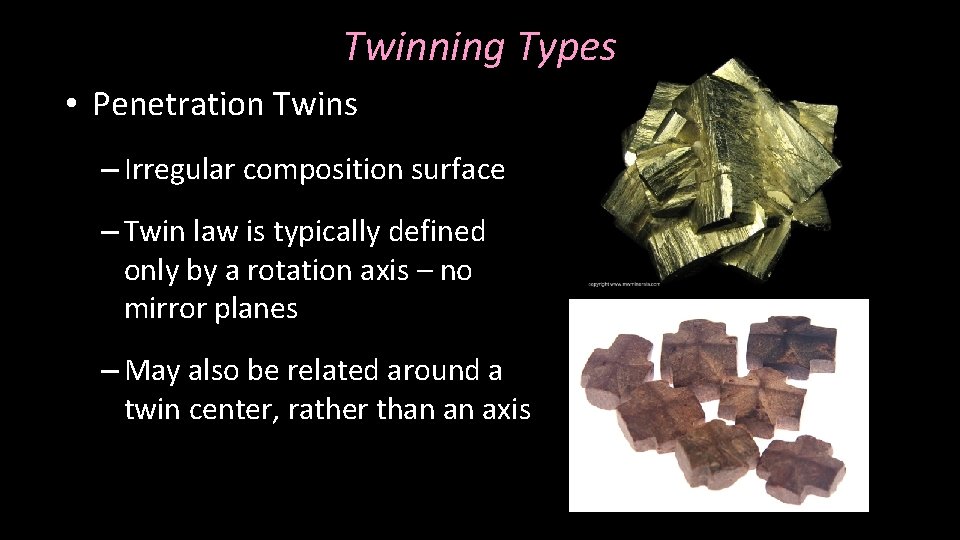
Twinning Types • Penetration Twins – Irregular composition surface – Twin law is typically defined only by a rotation axis – no mirror planes – May also be related around a twin center, rather than an axis
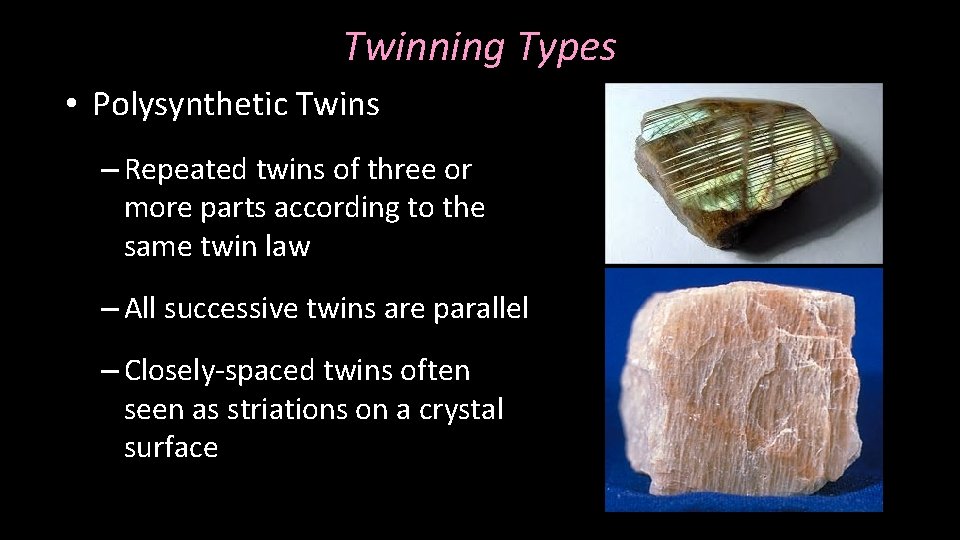
Twinning Types • Polysynthetic Twins – Repeated twins of three or more parts according to the same twin law – All successive twins are parallel – Closely-spaced twins often seen as striations on a crystal surface
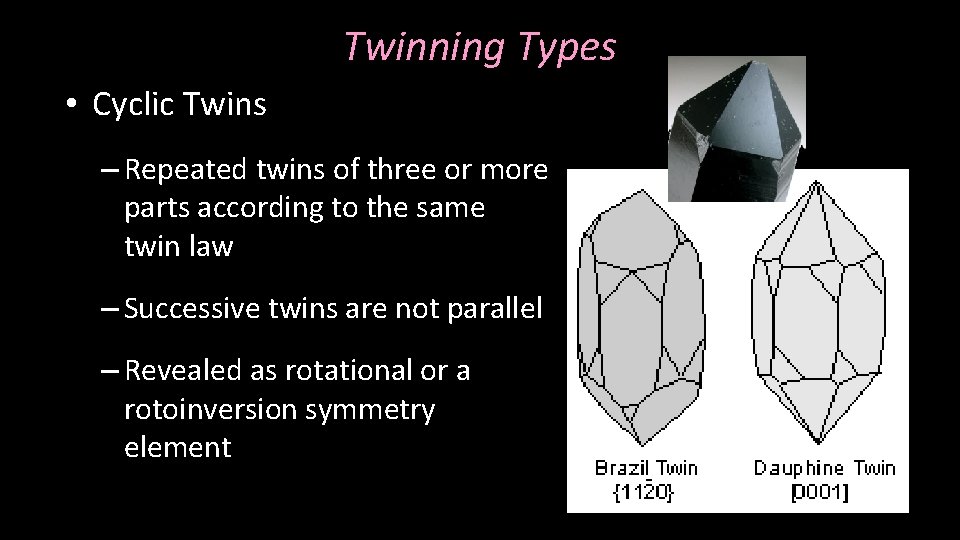
Twinning Types • Cyclic Twins – Repeated twins of three or more parts according to the same twin law – Successive twins are not parallel – Revealed as rotational or a rotoinversion symmetry element
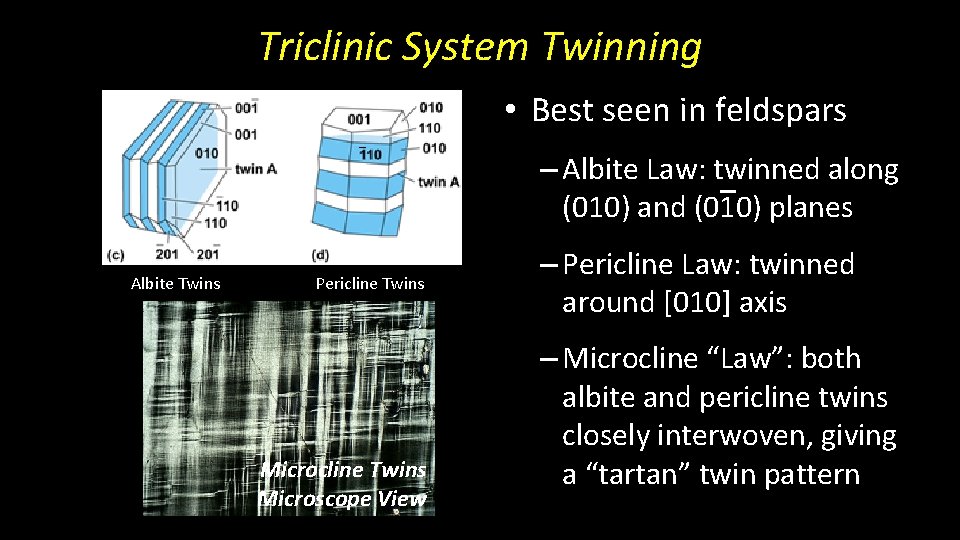
Triclinic System Twinning • Best seen in feldspars – Albite Law: twinned along (010) and (010) planes Albite Twins Pericline Twins Microscope View – Pericline Law: twinned around [010] axis – Microcline “Law”: both albite and pericline twins closely interwoven, giving a “tartan” twin pattern
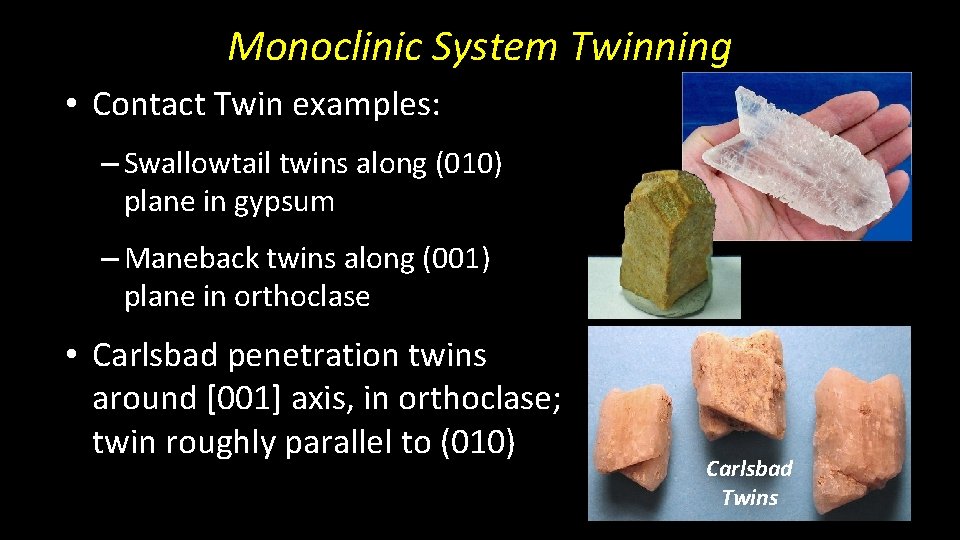
Monoclinic System Twinning • Contact Twin examples: – Swallowtail twins along (010) plane in gypsum – Maneback twins along (001) plane in orthoclase • Carlsbad penetration twins around [001] axis, in orthoclase; twin roughly parallel to (010) Carlsbad Twins
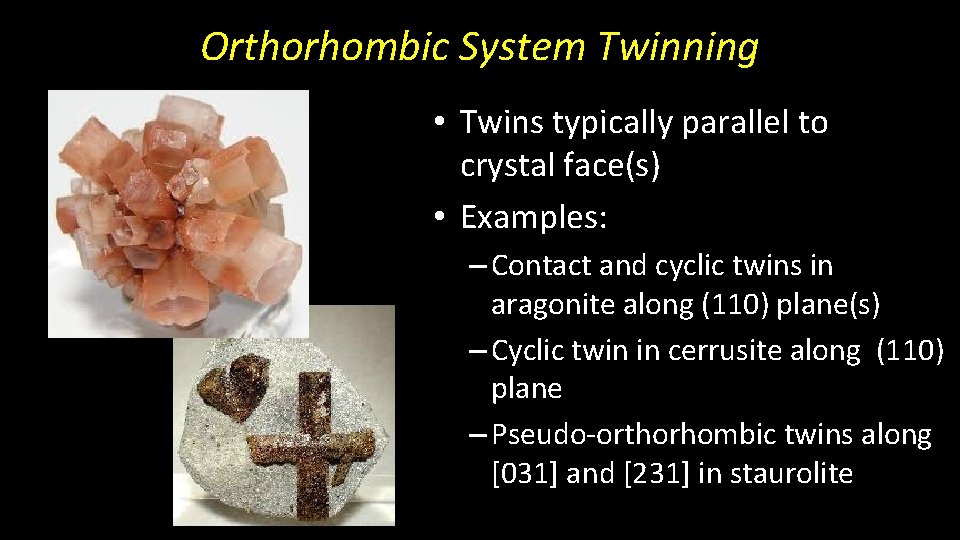
Orthorhombic System Twinning • Twins typically parallel to crystal face(s) • Examples: – Contact and cyclic twins in aragonite along (110) plane(s) – Cyclic twin in cerrusite along (110) plane – Pseudo-orthorhombic twins along [031] and [231] in staurolite
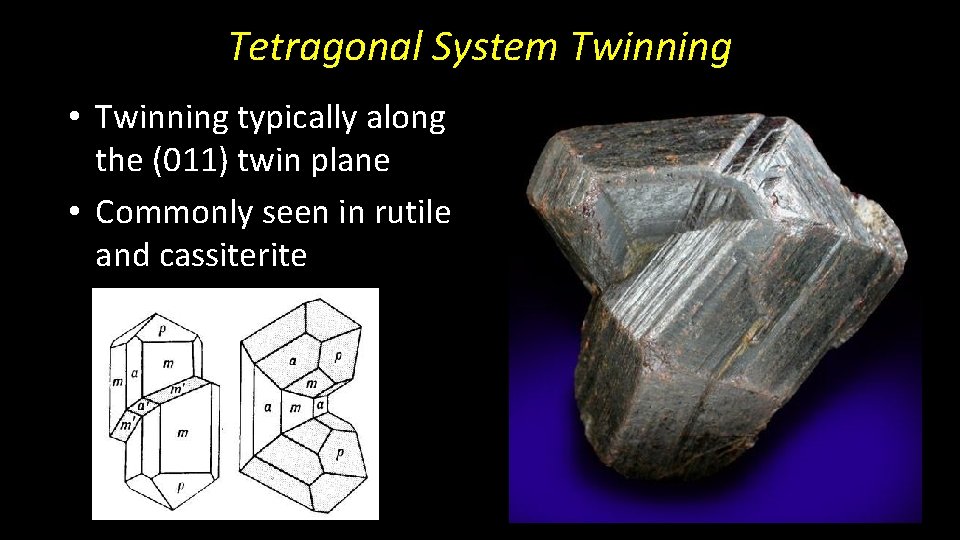
Tetragonal System Twinning • Twinning typically along the (011) twin plane • Commonly seen in rutile and cassiterite
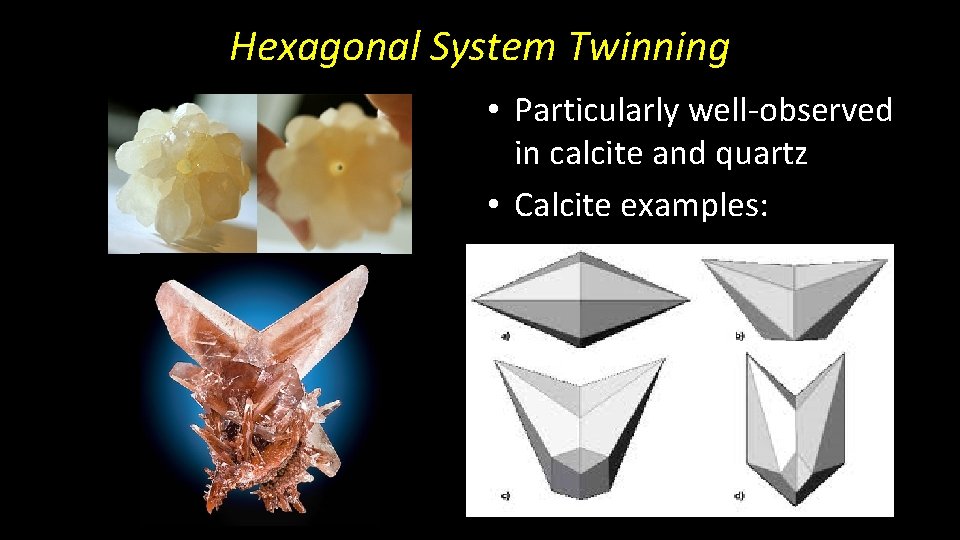
Hexagonal System Twinning • Particularly well-observed in calcite and quartz • Calcite examples:
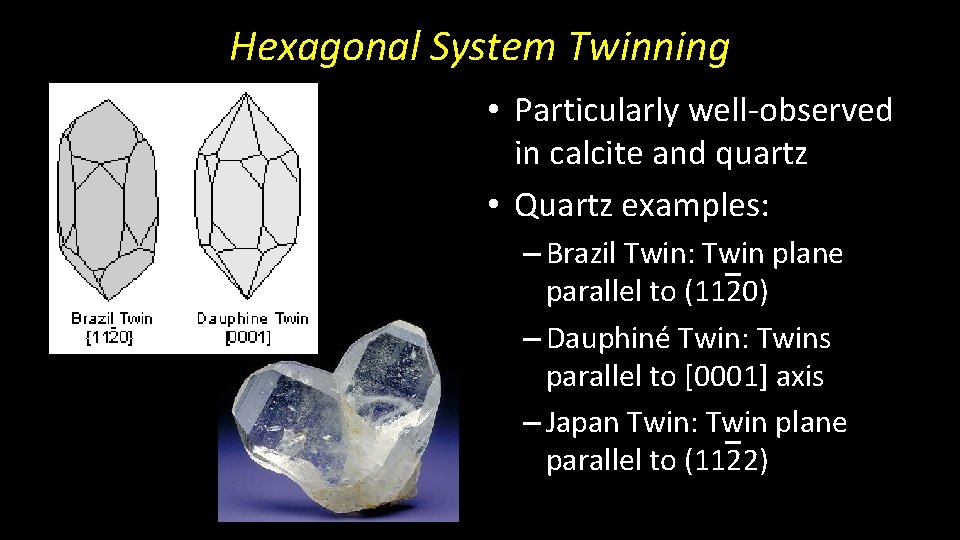
Hexagonal System Twinning • Particularly well-observed in calcite and quartz • Quartz examples: – Brazil Twin: Twin plane parallel to (1120) – Dauphiné Twin: Twins parallel to [0001] axis – Japan Twin: Twin plane parallel to (1122)
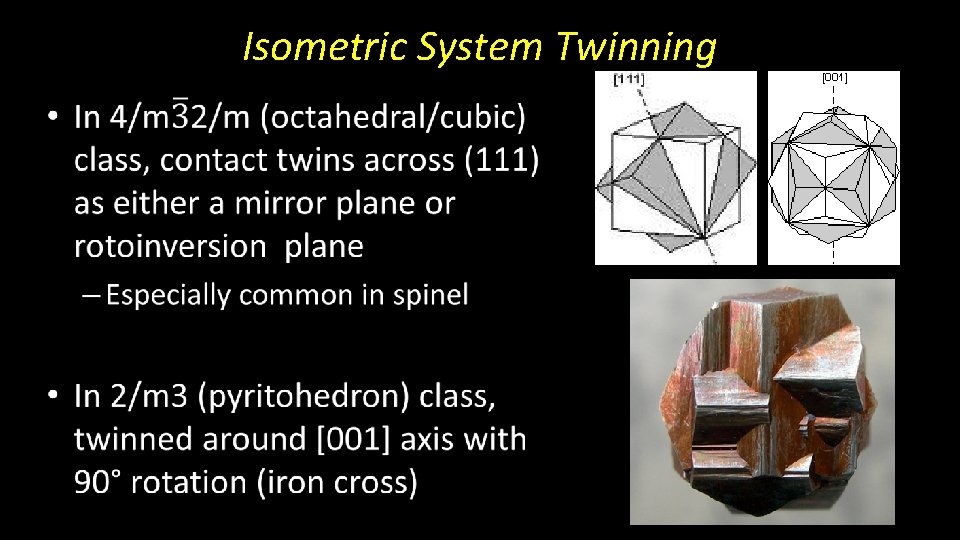
Isometric System Twinning •
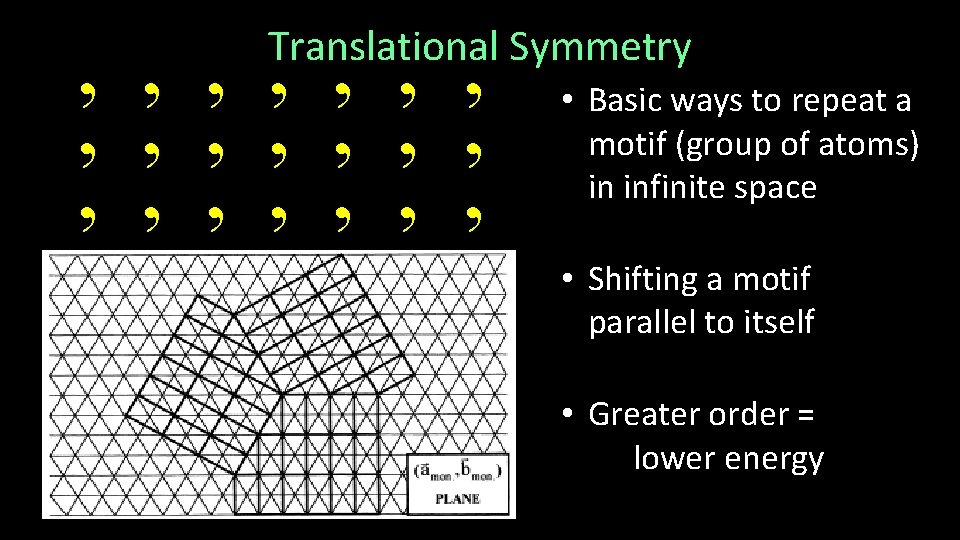
Translational Symmetry ’’’’’’’ • Basic ways to repeat a motif (group of atoms) in infinite space • Shifting a motif parallel to itself • Greater order = lower energy
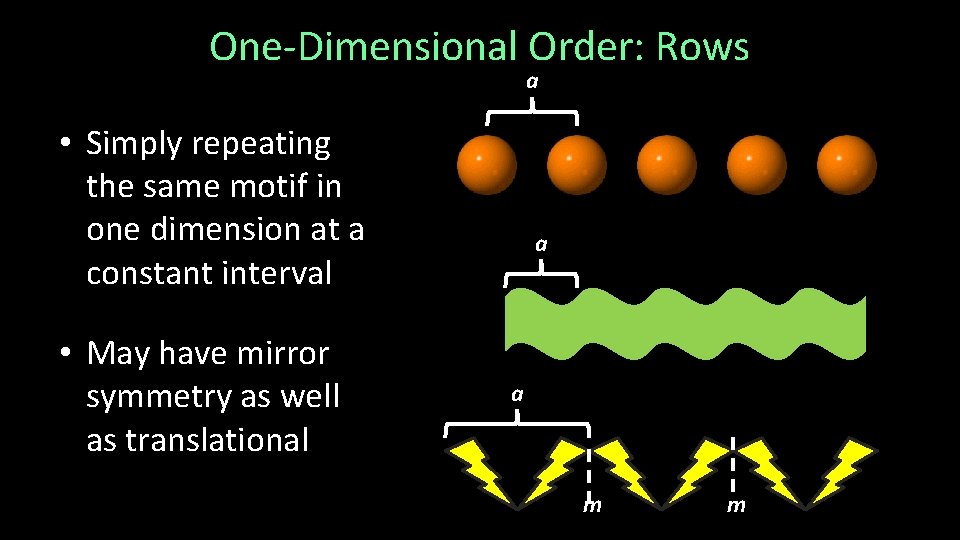
One-Dimensional Order: Rows a • Simply repeating the same motif in one dimension at a constant interval • May have mirror symmetry as well as translational a a m m
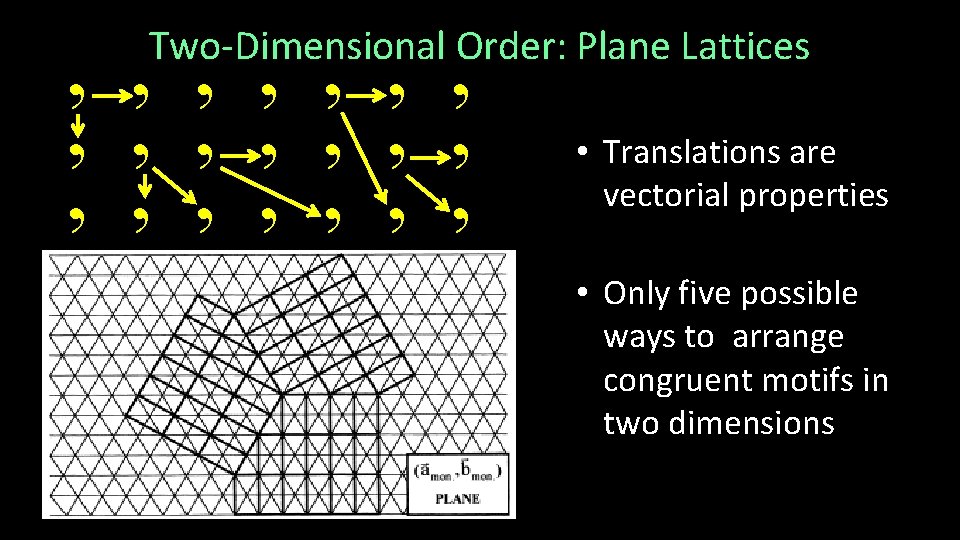
Two-Dimensional Order: Plane Lattices ’’’’’’’ • Translations are vectorial properties • Only five possible ways to arrange congruent motifs in two dimensions
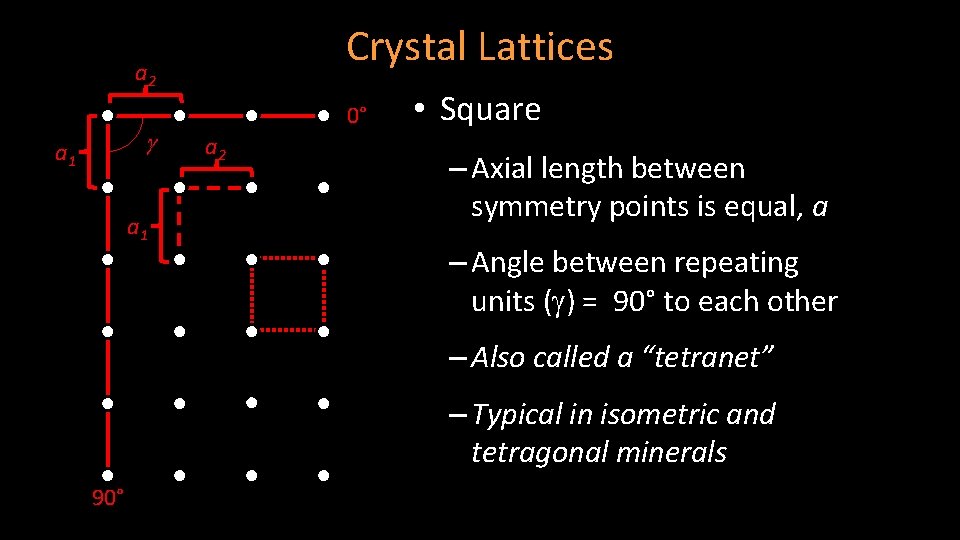
Crystal Lattices a 2 g a 1 0° a 2 • Square – Axial length between symmetry points is equal, a – Angle between repeating units (g) = 90° to each other – Also called a “tetranet” – Typical in isometric and tetragonal minerals 90°
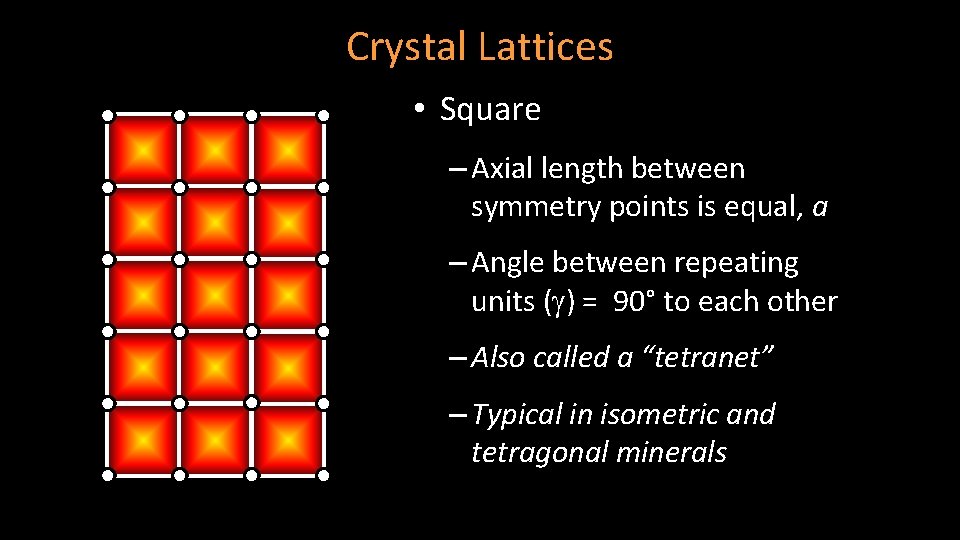
Crystal Lattices • Square – Axial length between symmetry points is equal, a – Angle between repeating units (g) = 90° to each other – Also called a “tetranet” – Typical in isometric and tetragonal minerals
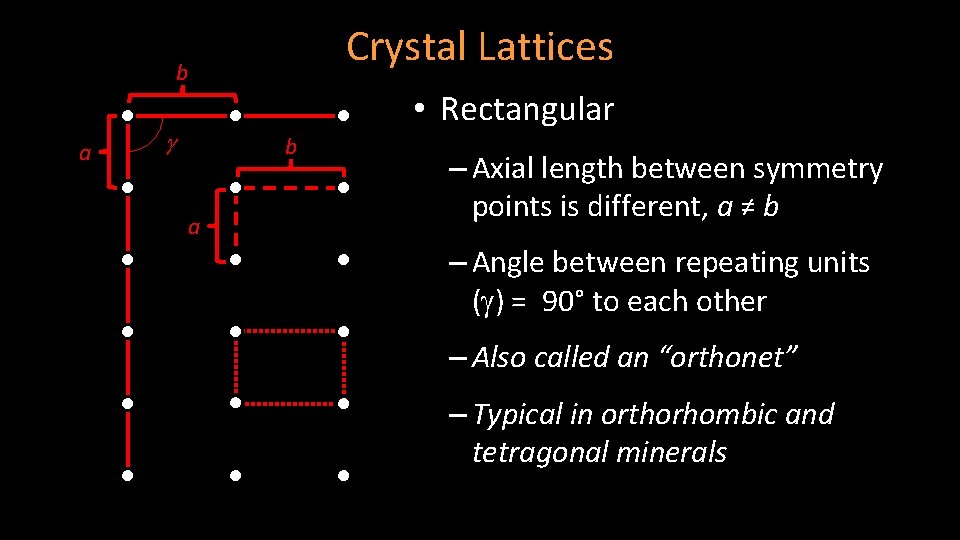
Crystal Lattices b a g • Rectangular b a – Axial length between symmetry points is different, a ≠ b – Angle between repeating units (g) = 90° to each other – Also called an “orthonet” – Typical in orthorhombic and tetragonal minerals
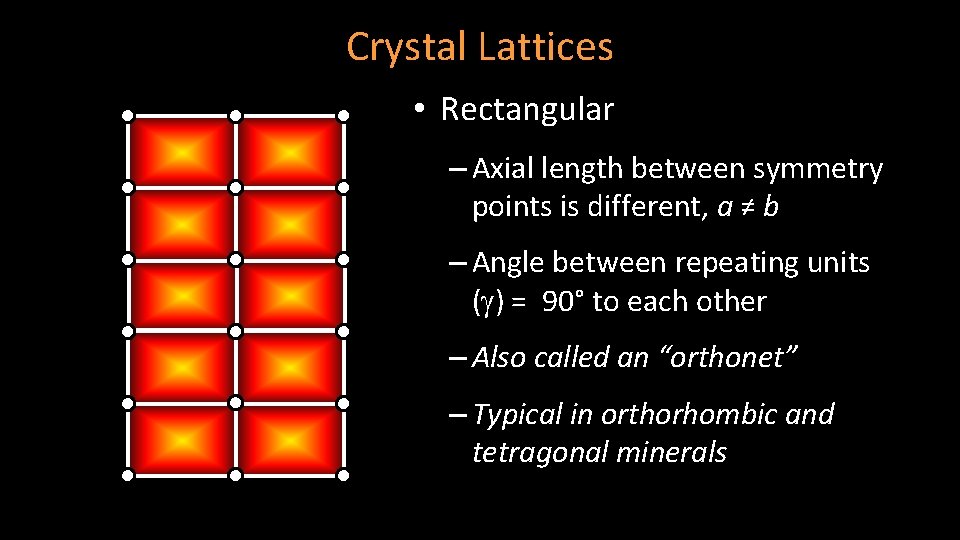
Crystal Lattices • Rectangular – Axial length between symmetry points is different, a ≠ b – Angle between repeating units (g) = 90° to each other – Also called an “orthonet” – Typical in orthorhombic and tetragonal minerals
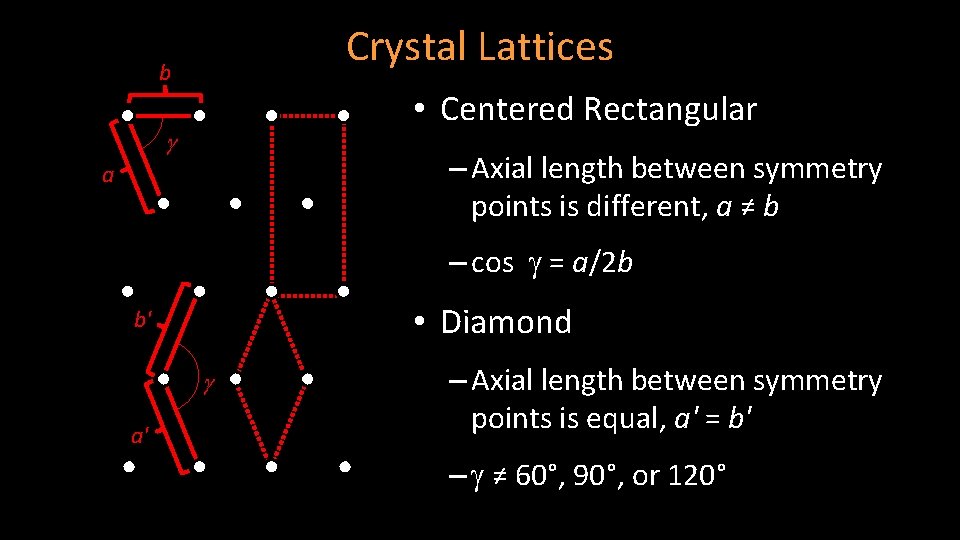
Crystal Lattices b • Centered Rectangular g – Axial length between symmetry points is different, a ≠ b a – cos g = a/2 b • Diamond b' g a' – Axial length between symmetry points is equal, a' = b' – g ≠ 60°, 90°, or 120°
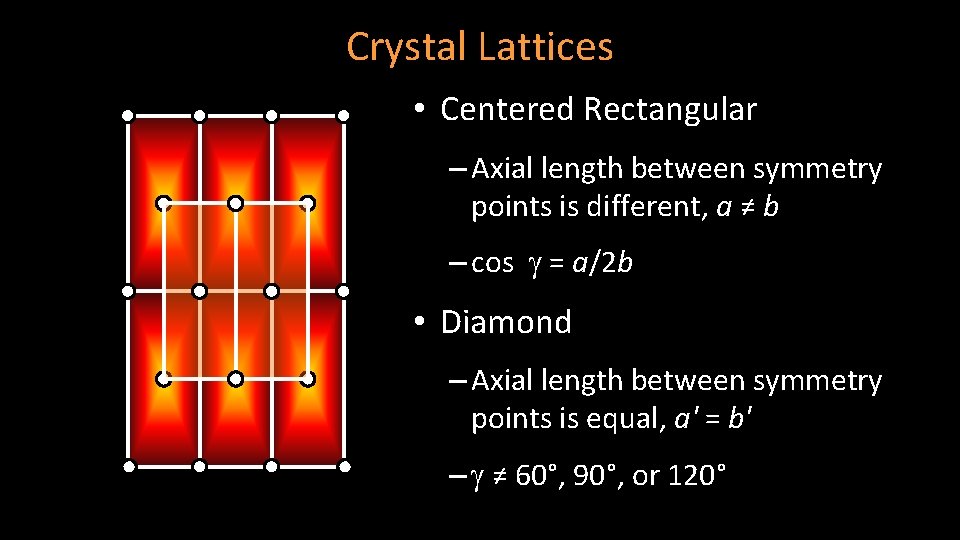
Crystal Lattices • Centered Rectangular – Axial length between symmetry points is different, a ≠ b – cos g = a/2 b • Diamond – Axial length between symmetry points is equal, a' = b' – g ≠ 60°, 90°, or 120°
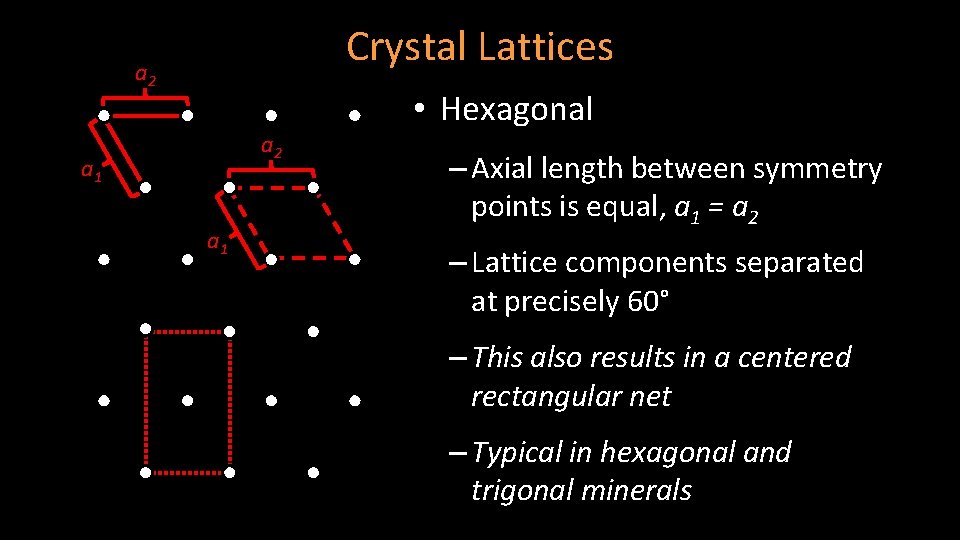
Crystal Lattices a 2 a 1 • Hexagonal – Axial length between symmetry points is equal, a 1 = a 2 – Lattice components separated at precisely 60° – This also results in a centered rectangular net – Typical in hexagonal and trigonal minerals
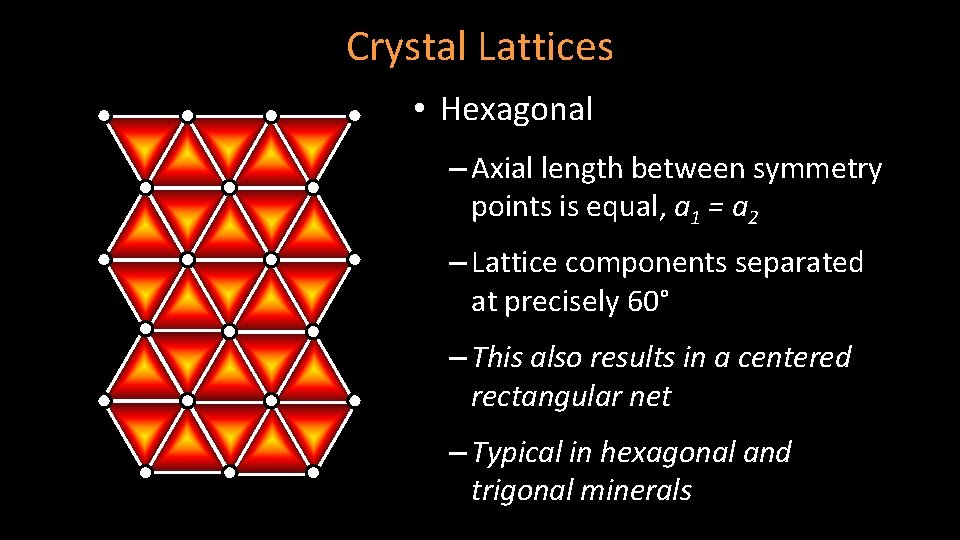
Crystal Lattices • Hexagonal – Axial length between symmetry points is equal, a 1 = a 2 – Lattice components separated at precisely 60° – This also results in a centered rectangular net – Typical in hexagonal and trigonal minerals
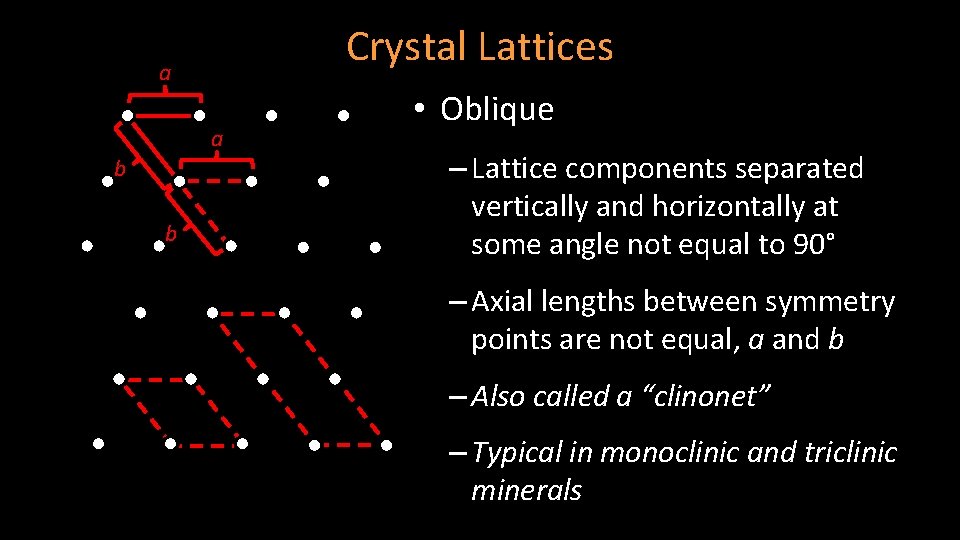
Crystal Lattices a a b b • Oblique – Lattice components separated vertically and horizontally at some angle not equal to 90° – Axial lengths between symmetry points are not equal, a and b – Also called a “clinonet” – Typical in monoclinic and triclinic minerals
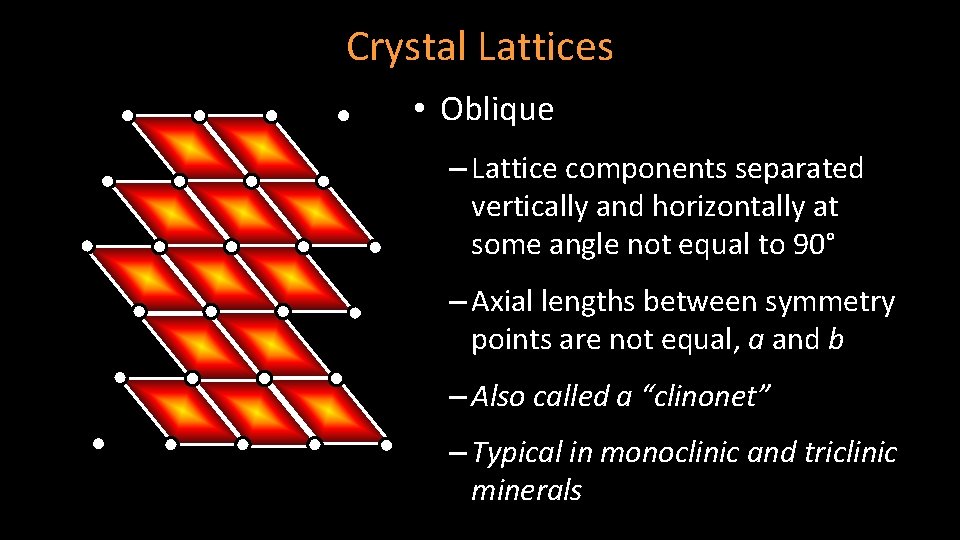
Crystal Lattices • Oblique – Lattice components separated vertically and horizontally at some angle not equal to 90° – Axial lengths between symmetry points are not equal, a and b – Also called a “clinonet” – Typical in monoclinic and triclinic minerals
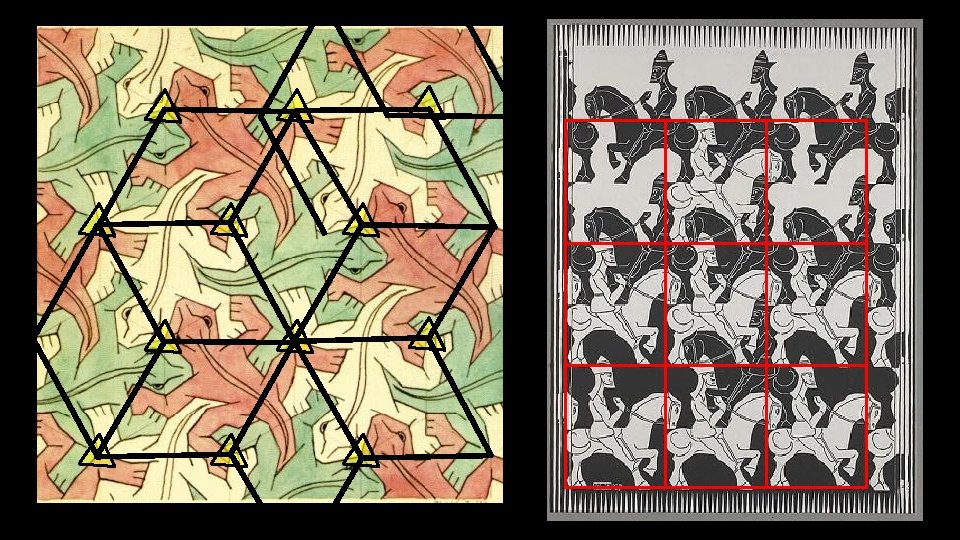
Tesselations • Two dimensional coverings using a lattice or net repeated by translation and/or rotation and/or mirror planes • These five just discussed are the only ones possible for a simple, translational tessellation • Patterns of rotation axes and mirrors are expressed in twodimensional Plane Groups, to be covered in the next lecture
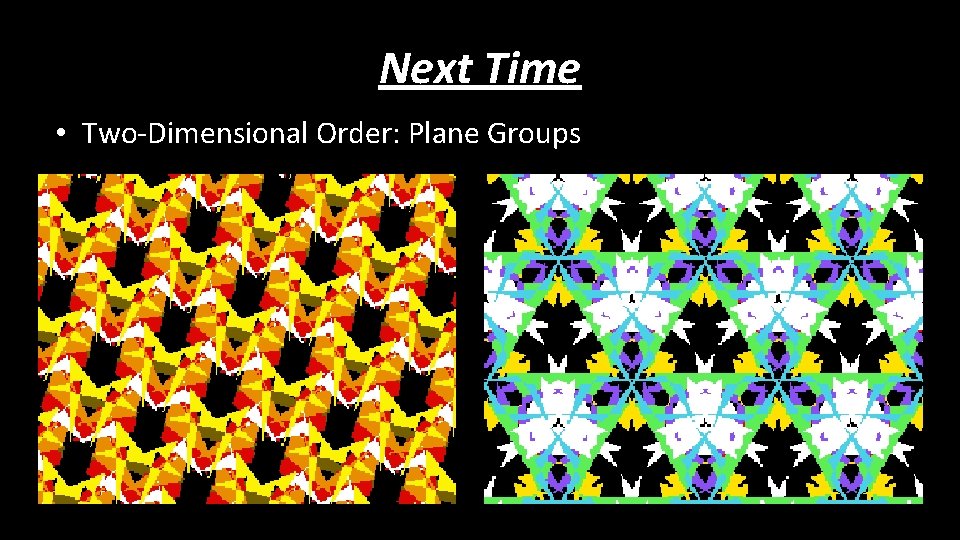
Next Time • Two-Dimensional Order: Plane Groups
- Slides: 35