
CRYSTAL STRUCTURES The SolidState Structure of Metals and
- Slides: 12
CRYSTAL STRUCTURES The Solid-State Structure of Metals and Ionic Compounds
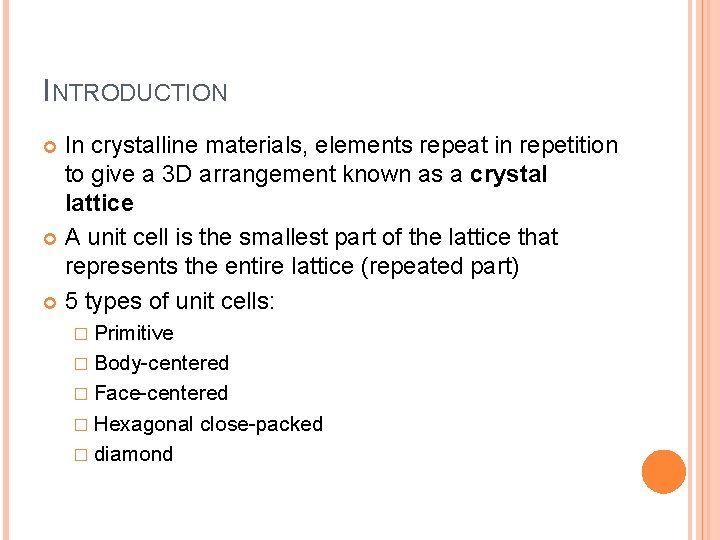
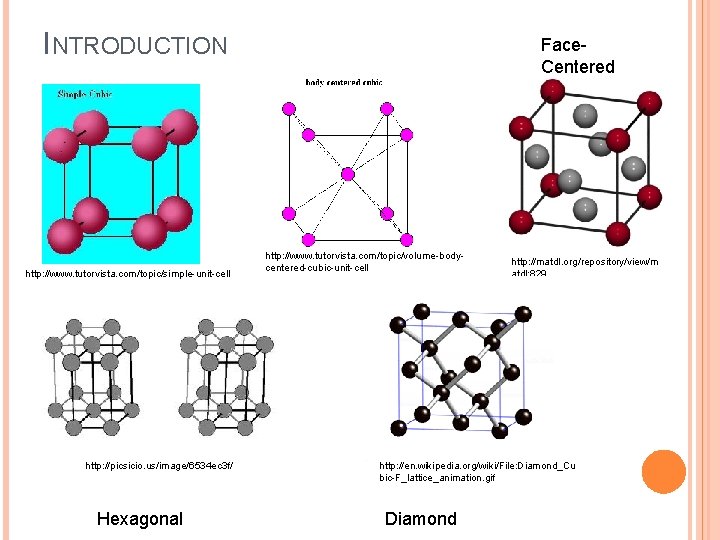
INTRODUCTION In crystalline materials, elements repeat in repetition to give a 3 D arrangement known as a crystal lattice A unit cell is the smallest part of the lattice that represents the entire lattice (repeated part) 5 types of unit cells: � Primitive � Body-centered � Face-centered � Hexagonal � diamond close-packed
INTRODUCTION http: //www. tutorvista. com/topic/simple-unit-cell http: //picsicio. us/image/6534 ec 3 f/ Hexagonal Face. Centered http: //www. tutorvista. com/topic/volume-bodycentered-cubic-unit-cell http: //matdl. org/repository/view/m atdl: 829 http: //en. wikipedia. org/wiki/File: Diamond_Cu bic-F_lattice_animation. gif Diamond
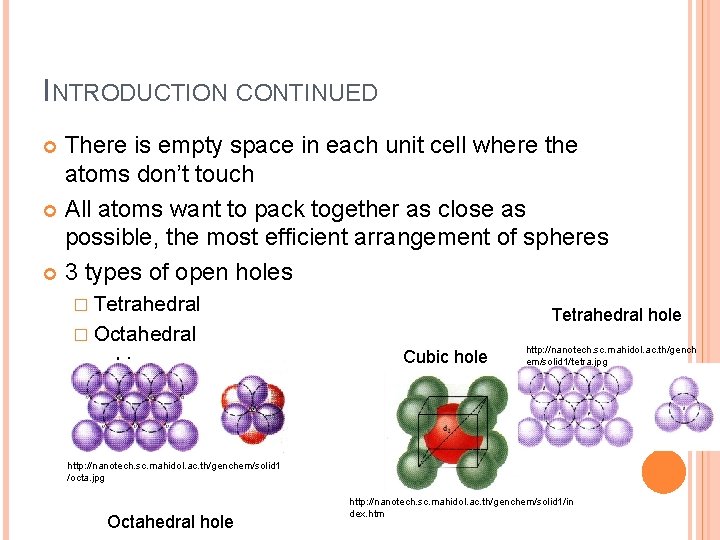
INTRODUCTION CONTINUED There is empty space in each unit cell where the atoms don’t touch All atoms want to pack together as close as possible, the most efficient arrangement of spheres 3 types of open holes � Tetrahedral hole � Octahedral � cubic Cubic hole http: //nanotech. sc. mahidol. ac. th/gench em/solid 1/tetra. jpg http: //nanotech. sc. mahidol. ac. th/genchem/solid 1 /octa. jpg Octahedral hole http: //nanotech. sc. mahidol. ac. th/genchem/solid 1/in dex. htm
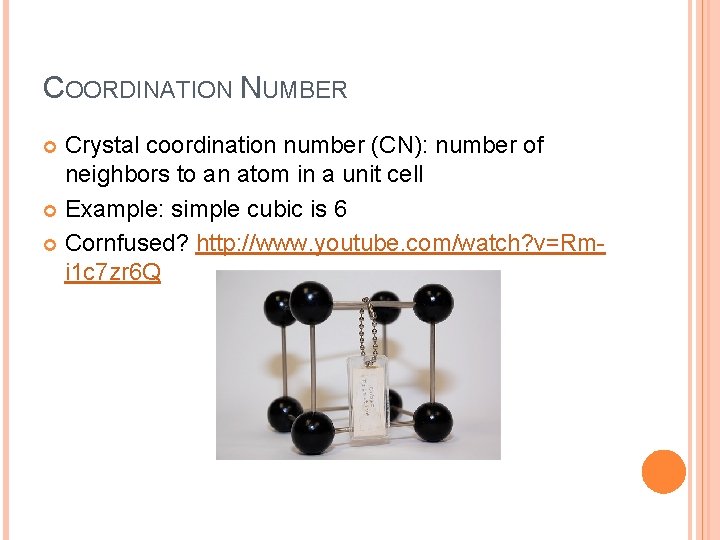
COORDINATION NUMBER Crystal coordination number (CN): number of neighbors to an atom in a unit cell Example: simple cubic is 6 Cornfused? http: //www. youtube. com/watch? v=Rmi 1 c 7 zr 6 Q
COORDINATION NUMBER Body-centered: CN of 8 Face-centered: CN of 12
THERE ARE FOUR TYPES OF CRYSTALS Molecular crystal Metallic crystal Covalent crystal Ionic crystal http: //www. youtube. com/watch? v=Rw_p. DVbnf. Qk
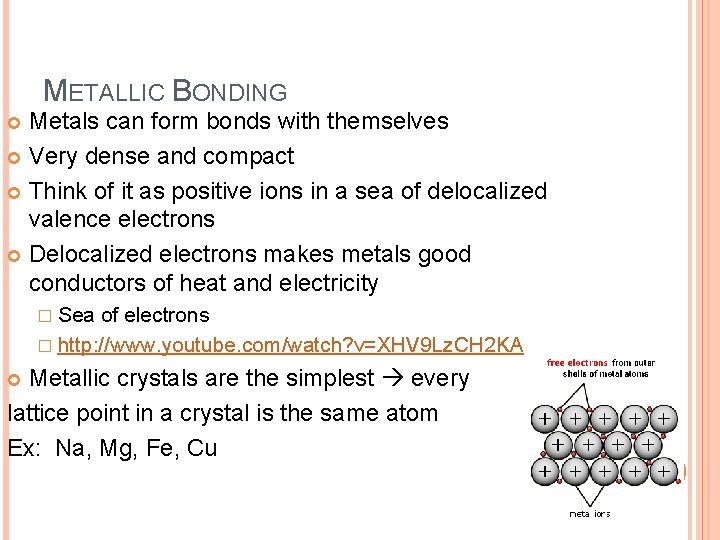
METALLIC BONDING Metals can form bonds with themselves Very dense and compact Think of it as positive ions in a sea of delocalized valence electrons Delocalized electrons makes metals good conductors of heat and electricity � Sea of electrons � http: //www. youtube. com/watch? v=XHV 9 Lz. CH 2 KA Metallic crystals are the simplest every lattice point in a crystal is the same atom Ex: Na, Mg, Fe, Cu
MOLECULAR CRYSTALS Lattice points are occupied by molecules and the attractive forces are van der Waals forces and/or hydrogen bonding Soft, low melting points, poor conductors of heat and electricity, MOST ARE LIQUIDS AND GASES AT ROOM TEMPERATURE! All nonmetals Ex: CO 2, I 2, H 2 O
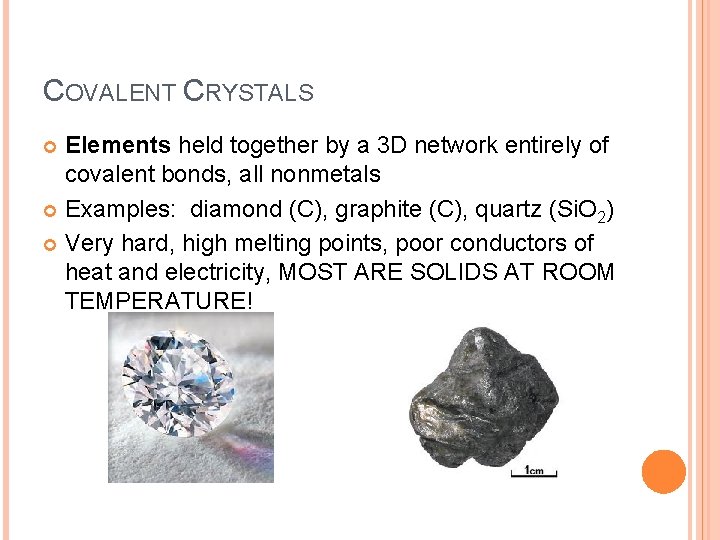
COVALENT CRYSTALS Elements held together by a 3 D network entirely of covalent bonds, all nonmetals Examples: diamond (C), graphite (C), quartz (Si. O 2) Very hard, high melting points, poor conductors of heat and electricity, MOST ARE SOLIDS AT ROOM TEMPERATURE!
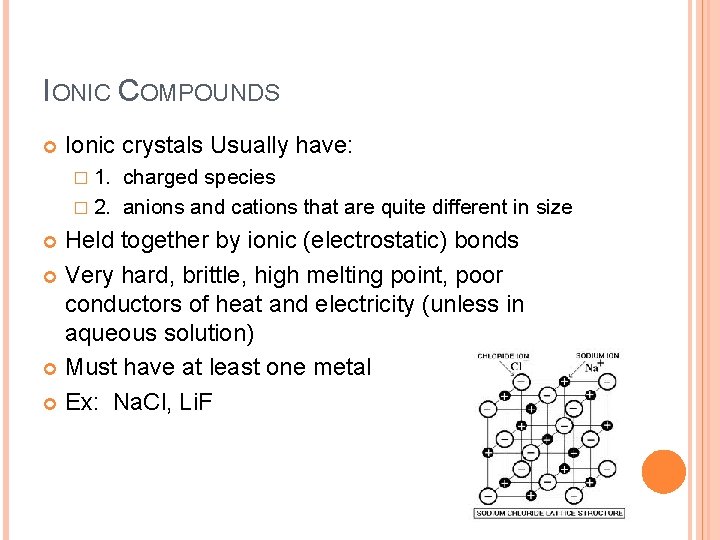
IONIC COMPOUNDS Ionic crystals Usually have: � 1. charged species � 2. anions and cations that are quite different in size Held together by ionic (electrostatic) bonds Very hard, brittle, high melting point, poor conductors of heat and electricity (unless in aqueous solution) Must have at least one metal Ex: Na. Cl, Li. F
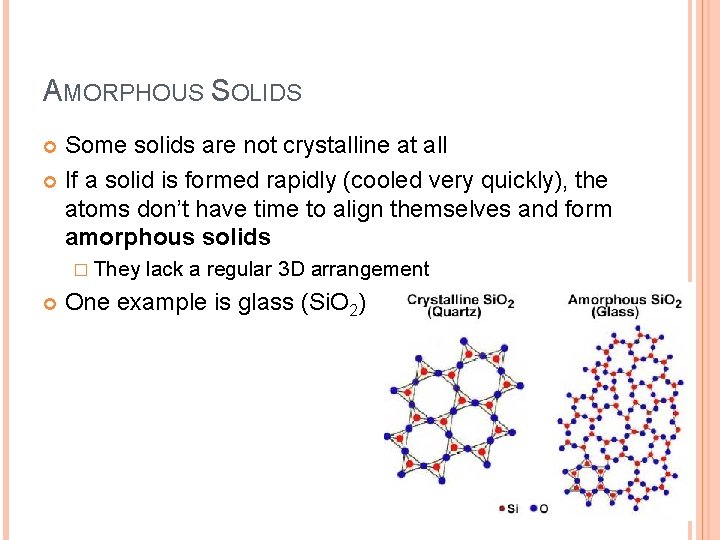
AMORPHOUS SOLIDS Some solids are not crystalline at all If a solid is formed rapidly (cooled very quickly), the atoms don’t have time to align themselves and form amorphous solids � They lack a regular 3 D arrangement One example is glass (Si. O 2)