
Crystal Channeling Study experiment to study and apply
- Slides: 24
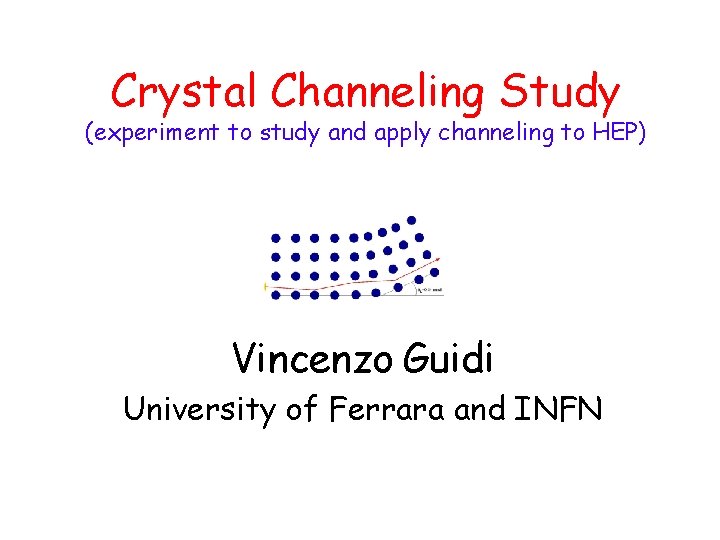
Crystal Channeling Study (experiment to study and apply channeling to HEP) Vincenzo Guidi University of Ferrara and INFN
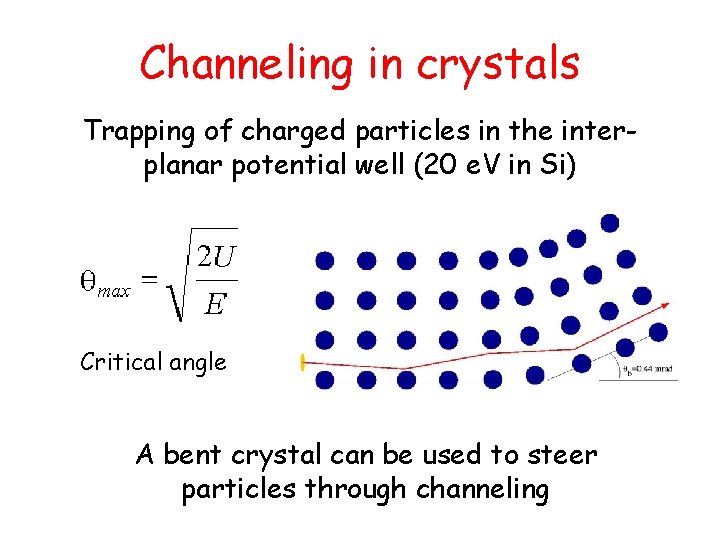
Channeling in crystals Trapping of charged particles in the interplanar potential well (20 e. V in Si) Critical angle A bent crystal can be used to steer particles through channeling
Applications to HEP • Halo cleaning in the LHC • Diffractive physics (TOTEM experiment) • In-situ calibration of the calorimeters in LHC experiments
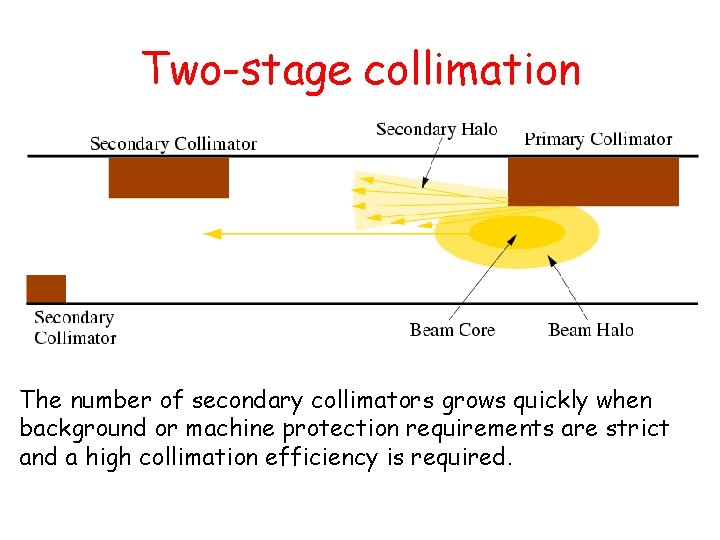
Two-stage collimation The number of secondary collimators grows quickly when background or machine protection requirements are strict and a high collimation efficiency is required.
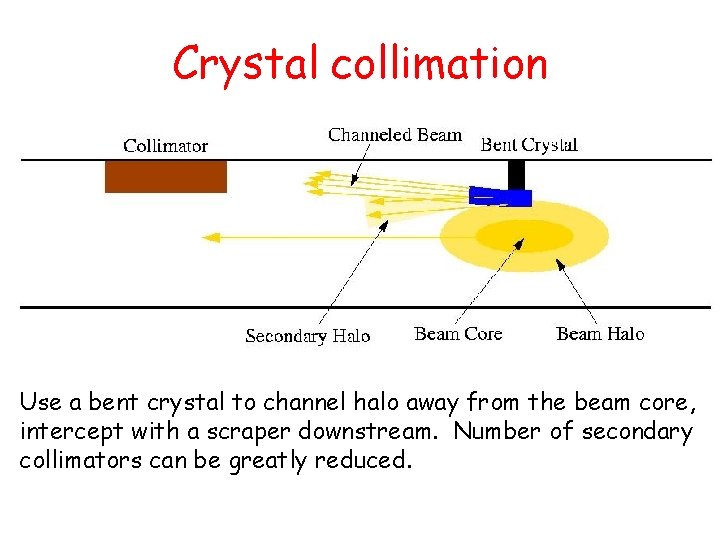
Crystal collimation Use a bent crystal to channel halo away from the beam core, intercept with a scraper downstream. Number of secondary collimators can be greatly reduced.
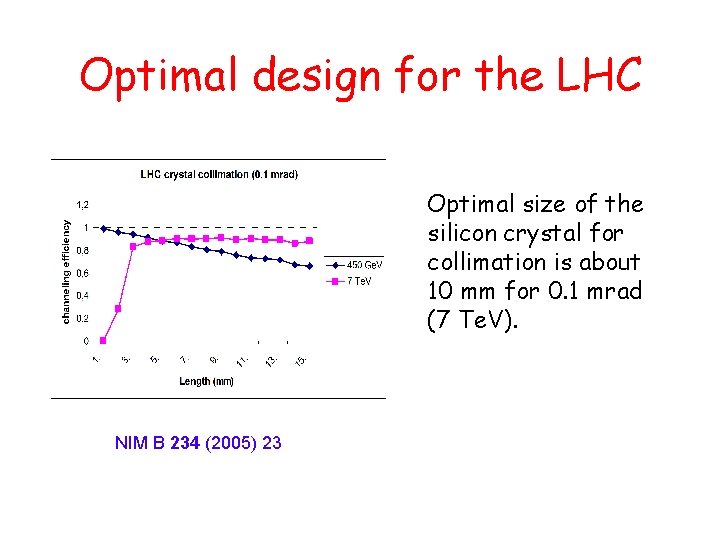
Optimal design for the LHC Optimal size of the silicon crystal for collimation is about 10 mm for 0. 1 mrad (7 Te. V). NIM B 234 (2005) 23
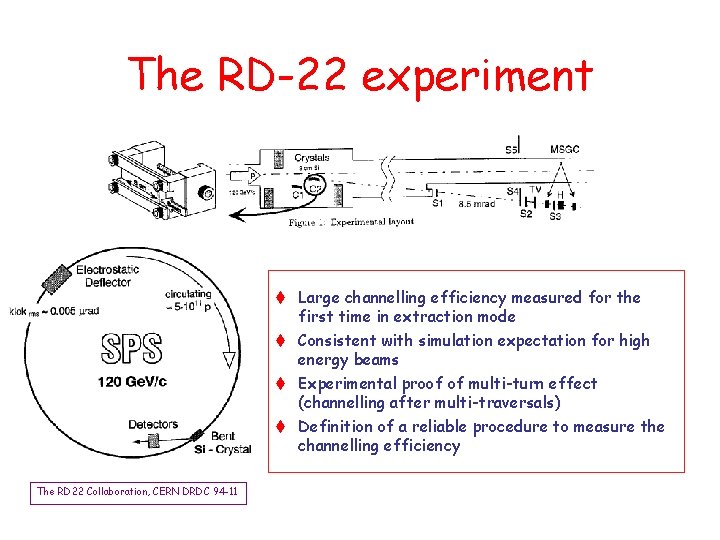
The RD-22 experiment t Large channelling efficiency measured for the first time in extraction mode t Consistent with simulation expectation for high energy beams t Experimental proof of multi-turn effect (channelling after multi-traversals) t Definition of a reliable procedure to measure the channelling efficiency The RD 22 Collaboration, CERN DRDC 94 -11
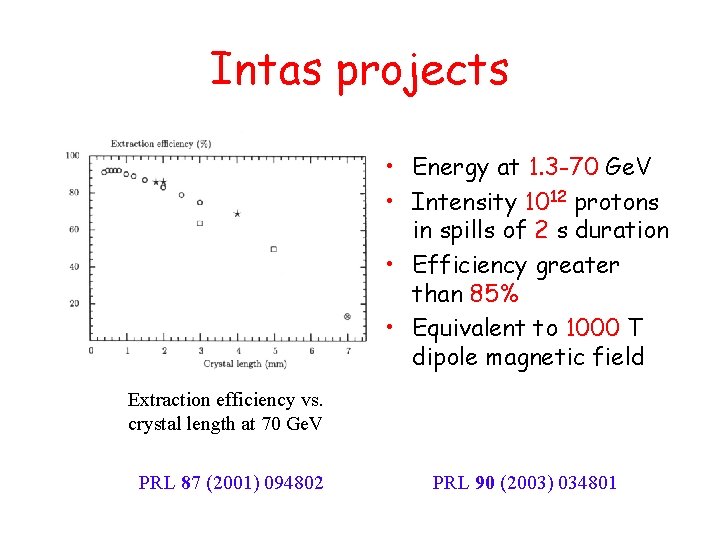
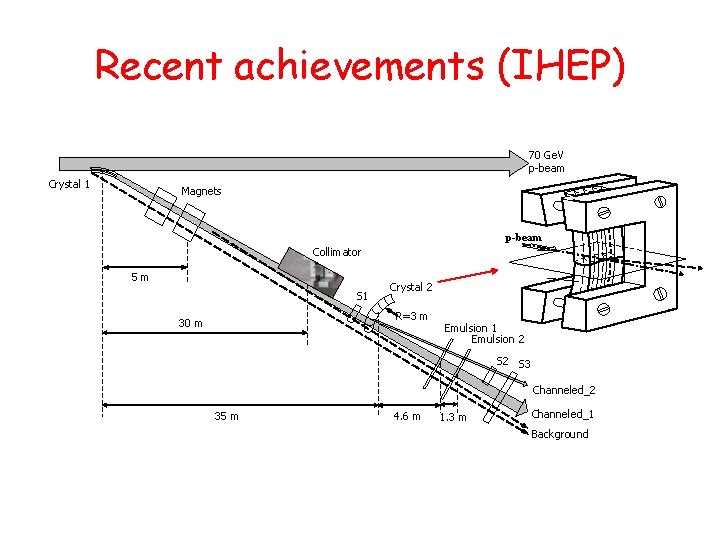
Intas projects • Energy at 1. 3 -70 Ge. V • Intensity 1012 protons in spills of 2 s duration • Efficiency greater than 85% • Equivalent to 1000 T dipole magnetic field Extraction efficiency vs. crystal length at 70 Ge. V PRL 87 (2001) 094802 PRL 90 (2003) 034801
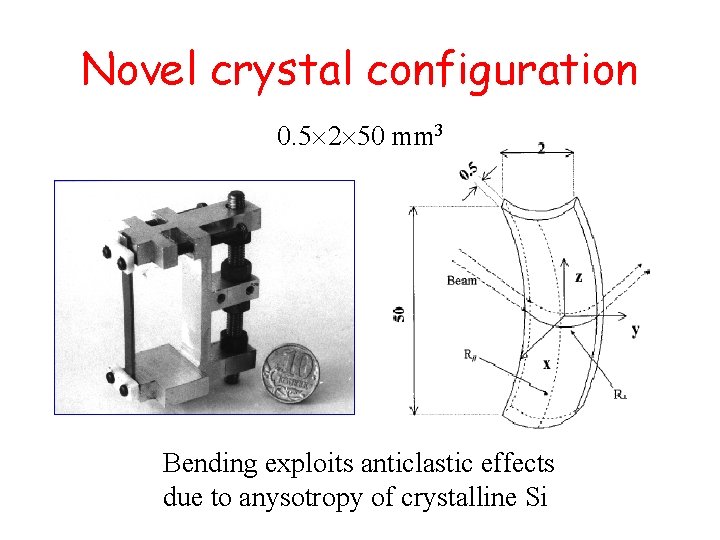
Novel crystal configuration 0. 5 2 50 mm 3 Bending exploits anticlastic effects due to anysotropy of crystalline Si
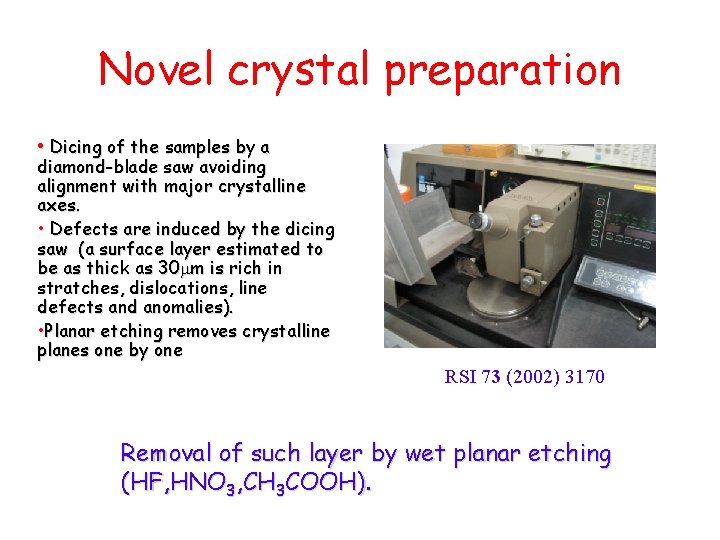
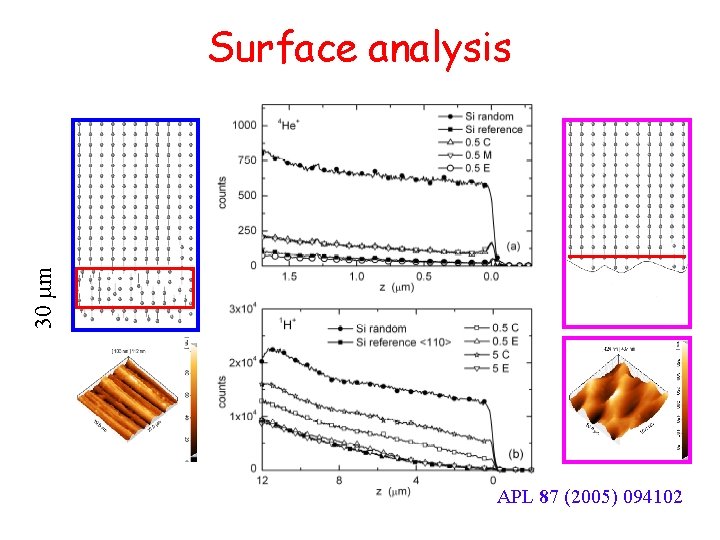
Novel crystal preparation • Dicing of the samples by a diamond-blade saw avoiding alignment with major crystalline axes. • Defects are induced by the dicing saw (a surface layer estimated to be as thick as 30 m is rich in stratches, dislocations, line defects and anomalies). • Planar etching removes crystalline planes one by one RSI 73 (2002) 3170 Removal of such layer by wet planar etching (HF, HNO 3, CH 3 COOH).
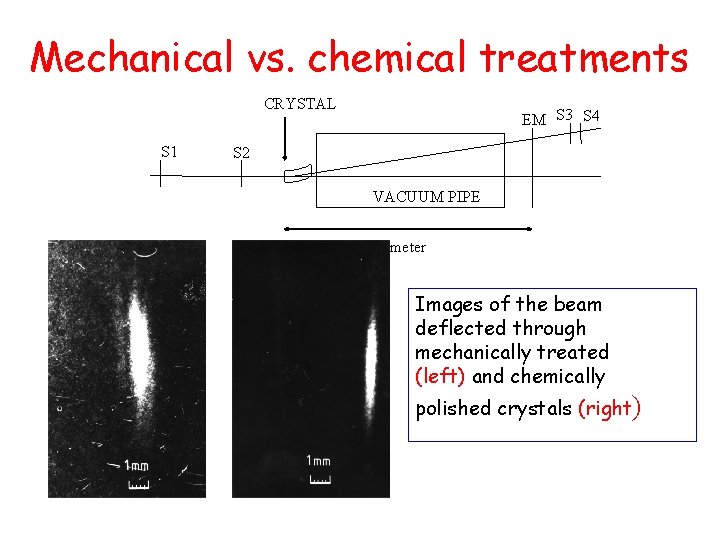
Mechanical vs. chemical treatments CRYSTAL S 1 EM S 3 S 4 S 2 VACUUM PIPE 7 meter Images of the beam deflected through mechanically treated (left) and chemically polished crystals (right)
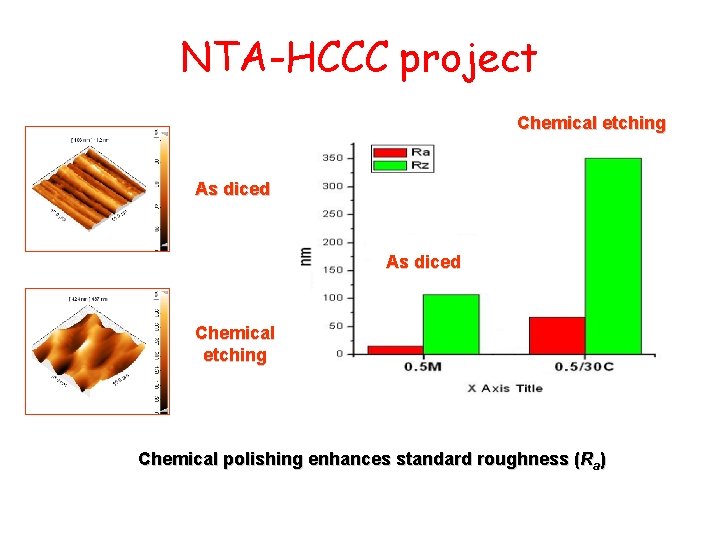
NTA-HCCC project Chemical etching As diced Chemical etching Chemical polishing enhances standard roughness (Ra)
30 m Surface analysis APL 87 (2005) 094102
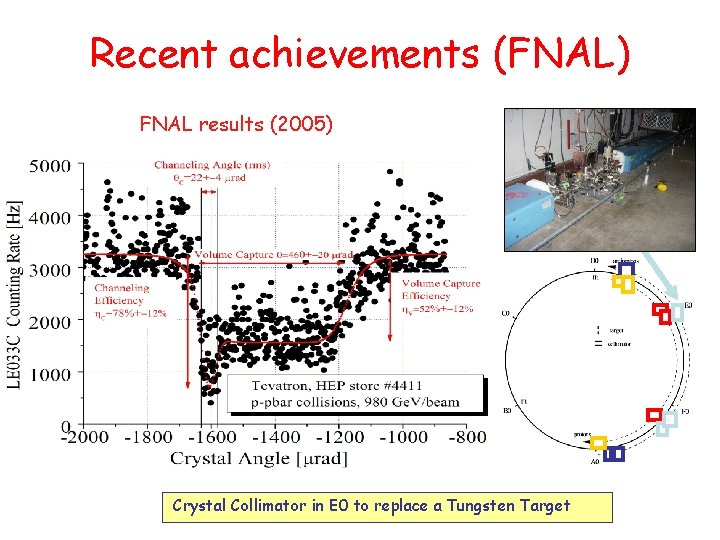
Recent achievements (FNAL) FNAL results (2005) Crystal Collimator in E 0 to replace a Tungsten Target
Recent achievements (IHEP) 70 Ge. V p-beam Crystal 1 Magnets p-beam Collimator 5 m S 1 Crystal 2 R=3 m 30 m Emulsion 1 Emulsion 2 S 3 Channeled_2 35 m 4. 6 m 1. 3 m Channeled_1 Background
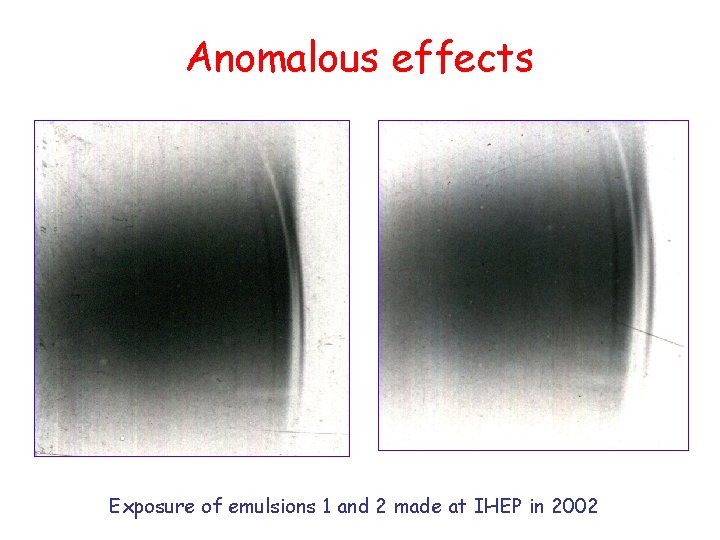
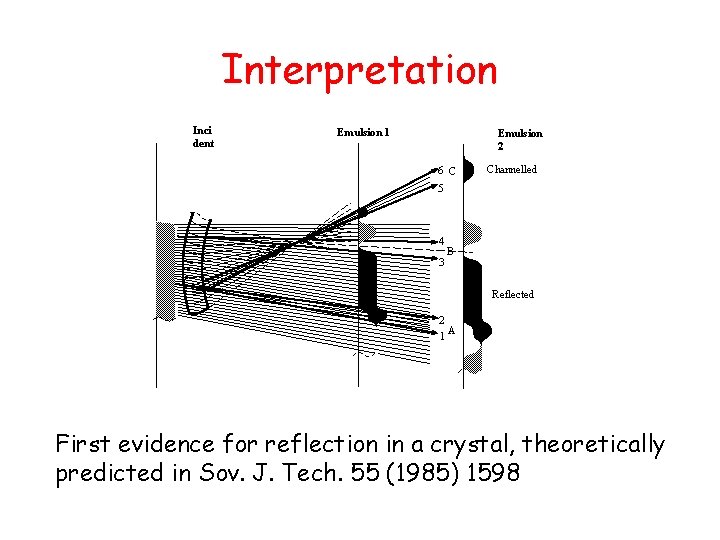
Anomalous effects Exposure of emulsions 1 and 2 made at IHEP in 2002
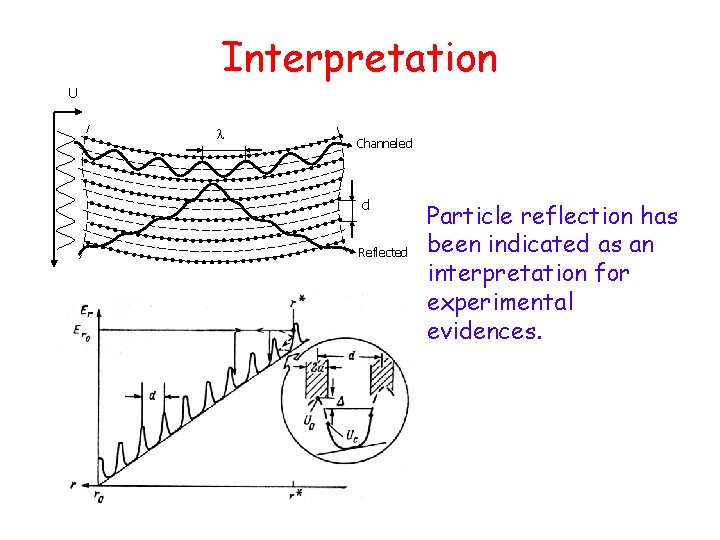
Interpretation U Channeled d Reflected Particle reflection has been indicated as an interpretation for experimental evidences.
Interpretation Inci dent Emulsion 1 Emulsion 2 6 C Channelled 5 4 3 B Reflected 2 A 1 First evidence for reflection in a crystal, theoretically predicted in Sov. J. Tech. 55 (1985) 1598
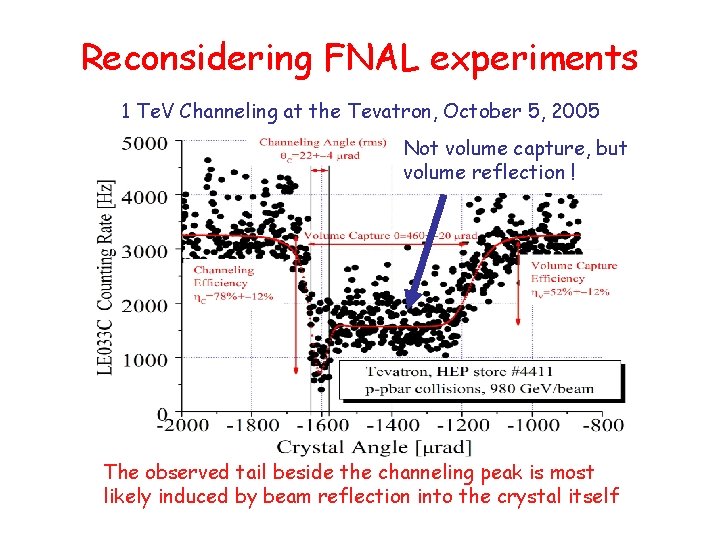
Reconsidering FNAL experiments 1 Te. V Channeling at the Tevatron, October 5, 2005 Not volume capture, but volume reflection ! The observed tail beside the channeling peak is most likely induced by beam reflection into the crystal itself
CCS: an experiment to study and apply channeling to HEP • Continuous upgrading of performance of crystals boosted new achievements and new prospects. • Need for a newly conceived experiment to investigate novel phenomena. • Three-weeks machine time (external line H 8, SPS) has been requested in 2006 and decision will be taken soon.
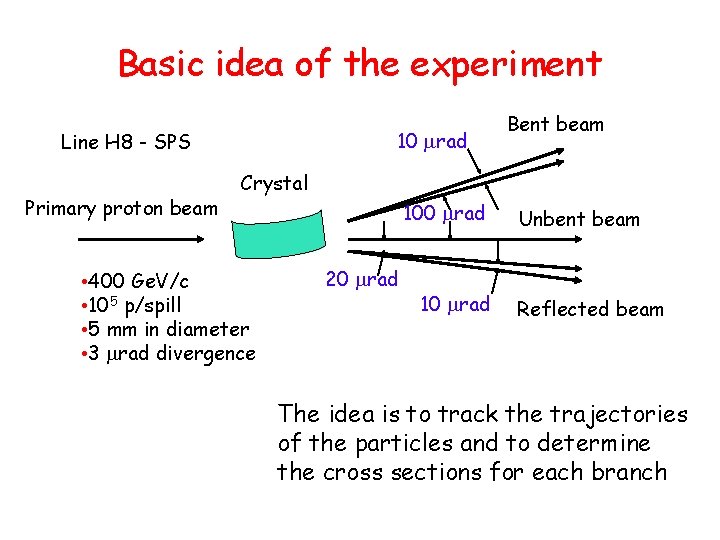
Basic idea of the experiment 10 rad Line H 8 - SPS Primary proton beam Bent beam Crystal • 400 Ge. V/c • 105 p/spill • 5 mm in diameter • 3 rad divergence 100 rad 20 rad 10 rad Unbent beam Reflected beam The idea is to track the trajectories of the particles and to determine the cross sections for each branch
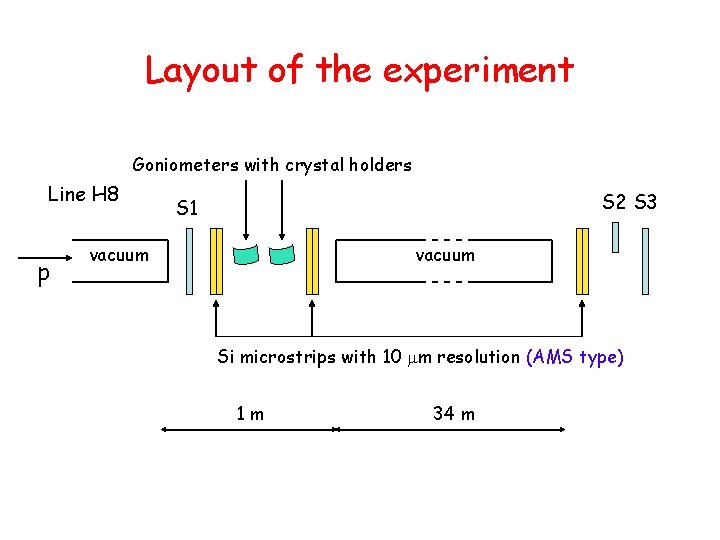
Layout of the experiment Goniometers with crystal holders Line H 8 p S 2 S 3 S 1 vacuum Si microstrips with 10 m resolution (AMS type) 1 m 34 m
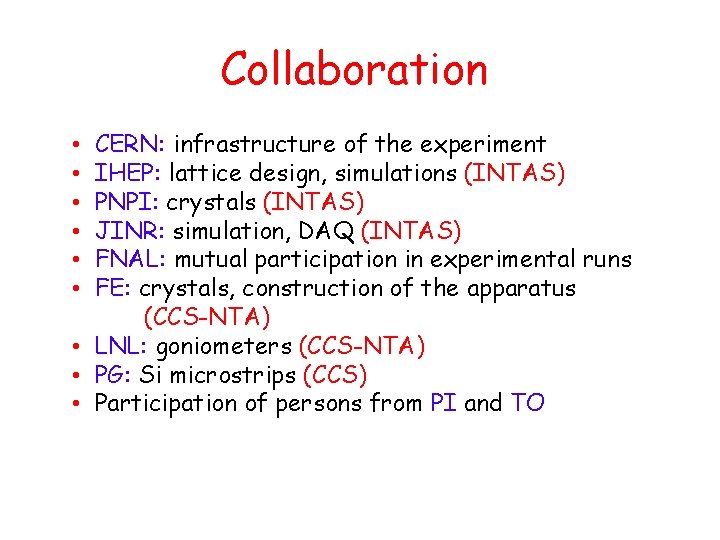
Collaboration CERN: infrastructure of the experiment IHEP: lattice design, simulations (INTAS) PNPI: crystals (INTAS) JINR: simulation, DAQ (INTAS) FNAL: mutual participation in experimental runs FE: crystals, construction of the apparatus (CCS-NTA) • LNL: goniometers (CCS-NTA) • PG: Si microstrips (CCS) • Participation of persons from PI and TO • • •
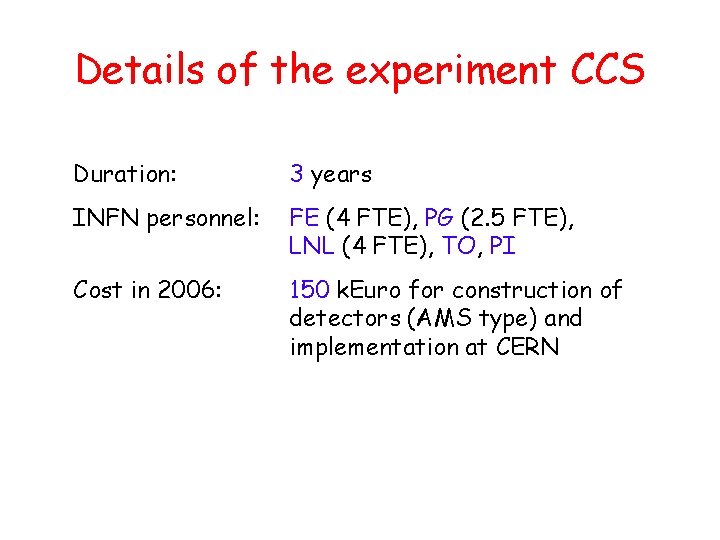
Details of the experiment CCS Duration: 3 years INFN personnel: FE (4 FTE), PG (2. 5 FTE), LNL (4 FTE), TO, PI Cost in 2006: 150 k. Euro for construction of detectors (AMS type) and implementation at CERN