
Cryptosporidium species Classification Phylum Apicomplexa Class Sporozoea Subclass
Cryptosporidium species

Classification: • Phylum : Apicomplexa – Class: Sporozoea • Subclass : Coccidia – Family: Cryptosporiidae » Genus: Cryptosporidium » Species : parvum
Introduction • Cryptosporidium is a coccidian protozoan parasite • It is associated with municipal water supplies which causes diarrhea • Cryptosporidium parvum causes the disease Cryptosporidiosis.
Introduction con… • Definitive Host: Human • Reservoir Hosts: kittens, puppies, goats, calves, mice • # It is a zoonotic disease and can travel from animals to humans.

Geographical Distribution: • World wide in temperate and tropical zone
DR. RAAFAT MOHAMED

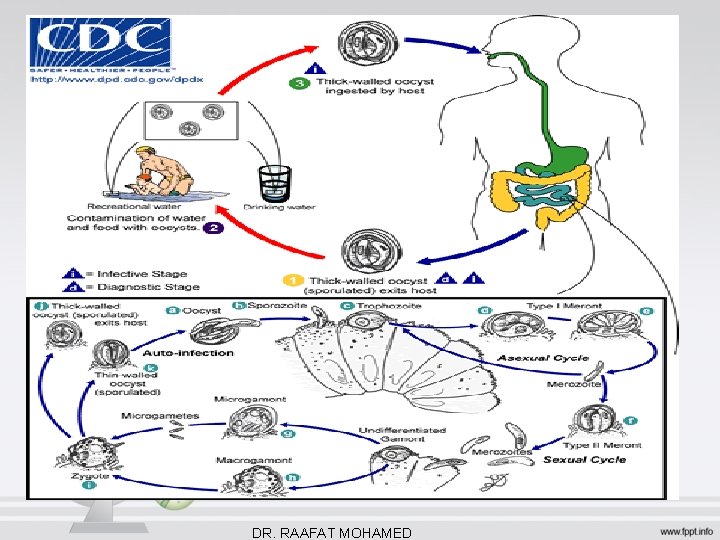
Development of Cryptosporidium in human body Thick-walled oocysts External autoinfection Sporozoite attack brush border of epithelial cells Thin-walled oocysts Internal autoinfection Zygote ♂ ♀ gametocyte Gametogony (sexual reproduction) Meront with merozoites Merogony (asexual reproduction) DR. RAAFAT MOHAMED
Symptoms �Some individuals can be asymptomatic �Incubation period 2 -10 days �Symptoms include: �Stomach cramps, pain, watery diarrhea, dehydration, weight loss, vomiting, fever. �Immuno-competent individuals: 1 -2 weeks �Immuno-compromised individuals: longer (months, even years!)
Diagnosis: Ø Stool analysis is done by: 1 - Direct smear method. 2 - Concentration method using Shaether’s sugar floatation technique Oocysts are seen by: - Staining stool smear with modified Ziehl Neelsen stain.
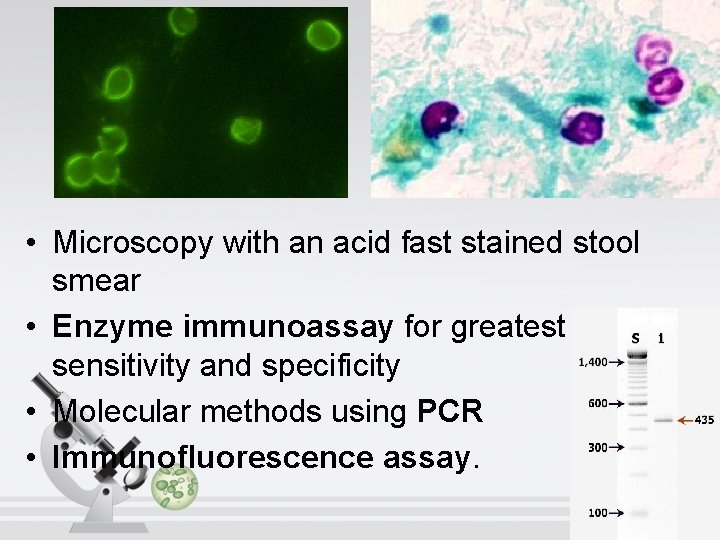
• Microscopy with an acid fast stained stool smear • Enzyme immunoassay for greatest sensitivity and specificity • Molecular methods using PCR • Immunofluorescence assay.
Treatment Ø Immunocompetent: self-limited Ø Immunocompromized: Paromomycin (Cryptosporidium)
Control Methods: �Water purification and filtration �Routine testing �Use of 1 micron filter to remove cysts �Boil water �Drink bottled water when traveling abroad. �Educate public. �Wash hands frequently.
Interesting Facts • Cryptosporidium is resistant to chlorine. • Cannot be infected by blood exposure • The Oocysts are resistant to most chemical disinfectants, but are susceptible to drying and the ultraviolet portion of sunlight.
Isospora belli

Classification: • Phylum: Apicomplexa • Class: Conoidasida • Family: Sarcocystidae • Genus: Cystoisospora • Species: C. belli Cystoisospora belli(Wenyon, 1923) • Synonyms: Isospora belli
Background • Like Cryptosporidium but less common • Worldwide, especially in tropical and subtropical areas • Infection occurs in immunodepressed individuals. • Outbreaks have been reported in institutionalized groups in the United States
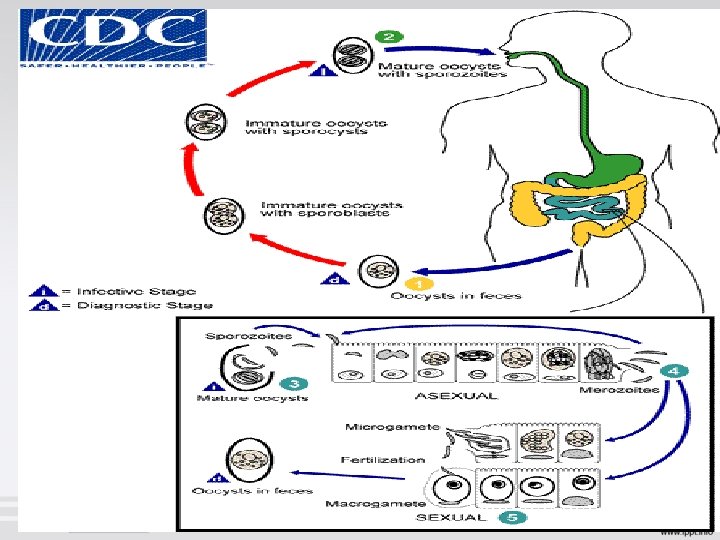
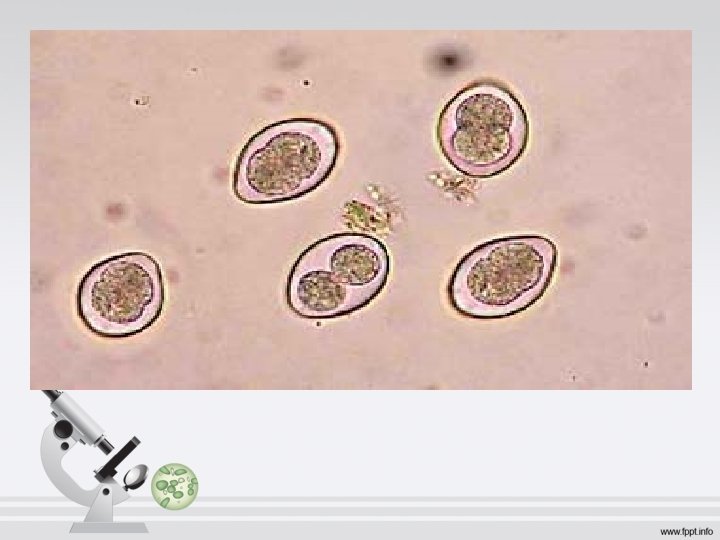
Lifecycle • At time of excretion, the immature oocyst contains usually one sporoblast • Further maturation the sporoblast divides in two • the sporoblasts secrete a cyst wall, thus becoming sporocysts • and the sporocysts divide twice to produce four sporozoites each
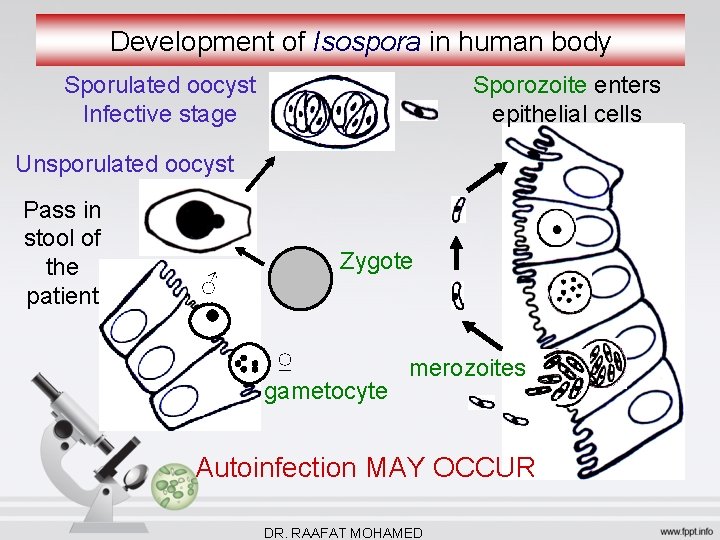
Development of Isospora in human body Sporulated oocyst Infective stage Sporozoite enters epithelial cells Unsporulated oocyst Pass in stool of the patient ♂ Zygote ♀ merozoites gametocyte Autoinfection MAY OCCUR DR. RAAFAT MOHAMED
Isosporiosis • acute, non bloody diarrhoea with crampy abdominal pain, which can last for weeks and result in malabsorption and weight loss • In immunodepressed patients, and in infants and children, the diarrhoea can be severe
Lab. diagnosis • Specimen: stool • Microscopic demonstration of the large, typically shaped oocysts • repeated stool examinations and concentration procedures are recommended. • examination of duodenal specimens by biopsy or string test
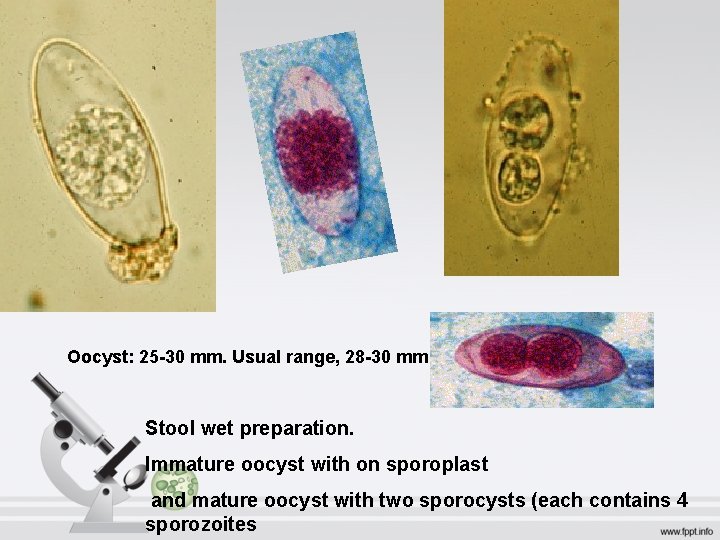
Oocyst: 25 -30 mm. Usual range, 28 -30 mm Stool wet preparation. Immature oocyst with on sporoplast and mature oocyst with two sporocysts (each contains 4 sporozoites


References: • Centers for Disease Control and Prevention(CDC) • Monica Cheesbrough (volume 1) • DR. RAAFAT MOHAMED
- Slides: 27