
Cryptography Reference Network Security PRIVATE Communication in a
- Slides: 21
Cryptography Reference: Network Security PRIVATE Communication in a PUBLIC World. by Kaufman, Perlman & Speciner. 1
Secret Key Cryptography • Single key used to encrypt and decrypt. • Key must be known by both parties. • Assuming we live in a hostile environment (otherwise - why the need for cryptography? ), it may be hard to share a secret key. 2
Public Key Cryptography (a. k. a. asymmetric cryptography) • Relatively new field - 1975 (as far as we know, the NSA is not talking). • Each entity has 2 keys: – private key (a secret) – public key (well known). 3
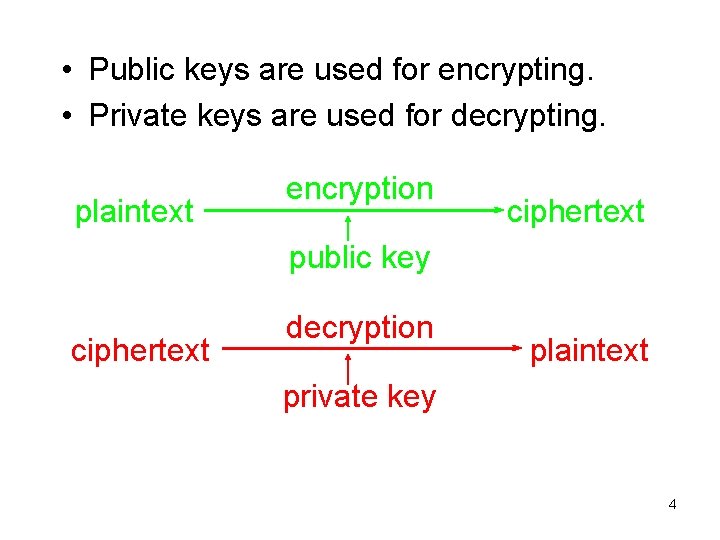
• Public keys are used for encrypting. • Private keys are used for decrypting. plaintext encryption ciphertext public key ciphertext decryption plaintext private key 4
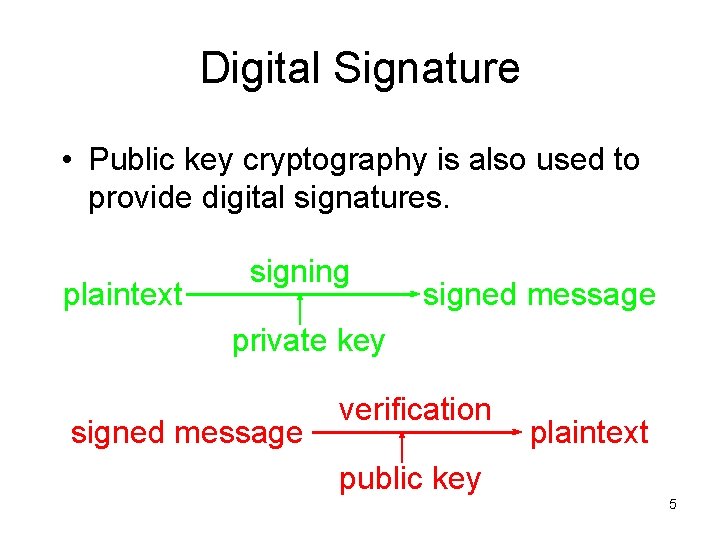
Digital Signature • Public key cryptography is also used to provide digital signatures. plaintext signing signed message private key signed message verification plaintext public key 5
Transmitting over an insecure channel. Alice wants to send Bob a private message. Apublic is Alice’s public key. Aprivate is Alice’s private key. Bpublic is Bob’s public key. Bprivate is Bob’s private key. 6
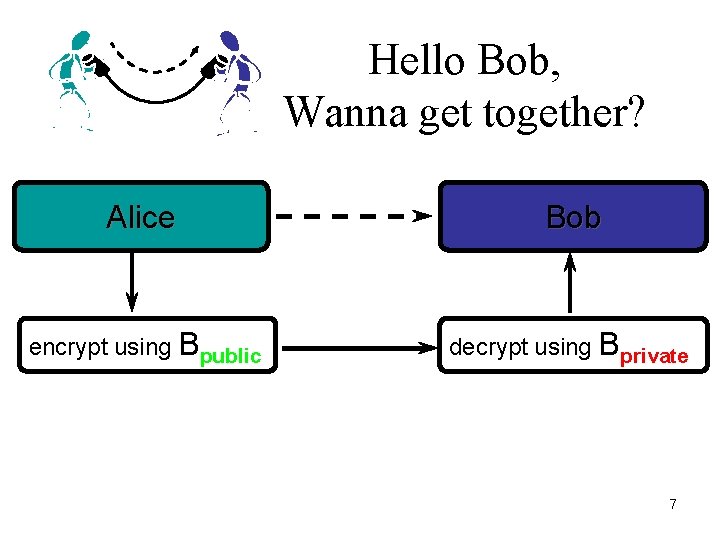
Hello Bob, Wanna get together? Alice Bob encrypt using Bpublic decrypt using Bprivate 7
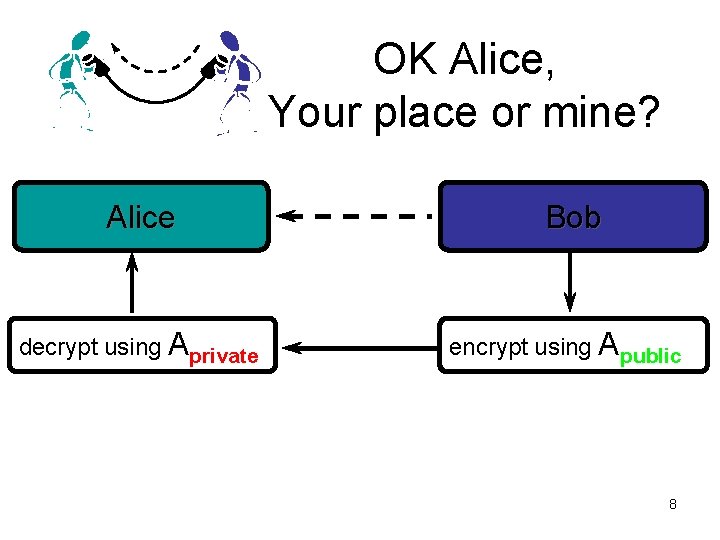
OK Alice, Your place or mine? Alice decrypt using Aprivate Bob encrypt using Apublic 8
Bob’s Dilemma • Nobody can read the message from Alice, but anyone could produce it. • How does Bob know that the message was really sent from Alice? • Bob may be comforted to know that only Alice can read his reply. 9
Alice can sign her message! • Alice can create a digital signature and prove she sent the message (or someone with knowledge of her private key). • The signature can be a message digest encrypted with Aprivate. 10
Message Digest • Also known as “hash function” or “one-way transformation”. • Transforms a message of any length and computes a fixed length string. • We want it to be hard to guess what the message was given only the digest. – Guessing is always possible. 11
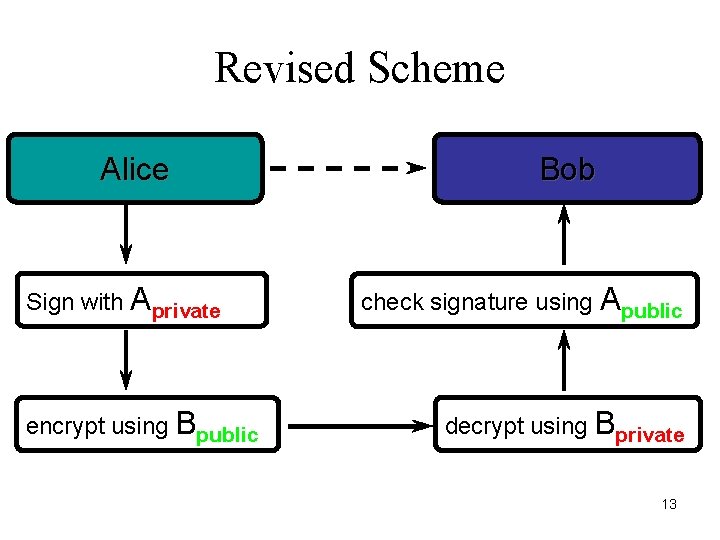
Alice’s Signature • Alice feeds her original message through a hash function and encrypts the message digest with Aprivate. • Bob can decrypt the message digest using Apublic. • Bob can compute the message digest himself. • If the 2 message digests are identical Bob knows Alice sent the message. 12
Revised Scheme Alice Sign with Aprivate encrypt using Bpublic Bob check signature using Apublic decrypt using Bprivate 13
Why the digest? • Alice could just encrypt her name, and then Bob could decrypt it with Apublic. • Why wouldn’t this be sufficient? 14
Implications • Suppose Alice denies she sent the message? • Bob can prove that only someone with Alice’s key could have produced the message. 15
Another possible problem • Suppose O. J. receives a message from Alice including a digital signature. • O. J. sends the same message to Bob claiming to be Alice, and includes the digital signature from the message Alice sent to him. • Bob is convinced Alice sent the message! 16
Solution? • Always start your messages with: – Dear O. J. • Create a digest from the encrypted message and sign that digest. • There are many other schemes as well. 17
Speed • Secret key encryption/decryption algorithms are much faster than public key algorithms. • Many times a combination is used: – use public key cryptography to share a secret key. – use the secret key to encrypt the bulk of the communication. 18
Secure Protocols • There a growing number of applications for secure protocols: – email – electronic commerce – electronic voting – homework submission 19
Secure Protocols • Many application protocols include the use of cryptography as part of the application level protocol. • Secure Sockets Layer (SSL) is a different approach - a new layer is added that provides a secure channel (currently TCP only). • Most secure WWW communication is SSL based. 20
Security • There is a course on security offered much more in depth. • I have lots of books for anyone interested in secure protocols, encryption standards and algorithms, etc. 21