
Cryptography Lecture 24 Dlogbased PKE DiffieHellman key exchange
Cryptography Lecture 24
Dlog-based PKE
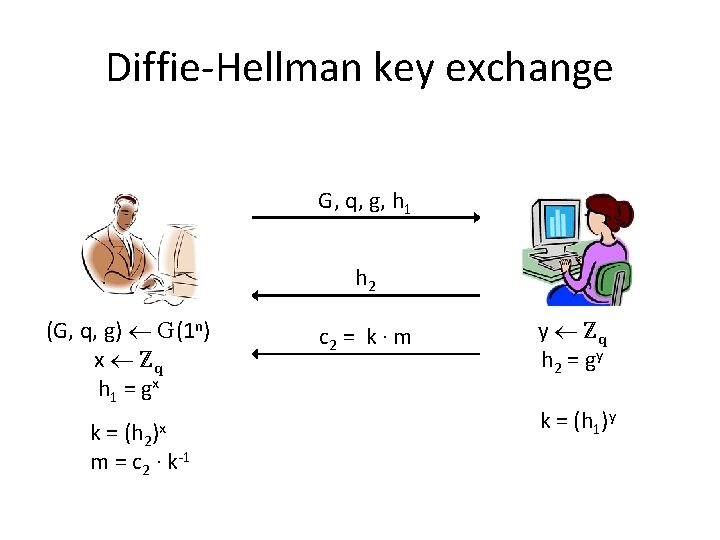
Diffie-Hellman key exchange G, q, g, h 1 h 2 (G, q, g) G(1 n) x ℤq h 1 = g x )x k = (h 2 m = c 2 · k-1 c 2 = k · m y ℤq h 2 = g y k = (h 1)y
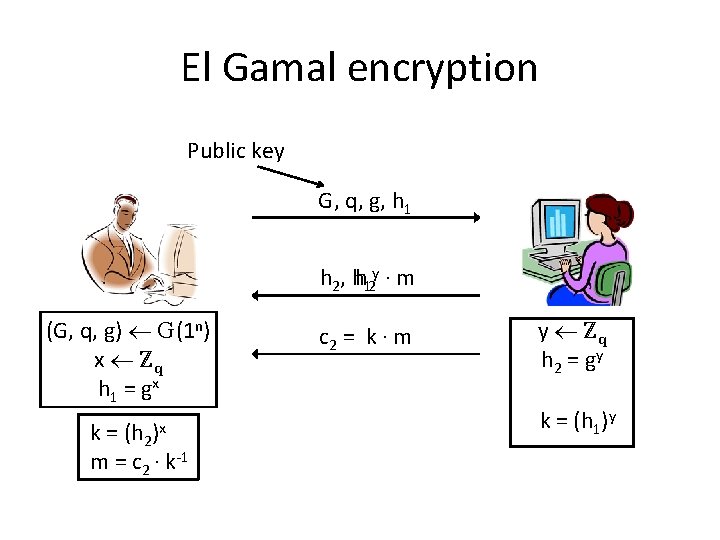
El Gamal encryption Public key G, q, g, h 1 h 2, hh 12 y · m (G, q, g) G(1 n) x ℤq h 1 = g x )x k = (h 2 m = c 2 · k-1 c 2 = k · m y ℤq h 2 = g y k = (h 1)y
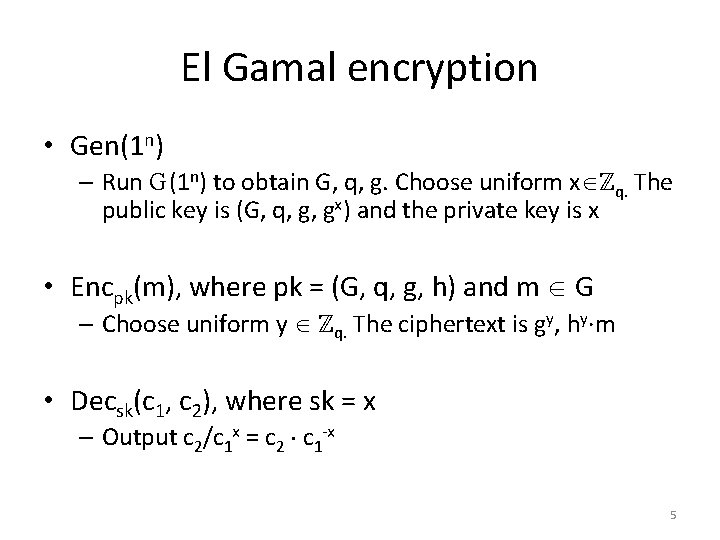
El Gamal encryption • Gen(1 n) – Run G(1 n) to obtain G, q, g. Choose uniform x ℤq. The public key is (G, q, g, gx) and the private key is x • Encpk(m), where pk = (G, q, g, h) and m G – Choose uniform y ℤq. The ciphertext is gy, hy·m • Decsk(c 1, c 2), where sk = x – Output c 2/c 1 x = c 2 c 1 -x 5
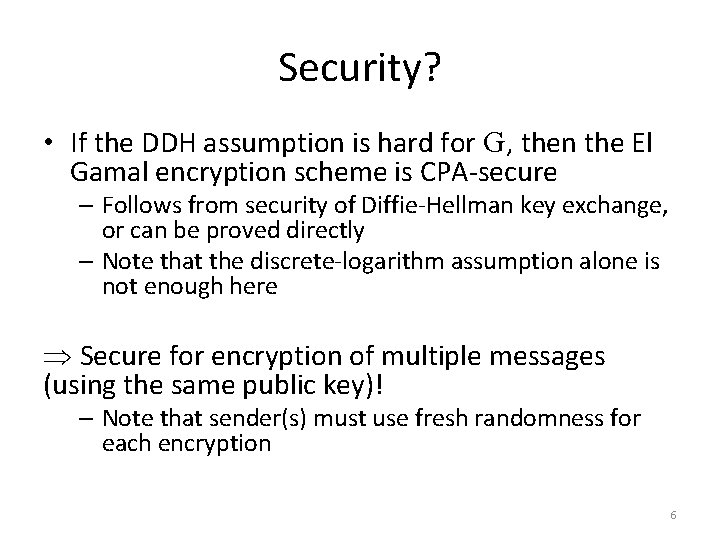
Security? • If the DDH assumption is hard for G, then the El Gamal encryption scheme is CPA-secure – Follows from security of Diffie-Hellman key exchange, or can be proved directly – Note that the discrete-logarithm assumption alone is not enough here Secure for encryption of multiple messages (using the same public key)! – Note that sender(s) must use fresh randomness for each encryption 6
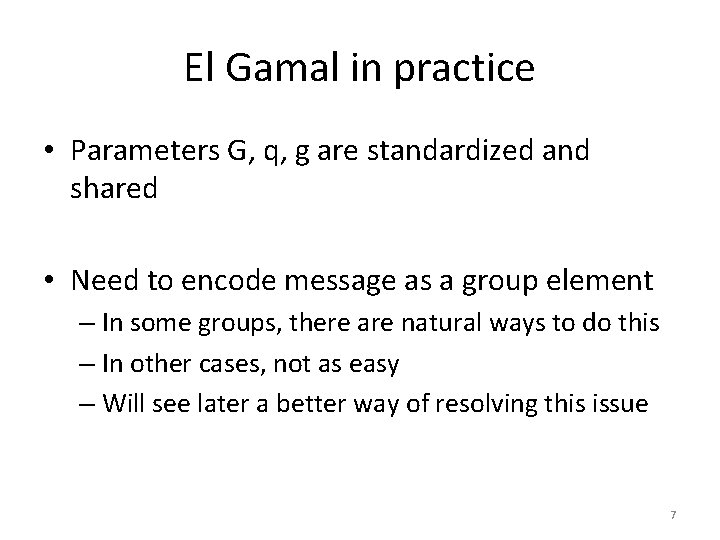
El Gamal in practice • Parameters G, q, g are standardized and shared • Need to encode message as a group element – In some groups, there are natural ways to do this – In other cases, not as easy – Will see later a better way of resolving this issue 7
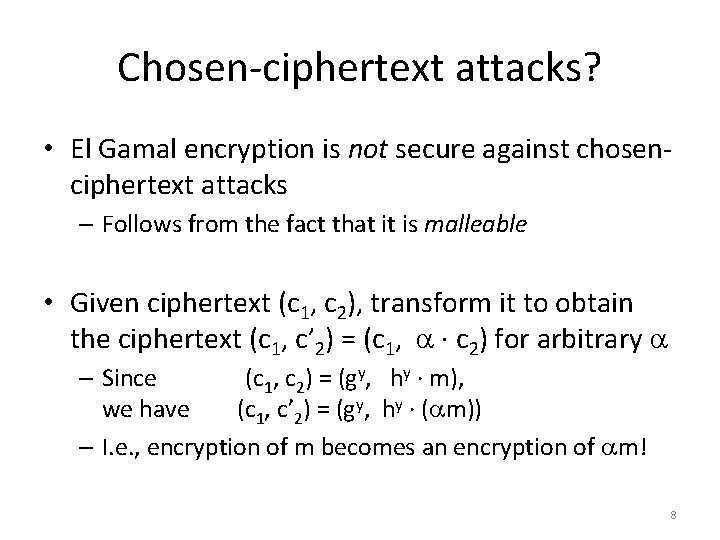
Chosen-ciphertext attacks? • El Gamal encryption is not secure against chosenciphertext attacks – Follows from the fact that it is malleable • Given ciphertext (c 1, c 2), transform it to obtain the ciphertext (c 1, c’ 2) = (c 1, · c 2) for arbitrary – Since (c 1, c 2) = (gy, hy · m), we have (c 1, c’ 2) = (gy, hy · ( m)) – I. e. , encryption of m becomes an encryption of m! 8
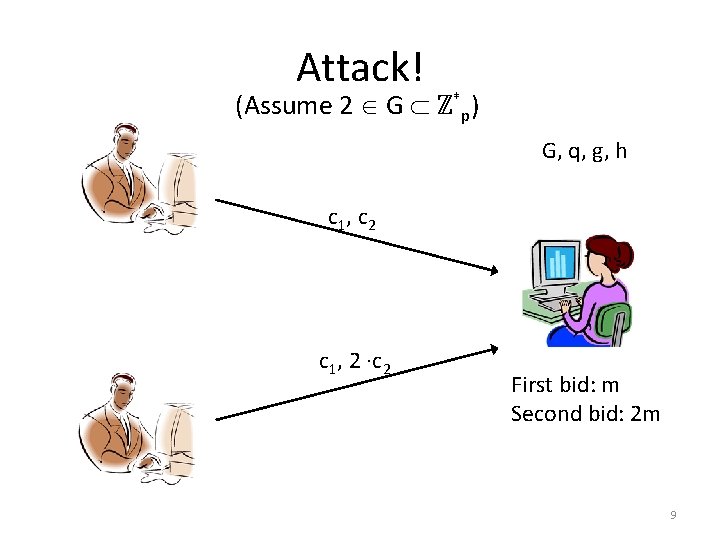
Attack! (Assume 2 G ℤ*p) G, q, g, h c 1, c 2 c 1, 2 ·c 2 First bid: m Second bid: 2 m 9
Hybrid encryption and KEMs
Encrypting long messages • Public-key encryption schemes “natively” defined for short messages – E. g. , El Gamal encryption • How can longer messages be encrypted?
Encrypting long messages • Can always encrypt block-by-block – I. e. , to encrypt M = m 1, m 2, …, ml, do: Encpk(m 1), …, Encpk(ml) • If the underlying scheme is CPA-secure (for short messages), then this is CPA-secure (for arbitrary length messages) – Why?
Note • (Public-key) encryption is NOT a block cipher – Fk is deterministic, one-to-one, and looks random – Encpk is randomized (if it is CPA-secure), thus not one-to-one, and may not look random CTR-mode/CBC-mode don’t make sense for public-key encryption CTR-mode is completely insecure. . .
Encrypting long messages • Encrypting block-by-block is inefficient – Ciphertext expansion in each block – Public-key encryption is “expensive” • Can we do better?
Hybrid encryption • Main idea – Use public-key encryption to establish a (shared, secret) key k – Use k to encrypt the message with a symmetrickey encryption scheme • Benefits – Lower ciphertext expansion – Amortized efficiency of symmetric-key encryption
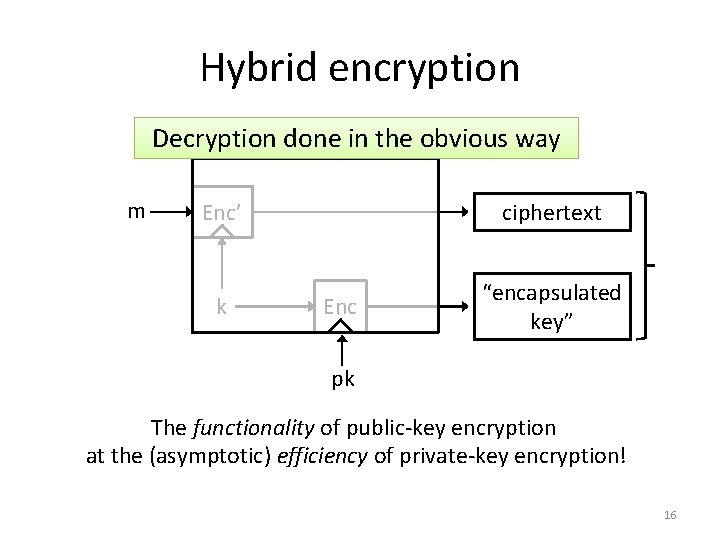
Hybrid encryption Decryption done in the obvious way m ciphertext Enc’ k Enc “encapsulated key” pk The functionality of public-key encryption at the (asymptotic) efficiency of private-key encryption! 16
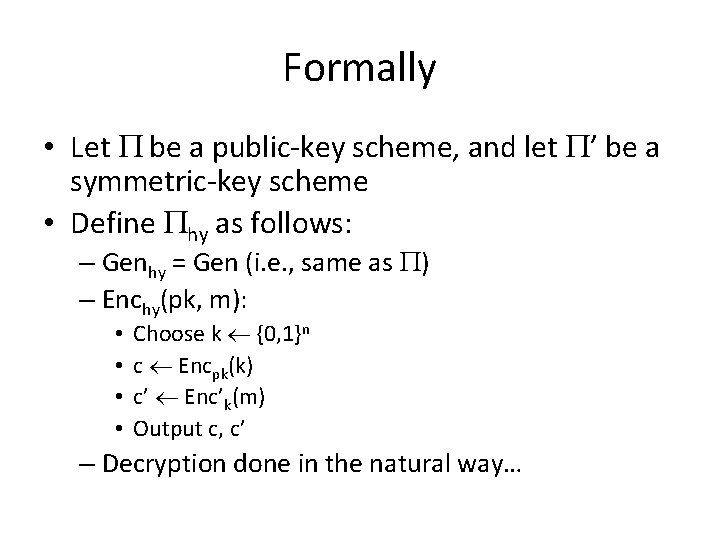
Formally • Let be a public-key scheme, and let ’ be a symmetric-key scheme • Define hy as follows: – Genhy = Gen (i. e. , same as ) – Enchy(pk, m): • • Choose k {0, 1}n c Encpk(k) c’ Enc’k(m) Output c, c’ – Decryption done in the natural way…
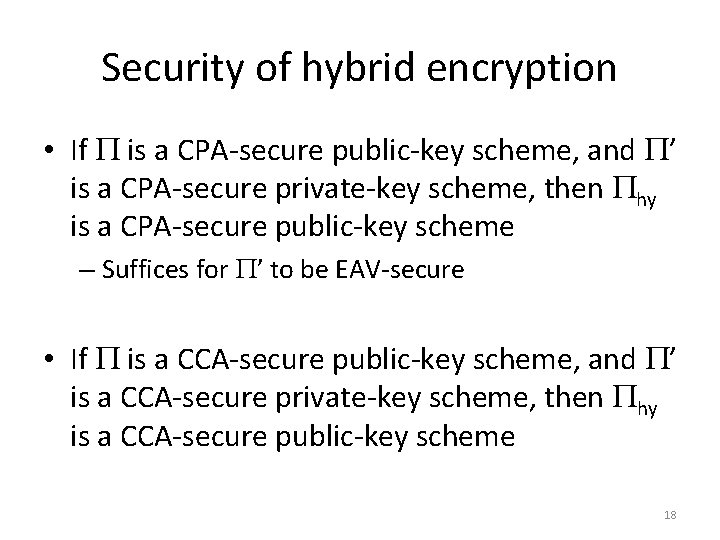
Security of hybrid encryption • If is a CPA-secure public-key scheme, and ’ is a CPA-secure private-key scheme, then hy is a CPA-secure public-key scheme – Suffices for ’ to be EAV-secure • If is a CCA-secure public-key scheme, and ’ is a CCA-secure private-key scheme, then hy is a CCA-secure public-key scheme 18
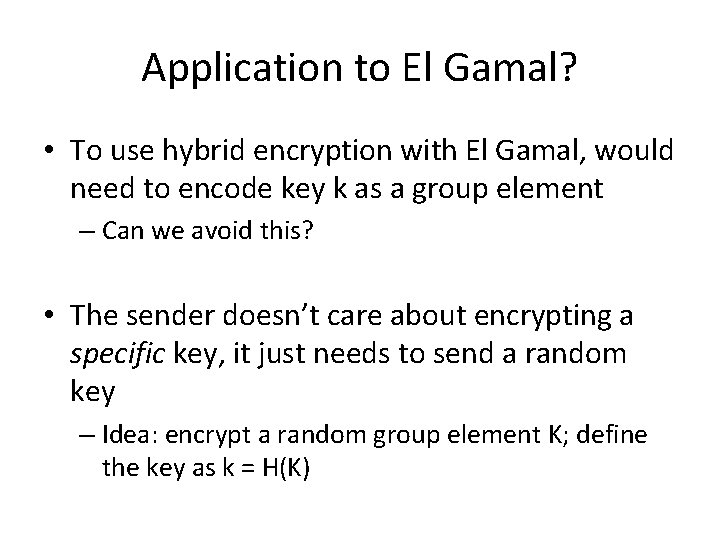
Application to El Gamal? • To use hybrid encryption with El Gamal, would need to encode key k as a group element – Can we avoid this? • The sender doesn’t care about encrypting a specific key, it just needs to send a random key – Idea: encrypt a random group element K; define the key as k = H(K)
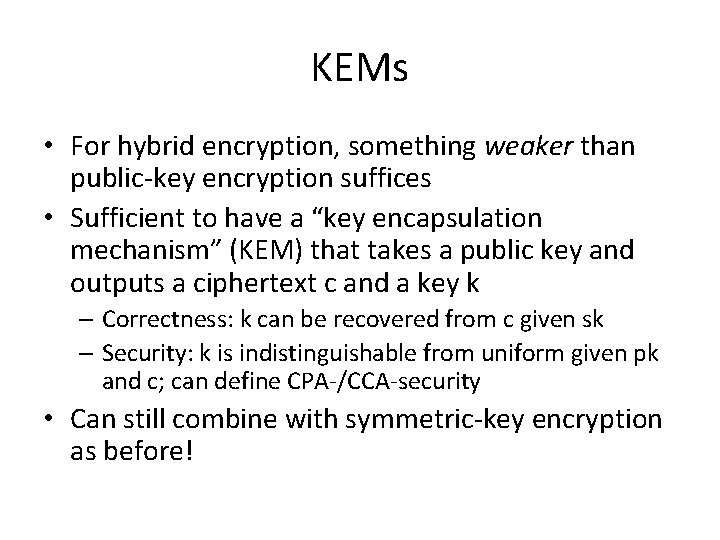
KEMs • For hybrid encryption, something weaker than public-key encryption suffices • Sufficient to have a “key encapsulation mechanism” (KEM) that takes a public key and outputs a ciphertext c and a key k – Correctness: k can be recovered from c given sk – Security: k is indistinguishable from uniform given pk and c; can define CPA-/CCA-security • Can still combine with symmetric-key encryption as before!
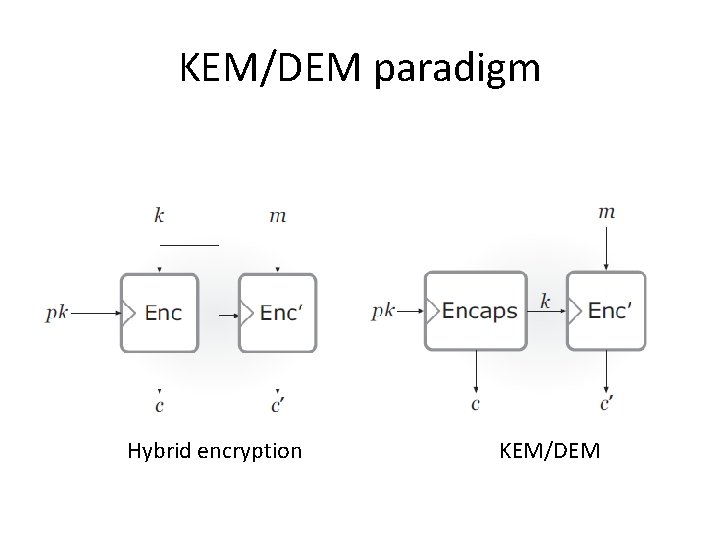
KEM/DEM paradigm Hybrid encryption KEM/DEM
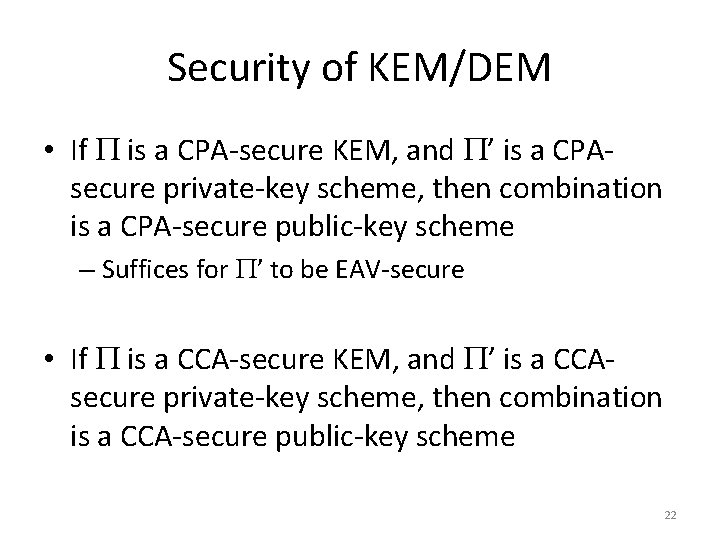
Security of KEM/DEM • If is a CPA-secure KEM, and ’ is a CPAsecure private-key scheme, then combination is a CPA-secure public-key scheme – Suffices for ’ to be EAV-secure • If is a CCA-secure KEM, and ’ is a CCAsecure private-key scheme, then combination is a CCA-secure public-key scheme 22
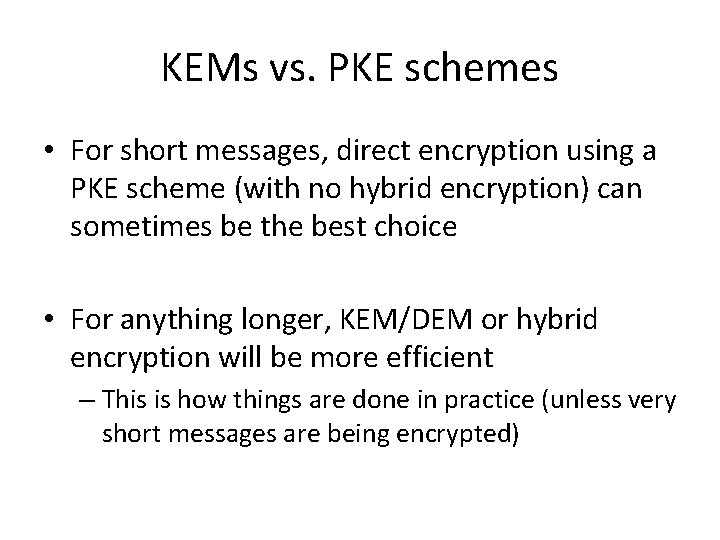
KEMs vs. PKE schemes • For short messages, direct encryption using a PKE scheme (with no hybrid encryption) can sometimes be the best choice • For anything longer, KEM/DEM or hybrid encryption will be more efficient – This is how things are done in practice (unless very short messages are being encrypted)
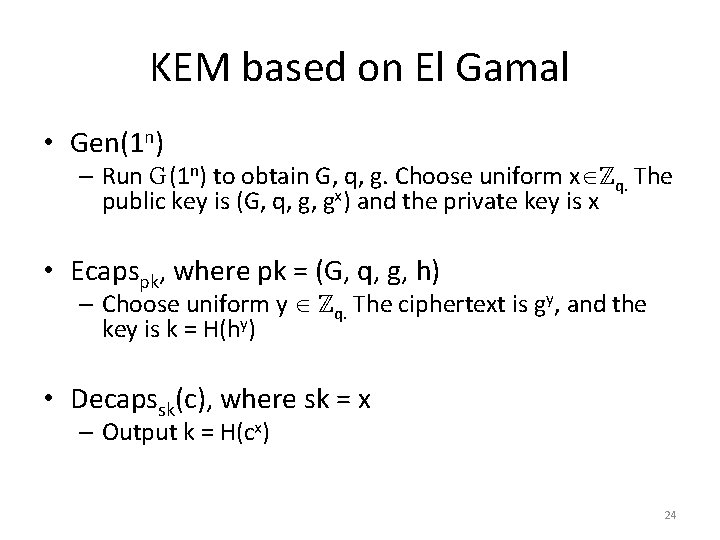
KEM based on El Gamal • Gen(1 n) – Run G(1 n) to obtain G, q, g. Choose uniform x ℤq. The public key is (G, q, g, gx) and the private key is x • Ecapspk, where pk = (G, q, g, h) – Choose uniform y ℤq. The ciphertext is gy, and the key is k = H(hy) • Decapssk(c), where sk = x – Output k = H(cx) 24
Security? • If the DDH assumption holds, and H is modeled as a random oracle, then this KEM is CPA-secure
Complete scheme • Combine the KEM with private-key encryption • I. e. , encryption of message m is gy, Enc’k(m), where k = H(hy) and Enc’ is a symmetric-key encryption scheme – If Enc’ is CPA-secure and H is modeled as a random oracle, this is a CPA-secure public-key encryption scheme
Chosen-ciphertext security • Under stronger assumptions, this approach can be proven to give CCA security – If Enc’ is a CCA-secure symmetric-key scheme • Can at least see why the previous attack no longer works • Standardized as DHIES/ECIES 27
- Slides: 27