
Cryptography Lecture 23 Cyclic groups Let G be
Cryptography Lecture 23
Cyclic groups • Let G be a finite group of order q (written multiplicatively) • Let g be some element of G • Consider the set <g> = {g 0, g 1, …} – We know gq = 1 = g 0, so the set has ≤ q elements – If the set has q elements, then it is all of G ! • In this case, we say g is a generator of G • If G has a generator, we say G is cyclic
Examples • ℤN – Cyclic (for any N); 1 is always a generator: {0, 1, 2, …, N-1} • ℤ 8 – Is 3 a generator? {0, 3, 6, 1, 4, 7, 2, 5} – yes! – Is 2 a generator? {0, 2, 4, 6} – no!
Example • ℤ*11 – Is 3 a generator? {1, 3, 9, 5, 4} – no! – Is 2 a generator? {1, 2, 4, 8, 5, 10, 9, 7, 3, 6} – yes! – Is 8 a generator? {1, 8, 9, 6, 4, 10, 3, 2, 5, 7} – yes! Note that elements appear in a different order from above…
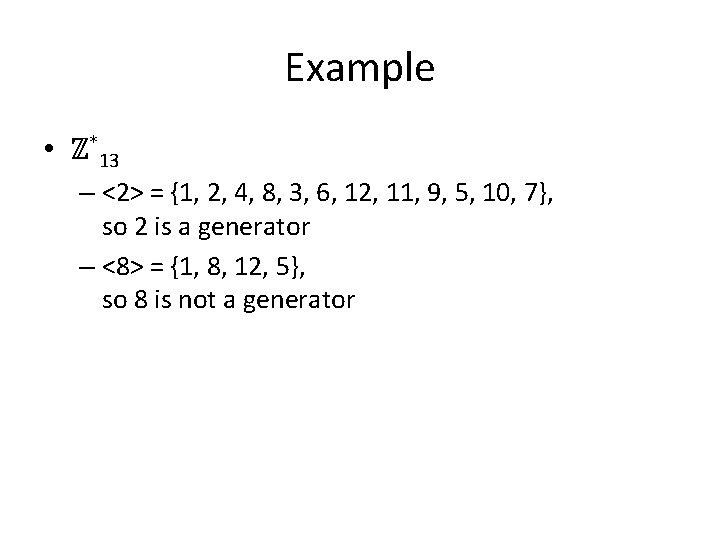
Example • ℤ*13 – <2> = {1, 2, 4, 8, 3, 6, 12, 11, 9, 5, 10, 7}, so 2 is a generator – <8> = {1, 8, 12, 5}, so 8 is not a generator

Important examples • Theorem: Any group of prime order is cyclic, and every non-identity element is a generator • Theorem: If p is prime, then ℤ*p is cyclic – Note: the order is p-1, which is not prime for p > 3
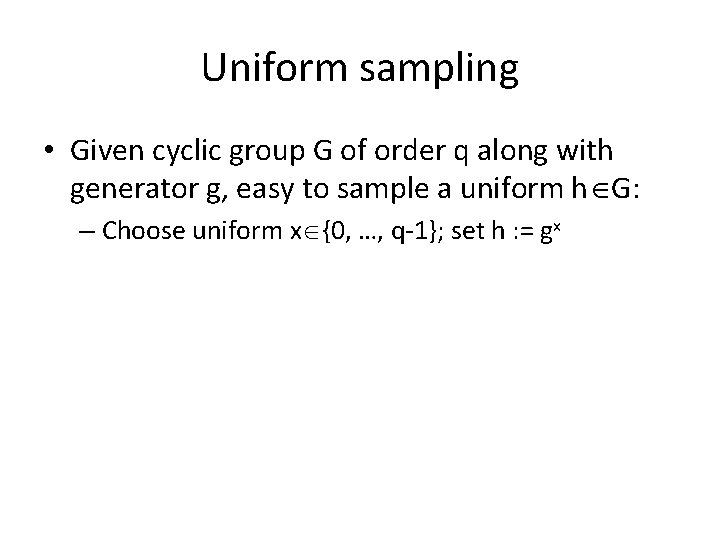
Uniform sampling • Given cyclic group G of order q along with generator g, easy to sample a uniform h G: – Choose uniform x {0, …, q-1}; set h : = gx
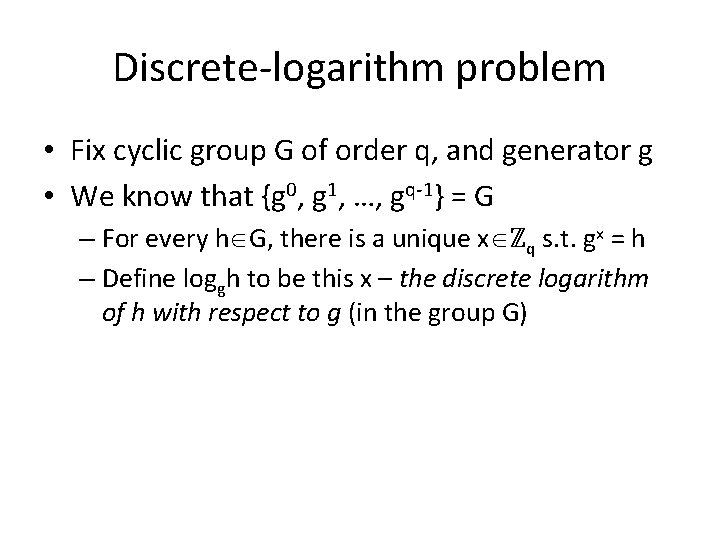
Discrete-logarithm problem • Fix cyclic group G of order q, and generator g • We know that {g 0, g 1, …, gq-1} = G – For every h G, there is a unique x ℤq s. t. gx = h – Define loggh to be this x – the discrete logarithm of h with respect to g (in the group G)
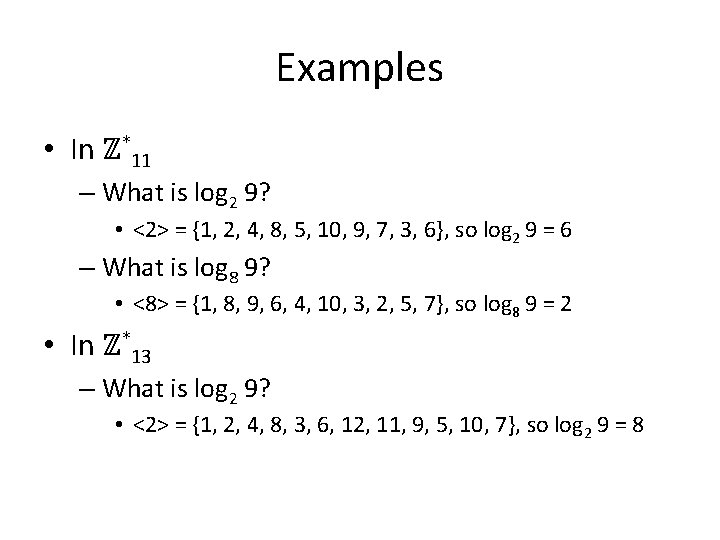
Examples • In ℤ*11 – What is log 2 9? • <2> = {1, 2, 4, 8, 5, 10, 9, 7, 3, 6}, so log 2 9 = 6 – What is log 8 9? • <8> = {1, 8, 9, 6, 4, 10, 3, 2, 5, 7}, so log 8 9 = 2 • In ℤ*13 – What is log 2 9? • <2> = {1, 2, 4, 8, 3, 6, 12, 11, 9, 5, 10, 7}, so log 2 9 = 8
Discrete-logarithm problem (informal) • Dlog problem in G: Given generator g and element h, compute loggh • Dlog assumption in G: Solving the discrete log problem in G is hard
Example • In ℤ*3092091139 – What is log 2 1656755742 ?
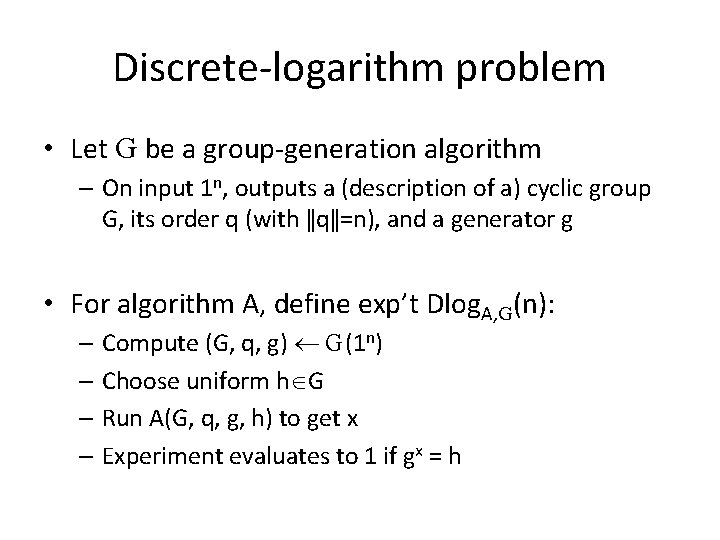
Discrete-logarithm problem • Let G be a group-generation algorithm – On input 1 n, outputs a (description of a) cyclic group G, its order q (with ǁqǁ=n), and a generator g • For algorithm A, define exp’t Dlog. A, G (n): – Compute (G, q, g) G(1 n) – Choose uniform h G – Run A(G, q, g, h) to get x – Experiment evaluates to 1 if gx = h
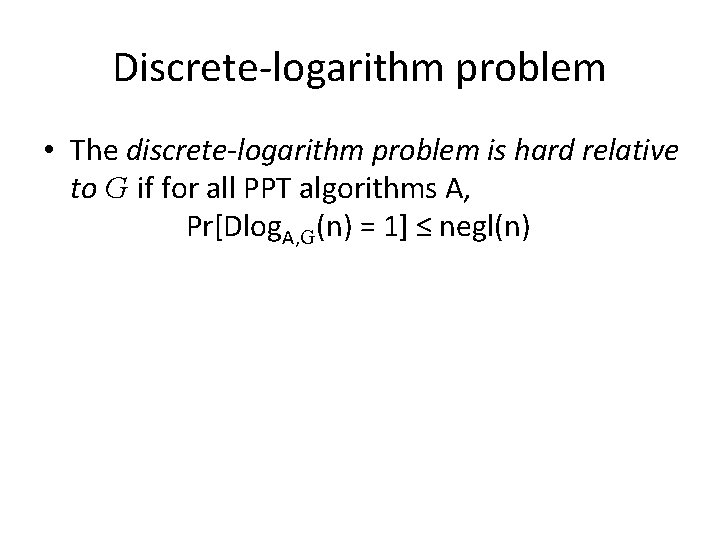
Discrete-logarithm problem • The discrete-logarithm problem is hard relative to G if for all PPT algorithms A, Pr[Dlog. A, G (n) = 1] ≤ negl(n)
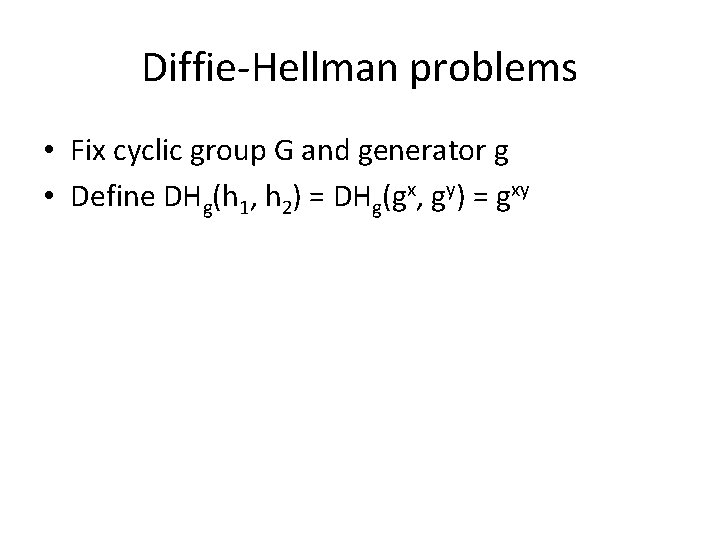
Diffie-Hellman problems • Fix cyclic group G and generator g • Define DHg(h 1, h 2) = DHg(gx, gy) = gxy
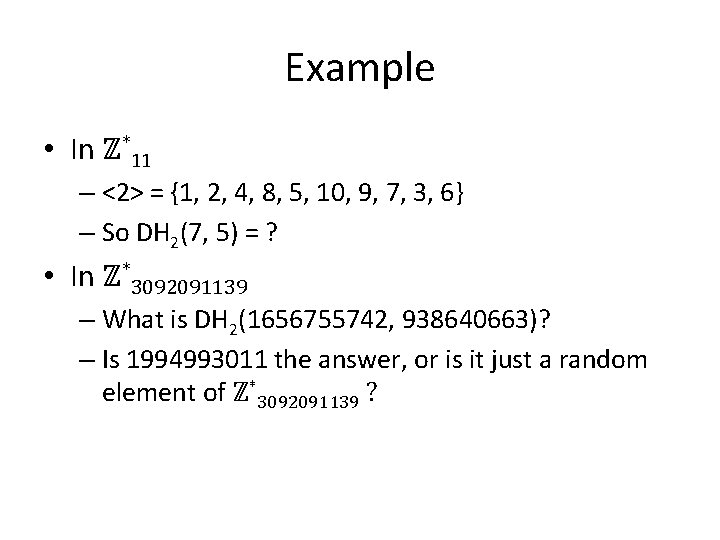
Example • In ℤ*11 – <2> = {1, 2, 4, 8, 5, 10, 9, 7, 3, 6} – So DH 2(7, 5) = ? • In ℤ*3092091139 – What is DH 2(1656755742, 938640663)? – Is 1994993011 the answer, or is it just a random element of ℤ*3092091139 ?
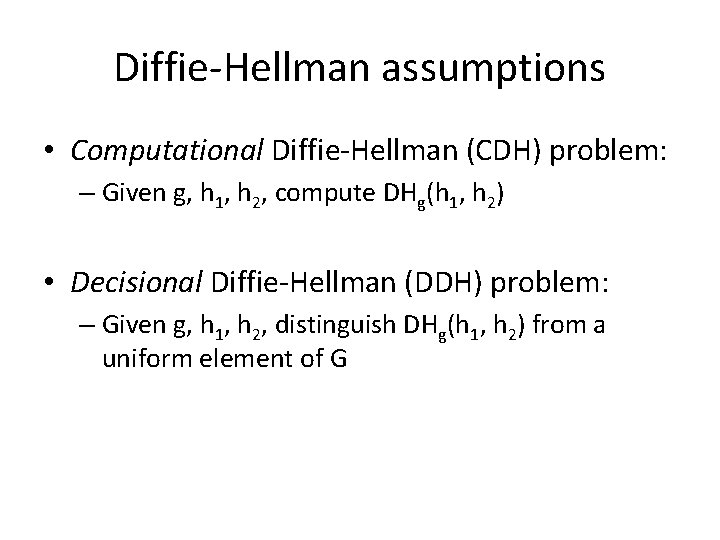
Diffie-Hellman assumptions • Computational Diffie-Hellman (CDH) problem: – Given g, h 1, h 2, compute DHg(h 1, h 2) • Decisional Diffie-Hellman (DDH) problem: – Given g, h 1, h 2, distinguish DHg(h 1, h 2) from a uniform element of G
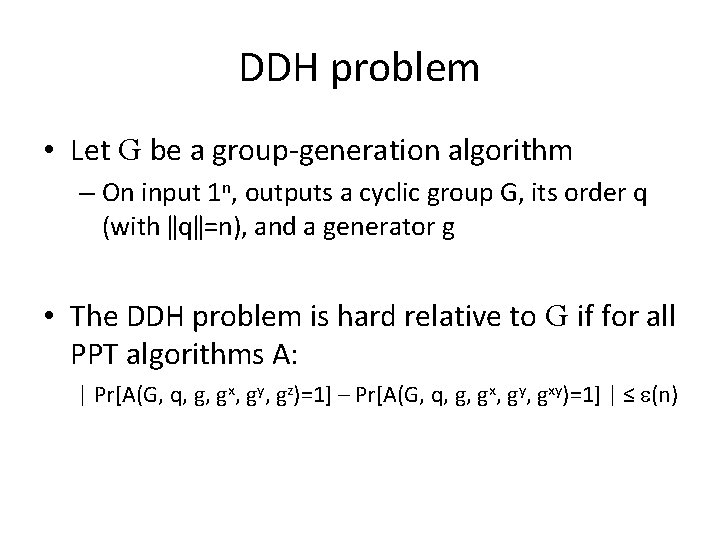
DDH problem • Let G be a group-generation algorithm – On input 1 n, outputs a cyclic group G, its order q (with ǁqǁ=n), and a generator g • The DDH problem is hard relative to G if for all PPT algorithms A: | Pr[A(G, q, g, gx, gy, gz)=1] – Pr[A(G, q, g, gx, gy, gxy)=1] | ≤ (n)
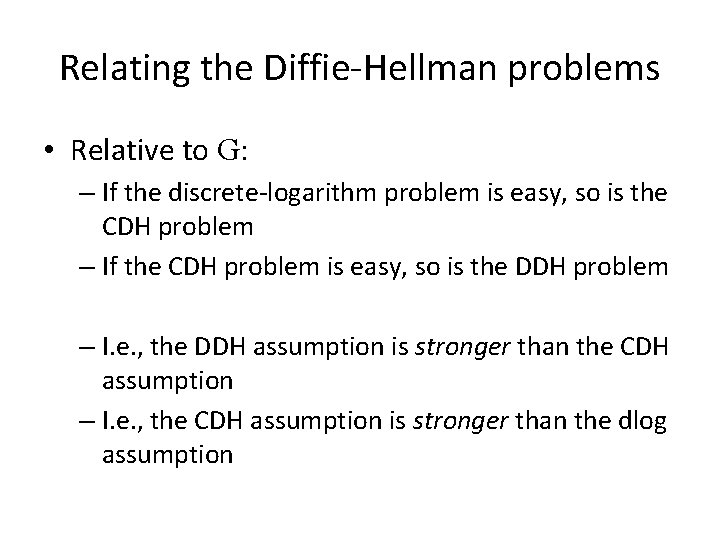
Relating the Diffie-Hellman problems • Relative to G: – If the discrete-logarithm problem is easy, so is the CDH problem – If the CDH problem is easy, so is the DDH problem – I. e. , the DDH assumption is stronger than the CDH assumption – I. e. , the CDH assumption is stronger than the dlog assumption
Group selection • The discrete logarithm is not hard in all groups! – For example, it is easy in ℤN (for any N, and for any generator) • Nevertheless, there are certain groups where the problem is believed to be hard – Note: since all cyclic groups of the same order are isomorphic, the group representation matters!
Group selection • For cryptographic applications, best to use prime-order groups – The dlog problem becomes easier if the order of the group has small prime factors – Prime-order groups have several nice features • E. g. , every element except identity is a generator • Two common choices of groups…
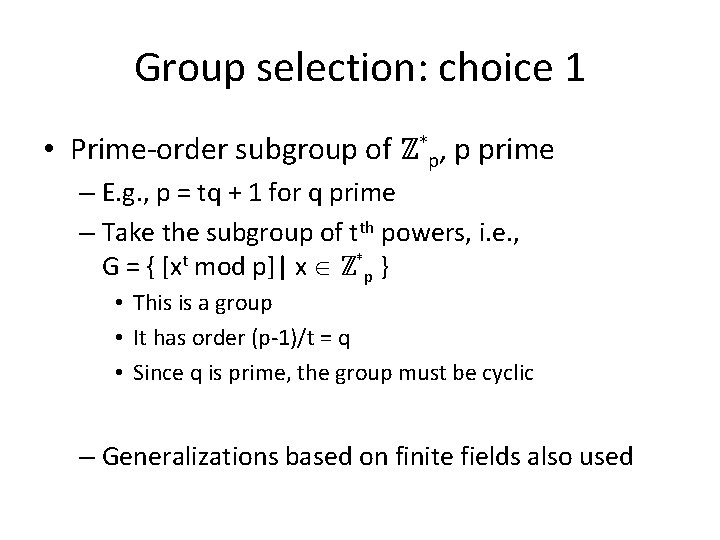
Group selection: choice 1 • Prime-order subgroup of ℤ*p, p prime – E. g. , p = tq + 1 for q prime – Take the subgroup of tth powers, i. e. , G = { [xt mod p]| x ℤ*p } • This is a group • It has order (p-1)/t = q • Since q is prime, the group must be cyclic – Generalizations based on finite fields also used
Group selection: choice 2 • Prime-order subgroup of an elliptic curve group – See book for details…
Group selection • We will describe algorithms in “abstract” groups – Can ignore details of the underlying group in the analysis – Can instantiate with any (appropriate) group for an implementation
- Slides: 23