
Cryptography Lecture 17 Feistel networks Feistel networks Build
Cryptography Lecture 17

Feistel networks
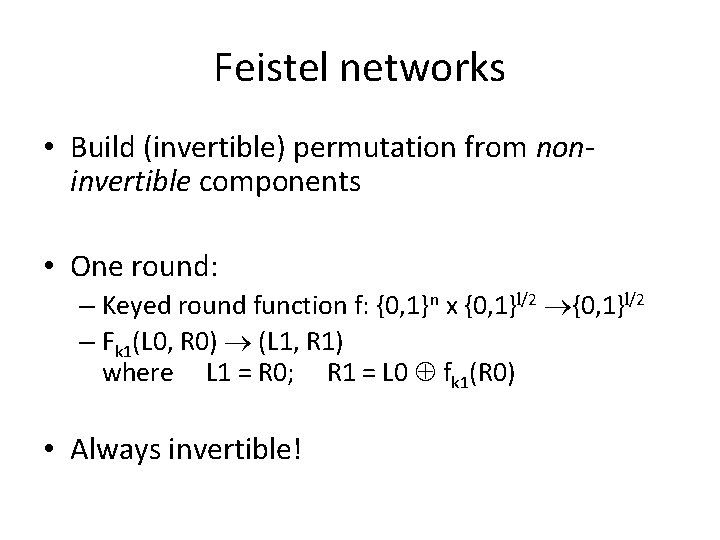
Feistel networks • Build (invertible) permutation from noninvertible components • One round: – Keyed round function f: {0, 1}n x {0, 1}l/2 – Fk 1(L 0, R 0) (L 1, R 1) where L 1 = R 0; R 1 = L 0 fk 1(R 0) • Always invertible!

L 0 L 1 R 0 fk R 1
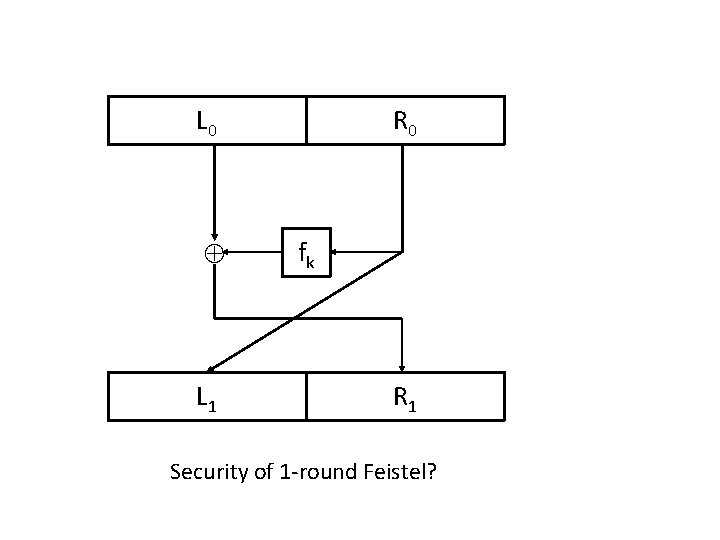
L 0 L 1 R 0 fk R 1 Security of 1 -round Feistel?
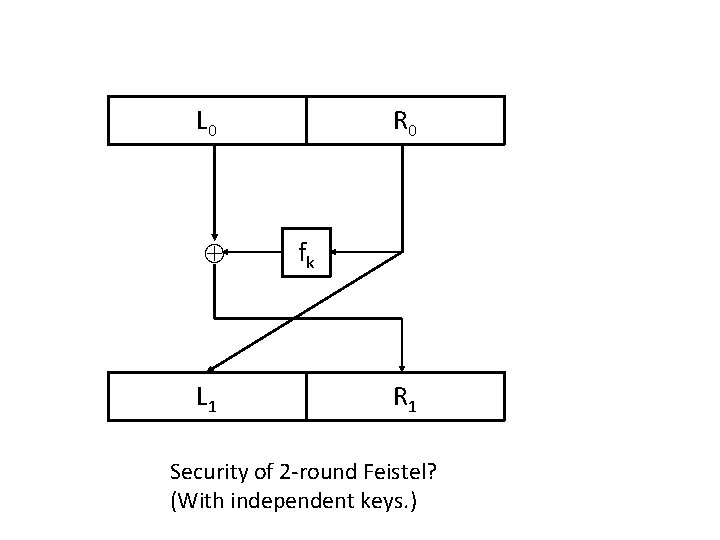
L 0 L 1 R 0 fk R 1 Security of 2 -round Feistel? (With independent keys. )
Security? • Security of 3/4 -round Feistel? – (When round functions are random and independent)
Data Encryption Standard (DES) • Standardized in 1977 • 56 -bit keys, 64 -bit block length • 16 -round Feistel network – Same round function (“mangler function”) in all rounds – Different sub-keys in each round, each derived from the master key – The round function is basically an SPN!

DES mangler function
DES mangler function • S-boxes – Each S-box is 4 -to-1 – Changing 1 bit of input changes at least 2 bits of output • Mixing permutation – The 4 bits of output from any S-box affect the input to 6 S-boxes in the next round
Key schedule • 56 -bit master key, 48 -bit subkey in each round – Each subkey takes 24 bits from the left half of the master key, and 24 bits from the right half of the master key
Avalanche effect • Consider 1 -bit difference in left half of input – After 1 round, 1 -bit difference in right half – S-boxes cause a 2 -bit difference, implying a 3 -bit difference overall after 2 rounds – Mixing permutation spreads differences into different S-boxes –…
Security of DES • DES is extremely well-designed – Except for some attacks that require large amounts of plaintext, no attacks better than brute -force are known • But … parameters are too small!
56 -bit key length • A concern as soon as DES was released • Brute-force search over 256 keys is possible – 1997: 1000 s of computers, 96 days – 1998: distributed. net, 41 days – 1999: Deep Crack ($250, 000), 56 hours – Today: 48 FPGAs, ~1 day
64 -bit block length • Birthday collisions relatively likely • E. g. , encrypt 230 ( 1 billion) records using CTR mode; chances of a collision are 260/264 = 1/16
Increasing key length? • DES has a key that is too short • How to fix? – Design new cipher – Tweak DES so that it takes a larger key – Build new cipher using DES as a black box
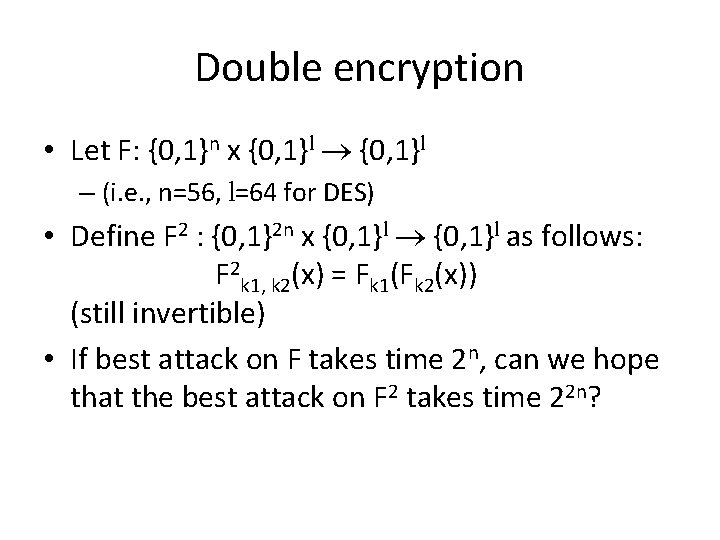
Double encryption • Let F: {0, 1}n x {0, 1}l – (i. e. , n=56, l=64 for DES) • Define F 2 : {0, 1}2 n x {0, 1}l as follows: F 2 k 1, k 2(x) = Fk 1(Fk 2(x)) (still invertible) • If best attack on F takes time 2 n, can we hope that the best attack on F 2 takes time 22 n?
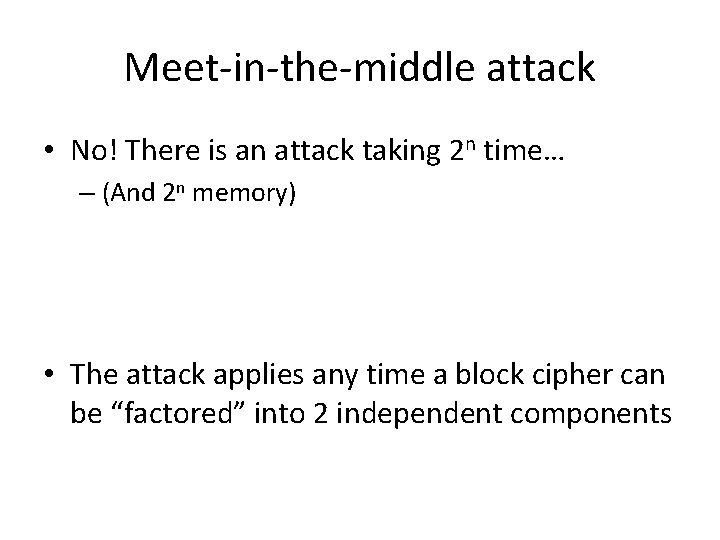
Meet-in-the-middle attack • No! There is an attack taking 2 n time… – (And 2 n memory) • The attack applies any time a block cipher can be “factored” into 2 independent components
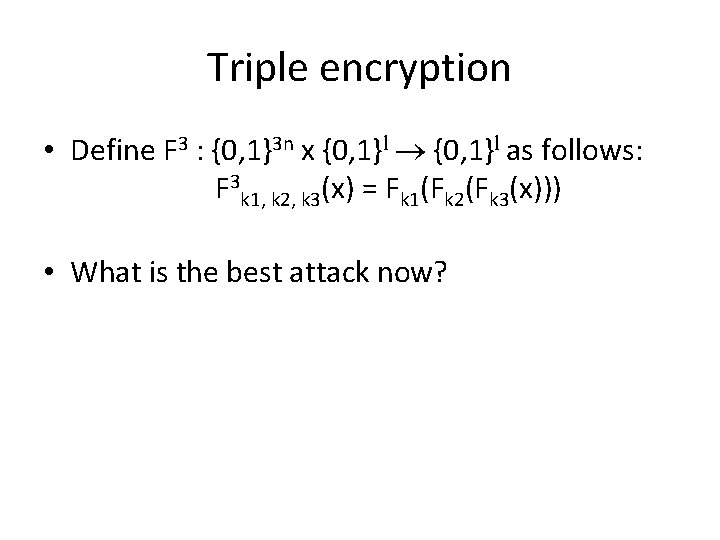
Triple encryption • Define F 3 : {0, 1}3 n x {0, 1}l as follows: F 3 k 1, k 2, k 3(x) = Fk 1(Fk 2(Fk 3(x))) • What is the best attack now?
Two-key triple encryption • Define F 3 : {0, 1}2 n x {0, 1}l as follows: F 3 k 1, k 2(x) = Fk 1(Fk 2(Fk 1(x))) • Best attack takes time 22 n – optimal given the key length! • This approach is taken by triple-DES
Advanced encryption standard (AES) • Public design competition run by NIST • Began in Jan 1997 – 15 algorithms submitted • Workshops in 1998, 1999 – Narrowed to 5 finalists • Workshop in early 2000; winner announced in late 2000 – Factors besides security taken into account
AES • 128 -bit block length • 128 -, 192 -, and 256 -bit key lengths • Basically an SPN structure! – 1 -byte S-box (same for all bytes) – Mixing permutation replaced by invertible linear transformation • If two inputs differ in b bytes, outputs differ in ≥ 5 -b bytes • No attacks better than brute-force known
- Slides: 22