
Cryptography Lecture 15 Summary and review We have

- Slides: 19
Cryptography Lecture 15
Summary and review • We have finished our treatment of private-key schemes! – (Though it will come up again later) • Private-key crypto is used extensively in practice – Arguably more than public-key crypto
So far… • We have seen how to construct schemes based on various lower-level primitives – Stream ciphers/PRGs – Block ciphers/PRFs – Hash functions • How do we construct these primitives?
Two approaches • Construct from even lower-level assumptions – Can prove secure (given lower-level assumption) – Typically inefficient • Build directly – Much more efficient! – Need to assume security, but • We have formal definitions to aim for • We can concentrate our analysis on these primitives • We can develop/analyze various design principles
Stream ciphers/PRGs
Terminology • Init algorithm – Takes as input a key + initialization vector (IV) – Outputs initial state • Get. Bits algorithm – Takes as input the current state – Outputs next bit/byte/chunk and updated state – Allows generation of as many bits as needed
Security requirements • If there is no IV, then (for a uniform key) the output of Get. Bits should be indistinguishable from a uniform, independent stream of bits • If there is an IV, then (for a uniform key) the outputs of Get. Bits on multiple, uniform IVs should be indistinguishable from multiple uniform, independent streams of bits – Even if the attacker is given the IVs
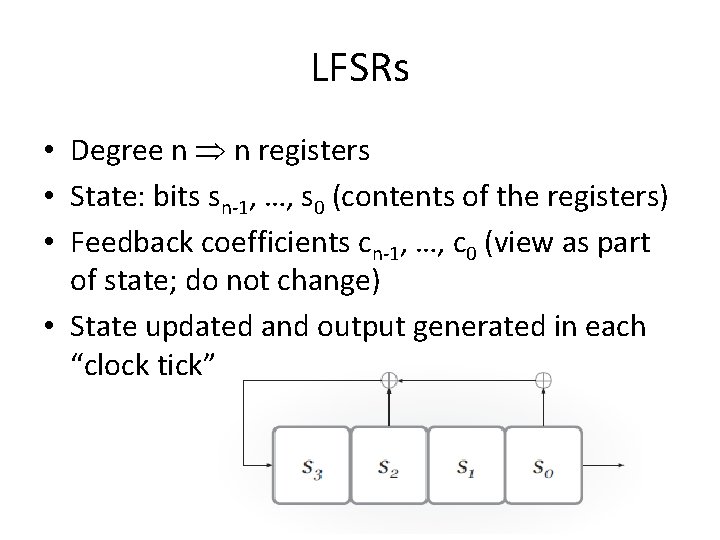
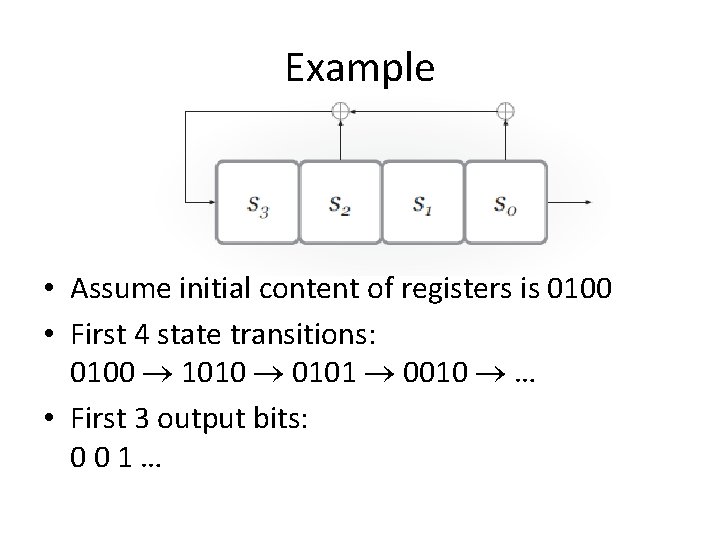
LFSRs • Degree n n registers • State: bits sn-1, …, s 0 (contents of the registers) • Feedback coefficients cn-1, …, c 0 (view as part of state; do not change) • State updated and output generated in each “clock tick”
Example • Assume initial content of registers is 0100 • First 4 state transitions: 0100 1010 0101 0010 … • First 3 output bits: 001…
LFSRs as stream ciphers • Key + IV used to initialize the state of the LFSR (possibly including feedback coefficients) • One bit of output per clock tick – State updated
LFSRs • State (and output) “cycles” if state ever repeated • Maximal-length LFSR cycles through all 2 n - 1 nonzero states – Known how to set feedback coefficients so as to achieve maximal length
LFSRs • Maximal-length LFSRs have good statistical properties… • …but they are not cryptographically secure!
Security? • Are LFSRs secure? • Might hope for 2 n-bit security – n-bit state + n bits to specify feedback – Slightly less if we insist on maximal-length LFSR
LFSRs • If feedback coefficients known, the first n output bits directly reveal the initial state! • Even if feedback coefficients are unknown, can use linear algebra to learn everything from 2 n consecutive output bits • Moral: linearity is bad for cryptography (because linear algebra is so powerful)
Nonlinear FSRs • Add nonlinearity to prevent attacks – Nonlinear feedback – Output is a nonlinear function of the state – Multiple (coupled) LFSRs – …or any combination of the above • Still want to preserve statistical properties of the output, and long cycle length
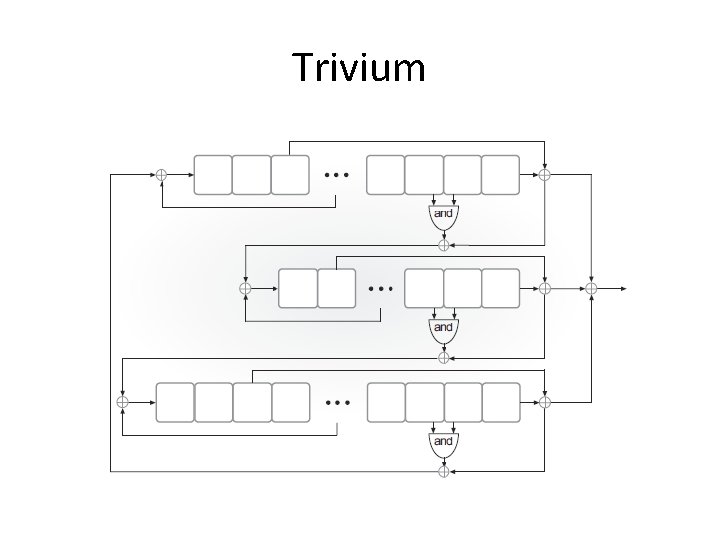
Trivium • Designed by De Cannière and Preneel in 2006 as part of e. STREAM competition • Intended to be simple and efficient (especially in hardware) • Essentially no attacks better than brute-force search are known
Trivium
Trivium • Three FSRs of degree 93, 84, and 111 • Initialization: – 80 -bit key in left-most registers of first FSR – 80 -bit IV in left-most registers of second FSR – Remaining registers set to 0, except for three right -most registers of third FSR – Run for 4 x 288 clock ticks