
Cryptography Lecture 13 Arpita Patra Arpita Patra Recall

![Proof via Hybrid Argument Pr [D(G’(s)) = 1] - Pr [D(r) = 1] <](https://slidetodoc.com/presentation_image/22417ffc42bac54c782974ab19470661/image-12.jpg "Proof via Hybrid Argument Pr [D(G’(s)) = 1] - Pr [D(r) = 1] <")

- Slides: 15
Cryptography Lecture 13 Arpita Patra © Arpita Patra
Recall - One-way Functions (OWF) & One-way Permutations (OWP) o Definition o Do they exist? o Candidate OWFs - Hard-core Predicates of OWF/OWP o Definition o Non-triviality of finding it. o Hard-core predicates from OWF/OWP (Goldreich-Levin Theorem) – partial proof - Roadmap of constructing PRG for poly expansion factor from OWF + Hard-core predicate
Roadmap PRF OWF/P g, hc OWF/P f
Today’s Goal o Construction o Proof
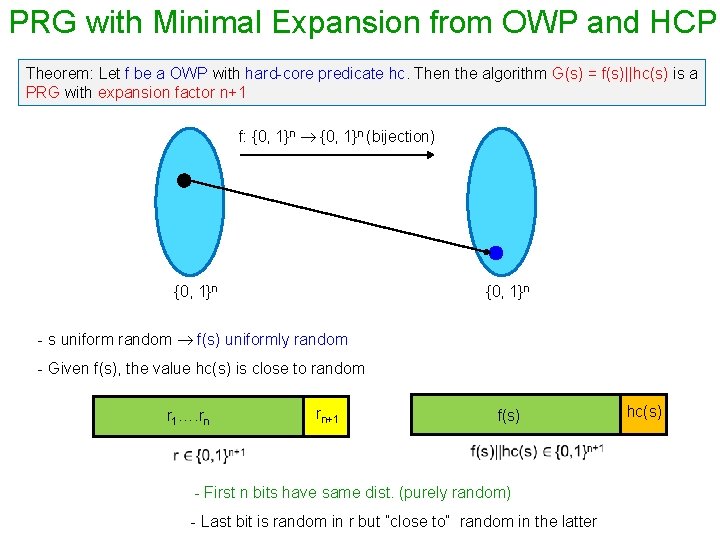
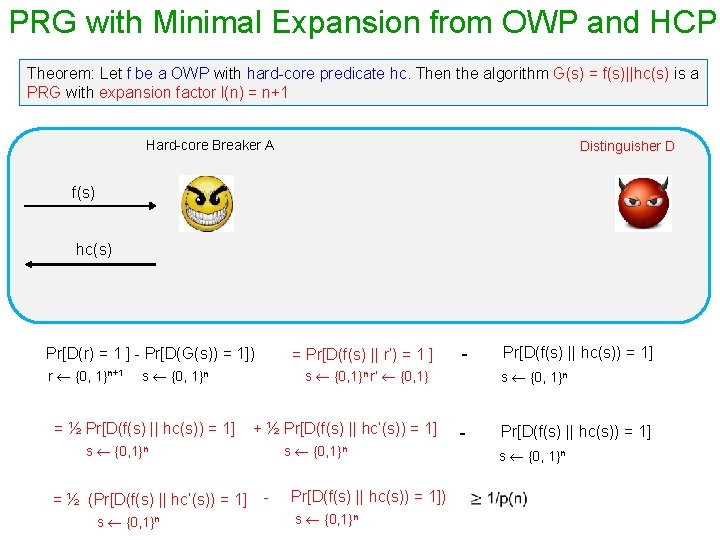
PRG with Minimal Expansion from OWP and HCP Theorem: Let f be a OWP with hard-core predicate hc. Then the algorithm G(s) = f(s)||hc(s) is a PRG with expansion factor n+1 f: {0, 1}n (bijection) {0, 1}n - s uniform random f(s) uniformly random - Given f(s), the value hc(s) is close to random r 1…. rn rn+1 f(s) - First n bits have same dist. (purely random) - Last bit is random in r but ”close to” random in the latter hc(s)
PRG with Minimal Expansion from OWP and HCP Theorem: Let f be a OWP with hard-core predicate hc. Then the algorithm G(s) = f(s)||hc(s) is a PRG with expansion factor l(n) = n+1 Hard-core Breaker A Distinguisher D f(s) hc(s) Pr[D(r) = 1 ] - Pr[D(G(s)) = 1]) r {0, 1}n+1 + ½ Pr[D(f(s) || hc’(s)) = 1] s {0, 1}n = ½ (Pr[D(f(s) || hc’(s)) = 1] s {0, 1}n Pr[D(f(s) || hc(s)) = 1] - s {0, 1}n r’ {0, 1} s {0, 1}n = ½ Pr[D(f(s) || hc(s)) = 1] s = Pr[D(f(s) || r’) = 1 ] - s {0, 1}n Pr[D(f(s) || hc(s)) = 1] - {0, 1}n Pr[D(f(s) || hc(s)) = 1]) s {0, 1}n
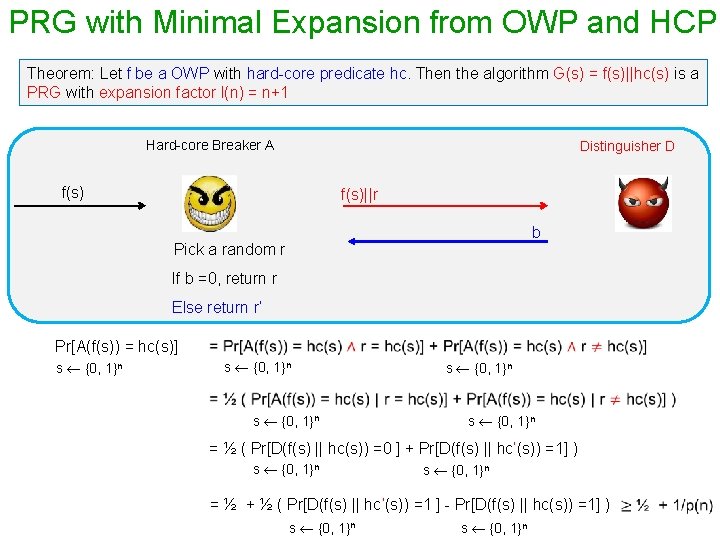
PRG with Minimal Expansion from OWP and HCP Theorem: Let f be a OWP with hard-core predicate hc. Then the algorithm G(s) = f(s)||hc(s) is a PRG with expansion factor l(n) = n+1 Hard-core Breaker A Distinguisher D f(s)||r b Pick a random r If b =0, return r Else return r’ Pr[A(f(s)) = hc(s)] s {0, 1}n s {0, 1}n = ½ ( Pr[D(f(s) || hc(s)) =0 ] + Pr[D(f(s) || hc’(s)) =1] ) s {0, 1}n = ½ + ½ ( Pr[D(f(s) || hc’(s)) =1 ] - Pr[D(f(s) || hc(s)) =1] ) s {0, 1}n
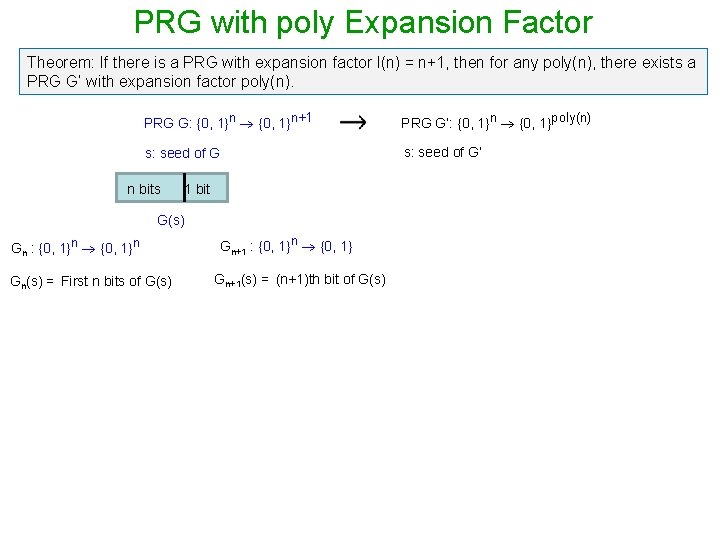
PRG with poly Expansion Factor Theorem: If there is a PRG with expansion factor l(n) = n+1, then for any poly(n), there exists a PRG G’ with expansion factor poly(n). PRG G: {0, 1}n+1 s: seed of G n bits 1 bit G(s) Gn : {0, 1}n Gn(s) = First n bits of G(s) Gn+1 : {0, 1}n {0, 1} Gn+1(s) = (n+1)th bit of G(s) PRG G’: {0, 1}n {0, 1}poly(n) s: seed of G’
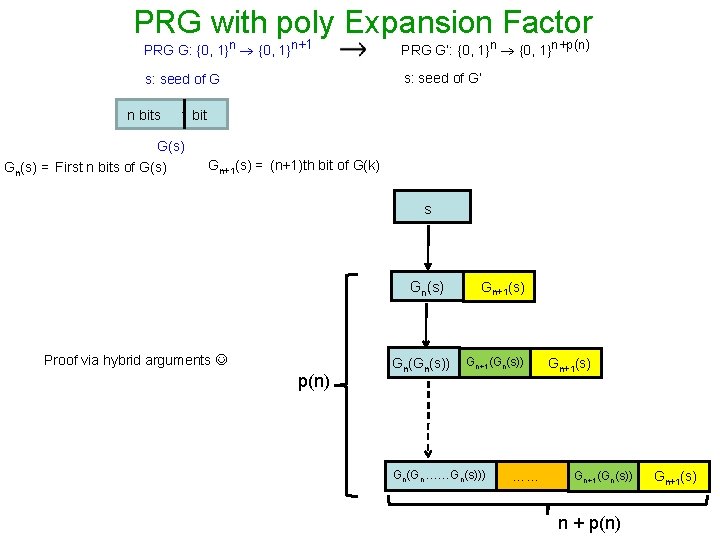
PRG with poly Expansion Factor PRG G: {0, 1}n+1 PRG G’: {0, 1}n+p(n) s: seed of G’ n bits 1 bit G(s) Gn(s) = First n bits of G(s) Gn+1(s) = (n+1)th bit of G(k) s Gn(s) Proof via hybrid arguments p(n) Gn(Gn(s)) Gn+1(s) Gn+1(Gn(s)) Gn(Gn ……Gn(s))) …… Gn+1(s) Gn+1(Gn(s)) n + p(n) Gn+1(s)
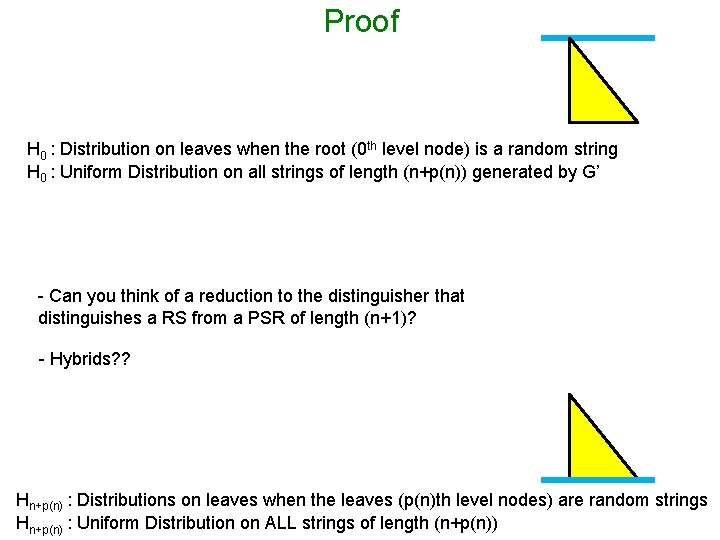
Proof H 0 : Distribution on leaves when the root (0 th level node) is a random string H 0 : Uniform Distribution on all strings of length (n+p(n)) generated by G’ - Can you think of a reduction to the distinguisher that distinguishes a RS from a PSR of length (n+1)? - Hybrids? ? Hn+p(n) : Distributions on leaves when the leaves (p(n)th level nodes) are random strings Hn+p(n) : Uniform Distribution on ALL strings of length (n+p(n))
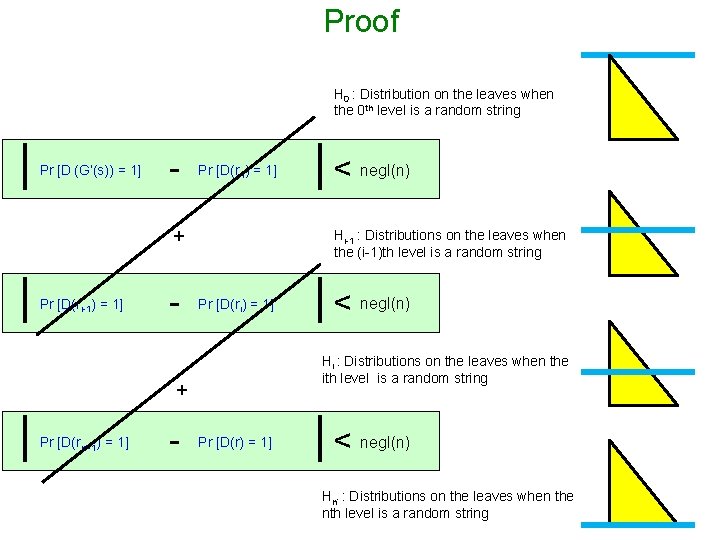
Proof H 0 : Distribution on the leaves when the 0 th level is a random string Pr [D (G’(s)) = 1] - Pr [D(r 1) = 1] + Pr [D(ri-1) = 1] - Hi-1 : Distributions on the leaves when the (i-1)th level is a random string Pr [D(ri) = 1] - < negl(n) Hi : Distributions on the leaves when the ith level is a random string + Pr [D(rn’-1) = 1] < negl(n) Pr [D(r) = 1] < negl(n) Hn’ : Distributions on the leaves when the nth level is a random string
Proof via Hybrid Argument Pr [D(G’(s)) = 1] - Pr [D(r) = 1] < n’. negl(n)
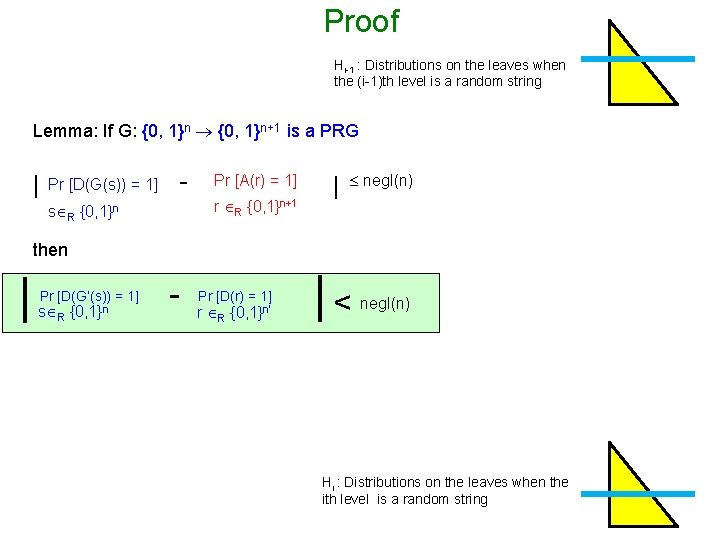
Proof Hi-1 : Distributions on the leaves when the (i-1)th level is a random string Lemma: If G: {0, 1}n+1 is a PRG | - Pr [D(G(s)) = 1] Pr [A(r) = 1] r R {0, 1}n+1 s R {0, 1}n | negl(n) then Pr [D(G’(s)) = 1] s R {0, 1}n - Pr [D(r) = 1] r R {0, 1}n’ < negl(n) Hi : Distributions on the leaves when the ith level is a random string
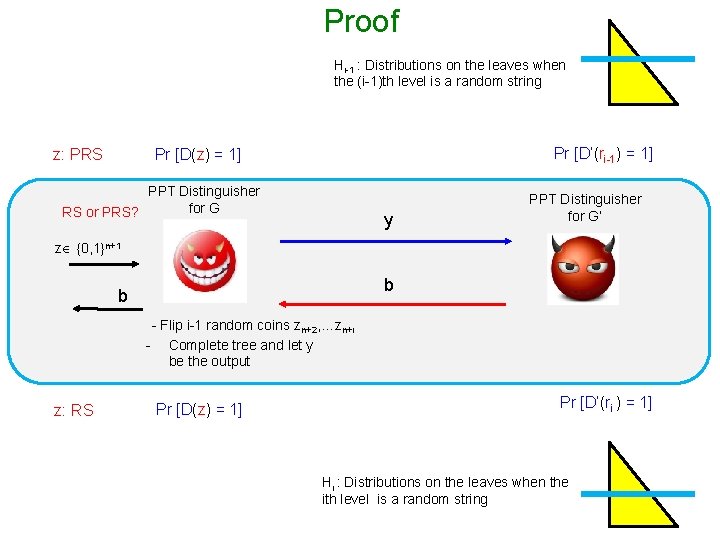
Proof Hi-1 : Distributions on the leaves when the (i-1)th level is a random string z: PRS Pr [D’(ri-1) = 1] Pr [D(z) = 1] PPT Distinguisher for G RS or PRS? y PPT Distinguisher for G’ z {0, 1}n+1 b b - Flip i-1 random coins zn+2, …zn+i - Complete tree and let y be the output z: RS Pr [D(z) = 1] Pr [D’(ri ) = 1] Hi : Distributions on the leaves when the ith level is a random string