
CRYPTOGRAPHY FAILURES PAST PRESENT AND FUTURE Josip Medved

- Slides: 45
CRYPTOGRAPHY FAILURES PAST, PRESENT, AND FUTURE Josip Medved medo 64. com @medo 64
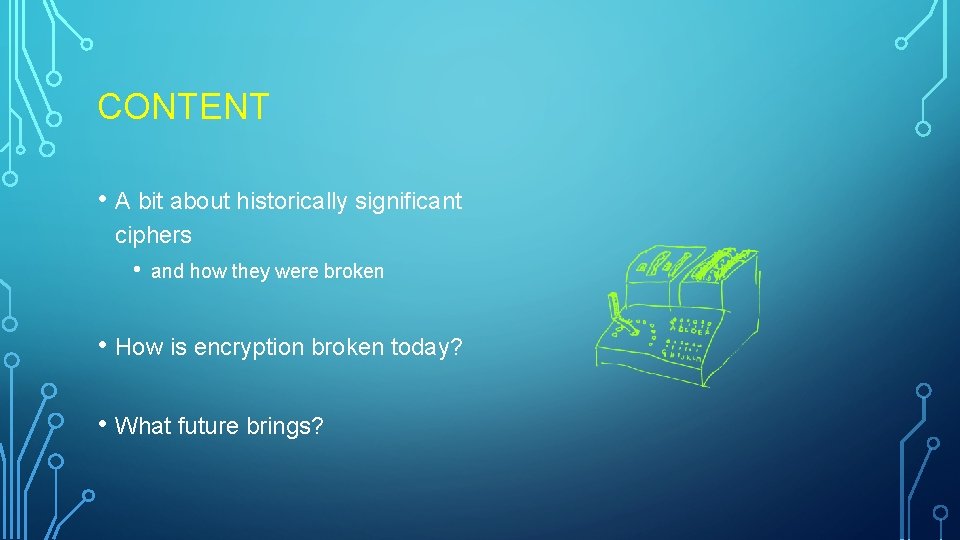
CONTENT • A bit about historically significant ciphers • and how they were broken • How is encryption broken today? • What future brings?
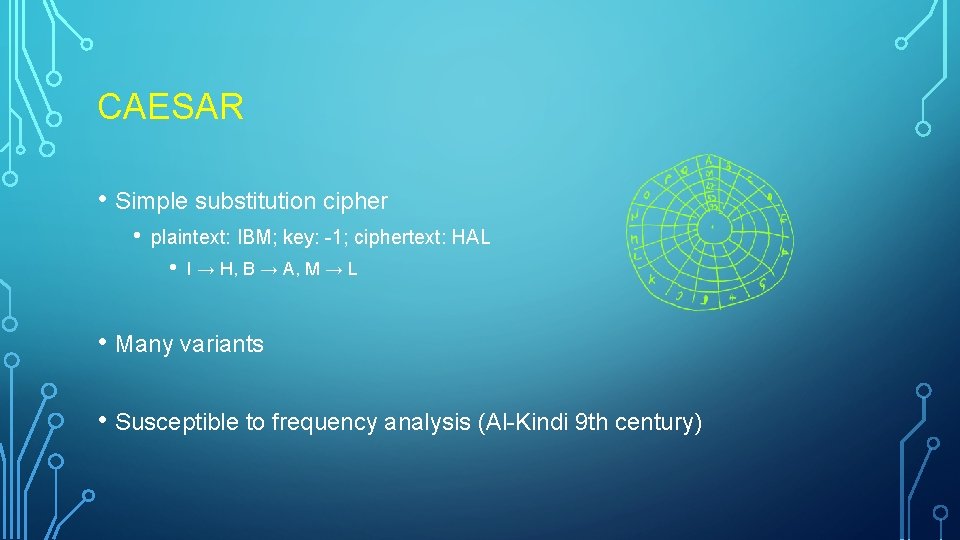
CAESAR • Simple substitution cipher • plaintext: IBM; key: -1; ciphertext: HAL • I → H, B → A, M → L • Many variants • Susceptible to frequency analysis (Al-Kindi 9 th century)
CAESAR: HISTORY • First known usage by Julius Caesar (cca 100 BC) • he also used a bit more complicated one – lost to history • Reasonably secure for the time • Used even in modern times
CAESAR: FAILURE • 2006: • • Bernardo Provenzano (mafia boss) used variation of it A → 4, B → 5, C → 6, . . . caught : ) • 2011: Rajib Karim (terrorist) • • used PGP personally his Bangladeshi partners refused to use program made by “infidels”
CAESAR: LESSONS • Old “software” dies hard : ) • Obfuscation is sometime ok • just don’t use it for anything important • Security is only as good as the weakest link • friends don’t let friends use weak ciphers
VIGENÈRE • Polyalphabetic substitution • plaintext: ABCD; key: KEY; ciphertext: KFAN • A → K, B → F, C → A, D → N
VIGENÈRE: HISTORY • First described by Giovan Battista Bellaso in 1553 • Called “Le chiffre indéchiffrable” • Friedrich Kasiski solved it in 1863 • Charles Babbage broke it as early as 1846
VIGENÈRE: FAILURE • 1892: Anarhists used variant called Gronsfeld/Beaufort • essentially just used letter/number combination
VIGENÈRE: LESSONS • Just because it looks undecipherable, it isn’t necessarily safe
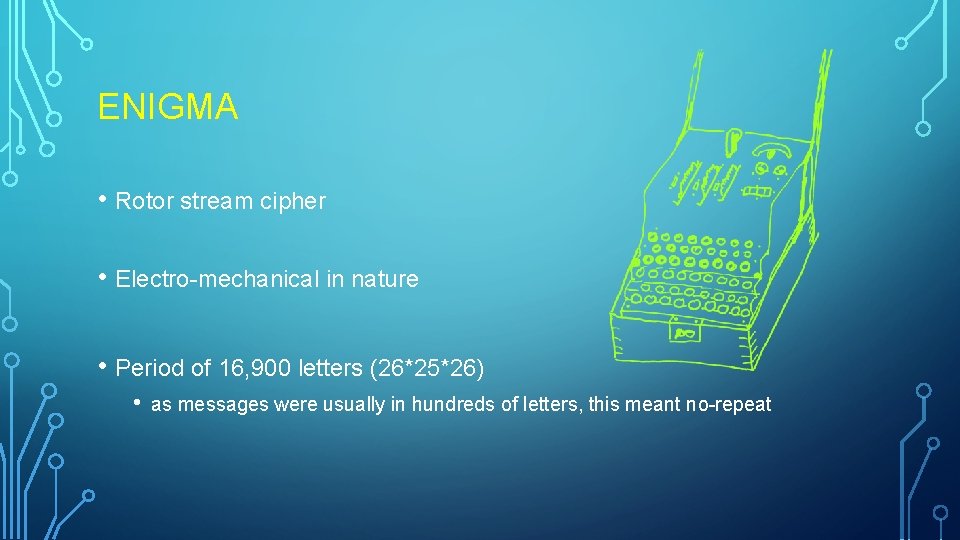
ENIGMA • Rotor stream cipher • Electro-mechanical in nature • Period of 16, 900 letters (26*25*26) • as messages were usually in hundreds of letters, this meant no-repeat
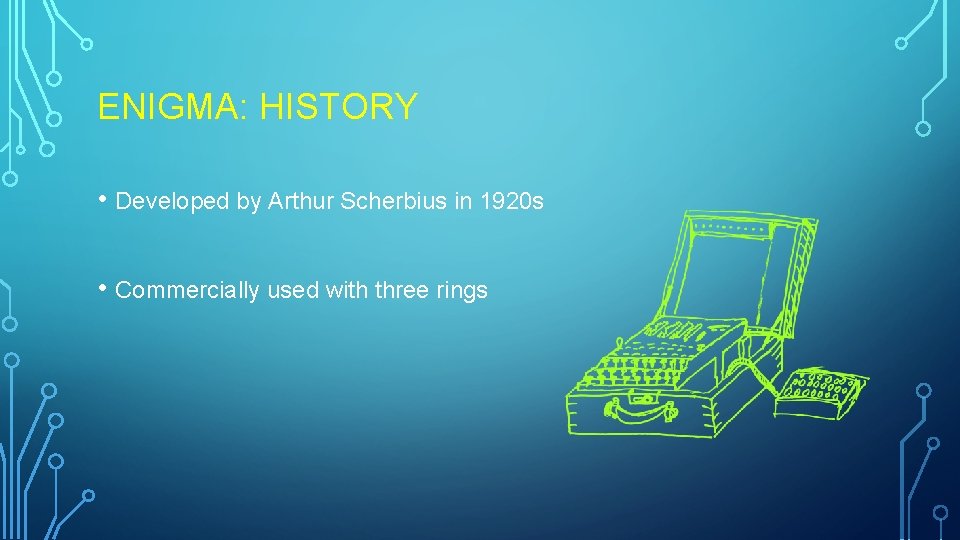
ENIGMA: HISTORY • Developed by Arthur Scherbius in 1920 s • Commercially used with three rings
ENIGMA: FAILURE • Math behind enigma was cracked by Marian Rejewski in 1932 • This didn’t actually break anything • Actual breaking happened later that year • French spy Hans-Thilo Schmidt obtained daily keys • British cracked five-rotor machine in Bletchley Park in 1941
ENIGMA: LESSONS • Output must be random • Correlations are killer • Bigger key space makes a difference • Attack on partial rounds can always be expanded
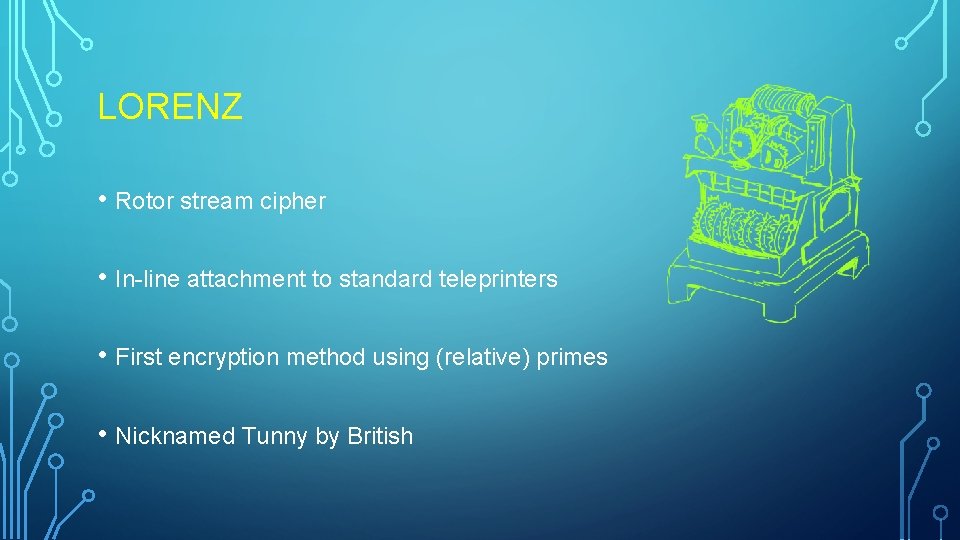
LORENZ • Rotor stream cipher • In-line attachment to standard teleprinters • First encryption method using (relative) primes • Nicknamed Tunny by British
LORENZ: HISTORY • Based on work by Gilbert Vernam at AT&T Bell Labs in 1917 • XOR baby! • First experimental link (SZ 40) in June 1941 • Used for army communications from mid-1942 • with variants SZ 42 A and later SZ 42 B
LORENZ: FAILURE • 4000 character message sent in August 1941 from Athens to Vienna • • • receiving operator asked for repeat sending operator repeated message with the same key but slight abbreviations both plain texts were extracted together with their key • Bill Tutte discovered 41 -character repetition pattern • most of team working with him later worked on Enigma
LORENZ: LESSONS • Don’t encrypt different plaintext with the same key • EVER • Don’t leak encryption state information • Unencrypted header accompanied Lorenz traffic • Don’t get fancy
MD-5 • Designed by Roland Rivest in 1991 • 128 -bit hash
MD-5: HISTORY • 1993: pseudo-collision • 1996: first full collision is found • 2004: distributed birthday attack • 2005: document content collision • 2008: changing end-certificate to intermediate CA • 2010: first single-block collision published • 2013: second single-block collision – published with source and documentation
MD-5: ATTACKS • 2012: Flame malware forged Windows update certificate
MD-5: LESSONS • Allow algorithms to change over time • quite a few applications had 16 bytes for hash hardcoded • Replace algorithms early • • • Symantec phased MD-5 out starting in 2009 Microsoft phased MD-5 certificates in 2014 still often used in anti-virus industry
SHA-1 • Designed as part of US government Capstone project • • authored by NSA original implementation (now called SHA-0) was slightly corrected • Published in 1995 • 160 -bit
SHA-1: HISTORY • 2005: reduced version attack (53 rounds) • 2006: two-block collision • 2010: single-block attack extended to 73 • 2015: first full collision (aka SHAppening) • 2017: first public collision (aka SHAttered) • 2017: SSL certificates not accepted by major browsers
SHA-1: LESSONS • Allow algorithms to change over time • quite a few applications had 20 bytes for hash hardcoded • Replace algorithms early • • Major browsers abandoning only in 2017 Still often used
HOW ATTACKS LOOK THESE DAYS?
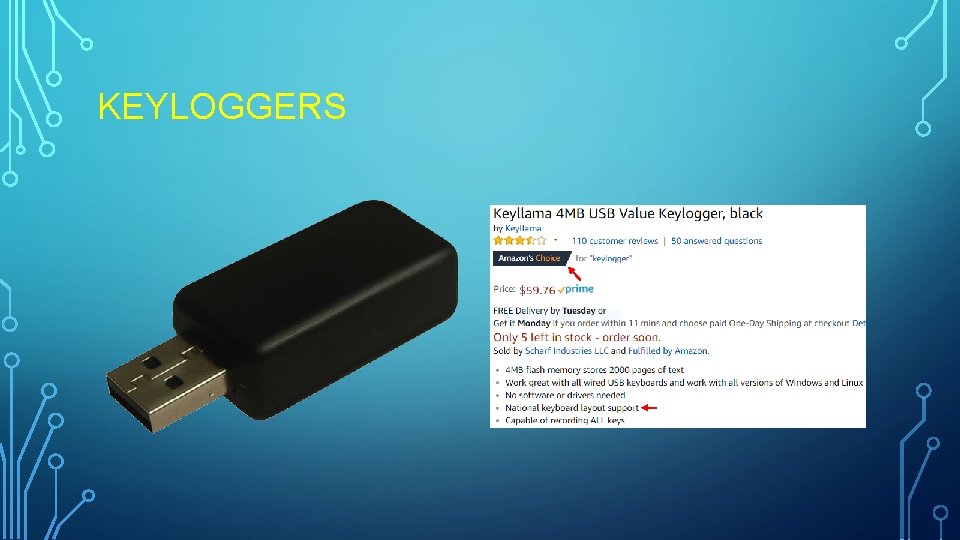
KEYLOGGERS
KEYLOGGERS • Software keyloggers are easier • FBI Magic Lantern (as of 2001) • also captures web history, network ports, and passwords stored • CIPAV (Computer and Internet Protocol Address Verifier, as of 2007) • captures location information and IP addresses computer connects to
NICODEMO SALVATORE SCARFO • Used encryption! • 1999 • Used dial-up! • • Cosa nostra 14 years in prison • remote connection unlikely • FBI broke into his offices twice : )
LARRY ROPP • KEYKatcher • 2004 • Did not violate federal wire-tap law • Spied on his employer • Dismissed
JOSH GLAZEBROOK • Handwritten notes • 2007 • Washington school bomb threats • Anonymous e-mail • Anonymous My. Space profile • Anonymous VPN • 90 days in custody • FBI installed CIPAV on My. Space profile
KEYLOGGERS: ADVICE • Check occasionally for rogue USB devices • Watch what you click • Think about reinstalling your computer from time to time • Cover camera?
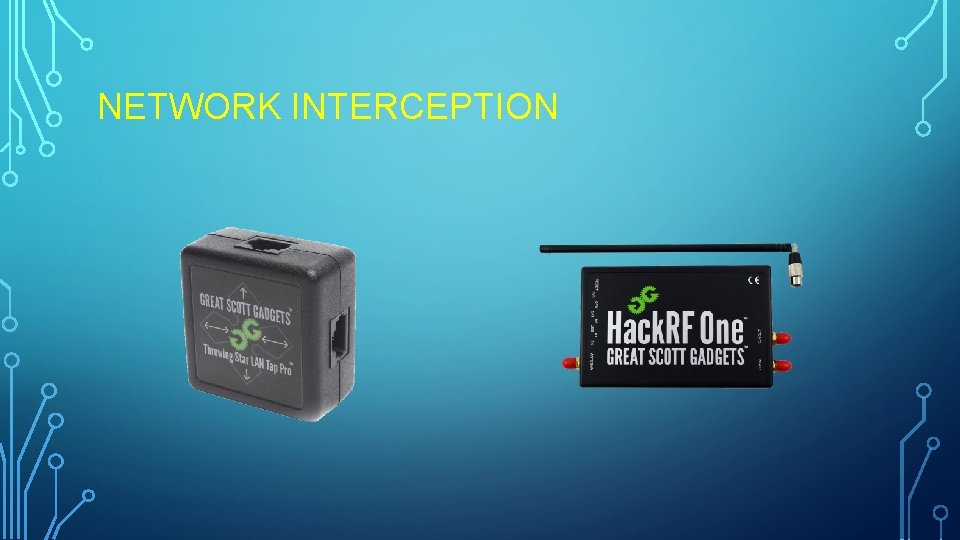
NETWORK INTERCEPTION
NETWORK INTERCEPTION • Useful for pen-testing • You get it for free on public wireless • Western District of Pennsylvania • • available to attorneys, other legal staff and the media in terms: “we reserve the right to log or monitor traffic”
GOGO INFLIGHT • Issues fake SSL certificates • 2016 • “to better serve consumer” • Man-in-the-middle attack • • throttling, naughty site protection. . . and CALEA • Nothing to see here – part of privacy policy
STARBUCKS* • Public Wi. Fi was hacked • 2017 • Customer laptops were taken over by • Man-in-the-middle attack * Starbucks were not actually involved – just their store rogue Java. Script • Monero mining
VPNFILTER • Targets devices using Modbus protocol • 2018 • Russian botnet • • Fancy bear group : ) Seized by FBI • industrial hardware control • 500, 000 devices infected • 50 ish router models • Asus, D-Link, Huawei, Linksys, Mikrotik, Netgear, QNAP, TP-Link, Ubiquity, Upvel, ZTE
NETWORK INTERCEPTION: ADVICE • Always use VPN on public networks • Make sure your internal communication is encrypted too • Update firmware regularly
BACKDOORS • Accidental • Debian’s Open. SSL issue in 2008 • Intentional • elliptic curve RNG • Hardware-based
DEBIAN OPENSSL • Bug limited number of keys to 32, 768 • Broken in 2006 • Also present on Debian’s derivative • Fixed in 2008 • e. g. Ubuntu • Probably some of these keys are present today too
DUAL_EC_DRBG • Weakened encryption • Published in 2006 • Withdrawn in 2014 • non-transparently chosen initial state • Default in BSAFE • by RSA Security • Non-default in many more
SIMON AND SPECK • Lightweight block ciphers • Created in 2013 • Optimized for Io. T • Rejected by ISO in 2018
BACKDOORS: ADVICE • Trust no one? • Update software regularly • Update firmware regularly • Physical security is important
FUTURE • Io. T encryption algorithms • primary goal is to have it run on weak hardware • Quantum computers • • Making RSA obsolete Politics
THANK YOU Josip Medved medo 64. com @medo 64