
Cryptography CS 555 Topic 17 Textbook RSA encryption
Cryptography CS 555 Topic 17: Textbook RSA encryption CS 555 Spring 2012/Topic 17 1
Outline and Readings • Outline • One-way functions • RSA • Readings: • Katz and Lindell: Chapter 6. 0, 6. 1. 1, 6. 1. 2, 7. 2 CS 555 Spring 2012/Topic 17 2
Towards One-Way Function • We know how to use Pseudo-Random Generator (PRG) and Pseudo-Random Function (PRF) to construct encryption schemes and MAC. • We know what algorithms that are used in practice in instantiate PRG and PRF. – But we cannot prove that they are PRG or PRF; we can only assume that they are • Can we prove that some constructions are PRG or PRF based on something else? CS 555 Spring 2012/Topic 17 3
One-Way Function • A function f is one-way if – It is easy to compute – It is hard to invert, that is, given y=f(x), where x is randomly chosen, it is difficult to find x’ such that f(x’)=y • A one-way permutation is length-preserving (input and output have the same size) and one-to -one. • Candidates for one-way functions – Multiplication: f(x, y) = xy CS 555 Spring 2012/Topic 17 4
Relationship of One-Way Functions and Cryptography • Secure encryption and MAC schemes imply/require the existence of one-way functions • Given a one-way function, one can construct PRG, PRF, PRP – Thus one can construct secure encryption and MAC schemes – Details are more suitable for 655 • One-way functions are foundation of modern cryptography theory CS 555 Spring 2012/Topic 17 5
Trapdoor One-way Functions Definition: A function f: {0, 1}* is a trapdoor oneway function iff f(x) is a one-way function; however, given some extra information it becomes feasible to compute f-1: given y, find x s. t. y = f(x) CS 555 Spring 2012/Topic 17 6
Public-Key Encryption Needs One-way Trapdoor Functions • Given a public-key crypto system, – Alice has public key K – EK must be a one-way function, knowing y= EK[x], it should be difficult to find x – However, EK must not be one-way from Alice’s perspective. The function EK must have a trapdoor such that knowledge of the trapdoor enables one to invert it CS 555 Spring 2012/Topic 17 7
RSA Algorithm • Invented in 1978 by Ron Rivest, Adi Shamir and Leonard Adleman – Published as R L Rivest, A Shamir, L Adleman, "On Digital Signatures and Public Key Cryptosystems", Communications of the ACM, vol 21 no 2, pp 120 -126, Feb 1978 • Security relies on the difficulty of factoring large composite numbers • Essentially the same algorithm was discovered in 1973 by Clifford Cocks, who works for the British intelligence CS 555 Spring 2012/Topic 17 8
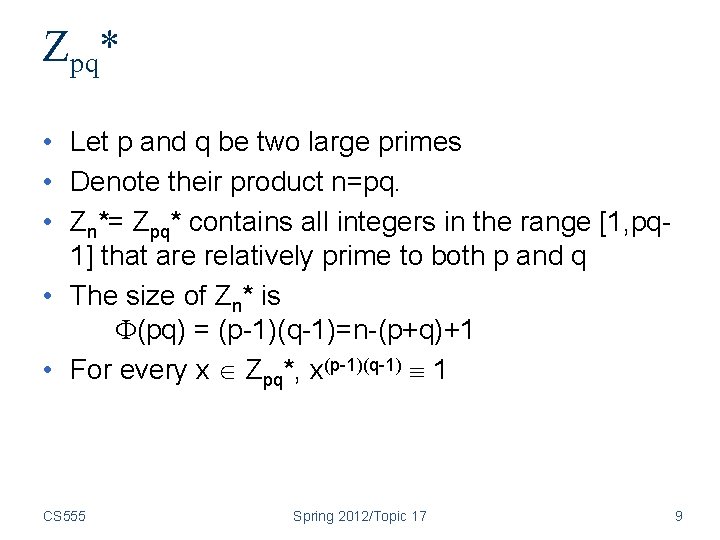
Zpq* • Let p and q be two large primes • Denote their product n=pq. • Zn*= Zpq* contains all integers in the range [1, pq 1] that are relatively prime to both p and q • The size of Zn* is (pq) = (p-1)(q-1)=n-(p+q)+1 • For every x Zpq*, x(p-1)(q-1) 1 CS 555 Spring 2012/Topic 17 9
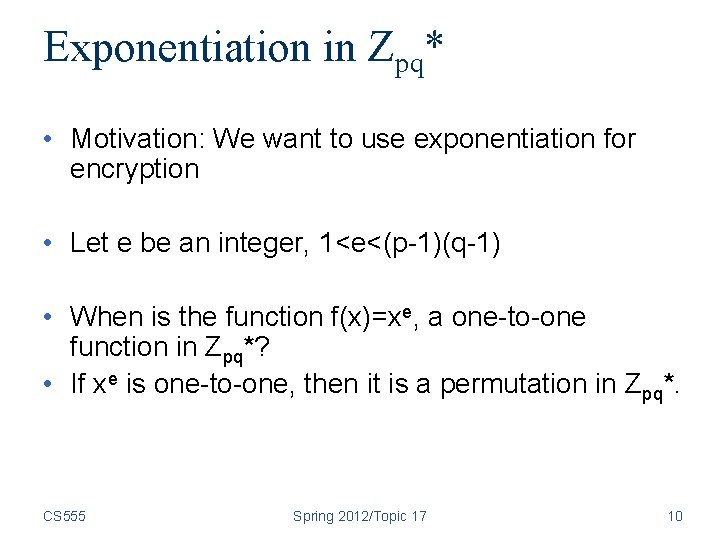
Exponentiation in Zpq* • Motivation: We want to use exponentiation for encryption • Let e be an integer, 1<e<(p-1)(q-1) • When is the function f(x)=xe, a one-to-one function in Zpq*? • If xe is one-to-one, then it is a permutation in Zpq*. CS 555 Spring 2012/Topic 17 10
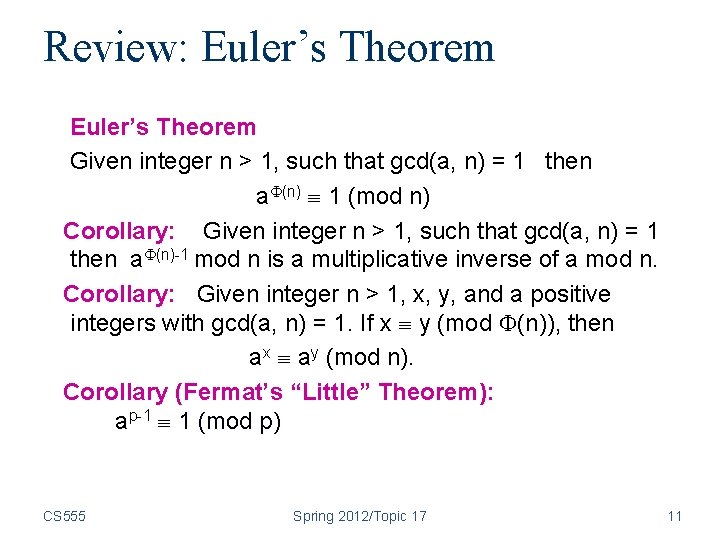
Review: Euler’s Theorem Given integer n > 1, such that gcd(a, n) = 1 then a (n) 1 (mod n) Corollary: Given integer n > 1, such that gcd(a, n) = 1 then a (n)-1 mod n is a multiplicative inverse of a mod n. Corollary: Given integer n > 1, x, y, and a positive integers with gcd(a, n) = 1. If x y (mod (n)), then ax ay (mod n). Corollary (Fermat’s “Little” Theorem): ap-1 1 (mod p) CS 555 Spring 2012/Topic 17 11
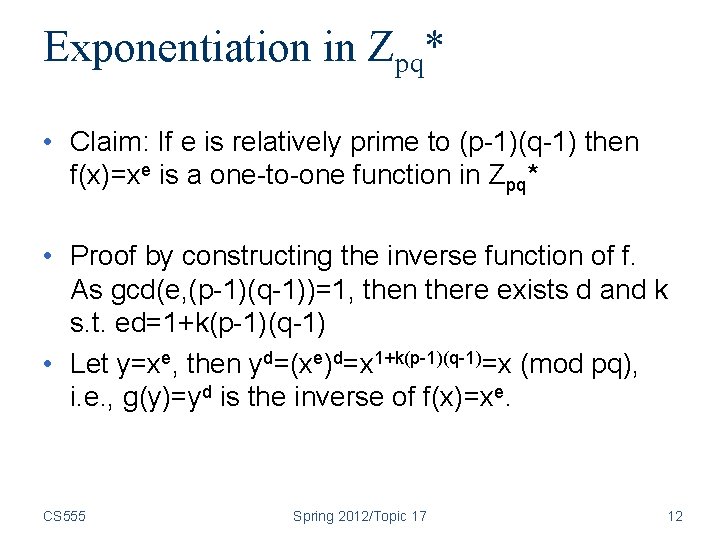
Exponentiation in Zpq* • Claim: If e is relatively prime to (p-1)(q-1) then f(x)=xe is a one-to-one function in Zpq* • Proof by constructing the inverse function of f. As gcd(e, (p-1)(q-1))=1, then there exists d and k s. t. ed=1+k(p-1)(q-1) • Let y=xe, then yd=(xe)d=x 1+k(p-1)(q-1)=x (mod pq), i. e. , g(y)=yd is the inverse of f(x)=xe. CS 555 Spring 2012/Topic 17 12
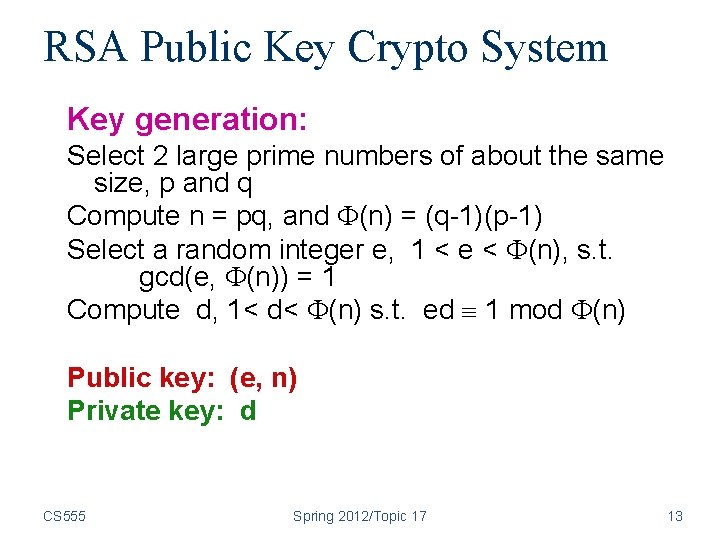
RSA Public Key Crypto System Key generation: Select 2 large prime numbers of about the same size, p and q Compute n = pq, and (n) = (q-1)(p-1) Select a random integer e, 1 < e < (n), s. t. gcd(e, (n)) = 1 Compute d, 1< d< (n) s. t. ed 1 mod (n) Public key: (e, n) Private key: d CS 555 Spring 2012/Topic 17 13
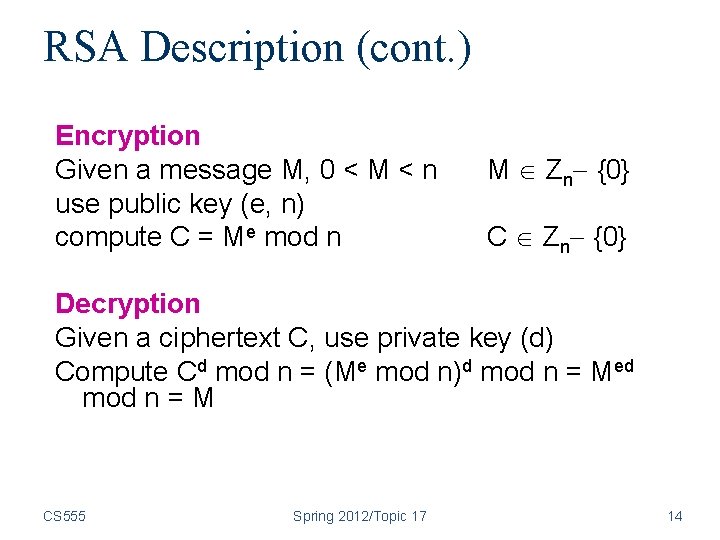
RSA Description (cont. ) Encryption Given a message M, 0 < M < n use public key (e, n) compute C = Me mod n M Zn {0} C Zn {0} Decryption Given a ciphertext C, use private key (d) Compute Cd mod n = (Me mod n)d mod n = Med mod n = M CS 555 Spring 2012/Topic 17 14
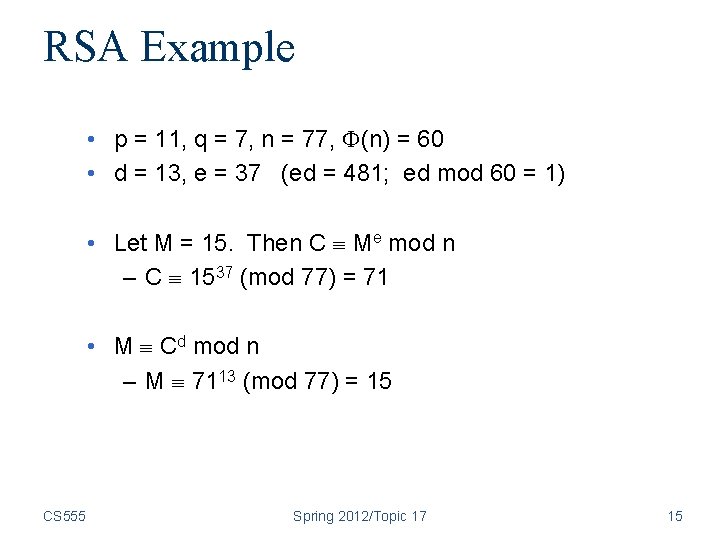
RSA Example • p = 11, q = 7, n = 77, (n) = 60 • d = 13, e = 37 (ed = 481; ed mod 60 = 1) • Let M = 15. Then C Me mod n – C 1537 (mod 77) = 71 • M Cd mod n – M 7113 (mod 77) = 15 CS 555 Spring 2012/Topic 17 15
Coming Attractions … • RSA Security • Prime number generation • Reading: Katz & Lindell: 7. 2 CS 555 Spring 2012/Topic 17 16
- Slides: 16