
Cryptography CS 555 Topic 15 HMAC Combining Encryption
Cryptography CS 555 Topic 15: HMAC, Combining Encryption & Authentication CS 555 Spring 2012/Topic 15 1
Outline and Readings • Outline • • Hash Family NMAC and HMAC CCA-secure encryption Combining encryption & authentication • Readings: • Katz and Lindell: : 4. 7, 4. 8, 4. 9 CS 555 Spring 2012/Topic 15 2
Hash Family (Called Hash Function in the Textbook) • A hash family H is a function K X Y – – – X is a set of possible messages Y is a finite set of possible message digests K is the keyspace For each s K, there is a hash function hs H. Here, it is typically assumed that s is made public • Unlike when we analyze a PRF • Hash functions in practice (SHA-1, SHA-2) can be viewed as hash family, where the IV is viewed as the key CS 555 Spring 2012/Topic 15 3
Collision Resistant Hash Family • A Hash family is collision resistant if no adversary has negligible advantage in the following experiment: – A key s is generated. – Adversary is given s, and needs to find a collision on hs , that is find x 1, x 2 such that hs(x 1)=hs(x 2) • A random hash function is chosen, and the adversary needs to produce a collision on that • Advantage of using the concept of collision resistant hash family instead of a collision resistant hash function – Now it makes sense to assume that there is no adversary algorithm can produce collision. – Why it does not make sense to say that there exists no algorithm to produce a collision on a fixed hash function? CS 555 Spring 2012/Topic 15 4
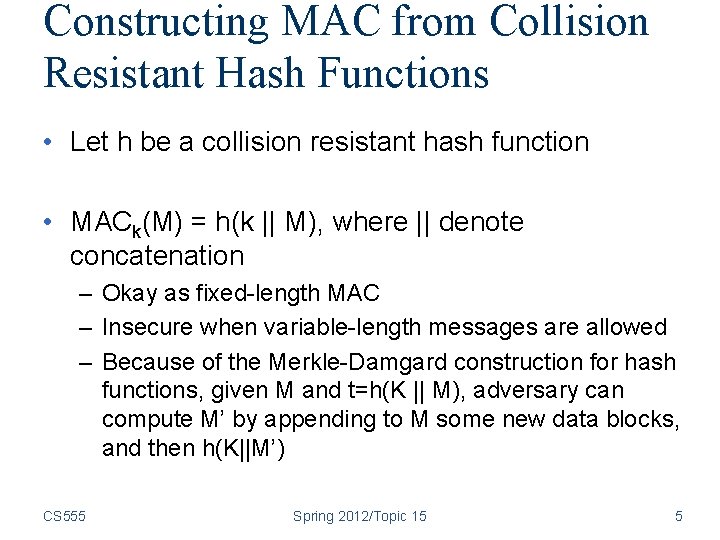
Constructing MAC from Collision Resistant Hash Functions • Let h be a collision resistant hash function • MACk(M) = h(k || M), where || denote concatenation – Okay as fixed-length MAC – Insecure when variable-length messages are allowed – Because of the Merkle-Damgard construction for hash functions, given M and t=h(K || M), adversary can compute M’ by appending to M some new data blocks, and then h(K||M’) CS 555 Spring 2012/Topic 15 5
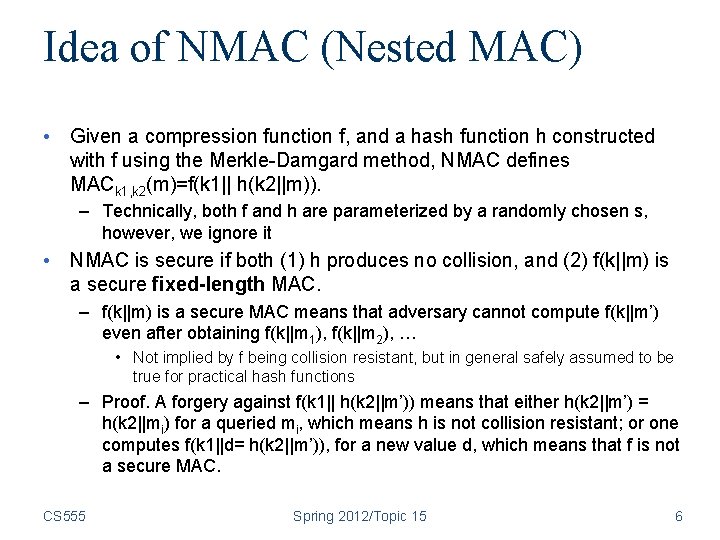
Idea of NMAC (Nested MAC) • Given a compression function f, and a hash function h constructed with f using the Merkle-Damgard method, NMAC defines MACk 1, k 2(m)=f(k 1|| h(k 2||m)). – Technically, both f and h are parameterized by a randomly chosen s, however, we ignore it • NMAC is secure if both (1) h produces no collision, and (2) f(k||m) is a secure fixed-length MAC. – f(k||m) is a secure MAC means that adversary cannot compute f(k||m’) even after obtaining f(k||m 1), f(k||m 2), … • Not implied by f being collision resistant, but in general safely assumed to be true for practical hash functions – Proof. A forgery against f(k 1|| h(k 2||m’)) means that either h(k 2||m’) = h(k 2||mi) for a queried mi, which means h is not collision resistant; or one computes f(k 1||d= h(k 2||m’)), for a new value d, which means that f is not a secure MAC. CS 555 Spring 2012/Topic 15 6
![HMAC: A Derivative of NMAC HMACK[M] = Hash[(K+ opad) || Hash[(K+ ipad)||M)]] • K+](http://slidetodoc.com/presentation_image_h2/b2afbe41072289f0672c3c7bce8314d2/image-7.jpg "HMAC: A Derivative of NMAC HMACK[M] = Hash[(K+ opad) || Hash[(K+ ipad)||M)]] • K+")
HMAC: A Derivative of NMAC HMACK[M] = Hash[(K+ opad) || Hash[(K+ ipad)||M)]] • K+ is the key padded (with 0) to B bytes, the input block size of the hash function • ipad = the byte 0 x 36 repeated B times • opad = the byte 0 x 5 C repeated B times. • Essentially NMAC. Differs in that NMAC uses independent k 1 and k 2, HMAC uses two keys that are computed from one key • Proven to be PRF if compression function is PRF. • If used with a secure hash functions (e. g. , SHA-256) and according to the specification (key size, and use correct output), no known practical attacks against HMAC exists CS 555 Spring 2012/Topic 15 7
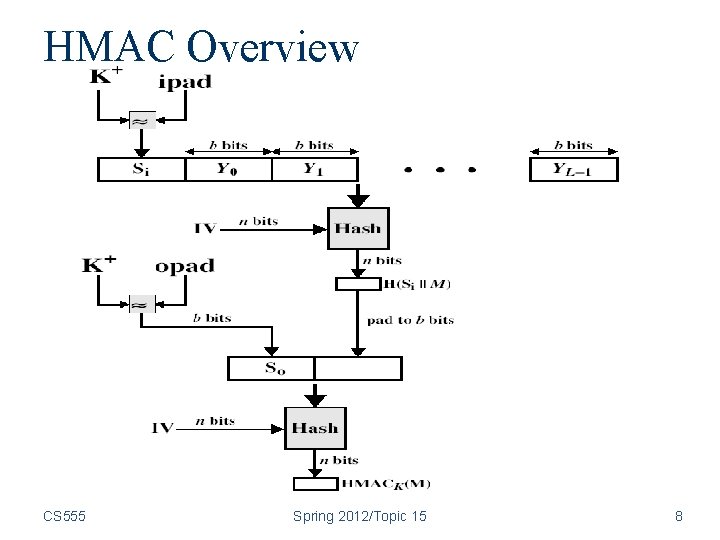
HMAC Overview CS 555 Spring 2012/Topic 15 8
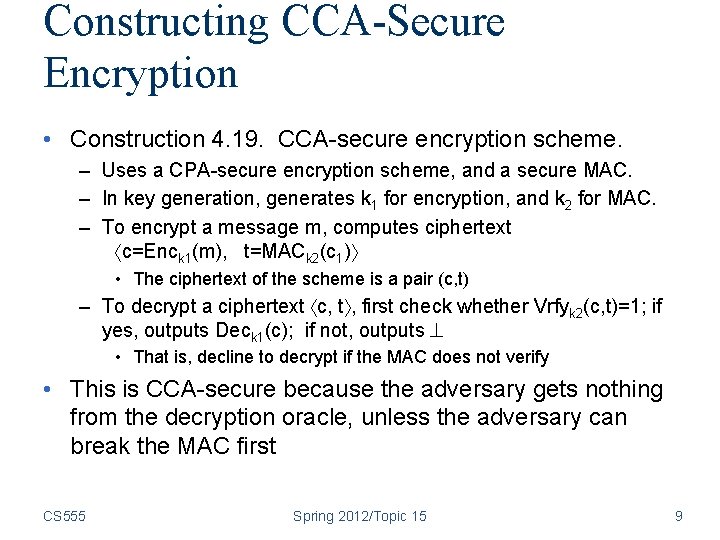
Constructing CCA-Secure Encryption • Construction 4. 19. CCA-secure encryption scheme. – Uses a CPA-secure encryption scheme, and a secure MAC. – In key generation, generates k 1 for encryption, and k 2 for MAC. – To encrypt a message m, computes ciphertext c=Enck 1(m), t=MACk 2(c 1) • The ciphertext of the scheme is a pair (c, t) – To decrypt a ciphertext c, t , first check whether Vrfyk 2(c, t)=1; if yes, outputs Deck 1(c); if not, outputs • That is, decline to decrypt if the MAC does not verify • This is CCA-secure because the adversary gets nothing from the decryption oracle, unless the adversary can break the MAC first CS 555 Spring 2012/Topic 15 9
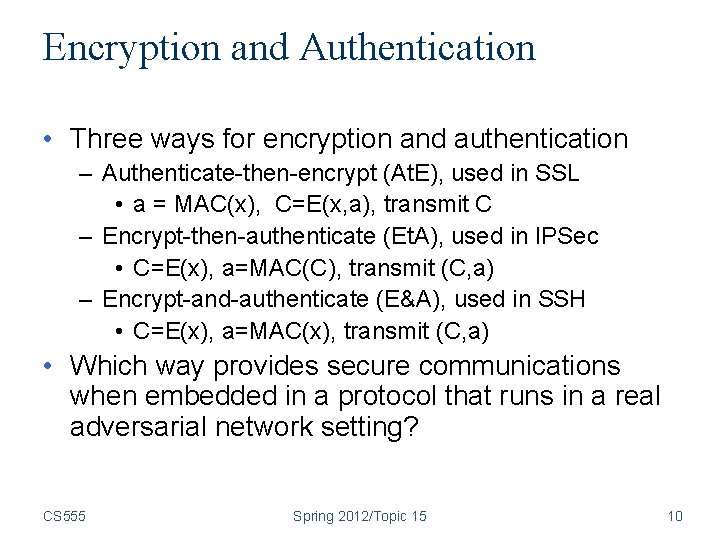
Encryption and Authentication • Three ways for encryption and authentication – Authenticate-then-encrypt (At. E), used in SSL • a = MAC(x), C=E(x, a), transmit C – Encrypt-then-authenticate (Et. A), used in IPSec • C=E(x), a=MAC(C), transmit (C, a) – Encrypt-and-authenticate (E&A), used in SSH • C=E(x), a=MAC(x), transmit (C, a) • Which way provides secure communications when embedded in a protocol that runs in a real adversarial network setting? CS 555 Spring 2012/Topic 15 10
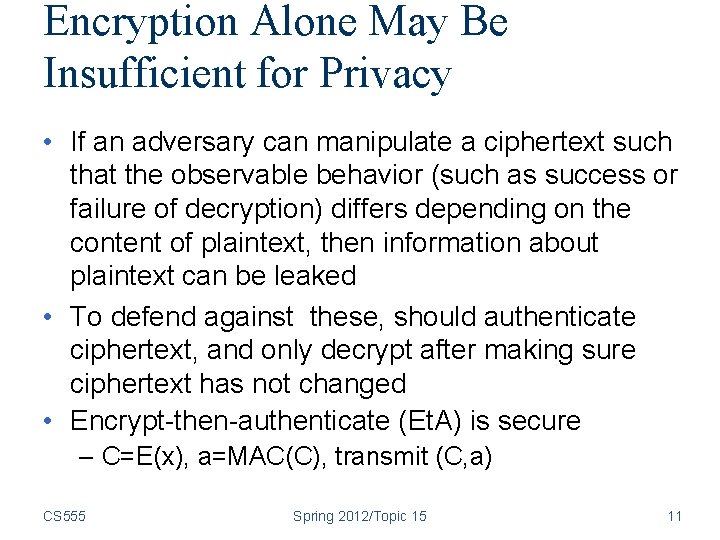
Encryption Alone May Be Insufficient for Privacy • If an adversary can manipulate a ciphertext such that the observable behavior (such as success or failure of decryption) differs depending on the content of plaintext, then information about plaintext can be leaked • To defend against these, should authenticate ciphertext, and only decrypt after making sure ciphertext has not changed • Encrypt-then-authenticate (Et. A) is secure – C=E(x), a=MAC(C), transmit (C, a) CS 555 Spring 2012/Topic 15 11
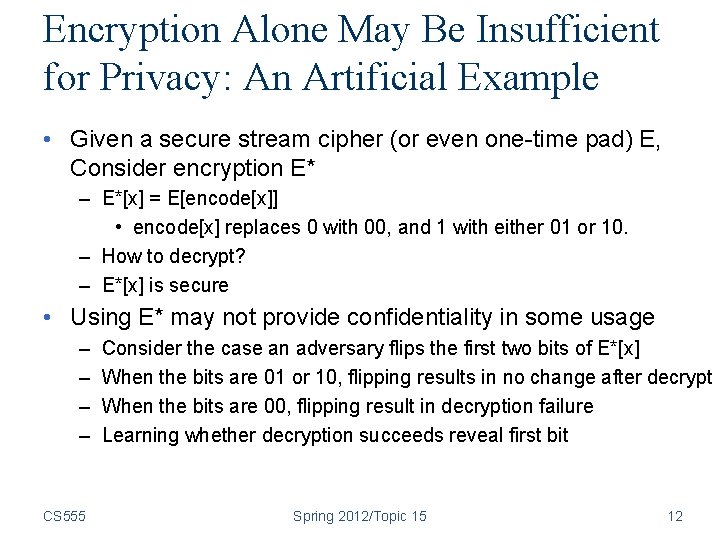
Encryption Alone May Be Insufficient for Privacy: An Artificial Example • Given a secure stream cipher (or even one-time pad) E, Consider encryption E* – E*[x] = E[encode[x]] • encode[x] replaces 0 with 00, and 1 with either 01 or 10. – How to decrypt? – E*[x] is secure • Using E* may not provide confidentiality in some usage – – CS 555 Consider the case an adversary flips the first two bits of E*[x] When the bits are 01 or 10, flipping results in no change after decrypt When the bits are 00, flipping result in decryption failure Learning whether decryption succeeds reveal first bit Spring 2012/Topic 15 12
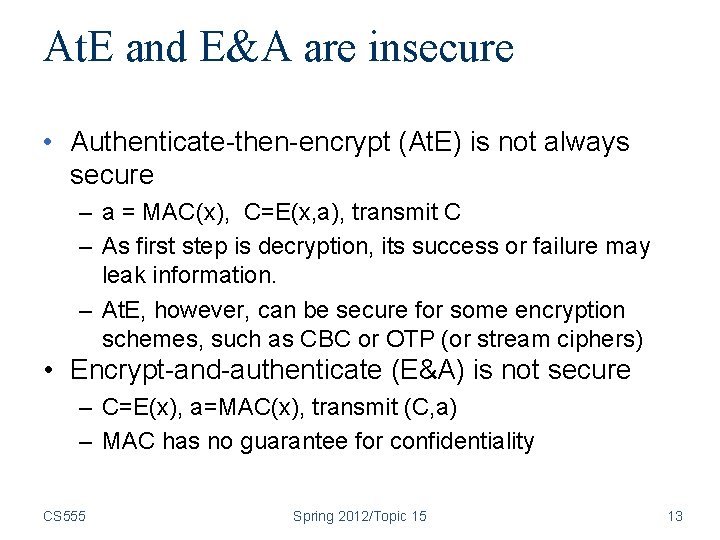
At. E and E&A are insecure • Authenticate-then-encrypt (At. E) is not always secure – a = MAC(x), C=E(x, a), transmit C – As first step is decryption, its success or failure may leak information. – At. E, however, can be secure for some encryption schemes, such as CBC or OTP (or stream ciphers) • Encrypt-and-authenticate (E&A) is not secure – C=E(x), a=MAC(x), transmit (C, a) – MAC has no guarantee for confidentiality CS 555 Spring 2012/Topic 15 13

Coming Attractions … • Private key management and the Public key revolution • Reading: Katz & Lindell: Chapter 9 CS 555 Spring 2012/Topic 15 14
- Slides: 14