
Cryptography CS 555 Lecture 22 Secure Function Evaluation

- Slides: 11
Cryptography CS 555 Lecture 22 Secure Function Evaluation Ninghui Li Fall 2004/Lecture 22 1
Lecture Outline • The Secure Function Evaluation Problem • 1 -out-2 Oblivious Transfer • Yao’s Scrambled Circuits for 2 -party SFE • Secret Sharing • n-party SFE Ninghui Li Fall 2004/Lecture 22 2
Secure Function Evaluation • Also known as Secure Multiparty Computation • 2 -party SFE: Alice has x, Bob has y, and they want to compute two functions f. A(x, y), f. B(x, y). At the end of the protocol – Alice learns f. A(x, y) and nothing else – Bob learns f. B(x, y) and nothing else • n-party SFE: n parties each have a private input, and they join compute functions Ninghui Li Fall 2004/Lecture 22 3
Oblivious Transfer • 1 out of 2 OT – Alice has two messages x 0 and x 1 – At the end of the protocol • Bob gets exactly one of x 0 and x 1 • Alice does not know which one Bob gets • 1 out of n OT – Alice has n messages – Bob gets exactly one message, Alice does not know which one Bob gets – 1 out of 2 OT implies 1 out of n OT Ninghui Li Fall 2004/Lecture 22 4
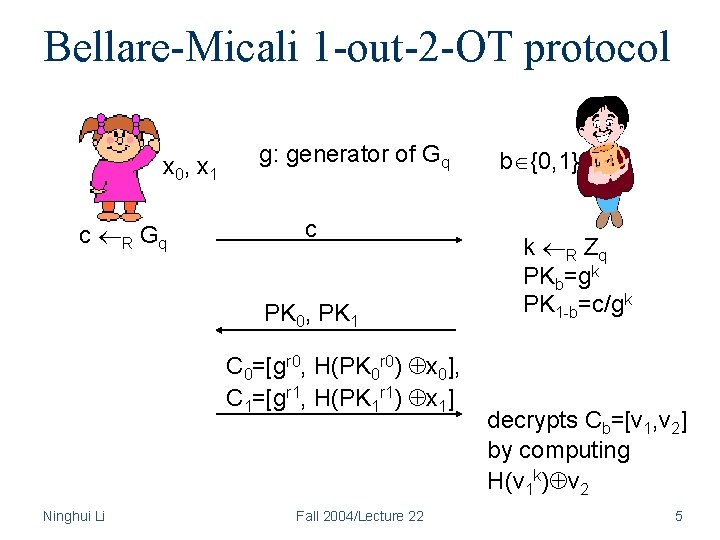
Bellare-Micali 1 -out-2 -OT protocol x 0, x 1 c R Gq g: generator of Gq c PK 0, PK 1 C 0=[gr 0, H(PK 0 r 0) x 0], C 1=[gr 1, H(PK 1 r 1) x 1] Ninghui Li Fall 2004/Lecture 22 b {0, 1} k R Zq PKb=gk PK 1 -b=c/gk decrypts Cb=[v 1, v 2] by computing H(v 1 k) v 2 5
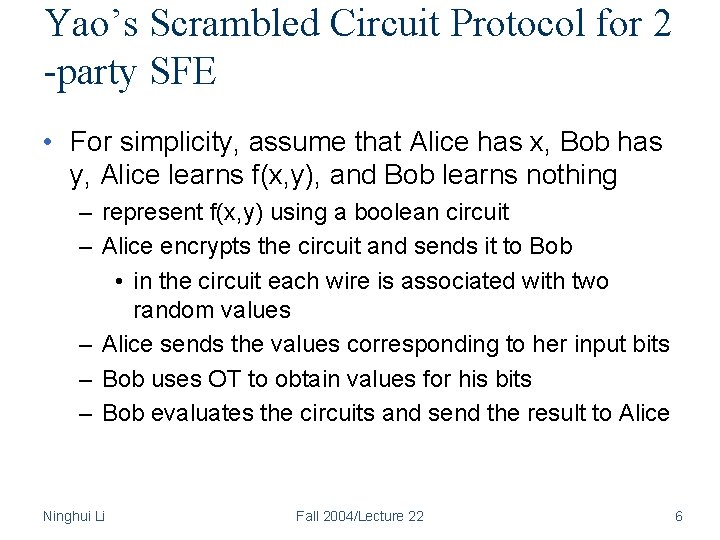
Yao’s Scrambled Circuit Protocol for 2 -party SFE • For simplicity, assume that Alice has x, Bob has y, Alice learns f(x, y), and Bob learns nothing – represent f(x, y) using a boolean circuit – Alice encrypts the circuit and sends it to Bob • in the circuit each wire is associated with two random values – Alice sends the values corresponding to her input bits – Bob uses OT to obtain values for his bits – Bob evaluates the circuits and send the result to Alice Ninghui Li Fall 2004/Lecture 22 6
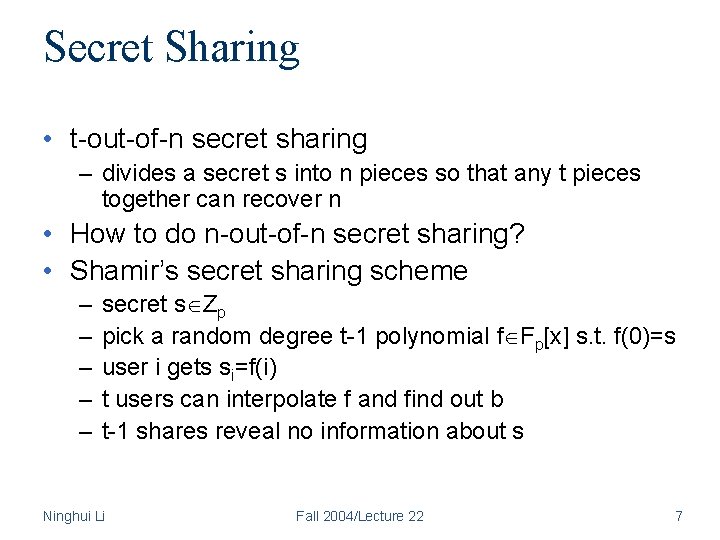
Secret Sharing • t-out-of-n secret sharing – divides a secret s into n pieces so that any t pieces together can recover n • How to do n-out-of-n secret sharing? • Shamir’s secret sharing scheme – – – secret s Zp pick a random degree t-1 polynomial f Fp[x] s. t. f(0)=s user i gets si=f(i) t users can interpolate f and find out b t-1 shares reveal no information about s Ninghui Li Fall 2004/Lecture 22 7
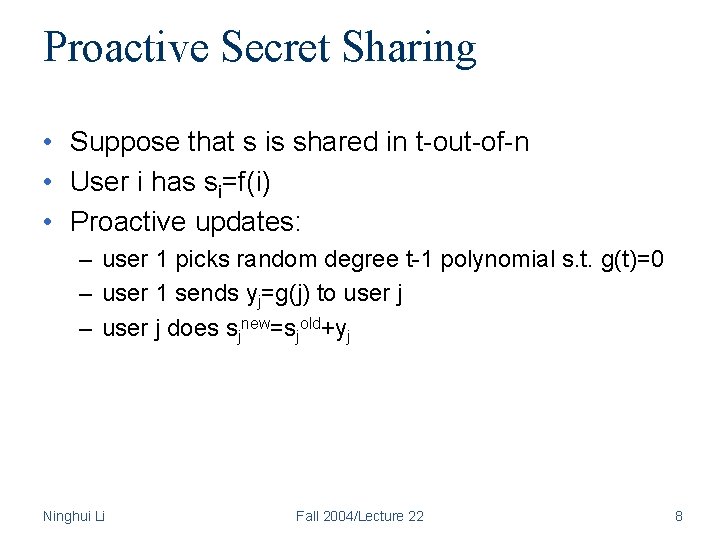
Proactive Secret Sharing • Suppose that s is shared in t-out-of-n • User i has si=f(i) • Proactive updates: – user 1 picks random degree t-1 polynomial s. t. g(t)=0 – user 1 sends yj=g(j) to user j – user j does sjnew=sjold+yj Ninghui Li Fall 2004/Lecture 22 8
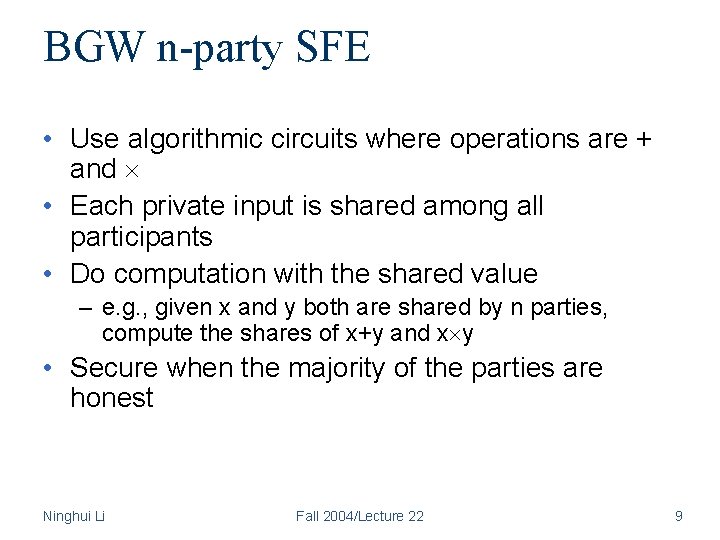
BGW n-party SFE • Use algorithmic circuits where operations are + and • Each private input is shared among all participants • Do computation with the shared value – e. g. , given x and y both are shared by n parties, compute the shares of x+y and x y • Secure when the majority of the parties are honest Ninghui Li Fall 2004/Lecture 22 9
Summary • Yao’s 2 -part SFE uses OT and block cipher • BGW’s n-party SFE uses secret sharing Ninghui Li Fall 2004/Lecture 22 10
Next Lecture… • Quantum Cryptography Ninghui Li Fall 2004/Lecture 22 11