
Cryptography and Network Security Sixth Edition by William
Cryptography and Network Security Sixth Edition by William Stallings
Chapter 15 User Authentication
“Badges? We ain’t got no badges! We don’t need no badges! I don’t have to show you any stinking badges!” —The Treasure of the Sierra Madre, 1948

Remote User-Authentication Principles • The process of verifying an identity claimed by or for a system entity • An authentication process consists of two steps: Verification � Presenting an identifier to the security system Identification step � Presenting or generating step authentication information that corroborates the binding between the entity and the identifier
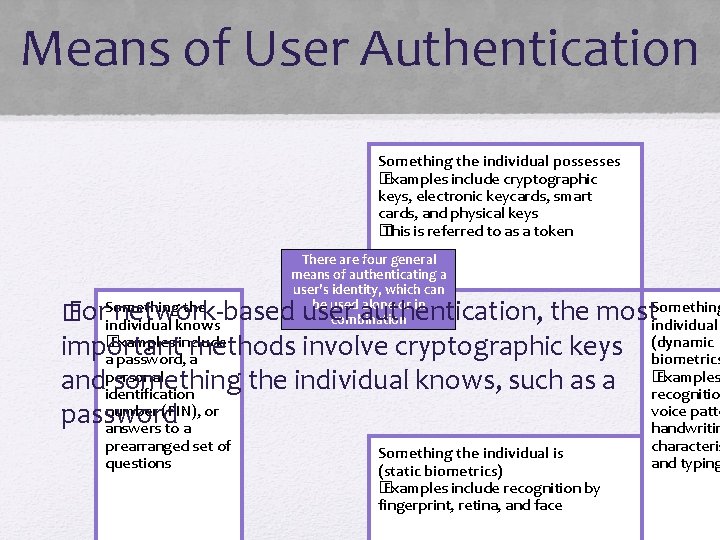
Means of User Authentication Something the individual possesses � Examples include cryptographic keys, electronic keycards, smart cards, and physical keys � This is referred to as a token There are four general means of authenticating a user’s identity, which can be used alone or in combination the Something � For. Something network-based user authentication, the most individual knows individual � Examples include important methods involve cryptographic keys a password, a andpersonal something the individual knows, such as a identification number (PIN), or password answers to a prearranged set of questions Something the individual is (static biometrics) � Examples include recognition by fingerprint, retina, and face (dynamic biometrics � Examples recognition voice patte handwritin characteris and typing
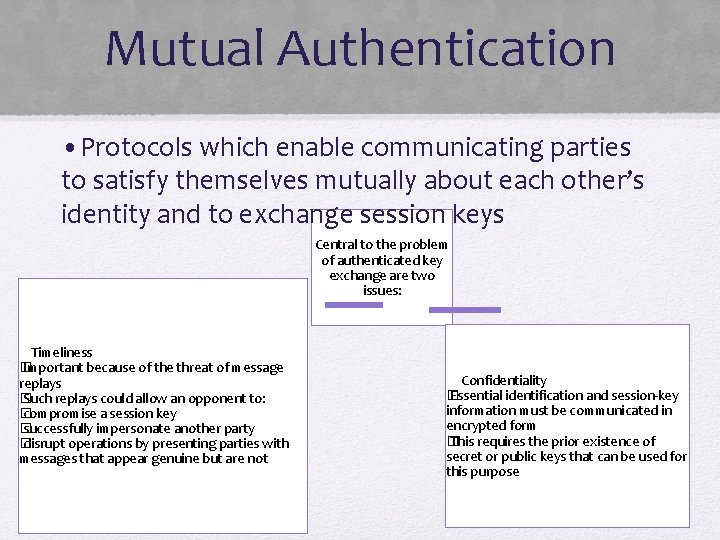
Mutual Authentication • Protocols which enable communicating parties to satisfy themselves mutually about each other’s identity and to exchange session keys Central to the problem of authenticated key exchange are two issues: Timeliness � Important because of the threat of message replays � Such replays could allow an opponent to: � compromise a session key � successfully impersonate another party � disrupt operations by presenting parties with messages that appear genuine but are not Confidentiality � Essential identification and session-key information must be communicated in encrypted form � This requires the prior existence of secret or public keys that can be used for this purpose
Replay Attacks 1. The simplest replay attack is one in which the opponent simply copies a message and replays it later 2. An opponent can replay a timestamped message within the valid time window 3. An opponent can replay a timestamped message within the valid time window, but in addition, the opponent suppresses the original message; thus, the repetition cannot be detected 4. Another attack involves a backward replay without modification and is possible if symmetric
Approaches to Coping With Replay Attacks • Attach a sequence number to each message used in an authentication exchange • A new message is accepted only if its sequence number is in the proper order • Difficulty with this approach is that it requires each party to keep track of the last sequence number for each claimant it has dealt with • Generally not used for authentication and key exchange because of overhead • Timestamps • Requires that clocks among the various participants be synchronized
One-Way Authentication One application for which encryption is growing in popularity is electronic mail (e-mail) � Header of the e-mail message must be in the clear so that the message can be handled by the store-and-forward e-mail protocol, such as SMTP or X. 400 � The e-mail message should be encrypted such that the mailhandling system is not in possession of the decryption key See Chapter 19 on securing email A second requirement is that of authentication � The recipient wants some assurance that the message is from the alleged sender
Remote User-Authentication Using Symmetric Encryption A two-level hierarchy of symmetric keys can be used to provide confidentiality for communication in a distributed environment � Strategy involves the use of a trusted key distribution center (KDC) � Each party shares a secret key, known as a master key, with the KDC � KDC is responsible for generating keys to be used for a short time over a connection between two parties and for distributing those keys using the master keys to protect the distribution
Suppress-Replay Attacks • The Denning protocol requires reliance on clocks that are synchronized throughout the network • A risk involved is based on the fact that the distributed clocks can become unsynchronized as a result of sabotage on or faults in the clocks or the synchronization mechanism • The problem occurs when a sender’s clock is ahead of the intended recipient’s clock • An opponent can intercept a message from the sender and replay it later when the timestamp in the message becomes current at the recipient’s site
Kerberos • Authentication service developed as part of Project Athena at MIT • A workstation cannot be trusted to identify its users correctly to network services • A user may gain access to a particular workstation and pretend to be another user operating from that workstation • A user may alter the network address of a workstation so that the requests sent from the altered workstation appear to come from the impersonated workstation • A user may eavesdrop on exchanges and use a
Kerberos Requirements • The first published report on Kerberos listed the following requirements: � A network eavesdropper should not be able to obtain the necessary information to impersonate a user Secure � The system should be capable of supporting large numbers of clients and servers � Should be highly reliable and should employ a distributed server architecture with one system able to back up another Reliable � Ideally, the user should not be aware that authentication is taking place beyond the requirement to enter a password
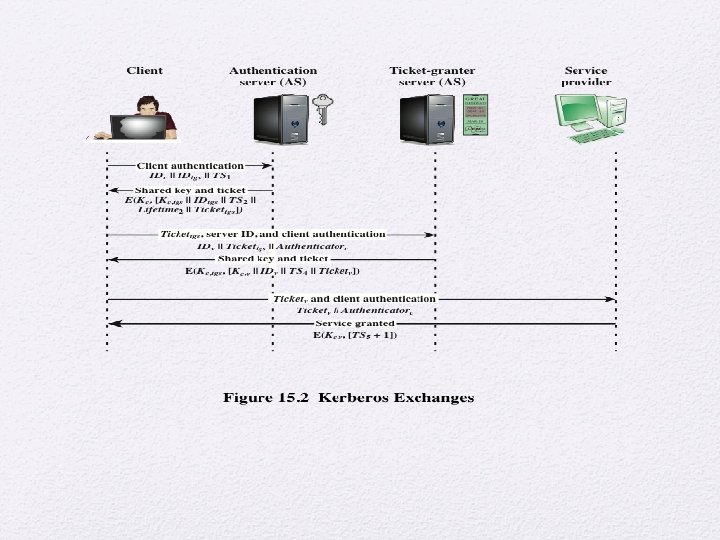
Kerberos Version 4 • Makes use of DES to provide the authentication service • Authentication server (AS) • Knows the passwords of all users and stores these in a centralized database • Shares a unique secret key with each server • Ticket • Created once the AS accepts the user as authentic; contains the user’s ID and network address and the server’s ID • Encrypted using the secret key shared by the AS and the server
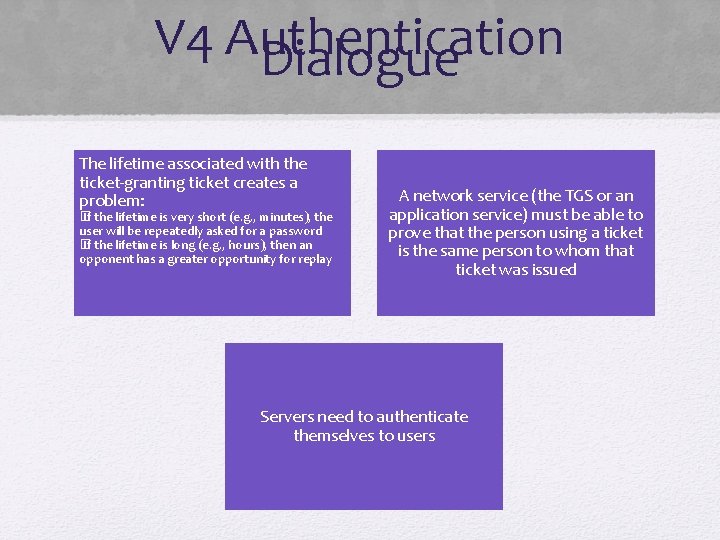
V 4 Authentication Dialogue The lifetime associated with the ticket-granting ticket creates a problem: � If the lifetime is very short (e. g. , minutes), the user will be repeatedly asked for a password � If the lifetime is long (e. g. , hours), then an opponent has a greater opportunity for replay A network service (the TGS or an application service) must be able to prove that the person using a ticket is the same person to whom that ticket was issued Servers need to authenticate themselves to users
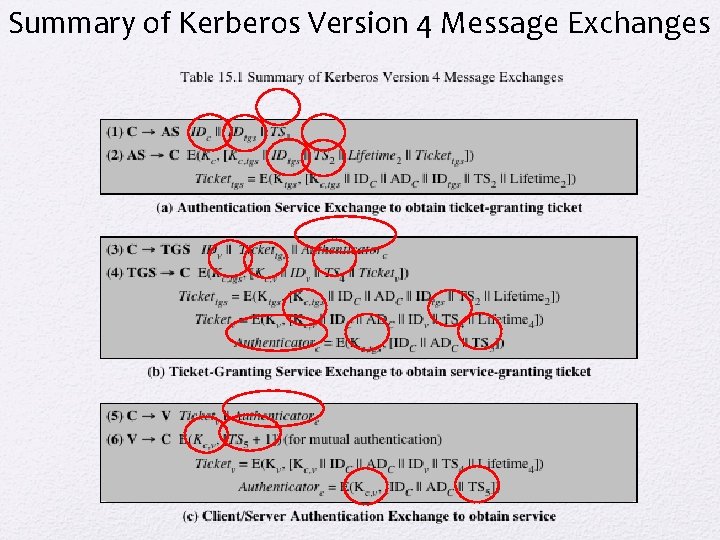
Summary of Kerberos Version 4 Message Exchanges
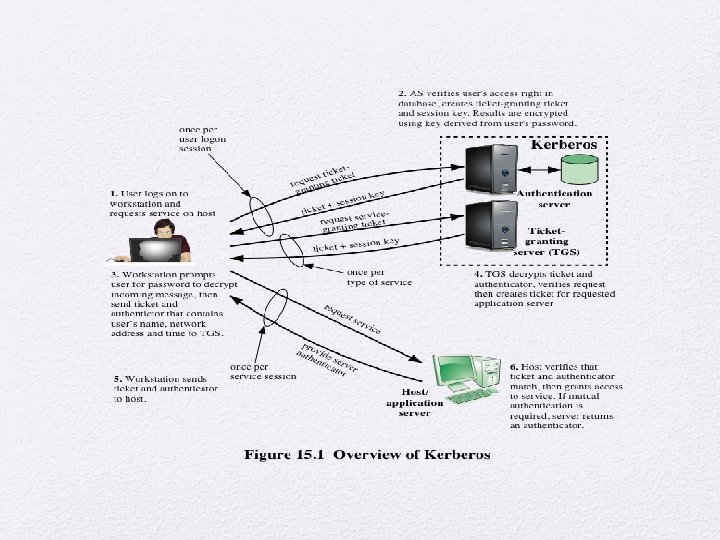
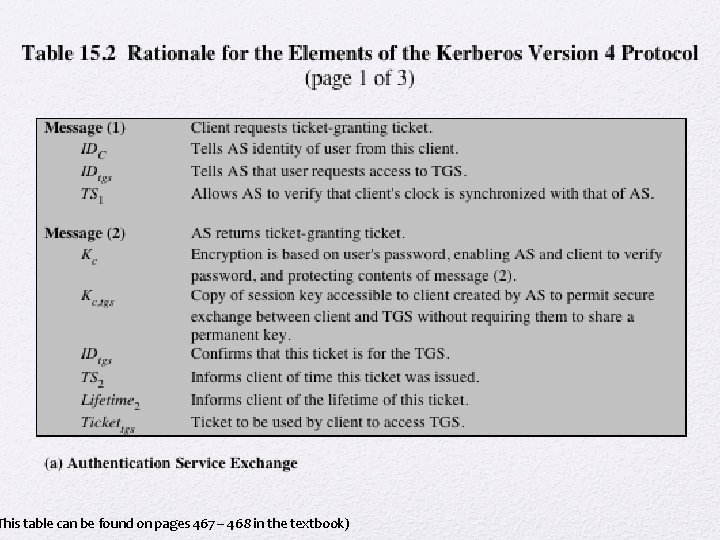
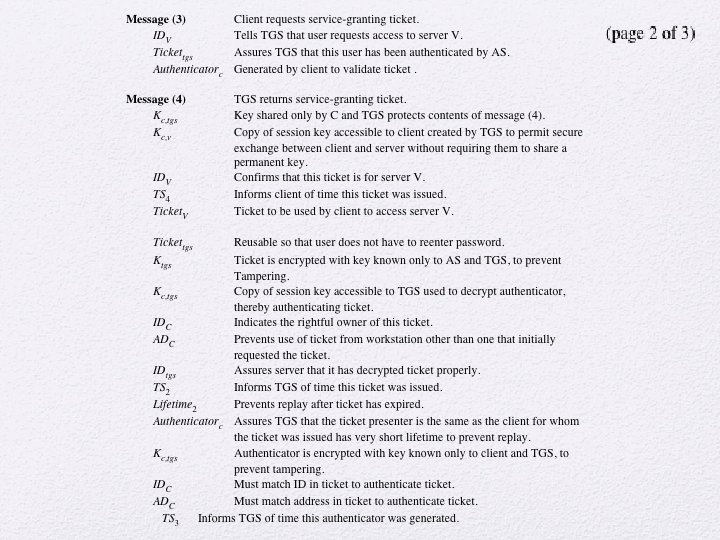
This table can be found on pages 467 – 468 in the textbook)
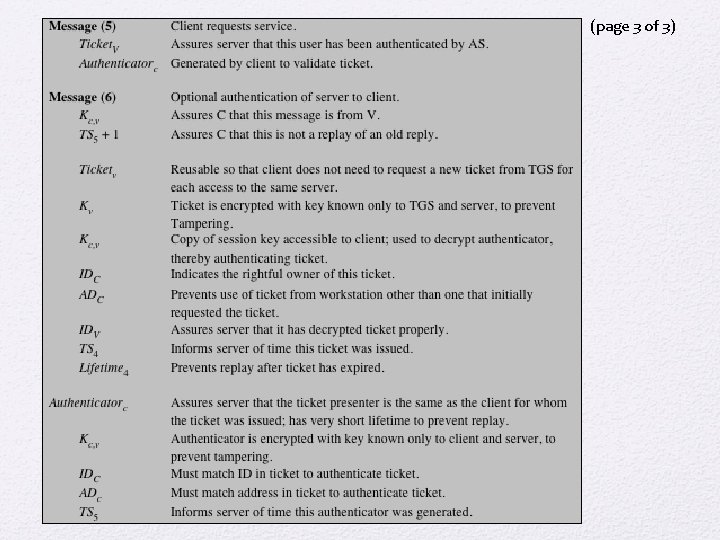
(page 3 of 3)
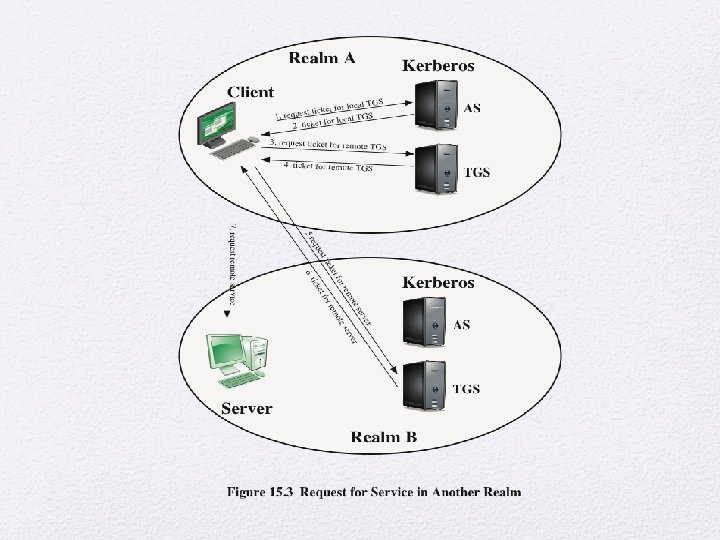
Kerberos Realms and Multiple Kerberi • A full-service Kerberos environment consisting of a Kerberos server, a number of clients, and a number of application servers requires that: • The Kerberos server must have the user ID and hashed passwords of all participating users in its database; all users are registered with the Kerberos server • The Kerberos server must share a secret key with each server; all servers are registered with the Kerberos server • The Kerberos server in each interoperating realm shares a secret key with the server in the other
Kerberos Realm • A set of managed nodes that share the same Kerberos database • The database resides on the Kerberos master computer system, which should be kept in a physically secure room • A read-only copy of the Kerberos database might also reside on other Kerberos computer systems • All changes to the database must be made on the master computer system • Changing or accessing the contents of a Kerberos database requires the Kerberos master
Kerberos Principal • A service or user that is known to the Kerberos system • Identified by its principal name An instance name A service or user name A realm name Three parts of a principal name

Differences Between Versions 4 and 5
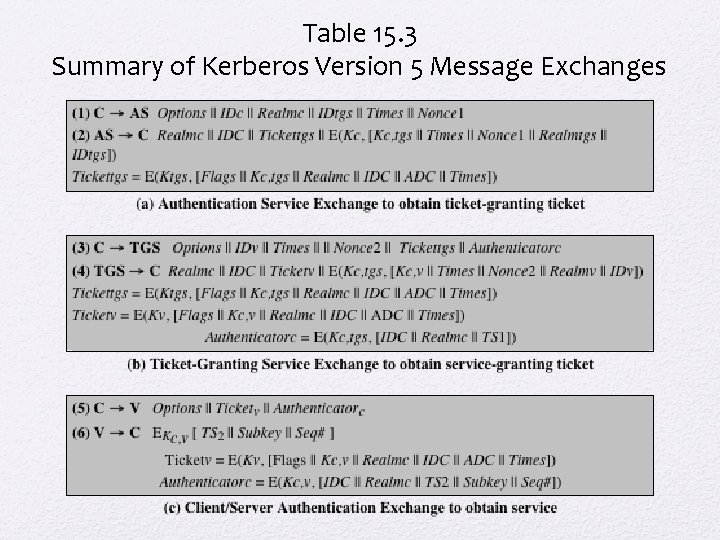
Table 15. 3 Summary of Kerberos Version 5 Message Exchanges
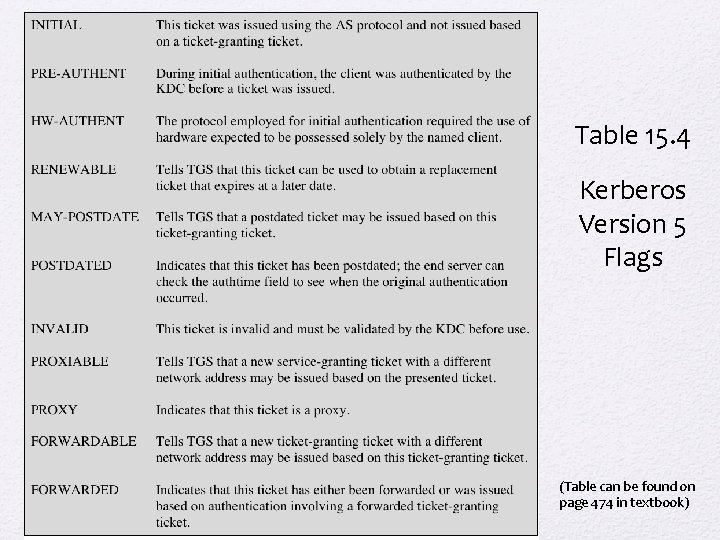
Table 15. 4 Kerberos Version 5 Flags (Table can be found on page 474 in textbook)
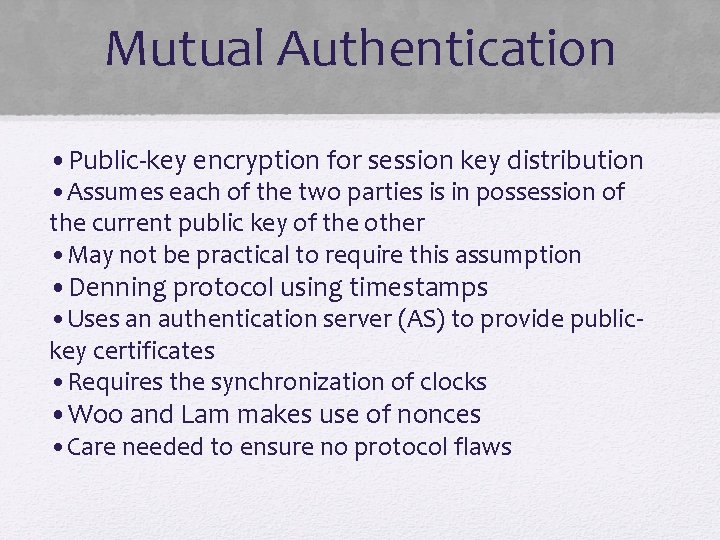
Mutual Authentication • Public-key encryption for session key distribution • Assumes each of the two parties is in possession of the current public key of the other • May not be practical to require this assumption • Denning protocol using timestamps • Uses an authentication server (AS) to provide publickey certificates • Requires the synchronization of clocks • Woo and Lam makes use of nonces • Care needed to ensure no protocol flaws
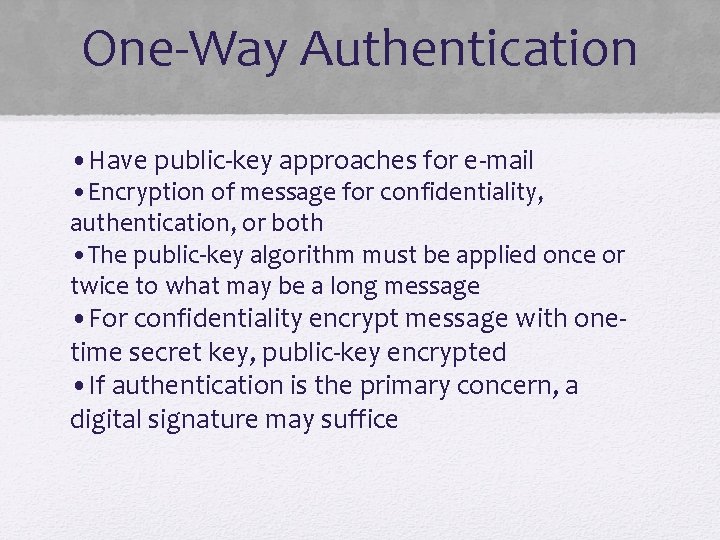
One-Way Authentication • Have public-key approaches for e-mail • Encryption of message for confidentiality, authentication, or both • The public-key algorithm must be applied once or twice to what may be a long message • For confidentiality encrypt message with onetime secret key, public-key encrypted • If authentication is the primary concern, a digital signature may suffice
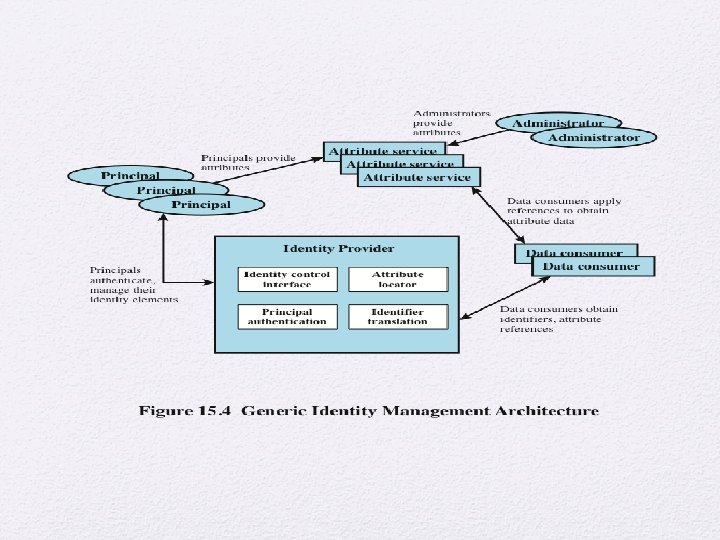
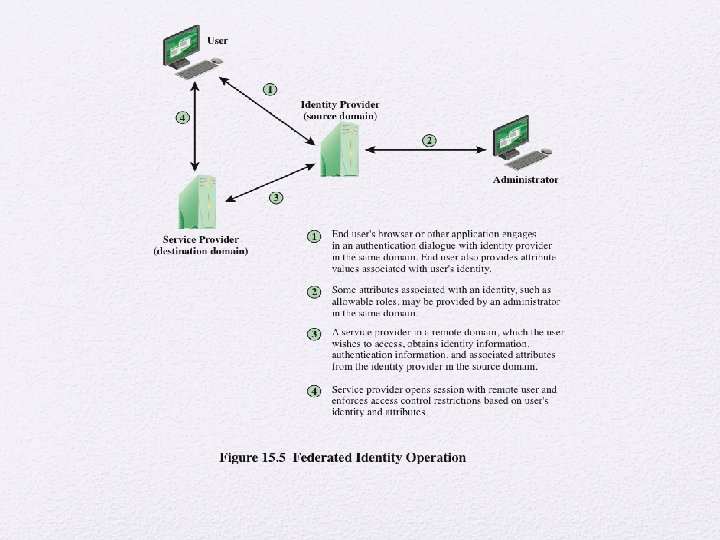
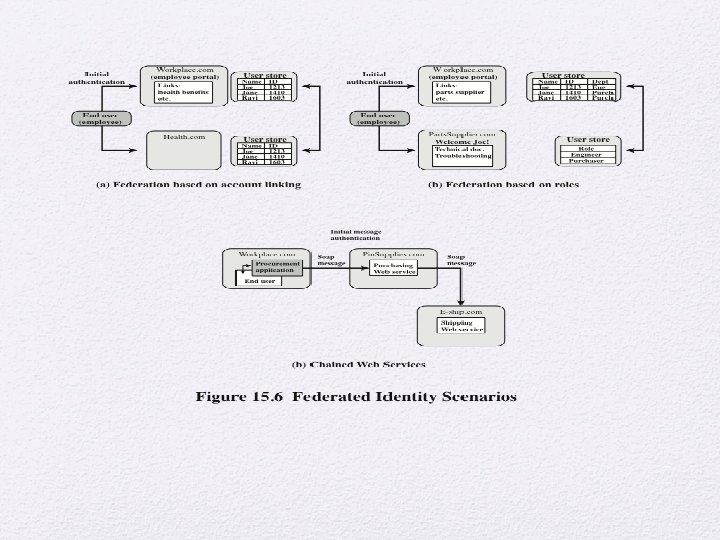
Federated Identity Management • Relatively new concept dealing with the use of a common identity management scheme across multiple enterprise and numerous applications and supporting many users • Services provided include: • Point of contact • SSO protocol services • Trust services • Key services • Identity services • Authorization • Provisioning

Key Standards
Personal Identity Verification • User authentication based on the possession of a smart card is becoming more widespread • Has the appearance of a credit card • Has an electronic interface • May use a variety of authentication protocols • A smart card contains within it an entire microprocessor, including processor, memory, and I/O ports • A smart card includes three types of memory: • Read-only memory (ROM) stores data that does not change during the card’s life • Electronically erasable programmable ROM
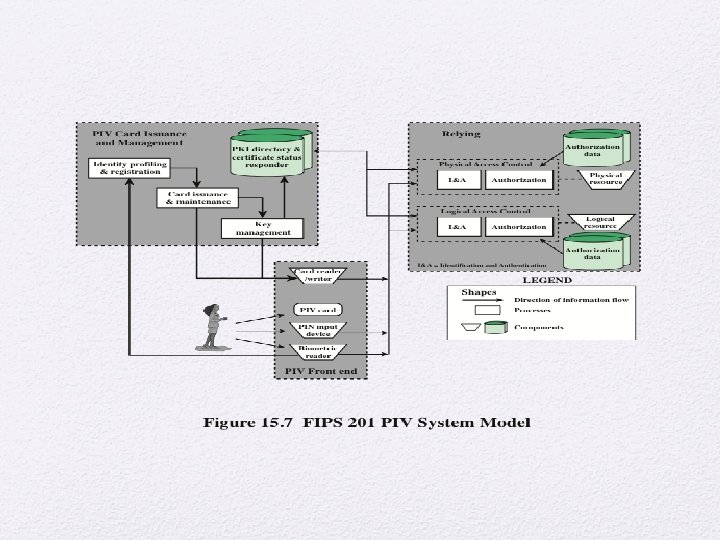
n mechanisms to manage PIV Documentation physical • FIPS 201 -2— access to Federal Personal government Identity facilities and Verification assets (PIV) of • SP 800 -79 Federal 1— Employees
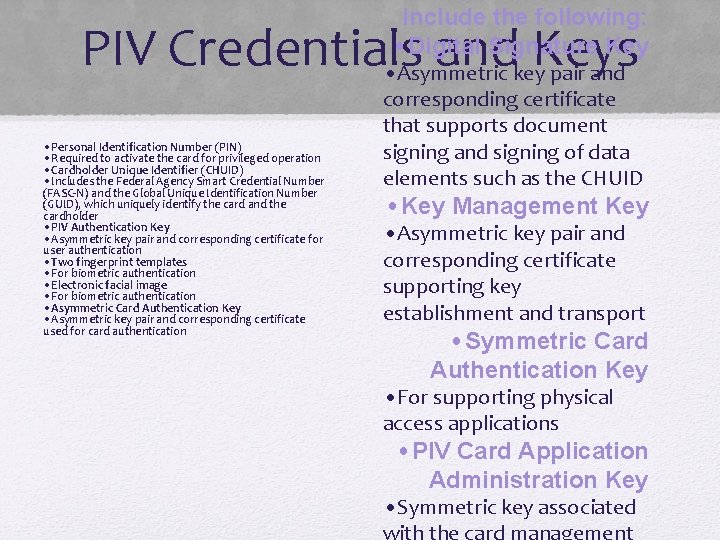
include the following: • Digital Signature Key PIV Credentials and Keys • Asymmetric key pair and • Personal Identification Number (PIN) • Required to activate the card for privileged operation • Cardholder Unique Identifier (CHUID) • Includes the Federal Agency Smart Credential Number (FASC-N) and the Global Unique Identification Number (GUID), which uniquely identify the card and the cardholder • PIV Authentication Key • Asymmetric key pair and corresponding certificate for user authentication • Two fingerprint templates • For biometric authentication • Electronic facial image • For biometric authentication • Asymmetric Card Authentication Key • Asymmetric key pair and corresponding certificate used for card authentication corresponding certificate that supports document signing and signing of data elements such as the CHUID • Key Management Key • Asymmetric key pair and corresponding certificate supporting key establishment and transport • Symmetric Card Authentication Key • For supporting physical access applications • PIV Card Application Administration Key • Symmetric key associated
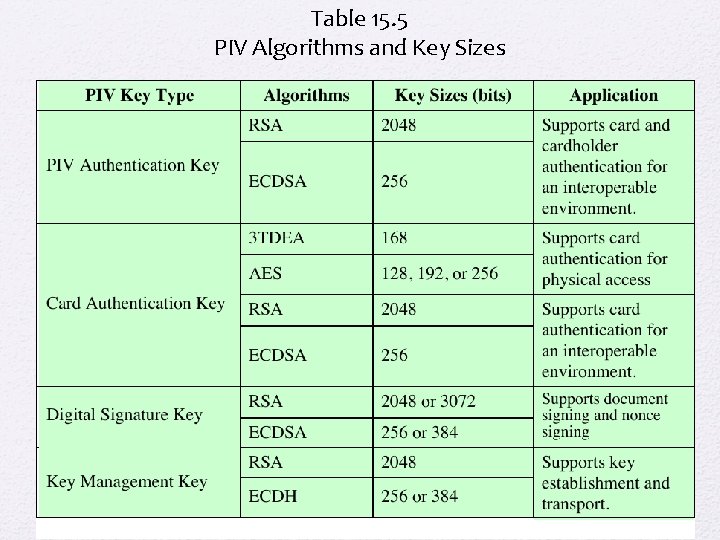
Table 15. 5 PIV Algorithms and Key Sizes
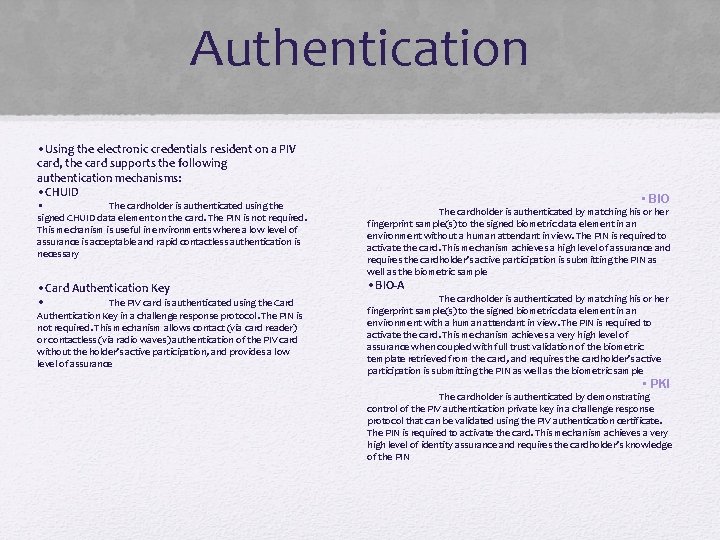
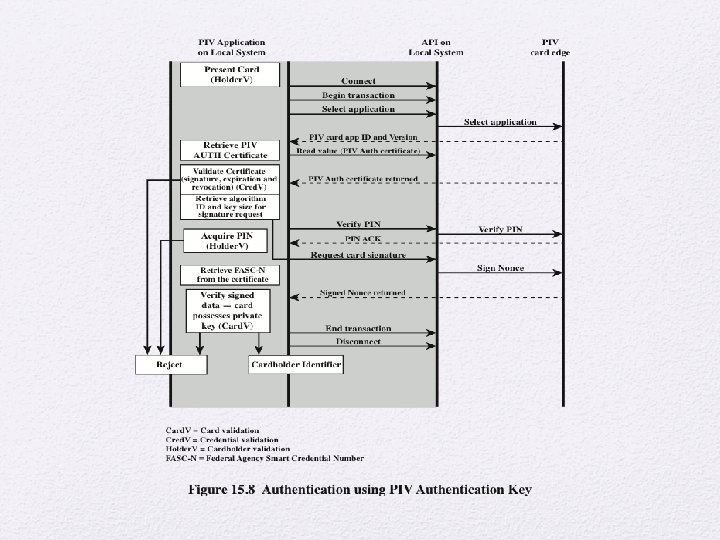
Authentication • Using the electronic credentials resident on a PIV card, the card supports the following authentication mechanisms: • CHUID • The cardholder is authenticated using the signed CHUID data element on the card. The PIN is not required. This mechanism is useful in environments where a low level of assurance is acceptable and rapid contactless authentication is necessary • Card Authentication Key • The PIV card is authenticated using the Card Authentication Key in a challenge response protocol. The PIN is not required. This mechanism allows contact (via card reader) or contactless (via radio waves) authentication of the PIV card without the holder’s active participation, and provides a low level of assurance • BIO The cardholder is authenticated by matching his or her fingerprint sample(s) to the signed biometric data element in an environment without a human attendant in view. The PIN is required to activate the card. This mechanism achieves a high level of assurance and requires the cardholder’s active participation is submitting the PIN as well as the biometric sample • BIO-A The cardholder is authenticated by matching his or her fingerprint sample(s) to the signed biometric data element in an environment with a human attendant in view. The PIN is required to activate the card. This mechanism achieves a very high level of assurance when coupled with full trust validation of the biometric template retrieved from the card, and requires the cardholder’s active participation is submitting the PIN as well as the biometric sample • PKI The cardholder is authenticated by demonstrating control of the PIV authentication private key in a challenge response protocol that can be validated using the PIV authentication certificate. The PIN is required to activate the card. This mechanism achieves a very high level of identity assurance and requires the cardholder’s knowledge of the PIN
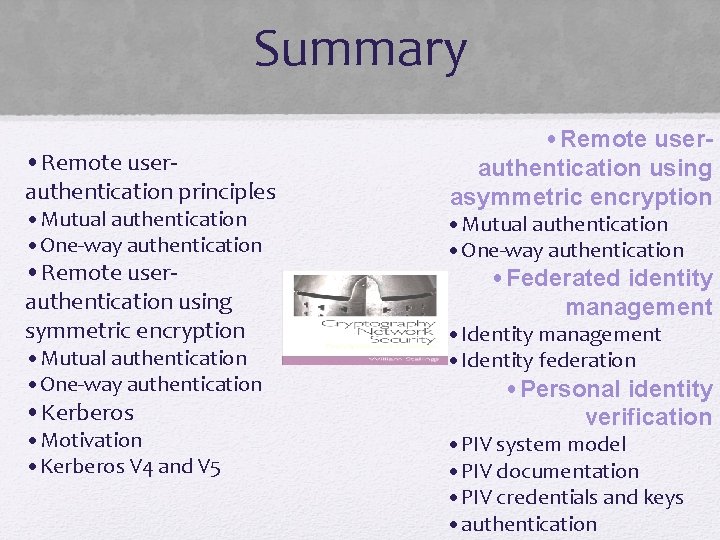
Summary • Remote userauthentication principles • Mutual authentication • One-way authentication • Remote userauthentication using symmetric encryption • Mutual authentication • One-way authentication • Kerberos • Motivation • Kerberos V 4 and V 5 • Remote userauthentication using asymmetric encryption • Mutual authentication • One-way authentication • Federated identity management • Identity management • Identity federation • Personal identity verification • PIV system model • PIV documentation • PIV credentials and keys • authentication
- Slides: 43