
Cryptography and Network Security Seventh Edition Global Edition
Cryptography and Network Security Seventh Edition, Global Edition by William Stallings © 2017 Pearson Education, Ltd. , All rights reserved.
Chapter 14 Key Management and Distribution © 2017 Pearson Education, Ltd. , All rights reserved.
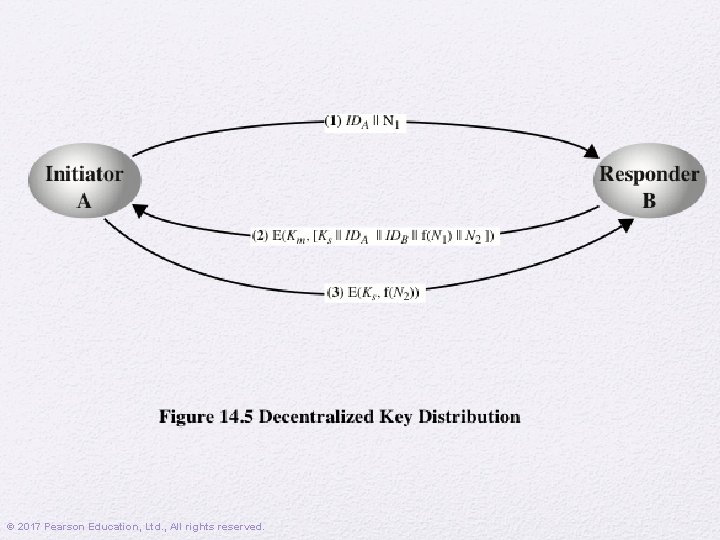
Key Distribution Technique • Term that refers to the means of delivering a key to two parties who wish to exchange data without allowing others to see the key • For symmetric encryption to work, the two parties to an exchange must share the same key, and that key must be protected from access by others • Frequent key changes are desirable to limit the amount of data compromised if an attacker learns the key © 2017 Pearson Education, Ltd. , All rights reserved.
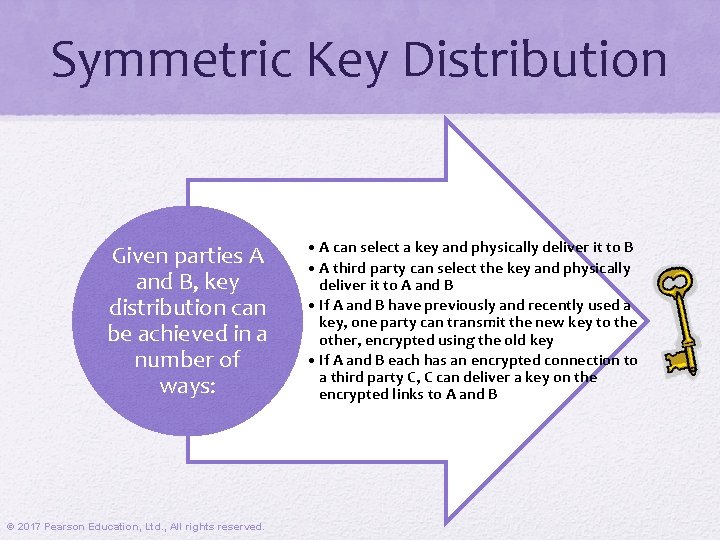
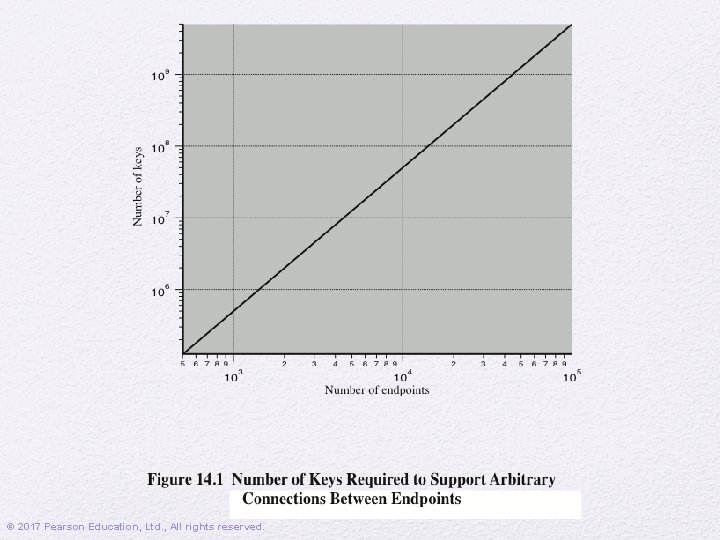
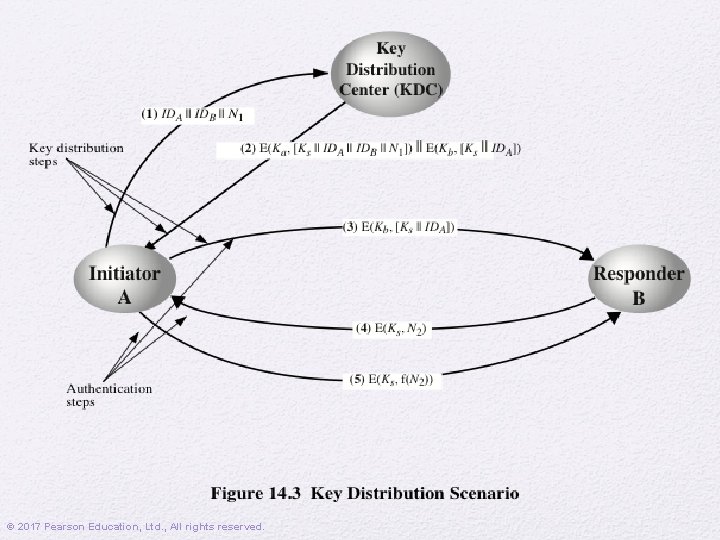
Symmetric Key Distribution Given parties A and B, key distribution can be achieved in a number of ways: © 2017 Pearson Education, Ltd. , All rights reserved. • A can select a key and physically deliver it to B • A third party can select the key and physically deliver it to A and B • If A and B have previously and recently used a key, one party can transmit the new key to the other, encrypted using the old key • If A and B each has an encrypted connection to a third party C, C can deliver a key on the encrypted links to A and B
© 2017 Pearson Education, Ltd. , All rights reserved.
© 2017 Pearson Education, Ltd. , All rights reserved.
© 2017 Pearson Education, Ltd. , All rights reserved.
Hierarchical Key Control • For communication among entities within the same local domain, the local KDC is responsible for key distribution • If two entities in different domains desire a shared key, then the corresponding local KDC’s can communicate through a global KDC • The hierarchical concept can be extended to three or more layers • Scheme minimizes the effort involved in master key distribution because most master keys are those shared by a local KDC with its local entities • Limits the range of a faulty or subverted KDC to its local area only © 2017 Pearson Education, Ltd. , All rights reserved.
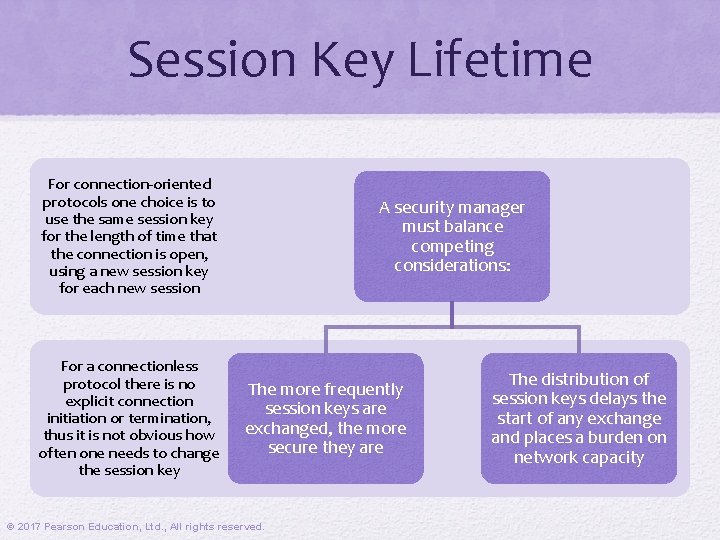
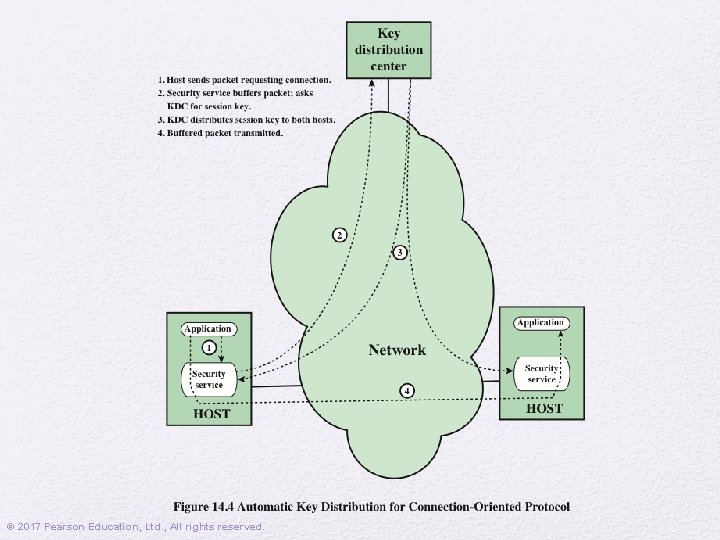
Session Key Lifetime For connection-oriented protocols one choice is to use the same session key for the length of time that the connection is open, using a new session key for each new session For a connectionless protocol there is no explicit connection initiation or termination, thus it is not obvious how often one needs to change the session key A security manager must balance competing considerations: The more frequently session keys are exchanged, the more secure they are © 2017 Pearson Education, Ltd. , All rights reserved. The distribution of session keys delays the start of any exchange and places a burden on network capacity
© 2017 Pearson Education, Ltd. , All rights reserved.
© 2017 Pearson Education, Ltd. , All rights reserved.
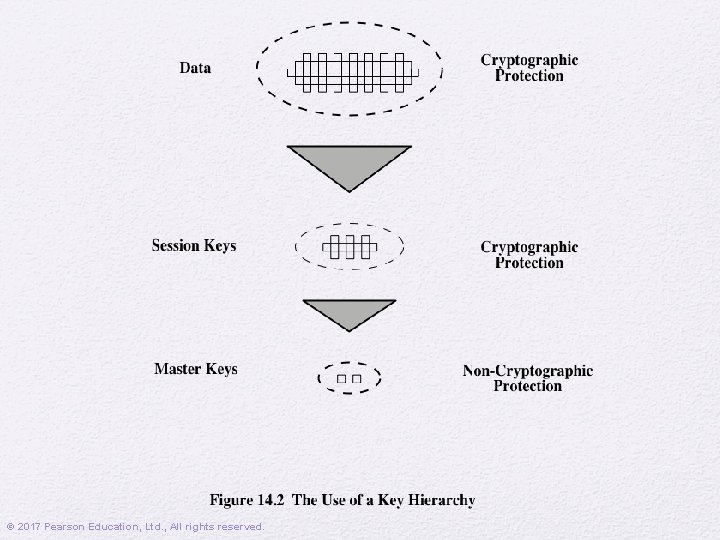
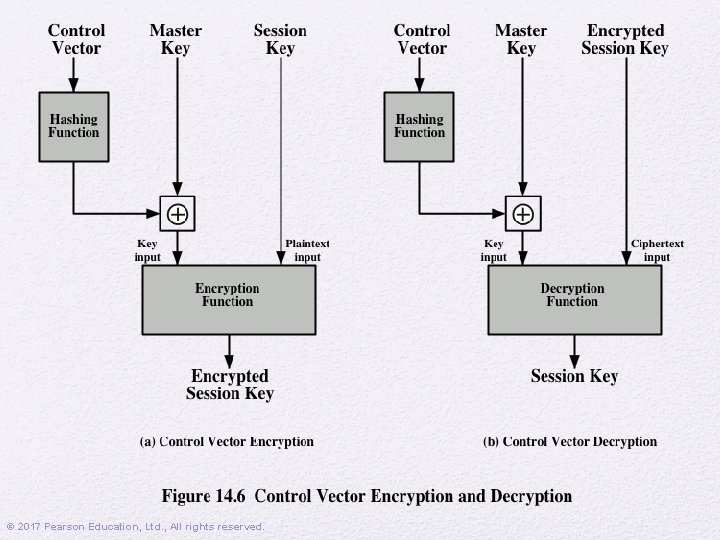
Controlling Key Usage • The concept of a key hierarchy and the use of automated key distribution techniques greatly reduce the number of keys that must be manually managed and distributed • It also may be desirable to impose some control on the way in which automatically distributed keys are used • For example, in addition to separating master keys from session keys, we may wish to define different types of session keys on the basis of use © 2017 Pearson Education, Ltd. , All rights reserved.
Key Controls • Associate a tag with each key • For use with DES and makes use of the extra 8 bits in each 64 -bit DES key • The eight non-key bits ordinarily reserved for parity checking form the key tag • Because the tag is embedded in the key, it is encrypted along with the key when that key is distributed, thus providing protection Drawbacks: • The tag length is limited to 8 bits, limiting its flexibility and functionality • Because the tag is not transmitted in clear form, it can be used only at the point of decryption, limiting the ways in which key use can be controlled © 2017 Pearson Education, Ltd. , All rights reserved.
© 2017 Pearson Education, Ltd. , All rights reserved.
© 2017 Pearson Education, Ltd. , All rights reserved.
© 2017 Pearson Education, Ltd. , All rights reserved.
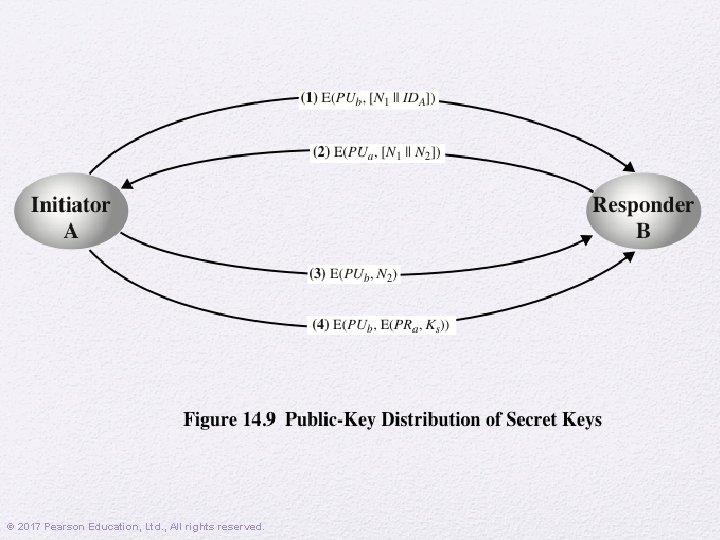
© 2017 Pearson Education, Ltd. , All rights reserved.
A Hybrid Scheme • In use on IBM mainframes • Retains the use of a key distribution center (KDC) that shares a secret master key with each user and distributes secret session keys encrypted with the master key • A public-key scheme is used to distribute the master keys Rationale : © 2017 Pearson Education, Ltd. , All rights reserved. • Performance • Backward compatibility
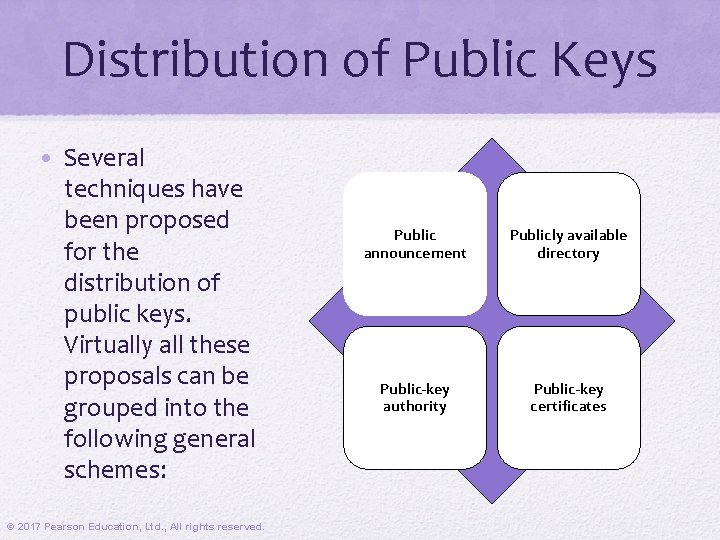
Distribution of Public Keys • Several techniques have been proposed for the distribution of public keys. Virtually all these proposals can be grouped into the following general schemes: © 2017 Pearson Education, Ltd. , All rights reserved. Public announcement Publicly available directory Public-key authority Public-key certificates
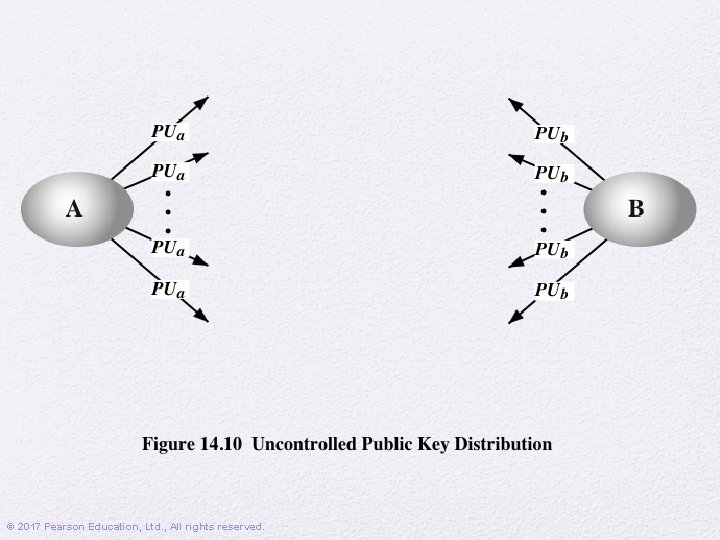
© 2017 Pearson Education, Ltd. , All rights reserved.
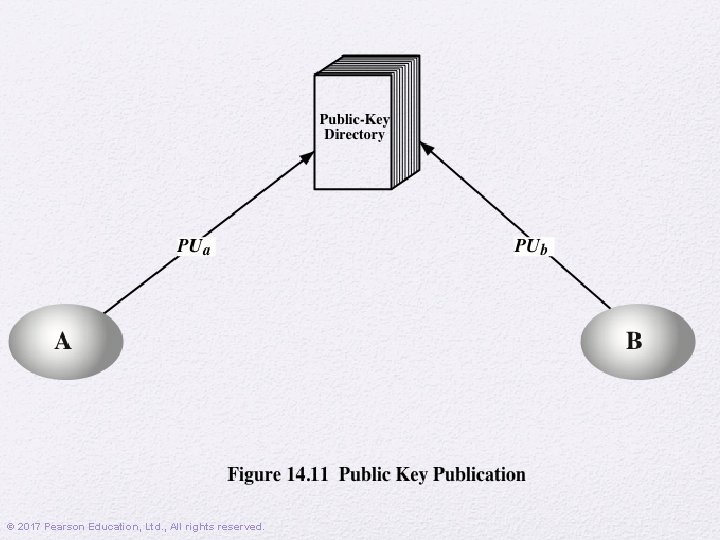
© 2017 Pearson Education, Ltd. , All rights reserved.
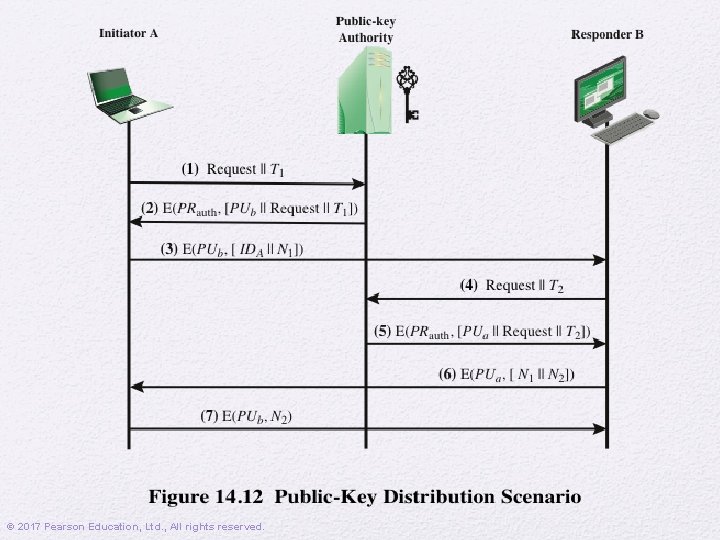
© 2017 Pearson Education, Ltd. , All rights reserved.
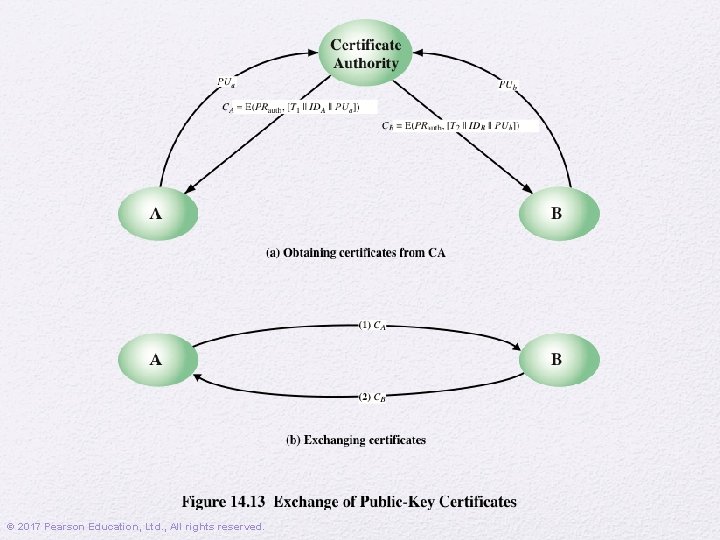
© 2017 Pearson Education, Ltd. , All rights reserved.
X. 509 Certificates • Part of the X. 500 series of recommendations that define a directory service • The directory is, in effect, a server or distributed set of servers that maintains a database of information about users • X. 509 defines a framework for the provision of authentication services by the X. 500 directory to its users • • Was initially issued in 1988 with the latest revision in 2012 Based on the use of public-key cryptography and digital signatures Does not dictate the use of a specific algorithm but recommends RSA Does not dictate a specific hash algorithm • Each certificate contains the public key of a user and is signed with the private key of a trusted certification authority • X. 509 defines alternative authentication protocols based on the use of public-key certificates © 2017 Pearson Education, Ltd. , All rights reserved.
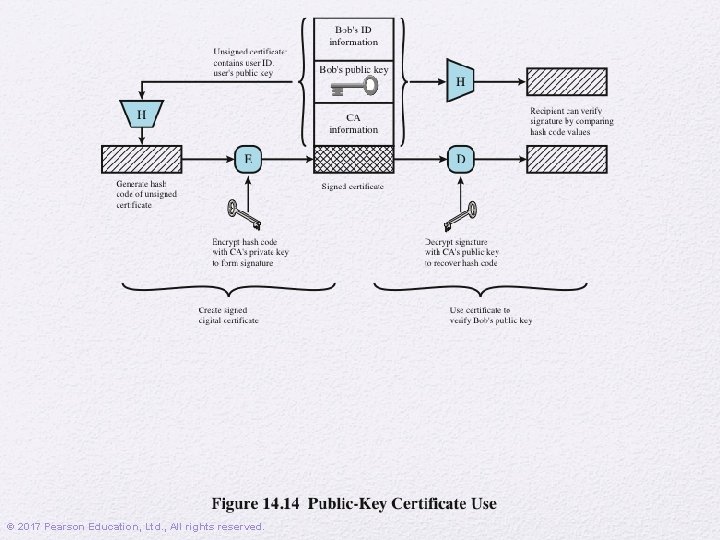
© 2017 Pearson Education, Ltd. , All rights reserved.
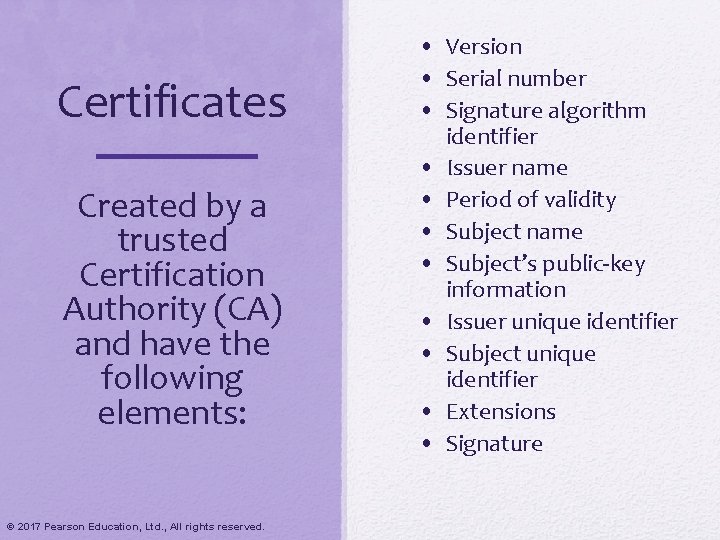
Certificates Created by a trusted Certification Authority (CA) and have the following elements: © 2017 Pearson Education, Ltd. , All rights reserved. • Version • Serial number • Signature algorithm identifier • Issuer name • Period of validity • Subject name • Subject’s public-key information • Issuer unique identifier • Subject unique identifier • Extensions • Signature
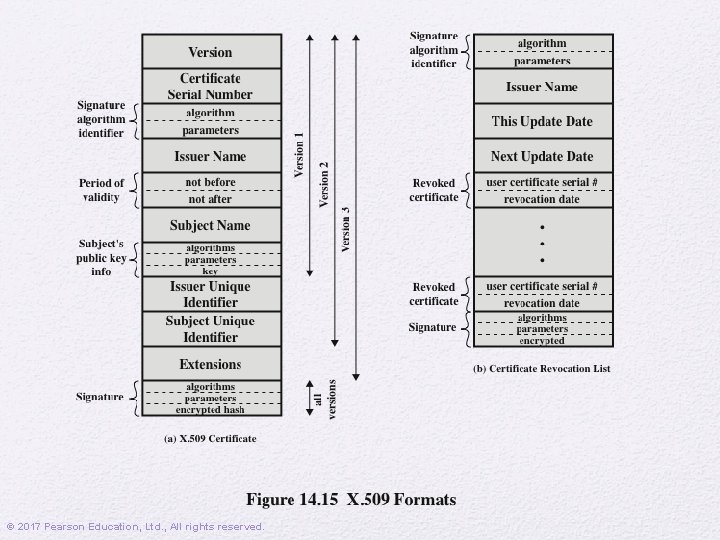
© 2017 Pearson Education, Ltd. , All rights reserved.
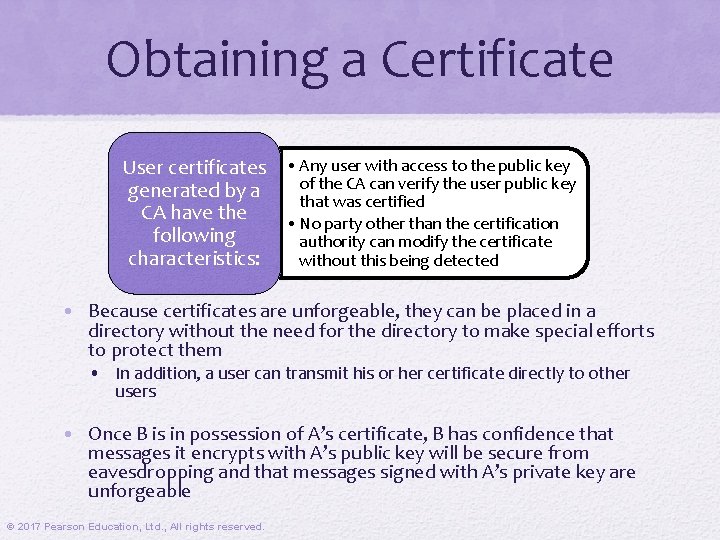
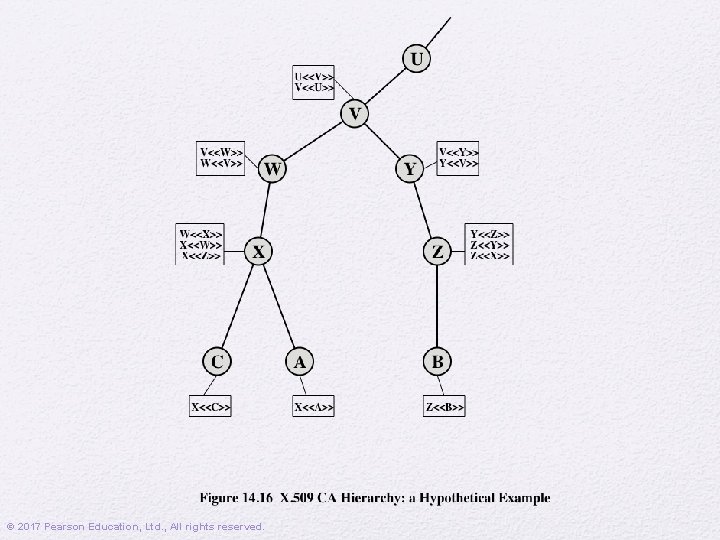
Obtaining a Certificate User certificates • Any user with access to the public key of the CA can verify the user public key generated by a that was certified CA have the • No party other than the certification following authority can modify the certificate characteristics: without this being detected • Because certificates are unforgeable, they can be placed in a directory without the need for the directory to make special efforts to protect them • In addition, a user can transmit his or her certificate directly to other users • Once B is in possession of A’s certificate, B has confidence that messages it encrypts with A’s public key will be secure from eavesdropping and that messages signed with A’s private key are unforgeable © 2017 Pearson Education, Ltd. , All rights reserved.
© 2017 Pearson Education, Ltd. , All rights reserved.
Certificate Revocation • Each certificate includes a period of validity • Typically a new certificate is issued just before the expiration of the old one • It may be desirable on occasion to revoke a certificate before it expires, for one of the following reasons: • The user’s private key is assumed to be compromised • The user is no longer certified by this CA • The CA’s certificate is assumed to be compromised • Each CA must maintain a list consisting of all revoked but not expired certificates issued by that CA • These lists should be posted on the directory © 2017 Pearson Education, Ltd. , All rights reserved.
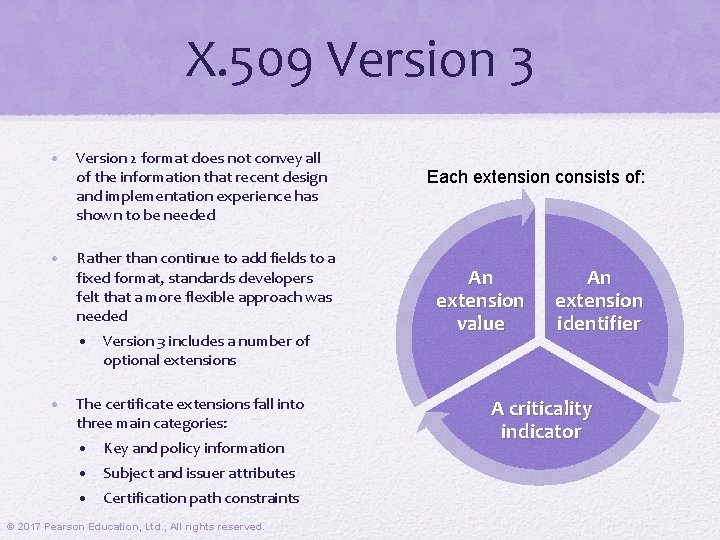
X. 509 Version 3 • Version 2 format does not convey all of the information that recent design and implementation experience has shown to be needed • Rather than continue to add fields to a fixed format, standards developers felt that a more flexible approach was needed • Version 3 includes a number of optional extensions • The certificate extensions fall into three main categories: • Key and policy information • Subject and issuer attributes • Certification path constraints © 2017 Pearson Education, Ltd. , All rights reserved. Each extension consists of: An extension value An extension identifier A criticality indicator
Key and Policy Information • These extensions convey additional information about the subject and issuer keys plus indicators of certificate policy • A certificate policy is a named set of rules that indicates the applicability of a certificate to a particular community and/or class of application with common security requirements Included are: • Authority key identifier • Subject key identifier • Key usage • Private-key usage period • Certificate policies • Policy mappings © 2017 Pearson Education, Ltd. , All rights reserved.
Certificate Subject and Issuer Attributes • These extensions support alternative names, in alternative formats, for a certificate subject or certificate issuer • Can convey additional information about the certificate subject to increase a certificate user’s confidence that the certificate subject is a particular person or entity • The extension fields in this area include: • Subject alternative name • Issuer alternative name • Subject directory attributes © 2017 Pearson Education, Ltd. , All rights reserved.
Certification Path Constraints • These extensions allow constraint specifications to be included in certificates issued for CAs by other CAs • The constraints may restrict the types of certificates that can be issued by the subject CA or that may occur subsequently in a certification chain • The extension fields in this area include: • Basic constraints • Name constraints • Policy constraints © 2017 Pearson Education, Ltd. , All rights reserved.
© 2017 Pearson Education, Ltd. , All rights reserved.
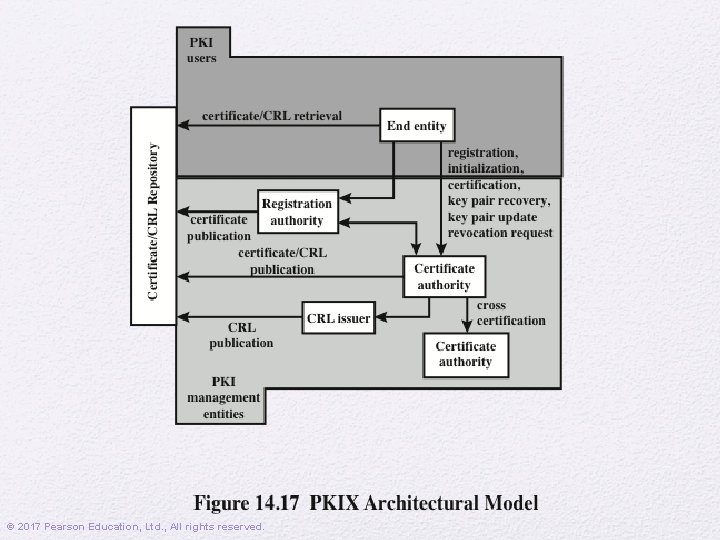
PKIX Management Functions • PKIX identifies a number of management functions that potentially need to be supported by management protocols: • • Registration Initialization Certification Key pair recovery Key pair update Revocation request Cross certification © 2017 Pearson Education, Ltd. , All rights reserved.
Summary • Symmetric key distribution using symmetric encryption • • Key distribution scenario Hierarchical key control Session key lifetime Transparent key control scheme • Decentralized key control • Controlling key usage • Symmetric key distribution using asymmetric encryption • Simple secret key distribution • Secret key distribution with confidentiality and authentication • Hybrid scheme © 2017 Pearson Education, Ltd. , All rights reserved. • Distribution of public keys • Public announcement of public keys • Publicly available directory • Public-key authority • Public-key certificates • X. 509 Certificates • X. 509 Version 3 • Public-key infrastructure • PKIX management functions • PKIX management protocols
- Slides: 37