
Cryptography and Network Security Seventh Edition Global Edition
Cryptography and Network Security Seventh Edition, Global Edition by William Stallings
Chapter 2 Introduction to Number Theory © 2017 Pearson Education, Ltd. , All rights reserved.
Divisibility • We say that a nonzero b divides a if a = mb for some m, where a, b, and m are integers • b divides a if there is no remainder on division • The notation b | a is commonly used to mean b divides a • If b | a we say that b is a divisor of a The positive divisors of 24 are 1, 2, 3, 4, 6, 8, 12, and 24 13 | 182; - 5 | 30; 17 | 289; - 3 | 33; 17 | 0 © 2017 Pearson Education, Ltd. , All rights reserved.
Properties of Divisibility • If a | 1, then a = ± 1 • If a | b and b | a, then a = ±b • Any b ≠ 0 divides 0 • If a | b and b | c, then a | c 11 | 66 and 66 | 198 = 11 | 198 • If b | g and b | h, then b | (mg + nh) for arbitrary integers m and n © 2017 Pearson Education, Ltd. , All rights reserved.
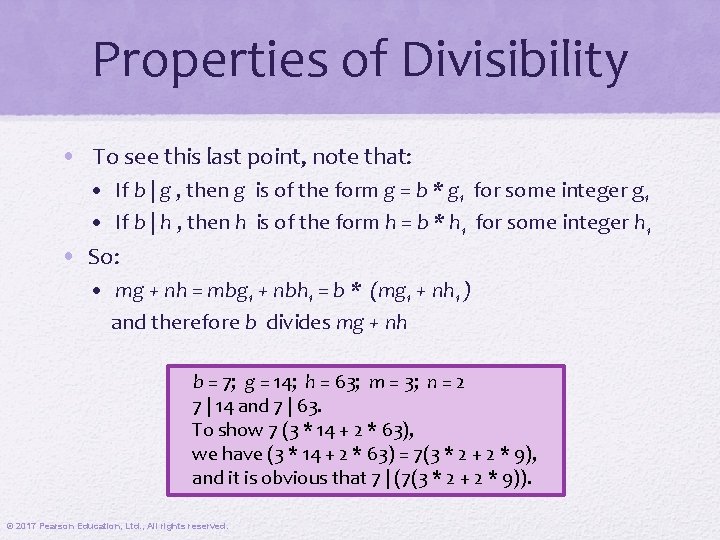
Properties of Divisibility • To see this last point, note that: • If b | g , then g is of the form g = b * g 1 for some integer g 1 • If b | h , then h is of the form h = b * h 1 for some integer h 1 • So: • mg + nh = mbg 1 + nbh 1 = b * (mg 1 + nh 1 ) and therefore b divides mg + nh b = 7; g = 14; h = 63; m = 3; n = 2 7 | 14 and 7 | 63. To show 7 (3 * 14 + 2 * 63), we have (3 * 14 + 2 * 63) = 7(3 * 2 + 2 * 9), and it is obvious that 7 | (7(3 * 2 + 2 * 9)). © 2017 Pearson Education, Ltd. , All rights reserved.
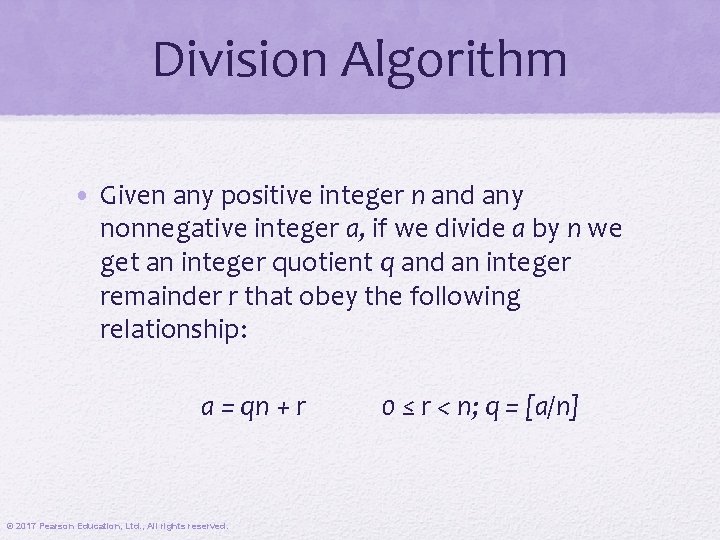
Division Algorithm • Given any positive integer n and any nonnegative integer a, if we divide a by n we get an integer quotient q and an integer remainder r that obey the following relationship: a = qn + r © 2017 Pearson Education, Ltd. , All rights reserved. 0 ≤ r < n; q = [a/n]
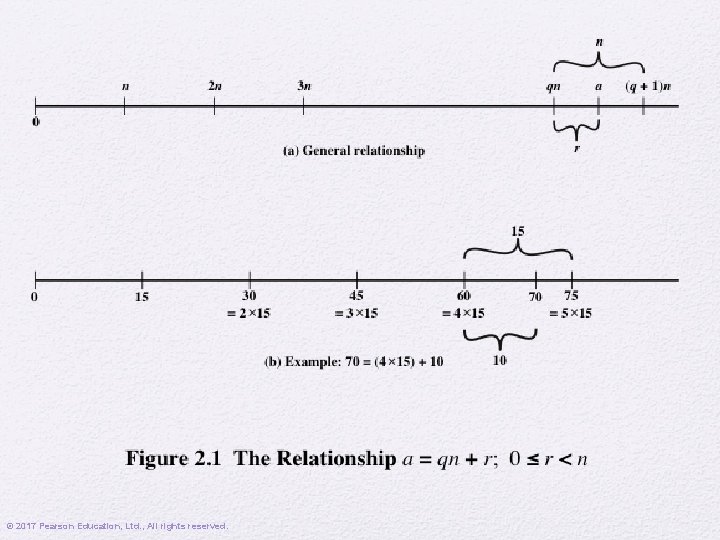
© 2017 Pearson Education, Ltd. , All rights reserved.
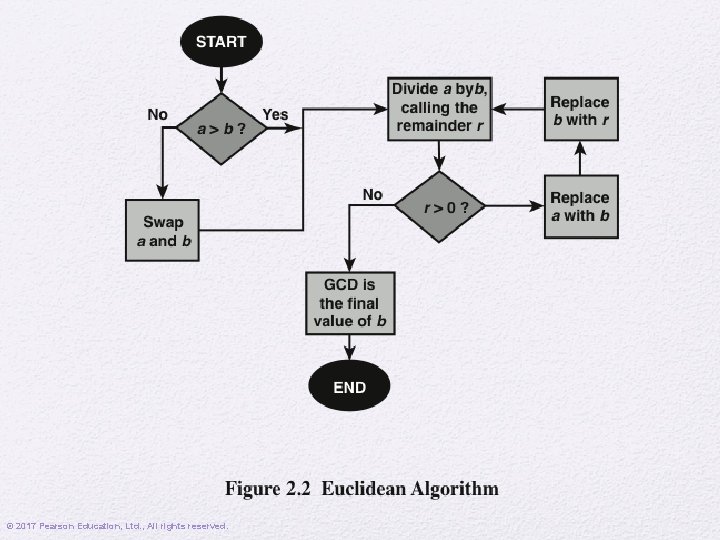
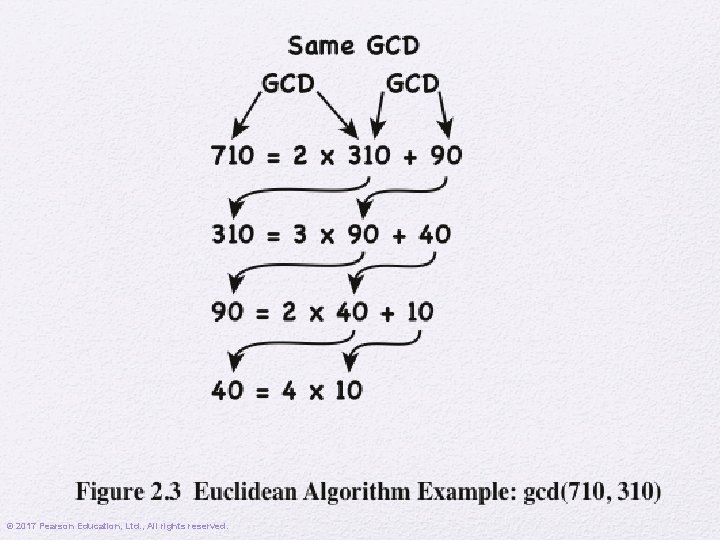
Euclidean Algorithm • One of the basic techniques of number theory • Procedure for determining the greatest common divisor of two positive integers • Two integers are relatively prime if their only common positive integer factor is 1 © 2017 Pearson Education, Ltd. , All rights reserved.
Greatest Common Divisor (GCD) • The greatest common divisor of a and b is the largest integer that divides both a and b • We can use the notation gcd(a, b) to mean the greatest common divisor of a and b • We also define gcd(0, 0) = 0 • Positive integer c is said to be the gcd of a and b if: • c is a divisor of a and b • Any divisor of a and b is a divisor of c • An equivalent definition is: gcd(a, b) = max[k, such that k | a and k | b] © 2017 Pearson Education, Ltd. , All rights reserved.
GCD • Because we require that the greatest common divisor be positive, gcd(a, b) = gcd(a, -b) = gcd(-a, -b) • In general, gcd(a, b) = gcd(| a |, | b |) gcd(60, 24) = gcd(60, - 24) = 12 • Also, because all nonzero integers divide 0, we have gcd(a, 0) = | a | • We stated that two integers a and b are relatively prime if their only common positive integer factor is 1; this is equivalent to saying that a and b are relatively prime if gcd(a, b) = 1 8 and 15 are relatively prime because the positive divisors of 8 are 1, 2, 4, and 8, and the positive divisors of 15 are 1, 3, 5, and 15. So 1 is the only integer on both lists. © 2017 Pearson Education, Ltd. , All rights reserved.
© 2017 Pearson Education, Ltd. , All rights reserved.
© 2017 Pearson Education, Ltd. , All rights reserved.
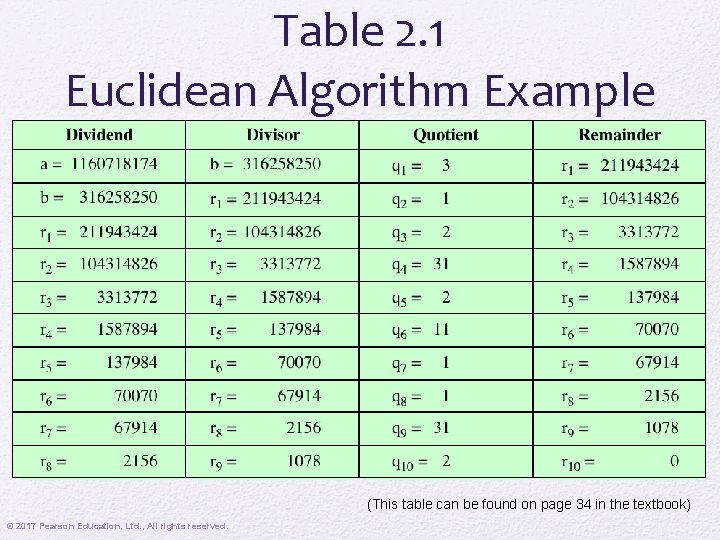
Table 2. 1 Euclidean Algorithm Example (This table can be found on page 34 in the textbook) © 2017 Pearson Education, Ltd. , All rights reserved.
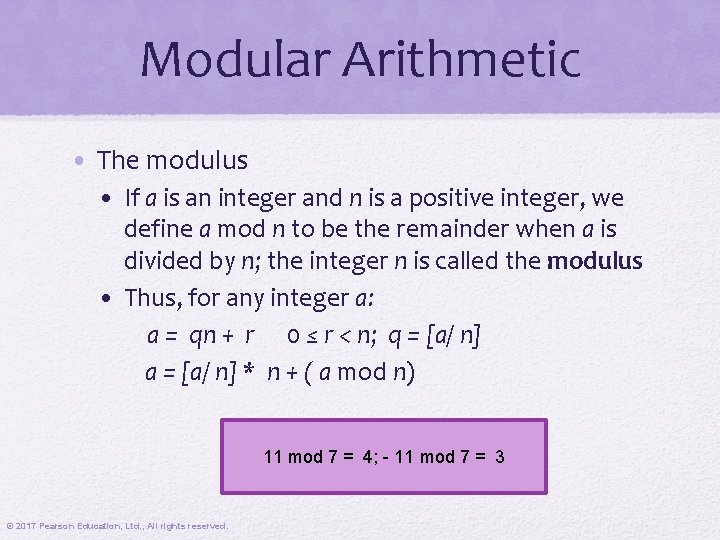
Modular Arithmetic • The modulus • If a is an integer and n is a positive integer, we define a mod n to be the remainder when a is divided by n; the integer n is called the modulus • Thus, for any integer a: a = qn + r 0 ≤ r < n; q = [a/ n] a = [a/ n] * n + ( a mod n) 11 mod 7 = 4; - 11 mod 7 = 3 © 2017 Pearson Education, Ltd. , All rights reserved.
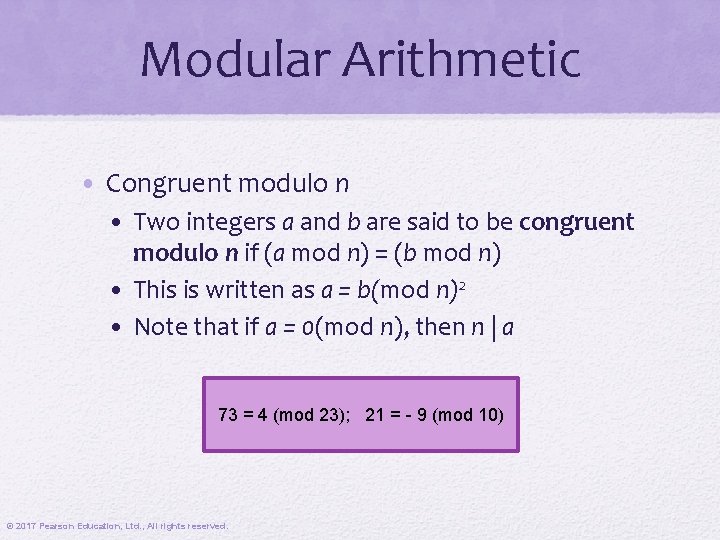
Modular Arithmetic • Congruent modulo n • Two integers a and b are said to be congruent modulo n if (a mod n) = (b mod n) • This is written as a = b(mod n)2 • Note that if a = 0(mod n), then n | a 73 = 4 (mod 23); 21 = - 9 (mod 10) © 2017 Pearson Education, Ltd. , All rights reserved.
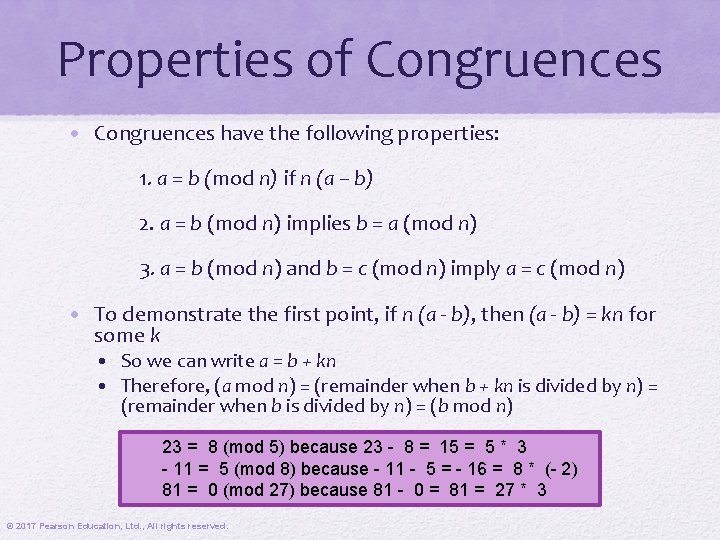
Properties of Congruences • Congruences have the following properties: 1. a = b (mod n) if n (a – b) 2. a = b (mod n) implies b = a (mod n) 3. a = b (mod n) and b = c (mod n) imply a = c (mod n) • To demonstrate the first point, if n (a - b), then (a - b) = kn for some k • So we can write a = b + kn • Therefore, (a mod n) = (remainder when b + kn is divided by n) = (remainder when b is divided by n) = (b mod n) 23 = 8 (mod 5) because 23 - 8 = 15 = 5 * 3 - 11 = 5 (mod 8) because - 11 - 5 = - 16 = 8 * (- 2) 81 = 0 (mod 27) because 81 - 0 = 81 = 27 * 3 © 2017 Pearson Education, Ltd. , All rights reserved.
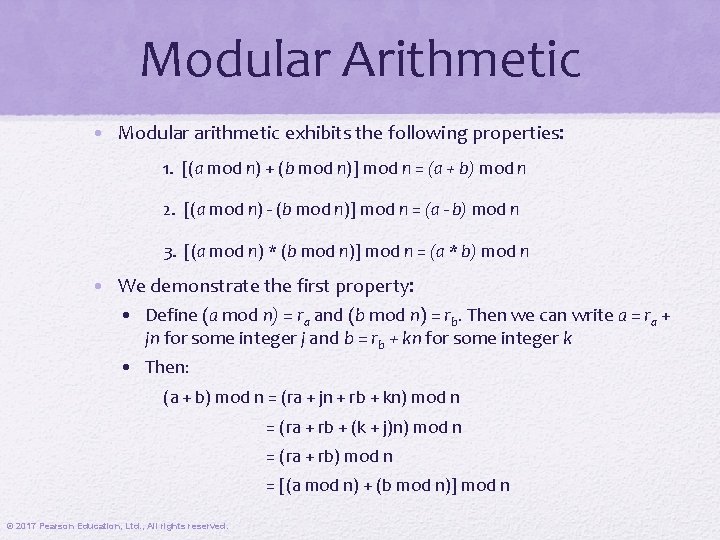
Modular Arithmetic • Modular arithmetic exhibits the following properties: 1. [(a mod n) + (b mod n)] mod n = (a + b) mod n 2. [(a mod n) - (b mod n)] mod n = (a - b) mod n 3. [(a mod n) * (b mod n)] mod n = (a * b) mod n • We demonstrate the first property: • Define (a mod n) = ra and (b mod n) = rb. Then we can write a = ra + jn for some integer j and b = rb + kn for some integer k • Then: (a + b) mod n = (ra + jn + rb + kn) mod n = (ra + rb + (k + j)n) mod n = (ra + rb) mod n = [(a mod n) + (b mod n)] mod n © 2017 Pearson Education, Ltd. , All rights reserved.
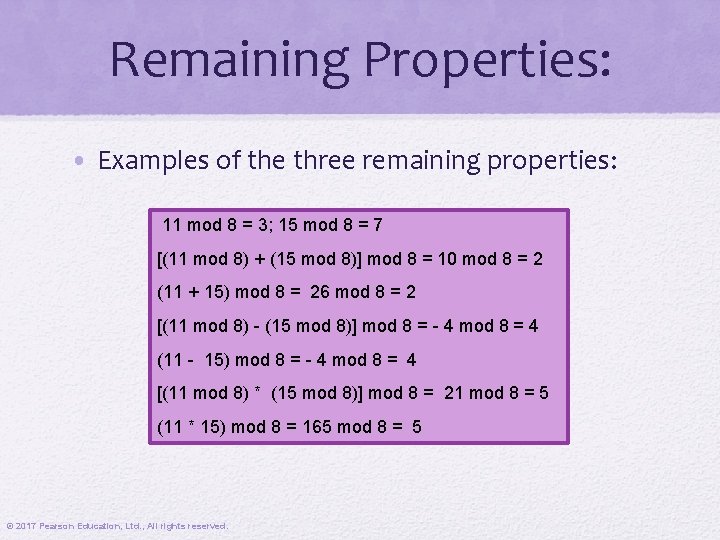
Remaining Properties: • Examples of the three remaining properties: 11 mod 8 = 3; 15 mod 8 = 7 [(11 mod 8) + (15 mod 8)] mod 8 = 10 mod 8 = 2 (11 + 15) mod 8 = 26 mod 8 = 2 [(11 mod 8) - (15 mod 8)] mod 8 = - 4 mod 8 = 4 (11 - 15) mod 8 = - 4 mod 8 = 4 [(11 mod 8) * (15 mod 8)] mod 8 = 21 mod 8 = 5 (11 * 15) mod 8 = 165 mod 8 = 5 © 2017 Pearson Education, Ltd. , All rights reserved.
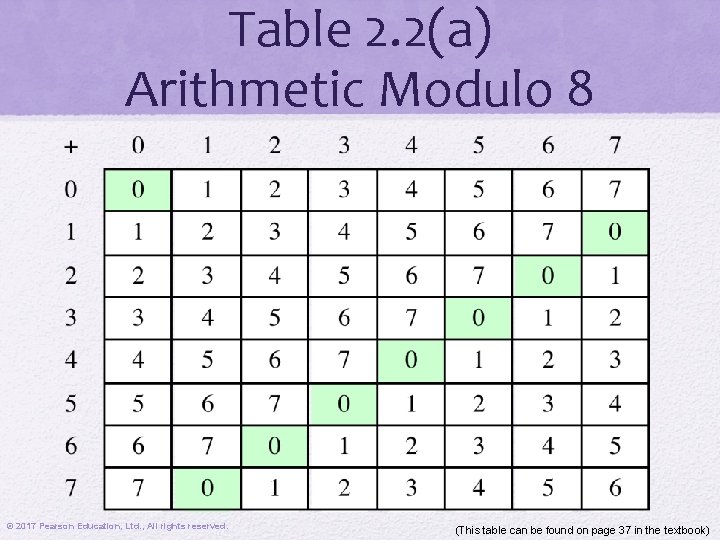
Table 2. 2(a) Arithmetic Modulo 8 © 2017 Pearson Education, Ltd. , All rights reserved. (This table can be found on page 37 in the textbook)
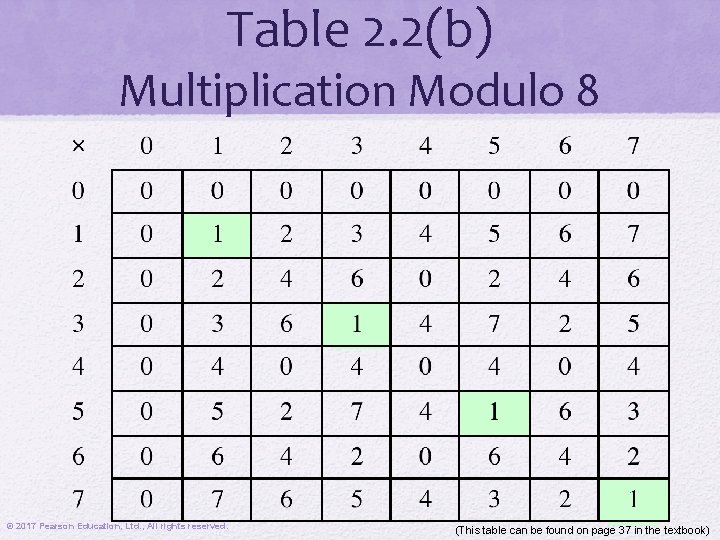
Table 2. 2(b) Multiplication Modulo 8 © 2017 Pearson Education, Ltd. , All rights reserved. (This table can be found on page 37 in the textbook)
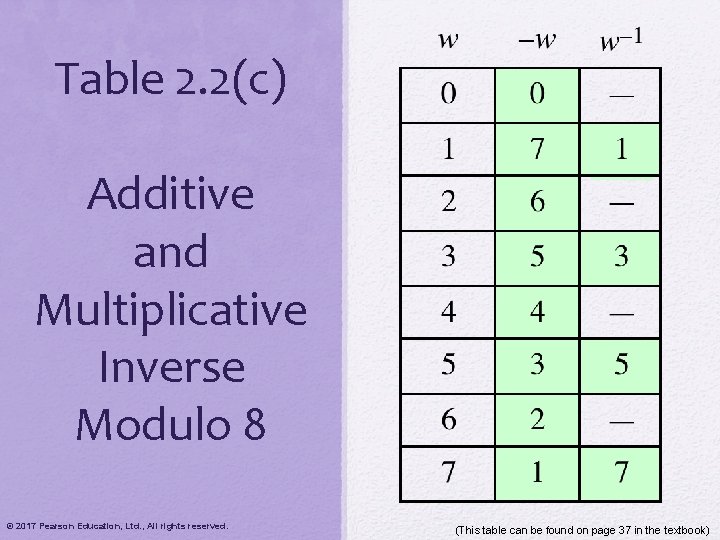
Table 2. 2(c) Additive and Multiplicative Inverse Modulo 8 © 2017 Pearson Education, Ltd. , All rights reserved. (This table can be found on page 37 in the textbook)
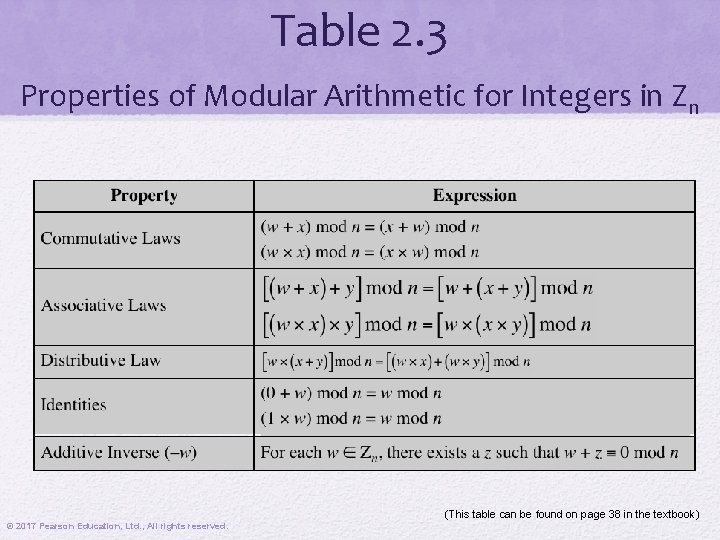
Table 2. 3 Properties of Modular Arithmetic for Integers in Z n (This table can be found on page 38 in the textbook) © 2017 Pearson Education, Ltd. , All rights reserved.
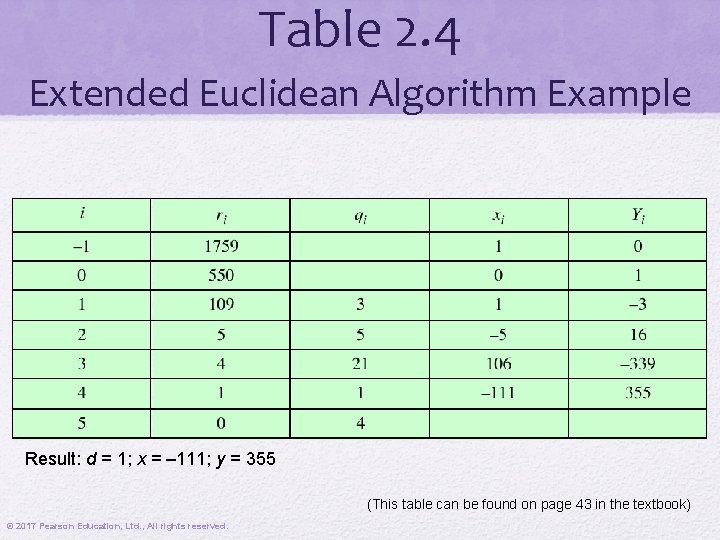
Table 2. 4 Extended Euclidean Algorithm Example Result: d = 1; x = – 111; y = 355 (This table can be found on page 43 in the textbook) © 2017 Pearson Education, Ltd. , All rights reserved.
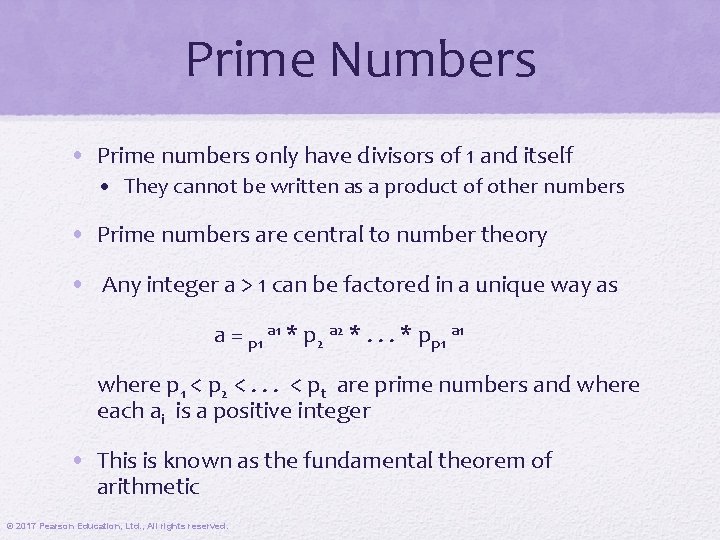
Prime Numbers • Prime numbers only have divisors of 1 and itself • They cannot be written as a product of other numbers • Prime numbers are central to number theory • Any integer a > 1 can be factored in a unique way as a = p 1 a 1 * p 2 a 2 *. . . * pp 1 a 1 where p 1 < p 2 <. . . < pt are prime numbers and where each ai is a positive integer • This is known as the fundamental theorem of arithmetic © 2017 Pearson Education, Ltd. , All rights reserved.
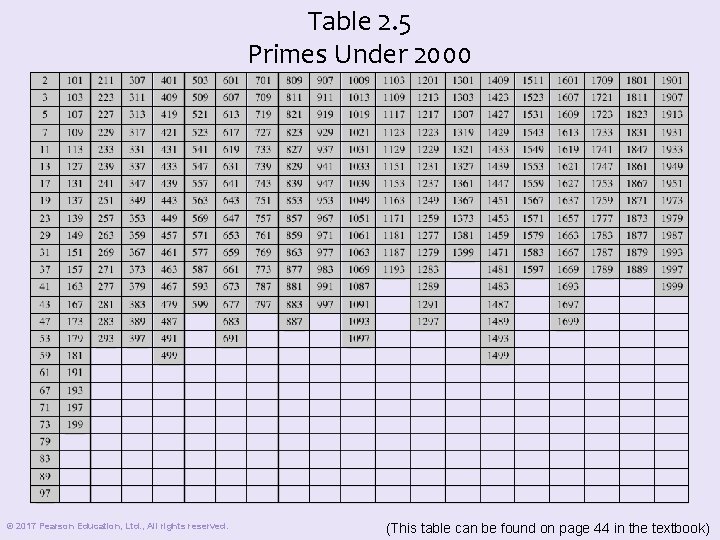
Table 2. 5 Primes Under 2000 © 2017 Pearson Education, Ltd. , All rights reserved. (This table can be found on page 44 in the textbook)
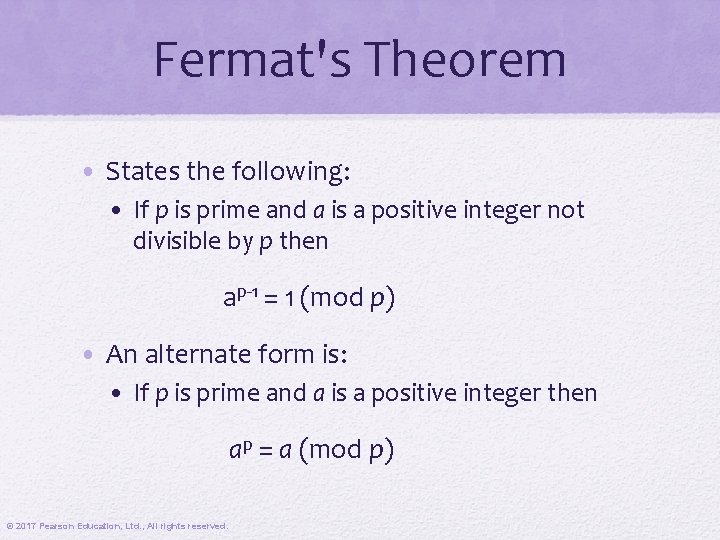
Fermat's Theorem • States the following: • If p is prime and a is a positive integer not divisible by p then ap-1 = 1 (mod p) • An alternate form is: • If p is prime and a is a positive integer then ap = a (mod p) © 2017 Pearson Education, Ltd. , All rights reserved.
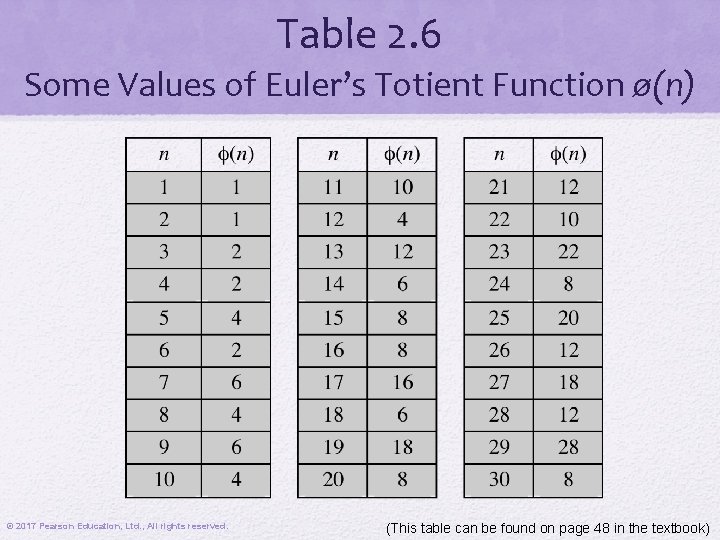
Table 2. 6 Some Values of Euler’s Totient Function ø(n) © 2017 Pearson Education, Ltd. , All rights reserved. (This table can be found on page 48 in the textbook)
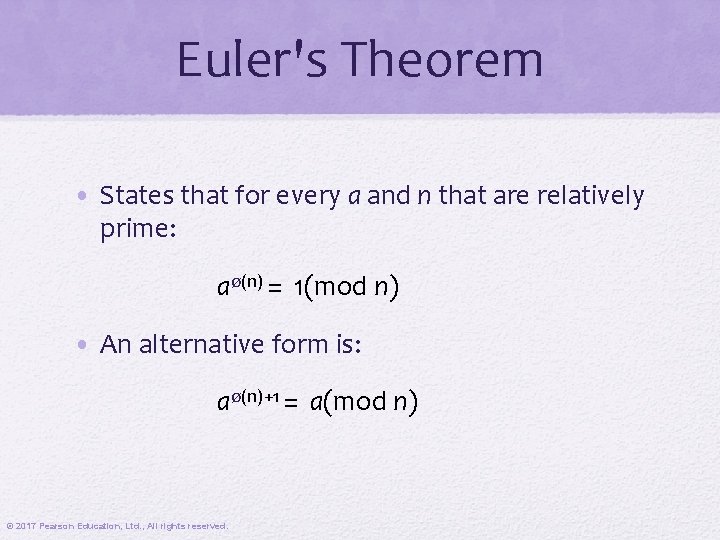
Euler's Theorem • States that for every a and n that are relatively prime: aø(n) = 1(mod n) • An alternative form is: aø(n)+1 = a(mod n) © 2017 Pearson Education, Ltd. , All rights reserved.
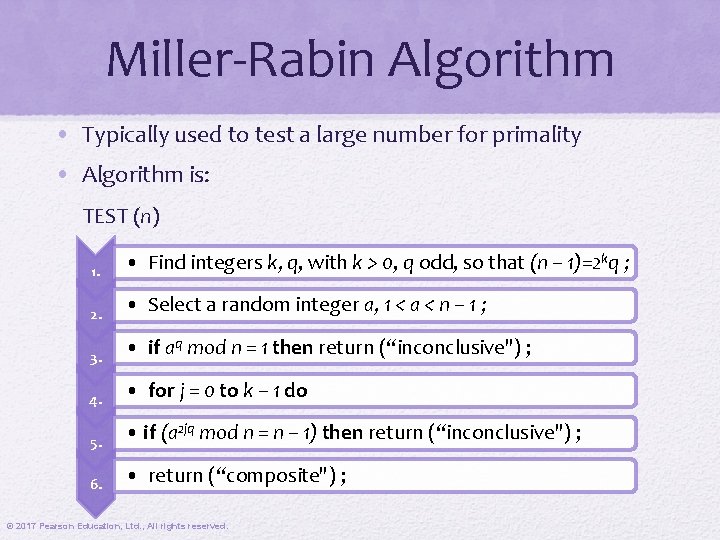
Miller-Rabin Algorithm • Typically used to test a large number for primality • Algorithm is: TEST (n) 1. • Find integers k, q, with k > 0, q odd, so that (n – 1)=2 kq ; 2. • Select a random integer a, 1 < a < n – 1 ; 3. • if aq mod n = 1 then return (“inconclusive") ; 4. • for j = 0 to k – 1 do 5. • if (a 2 jq mod n = n – 1) then return (“inconclusive") ; 6. • return (“composite") ; © 2017 Pearson Education, Ltd. , All rights reserved.
Deterministic Primality Algorithm • Prior to 2002 there was no known method of efficiently proving the primality of very large numbers • All of the algorithms in use produced a probabilistic result • In 2002 Agrawal, Kayal, and Saxena developed an algorithm that efficiently determines whether a given large number is prime • Known as the AKS algorithm • Does not appear to be as efficient as the Miller-Rabin algorithm © 2017 Pearson Education, Ltd. , All rights reserved.
Chinese Remainder Theorem (CRT) • Believed to have been discovered by the Chinese mathematician Sun-Tsu in around 100 A. D. • One of the most useful results of number theory • Says it is possible to reconstruct integers in a certain range from their residues modulo a set of pairwise relatively prime moduli • Can be stated in several ways Provides a way to manipulate (potentially very large) numbers mod M in terms of tuples of smaller numbers • This can be useful when M is 150 digits or more • However, it is necessary to know beforehand the factorization of M © 2017 Pearson Education, Ltd. , All rights reserved.
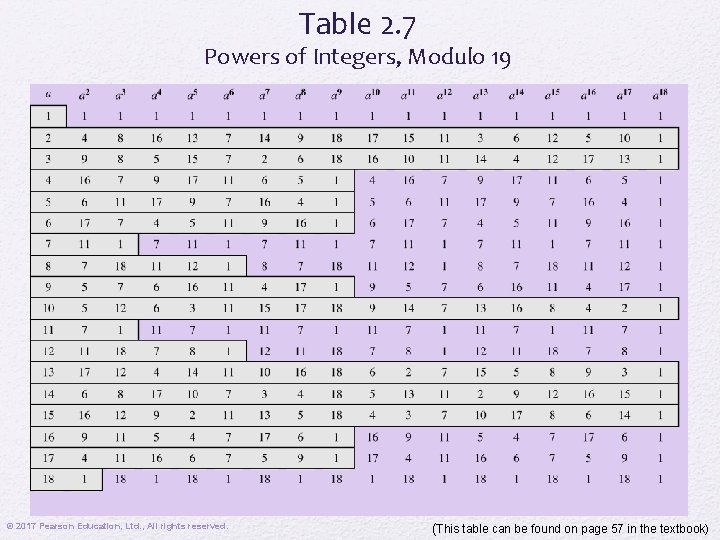
Table 2. 7 Powers of Integers, Modulo 19 © 2017 Pearson Education, Ltd. , All rights reserved. (This table can be found on page 57 in the textbook)
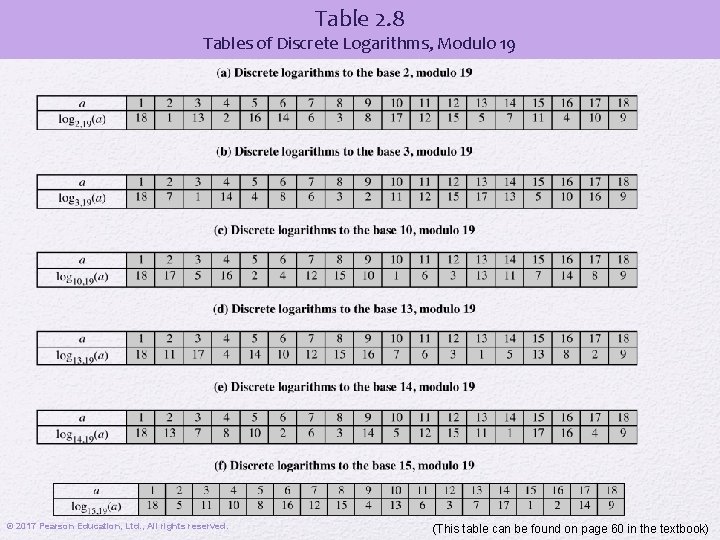
Table 2. 8 Tables of Discrete Logarithms, Modulo 19 © 2017 Pearson Education, Ltd. , All rights reserved. (This table can be found on page 60 in the textbook)
Summary • Divisibility and the division algorithm • The Euclidean algorithm • Fermat’s Theorem • Euler’s totient function • Greatest Common Divisor • Euler’s Theorem • Finding the Greatest Common Divisor • Testing for primality • Modular arithmetic • The modulus • Properties of congruences • Modular arithmetic operations • Properties of modular arithmetic • Euclidean algorithm revisited • The extended Euclidean algorithm • Prime numbers © 2017 Pearson Education, Ltd. , All rights reserved. • • • Miller-Rabin algorithm A deterministic primality algorithm Distribution of primes • The Chinese Remainder Theorem • Discrete logarithms • • • Powers of an integer, modulo n Logarithms for modular arithmetic Calculation of discrete logarithms
- Slides: 34