
Cryptographic Tools cryptographic algorithms important element in security
- Slides: 30
Cryptographic Tools • cryptographic algorithms important element in security services • review various types of elements – symmetric encryption – public-key (asymmetric) encryption – digital signatures and key management – secure hash functions • example is use to encrypt stored data
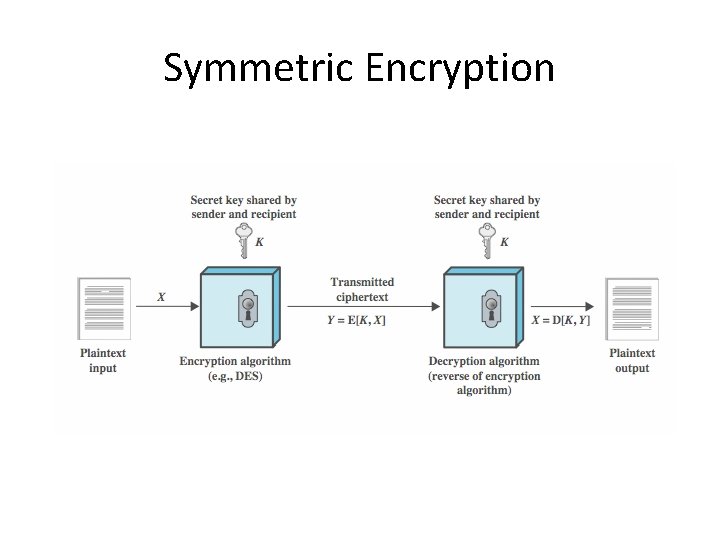
Symmetric Encryption
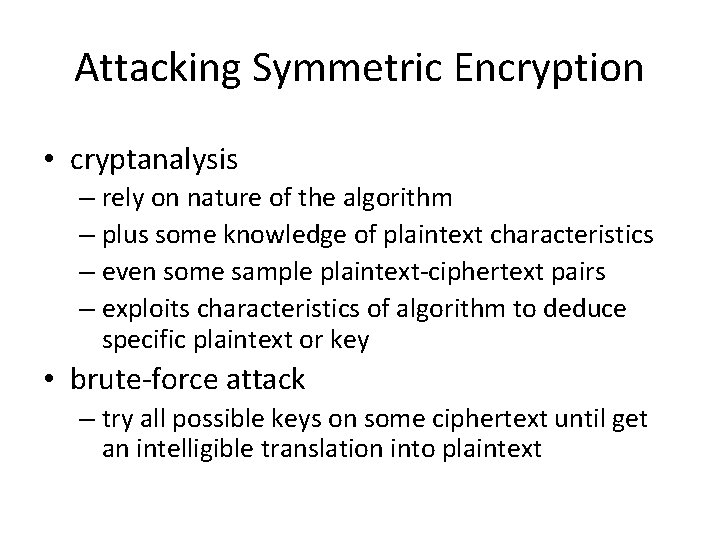
Attacking Symmetric Encryption • cryptanalysis – rely on nature of the algorithm – plus some knowledge of plaintext characteristics – even some sample plaintext-ciphertext pairs – exploits characteristics of algorithm to deduce specific plaintext or key • brute-force attack – try all possible keys on some ciphertext until get an intelligible translation into plaintext
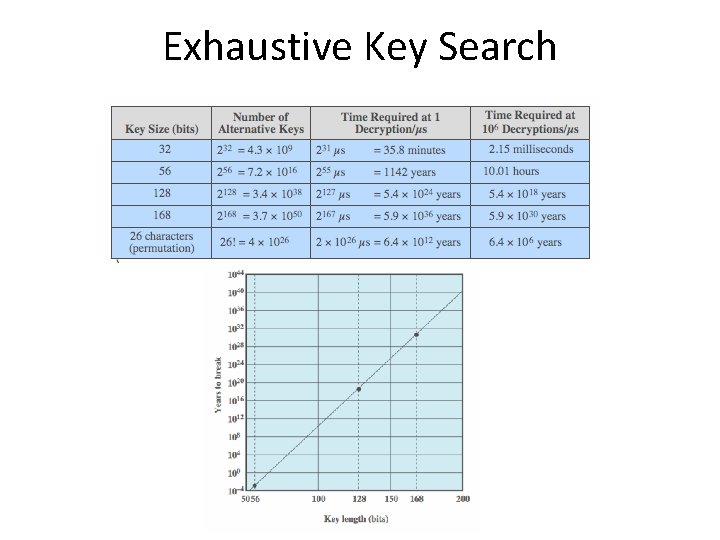
Exhaustive Key Search
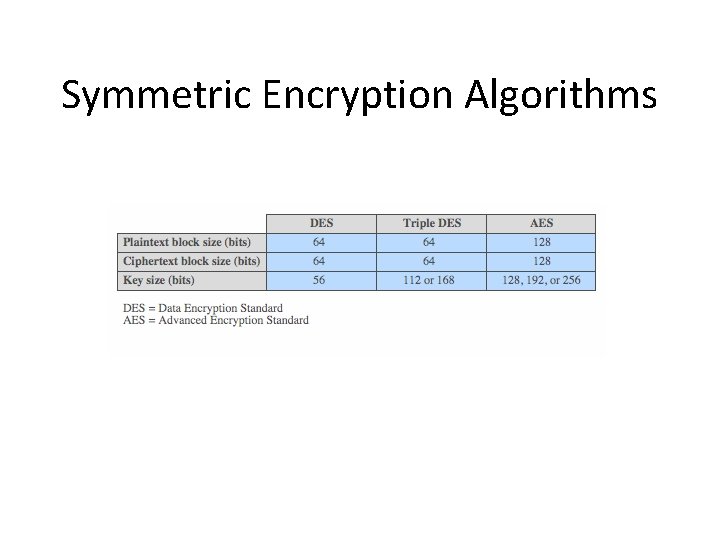
Symmetric Encryption Algorithms
DES and Triple-DES • Data Encryption Standard (DES) is the most widely used encryption scheme – uses 64 bit plaintext block and 56 bit key to produce a 64 bit ciphertext block – concerns about algorithm & use of 56 -bit key • Triple-DES – repeats basic DES algorithm three times – using either two or three unique keys – much more secure but also much slower
Advanced Encryption Standard (AES) • • needed a better replacement for DES NIST called for proposals in 1997 selected Rijndael in Nov 2001 published as FIPS 197 symmetric block cipher uses 128 bit data & 128/192/256 bit keys now widely available commercially
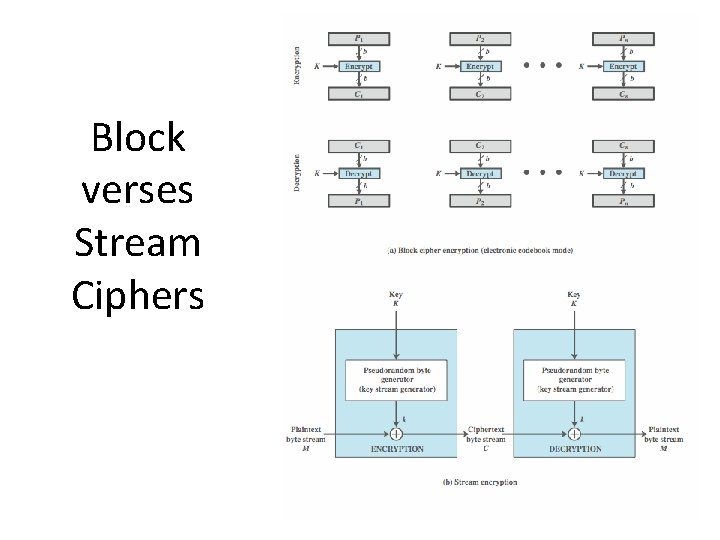
Block verses Stream Ciphers
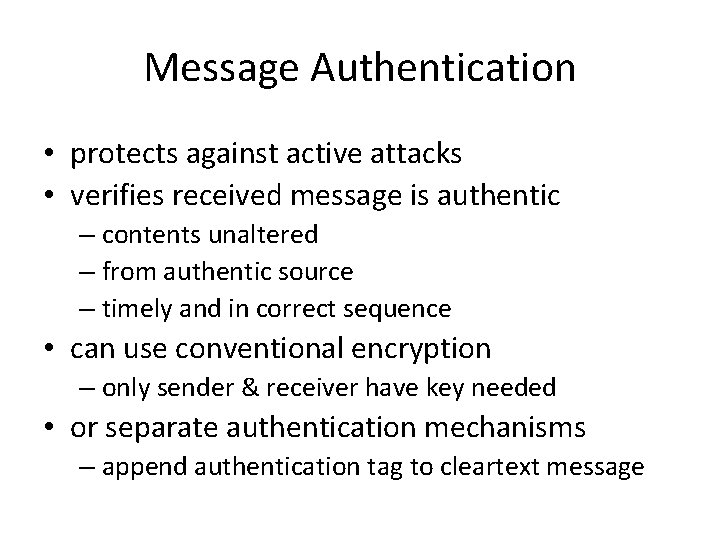
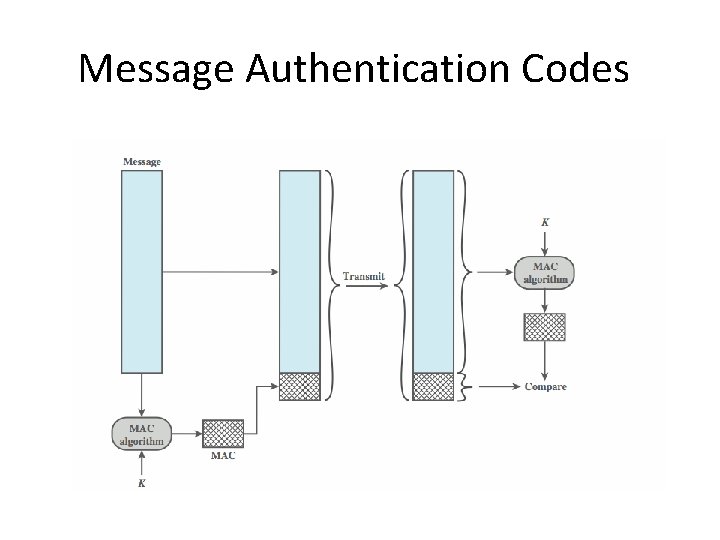
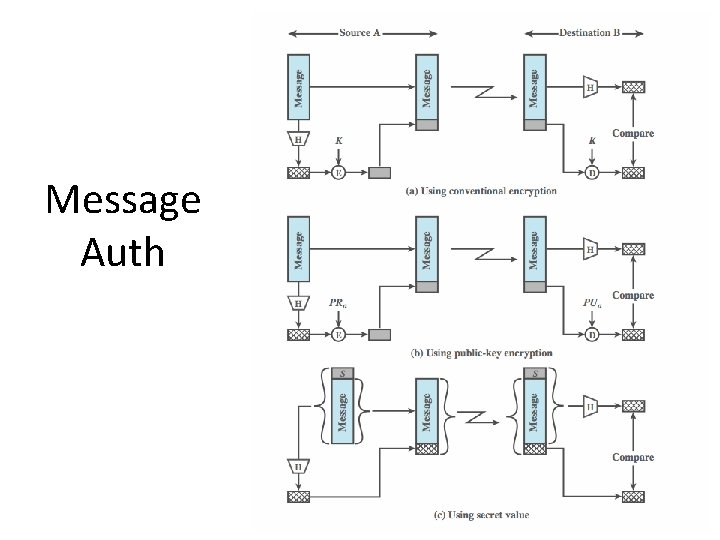
Message Authentication • protects against active attacks • verifies received message is authentic – contents unaltered – from authentic source – timely and in correct sequence • can use conventional encryption – only sender & receiver have key needed • or separate authentication mechanisms – append authentication tag to cleartext message
Message Authentication Codes
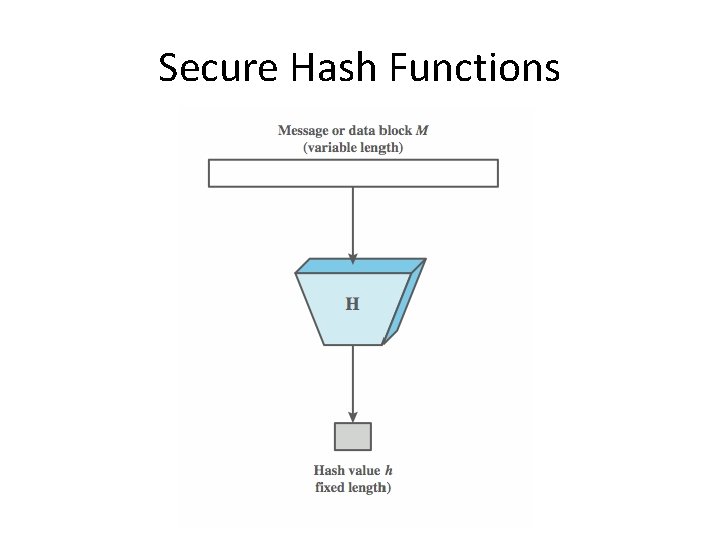
Secure Hash Functions
Message Auth
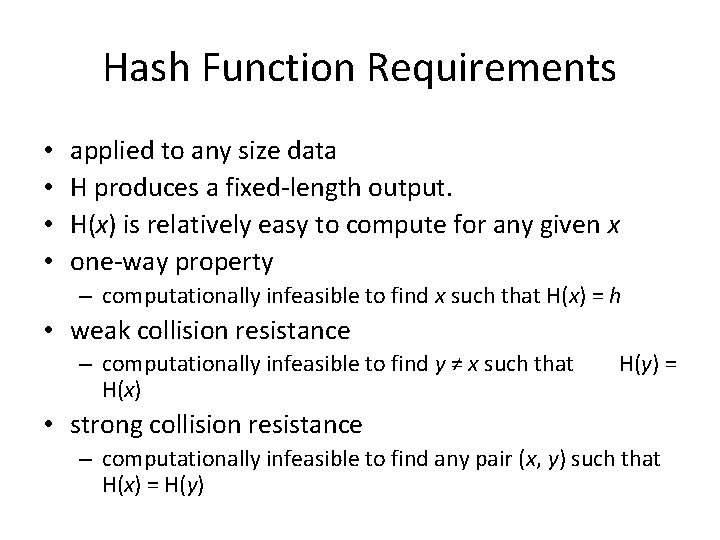
Hash Function Requirements • • applied to any size data H produces a fixed-length output. H(x) is relatively easy to compute for any given x one-way property – computationally infeasible to find x such that H(x) = h • weak collision resistance – computationally infeasible to find y ≠ x such that H(x) H(y) = • strong collision resistance – computationally infeasible to find any pair (x, y) such that H(x) = H(y)
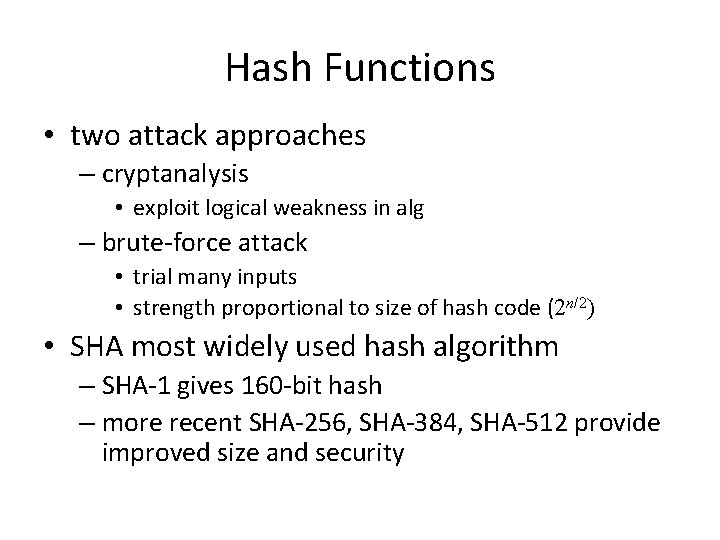
Hash Functions • two attack approaches – cryptanalysis • exploit logical weakness in alg – brute-force attack • trial many inputs • strength proportional to size of hash code (2 n/2) • SHA most widely used hash algorithm – SHA-1 gives 160 -bit hash – more recent SHA-256, SHA-384, SHA-512 provide improved size and security
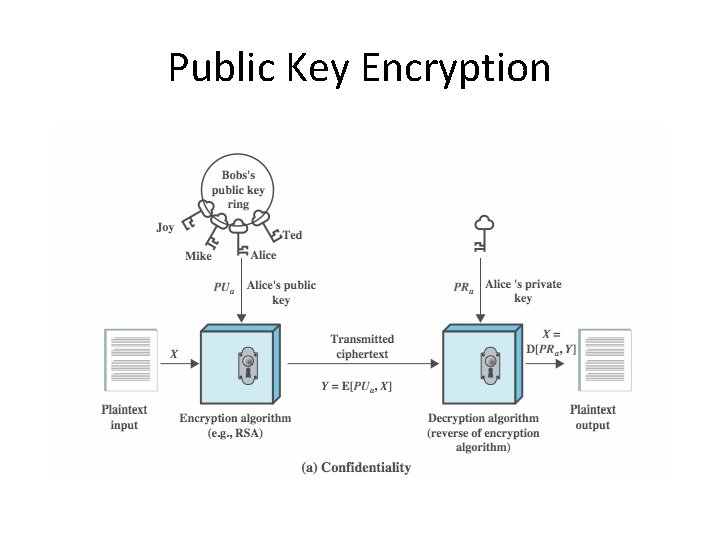
Public Key Encryption
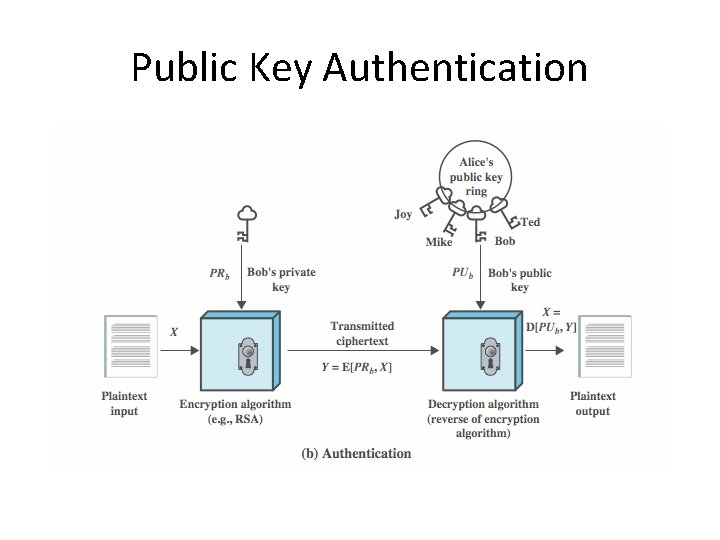
Public Key Authentication
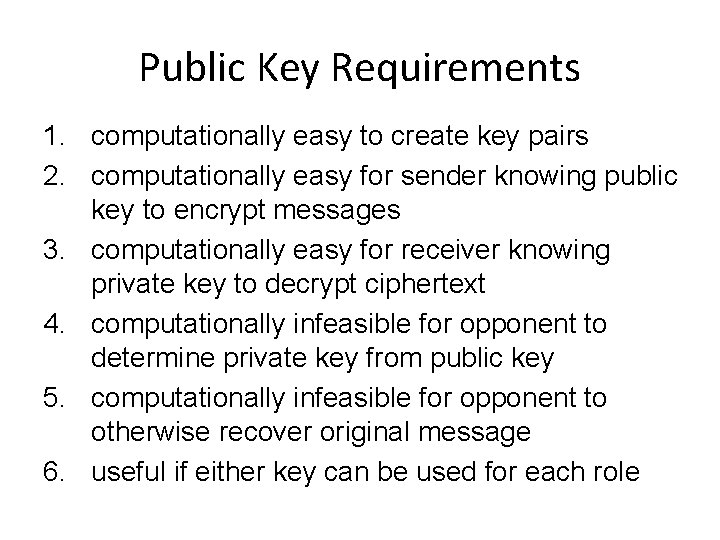
Public Key Requirements 1. computationally easy to create key pairs 2. computationally easy for sender knowing public key to encrypt messages 3. computationally easy for receiver knowing private key to decrypt ciphertext 4. computationally infeasible for opponent to determine private key from public key 5. computationally infeasible for opponent to otherwise recover original message 6. useful if either key can be used for each role
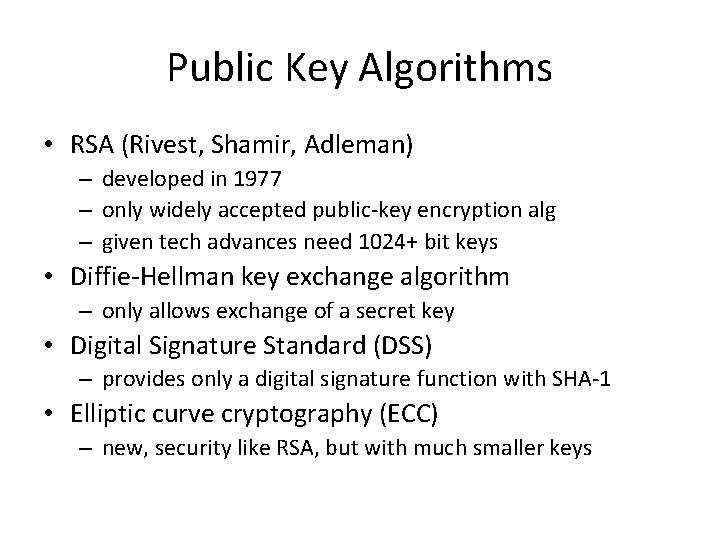
Public Key Algorithms • RSA (Rivest, Shamir, Adleman) – developed in 1977 – only widely accepted public-key encryption alg – given tech advances need 1024+ bit keys • Diffie-Hellman key exchange algorithm – only allows exchange of a secret key • Digital Signature Standard (DSS) – provides only a digital signature function with SHA-1 • Elliptic curve cryptography (ECC) – new, security like RSA, but with much smaller keys
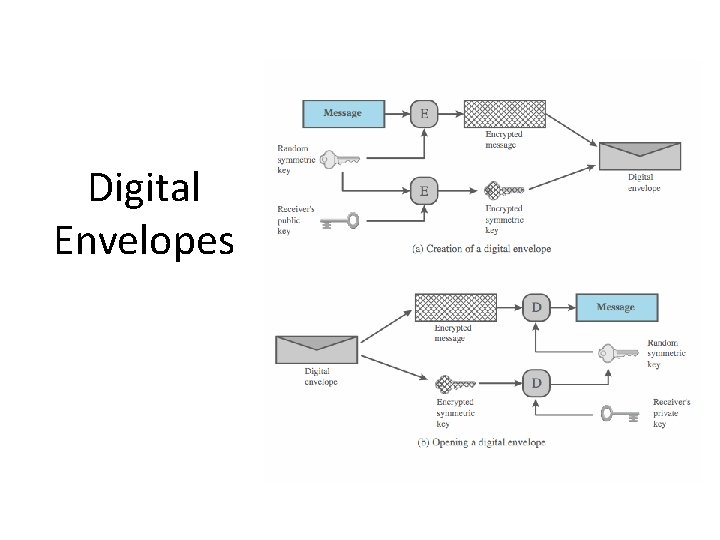
Digital Envelopes
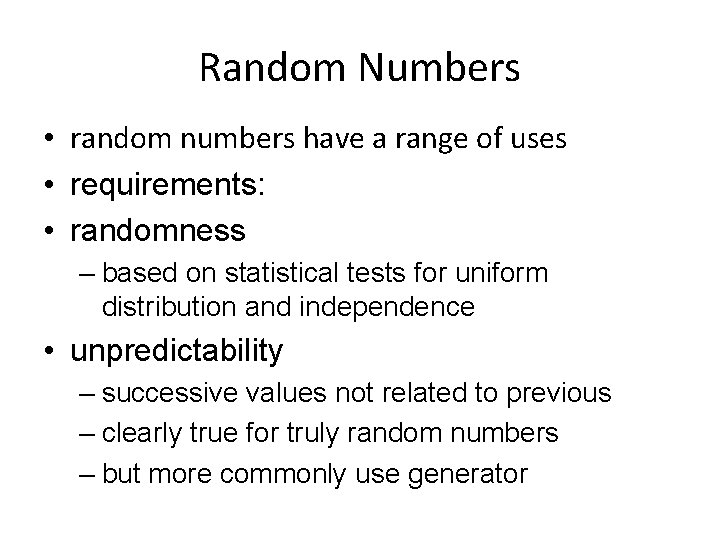
Random Numbers • random numbers have a range of uses • requirements: • randomness – based on statistical tests for uniform distribution and independence • unpredictability – successive values not related to previous – clearly true for truly random numbers – but more commonly use generator
Pseudorandom verses Random Numbers • often use algorithmic technique to create pseudorandom numbers – which satisfy statistical randomness tests – but likely to be predictable • true random number generators use a nondeterministic source – e. g. radiation, gas discharge, leaky capacitors – increasingly provided on modern processors
Diffie-Hellman Algorithm • Start with well known and public values – p must be prime – g is an integer less than p • Alice and Bob want to create a shared key K
Diffie Hellman, Continued • Alice chooses a random value a , then computes • Bob chooses a random value b, then computes
Diffie Hellman, Continued • • Alice and Bob then exchange x and y Anyone can overhear the x and y values Anyone knows p and g Alice and Bob then compute K
Diffie Hellman, Continued • At this point, both Alice and Bob have the same value K, but no eavesdropper can compute K, since they cannot know either a or b.
The RSA Algorithm • The Rivest Shamir Adleman algorithm is a PUBLIC KEY approach to security • Each person using RSA has a well known and publicly available “public key” • Each public key has a corresponding “private key” that is kept secret.
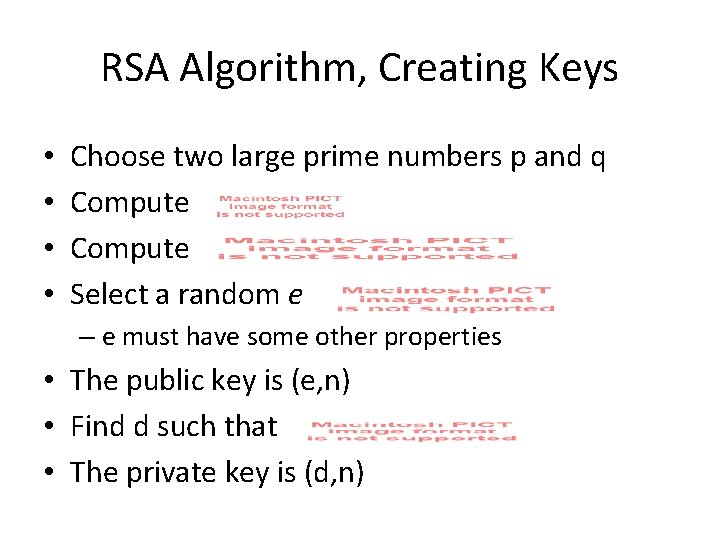
RSA Algorithm, Creating Keys • • Choose two large prime numbers p and q Compute Select a random e – e must have some other properties • The public key is (e, n) • Find d such that • The private key is (d, n)
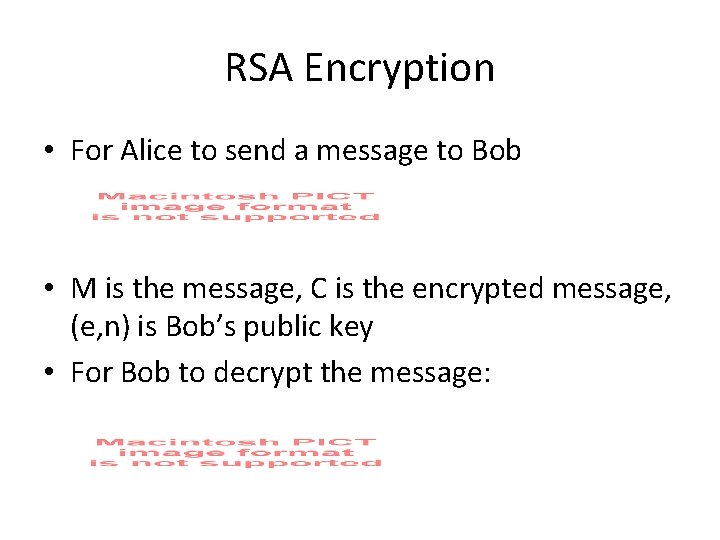
RSA Encryption • For Alice to send a message to Bob • M is the message, C is the encrypted message, (e, n) is Bob’s public key • For Bob to decrypt the message:
RSA Encryption • The encryption and decryption steps can be done efficiently using “exponentian by squaring”. • This runs in O(lg e) steps • RSA Security depends on the difficulty of computing p and q, given n – Factoring into primes
Summary • introduced cryptographic algorithms • symmetric encryption algorithms for confidentiality • message authentication & hash functions • public-key encryption • digital signatures and key management • random numbers