
Cryptanalysis Lecture 11 Boolean Functions and Cryptanalysis John

Cryptanalysis Lecture 11: Boolean Functions and Cryptanalysis John Manferdelli jmanfer@microsoft. com John. Manferdelli@hotmail. com © 2004 -2008, John L. Manferdelli. This material is provided without warranty of any kind including, without limitation, warranty of non-infringement or suitability for any purpose. This material is not guaranteed to be error free and is intended for instructional use only. jlm 20090204 1

Schedule Date Topic/Speaker Jan 5, 2009 John: Error Correcting Codes and Mc. Eliece's Public Key System Jan 12, 2009 John: Boolean Functions Jan 19, 2009 No class, MLK day. Jan 26, 2009 MOV attack. Dustin Moody. Guest lecture. Feb 2, 2009 Linear and differential cryptanalysis of DES. Slava Chernyak, Sourav Sen Gupta. Feb 9, 2009 Algebraic attacks, Paul Carr. MOV computation, Dan Shumow, Feb 16, 2009 No class. Feb 23, 2009 No class (Hash workshop in Cologne). March 2, 2009 Attacks on MD 4 and MD 5. Owen Anderson. Factoring attacks. Wenhan Wang. March 9, 2009 Attacks on stream ciphers. Karl Koscher (CSE). JLM 20081102 2
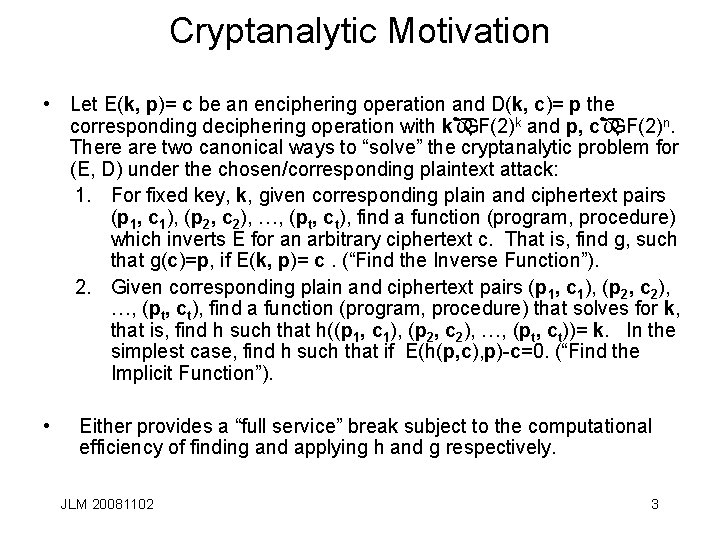
Cryptanalytic Motivation • Let E(k, p)= c be an enciphering operation and D(k, c)= p the corresponding deciphering operation with kÎGF(2)k and p, cÎGF(2)n. There are two canonical ways to “solve” the cryptanalytic problem for (E, D) under the chosen/corresponding plaintext attack: 1. For fixed key, k, given corresponding plain and ciphertext pairs (p 1, c 1), (p 2, c 2), …, (pt, ct), find a function (program, procedure) which inverts E for an arbitrary ciphertext c. That is, find g, such that g(c)=p, if E(k, p)= c. (“Find the Inverse Function”). 2. Given corresponding plain and ciphertext pairs (p 1, c 1), (p 2, c 2), …, (pt, ct), find a function (program, procedure) that solves for k, that is, find h such that h((p 1, c 1), (p 2, c 2), …, (pt, ct))= k. In the simplest case, find h such that if E(h(p, c), p)-c=0. (“Find the Implicit Function”). • Either provides a “full service” break subject to the computational efficiency of finding and applying h and g respectively. JLM 20081102 3
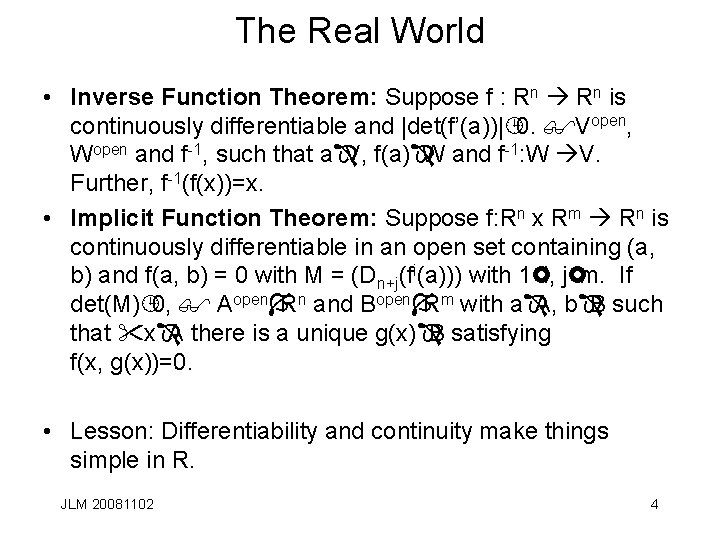
The Real World • Inverse Function Theorem: Suppose f : Rn is continuously differentiable and |det(f’(a))|¹ 0. $Vopen, Wopen and f-1, such that aÎV, f(a)ÎW and f-1: W V. Further, f-1(f(x))=x. • Implicit Function Theorem: Suppose f: Rn x Rm Rn is continuously differentiable in an open set containing (a, b) and f(a, b) = 0 with M = (Dn+j(fi(a))) with 1£i, j£m. If det(M)¹ 0, $ AopenÍRn and BopenÍRm with aÎA, bÎB such that "xÎA there is a unique g(x)ÎB satisfying f(x, g(x))=0. • Lesson: Differentiability and continuity make things simple in R. JLM 20081102 4

Boolean Functions are different from real functions 1. The concept of differentiability is different (and less useful) in finite fields. 2. Things change “discontinuously” so the existence proofs for the inverse and implicit function theorems don’t carry over from the real case. 3. When inverses and implicit functions exist, they are not always easy to specify because they are not “continuous. ” 4. All functions over finite fields can be represented as polynomials that is not true in the field of real numbers. 5. We can, in principle, construct a finite set containing every possible boolean function (for a fixed number of input and output variables), so we can in principle answer existence questions by exhaustive search of this list. 6. Constructing a “model” of how hard the inverse and implicit functions are to calculate is subtle in finite fields. JLM 20081102 5

But wait… • Not only “exact” solutions are useful. Even functions which meet the conditions of the implicit inverse function or implicit function theorem with high probability are quite valuable. • Invariants or “constraints” of the form a 1 k 1 + … + amkm= f(p, c) can help identify key bits even if they are right “slightly more frequently” than 1/2. This represents a correlation between key bits and plain/cipher bits. JLM 20081102 6

Simple examples of functional analysis • We’ve used these ideas before opportunistically: – Linear solution to cipher systems. – Reduction to parallel systems with independent keys or plaintext segments. – Solving sparse equations over “linearized” variables to obtain inverses. – Using invariants to reduce key space searches in both linear and differential cryptanalysis. • Now its time for a more systematic examination. This will allow us to completely determine inverse functions, implicit functions, correlations and invariant relationships. JLM 20081102 7
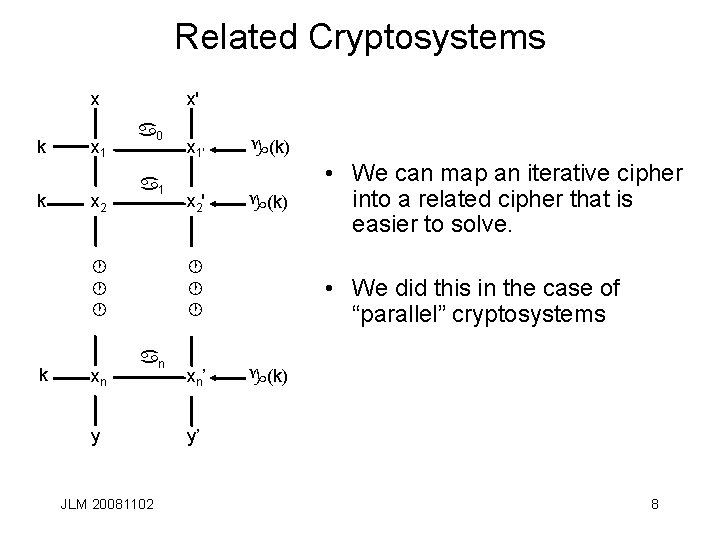
Related Cryptosystems x k k x 1 x 2 x' a 0 a 1 · · · k xn x 1' g(k) x 2' g(k) · · · an y JLM 20081102 xn’ • We can map an iterative cipher into a related cipher that is easier to solve. • We did this in the case of “parallel” cryptosystems g(k) y’ 8
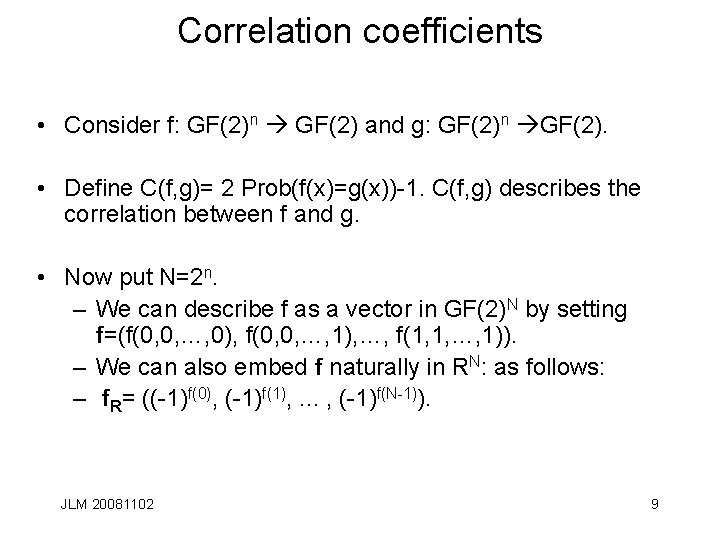
Correlation coefficients • Consider f: GF(2)n GF(2) and g: GF(2)n GF(2). • Define C(f, g)= 2 Prob(f(x)=g(x))-1. C(f, g) describes the correlation between f and g. • Now put N=2 n. – We can describe f as a vector in GF(2)N by setting f=(f(0, 0, …, 0), f(0, 0, …, 1), …, f(1, 1, …, 1)). – We can also embed f naturally in RN: as follows: – f. R= ((-1)f(0), (-1)f(1), . . . , (-1)f(N-1)). JLM 20081102 9
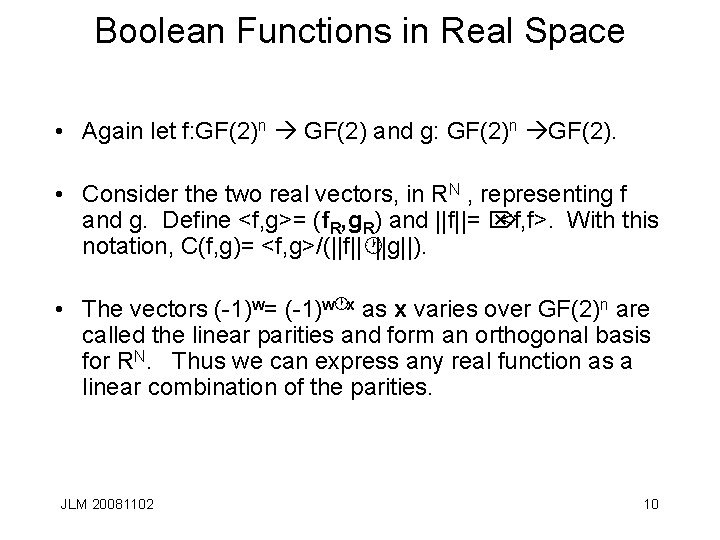
Boolean Functions in Real Space • Again let f: GF(2)n GF(2) and g: GF(2)n GF(2). • Consider the two real vectors, in RN , representing f and g. Define <f, g>= (f. R, g. R) and ||f||= Ö <f, f>. With this notation, C(f, g)= <f, g>/(||f||·||g||). • The vectors (-1)w= (-1)w·x as x varies over GF(2)n are called the linear parities and form an orthogonal basis for RN. Thus we can express any real function as a linear combination of the parities. JLM 20081102 10

Boolean Functions and polynomials • For Boolean f, V=GF(2)m, f(v 1, v 2 , . . . , vm ) = PaÎV g(a) v 1 a 1 v 2 a 2. . . vmam • g(a)= Sb Ía f(b 1 , b 2 , . . . , bm ) (subset means positions of 1's in a is a subset of b positions of 1's in b. ) • Theorem: If f is balanced, Sw F(w) = ± 2 n. • Proof: Sw F(w)= Sw Sx (-1)f(x)+w×x= Sx (-1)f(x) (Sw (-1)w×x)= Sx (-1)f(x) 2 n dw, x, so Sx (-1)w×x+c = (-1)c 2 n, w =0, 0, w¹ 0. Let F(w, c)= Sx (-1)f(x+w×x+c) then Sw, c F(w, c)= 0. JLM 20081102 11
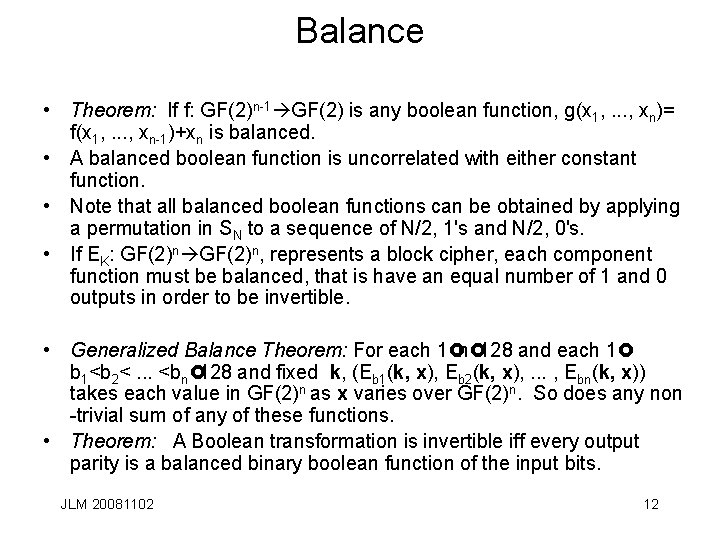
Balance • Theorem: If f: GF(2)n-1 GF(2) is any boolean function, g(x 1, . . . , xn)= f(x 1, . . . , xn-1)+xn is balanced. • A balanced boolean function is uncorrelated with either constant function. • Note that all balanced boolean functions can be obtained by applying a permutation in SN to a sequence of N/2, 1's and N/2, 0's. • If EK: GF(2)n, represents a block cipher, each component function must be balanced, that is have an equal number of 1 and 0 outputs in order to be invertible. • Generalized Balance Theorem: For each 1£n£ 128 and each 1£ b 1<b 2<. . . <bn£ 128 and fixed k, (Eb 1(k, x), Eb 2(k, x), . . . , Ebn(k, x)) takes each value in GF(2)n as x varies over GF(2)n. So does any non -trivial sum of any of these functions. • Theorem: A Boolean transformation is invertible iff every output parity is a balanced binary boolean function of the input bits. JLM 20081102 12
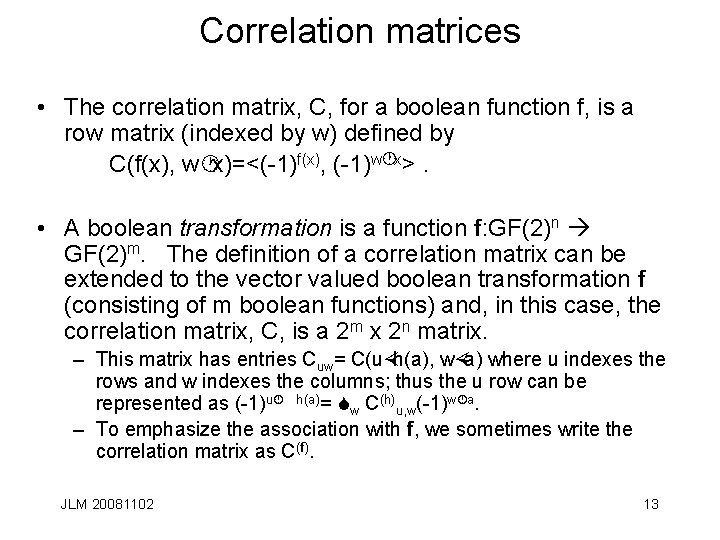
Correlation matrices • The correlation matrix, C, for a boolean function f, is a row matrix (indexed by w) defined by C(f(x), w·x)=<(-1)f(x), (-1)w·x>. • A boolean transformation is a function f: GF(2)n GF(2)m. The definition of a correlation matrix can be extended to the vector valued boolean transformation f (consisting of m boolean functions) and, in this case, the correlation matrix, C, is a 2 m x 2 n matrix. – This matrix has entries Cuw= C(u×h(a), w×a) where u indexes the rows and w indexes the columns; thus the u row can be represented as (-1)u· h(a)= Sw C(h)u, w(-1)w·a. – To emphasize the association with f, we sometimes write the correlation matrix as C(f). JLM 20081102 13
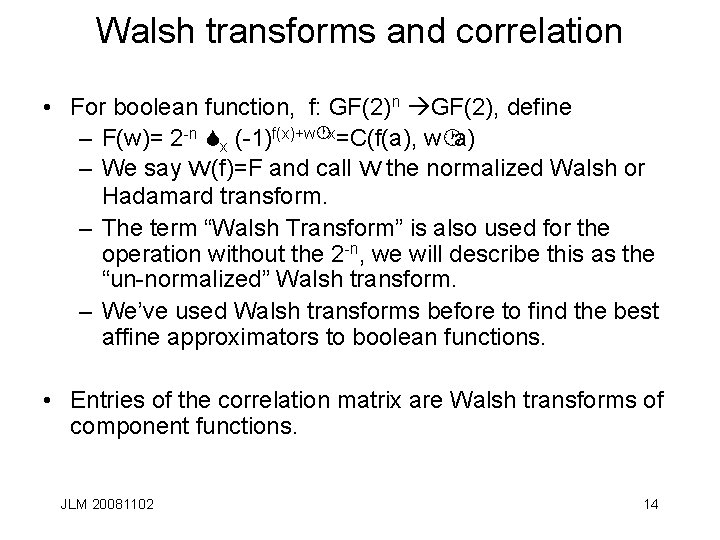
Walsh transforms and correlation • For boolean function, f: GF(2)n GF(2), define – F(w)= 2 -n Sx (-1)f(x)+w·x=C(f(a), w·a) – We say W(f)=F and call W the normalized Walsh or Hadamard transform. – The term “Walsh Transform” is also used for the operation without the 2 -n, we will describe this as the “un-normalized” Walsh transform. – We’ve used Walsh transforms before to find the best affine approximators to boolean functions. • Entries of the correlation matrix are Walsh transforms of component functions. JLM 20081102 14
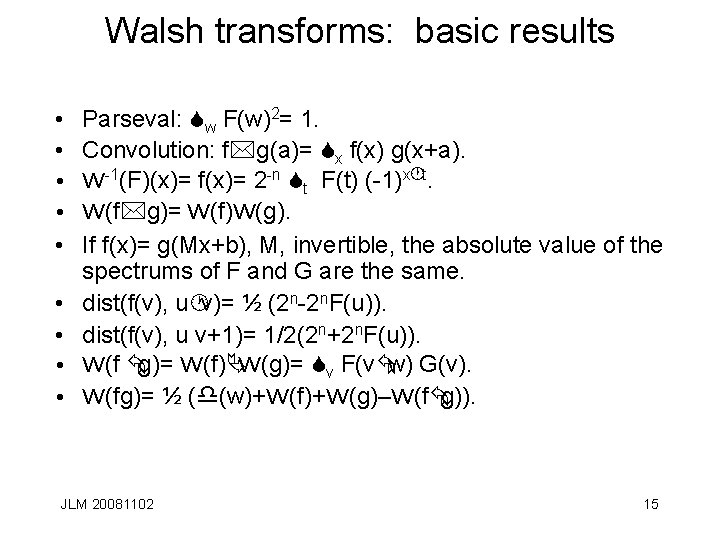
Walsh transforms: basic results • • • Parseval: Sw F(w)2= 1. Convolution: f*g(a)= Sx f(x) g(x+a). W-1(F)(x)= f(x)= 2 -n St F(t) (-1)x·t. W(f*g)= W(f)W(g). If f(x)= g(Mx+b), M, invertible, the absolute value of the spectrums of F and G are the same. dist(f(v), u·v)= ½ (2 n-2 n. F(u)). dist(f(v), u v+1)= 1/2(2 n+2 n. F(u)). W(f Åg)= W(f)ÄW(g)= Sv F(vÅw) G(v). W(fg)= ½ (d(w)+W(f)+W(g)–W(fÅg)). JLM 20081102 15
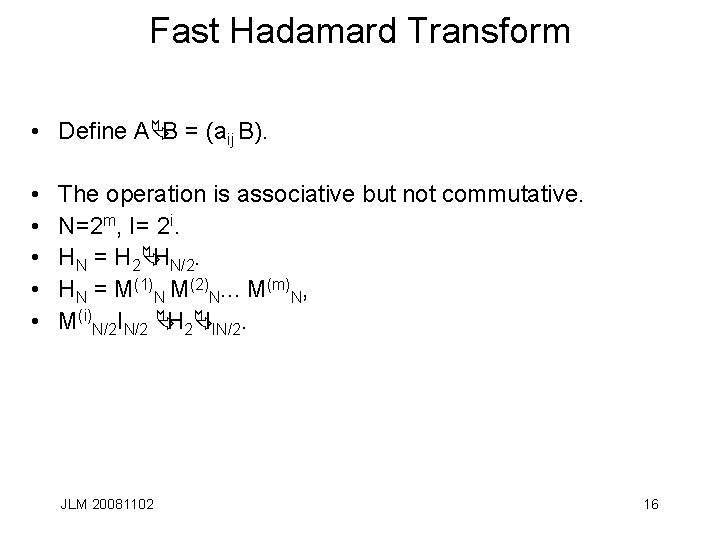
Fast Hadamard Transform • Define AÄB = (aij B). • • • The operation is associative but not commutative. N=2 m, I= 2 i. HN = H 2ÄHN/2. HN = M(1)N M(2)N. . . M(m)N, M(i)N/2 IN/2 ÄH 2ÄIIN/2. JLM 20081102 16

Properties of component functions • Let f is a Boolean Function define S 0 f= {x: f(x)=0 } and S 1 f {x: f(x)=1}. • If ei(x)= Ei(k, x) then |Sbe 1È Sbe 2È. . . È Sbek|=2 n-k. • Note that all balanced boolean functions can be obtained by applying a permutation in SN to a sequence of N/2, 1's and N/2, 0's. • Counting Results: Let N=2 n and BF(n) denotes the set of boolean functions on n-bit values then |BF(n)|= 2 N. M=2 m. Let BBF(n) be the balanced functions on n bits then |BBF(n)|= NCN/2, |GA(n)| ~ 2 M+m. JLM 20081102 17
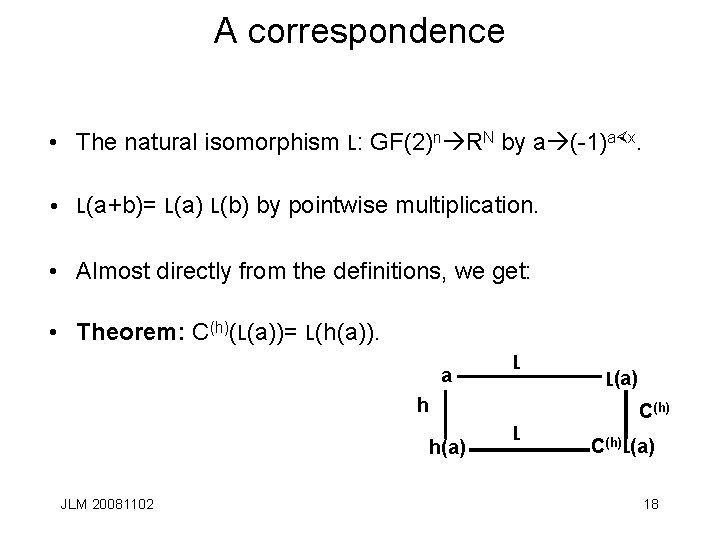
A correspondence • The natural isomorphism L: GF(2)n RN by a (-1)a×x. • L(a+b)= L(a) L(b) by pointwise multiplication. • Almost directly from the definitions, we get: • Theorem: C(h)(L(a))= L(h(a)). a L h h(a) JLM 20081102 L(a) C(h) L C(h)L(a) 18
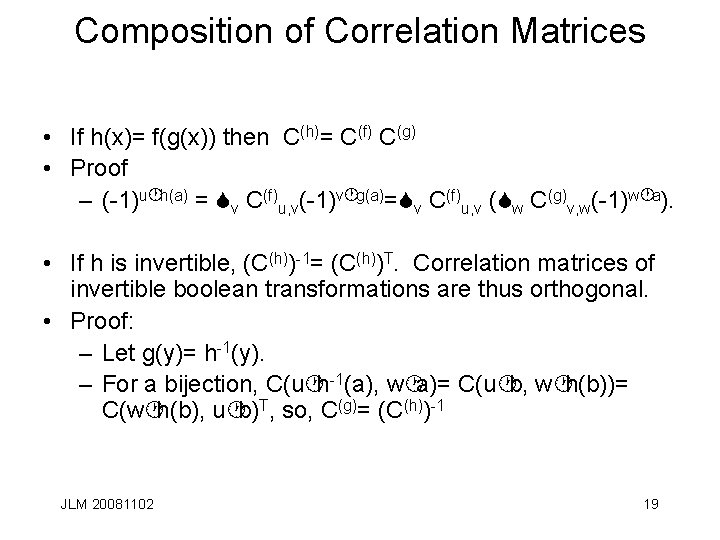
Composition of Correlation Matrices • If h(x)= f(g(x)) then C(h)= C(f) C(g) • Proof – (-1)u·h(a) = Sv C(f)u, v(-1)v·g(a)=Sv C(f)u, v (Sw C(g)v, w(-1)w·a). • If h is invertible, (C(h))-1= (C(h))T. Correlation matrices of invertible boolean transformations are thus orthogonal. • Proof: – Let g(y)= h-1(y). – For a bijection, C(u·h-1(a), w·a)= C(u·b, w·h(b))= C(w·h(b), u·b)T, so, C(g)= (C(h))-1 JLM 20081102 19
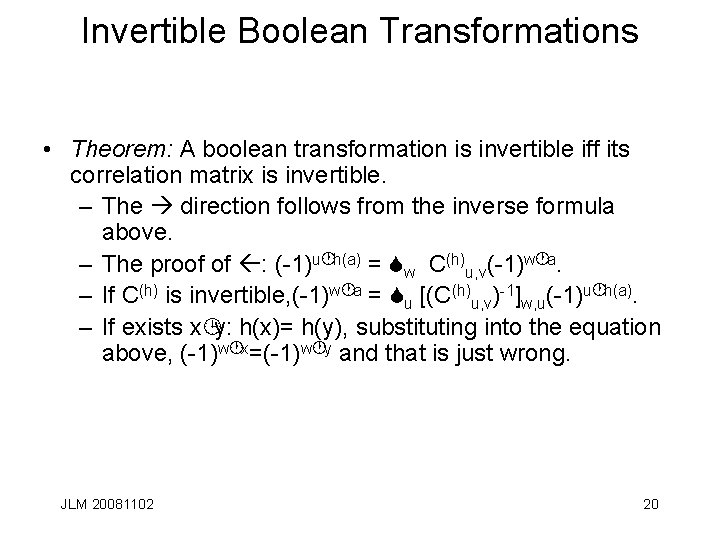
Invertible Boolean Transformations • Theorem: A boolean transformation is invertible iff its correlation matrix is invertible. – The direction follows from the inverse formula above. – The proof of : (-1)u·h(a) = Sw C(h)u, v(-1)w·a. – If C(h) is invertible, (-1)w·a = Su [(C(h)u, v)-1]w, u(-1)u·h(a). – If exists x¹y: h(x)= h(y), substituting into the equation above, (-1)w·x=(-1)w·y and that is just wrong. JLM 20081102 20
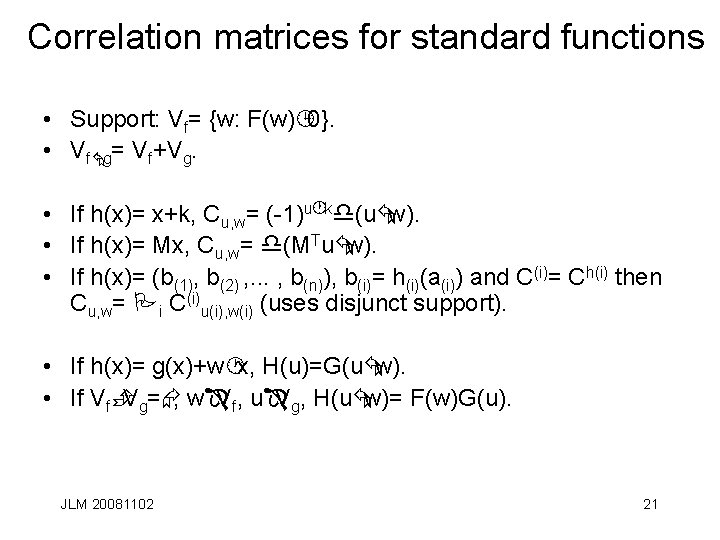
Correlation matrices for standard functions • Support: Vf= {w: F(w)¹ 0}. • VfÅg= Vf+Vg. • If h(x)= x+k, Cu, w= (-1)u·kd(uÅw). • If h(x)= Mx, Cu, w= d(MTuÅw). • If h(x)= (b(1), b(2) , . . . , b(n)), b(i)= h(i)(a(i)) and C(i)= Ch(i) then Cu, w= Pi C(i)u(i), w(i) (uses disjunct support). • If h(x)= g(x)+w·x, H(u)=G(uÅw). • If VfÈ Vg=Æ, wÎVf, uÎVg, H(uÅw)= F(w)G(u). JLM 20081102 21
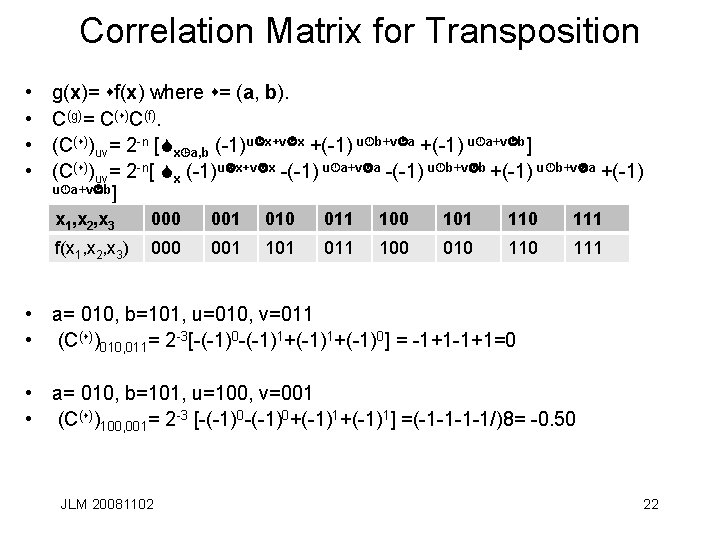
Correlation Matrix for Transposition • • g(x)= sf(x) where s= (a, b). C(g)= C(s)C(f). (C(s))uv= 2 -n [Sx¹a, b (-1)u·x+v·x +(-1) u·b+v·a +(-1) u·a+v·b] (C(s))uv= 2 -n[ Sx (-1)u·x+v·x -(-1) u·a+v·a -(-1) u·b+v·b +(-1) u·b+v·a +(-1) u·a+v·b] x 1, x 2, x 3 000 001 010 011 100 101 110 111 f(x 1, x 2, x 3) 000 001 101 011 100 010 111 • a= 010, b=101, u=010, v=011 • (C(s))010, 011= 2 -3[-(-1)0 -(-1)1+(-1)0] = -1+1=0 • a= 010, b=101, u=100, v=001 • (C(s))100, 001= 2 -3 [-(-1)0+(-1)1] =(-1 -1/)8= -0. 50 JLM 20081102 22
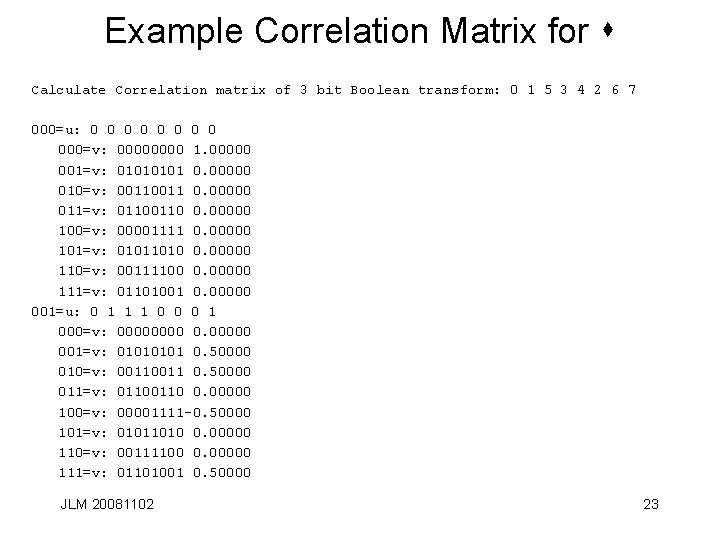
Example Correlation Matrix for s Calculate Correlation matrix of 3 bit Boolean transform: 0 1 5 3 4 2 6 7 000=u: 0 0 0 0 000=v: 0000 1. 00000 001=v: 0101 0. 00000 010=v: 0011 0. 00000 011=v: 0110 0. 00000 100=v: 00001111 0. 00000 101=v: 01011010 0. 00000 110=v: 00111100 0. 00000 111=v: 01101001 0. 00000 001=u: 0 1 1 1 0 0 0 1 000=v: 0000 0. 00000 001=v: 0101 0. 50000 010=v: 0011 0. 50000 011=v: 0110 0. 00000 100=v: 00001111 -0. 50000 101=v: 01011010 0. 00000 110=v: 00111100 0. 00000 111=v: 01101001 0. 50000 JLM 20081102 23
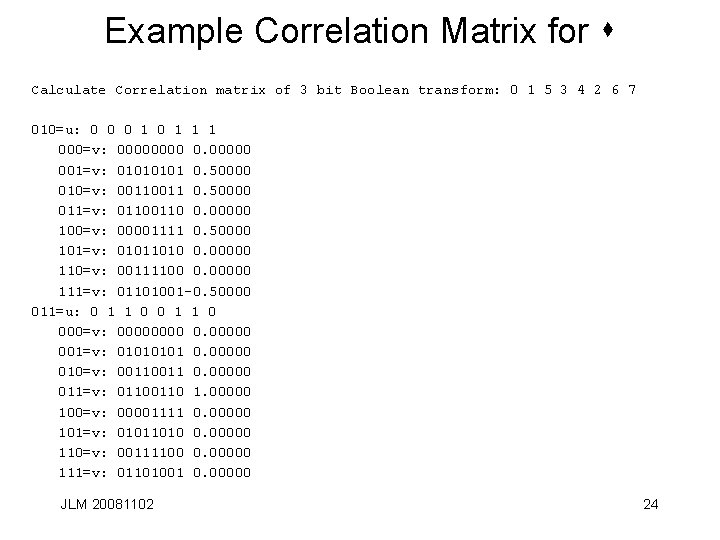
Example Correlation Matrix for s Calculate Correlation matrix of 3 bit Boolean transform: 0 1 5 3 4 2 6 7 010=u: 0 0 0 1 1 1 000=v: 0000 0. 00000 001=v: 0101 0. 50000 010=v: 0011 0. 50000 011=v: 0110 0. 00000 100=v: 00001111 0. 50000 101=v: 01011010 0. 00000 110=v: 00111100 0. 00000 111=v: 01101001 -0. 50000 011=u: 0 1 1 0 000=v: 0000 0. 00000 001=v: 0101 0. 00000 010=v: 0011 0. 00000 011=v: 0110 1. 00000 100=v: 00001111 0. 00000 101=v: 01011010 0. 00000 110=v: 00111100 0. 00000 111=v: 01101001 0. 00000 JLM 20081102 24
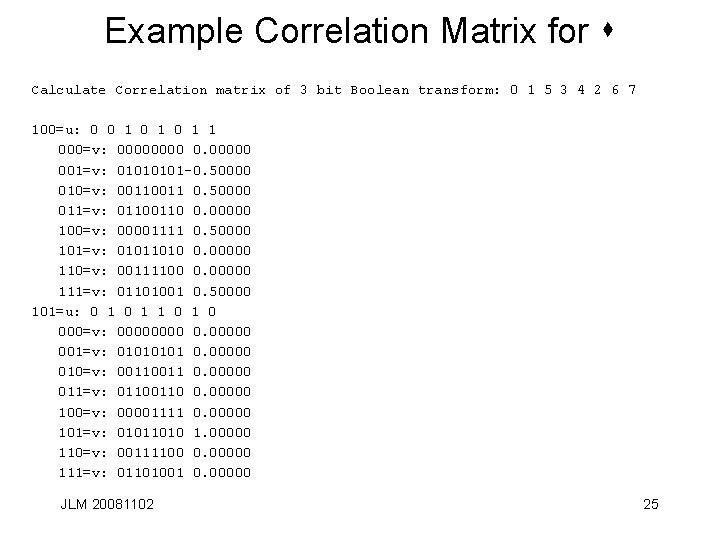
Example Correlation Matrix for s Calculate Correlation matrix of 3 bit Boolean transform: 0 1 5 3 4 2 6 7 100=u: 0 0 1 0 1 1 000=v: 0000 0. 00000 001=v: 0101 -0. 50000 010=v: 0011 0. 50000 011=v: 0110 0. 00000 100=v: 00001111 0. 50000 101=v: 01011010 0. 00000 110=v: 00111100 0. 00000 111=v: 01101001 0. 50000 101=u: 0 1 1 0 000=v: 0000 0. 00000 001=v: 0101 0. 00000 010=v: 0011 0. 00000 011=v: 0110 0. 00000 100=v: 00001111 0. 00000 101=v: 01011010 1. 00000 110=v: 00111100 0. 00000 111=v: 01101001 0. 00000 JLM 20081102 25
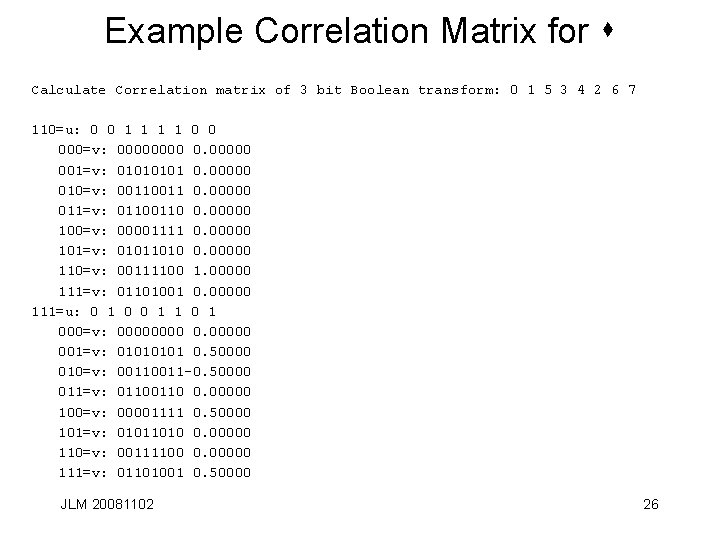
Example Correlation Matrix for s Calculate Correlation matrix of 3 bit Boolean transform: 0 1 5 3 4 2 6 7 110=u: 0 0 1 1 0 0 000=v: 0000 0. 00000 001=v: 0101 0. 00000 010=v: 0011 0. 00000 011=v: 0110 0. 00000 100=v: 00001111 0. 00000 101=v: 01011010 0. 00000 110=v: 00111100 1. 00000 111=v: 01101001 0. 00000 111=u: 0 1 0 0 1 1 000=v: 0000 0. 00000 001=v: 0101 0. 50000 010=v: 0011 -0. 50000 011=v: 0110 0. 00000 100=v: 00001111 0. 50000 101=v: 01011010 0. 00000 110=v: 00111100 0. 00000 111=v: 01101001 0. 50000 JLM 20081102 26
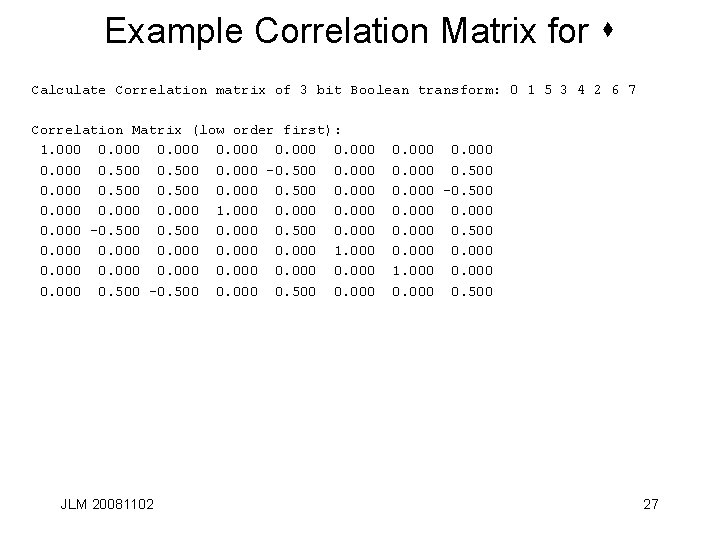
Example Correlation Matrix for s Calculate Correlation matrix of 3 bit Boolean transform: 0 1 5 3 4 2 6 7 Correlation Matrix (low order first): 1. 000 0. 500 0. 000 -0. 500 0. 000 0. 000 1. 000 0. 500 -0. 500 0. 000 JLM 20081102 0. 000 0. 500 0. 000 -0. 500 0. 000 1. 000 0. 500 27
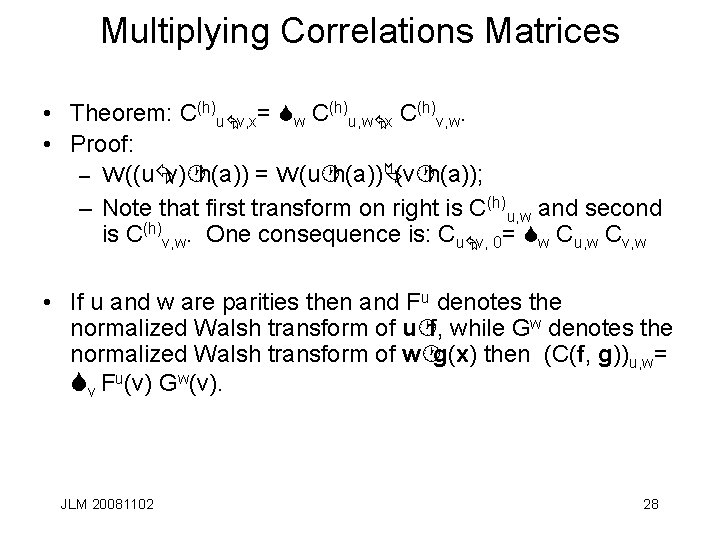
Multiplying Correlations Matrices • Theorem: C(h)uÅv, x= Sw C(h)u, wÅx C(h)v, w. • Proof: – W((uÅv)·h(a)) = W(u·h(a))Ä(v·h(a)); – Note that first transform on right is C(h)u, w and second is C(h)v, w. One consequence is: CuÅv, 0= Sw Cu, w Cv, w • If u and w are parities then and Fu denotes the normalized Walsh transform of u·f, while Gw denotes the normalized Walsh transform of w·g(x) then (C(f, g))u, w= Sv Fu(v) Gw(v). JLM 20081102 28
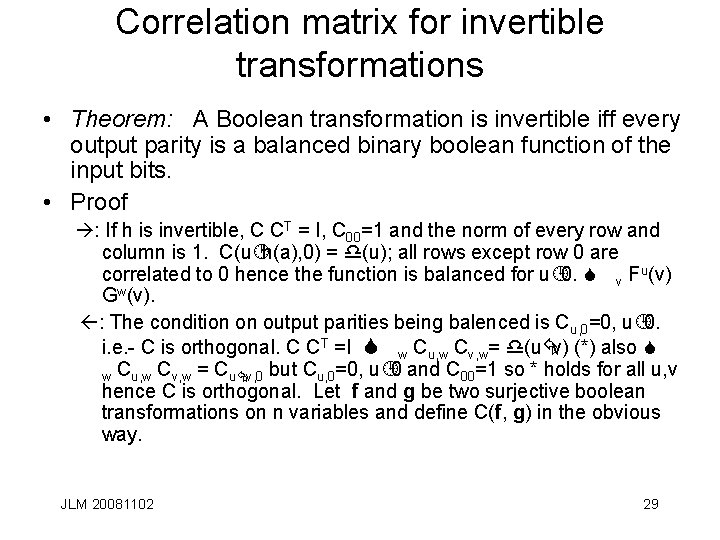
Correlation matrix for invertible transformations • Theorem: A Boolean transformation is invertible iff every output parity is a balanced binary boolean function of the input bits. • Proof : If h is invertible, C CT = I, C 00=1 and the norm of every row and column is 1. C(u·h(a), 0) = d(u); all rows except row 0 are correlated to 0 hence the function is balanced for u¹ 0. S v Fu(v) Gw(v). : The condition on output parities being balenced is Cu, 0=0, u¹ 0. i. e. - C is orthogonal. C CT =I S w Cu, w Cv, w= d(uÅv) (*) also S 0 and C 00=1 so * holds for all u, v w Cu, w Cv, w = CuÅv, 0 but Cu, 0=0, u¹ hence C is orthogonal. Let f and g be two surjective boolean transformations on n variables and define C(f, g) in the obvious way. JLM 20081102 29
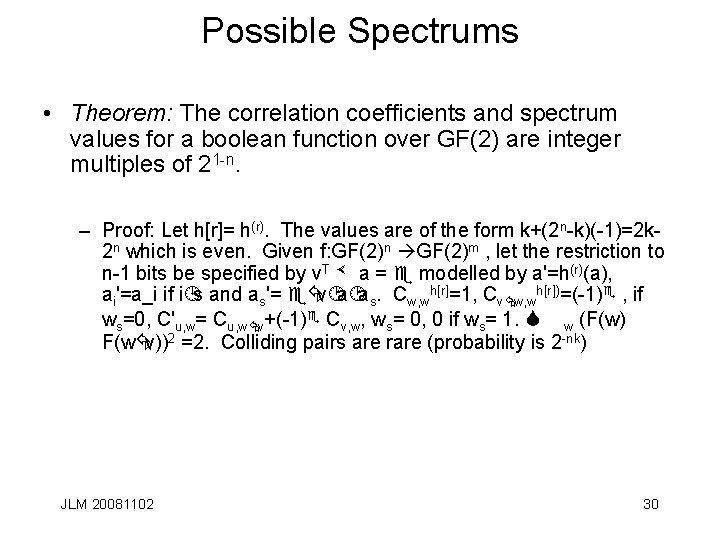
Possible Spectrums • Theorem: The correlation coefficients and spectrum values for a boolean function over GF(2) are integer multiples of 21 -n. – Proof: Let h[r]= h(r). The values are of the form k+(2 n-k)(-1)=2 k 2 n which is even. Given f: GF(2)n GF(2)m , let the restriction to n-1 bits be specified by v. T × a = e modelled by a'=h(r)(a), ai'=a_i if i¹s and as'= eÅv·a·as. Cw, wh[r]=1, CvÅw, wh[r])=(-1)e , if ws=0, C'u, w= Cu, wÅv+(-1)e Cv, w, ws= 0, 0 if ws= 1. S w (F(w) F(wÅv))2 =2. Colliding pairs are rare (probability is 2 -nk) JLM 20081102 30

Constructing Boolean Transformations • Each possible Boolean transformation on n bits is a permutation on the 2 n, n-bit values and so listing them in order, the columns are the possible f vectors representing the component functions. • If we label these as points in GF(2)N and draw an edge for allowable co-components with the edges labelled by the correlation between these vectors, any allowable n boolean functions form a complete graph with the label 0 on each edge. JLM 20081102 31
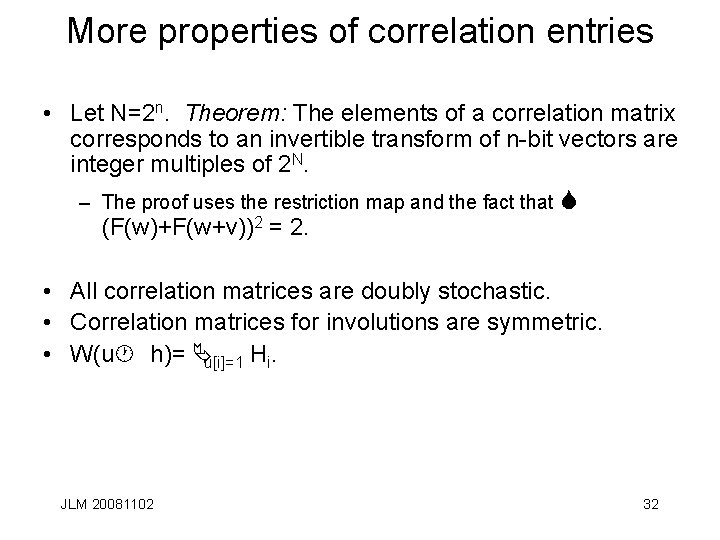
More properties of correlation entries • Let N=2 n. Theorem: The elements of a correlation matrix corresponds to an invertible transform of n-bit vectors are integer multiples of 2 N. – The proof uses the restriction map and the fact that S (F(w)+F(w+v))2 = 2. • All correlation matrices are doubly stochastic. • Correlation matrices for involutions are symmetric. • W(u· h)= Äu[i]=1 Hi. JLM 20081102 32
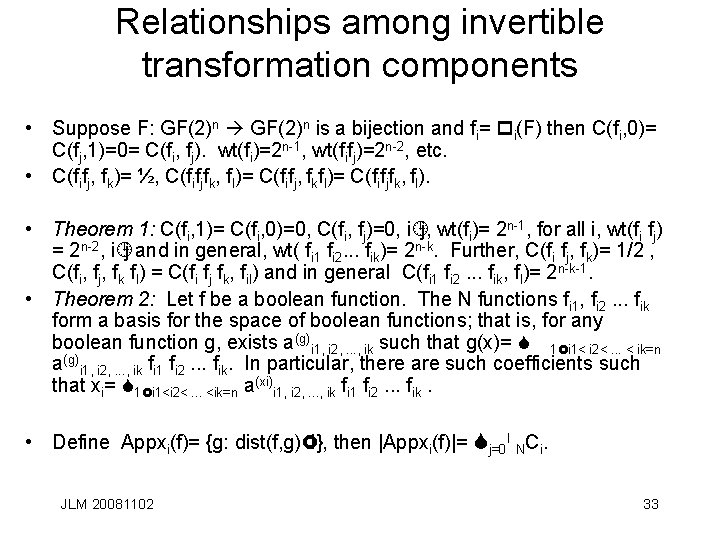
Relationships among invertible transformation components • Suppose F: GF(2)n is a bijection and fi= pi(F) then C(fi, 0)= C(fj, 1)=0= C(fi, fj). wt(fi)=2 n-1, wt(fifj)=2 n-2, etc. • C(fifj, fk)= ½, C(fifjfk, fl)= C(fifj, fkfl)= C(fifjfk, fl). • Theorem 1: C(fi, 1)= C(fi, 0)=0, C(fi, fj)=0, i¹j, wt(fi)= 2 n-1, for all i, wt(fi fj) = 2 n-2, i¹j and in general, wt( fi 1 fi 2. . . fik)= 2 n-k. Further, C(fi fj, fk)= 1/2 , C(fi, fj, fk fl) = C(fi fj fk, fil) and in general C(fi 1 fi 2. . . fik, fl)= 2 n-k-1. • Theorem 2: Let f be a boolean function. The N functions fi 1, fi 2. . . fik form a basis for the space of boolean functions; that is, for any boolean function g, exists a(g)i 1, i 2, . . . , ik such that g(x)= S 1£i 1< i 2<. . . < ik=n a(g)i 1, i 2, . . . , ik fi 1 fi 2. . . fik. In particular, there are such coefficients such that xi= S 1£i 1<i 2<. . . <ik=n a(xi)i 1, i 2, . . . , ik fi 1 fi 2. . . fik. • Define Appxi(f)= {g: dist(f, g)£i}, then |Appxi(f)|= Sj=0 I NCi. JLM 20081102 33
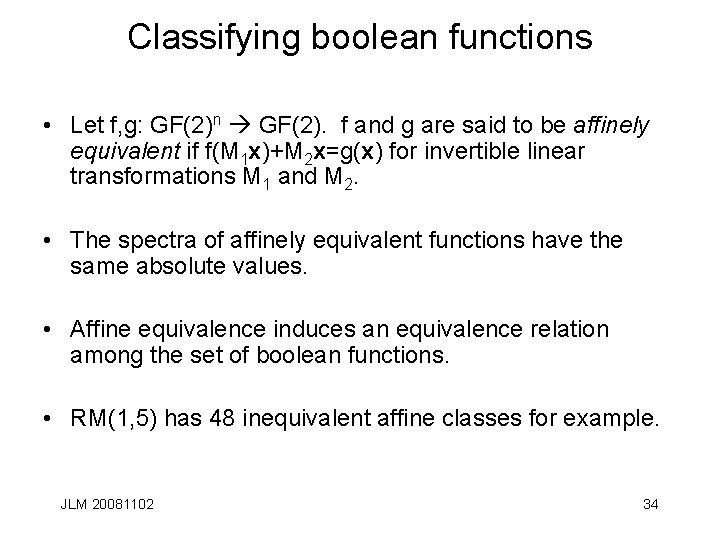
Classifying boolean functions • Let f, g: GF(2)n GF(2). f and g are said to be affinely equivalent if f(M 1 x)+M 2 x=g(x) for invertible linear transformations M 1 and M 2. • The spectra of affinely equivalent functions have the same absolute values. • Affine equivalence induces an equivalence relation among the set of boolean functions. • RM(1, 5) has 48 inequivalent affine classes for example. JLM 20081102 34

Bent Functions • Bent functions are furthest from linear. • All Hadamard transform values of bent functions are equal to ± 2 m/2 and hence the distance to any affine function is 2 m± 2 m/2 -1. • If f(x 1, x 2, . . . , xm) is bent and m³ 6 then f is indecomposable. • f(u 1, u 2, . . . , um, v 1, v 2, . . . , vm) = g(v 1, v 2, . . . , vm) + Si ui vi are bent. • If f(u 1, u 2, . . . , um, v 1, v 2, . . . , vm)= Si ui vi , then f+u 1 u 2 u 3, f+u 1 u 2 u 3 u 4, . . . , f+u 1 u 2 u 3. . . um are all inequivalent bent functions JLM 20081102 35

How many Boolean Matrices are invertible • Let rn be the ratio of the number of invertible matrices to the number of matrices. rn approaches. 288 and n ¥. – – – Proof: The number of boolean matrices is 2 N, N= n 2. The number of invertible matrices is tn= (2 n-1)(2 n-2)…(2 n-2 n-1). tn= 2 M(2 n-1)(2 n-1 -1)…(2 -1) where M=(n(n-1))/2. Define sn= (2 n-1)(2 n-1 -1)…(2 -1). Note that tn+1= 2 M’ sn (2 n+1 -1) where M’=(n(n+1))/2. As a result, tn+1= 2 M’ 2 -M (2 M sn)(2 n+1 -1)= 2 M’-M tn (2 n+1 -1)= 2 n(2 n+1 -1) tn. – Combining these we get, rn+1= tn+1/2 N’= 2 n(2 n+1 -1)(tn/2 N)2 N’-N, where N’= (n+1)2. – So rn+1= rn(2 n-(2 n+1) (2 n+1 -1)= rn(1 -2 -(n+1)). – Using this recurrence: rn= Pi=1 n (1 -2 -n). – The product approaches 0. 288 ---. JLM 20081102 36
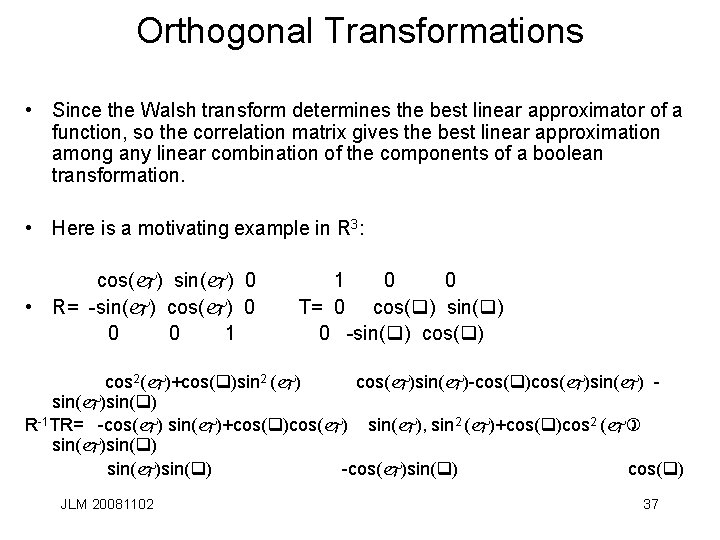
Orthogonal Transformations • Since the Walsh transform determines the best linear approximator of a function, so the correlation matrix gives the best linear approximation among any linear combination of the components of a boolean transformation. • Here is a motivating example in R 3: cos(j) sin(j) 0 • R= -sin(j) cos(j) 0 0 0 1 1 0 0 T= 0 cos(q) sin(q) 0 -sin(q) cos 2(j)+cos(q)sin 2 (j) cos(j)sin(j)-cos(q)cos(j)sin(j)sin(q) R-1 TR= -cos(j) sin(j)+cos(q)cos(j) sin(j), sin 2 (j)+cos(q)cos 2 (j) sin(j)sin(q) -cos(j)sin(q) cos(q) JLM 20081102 37
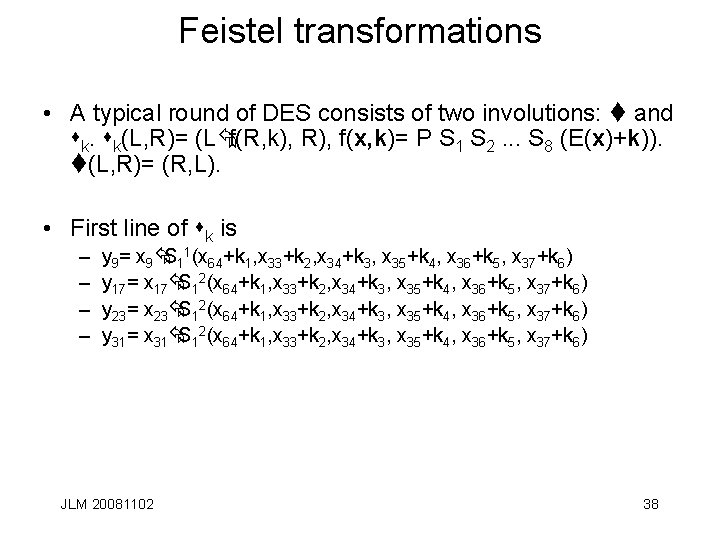
Feistel transformations • A typical round of DES consists of two involutions: t and sk. sk(L, R)= (LÅf(R, k), R), f(x, k)= P S 1 S 2. . . S 8 (E(x)+k)). t(L, R)= (R, L). • First line of sk is – – y 9= x 9ÅS 11(x 64+k 1, x 33+k 2, x 34+k 3, x 35+k 4, x 36+k 5, x 37+k 6) y 17= x 17ÅS 12(x 64+k 1, x 33+k 2, x 34+k 3, x 35+k 4, x 36+k 5, x 37+k 6) y 23= x 23ÅS 12(x 64+k 1, x 33+k 2, x 34+k 3, x 35+k 4, x 36+k 5, x 37+k 6) y 31= x 31ÅS 12(x 64+k 1, x 33+k 2, x 34+k 3, x 35+k 4, x 36+k 5, x 37+k 6) JLM 20081102 38
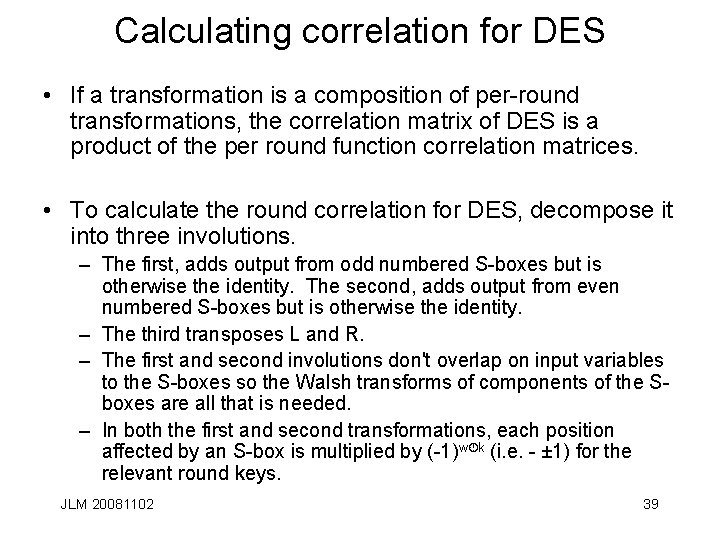
Calculating correlation for DES • If a transformation is a composition of per-round transformations, the correlation matrix of DES is a product of the per round function correlation matrices. • To calculate the round correlation for DES, decompose it into three involutions. – The first, adds output from odd numbered S-boxes but is otherwise the identity. The second, adds output from even numbered S-boxes but is otherwise the identity. – The third transposes L and R. – The first and second involutions don't overlap on input variables to the S-boxes so the Walsh transforms of components of the Sboxes are all that is needed. – In both the first and second transformations, each position affected by an S-box is multiplied by (-1)w·k (i. e. - ± 1) for the relevant round keys. JLM 20081102 39
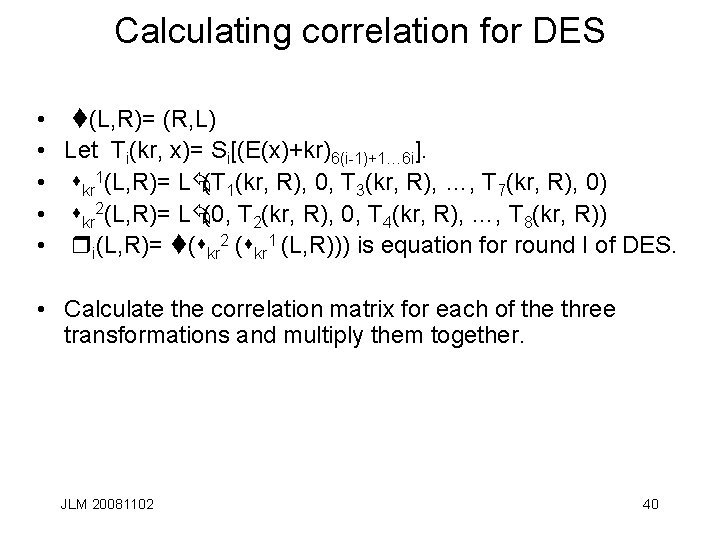
Calculating correlation for DES • t(L, R)= (R, L) • Let Ti(kr, x)= Si[(E(x)+kr)6(i-1)+1… 6 i]. • skr 1(L, R)= LÅ(T 1(kr, R), 0, T 3(kr, R), …, T 7(kr, R), 0) • skr 2(L, R)= LÅ(0, T 2(kr, R), 0, T 4(kr, R), …, T 8(kr, R)) • ri(L, R)= t(skr 2 (skr 1 (L, R))) is equation for round I of DES. • Calculate the correlation matrix for each of the three transformations and multiply them together. JLM 20081102 40
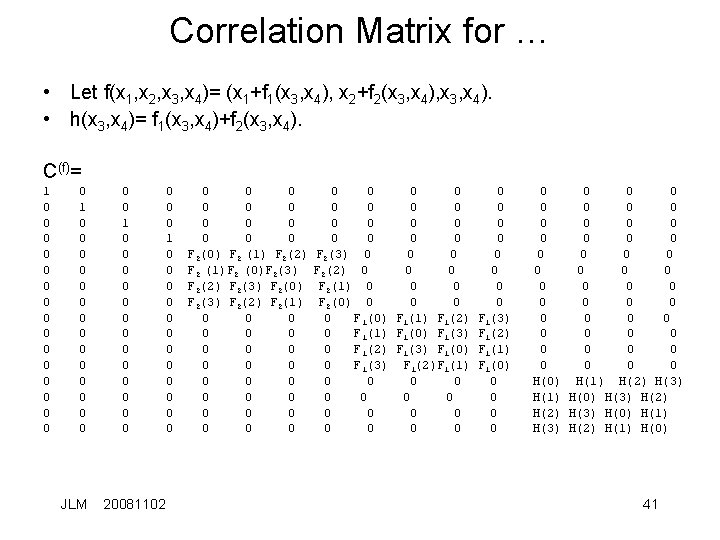
Correlation Matrix for … • Let f(x 1, x 2, x 3, x 4)= (x 1+f 1(x 3, x 4), x 2+f 2(x 3, x 4), x 3, x 4). • h(x 3, x 4)= f 1(x 3, x 4)+f 2(x 3, x 4). C(f)= 1 0 0 0 0 1 0 0 0 0 JLM 0 0 1 0 0 0 0 20081102 0 0 0 1 0 0 0 0 0 0 F 2(0) F 2 (1) F 2(2) F 2 (1)F 2 (0)F 2(3) F 2(2) F 2(3) F 2(0) F 2(3) F 2(2) F 2(1) 0 0 0 0 0 0 0 0 0 0 F 2(3) 0 0 0 F 2(2) 0 0 0 F 2(1) 0 0 0 F 2(0) 0 0 F 1(0) F 1(1) F 1(2) 0 F 1(1) F 1(0) F 1(3) 0 F 1(2) F 1(3) F 1(0) 0 F 1(3) F 1(2)F 1(1) 0 0 0 0 0 0 F 1(3) F 1(2) F 1(1) F 1(0) 0 0 0 0 0 0 0 0 0 0 0 0 0 H(0) H(1) H(2) H(3) H(1) H(0) H(3) H(2) H(3) H(0) H(1) H(3) H(2) H(1) H(0) 41
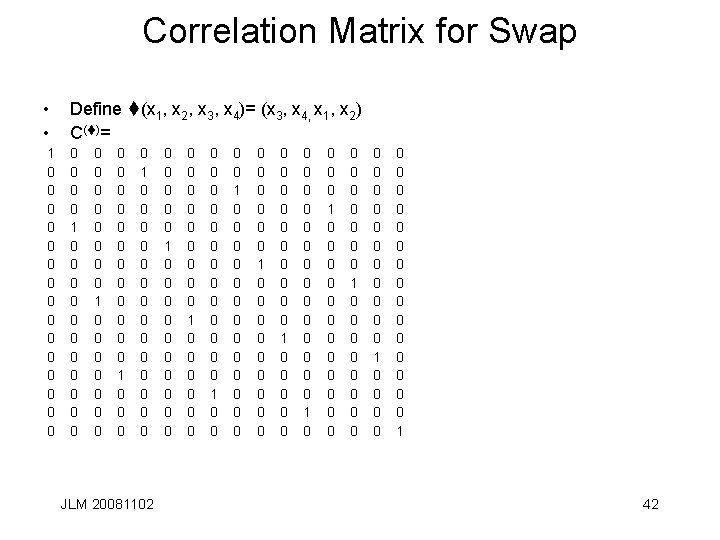
Correlation Matrix for Swap • • Define t(x 1, x 2, x 3, x 4)= (x 3, x 4, x 1, x 2) C(t)= 1 0 0 0 0 0 0 0 0 0 0 1 0 0 0 0 0 0 0 0 0 JLM 20081102 0 0 0 0 0 1 0 0 0 0 0 0 0 0 0 0 0 0 0 0 0 0 0 0 0 1 0 0 0 0 0 0 0 0 0 0 1 0 0 0 0 0 0 0 0 0 1 42
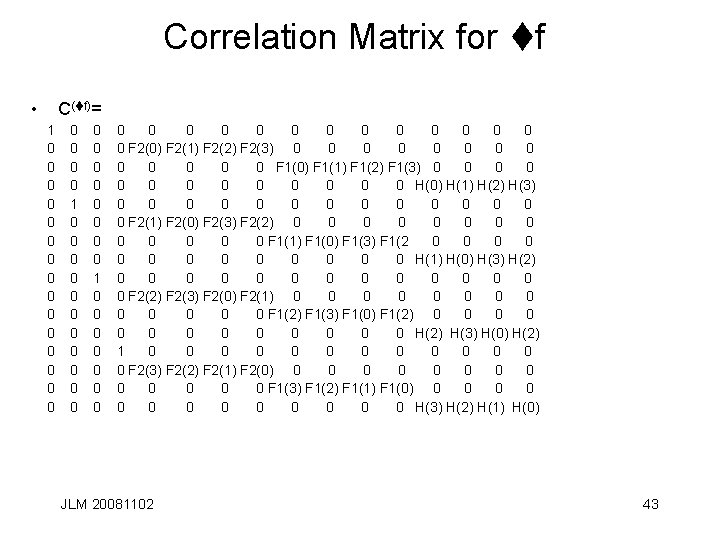
Correlation Matrix for tf • C(tf)= 1 0 0 0 0 0 0 0 0 0 0 1 0 0 0 0 0 0 F 2(0) F 2(1) F 2(2) F 2(3) 0 0 0 0 F 1(0) F 1(1) F 1(2) F 1(3) 0 0 0 0 H(0) H(1) H(2) H(3) 0 0 0 0 F 2(1) F 2(0) F 2(3) F 2(2) 0 0 0 0 F 1(1) F 1(0) F 1(3) F 1(2 0 0 0 0 H(1) H(0) H(3) H(2) 0 0 0 0 F 2(2) F 2(3) F 2(0) F 2(1) 0 0 0 0 F 1(2) F 1(3) F 1(0) F 1(2) 0 0 0 0 H(2) H(3) H(0) H(2) 1 0 0 0 0 F 2(3) F 2(2) F 2(1) F 2(0) 0 0 0 0 F 1(3) F 1(2) F 1(1) F 1(0) 0 0 0 0 H(3) H(2) H(1) H(0) JLM 20081102 43
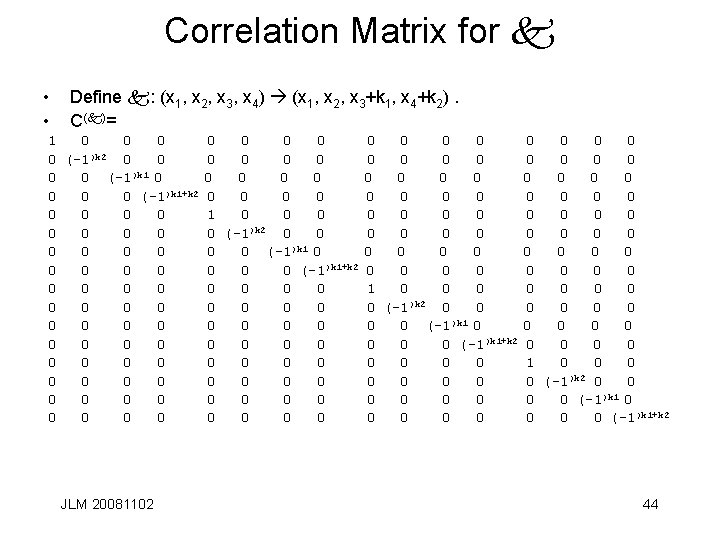
Correlation Matrix for k • • Define k: (x 1, x 2, x 3, x 4) (x 1, x 2, x 3+k 1, x 4+k 2). C(k)= 1 0 0 0 )k 2 0 (-1 0 0 0 0 (-1)k 1+k 2 0 0 0 0 0 0 0 0 0 0 0 0 JLM 20081102 0 0 0 0 1 0 0 (-1)k 2 0 0 )k 1 0 0 (-1)k 1+k 2 0 0 0 0 0 0 0 0 0 0 0 0 0 0 0 0 1 0 0 0 )k 2 0 (-1 0 0 0 0 (-1)k 1+k 2 0 0 0 0 0 0 0 0 0 0 0 0 0 0 0 0 1 0 0 (-1)k 2 0 0 )k 1 0 0 (-1)k 1+k 2 44
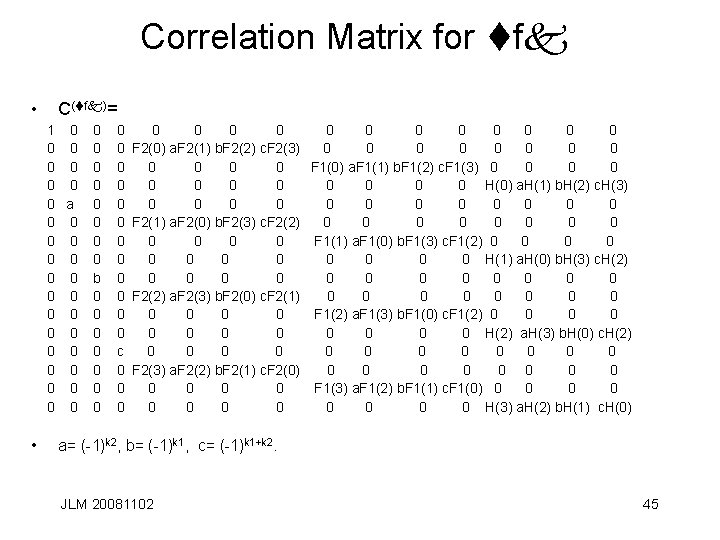
Correlation Matrix for tfk • C(tfk)= 1 0 0 0 0 a 0 0 0 0 0 0 • 0 0 0 0 b 0 0 0 0 0 c 0 0 0 0 F 2(0) a. F 2(1) b. F 2(2) c. F 2(3) 0 0 0 F 1(0) a. F 1(1) b. F 1(2) c. F 1(3) 0 0 0 H(0) a. H(1) b. H(2) c. H(3) 0 0 0 F 2(1) a. F 2(0) b. F 2(3) c. F 2(2) 0 0 0 F 1(1) a. F 1(0) b. F 1(3) c. F 1(2) 0 0 0 H(1) a. H(0) b. H(3) c. H(2) 0 0 0 F 2(2) a. F 2(3) b. F 2(0) c. F 2(1) 0 0 0 F 1(2) a. F 1(3) b. F 1(0) c. F 1(2) 0 0 0 H(2) a. H(3) b. H(0) c. H(2) 0 0 0 F 2(3) a. F 2(2) b. F 2(1) c. F 2(0) 0 0 0 F 1(3) a. F 1(2) b. F 1(1) c. F 1(0) 0 0 0 H(3) a. H(2) b. H(1) c. H(0) a= (-1)k 2, b= (-1)k 1, c= (-1)k 1+k 2. JLM 20081102 45
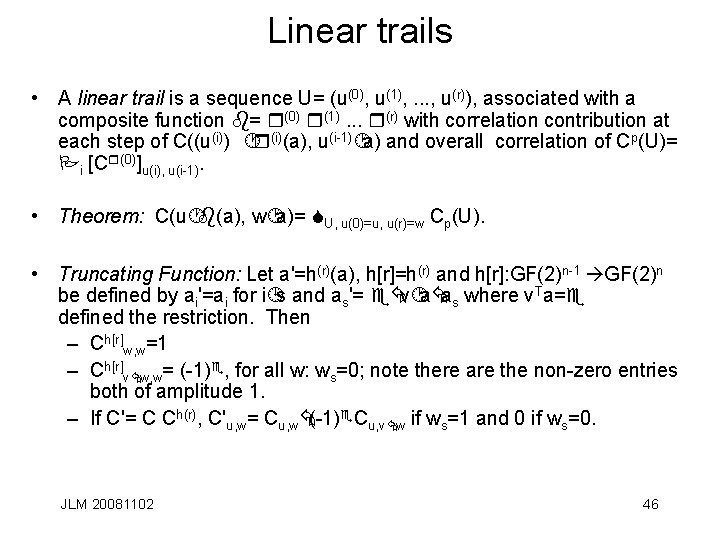
Linear trails • A linear trail is a sequence U= (u(0), u(1), . . . , u(r)), associated with a composite function b= r(0) r(1). . . r(r) with correlation contribution at each step of C((u(i)) ·r(i)(a), u(i-1)·a) and overall correlation of Cp(U)= Pi [Cr(0)]u(i), u(i-1). • Theorem: C(u·b(a), w·a)= SU, u(0)=u, u(r)=w Cp(U). • Truncating Function: Let a'=h(r)(a), h[r]=h(r) and h[r]: GF(2)n-1 GF(2)n be defined by ai'=ai for i¹s and as'= eÅv·aÅas where v. Ta=e defined the restriction. Then – Ch[r]w, w=1 – Ch[r]vÅw, w= (-1)e, for all w: ws=0; note there are the non-zero entries both of amplitude 1. – If C'= C Ch(r), C'u, w= Cu, wÅ(-1)e. Cu, vÅw if ws=1 and 0 if ws=0. JLM 20081102 46
![Long Range correlation • Put u[i]= u(i), k[i]=k(i), D[U]= d. UÅÅi(u(i))T k(i), s[i]= si,](http://slidetodoc.com/presentation_image_h2/aac41605241eed7b793a74ebff1ecb7b/image-47.jpg "Long Range correlation • Put u[i]= u(i), k[i]=k(i), D[U]= d. UÅÅi(u(i))T k(i), s[i]= si,")
Long Range correlation • Put u[i]= u(i), k[i]=k(i), D[U]= d. UÅÅi(u(i))T k(i), s[i]= si, D[U, K]= d. UÅUTK. • For key alternating ciphers, Cp(U)= Pi (-1)D[U] |Cp(U)|. • Put si= UTKÅd. U, C(v·b(a), w·a)= SU, u(0)=u, u(r)=w (-1)D[U, K] |Cp(U)|. • Cp(U)= (-1)s[i]Ci , averaging over the round keys we get E(Ct 2)= 2 -nk Sk (Si (-1)s[j]Ci )2. • After reduction, average correlation potential is E(Ct 2)= Si Ci 2, note that Ci Cj = 2 n. K d(iÅj) JLM 20081102 47
![Key Schedule and Correlation • Let U[j]= Uj, d[U, j]= d. U[j], h[r]= h(r).](http://slidetodoc.com/presentation_image_h2/aac41605241eed7b793a74ebff1ecb7b/image-48.jpg "Key Schedule and Correlation • Let U[j]= Uj, d[U, j]= d. U[j], h[r]= h(r).")
Key Schedule and Correlation • Let U[j]= Uj, d[U, j]= d. U[j], h[r]= h(r). C[h, r]= Ch[r]). D= (d[U, i]Åd[U, j])T MC[h, r]kÅd[U, i]Åd[U, j]. • F= (d[U, i]Åd[U, j])T fk (k)Åd[U, i]Åd[U, j]. • For key schedule K=Mkk, – E(Ct 2)= 2 -n. K S i S j (S k (-1)D)Ci Ci. • The inner sum simplifies to (-1)d[U, i]Åd[U, j]2 n. K d(Mk. T(UiÅUi)). • If the key schedule is not linear K=fk(k), the coefficient of the mixed term is (-1)F. • The probability that a multi-round expression holds is 1/2(1+Cp(U)) for the associated trail JLM 20081102 48
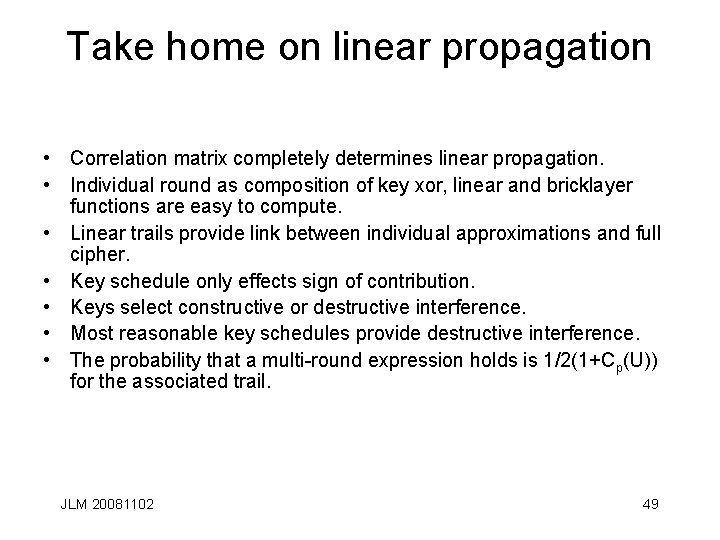
Take home on linear propagation • Correlation matrix completely determines linear propagation. • Individual round as composition of key xor, linear and bricklayer functions are easy to compute. • Linear trails provide link between individual approximations and full cipher. • Key schedule only effects sign of contribution. • Keys select constructive or destructive interference. • Most reasonable key schedules provide destructive interference. • The probability that a multi-round expression holds is 1/2(1+Cp(U)) for the associated trail. JLM 20081102 49
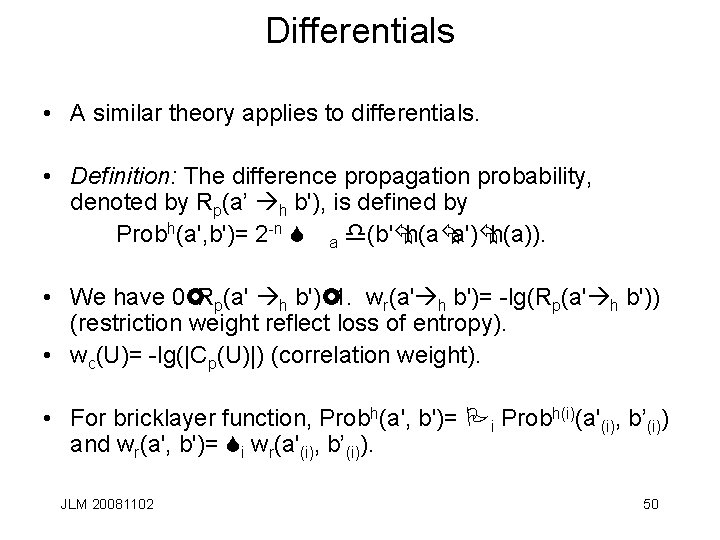
Differentials • A similar theory applies to differentials. • Definition: The difference propagation probability, denoted by Rp(a’ h b'), is defined by Probh(a', b')= 2 -n S a d(b'Åh(aÅa')Åh(a)). • We have 0£Rp(a' h b')£ 1. wr(a' h b')= -lg(Rp(a' h b')) (restriction weight reflect loss of entropy). • wc(U)= -lg(|Cp(U)|) (correlation weight). • For bricklayer function, Probh(a', b')= Pi Probh(i)(a'(i), b’(i)) and wr(a', b')= Si wr(a'(i), b’(i)). JLM 20081102 50
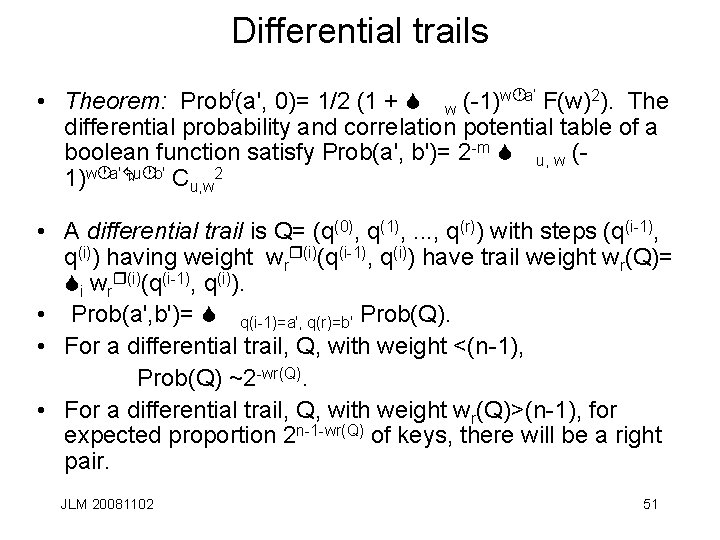
Differential trails • Theorem: Probf(a', 0)= 1/2 (1 + S w (-1)w·a’ F(w)2). The differential probability and correlation potential table of a boolean function satisfy Prob(a', b')= 2 -m S u, w (1)w·a'Åu·b' Cu, w 2 • A differential trail is Q= (q(0), q(1), . . . , q(r)) with steps (q(i-1), q(i)) having weight wrr(i)(q(i-1), q(i)) have trail weight wr(Q)= Si wrr(i)(q(i-1), q(i)). • Prob(a', b')= S q(i-1)=a', q(r)=b' Prob(Q). • For a differential trail, Q, with weight <(n-1), Prob(Q) ~2 -wr(Q). • For a differential trail, Q, with weight wr(Q)>(n-1), for expected proportion 2 n-1 -wr(Q) of keys, there will be a right pair. JLM 20081102 51
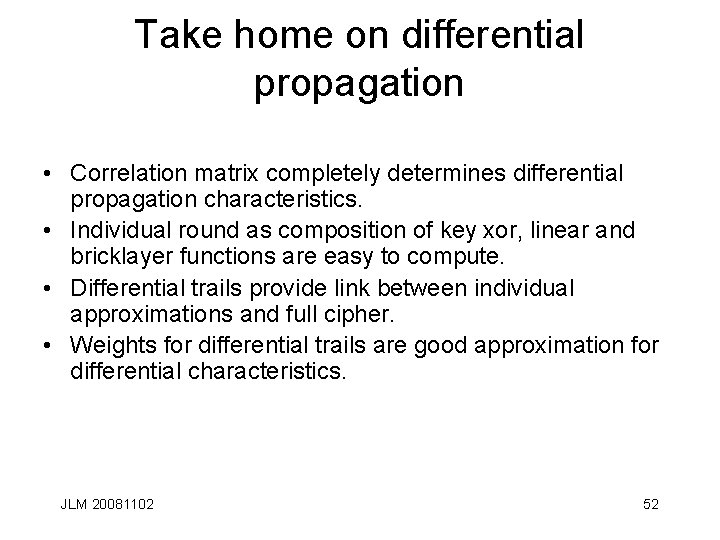
Take home on differential propagation • Correlation matrix completely determines differential propagation characteristics. • Individual round as composition of key xor, linear and bricklayer functions are easy to compute. • Differential trails provide link between individual approximations and full cipher. • Weights for differential trails are good approximation for differential characteristics. JLM 20081102 52

Rijndael Design Principles - motivation • The theory of linear and differential trails informed the design of Rijndael. • To eliminate low weight trails, there are two strategies: 1. Choose S-boxes with difference propagations that have high restriction weight and input-output correlations with high correlation weights; or, 2. Design round transformations so that only trails with many S-boxes occur. • Rijndael picks 2. • Wide trails strategy implements this. JLM 20081102 53

Rijndael Design Principles - continued • Linear cryptanalysis requires correlation > 2 -nb/2 over most rounds. This can't happen if we choose the number of rounds so that there are no such linear trails with correlation contribution >nk-1 2 -nb/2. Each output parity is correlated to an input parity since S w F(w)2=1 but if it occurs by constructive interference over many trails that share input/output selection then any such must be the result of at least nk linear trails which are unlikely to be key dependent. • Differential cryptanalysis requires input to output difference propagation with probability >21 -nb. If there are no differential trails with low weight, difference propagation results from multiple trails which again will not likely be key dependent. JLM 20081102 54

Rijndael Design Principles • Choose number of rounds so that there is no correlation over all but a few rounds with amplitude significantly larger than 2 nb/2 by insuring there are no linear trails with correlation contribution above nk-1 2 nb/2 and no differential trails with weight below nb. • Rijndael also insures that the diffusion layer provides that no multiple round trails have few active S-boxes. This guarantees no iteratively constructed correlation exists over several rounds. JLM 20081102 55

Amplitudes • Examine round transformations r= lg, where l is the mixing function and g is a bricklayer function that acts on bundles of nt bits. Block size is nb=m nt. • The correlation over g is the product of correlations over different S-box positions for given input and output patterns. • Define weight of correlation as -lg(Amplitude). • If output selection pattern is ¹ 0, the S-box is active. Looking for maximum amplitude of correlations and maximum difference propagation probability. • The weight of a trail is the sum of the weights of the selection patterns or the sum of the active S-box positions it is greater than the number of active S-boxes times the minimum correlation weight per S-box. • Wide trail: Design round transformations so there are no trails with low bundle weight. JLM 20081102 56

Branching and wide trails • Define wb(a) as the bundle weight of a. Let C(a, b, f, x)= a, b, C(a·x, b ·f(x))¹ 0. • Bd(f)= mina, b¹a (wb(aÅb)+wb(f(a)Åf(b))). • Bl(f, a)= min. C(a, b, f, x) (wb(a)+wb(b)). • Theorem: In an alternating key block cipher with g l round functions, the number of active bundles in a two round trail is ³the bundle branch number of l. If y= g q g l is a four round function, B(f) ³B(l) x Bc(q) where B can be either the linear or differential branch number. • The linear and differential branch numbers for an AES round is 5. JLM 20081102 57
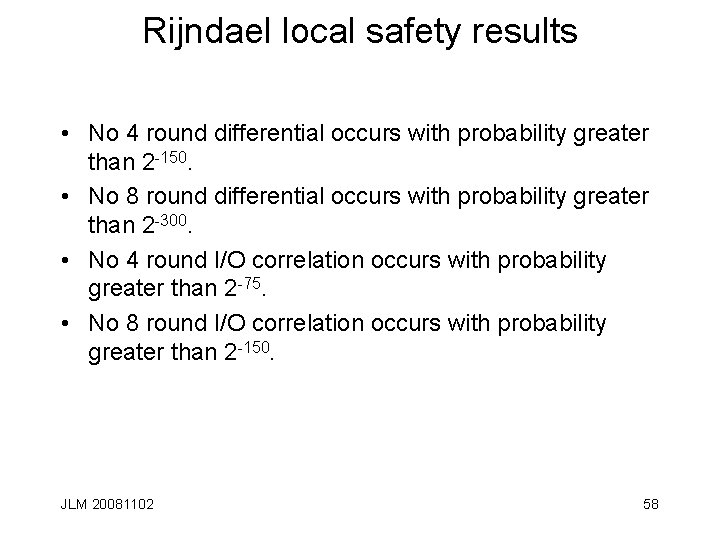
Rijndael local safety results • No 4 round differential occurs with probability greater than 2 -150. • No 8 round differential occurs with probability greater than 2 -300. • No 4 round I/O correlation occurs with probability greater than 2 -75. • No 8 round I/O correlation occurs with probability greater than 2 -150. JLM 20081102 58
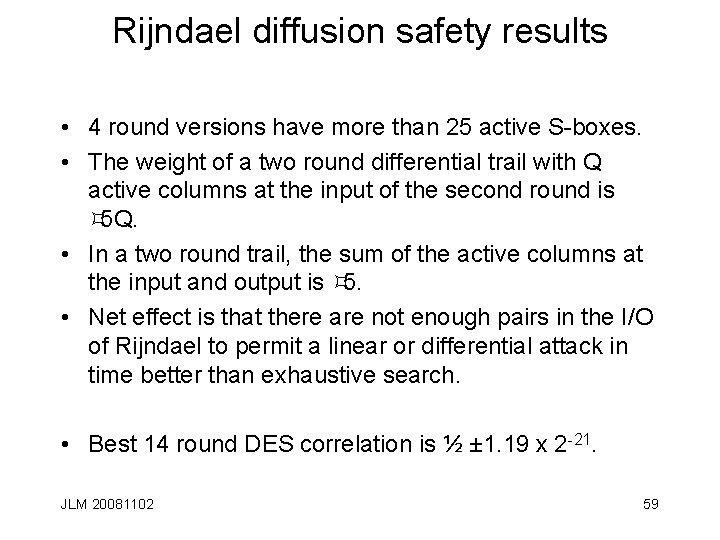
Rijndael diffusion safety results • 4 round versions have more than 25 active S-boxes. • The weight of a two round differential trail with Q active columns at the input of the second round is ³ 5 Q. • In a two round trail, the sum of the active columns at the input and output is ³ 5. • Net effect is that there are not enough pairs in the I/O of Rijndael to permit a linear or differential attack in time better than exhaustive search. • Best 14 round DES correlation is ½ ± 1. 19 x 2 -21. JLM 20081102 59

End JLM 20081102 60
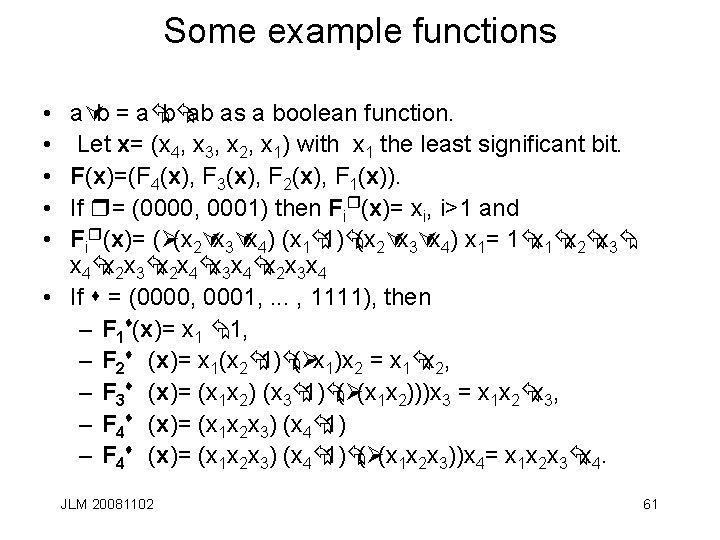
Some example functions • • • aÚb = aÅbÅab as a boolean function. Let x= (x 4, x 3, x 2, x 1) with x 1 the least significant bit. F(x)=(F 4(x), F 3(x), F 2(x), F 1(x)). If r= (0000, 0001) then Fir(x)= xi, i>1 and Fir(x)= (Ø(x 2Úx 3Úx 4) (x 1Å1)Å(x 2Úx 3Úx 4) x 1= 1Åx 2Åx 3Å x 4Åx 2 x 3Åx 2 x 4Åx 3 x 4Åx 2 x 3 x 4 • If s = (0000, 0001, . . . , 1111), then – F 1 s(x)= x 1 Å1, – F 2 s (x)= x 1(x 2Å1)Å(Øx 1)x 2 = x 1Åx 2, – F 3 s (x)= (x 1 x 2) (x 3Å1)Å(Ø(x 1 x 2)))x 3 = x 1 x 2Åx 3, – F 4 s (x)= (x 1 x 2 x 3) (x 4Å1)Å(Ø(x 1 x 2 x 3))x 4= x 1 x 2 x 3Åx 4. JLM 20081102 61

Ideas to study • Suppose the Boolean Transformation: Is there an easy to compute function, TK, obviously non-linear, so that TK EK TK -1 has good linear approximations? • How do you find such TK? • Finding the best approximation reduces to finding an orthogonal transformation that maximizes the largest entry. Suppose T is such a matrix; if T has all bad affine approximations • is it possible that there is another orthogonal transformation, R with • TR= R-1 T R such that maxij (|(TR)ij|)> maxij (|(T) ij|)? • If r 1, r 2, . . . , rn is a series of such transformations (like the iterated components of a block cipher), note that R-1 EK(x) R= R-1 r 1 R R-1 r 2 R … R-1 rn. R thus raising the possibility of better per round approximations on a related cipher. JLM 20081102 62
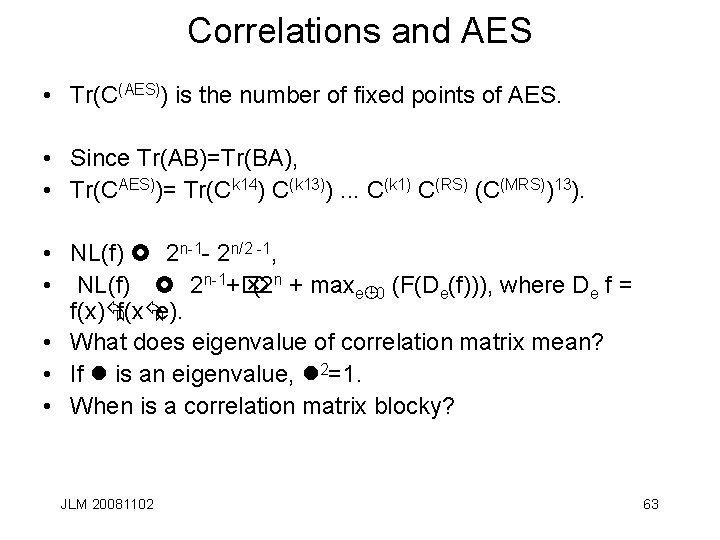
Correlations and AES • Tr(C(AES)) is the number of fixed points of AES. • Since Tr(AB)=Tr(BA), • Tr(CAES))= Tr(Ck 14) C(k 13)). . . C(k 1) C(RS) (C(MRS))13). • NL(f) £ 2 n-1 - 2 n/2 -1, • NL(f) £ 2 n-1+Ö (2 n + maxe¹ 0 (F(De(f))), where De f = f(x)Åf(xÅe). • What does eigenvalue of correlation matrix mean? • If l is an eigenvalue, l 2=1. • When is a correlation matrix blocky? JLM 20081102 63
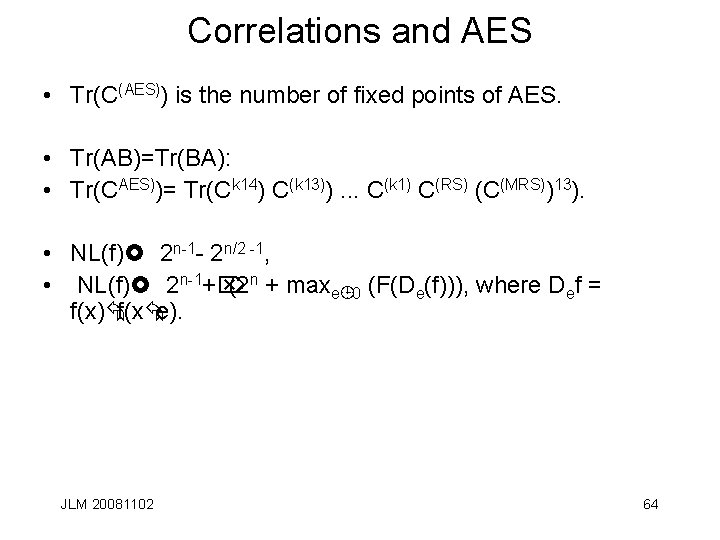
Correlations and AES • Tr(C(AES)) is the number of fixed points of AES. • Tr(AB)=Tr(BA): • Tr(CAES))= Tr(Ck 14) C(k 13)). . . C(k 1) C(RS) (C(MRS))13). • NL(f)£ 2 n-1 - 2 n/2 -1, • NL(f)£ 2 n-1+Ö (2 n + maxe¹ 0 (F(De(f))), where Def = f(x)Åf(xÅe). JLM 20081102 64
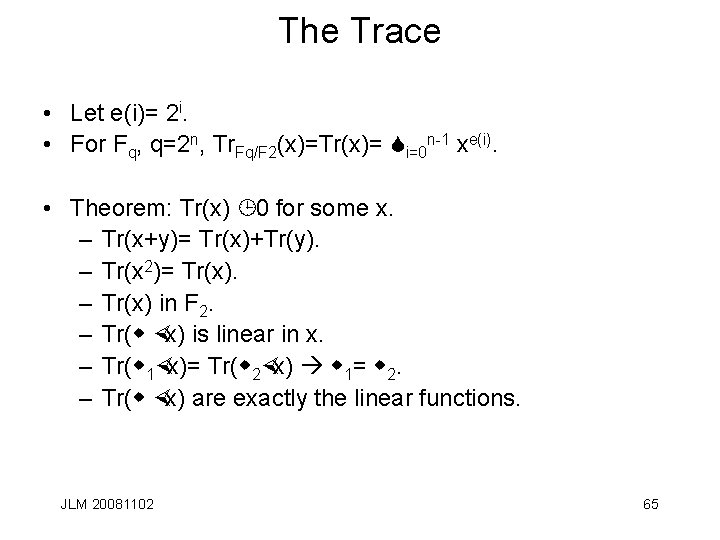
The Trace • Let e(i)= 2 i. • For Fq, q=2 n, Tr. Fq/F 2(x)=Tr(x)= Si=0 n-1 xe(i). • Theorem: Tr(x) ¹ 0 for some x. – Tr(x+y)= Tr(x)+Tr(y). – Tr(x 2)= Tr(x). – Tr(x) in F 2. – Tr(w ×x) is linear in x. – Tr(w 1×x)= Tr(w 2×x) w 1= w 2. – Tr(w ×x) are exactly the linear functions. JLM 20081102 65
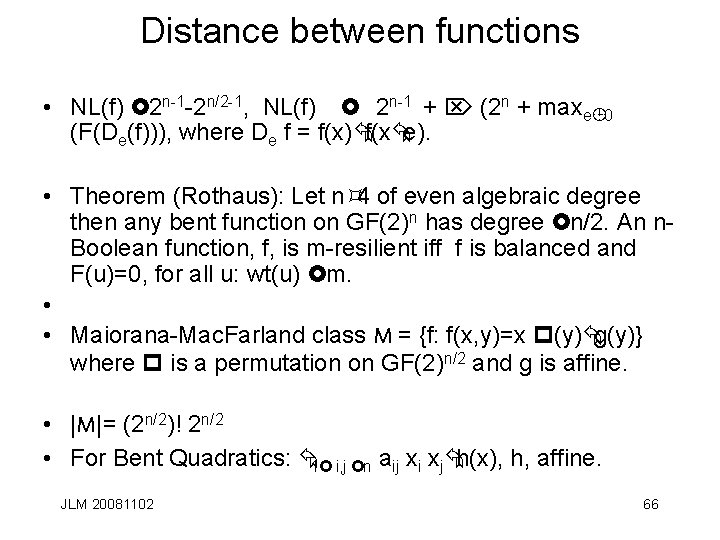
Distance between functions • NL(f) £ 2 n-1 -2 n/2 -1, NL(f) £ 2 n-1 + Ö (2 n + maxe¹ 0 (F(De(f))), where De f = f(x)Åf(xÅe). • Theorem (Rothaus): Let n³ 4 of even algebraic degree then any bent function on GF(2)n has degree £n/2. An n. Boolean function, f, is m-resilient iff f is balanced and F(u)=0, for all u: wt(u) £m. • • Maiorana-Mac. Farland class M = {f: f(x, y)=x p(y)Åg(y)} where p is a permutation on GF(2)n/2 and g is affine. • |M|= (2 n/2)! 2 n/2 • For Bent Quadratics: Å1£ i, j £n aij xi xjÅh(x), h, affine. JLM 20081102 66
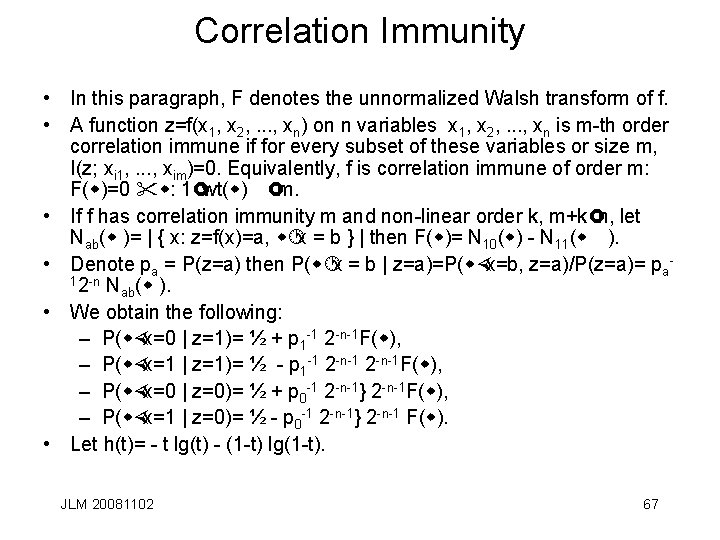
Correlation Immunity • In this paragraph, F denotes the unnormalized Walsh transform of f. • A function z=f(x 1, x 2, . . . , xn) on n variables x 1, x 2, . . . , xn is m-th order correlation immune if for every subset of these variables or size m, I(z; xi 1, . . . , xim)=0. Equivalently, f is correlation immune of order m: F(w)=0 "w: 1£wt(w) £m. • If f has correlation immunity m and non-linear order k, m+k£n, let Nab(w )= | { x: z=f(x)=a, w·x = b } | then F(w)= N 10(w) - N 11(w ). • Denote pa = P(z=a) then P(w·x = b | z=a)=P(w×x=b, z=a)/P(z=a)= pa 12 -n N (w ). ab • We obtain the following: – P(w×x=0 | z=1)= ½ + p 1 -1 2 -n-1 F(w), – P(w×x=1 | z=1)= ½ - p 1 -1 2 -n-1 F(w), – P(w×x=0 | z=0)= ½ + p 0 -1 2 -n-1} 2 -n-1 F(w), – P(w×x=1 | z=0)= ½ - p 0 -1 2 -n-1} 2 -n-1 F(w). • Let h(t)= - t lg(t) - (1 -t) lg(1 -t). JLM 20081102 67
Correlation Immunity based attack • s JLM 20081102 68
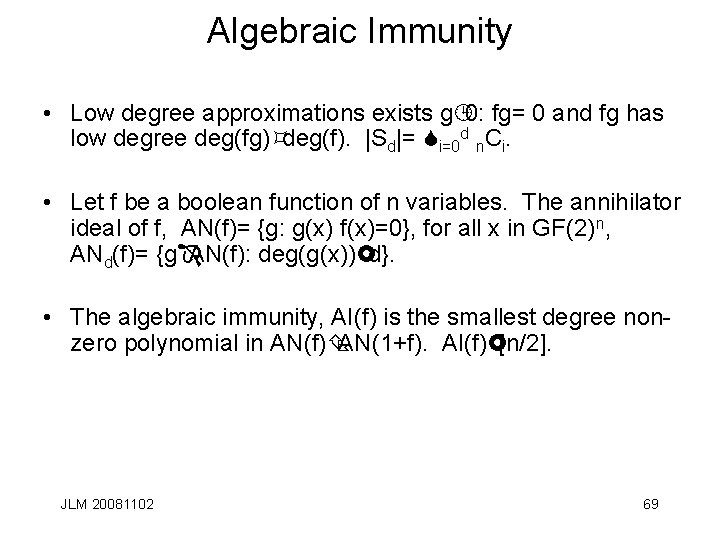
Algebraic Immunity • Low degree approximations exists g¹ 0: fg= 0 and fg has low degree deg(fg)³deg(f). |Sd|= Si=0 d n. Ci. • Let f be a boolean function of n variables. The annihilator ideal of f, AN(f)= {g: g(x) f(x)=0}, for all x in GF(2)n, ANd(f)= {gÎAN(f): deg(g(x))£d}. • The algebraic immunity, AI(f) is the smallest degree nonzero polynomial in AN(f)Ç AN(1+f). AI(f)£[n/2]. JLM 20081102 69
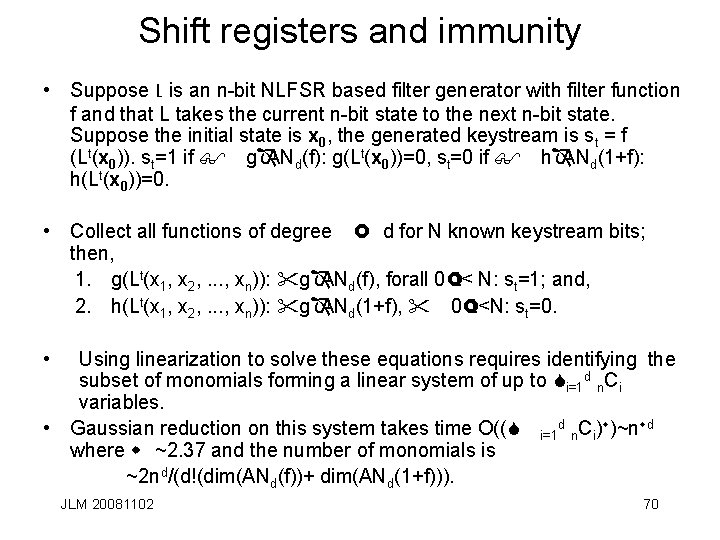
Shift registers and immunity • Suppose L is an n-bit NLFSR based filter generator with filter function f and that L takes the current n-bit state to the next n-bit state. Suppose the initial state is x 0, the generated keystream is st = f (Lt(x 0)). st=1 if $ gÎANd(f): g(Lt(x 0))=0, st=0 if $ hÎANd(1+f): h(Lt(x 0))=0. • Collect all functions of degree £ d for N known keystream bits; then, 1. g(Lt(x 1, x 2, . . . , xn)): "gÎANd(f), forall 0£t< N: st=1; and, 2. h(Lt(x 1, x 2, . . . , xn)): "gÎANd(1+f), " 0£t<N: st=0. • Using linearization to solve these equations requires identifying the subset of monomials forming a linear system of up to Si=1 d n. Ci variables. • Gaussian reduction on this system takes time O((S i=1 d n. Ci)w)~nwd where w ~2. 37 and the number of monomials is ~2 nd/(d!(dim(ANd(f))+ dim(ANd(1+f))). JLM 20081102 70
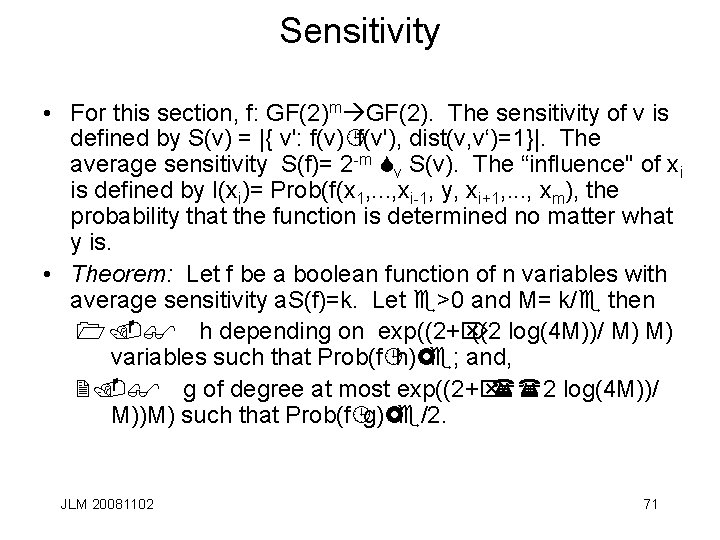
Sensitivity • For this section, f: GF(2)m GF(2). The sensitivity of v is defined by S(v) = |{ v': f(v)¹f(v'), dist(v, v‘)=1}|. The average sensitivity S(f)= 2 -m Sv S(v). The “influence'' of xi is defined by I(xi)= Prob(f(x 1, . . . , xi-1, y, xi+1, . . . , xm), the probability that the function is determined no matter what y is. • Theorem: Let f be a boolean function of n variables with average sensitivity a. S(f)=k. Let e>0 and M= k/e then 1. $ h depending on exp((2+Ö ((2 log(4 M))/ M) M) variables such that Prob(f¹h)£e; and, 2. $ g of degree at most exp((2+Ö ((2 log(4 M))/ M))M) such that Prob(f¹g)£e/2. JLM 20081102 71
- Slides: 71