
Cryostat Structural Thermal and Vacuum Systems 14 October
Cryostat Structural, Thermal, and Vacuum Systems 14 October 2008 Martin Nordby, Gary Guiffre, John Ku, John Hodgson
Contents • Cryostat design • Thermal design – Heat paths – Heat transfer • • • Radiation shielding Sensitivity to emissivity values Radiation heat transfer assumptions and calculations – Radiation through L 3 lens • • • Radiation heat flux profile on focal plane Temperature profile across window—L 3 lens and detectors Thermal-mechanical analysis – Grid heat loads – Distortion analysis L 3 lens analysis – FEA analysis of atmospheric pressure and thermal distortion Vacuum system design 2
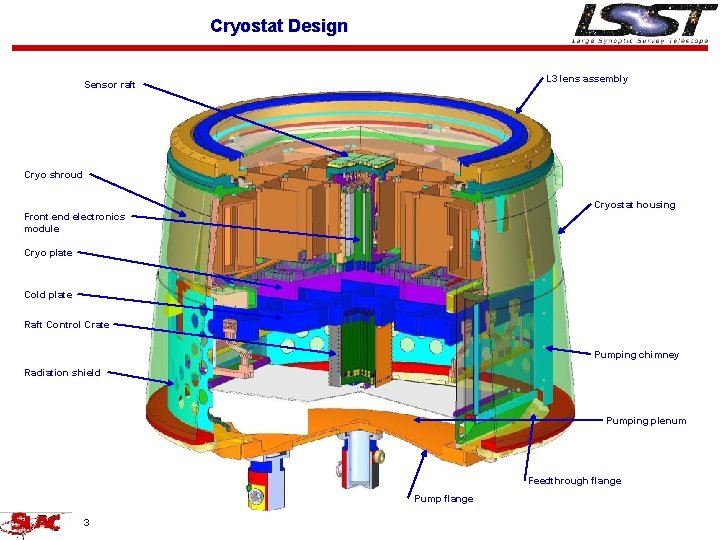
Cryostat Design L 3 lens assembly Sensor raft Cryo shroud Cryostat housing Front end electronics module Cryo plate Cold plate Raft Control Crate Pumping chimney Radiation shield Pumping plenum Feedthrough flange Pump flange 3
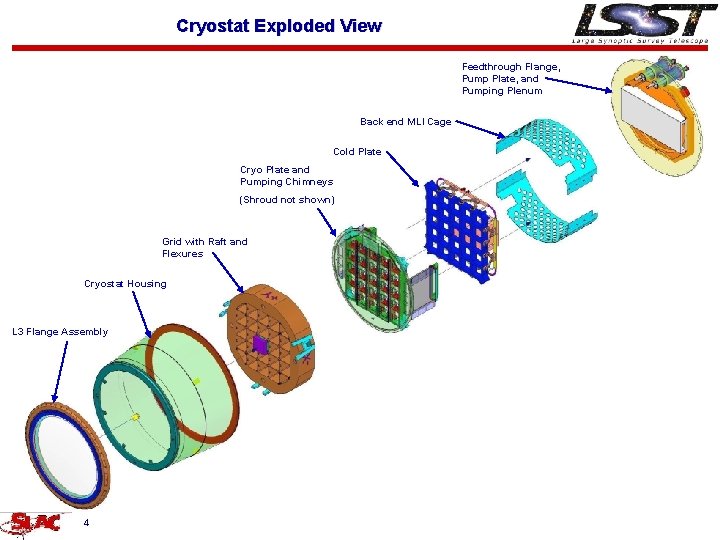
Cryostat Exploded View Feedthrough Flange, Pump Plate, and Pumping Plenum Back end MLI Cage Cold Plate Cryo Plate and Pumping Chimneys (Shroud not shown) Grid with Raft and Flexures Cryostat Housing L 3 Flange Assembly 4

Cryostat and Utility Trunk Components Support tube Structural support to camera back flange Valve box—vacuum-insulated Inlet/outlet lines for cryogens— vacuum-insulated Pneumatically actuated valves Cryostat vacuum pumping, valves, gauges 5 System electronics crates

Cryostat Thermal Design Cryo shroud plate Isolates Grid picture frame structure from radiant heating from front of cryostat Mat’l: nickel-plated copper Cryo shroud cone Isolates Grid perimeter from radiant heating from cryostat housing Mat’l: nickel-plated copper, wrapped in MLI Cryo plate Sinks and removes heat from front end Isolates Grid back side from radiant heating from cold plate Mat’l: copper plate / stainless steel ribs Cold plate Sinks and removes heat from back end Mat’l: copper Pump chimney/back end MLI shield Isolates RCC crates from radiant heating from cryostat housing Mat’l: nickel-plated stainless steel 6
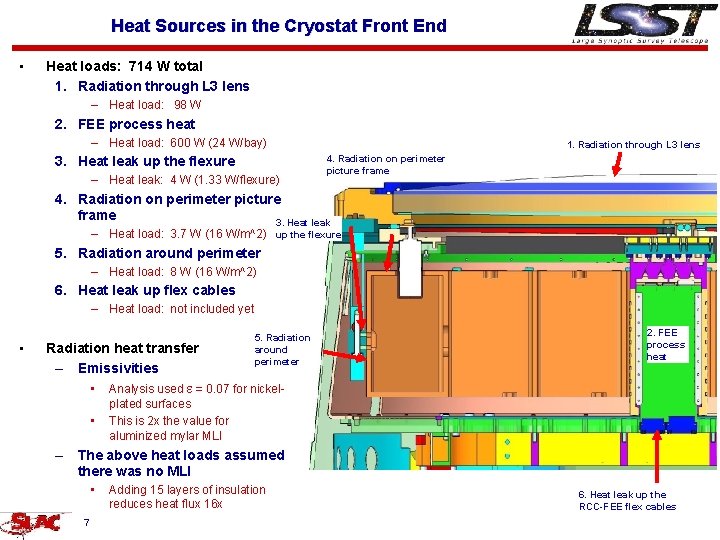
Heat Sources in the Cryostat Front End • Heat loads: 714 W total 1. Radiation through L 3 lens – Heat load: 98 W 2. FEE process heat – Heat load: 600 W (24 W/bay) 1. Radiation through L 3 lens 3. Heat leak up the flexure – Heat leak: 4 W (1. 33 W/flexure) 4. Radiation on perimeter picture frame 3. Heat leak – Heat load: 3. 7 W (16 W/m^2) up the flexure 5. Radiation around perimeter – Heat load: 8 W (16 W/m^2) 6. Heat leak up flex cables – Heat load: not included yet • 5. Radiation around perimeter Radiation heat transfer – Emissivities • Analysis used e = 0. 07 for nickel • 2. FEE process heat plated surfaces This is 2 x the value for aluminized mylar MLI – The above heat loads assumed there was no MLI • 7 Adding 15 layers of insulation reduces heat flux 16 x 6. Heat leak up the RCC-FEE flex cables
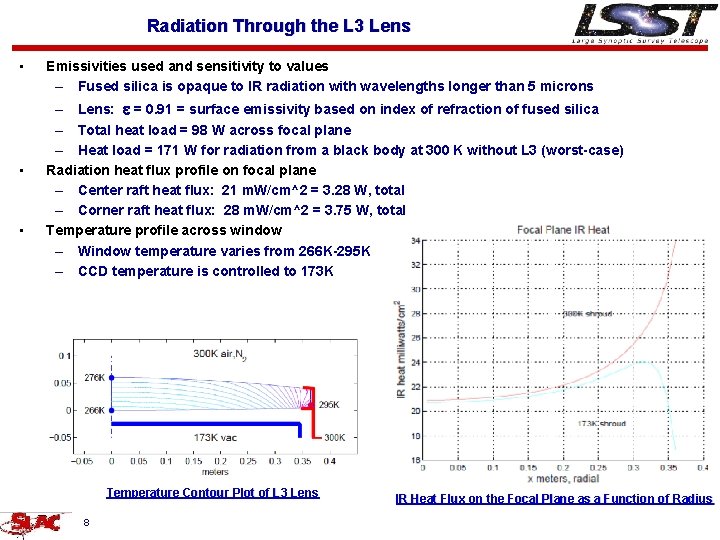
Radiation Through the L 3 Lens • • • Emissivities used and sensitivity to values – Fused silica is opaque to IR radiation with wavelengths longer than 5 microns – Lens: e = 0. 91 = surface emissivity based on index of refraction of fused silica – Total heat load = 98 W across focal plane – Heat load = 171 W for radiation from a black body at 300 K without L 3 (worst-case) Radiation heat flux profile on focal plane – Center raft heat flux: 21 m. W/cm^2 = 3. 28 W, total – Corner raft heat flux: 28 m. W/cm^2 = 3. 75 W, total Temperature profile across window – Window temperature varies from 266 K-295 K – CCD temperature is controlled to 173 K Temperature Contour Plot of L 3 Lens 8 IR Heat Flux on the Focal Plane as a Function of Radius
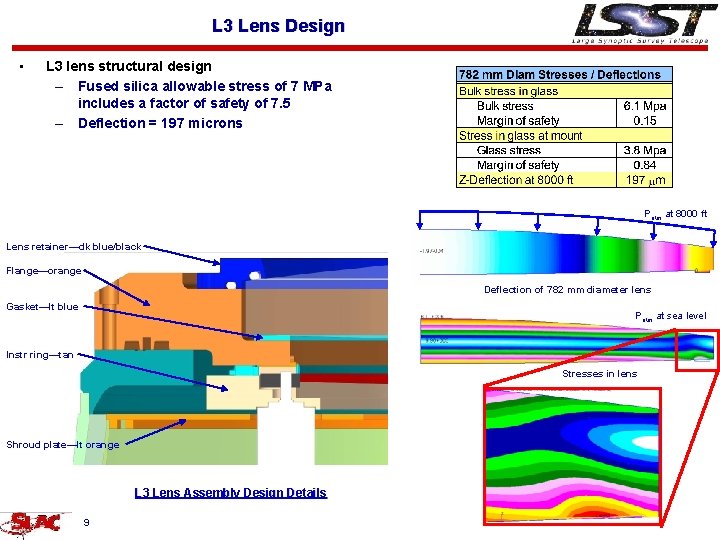
L 3 Lens Design • L 3 lens structural design – Fused silica allowable stress of 7 MPa includes a factor of safety of 7. 5 – Deflection = 197 microns Patm at 8000 ft Lens retainer—dk blue/black Flange—orange Deflection of 782 mm diameter lens Gasket—lt blue Patm at sea level Instr ring—tan Stresses in lens Shroud plate—lt orange L 3 Lens Assembly Design Details 9
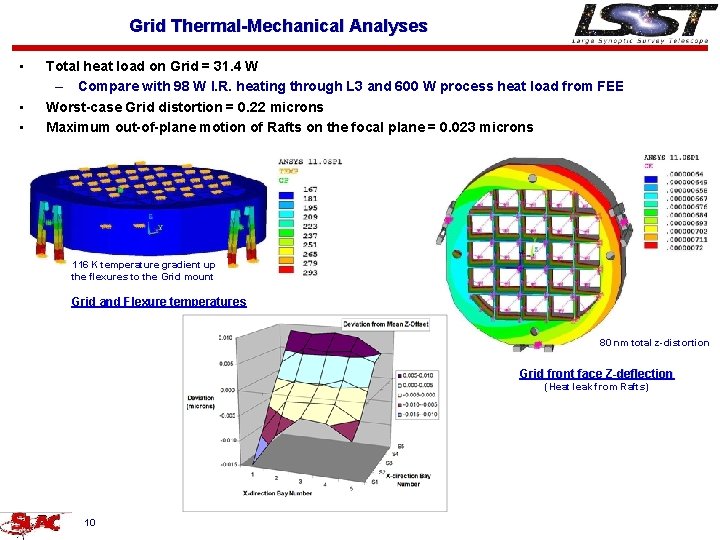
Grid Thermal-Mechanical Analyses • • • Total heat load on Grid = 31. 4 W – Compare with 98 W I. R. heating through L 3 and 600 W process heat load from FEE Worst-case Grid distortion = 0. 22 microns Maximum out-of-plane motion of Rafts on the focal plane = 0. 023 microns 116 K temperature gradient up the flexures to the Grid mount Grid and Flexure temperatures 80 nm total z-distortion Grid front face Z-deflection (Heat leak from Rafts) 10
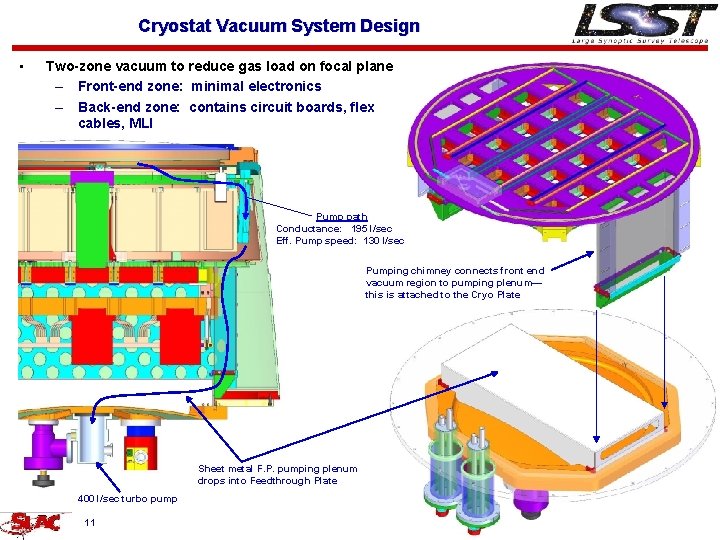
Cryostat Vacuum System Design • Two-zone vacuum to reduce gas load on focal plane – Front-end zone: minimal electronics – Back-end zone: contains circuit boards, flex cables, MLI Pump path Conductance: 195 l/sec Eff. Pump speed: 130 l/sec Pumping chimney connects front end vacuum region to pumping plenum— this is attached to the Cryo Plate Sheet metal F. P. pumping plenum drops into Feedthrough Plate 400 l/sec turbo pump 11
- Slides: 11