
Crude glycerol combustion particulate acrolein and other volatile
Crude glycerol combustion: particulate, acrolein, and other volatile organic emissions S. A. Steinmetz 1, 2, J. S. Herrington 3, 4, C. K. Winterrowd 5, W. L. Roberts 1, 2, J. O. L. Wendt 6, W. P. Linak 3 1 Department of Mechanical and Aerospace Engineering North Carolina State University Raleigh, NC 27695 USA 2(current address) Clean Combustion Research Center King Abdullah University of Science and Technology Thuwal, 23955 Saudi Arabia 3 Air Pollution Prevention and Control Division National Risk Management Research Laboratory U. S. Environmental Protection Agency Research Triangle Park, NC 27711 USA 4(current address) Restek Corporation Bellefonte, PA 16823 USA 5 ARCADIS Geraghty & Miller, Inc. Durham, NC 27709 USA 6 Department of Chemical Engineering University of Utah Salt Lake City, UT 84112, USA 34 th International Symposium on Combustion Warsaw, Poland 29 July – 4 August, 2012
Outline • Introduction • Crude glycerol • Acrolein • Previous work • Experimental method • Furnace • PM • VOCs • Results • CEMs • PM • VOCs • Conclusions • Future work • Acknowledgements 34 th International Symposium on Combustion 2
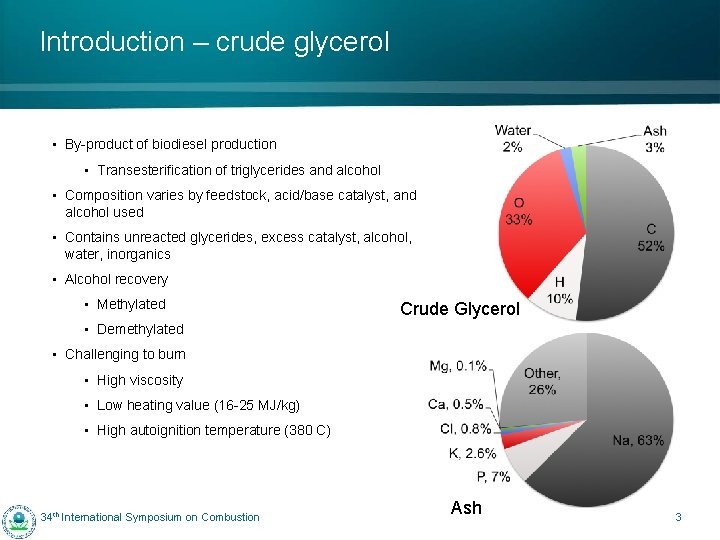
Introduction – crude glycerol • By-product of biodiesel production • Transesterification of triglycerides and alcohol • Composition varies by feedstock, acid/base catalyst, and alcohol used • Contains unreacted glycerides, excess catalyst, alcohol, water, inorganics • Alcohol recovery • Methylated Crude Glycerol • Demethylated • Challenging to burn • High viscosity • Low heating value (16 -25 MJ/kg) • High autoignition temperature (380 C) 34 th International Symposium on Combustion Ash 3
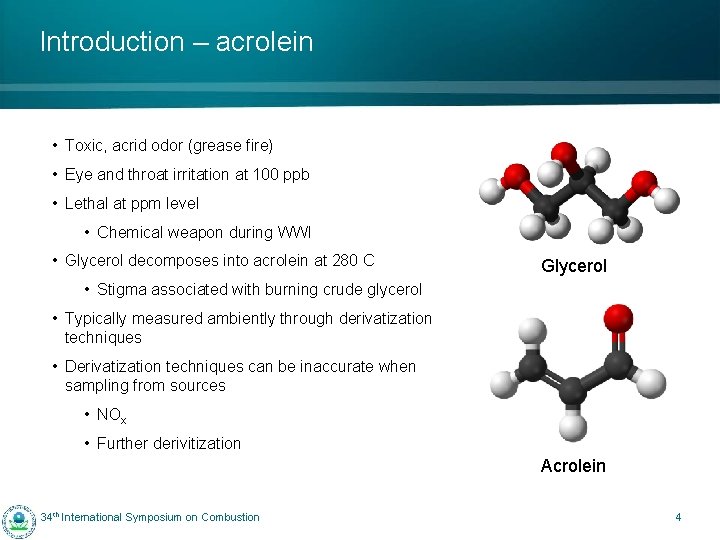
Introduction – acrolein • Toxic, acrid odor (grease fire) • Eye and throat irritation at 100 ppb • Lethal at ppm level • Chemical weapon during WWI • Glycerol decomposes into acrolein at 280 C Glycerol • Stigma associated with burning crude glycerol • Typically measured ambiently through derivatization techniques • Derivatization techniques can be inaccurate when sampling from sources • NOx • Further derivitization Acrolein 34 th International Symposium on Combustion 4
![Previous work • Bohon et al. [1, 2] demonstrated ability to produce stable 100%](http://slidetodoc.com/presentation_image_h/97c0533ed90620ed57ce4671f64fda56/image-5.jpg "Previous work • Bohon et al. [1, 2] demonstrated ability to produce stable 100%")
Previous work • Bohon et al. [1, 2] demonstrated ability to produce stable 100% crude glycerol flames at 82 k. W scale • Refractory-lined high-swirl furnace provided thermal feedback and long enough residence time to overcome low heating value and high autoignition temperature • Viscosity easily reduced by pre-heating fuel • Identified large particulate emissions • 2 -4 g/cm 3 • Due to presence of large amounts of inorganic species • Preliminary measurements of acrolein • Pure glycerol combustion in 7 k. W furnace • DNPH coated solid sorbent cartridges • No measurement greater than 17. 5 ppbv [1] M. D. Bohon, B. A. Metzger, W. P. Linak, C. J. King, W. L. Roberts, Proc. Combust. Inst. 33 (2011) 2717 -2724. [2] M. D. Bohon, Characterization of Glycerin Combustion and Emissions, MS thesis, North Carolina State University, Raleigh, NC, 2010. 34 th International Symposium on Combustion 5
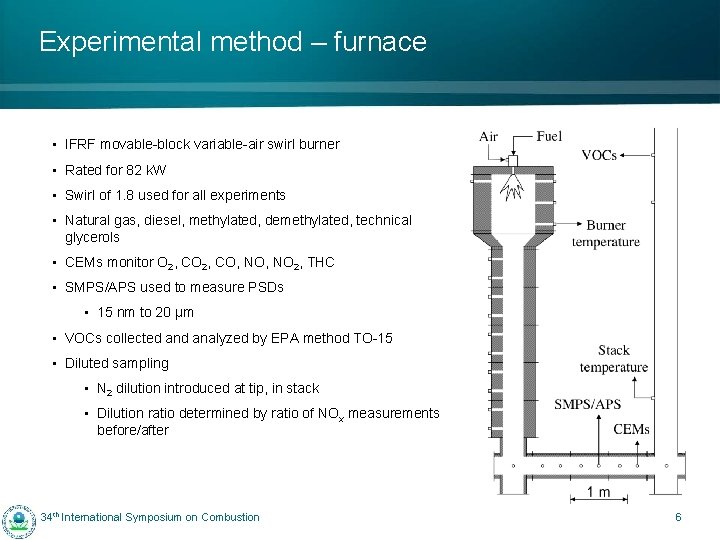
Experimental method – furnace • IFRF movable-block variable-air swirl burner • Rated for 82 k. W • Swirl of 1. 8 used for all experiments • Natural gas, diesel, methylated, demethylated, technical glycerols • CEMs monitor O 2, CO, NO 2, THC • SMPS/APS used to measure PSDs • 15 nm to 20 μm • VOCs collected analyzed by EPA method TO-15 • Diluted sampling • N 2 dilution introduced at tip, in stack • Dilution ratio determined by ratio of NOx measurements before/after 34 th International Symposium on Combustion 6
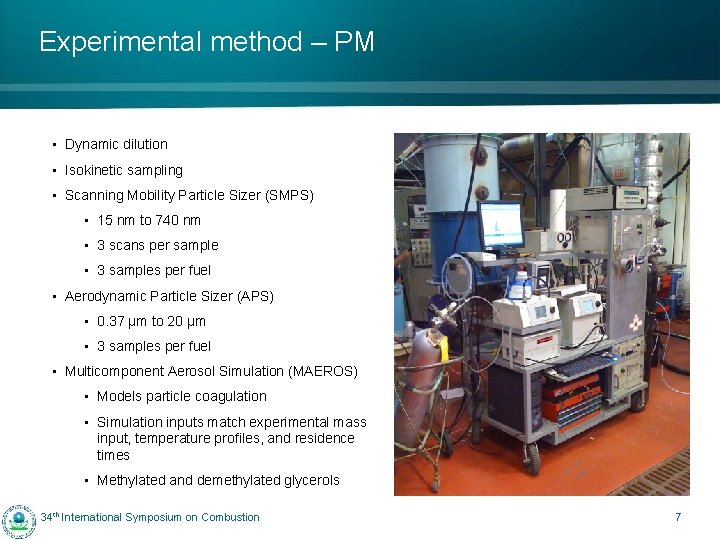
Experimental method – PM • Dynamic dilution • Isokinetic sampling • Scanning Mobility Particle Sizer (SMPS) • 15 nm to 740 nm • 3 scans per sample • 3 samples per fuel • Aerodynamic Particle Sizer (APS) • 0. 37 μm to 20 μm • 3 samples per fuel • Multicomponent Aerosol Simulation (MAEROS) • Models particle coagulation • Simulation inputs match experimental mass input, temperature profiles, and residence times • Methylated and demethylated glycerols 34 th International Symposium on Combustion 7
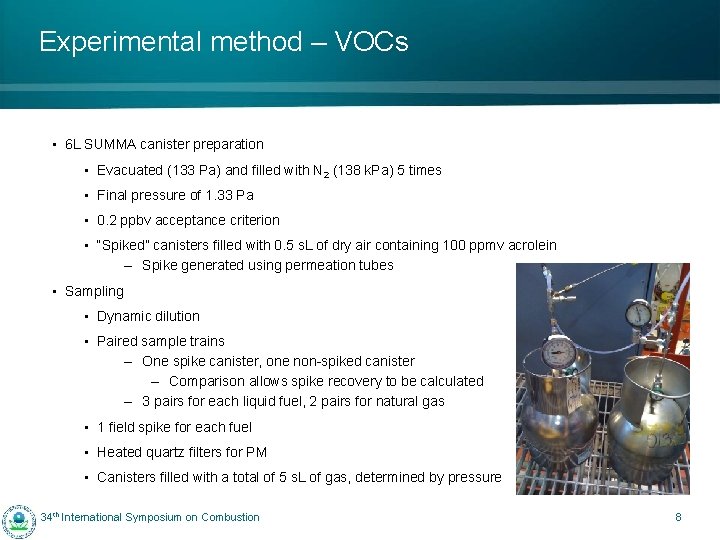
Experimental method – VOCs • 6 L SUMMA canister preparation • Evacuated (133 Pa) and filled with N 2 (138 k. Pa) 5 times • Final pressure of 1. 33 Pa • 0. 2 ppbv acceptance criterion • “Spiked” canisters filled with 0. 5 s. L of dry air containing 100 ppmv acrolein – Spike generated using permeation tubes • Sampling • Dynamic dilution • Paired sample trains – One spike canister, one non-spiked canister – Comparison allows spike recovery to be calculated – 3 pairs for each liquid fuel, 2 pairs for natural gas • 1 field spike for each fuel • Heated quartz filters for PM • Canisters filled with a total of 5 s. L of gas, determined by pressure 34 th International Symposium on Combustion 8
Experimental method – VOCs • Analysis • GC-MS analysis (TO-15) – 82 analytes • Preconcentrator – Concentrates sample gas and internal standards (3) • 5 point calibration from 2. 00 ppbv to 125 pptv for all analytes • Blank corrected • Levels of quantification • ND – no response from the MS after blank correction • Below detection limits – there is a response from the MS for a particular analyte, but it is within the limits of the “noise” of the system. Analyte may not actually be present • Below cal – response was above the detection limits, but below the lowest calibration point. The analyte is present in the sample, but the exact quantity may not be known for certain • Values within calibration range are considered true • Dilution and preconcentration values varied, so detection and calibration limits in-stack vary 34 th International Symposium on Combustion 9
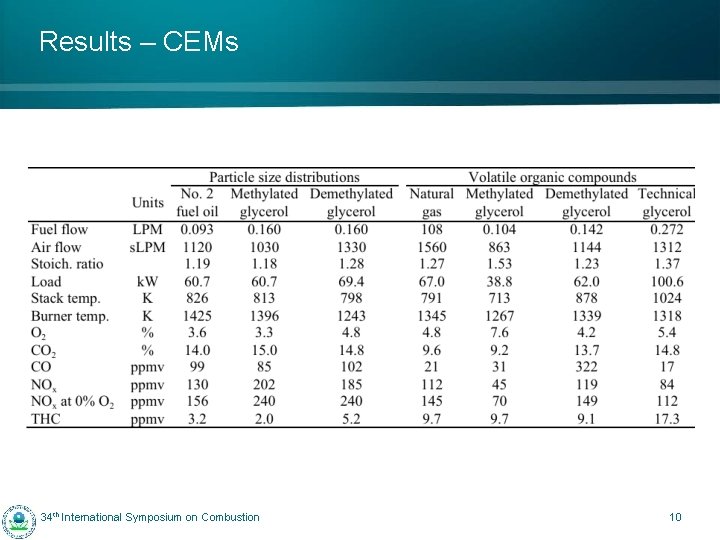
Results – CEMs 34 th International Symposium on Combustion 10
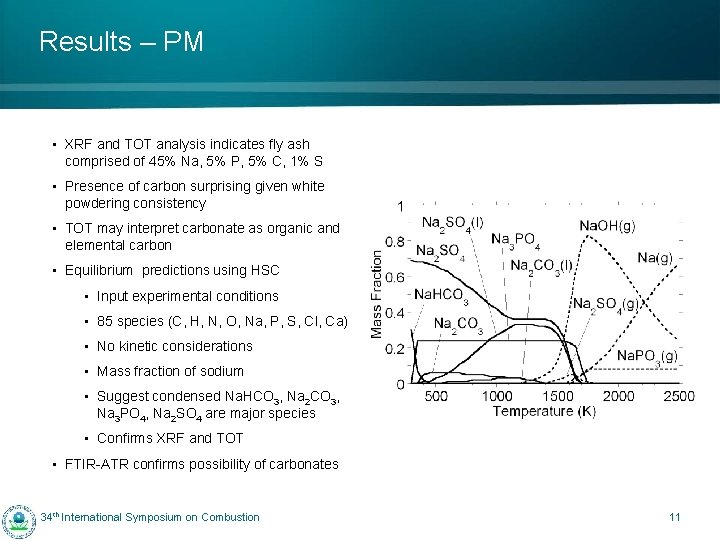
Results – PM • XRF and TOT analysis indicates fly ash comprised of 45% Na, 5% P, 5% C, 1% S • Presence of carbon surprising given white powdering consistency • TOT may interpret carbonate as organic and elemental carbon • Equilibrium predictions using HSC • Input experimental conditions • 85 species (C, H, N, O, Na, P, S, Cl, Ca) • No kinetic considerations • Mass fraction of sodium • Suggest condensed Na. HCO 3, Na 2 CO 3, Na 3 PO 4, Na 2 SO 4 are major species • Confirms XRF and TOT • FTIR-ATR confirms possibility of carbonates 34 th International Symposium on Combustion 11
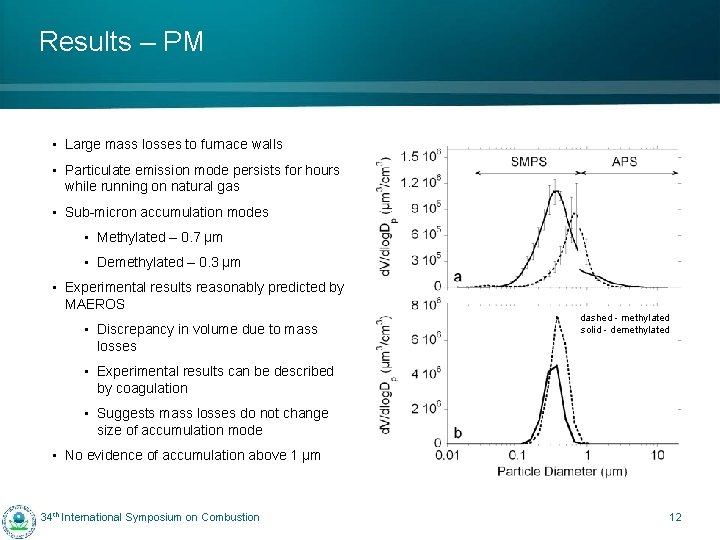
Results – PM • Large mass losses to furnace walls • Particulate emission mode persists for hours while running on natural gas • Sub-micron accumulation modes • Methylated – 0. 7 μm • Demethylated – 0. 3 μm • Experimental results reasonably predicted by MAEROS • Discrepancy in volume due to mass losses dashed - methylated solid - demethylated • Experimental results can be described by coagulation • Suggests mass losses do not change size of accumulation mode • No evidence of accumulation above 1 μm 34 th International Symposium on Combustion 12
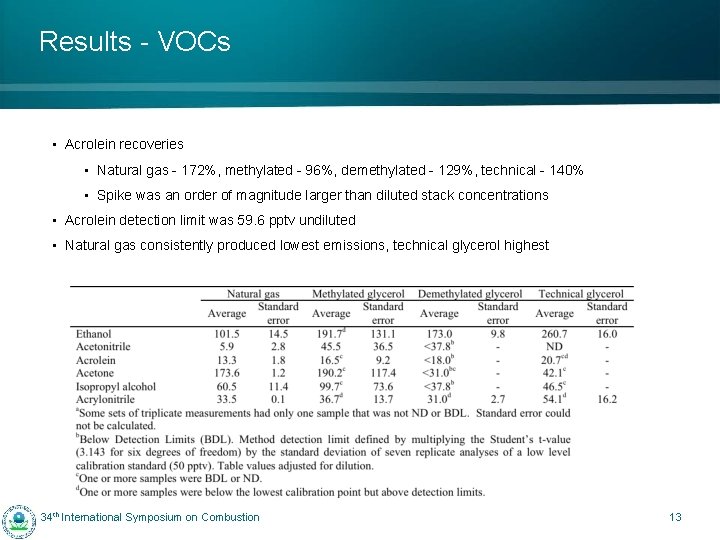
Results - VOCs • Acrolein recoveries • Natural gas - 172%, methylated - 96%, demethylated - 129%, technical - 140% • Spike was an order of magnitude larger than diluted stack concentrations • Acrolein detection limit was 59. 6 pptv undiluted • Natural gas consistently produced lowest emissions, technical glycerol highest 34 th International Symposium on Combustion 13
Conclusions • Large amounts of sub-micron fly ash comprised mostly of sodium carbonates, phosphate, and sulfate • Significant fouling of furnace due to presence of large amounts of alkali and alkaline earth elements and P in fuel • New biodiesel production processes that do not leave excess catalyst in the crude could greatly reduce particulate matter • Acrolein emissions are very low comparable to natural gas • Emissions of other VOCs are also low and comparable to natural gas • Method TO-15 may be viable for reliable in-stack acrolein measurements 34 th International Symposium on Combustion 14
Future work • Reduction in inorganics in crude glycerol • Fixed bed catalysts rather than soluble catalysts • Supercritical reaction without catalyst • Investigation of TO-15 for source acrolein measurements • Improved spiking (dynamic) • Larger number of samples • Construction of prototype burners (see Bohon et al. , 2011) for 82 k. W (furnace) and 730 k. W (boiler) demonstrations 34 th International Symposium on Combustion 15
Acknowledgements Portions of this work were sponsored under: • NCSU/EPA Cooperative Training Program in Environmental Sciences Research, Training Agreement CT 833235 -01 -0 with North Carolina State University • P. O. EP-09 -C 00114 with J. O. L. Wendt • Contract EP-C-09 -027 with ARCADIS U. S. , Inc. The authors are grateful to Mr. Daniel Janek, for his help operating the refractory-lined furnace, Dr. Simon Lappi, for his help with FTIR-ATR analyses at NCSU, and Mr. Myles Bohon, for his help with glycerol combustion issues. The research described in this presentation has been reviewed by the U. S. EPA National Risk Management Research Laboratory and approved for presentation. The contents of this presentation should not be construed to represent Agency policy nor does mention of trade names or commercial products constitute endorsement or recommendation for use. 34 th International Symposium on Combustion 16
Questions? Thank you 34 th International Symposium on Combustion 17
- Slides: 17