
Crowd Violence in Sport EXS 290 Marcella Brosnan

Crowd Violence in Sport EXS 290 Marcella Brosnan Jamie Winsper
Outline Why is sport important to society? ● Crowd Violence Statistics ● Factors Contributing to Fan Violence ● Steve Bartman Case Study ● Riots ● Change in Stadium Regulations ● Changes in Rules of Sport ● References
Why is Sport Important to Society? ● Fans have a thirst for violence and studies show that, within limits, as aggression goes up, so does viewership. (Discovery News, 2012) ● “Some psychologists have proposed that fans experience a sense of catharsis from viewing blows and wrecks. Others have suggested that watching others be aggressive helps people vicariously release their own pent-up emotions” (Discovery News, 2012) ● Sports provide key dynamics when it comes to the augmentation of communal principles by enhancing the physical and mental well-being of individuals and the integration of social classes (Macri, K. J. , 2012)
Why is Sport Important to Society Con’t ● The idea of “winning” in sports serves as a prime exemplar of success: a highly valued commodity which often results in elitism and superiority. (Macri, K. J. , 2012) ● Society defines “manliness” with toughness. Participating is viewed to some as tough and exemplifies strength and power. ● It gives people a sense of belongness to groups and society
Crowd Violence Statistics ● Studies of university students suggest that males are more likely than females to consider acts of aggression at sporting events, although this difference becomes less pronounced when less physical forms of aggression are considered. ● Reports of spectator ejections from sporting events suggest that rowdy and abusive fans tend to be middle-class professionals ● The six most common forms of spectator aggression are as follows: 1. verbal—singing, chanting, and yelling taunts or obscenities; 2. gesturing—signaling to others with threatening or obscene motions; 3. "missile" throwing—throwing items such as food, drinks, bricks, bottles, broken seats, and cell phones at particular or random targets; 4. swarming—rushing the field or stage and trying to crash the gates to gain entry, or rushing the exit, both of which may result in injury or death from trampling; 5. property destruction—knocking down sound systems, tearing up the playing field, and burning/damaging the venue or others' property; and 6. physical—spitting, kicking, shoving, fistfights, stabbings, and shootings. (Madensen, T. D. , & Eck, J. E. 2008)
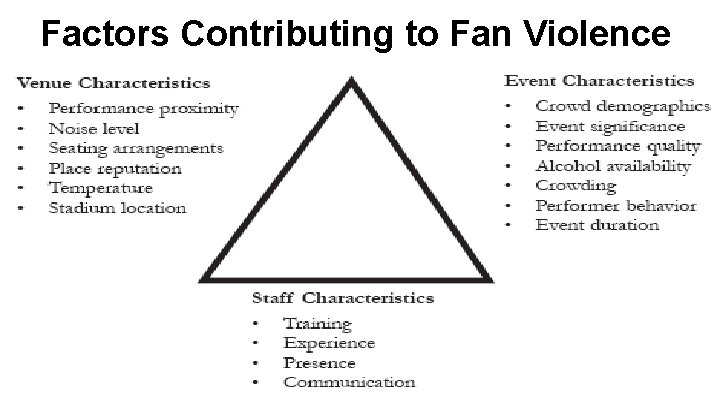
Factors Contributing to Fan Violence
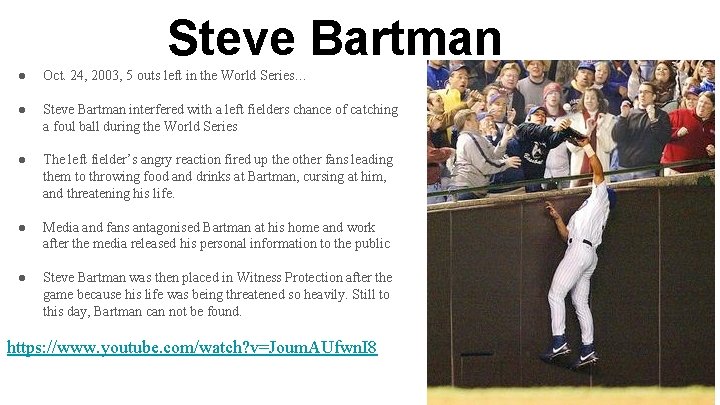
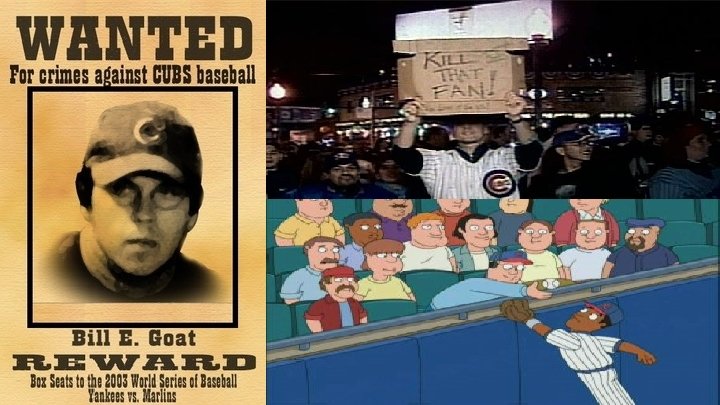
Steve Bartman ● Oct. 24, 2003, 5 outs left in the World Series… ● Steve Bartman interfered with a left fielders chance of catching a foul ball during the World Series ● The left fielder’s angry reaction fired up the other fans leading them to throwing food and drinks at Bartman, cursing at him, and threatening his life. ● Media and fans antagonised Bartman at his home and work after the media released his personal information to the public ● Steve Bartman was then placed in Witness Protection after the game because his life was being threatened so heavily. Still to this day, Bartman can not be found. https: //www. youtube. com/watch? v=Joum. AUfwn. I 8
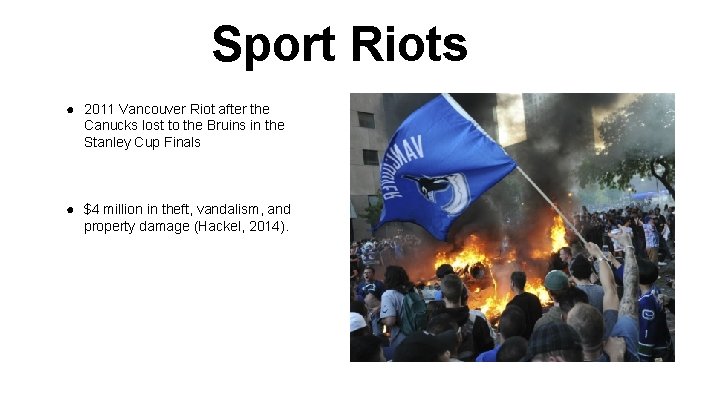
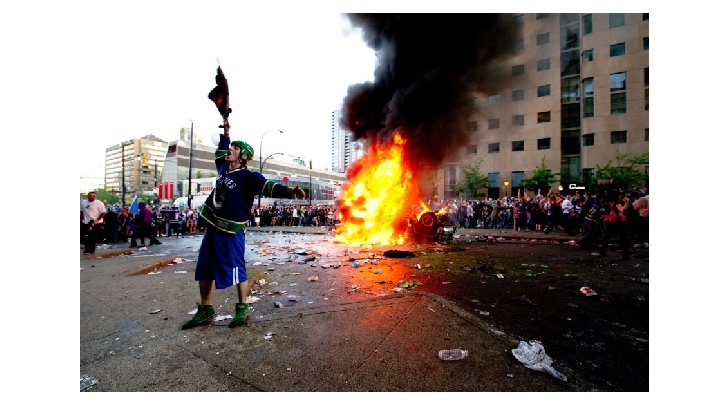
Sport Riots ● 2011 Vancouver Riot after the Canucks lost to the Bruins in the Stanley Cup Finals ● $4 million in theft, vandalism, and property damage (Hackel, 2014).
Sport Riots ● 1955 “Richard Riot” in Montreal ● Clarence Campbell suspended Maurice Richard, attended Canadiens-Red Wings game the following night ● Protesters remained outside the arena for hours before the game ● Campbell was verbally and physically attacked during the game until the crowd fled outside (Hackel, 2014)

“Richard Riot”
Changes in Stadium Regulations ● 1949 Blackhawks-Canadiens: Hawks fan reached over the boards and grabbed the sweater of Ken Reardon ● NHL Referee King Clancy jabbed with needle by fan ● 1979 Rangers-Bruins: Fan tried to grab Terry O’Reilly’s stick, O’Reilly retaliated by climbing into the stands, followed by his teammates ● 1989 Bruins climbed over the boards onto the ice to approach the referee (Hackel, 2014). https: //www. youtube. com/watch? v=sjupn. YB 5 v. UI
Changes in Stadium Regulations ● Increased security personnel and guest services departments ● Improved cameras ● Higher glass surrounding rink, netting (Hackel, 2014) ● Plexiglass barriers or fences ● Separate seating for fans of opposing teams (Madensen & Eck, 2008)
Changes in Stadium Regulations ● Alcohol lowers inhibitions ● “Drinking just gives you permission to do what you wanted anyway” (Hackel, 2014) ● No alcohol sales: Hockey: after second intermission Baseball: end of seventh inning Football: start of fourth quarter Basketball: start of fourth quarter ● NY Giants banned alcohol sales altogether at certain Monday night rivalry games ● 2 drink per customer per sale (Lenk et al. , 2010)
Changes in Rules ● “If spectator interference clearly prevents a fielder from catching a fly ball, the umpire shall declare the batter out. ” (Official Rules: 3. 00 Game Preliminaries, 2015) ● The NFL implemented a temporary stadium ban for anyone ejected for violating the fan code of conduct. ○ If ejected, a fan must enroll in and complete a fan-conduct-awareness class. ○ That fan must also submit a request to have the ban lifted, showing adequate remorse. (Athletic Business, 2015) ● Regulations on the Sale of Alcohol ○ Most stop serving alcohol at some point after the first half of the game ○ Some collegiate stadiums began selling alcohol in attempt to eliminate binge-drinking during tailgates (Athletic Business, 2015)
Conclusion ●Violence in sport is inevitable, and there is never going to fully be preventable. ●Suggestions: ○Increase Awareness of Crowd Violence ○Continue to Increase Security Measures
References ● ● ● ● ● Athletic Business. (2015). How to Prevent Fan Violence at Sporting Events. N. p. : Athletic Business. Retrieved from http: //www. athleticbusiness. com/stadium-arena-security/how-to-prevent-fan-violence-at-sporting-events. html Discovery News. (2012). Is Violence in Sports Inevitable? N. p. : Discovery Communications. Retrieved from http: //news. discovery. com/adventure/violence-sports-football-120307. htm Hackel, S. (2014). Fans Gone Wild. Hockey News, 68(9), 31 -32. Macri, K. J. (2012). "Not Just a Game: Sport and Society in the United States. " Student Pulse, 4(08). Retrieved from http: //www. studentpulse. com/a? id=676 Lenk, M. , Toomey, T. , Erickson, D. , Kilian, G. , Nelson, T. , & Fabian, L. (October, 2010). Public Health Reports. Madensen, T. D. , & Eck, J. E. (2008). The Problem of Spectator Violence in Stadiums. Retrieved from http: //www. popcenter. org/problems/spectator_violence/print/ Official Rules: 3. 00 Game Preliminaries. (n. d. ). Retrieved from http: //mlb. com/mlb/official_info/official_rules/objectives_1. jsp Roadburg, A. (2001). Factors Percipitating Fan Violence: a comparison of professional soccer in Britain and North America. N. p. : Dalhousie University. Russell, G. W. (n. d. ). Aggressive Behavior 1995 (Vol. 21, pp. 91 -100). N. p. : http: //www. wiley. co. uk. Retrieved from SPORTDiscus. Smith, M. D. (1976). Sociological Inquiry (48 th ed. , Vol. 2, pp. 121 -131). N. p. : York University.
- Slides: 18