
Crowd DB Answering Queries using Crowdsourcing Michael J
Crowd. DB: Answering Queries using Crowdsourcing Michael J. Franklin, Donald Kossmann, Tim Kraska, Sukriti Ramesh, Reynold Xin
Outline • Crowdsourcing • Motivation • Design Considerations • Overview of Crowd. DB • Crowd. SQL • User Interface Generation • Query Processing • Experimental Results
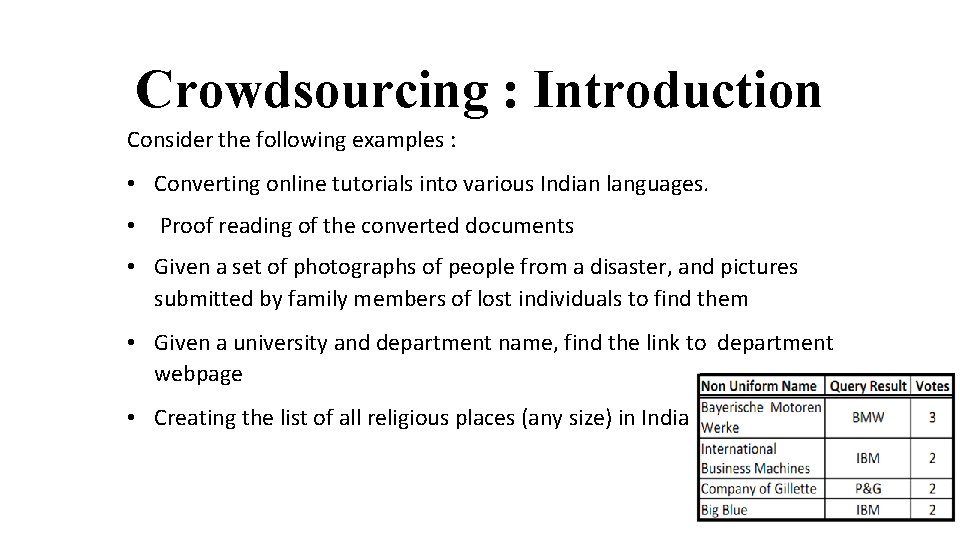
Crowdsourcing : Introduction Consider the following examples : • Converting online tutorials into various Indian languages. • Proof reading of the converted documents • Given a set of photographs of people from a disaster, and pictures submitted by family members of lost individuals to find them • Given a university and department name, find the link to department webpage • Creating the list of all religious places (any size) in India
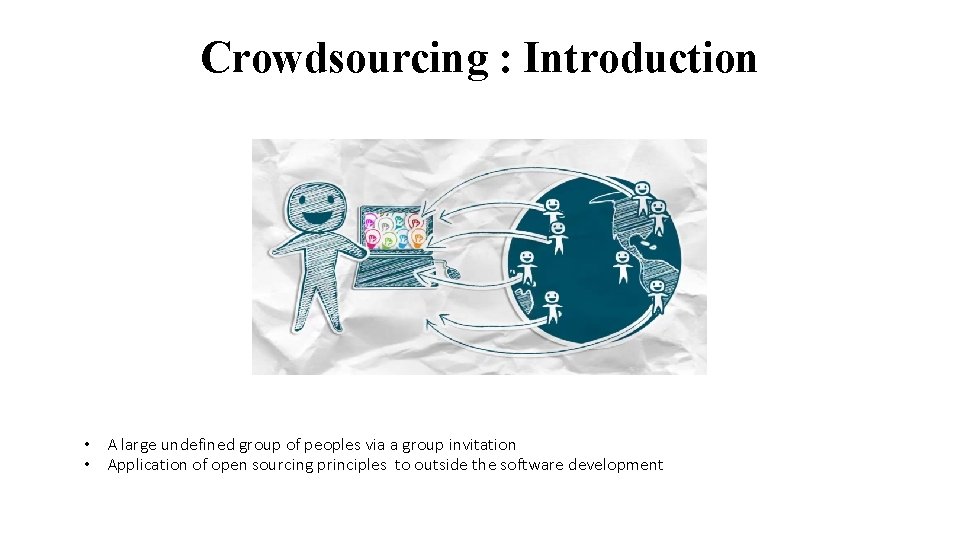
Crowdsourcing : Introduction • A large undefined group of peoples via a group invitation • Application of open sourcing principles to outside the software development
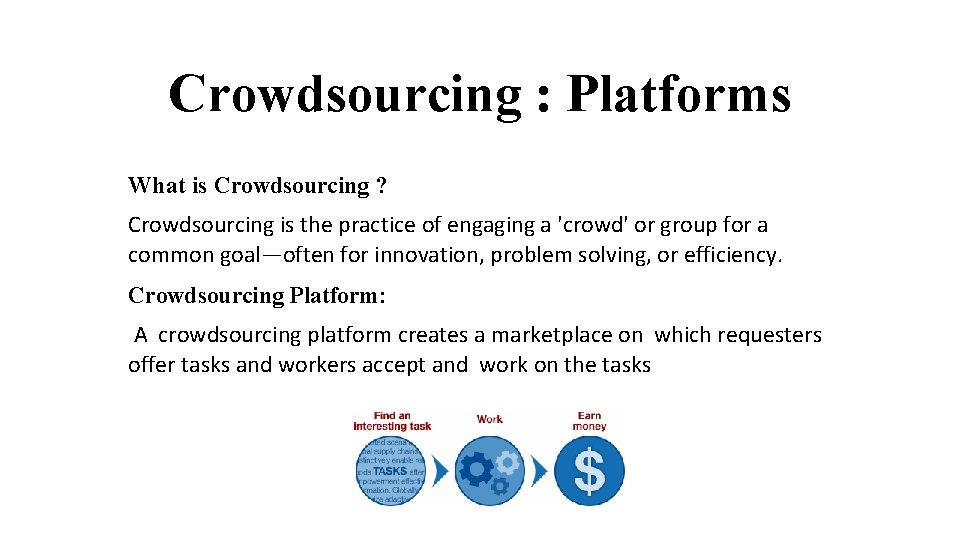
Crowdsourcing : Platforms What is Crowdsourcing ? Crowdsourcing is the practice of engaging a 'crowd' or group for a common goal—often for innovation, problem solving, or efficiency. Crowdsourcing Platform: A crowdsourcing platform creates a marketplace on which requesters offer tasks and workers accept and work on the tasks

Crowdsourcing : Platforms
Crowdsourcing : Platforms Some popular platforms are Ø Freelancer Ø Design. Crowd Ø One. Space Ø Innocentive Ø Amazon Mechanical Turk One of the largest among these is Amazon Mechanical Turk (AMT) Platform had 500, 000 workers in 2011 and continuously growing.
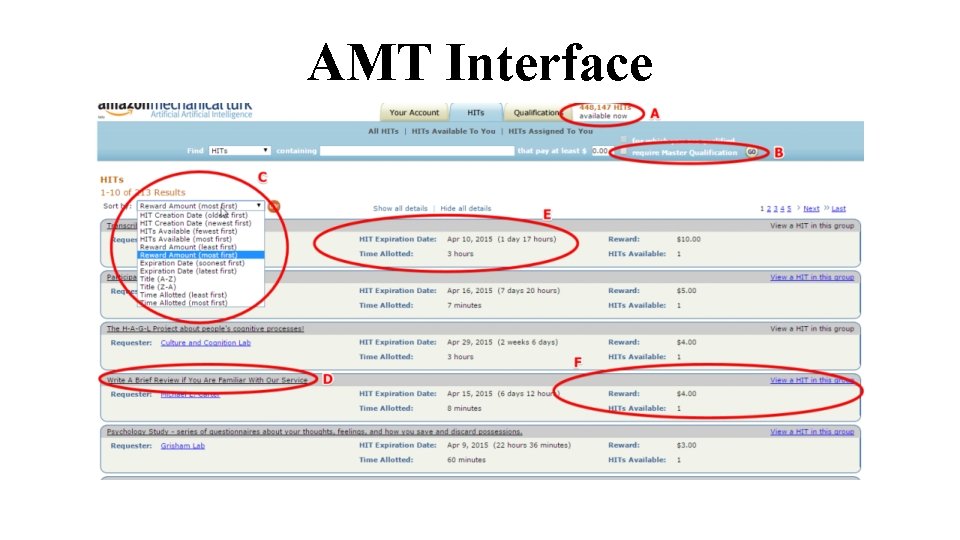
AMT Interface
AMT Terminologies • HIT : A Human Intelligent Task, or HIT, is the smallest entity of work a worker can accept to do. HITs contain one or more jobs. Hits are like micro tasks , which typically takes less than a minute Eg : In the novel , one page may act as a HIT. • Assignment : Every HIT can be replicated into multiple assignments enables majority voting, • HIT Group : Group of similar HITs. Grouped for assignments. Odd number of convenience of 'turkers‘ Eg : We can pages of the same novel may form a hit group.
AMT-Workflow • Package the jobs comprising of information into HITs, determines the number of assignments required for each HIT and posts the HITs • Optionally specify requirements that workers must meet in order to be able to accept the HIT • AMT Groups compatible HITs into HIT Groups and posts them so that they are searchable by workers • A worker accepts and processes assignments • Requesters then collect all the completed assignments for their HITs and apply whatever quality control methods they deem necessary and provide payment that enable hundreds of thousands of people to perform paid work
Design Considerations • Performance and variability • Ambiguity • Affinity • Relatively small worker pool • Open and Close world assumption
Motivation : Crowd. DB • Hybrid Human-Machine DBMS • Hard Database Problems 1. Missing Data: Generally because of left out or wrongly entered. Key limitation of relational technology stems from the Closed World Assumption. People, aided by tools such as search engines and reference sources, are quite capable of finding information that they do not have readily at hand. 2. Fuzzy Comparisons : People are skilled at making comparisons that are difficult or impossible to encode in a computer algorithm like “I. B. M” and “Big Blue” are refers to same entities 3. Need data that is cleaned , validated and free from inconsistencies Harness Human Computation for solving problems that are impossible or too to answer correctly using computers. expensive SELECT image FROM picture WHERE topic = "Business Success“ ORDER BY relevance LIMIT 1;
Overview of Crowd. DB In addition to functionality of traditional databases , Crowd. DB consists • Turker Relationship Management: Facilitates the important duties of a requester, such as approving/rejecting assignments, paying and granting bonuses, etc. • User Interface Management: HITs require user interfaces and human-readable instructions. At runtime, Generates user interfaces for HITs based on these annotations , standard type definitions and constraints appear in the schema. • HIT Manager: Manages the interactions between Crowd. DB and the crowdsourcing platform Note : Crowd. DB provides physical data independence
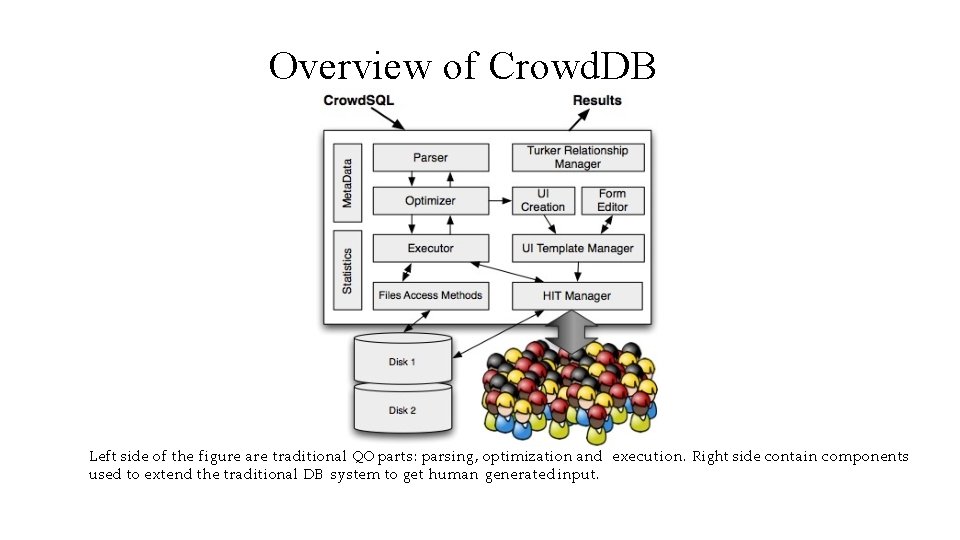
Overview of Crowd. DB Left side of the figure are traditional QO parts: parsing, optimization and execution. Right side contain components used to extend the traditional DB system to get human generated input.
Crowd. SQL is a SQL extension that supports crowdsourcing. Supports two main use cases: • allow crowdsourcing missing data • support subjective comparisons
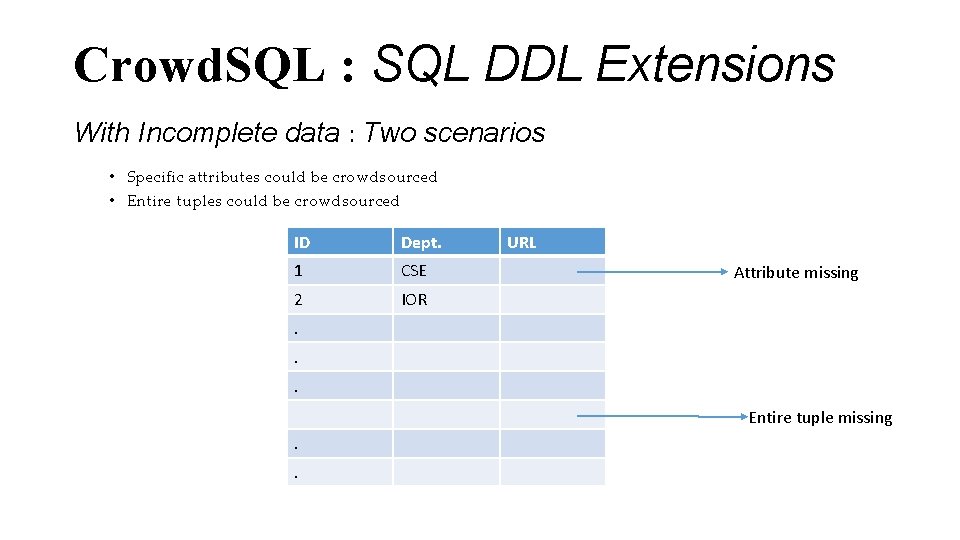
Crowd. SQL : SQL DDL Extensions With Incomplete data : Two scenarios • Specific attributes could be crowdsourced • Entire tuples could be crowdsourced ID Dept. 1 CSE 2 IOR URL Attribute missing . . . Entire tuple missing. .
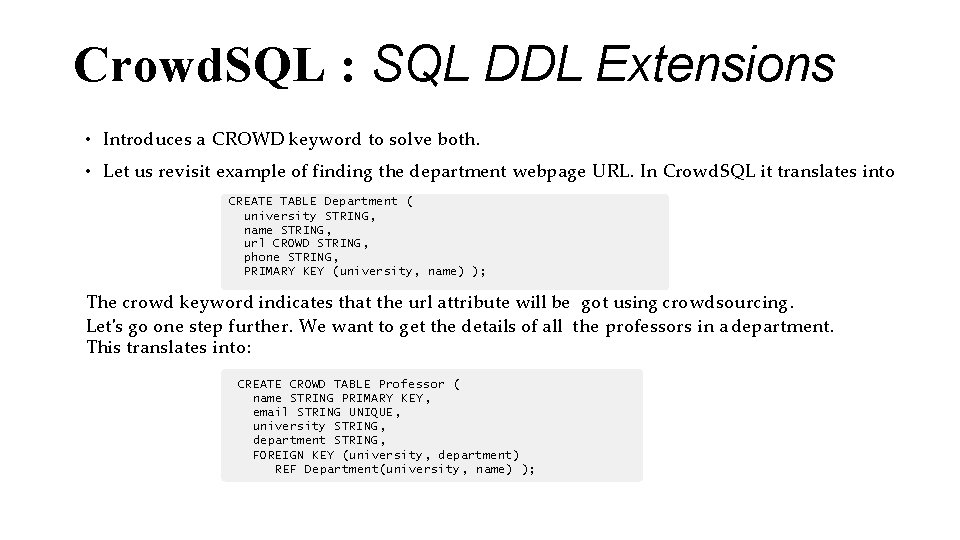
Crowd. SQL : SQL DDL Extensions • Introduces a CROWD keyword to solve both. • Let us revisit example of finding the department webpage URL. In Crowd. SQL it translates into CREATE TABLE Department ( university STRING, name STRING, url CROWD STRING, phone STRING, PRIMARY KEY (university, name) ); The crowd keyword indicates that the url attribute will be got using crowdsourcing. Let's go one step further. We want to get the details of all the professors in a department. This translates into: CREATE CROWD TABLE Professor ( name STRING PRIMARY KEY, email STRING UNIQUE, university STRING, department STRING, FOREIGN KEY (university, department) REF Department(university, name) );
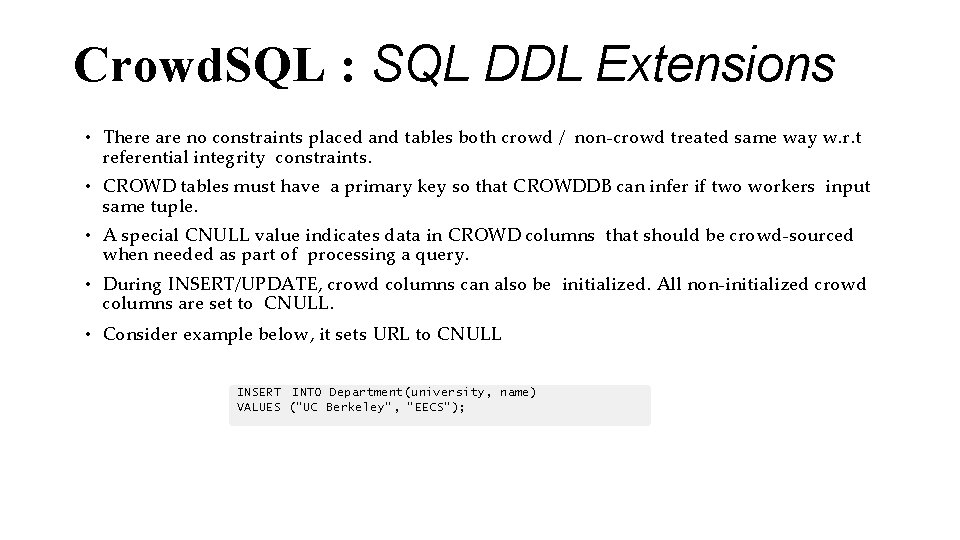
Crowd. SQL : SQL DDL Extensions • There are no constraints placed and tables both crowd / non-crowd treated same way w. r. t referential integrity constraints. • CROWD tables must have a primary key so that CROWDDB can infer if two workers input same tuple. • A special CNULL value indicates data in CROWD columns that should be crowd-sourced when needed as part of processing a query. • During INSERT/UPDATE, crowd columns can also be initialized. All non-initialized crowd columns are set to CNULL. • Consider example below, it sets URL to CNULL INSERT INTO Department(university, name) VALUES ("UC Berkeley", "EECS");
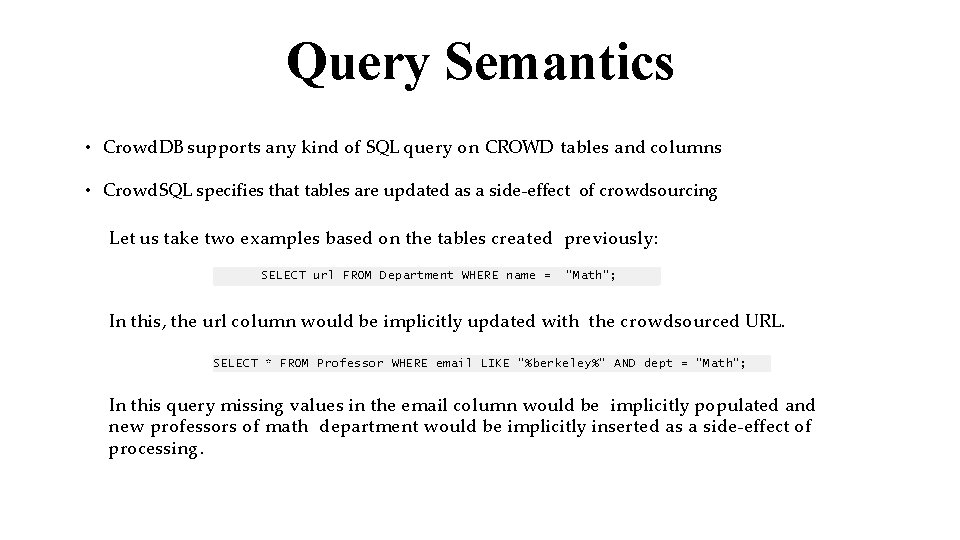
Query Semantics • Crowd. DB supports any kind of SQL query on CROWD tables and columns • Crowd. SQL specifies that tables are updated as a side-effect of crowdsourcing Let us take two examples based on the tables created previously: SELECT url FROM Department WHERE name = "Math"; In this, the url column would be implicitly updated with the crowdsourced URL. SELECT * FROM Professor WHERE email LIKE "%berkeley%" AND dept = "Math"; In this query missing values in the email column would be implicitly populated and new professors of math department would be implicitly inserted as a side-effect of processing.
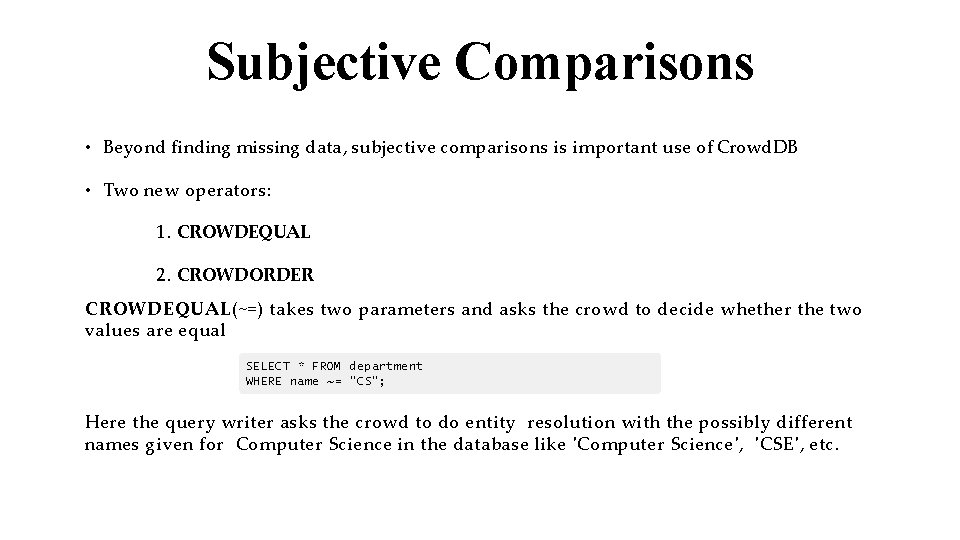
Subjective Comparisons • Beyond finding missing data, subjective comparisons is important use of Crowd. DB • Two new operators: 1. CROWDEQUAL 2. CROWDORDER CROWDEQUAL(~=) takes two parameters and asks the crowd to decide whether the two values are equal SELECT * FROM department WHERE name ~= "CS"; Here the query writer asks the crowd to do entity resolution with the possibly different names given for Computer Science in the database like 'Computer Science', 'CSE', etc.
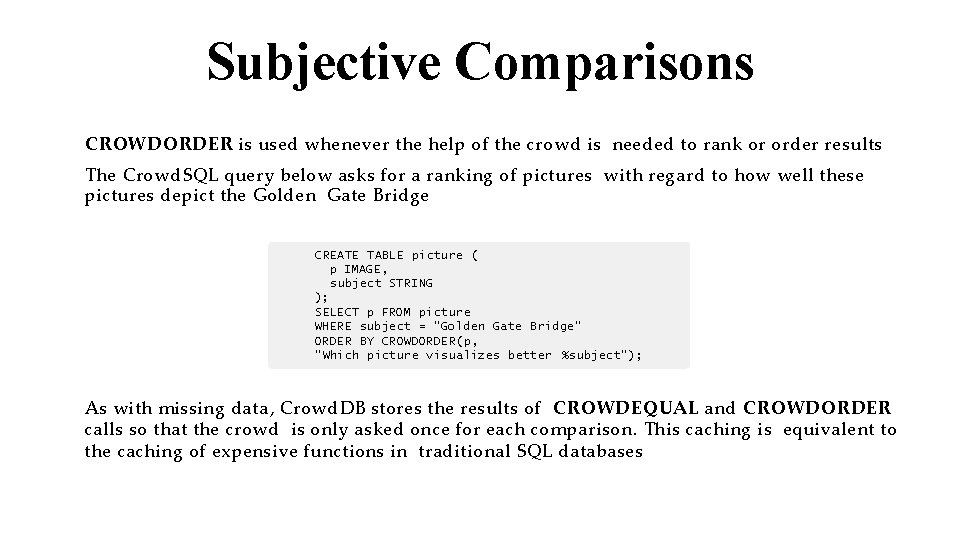
Subjective Comparisons CROWDORDER is used whenever the help of the crowd is needed to rank or order results The Crowd. SQL query below asks for a ranking of pictures with regard to how well these pictures depict the Golden Gate Bridge CREATE TABLE picture ( p IMAGE, subject STRING ); SELECT p FROM picture WHERE subject = "Golden Gate Bridge" ORDER BY CROWDORDER(p, "Which picture visualizes better %subject"); As with missing data, Crowd. DB stores the results of CROWDEQUAL and CROWDORDER calls so that the crowd is only asked once for each comparison. This caching is equivalent to the caching of expensive functions in traditional SQL databases
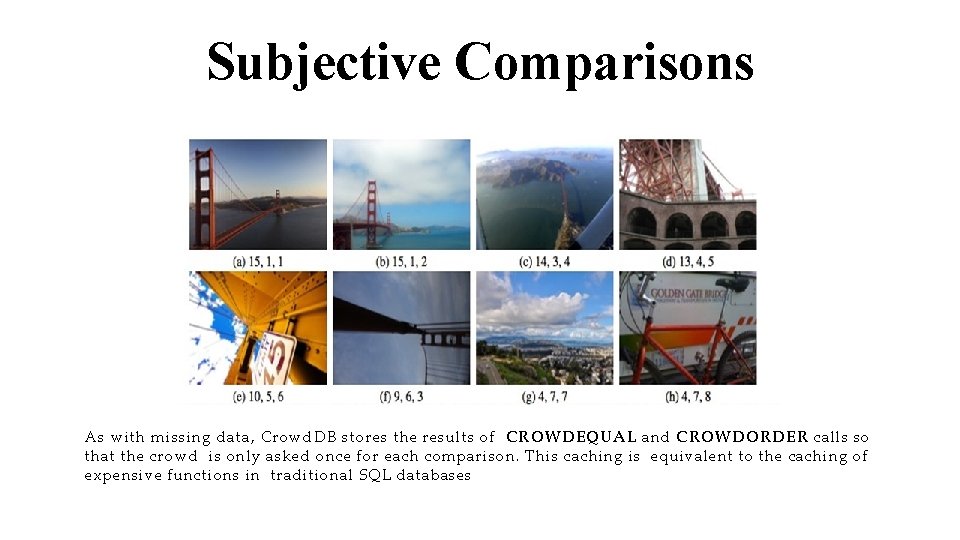
Subjective Comparisons As with missing data, Crowd. DB stores the results of CROWDEQUAL and CROWDORDER calls so that the crowd is only asked once for each comparison. This caching is equivalent to the caching of expensive functions in traditional SQL databases
UI Generation • UI is important, because clear, unambiguous user interface helps greatly in improving accuracy. • Two step process: 1. Compile-time: Crowd. DB creates templates to crowd-source missing information from all CROWD tables and all regular tables which have CROWD columns. JS is generated in addition to HTML to do type checking 2. Runtime: These templates are instantiated at runtime in order to provide a user interface for a concrete tuple or a set of tuples.
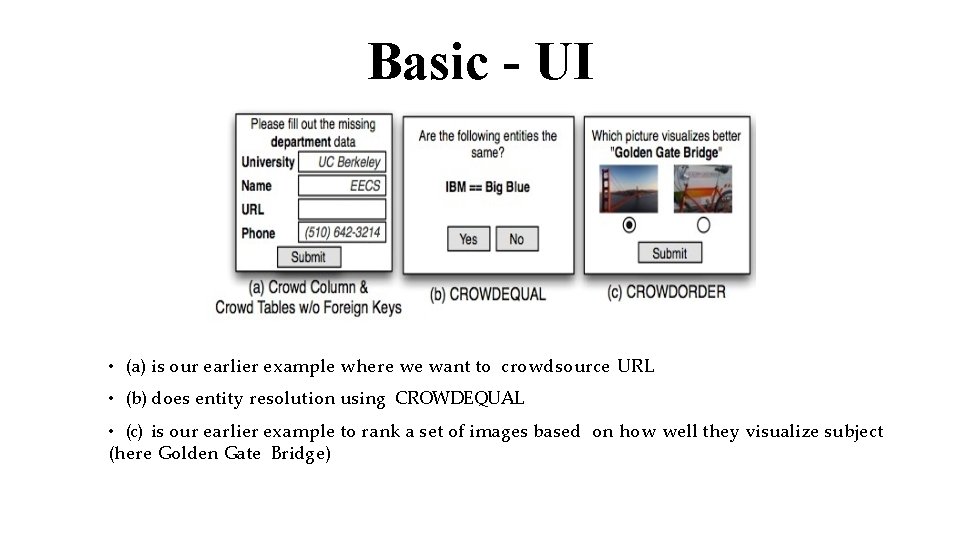
Basic - UI • (a) is our earlier example where we want to crowdsource URL • (b) does entity resolution using CROWDEQUAL • (c) is our earlier example to rank a set of images based on how well they visualize subject (here Golden Gate Bridge)
Basic - UI Optimizations: Prefetching: Crowdsourcing all the missing value of tuples at a time , eg: both the department and email of a professor are unknown, but only the email of that professor is required to process a query, it might make sense to get the department Batching: Get information of several tuples at once (eg: URL of Elec, CS, EP of UC-Berkeley). Assumption: cheaper to input two pieces of information of the same kind in a single form rather than separate forms Note: Trade off is there in case of prefetching. It may take time and hurt the performance but optimizes the requests
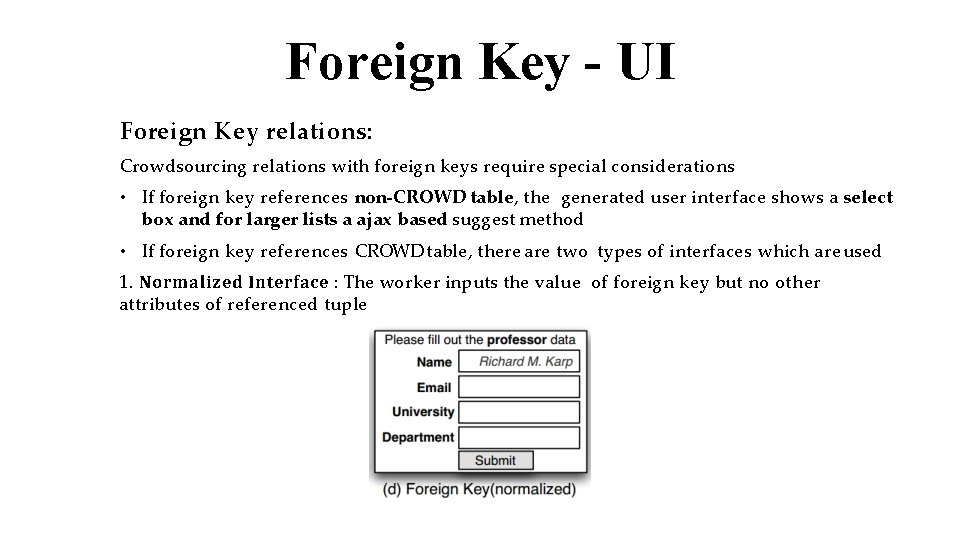
Foreign Key - UI Foreign Key relations: Crowdsourcing relations with foreign keys require special considerations • If foreign key references non-CROWD table, the generated user interface shows a select box and for larger lists a ajax based suggest method • If foreign key references CROWD table, there are two types of interfaces which are used 1. Normalized Interface : The worker inputs the value of foreign key but no other attributes of referenced tuple
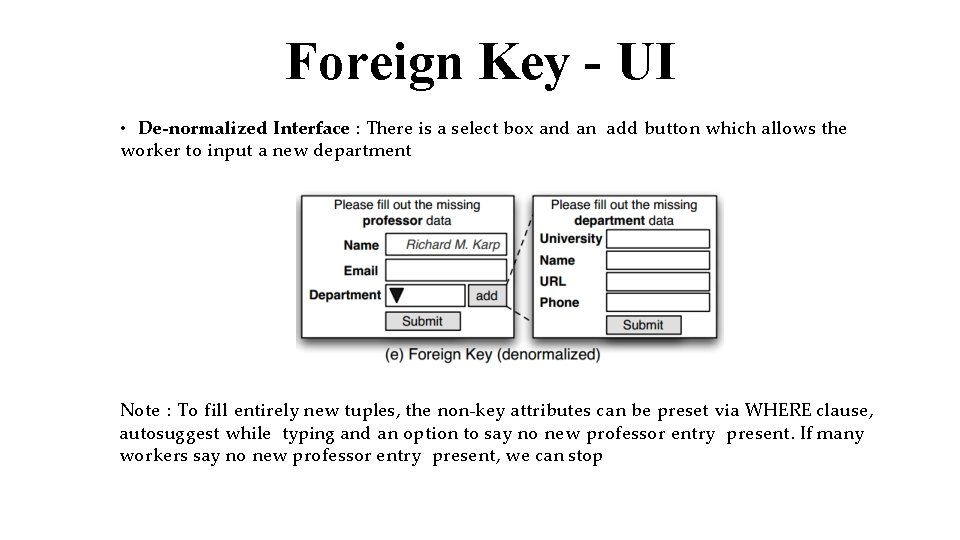
Foreign Key - UI • De-normalized Interface : There is a select box and an add button which allows the worker to input a new department Note : To fill entirely new tuples, the non-key attributes can be preset via WHERE clause, autosuggest while typing and an option to say no new professor entry present. If many workers say no new professor entry present, we can stop
Query Processing The traditional database model extended: • SQL extended to Crowd. SQL • Crowd Operators for crowdsourcing • Optimizer that handles crowd operators. • CPU time taken << time taken by crowd to answer i. e. goal of optimizer is to find plan which results in least number of queries to Crowd.
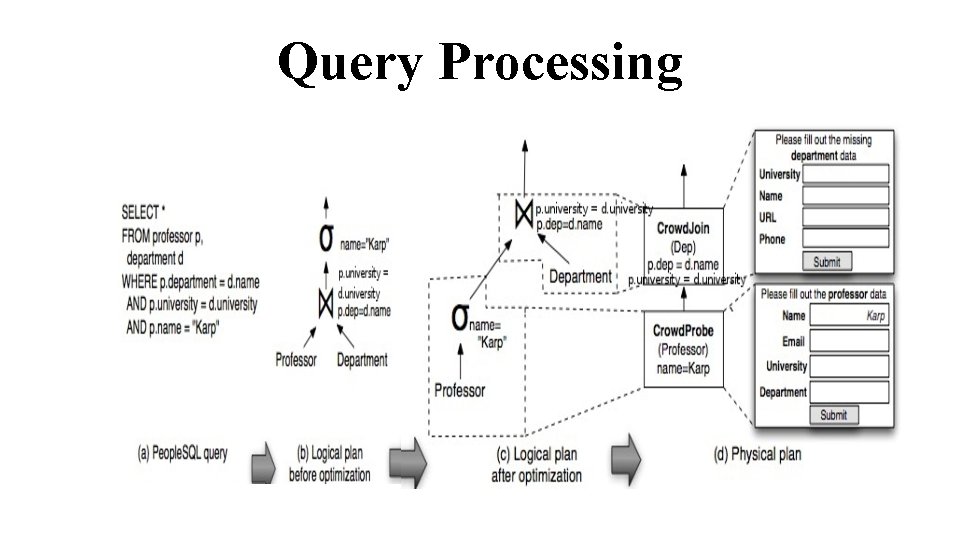
Query Processing
Query Processing CROWDPROBE: • Crowdsources missing information of CROWD columns (i. e. , CNULL values) and new tuples • Quality control carried by majority vote. If not majority achieved at max hits, choose randomly from most frequent ones • In the case of new tuples, finding majority impossible. The DB reposts the tasks with only primary key filled in.
Query Processing CROWD JOIN : • Implements a nested-loop join where at least one of the tables is a CROWD table • For every tuple of outer relation, creates HIT's to find the inner tuples CROWD COMPARE: • Implements the CROWDEQUAL and CROWDCOMPARE functions • Typically used inside a traditional operator like sorting
Query Processing The basic functionality of all Crowd operators is the same. • Initialized with a user interface template and the standard HIT parameters • At runtime, they consume a set of tuples • Depending on the Crowd operator, crowdsourcing can be used to source missing values of a tuple or to source new tuples. • Batch HITs. Create HIT Groups. • Consume tuples from crowd and do quality control Quality control is currently carried out by a majority vote. The number of workers assigned to each HIT is controlled by an Assignments parameter.
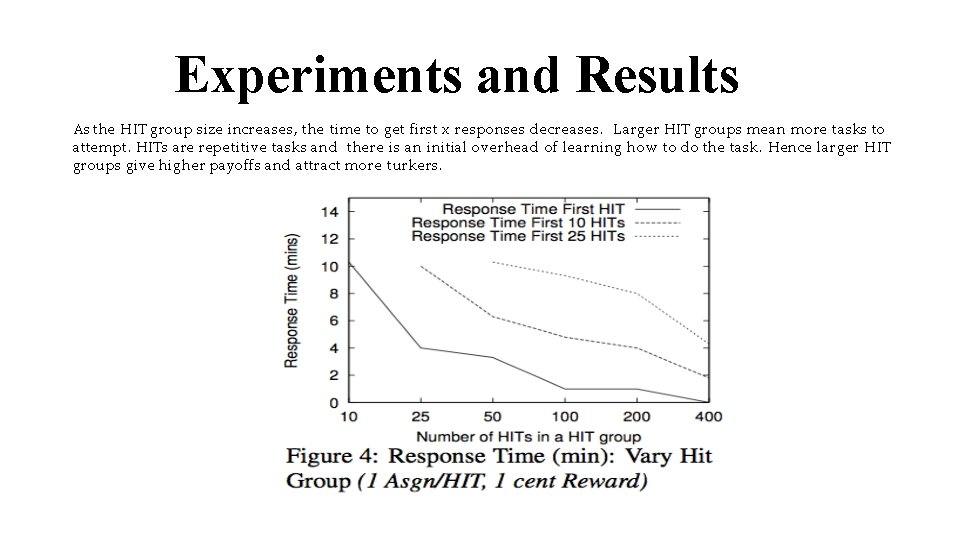
Experiments and Results As the HIT group size increases, the time to get first x responses decreases. Larger HIT groups mean more tasks to attempt. HITs are repetitive tasks and there is an initial overhead of learning how to do the task. Hence larger HIT groups give higher payoffs and attract more turkers.
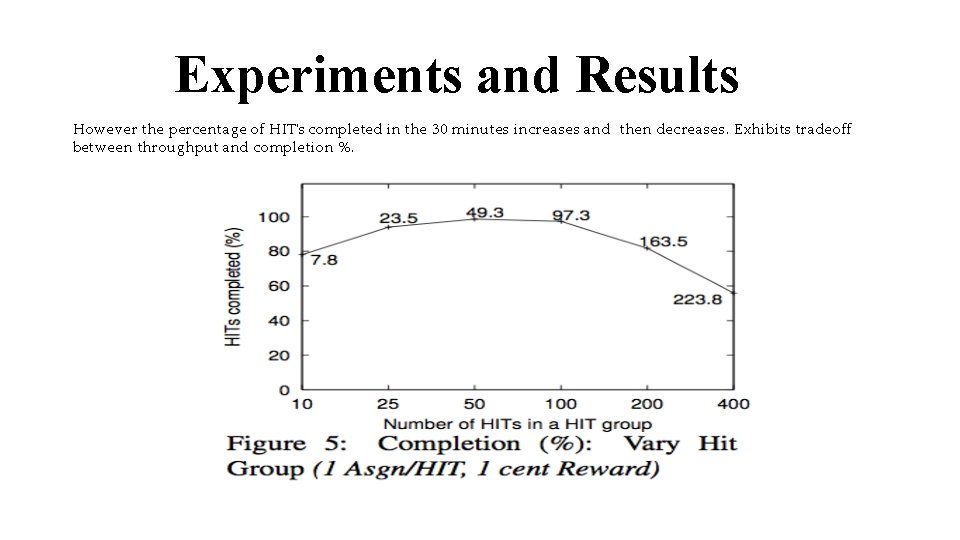
Experiments and Results However the percentage of HIT's completed in the 30 minutes increases and then decreases. Exhibits tradeoff between throughput and completion %.
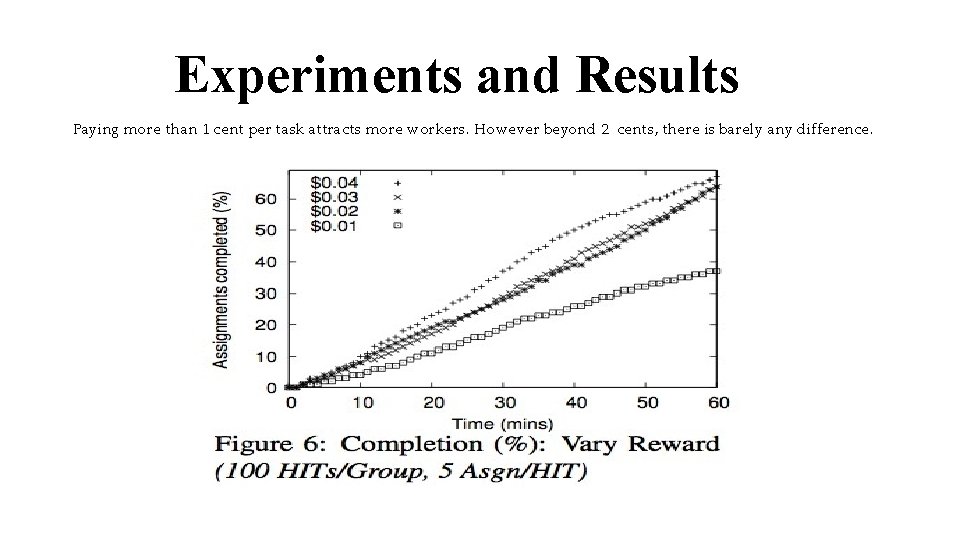
Experiments and Results Paying more than 1 cent per task attracts more workers. However beyond 2 cents, there is barely any difference.
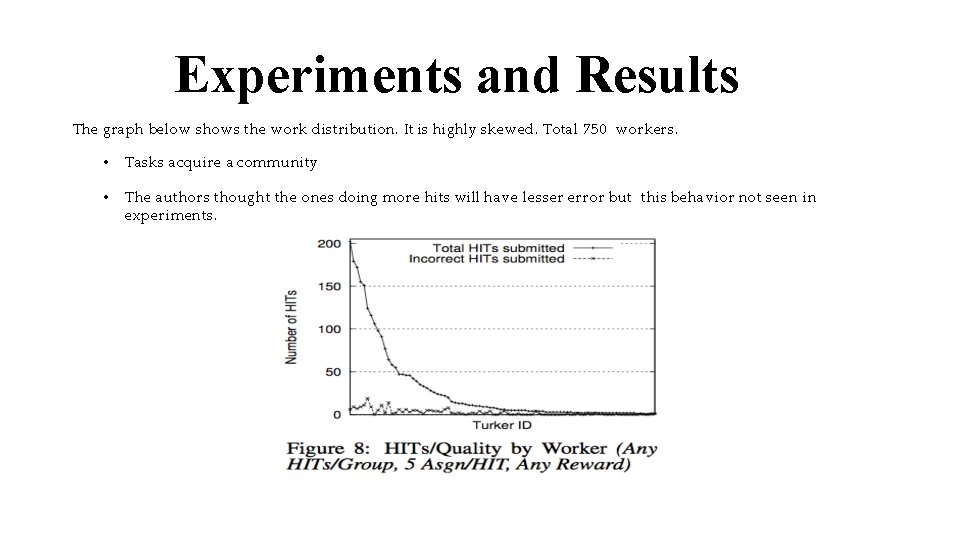
Experiments and Results The graph below shows the work distribution. It is highly skewed. Total 750 workers. • Tasks acquire a community • The authors thought the ones doing more hits will have lesser error but this behavior not seen in experiments.
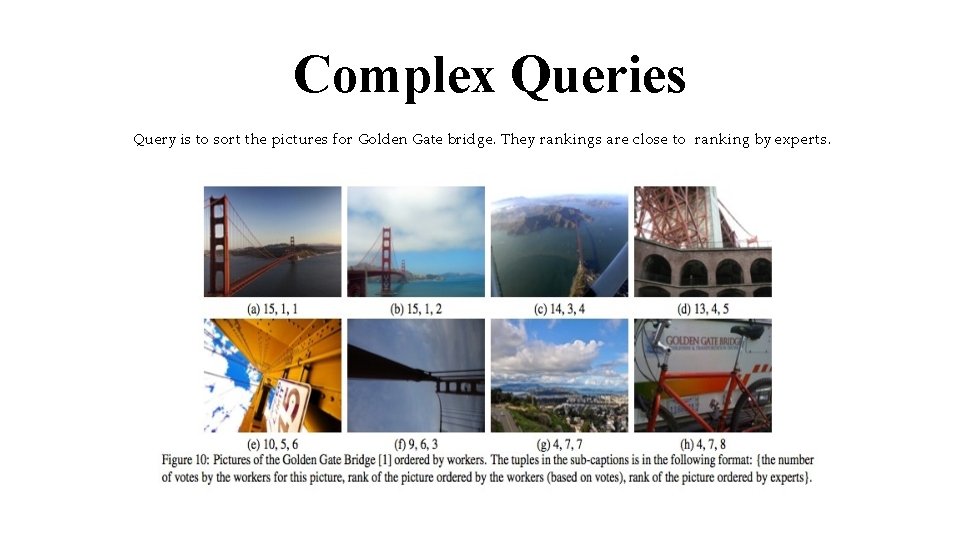
Complex Queries Query is to sort the pictures for Golden Gate bridge. They rankings are close to ranking by experts.

Thank You
- Slides: 38