
Crossinstrument Validity Reproducibility and Feasibility of Ambulatory Heart
Cross-instrument Validity, Reproducibility, and Feasibility of Ambulatory Heart Rate (Variability) Monitors Yoram K. Kunkels, MSc 1*, Arie M. van Roon, Ph. D 2, Marieke Wichers, Ph. D 1, Harriëtte Riese, Ph. D 1, 1 Interdisciplinary Center Psychopathology and Emotion regulation (ICPE), Department of Psychiatry, University of Groningen, University Medical Center Groningen, The Netherlands. 2 Department of Vascular Medicine, University of Groningen, University Medical Center Groningen, The Netherlands. *Presenting author
Overview Short Introduction of Ambulatory HR Monitoring Assessed Devices Study Design Preliminairy Results Conclusions

Short Introduction of Ambulatory HR Monitoring Ambulatory Heart Rate Monitoring is very popular
Short Introduction of Ambulatory HR Monitoring But is this popularity actually warranted?
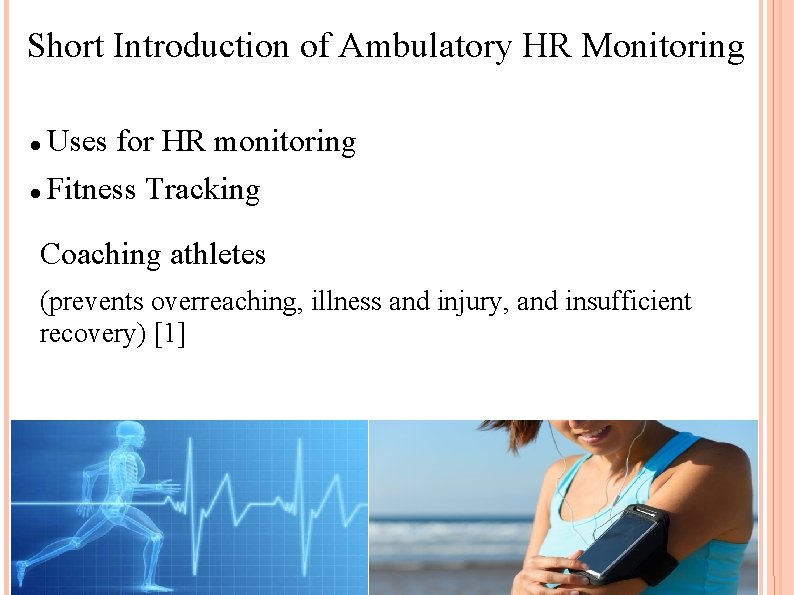
Short Introduction of Ambulatory HR Monitoring Uses for HR monitoring Fitness Tracking Coaching athletes (prevents overreaching, illness and injury, and insufficient recovery) [1]
Short Introduction of Ambulatory HR Monitoring Other uses for HR monitoring Clinical Continuous measurement of patients outside of the clinical environment [2]. Cardiovascular patients wanting to stay within the HR range recommended by their GP
Short Introduction of Ambulatory HR Monitoring Other uses for HR monitoring Research Investigating job strain as a predictor of cardiovascular disease in female nurses [5].
Short Introduction of Ambulatory HR Monitoring Advantages of Ambulatory HR Monitoring in Research Unobtrusive [1] User friendly [1, 2] Quick (<= 5 min. ) [2, 3] Relatively inexpensive [2]
Short Introduction of Ambulatory HR Monitoring Generally positive developments However. . .
Short Introduction of Ambulatory HR Monitoring Are these Ambulatory HR Monitors even: Valid? Reproducible? Feasible?
Short Introduction of Ambulatory HR Monitoring Earlier Validation studies were done, but. . . HR monitors were sometimes operated by Medical Experts They assess only one (supine) posture Very long acclimatisation periods were used (15 min)
Short Introduction of Ambulatory HR Monitoring What we need is validation studies that: are independent assess accuracy in multiple postures tests participants in both lab- and daily life settings uses naïve participants
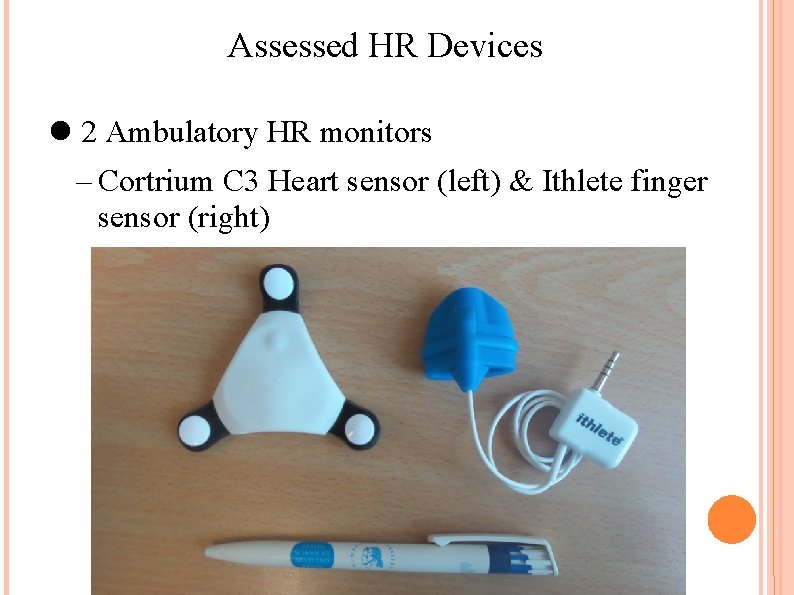
Assessed HR Devices 2 Ambulatory HR monitors – Cortrium C 3 Heart sensor (left) & Ithlete finger sensor (right)
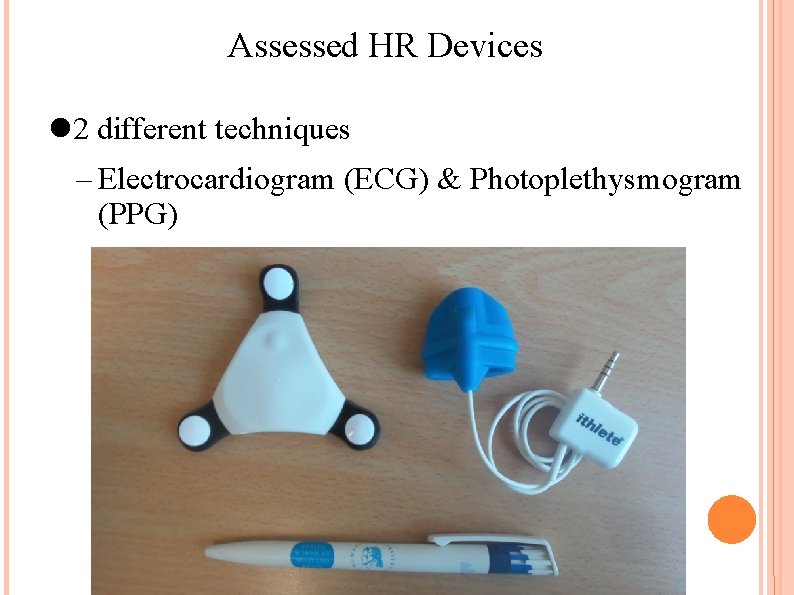
Assessed HR Devices 2 different techniques – Electrocardiogram (ECG) & Photoplethysmogram (PPG)
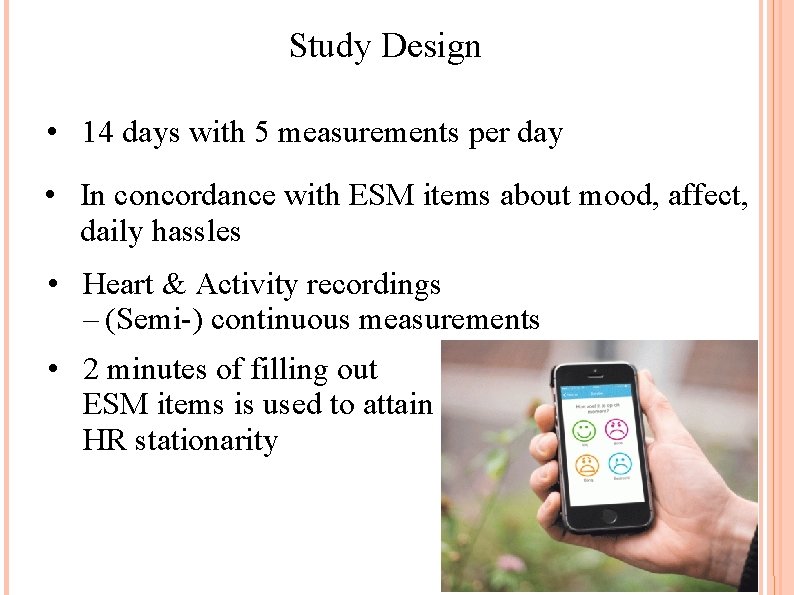
Study Design • 14 days with 5 measurements per day • In concordance with ESM items about mood, affect, daily hassles • Heart & Activity recordings – (Semi-) continuous measurements • 2 minutes of filling out ESM items is used to attain HR stationarity
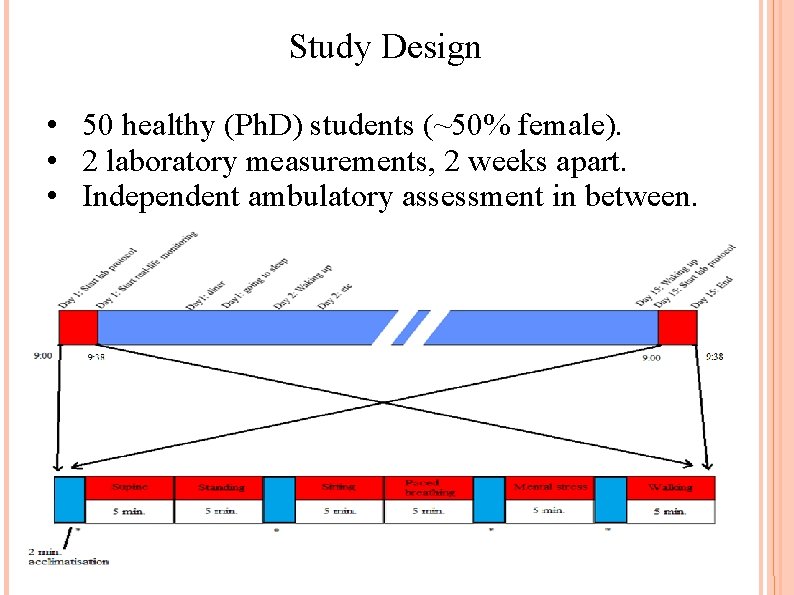
Study Design • 50 healthy (Ph. D) students (~50% female). • 2 laboratory measurements, 2 weeks apart. • Independent ambulatory assessment in between.
Preliminairy Results Descriptives • N = 16 • 75% Female • Mean age: 25. 44 y. o. (range: 19 -35 y. o. ) • Good compliance (> 80%)
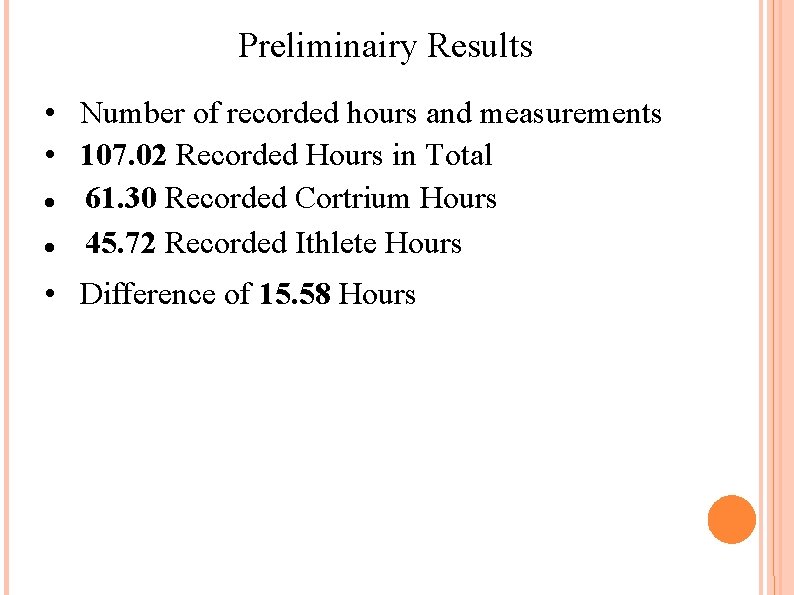
Preliminairy Results • Number of recorded hours and measurements • 107. 02 Recorded Hours in Total 61. 30 Recorded Cortrium Hours 45. 72 Recorded Ithlete Hours • Difference of 15. 58 Hours
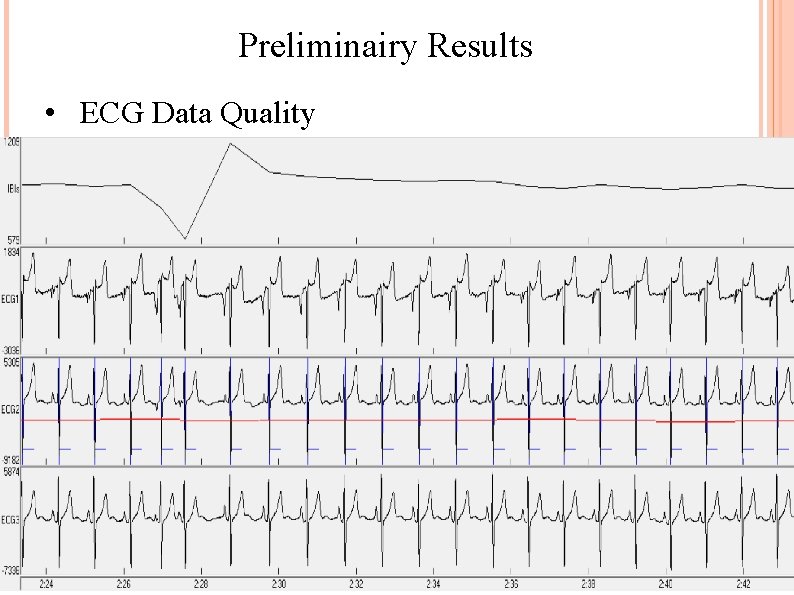
Preliminairy Results • ECG Data Quality
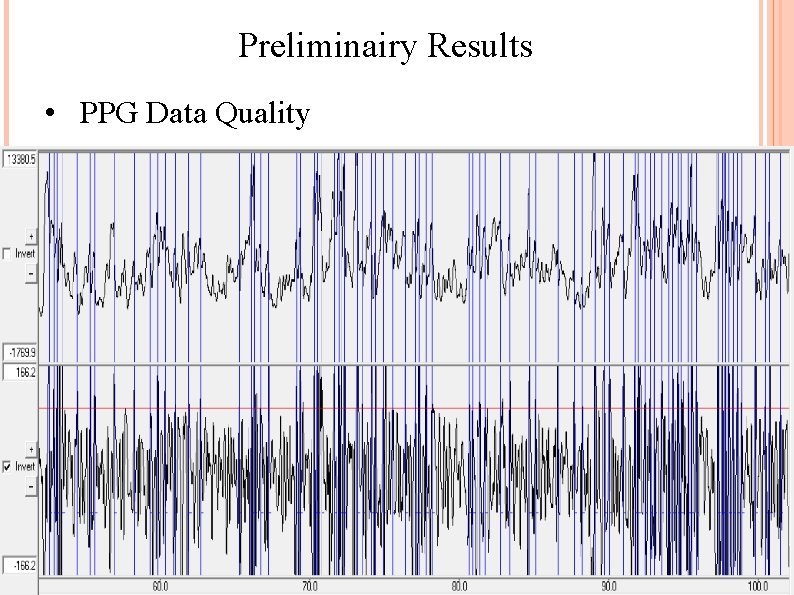
Preliminairy Results • PPG Data Quality
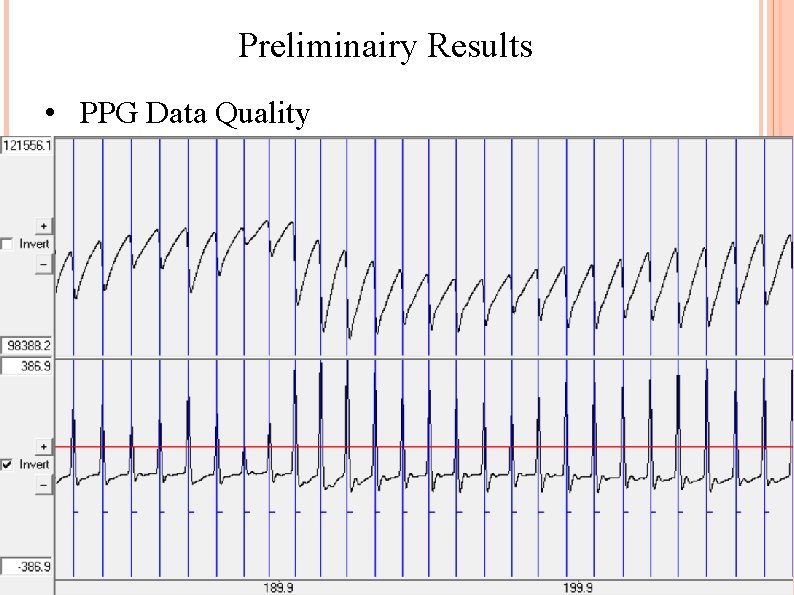
Preliminairy Results • PPG Data Quality
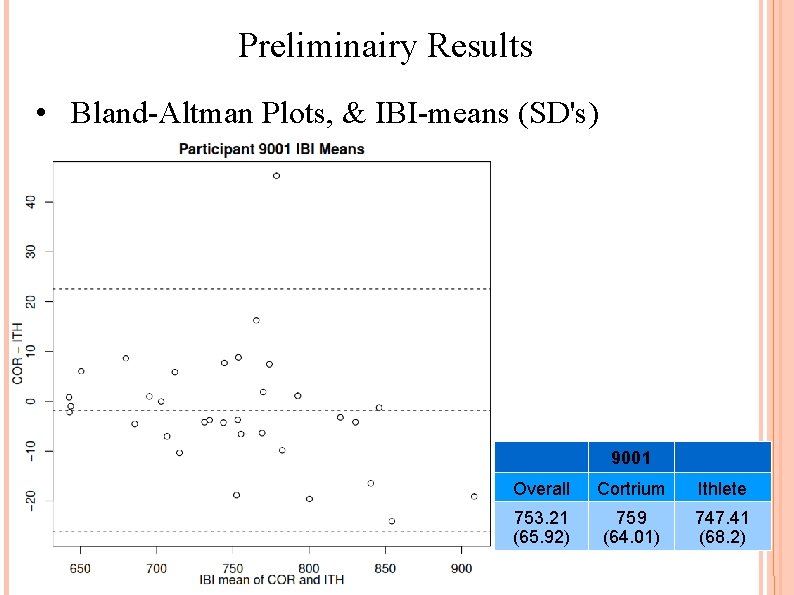
Preliminairy Results • Bland-Altman Plots, & IBI-means (SD's) 9001 Overall Cortrium Ithlete 753. 21 (65. 92) 759 (64. 01) 747. 41 (68. 2)
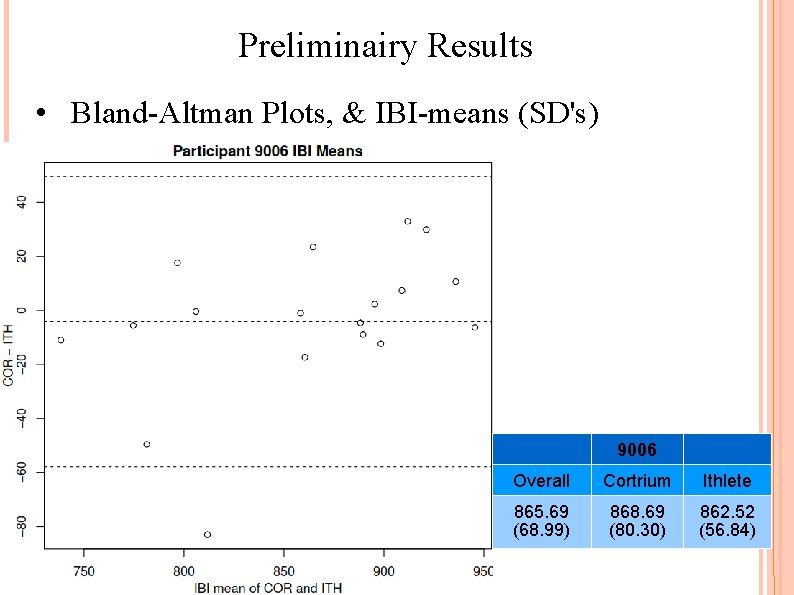
Preliminairy Results • Bland-Altman Plots, & IBI-means (SD's) 9006 Overall Cortrium Ithlete 865. 69 (68. 99) 868. 69 (80. 30) 862. 52 (56. 84)
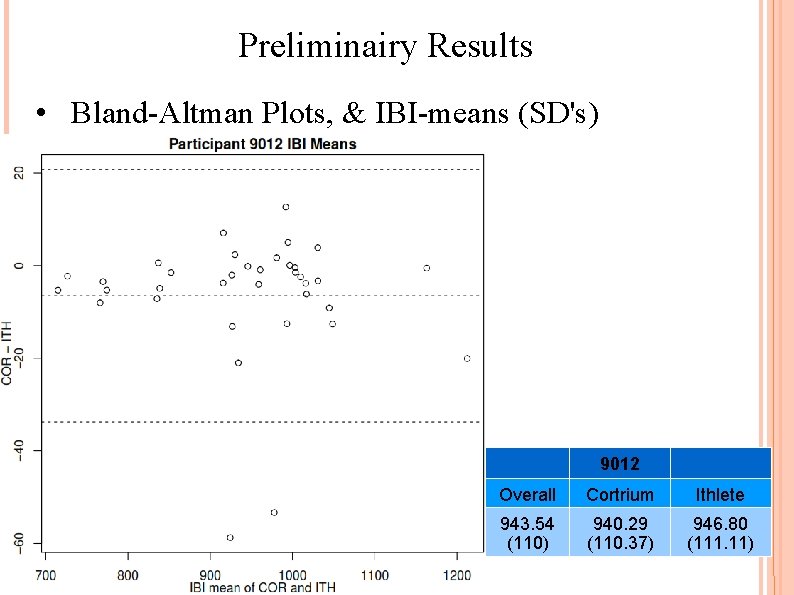
Preliminairy Results • Bland-Altman Plots, & IBI-means (SD's) 9012 Overall Cortrium Ithlete 943. 54 (110) 940. 29 (110. 37) 946. 80 (111. 11)
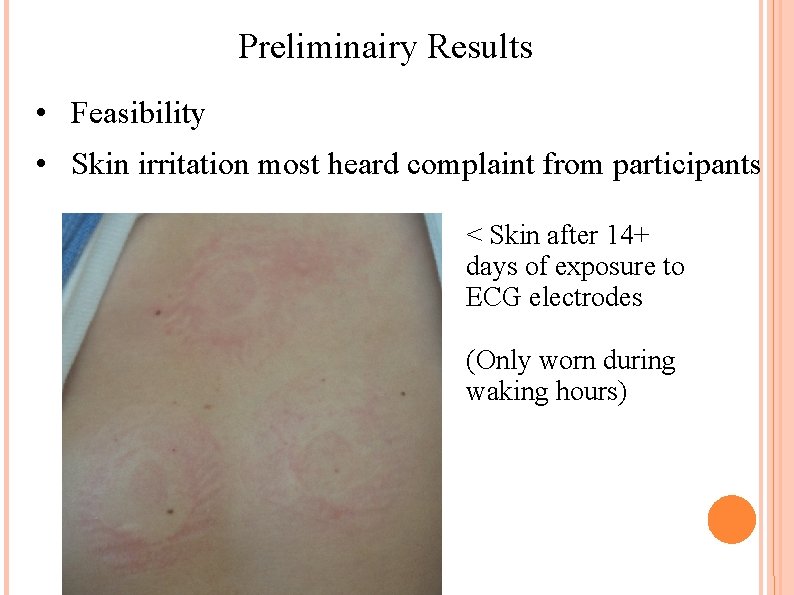
Preliminairy Results • Feasibility • Skin irritation most heard complaint from participants < Skin after 14+ days of exposure to ECG electrodes (Only worn during waking hours)
Preliminairy Results • Feasibility • Costs between devices vary wildly • Ithlete: very budget friendly • Cortrium: less budget friendly additional costs of ECG electrodes
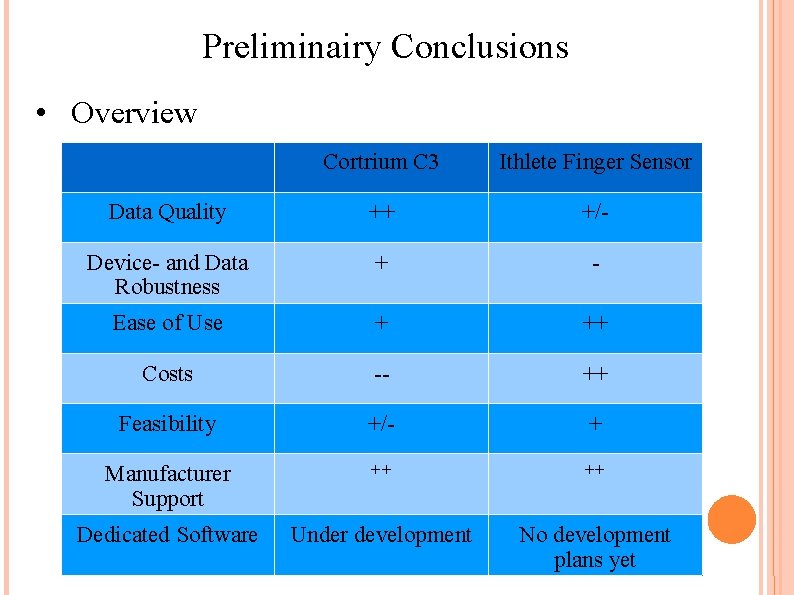
Preliminairy Conclusions • Overview Cortrium C 3 Ithlete Finger Sensor Data Quality ++ +/- Device- and Data Robustness + - Ease of Use + ++ Costs -- ++ Feasibility +/- + Manufacturer Support ++ ++ Dedicated Software Under development No development plans yet
Future Questions we hope to Answer Whether the 2 HR Monitors are equivalent to standard Holter ECG? – If so, in which postures? For which outcome variables and domains (time, frequency)? Are long-term ambulatory measurements feasible? • Can they be performed by non-experts? Good compliance? Can we shorten the required time?

Questions? y. k. kunkels@umcg. nl
![References [1] Quer, G. , Daftari, J. , & Rao, R. (2016). Heart rate](http://slidetodoc.com/presentation_image_h2/4f1443f6a93809d36a9b757115a68f76/image-30.jpg "References [1] Quer, G. , Daftari, J. , & Rao, R. (2016). Heart rate")
References [1] Quer, G. , Daftari, J. , & Rao, R. (2016). Heart rate wavelet coherence analysis to investigate group entrainment. Pervasive And Mobile Computing, 28, 21 -34. http: //dx. doi. org/10. 1016/j. pmcj. 2015. 09. 008 [2] Flatt, A. & Esco, M. (2013). Validity of the ithlete. TM Smart Phone Application for Determining Ultra-Short-Term Heart Rate Variability. Journal Of Human Kinetics, 39(1). http: //dx. doi. org/10. 2478/hukin-2013 -0071 [3] Munoz, M. , van Roon, A. , Riese, H. , Thio, C. , Oostenbroek, E. , & Westrik, I. et al. (2015). Validity of (Ultra)Short Recordings for Heart Rate Variability Measurements. PLOS ONE, 10(9), e 0138921. http: //dx. doi. org/10. 1371/journal. pone. 0138921 [4] Dilmaghani, R. , Bobarshad, H. , Ghavami, M. , Choobkar, S. , & Wolfe, C. (2011). Wireless Sensor Networks for Monitoring Physiological Signals of Multiple Patients. IEEE Transactions On Biomedical Circuits And Systems, 5(4), 347 -356. http: //dx. doi. org/10. 1109/tbcas. 2011. 2114661 [5] Riese, H. , Van Doornen, L. , Houtman, I. and De Geus, E. (2004). Job strain in relation to ambulatory blood pressure, heart rate, and heart rate variability among female nurses. Scandinavian Journal of Work, Environment & Health, 30(6), pp. 477 -485.
- Slides: 30