
CrossDiscipline Team Practices in Early Intervention and Schools
- Slides: 1
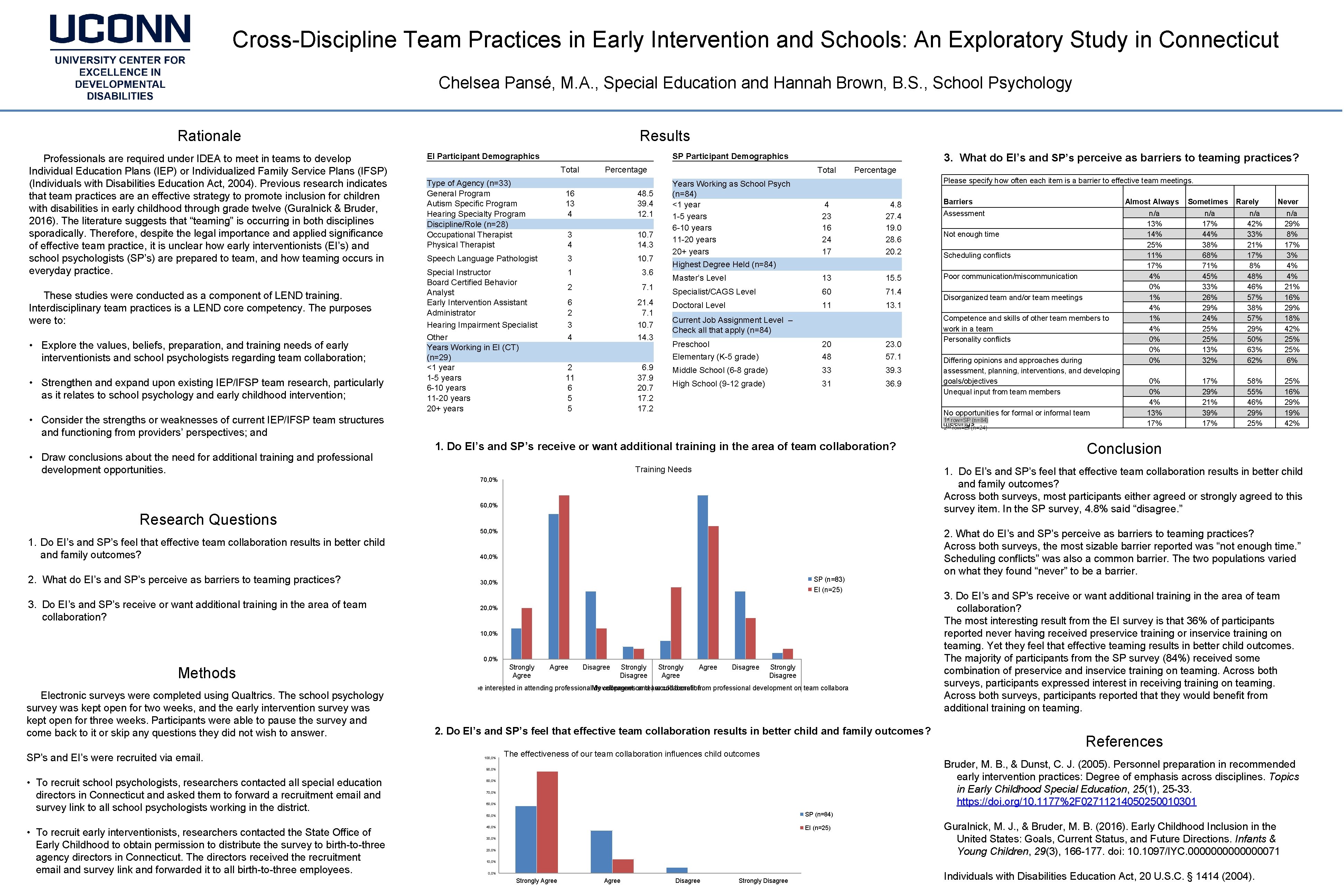
Cross-Discipline Team Practices in Early Intervention and Schools: An Exploratory Study in Connecticut Chelsea Pansé, M. A. , Special Education and Hannah Brown, B. S. , School Psychology Results Rationale Professionals are required under IDEA to meet in teams to develop Individual Education Plans (IEP) or Individualized Family Service Plans (IFSP) (Individuals with Disabilities Education Act, 2004). Previous research indicates that team practices are an effective strategy to promote inclusion for children with disabilities in early childhood through grade twelve (Guralnick & Bruder, 2016). The literature suggests that “teaming” is occurring in both disciplines sporadically. Therefore, despite the legal importance and applied significance of effective team practice, it is unclear how early interventionists (EI’s) and school psychologists (SP’s) are prepared to team, and how teaming occurs in everyday practice. These studies were conducted as a component of LEND training. Interdisciplinary team practices is a LEND core competency. The purposes were to: • Explore the values, beliefs, preparation, and training needs of early interventionists and school psychologists regarding team collaboration; • Strengthen and expand upon existing IEP/IFSP team research, particularly as it relates to school psychology and early childhood intervention; EI Participant Demographics 3. What do EI’s and SP’s perceive as barriers to teaming practices? SP Participant Demographics Total Type of Agency (n=33) General Program Autism Specific Program Hearing Specialty Program Discipline/Role (n=28) Occupational Therapist Physical Therapist Percentage 16 13 4 48. 5 39. 4 12. 1 3 4 10. 7 14. 3 Speech Language Pathologist 3 10. 7 Special Instructor Board Certified Behavior Analyst Early Intervention Assistant Administrator Hearing Impairment Specialist Other Years Working in EI (CT) (n=29) <1 year 1 -5 years 6 -10 years 11 -20 years 20+ years 1 3. 6 2 7. 1 6 2 3 4 21. 4 7. 1 10. 7 14. 3 2 11 6 5 5 6. 9 37. 9 20. 7 17. 2 Total Years Working as School Psych (n=84) <1 year 1 -5 years 6 -10 years 11 -20 years 20+ years Percentage Please specify how often each item is a barrier to effective team meetings. 4 23 16 24 17 4. 8 27. 4 19. 0 28. 6 20. 2 Barriers Master’s Level 13 15. 5 Poor communication/miscommunication Specialist/CAGS Level 60 71. 4 Doctoral Level 11 13. 1 Current Job Assignment Level – Check all that apply (n=84) Preschool Elementary (K-5 grade) 20 48 23. 0 57. 1 Middle School (6 -8 grade) 33 39. 3 High School (9 -12 grade) 31 36. 9 row=EI (n=24) n/a 13% 14% 25% 11% 17% 4% 0% 1% 4% 0% 0% 0% n/a 17% 44% 38% 68% 71% 45% 33% 26% 29% 24% 25% 13% 32% n/a 42% 33% 21% 17% 8% 46% 57% 38% 57% 29% 50% 63% 62% n/a 29% 8% 17% 3% 4% 4% 21% 16% 29% 18% 42% 25% 6% 0% 0% 4% 13% 17% 29% 21% 39% 17% 58% 55% 46% 29% 25% 16% 29% 19% 42% 1. Do EI’s and SP’s feel that effective team collaboration results in better child and family outcomes? Across both surveys, most participants either agreed or strongly agreed to this survey item. In the SP survey, 4. 8% said “disagree. ” 50, 0% 30, 0% SP (n=83) EI (n=25) 20, 0% 10, 0% Strongly Agree Methods Agree Disagree Strongly Disagree I would be interested in attending professional. My development colleagueson and team I would collaboration. benefit from professional development on team collaboration. 2. Do EI’s and SP’s feel that effective team collaboration results in better child and family outcomes? 100, 0% The effectiveness of our team collaboration influences child outcomes 80, 0% 70, 0% 60, 0% 50, 0% SP (n=84) 40, 0% EI (n=25) 30, 0% 2. What do EI’s and SP’s perceive as barriers to teaming practices? Across both surveys, the most sizable barrier reported was “not enough time. ” Scheduling conflicts” was also a common barrier. The two populations varied on what they found “never” to be a barrier. 3. Do EI’s and SP’s receive or want additional training in the area of team collaboration? The most interesting result from the EI survey is that 36% of participants reported never having received preservice training or inservice training on teaming. Yet they feel that effective teaming results in better child outcomes. The majority of participants from the SP survey (84%) received some combination of preservice and inservice training on teaming. Across both surveys, participants expressed interest in receiving training on teaming. Across both surveys, participants reported that they would benefit from additional training on teaming. References Bruder, M. B. , & Dunst, C. J. (2005). Personnel preparation in recommended early intervention practices: Degree of emphasis across disciplines. Topics in Early Childhood Special Education, 25(1), 25 -33. https: //doi. org/10. 1177%2 F 02711214050250010301 90, 0% • To recruit early interventionists, researchers contacted the State Office of Early Childhood to obtain permission to distribute the survey to birth-to-three agency directors in Connecticut. The directors received the recruitment email and survey link and forwarded it to all birth-to-three employees. Differing opinions and approaches during assessment, planning, interventions, and developing goals/objectives Unequal input from team members Never Training Needs 2. What do EI’s and SP’s perceive as barriers to teaming practices? • To recruit school psychologists, researchers contacted all special education directors in Connecticut and asked them to forward a recruitment email and survey link to all school psychologists working in the district. Competence and skills of other team members to work in a team Personality conflicts Rarely Conclusion 40, 0% SP’s and EI’s were recruited via email. Disorganized team and/or team meetings Sometimes 1. Do EI’s and SP’s receive or want additional training in the area of team collaboration? 1. Do EI’s and SP’s feel that effective team collaboration results in better child and family outcomes? Electronic surveys were completed using Qualtrics. The school psychology survey was kept open for two weeks, and the early intervention survey was kept open for three weeks. Participants were able to pause the survey and come back to it or skip any questions they did not wish to answer. Scheduling conflicts 2 60, 0% 3. Do EI’s and SP’s receive or want additional training in the area of team collaboration? Not enough time No opportunities formal or informal team 1 st row=SP (n=84) meetings nd 70, 0% Research Questions Assessment Highest Degree Held (n=84) • Consider the strengths or weaknesses of current IEP/IFSP team structures and functioning from providers’ perspectives; and • Draw conclusions about the need for additional training and professional development opportunities. Almost Always Guralnick, M. J. , & Bruder, M. B. (2016). Early Childhood Inclusion in the United States: Goals, Current Status, and Future Directions. Infants & Young Children, 29(3), 166 -177. doi: 10. 1097/IYC. 000000071 10, 0% Strongly Agree Disagree Strongly Disagree Individuals with Disabilities Education Act, 20 U. S. C. § 1414 (2004).