
CrossConnection Control Lessons learned TCEQ Water Supply Division
- Slides: 45
Cross-Connection Control: Lessons learned TCEQ Water Supply Division (WSD) Drinking Water Advisory Work Group (DWAWG) Austin, Texas | April 16, 2019 1
Outline n Importance of cross-connection control – History: 1854 to present n n n What is a Cross-Connection Control Program (CCCP)? RTCR assessment (etc. ) lessons learned Assistance available from TCEQ: – Surveys – Directed Assistance Module (DAM) 12 2
The importance of backflow protection is well understood n n Drinking water is at risk of contamination from non-potable liquid. Where a cross-connection exists: – Back-siphonage: Low pressure in system ‘sucks in’ contaminants. – Back-pressure: High pressure in connections ‘pushes in’ contaminants. 3
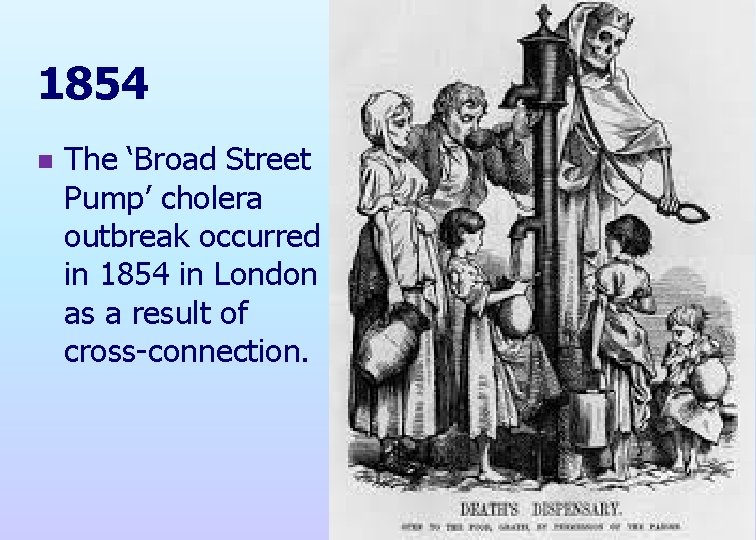
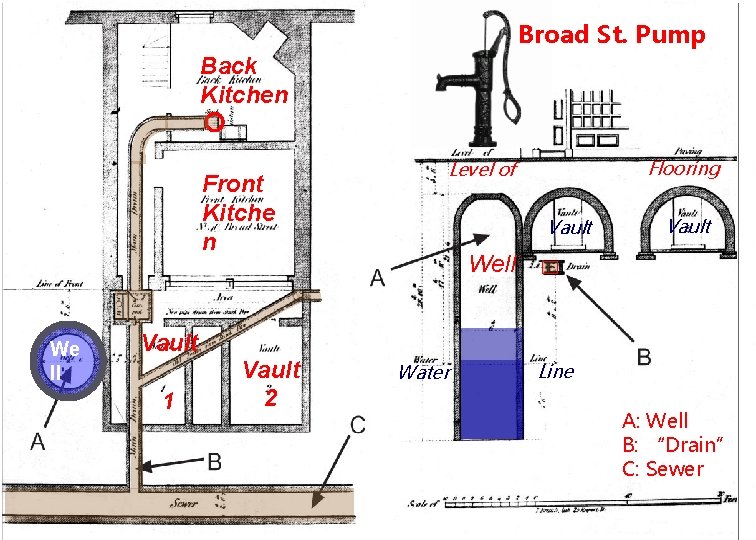
1854 n The ‘Broad Street Pump’ cholera outbreak occurred in 1854 in London as a result of cross-connection. 4
‹ # › Broad St. Pump Back Kitchen Front Kitche n We ll Vault 1 Vault 2 Flooring Level of Vault Well Water Line A: Well B: “Drain” C: Sewer 5
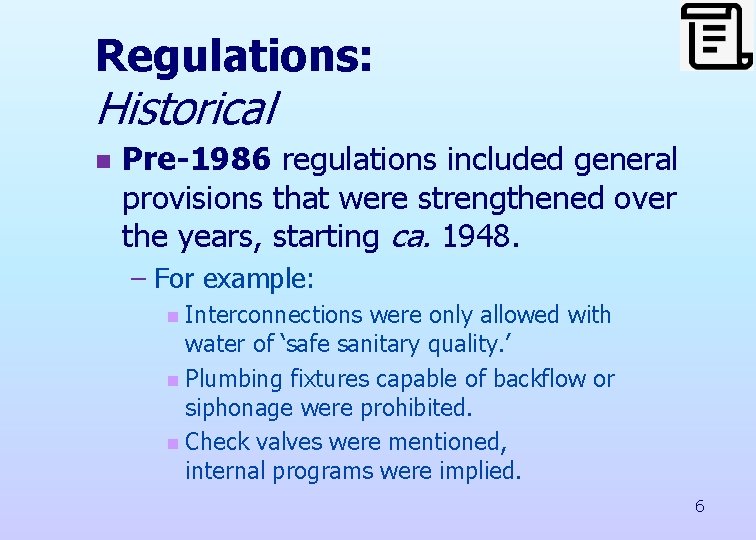
Regulations: Historical n Pre-1986 regulations included general provisions that were strengthened over the years, starting ca. 1948. – For example: n Interconnections were only allowed with water of ‘safe sanitary quality. ’ n Plumbing fixtures capable of backflow or siphonage were prohibited. n Check valves were mentioned, internal programs were implied. 6
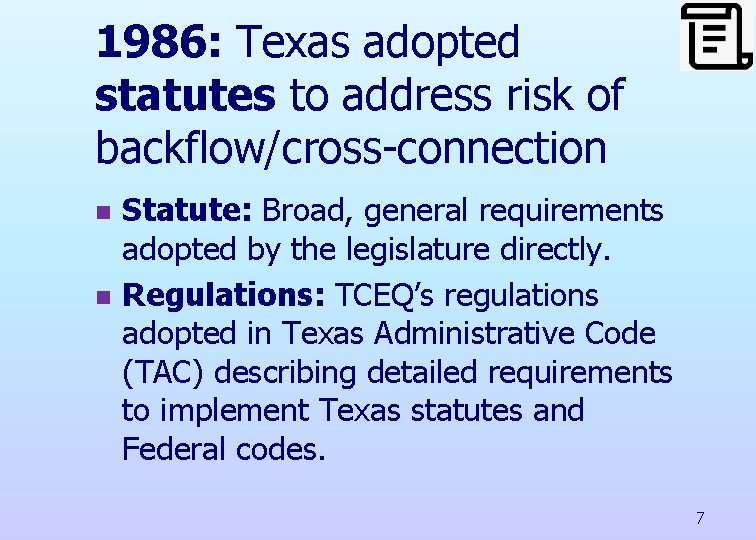
1986: Texas adopted statutes to address risk of backflow/cross-connection n n Statute: Broad, general requirements adopted by the legislature directly. Regulations: TCEQ’s regulations adopted in Texas Administrative Code (TAC) describing detailed requirements to implement Texas statutes and Federal codes. 7
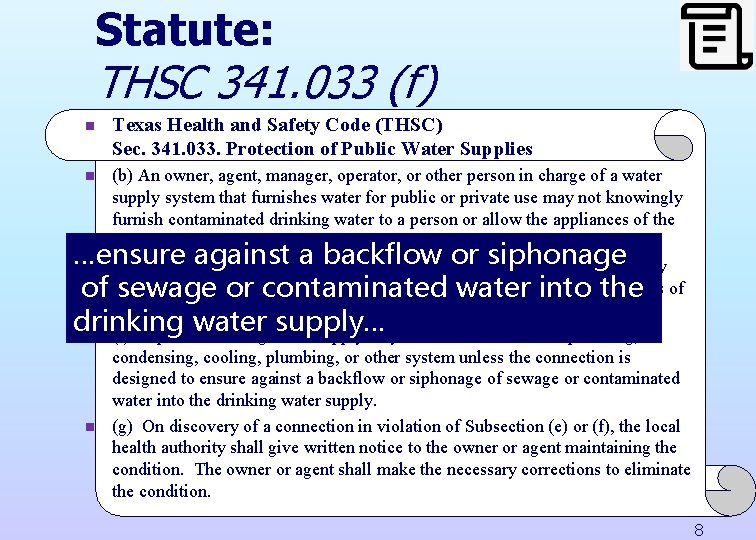
Statute: THSC 341. 033 (f) n Texas Health and Safety Code (THSC) Sec. 341. 033. Protection of Public Water Supplies (b) An owner, agent, manager, operator, or other person in charge of a water supply system that furnishes water for public or private use may not knowingly furnish contaminated drinking water to a person or allow the appliances of the water supply system to become unsanitary… …ensure against a backflow or siphonage n (e) The distribution system of a public drinking water supply and that of any water supply not be physically connected unless into the otherthe water is of of other sewage ormay contaminated water a safe and sanitary quality and the commission approves the connection. drinking water supply… n (f) A public drinking water supply may not be connected to a sprinkling, condensing, cooling, plumbing, or other system unless the connection is designed to ensure against a backflow or siphonage of sewage or contaminated water into the drinking water supply. n (g) On discovery of a connection in violation of Subsection (e) or (f), the local health authority shall give written notice to the owner or agent maintaining the condition. The owner or agent shall make the necessary corrections to eliminate the condition. n 8
Regulations: 30 TAC Chapter 290 n 1986: – To implement the 1986 statutes, more detailed requirements were adopted in 30 TAC § 290. 44 and § 290. 46. – Taken together, implementation of these regulations constitutes a “Cross-Connection Control Program. ” 9
2016: EPA adopts the RTCR n During the early 2000 s, EPA discussed adoption of broad rules for distribution systems. – This discussion resulted in the Revised Total Coliform Rule (RTCR). – Concerns regarding distribution management for avoidance of contaminant intrusion into potable water were included in Level 1 and Level 2 Assessments. 10
RTCR Assessments n Assessments are performed when the presence of coliform is more abundant than triggers defined in the RTCR. – More in the accompanying presentation. n An assessment looks at all potential pathogen pathways, including cross connections. 11
2019: Lessons learned n RTCR assessments (etc. ) show that not all PWSs have a robust, compliant Cross-Connection Control Programs. – RTCR defines a ‘sanitary defect’ as a ‘potential pathway for pathogens’ to enter the drinking water. – TCEQ may identify failure to implement a CCCP as a ‘sanitary defect’ in an assessment. 12
Elements of a successful CCCP n Authority – Service agreement and/or ordinance n Compliance programs – Inspections, testing, customer service inspections (CSIs), recordkeeping, etc. n Communication – Internal and external n Backflow-incident response plan. 13
Lessons learned ! n Authority may be lacking. n Response may be inadequate. n Hazards may be un-identified. n Communication may be a challenge. 14
Authority 15
Authority to implement the CCCP n § 290. 46(i) Plumbing Ordinance: – Public water systems must adopt an adequate plumbing ordinance, regulations, or service agreement with provisions for proper enforcement to insure that neither cross-connections nor other unacceptable plumbing practices are permitted. 16
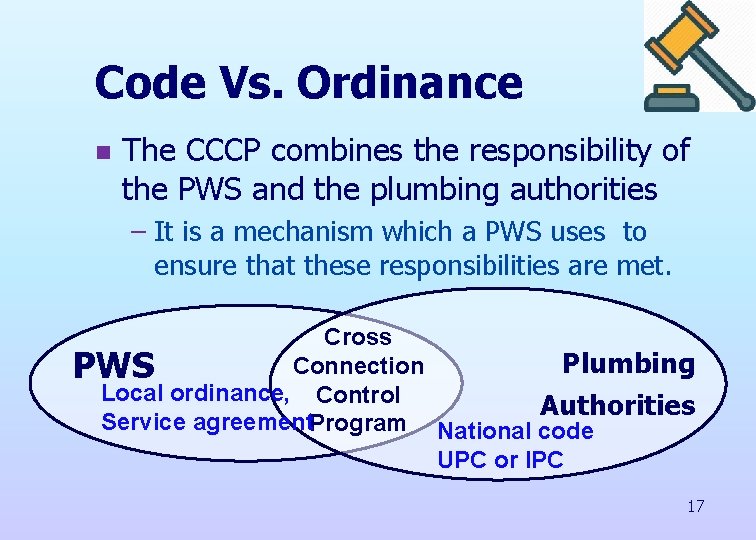
Code Vs. Ordinance n The CCCP combines the responsibility of the PWS and the plumbing authorities – It is a mechanism which a PWS uses to ensure that these responsibilities are met. Cross Plumbing Connection PWS Local ordinance, Control Authorities Service agreement. Program National code UPC or IPC 17
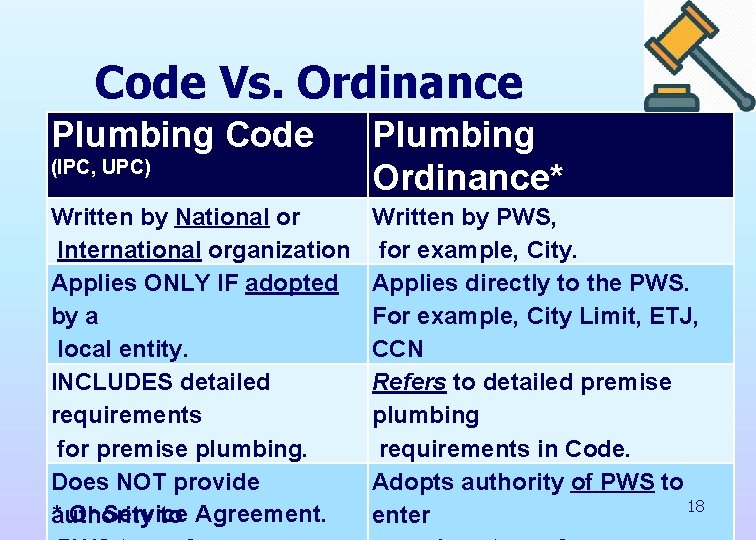
Code Vs. Ordinance Plumbing Code (IPC, UPC) Written by National or International organization Applies ONLY IF adopted by a local entity. INCLUDES detailed requirements for premise plumbing. Does NOT provide * Or Service authority to Agreement. Plumbing Ordinance* Written by PWS, for example, City. Applies directly to the PWS. For example, City Limit, ETJ, CCN Refers to detailed premise plumbing requirements in Code. Adopts authority of PWS to 18 enter
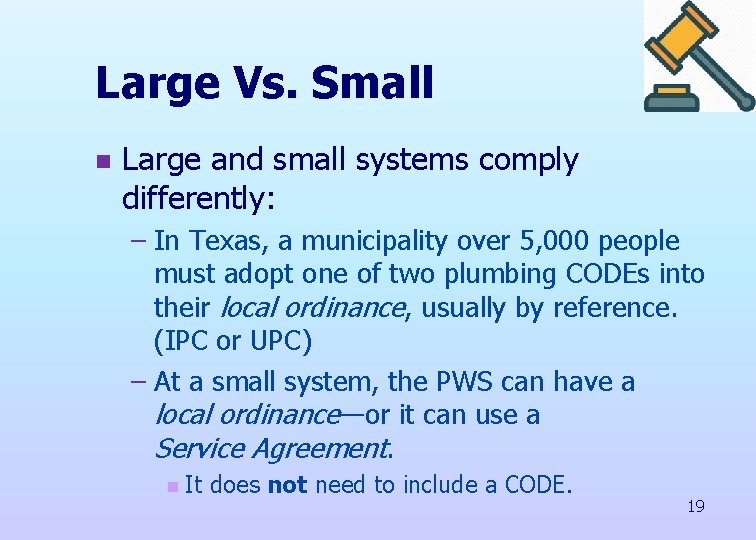
Large Vs. Small n Large and small systems comply differently: – In Texas, a municipality over 5, 000 people must adopt one of two plumbing CODEs into their local ordinance, usually by reference. (IPC or UPC) – At a small system, the PWS can have a local ordinance—or it can use a Service Agreement. n It does not need to include a CODE. 19
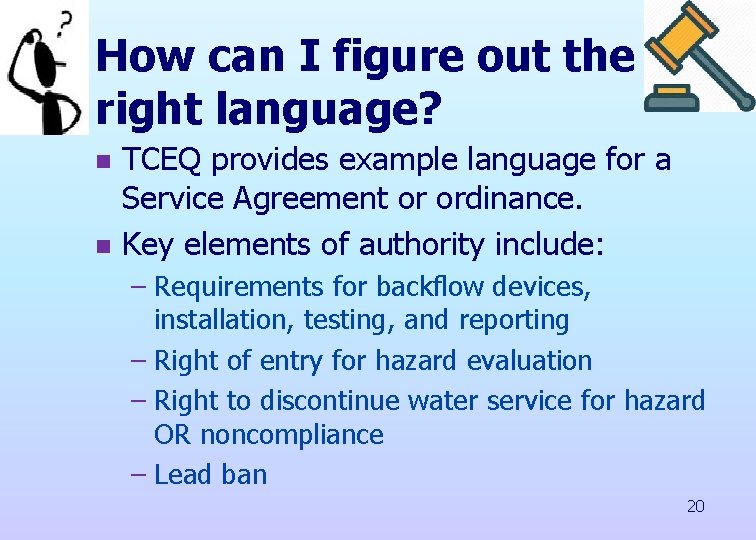
How can I figure out the right language? n n TCEQ provides example language for a Service Agreement or ordinance. Key elements of authority include: – Requirements for backflow devices, installation, testing, and reporting – Right of entry for hazard evaluation – Right to discontinue water service for hazard OR noncompliance – Lead ban 20
Authority: Reference material n TCEQ Web site: – www. tceq. texas. gov/drinkingwater/crossconnection n TCEQ Regulatory Guidance (RG): – RG 478: “Establishing and Managing an Effective Cross-Connection Control Program” n Available at: – www. tceq. texas. gov/assets/public/permitting/ … watersupply/groups/ccc/rg-478. pdf 21
Response Plan ! 22
A backflow event is a kind of emergency ! n It does not happen often, n But when it happens, it can be devastating. 23
A backflow response plan is like any ERP n ! Includes direction on: – Roles and responsibilities n Identifies communication pathways – Identifying contaminants – Isolating potential hazards n (maps with valves) – Flushing procedures n Don’t flush before identifying/isolating hazard 24
Lessons learned from backflow incident response n ! Don’t ‘flush first and ask questions later. ’ – Flushing before identifying the risk may cause the contaminant to be spread further through the distribution system. n An ounce of planning saves a pound of pain – Make sure that those required to implement the response have needed information before the event: Maps, labs, TCEQ #s, etc. 25
Lessons learned from backflow incident response n ! Identify the range of potential hazards present and become familiar with labs who can analyze for them – Potential contaminants include chemical or biological constituents that may not be routinely analyzed for – PWSs can’t have labs to analyze every chemical and microbe, but can have relationships with existing labs. 26
Backflow response: Reference material n ! TCEQ Regulatory Guidance (RG): – RG 477: “A PWS Guide to Preparing a Backflow-Incident Emergency-Response Plan” – RG 476: “A PWS Guide to Responding to a Backflow Incident” n TCEQ Web site: – www. tceq. texas. gov/drinkingwater/crossconnection 27
Hazards 28
The more you know… n Identifying hazards initially and periodically can eliminate surprises. – Initial evaluation of potential hazards at newly constructed homes or businesses n Review after the building is occupied – Periodic evaluation of potential new hazards n Checking with call center for complaints n Double checking previously identified hazard locations 29
Customer Service Inspections (CSIs) n CSIs are designed to identify hazards – Contaminants and pollutants n Hazards can come and go. – Hazard identification should be performed not just initially, but also periodically. – New businesses may use a different set of chemicals, for example. 30
Potential hazards n A strong CSI program will identify ranges of potential contaminants – Refineries will have certain chemicals, plating operations a different set. n Identifying a hazard from observing its effect in water is difficult. – Eg: “Foamy” “Acidic taste” “Slippery” – Knowing the potential scope will help make response to an event more efficient. 31
Hazards: Reference material n TCEQ Regulatory Guidance (RG): – RG 206: “Customer Service Inspections —A Guide for PWSs” n Under review, currently in draft form – RG 476: “A PWS Guide to Responding to a Backflow Incident” n Information n about types of identification of hazards TCEQ Web site: – www. tceq. texas. gov/drinkingwater/crossconnection 32
Communication 33
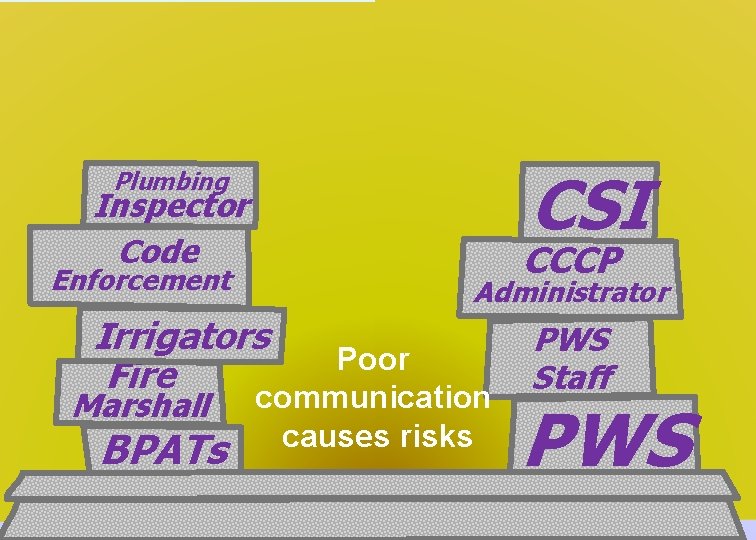
The 3 Cs n Implementing the 3 Cs leads to success: –Communication, –Coordination, –Cooperation. 34
The 3 Cs n Although no explicit regulations states that PWSs ‘must do the 3 Cs, ’ inadequate communication has been observed to cause issues. 35
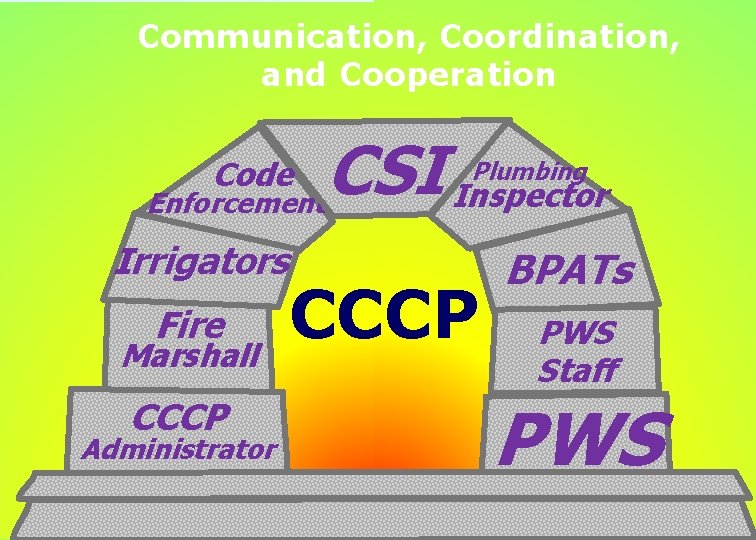
Communication, Coordination, and Cooperation CSI Inspector Enforcement Code Irrigators Fire Marshall CCCP Administrator Plumbing CCCP BPATs PWS Staff PWS 36
CSI Plumbing Inspector Code CCCP Enforcement Administrator Irrigators Fire Marshall BPATs Poor communication causes risks PWS Staff PWS 37
How to improve communication… n Identify stakeholders – Organizational units with some responsibility or authority over a piece of the CCCP n Identify highest level of authority exposed to risk – A backflow event can make a entity ‘look bad’ which can lead to job changes n Have an initial informational meeting to share—for example, training event. 38
How to improve communication… n Maintain communication – Keep stakeholders informed routinely – Don’t wait till an event occurs n Implement positive activities – Public education – Participation in ‘Water Week’ 39
Take-home message Assistance 40
TCEQ provides targeted compliance assistance n “We’re from the government, and we’re here to help!” – The shared mission of TCEQ drinking water programs and public water systems is to help ensure that Texans have safe and adequate drinking water. 41
CCCP Survey n 2 to 4 hour meeting with: – TCEQ Cross-Connection Control expert, and – System representatives. n Specific focus on PWS program – Strengths, weaknesses, opportunities, etc. – Go thru T&M forms, CSI forms, list of BPATs, local hazards, etc. – Develop action items for improving program. 42
Directed Assistance Module (DAM) n n Free, one-day, on-site general training Covers all aspects of cross-connection and backflow prevention. – Includes brief presentation and in-depth Student Manual for future reference – Given by FMT Assistance providers – Targeted to students’ and system’s needs – Covers all aspects of the CCCP in general 43
Call or email to get assistance n Call the TCEQ Water Supply Division at 512 -239 -4691 and ask to talk to the FMT assistance program or a crossconnection control expert, or Email FMT@tceq. texas. gov n Operators are standing by! n 44
Thanks! 45