
Crossborder Metropolitan Regions in Europe integration governance and
Cross-border Metropolitan Regions in Europe: integration, governance and rescaling Bernard Reitel, Professor of geography François Moullé, assistant-professor of geography Université d’Artois - France Ottawa – Borders In Globalisation (BIG) - 26/09/5/2014
European integration’s process • ‘Inner borders’ are peaceful recognized borders • Lack of interests from national governments • ‘Debordering’: change in the functions of the inner border: differentiations / assertion • European Interreg programmes (since 1990)
Cities on borders in Western Europe in the 1990 s • Changing relative geographical position • New interests in cross-border areas • Cross-border cooperation on local and regional scale
Globalisation / Metropolisation / States in Europe • In a competitive, globalised world, metropolises are driving forces of the economy • Rescaling of the State (Brenner, 2003) • States are identifying and fostering several cities as metropolises on national territory (Lefèbvre 2004; d’Albergho, 2011)
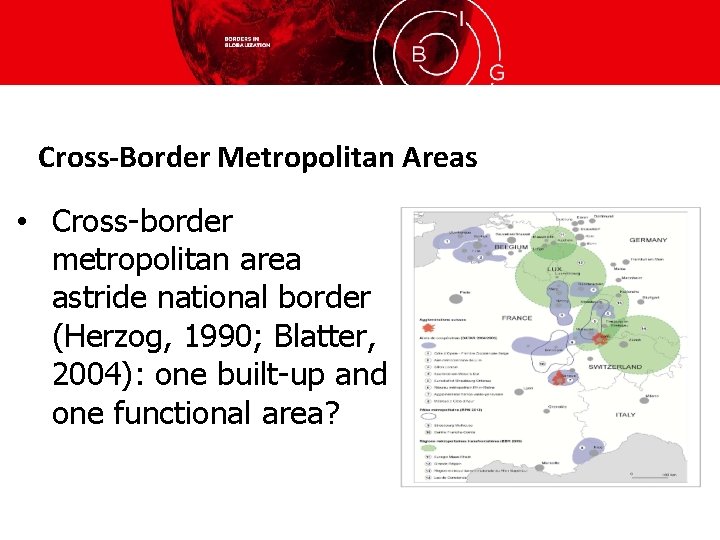
Cross-Border Metropolitan Areas • Cross-border metropolitan area astride national border (Herzog, 1990; Blatter, 2004): one built-up and one functional area?
Cross-Border Metropolitan Regions in Europe • A city located on a national border with several metropolitan functions • Metropolitan governance (Le Galès, 2006)
Methodology • 3 approaches (Van Houtum, 2000): functional, political, people (socio-cultural) • Functional: structure and integration’s degree of the cross-border build-up and/or the urban area – Features – Asymmetry/integration – Analysis grid (Blotevogel and Danielzyk, 2009)
Political: cross-border governance and rescaling (Blatter, 2004; Jouve and Lefèbvre, 2002, Sohn, Reitel, Walther, 2009) • Network of actors involved in the cross-border cooperation • Project and strategy • Political leadership and power relations • Political recognition by State(s) and EU • Analysis of discourses and strategic plans • Interviews
Socio-cultural (Simmel, 1911; Zijderveld, 2009) • The life in the great city: anonymity, stimulation • The border as a resource (opportunity) • Urbanity: a distinctive “style of life”; a civic culture of the city • A community of sense • Survey • Interviews (mental map)
Case studies • A first analysis on Basel and Geneva (2012 -2014) • Comparison, of 2 regions (new Ph. D) • Eurométropole Lille. Kortrijk-Tournai (F-B) • Upper Rhine CBMR (CH – D - F) • Schedules: end in 2017
Expected results: several issues • Complexity • Rescaling • Integration
Thank you for your attention Bernard Reitel, Professor of geography François Moullé, assistant-professor of geography Université d’Artois - France
- Slides: 12