
Crossbeam Wind Measurements with PhasedArray Doppler Weather Radar
Crossbeam Wind Measurements with Phased-Array Doppler Weather Radar Richard J. Doviak National Severe Storms Laboratory Guifu Zhang School of Meteorology, University of Oklahoma Norman, Oklahoma 25 Sept. 2006 ERAD 2006

Spaced Antenna Interferometry (Overview) • Interferometry: – Complementary to the Doppler method – Used by the MST community for a half century • Weather applications: – NCAR’s Multiple Antenna Profiling Radar (MAPR) – UMass’s Dual-polarization Spaced Antenna (DPSA) system • National Weather Radar Testbed (NWRT); (phased-array weather radar) – Good opportunity to revisit spaced antenna interferometry 25 Sept. 2006 ERAD 2006

Phase Array Radar (scanning diversity; multi-mission*; etc. ) *ARSR; ASR; TDWR; WR 25 Sept. 2006 ERAD 2006
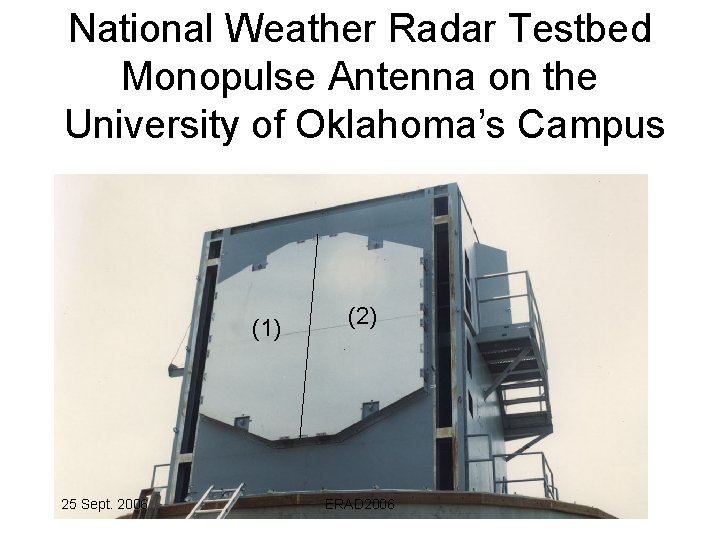
National Weather Radar Testbed Monopulse Antenna on the University of Oklahoma’s Campus (1) 25 Sept. 2006 (2) ERAD 2006
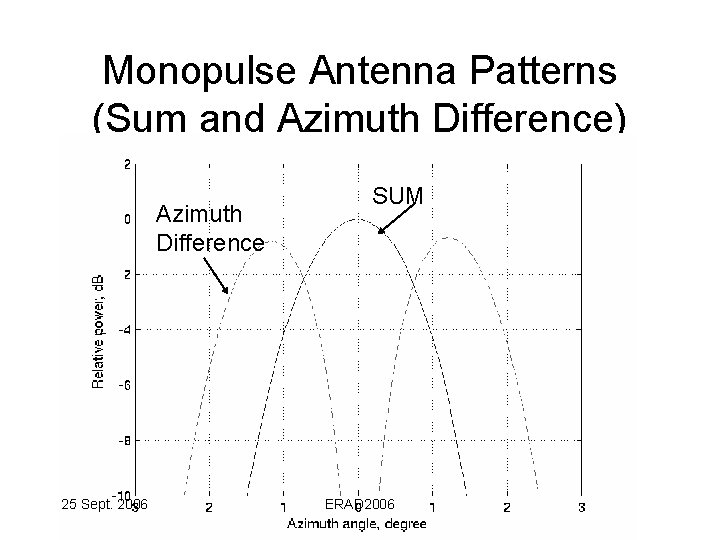
Monopulse Antenna Patterns (Sum and Azimuth Difference) Azimuth Difference 25 Sept. 2006 SUM ERAD 2006
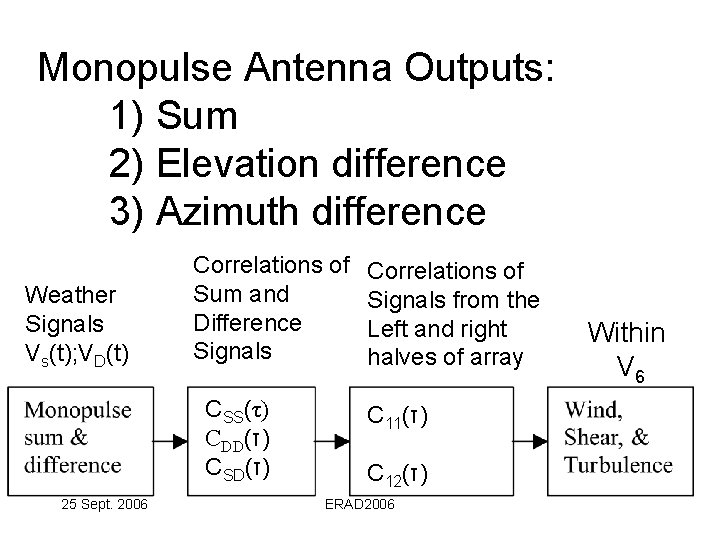
Monopulse Antenna Outputs: 1) Sum 2) Elevation difference 3) Azimuth difference Weather Signals Vs(t); VD(t) Correlations of Sum and Difference Signals CSS(τ) CDD(τ) CSD(τ) 25 Sept. 2006 Correlations of Signals from the Left and right halves of array C 11(τ) C 12(τ) ERAD 2006 Within V 6
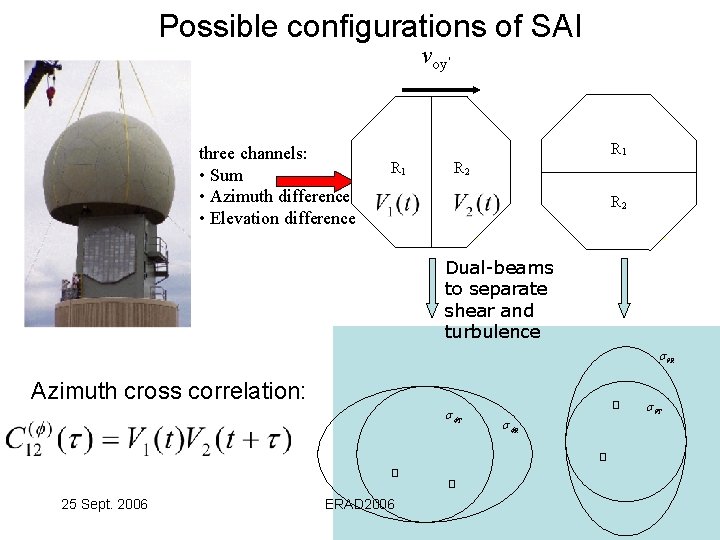
Possible configurations of SAI voy’ three channels: • Sum • Azimuth difference • Elevation difference V 1(t) V 2(t) R 1 R 2 Azimuth SA Elevation SA Dual-beams to separate shear and turbulence sq. R Azimuth cross correlation: s f. T � s f. R � � 25 Sept. 2006 ERAD 2006 � sq. T
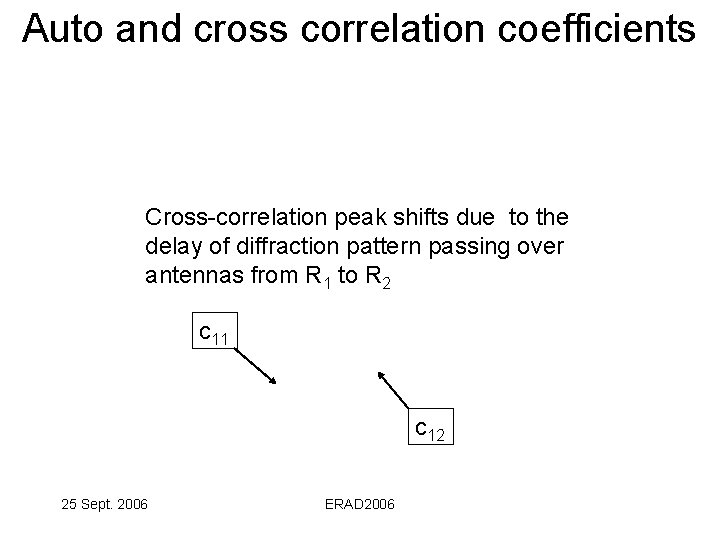
Auto and cross correlation coefficients Cross-correlation peak shifts due to the delay of diffraction pattern passing over antennas from R 1 to R 2 c 11 c 12 25 Sept. 2006 ERAD 2006
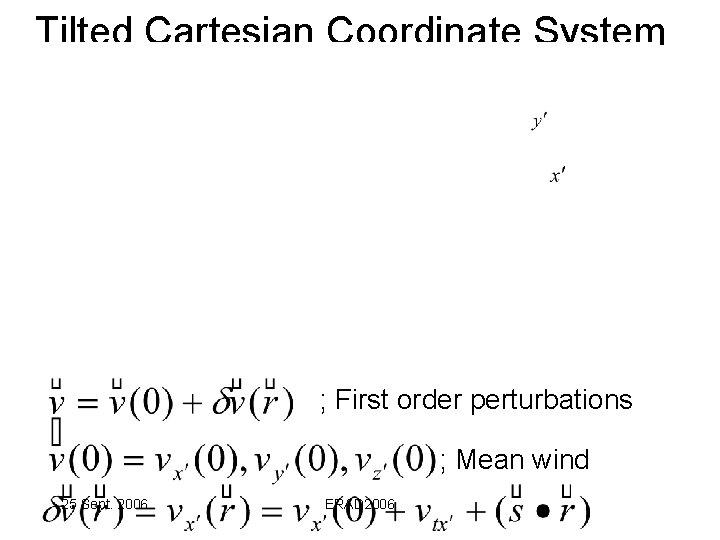
Tilted Cartesian Coordinate System ; First order perturbations ; Mean wind 25 Sept. 2006 ERAD 2006
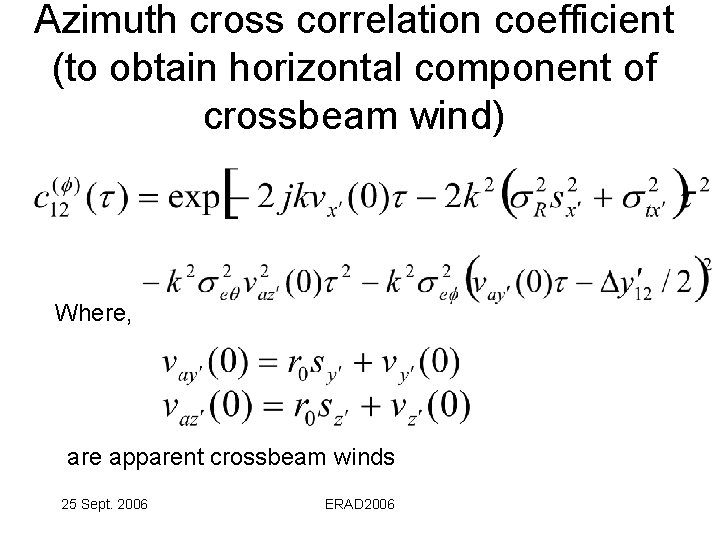
Azimuth cross correlation coefficient (to obtain horizontal component of crossbeam wind) Where, are apparent crossbeam winds 25 Sept. 2006 ERAD 2006
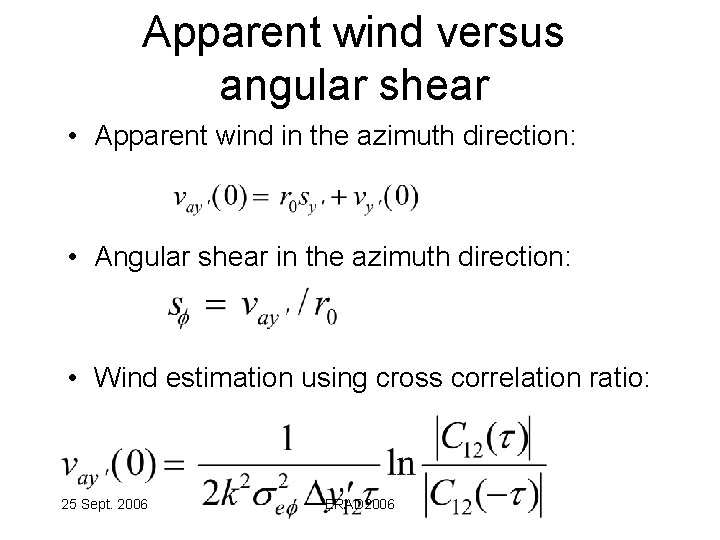
Apparent wind versus angular shear • Apparent wind in the azimuth direction: • Angular shear in the azimuth direction: • Wind estimation using cross correlation ratio: 25 Sept. 2006 ERAD 2006
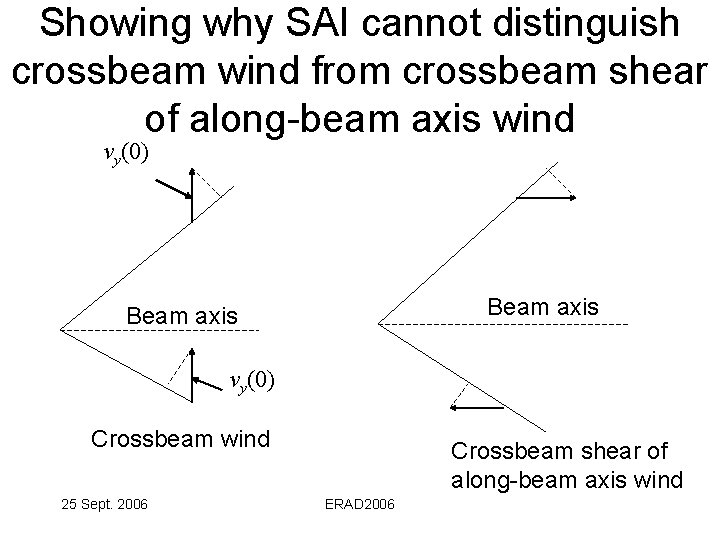
Showing why SAI cannot distinguish crossbeam wind from crossbeam shear of along-beam axis wind vy(0) Beam axis vy(0) Crossbeam wind 25 Sept. 2006 Crossbeam shear of along-beam axis wind ERAD 2006
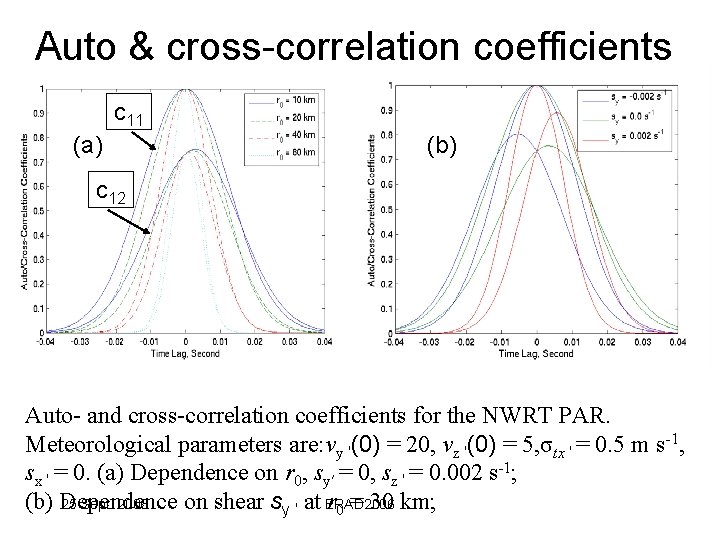
Auto & cross-correlation coefficients c 11 (a) (b) c 12 Auto- and cross-correlation coefficients for the NWRT PAR. Meteorological parameters are: vy ′(0) = 20, vz ′(0) = 5, σtx ′ = 0. 5 m s-1, sx ′ = 0. (a) Dependence on r 0, sy′ = 0, sz ′ = 0. 002 s-1; (b) Dependence on shear sy ′ at ERAD 2006 r 0 = 30 km; 25 Sept. 2006
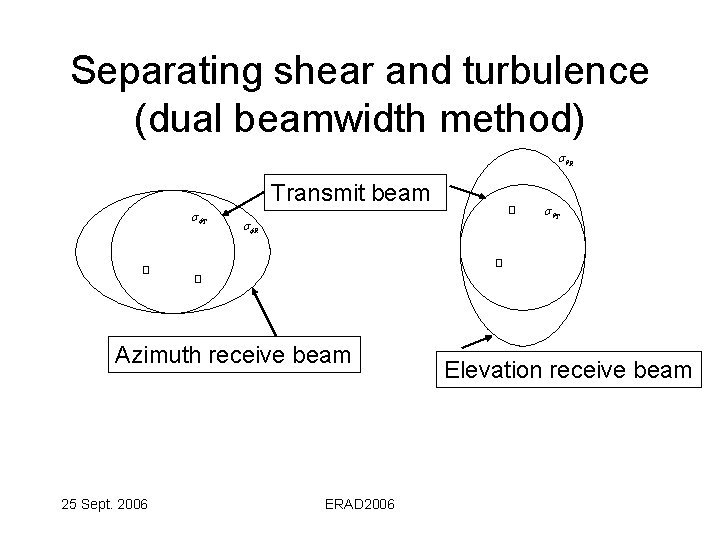
Separating shear and turbulence (dual beamwidth method) sq. R Transmit beam s f. T � s f. R sq. T � � Azimuth receive beam 25 Sept. 2006 � ERAD 2006 Elevation receive beam
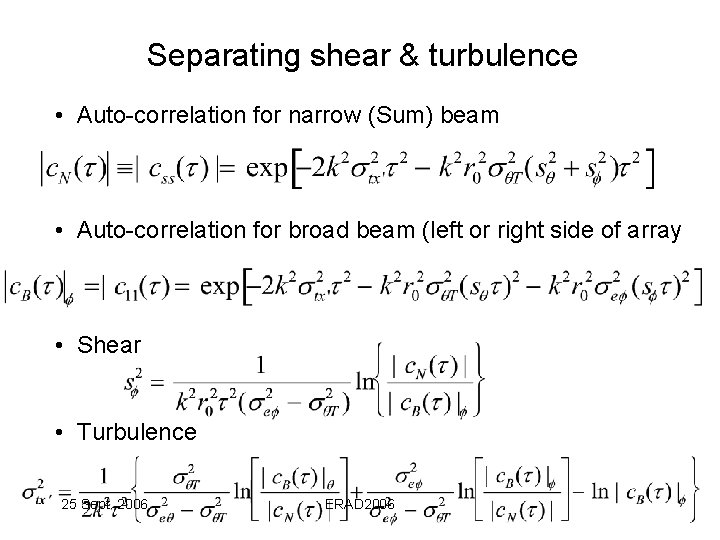
Separating shear & turbulence • Auto-correlation for narrow (Sum) beam • Auto-correlation for broad beam (left or right side of array • Shear • Turbulence 25 Sept. 2006 ERAD 2006
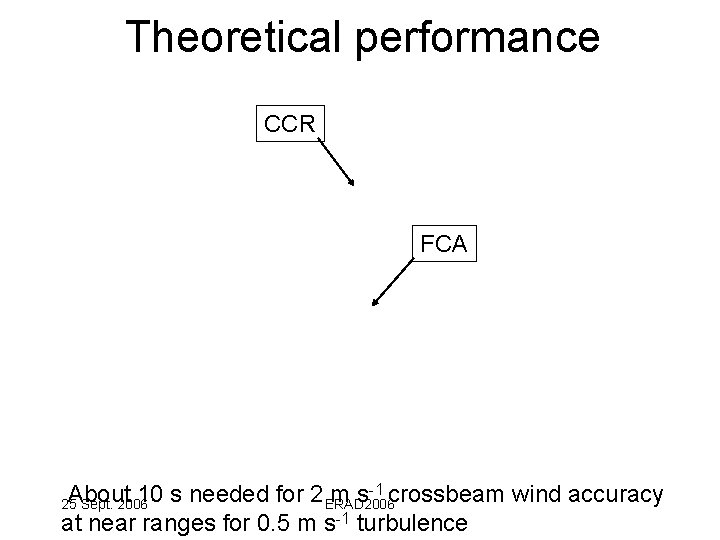
Theoretical performance CCR FCA -1 crossbeam wind accuracy About 10 s needed for 2 m s 25 Sept. 2006 ERAD 2006 at near ranges for 0. 5 m s-1 turbulence
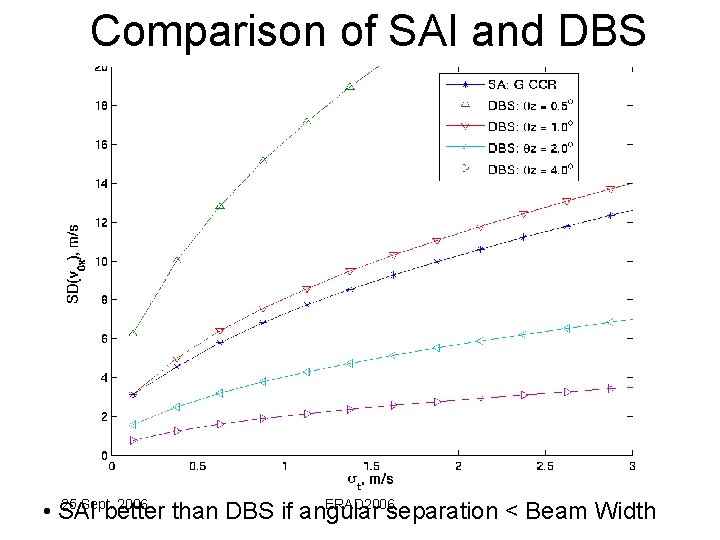
Comparison of SAI and DBS 25 Sept. 2006 ERAD 2006 • SAI better than DBS if angular separation < Beam Width
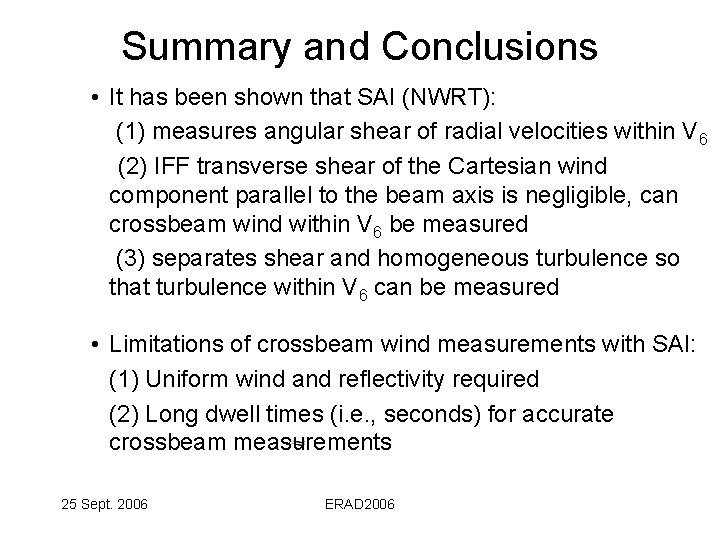
Summary and Conclusions • It has been shown that SAI (NWRT): (1) measures angular shear of radial velocities within V 6 (2) IFF transverse shear of the Cartesian wind component parallel to the beam axis is negligible, can crossbeam wind within V 6 be measured (3) separates shear and homogeneous turbulence so that turbulence within V 6 can be measured • Limitations of crossbeam wind measurements with SAI: (1) Uniform wind and reflectivity required (2) Long dwell times (i. e. , seconds) for accurate crossbeam measurements 25 Sept. 2006 ERAD 2006
End of Slide Show 25 Sept. 2006 ERAD 2006

Differences between current weather surveillance and PAR Technology A wide transmit beam and Multiple receive beams 25 Sept. 2006 ERAD 2006
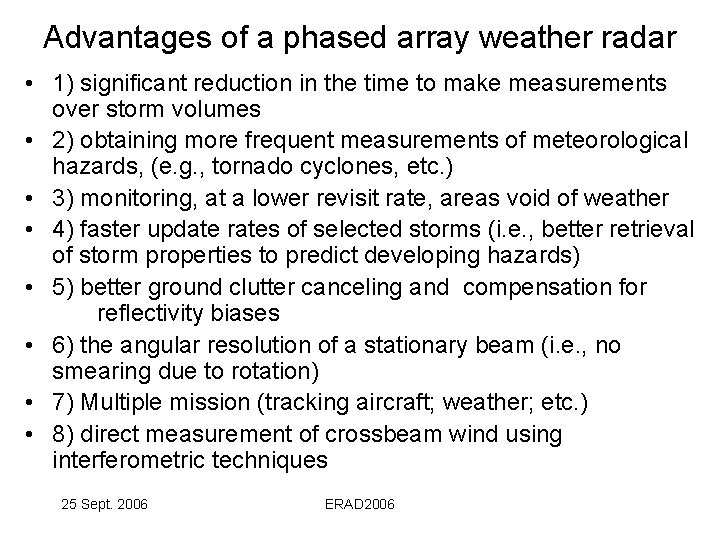
Advantages of a phased array weather radar • 1) significant reduction in the time to make measurements over storm volumes • 2) obtaining more frequent measurements of meteorological hazards, (e. g. , tornado cyclones, etc. ) • 3) monitoring, at a lower revisit rate, areas void of weather • 4) faster update rates of selected storms (i. e. , better retrieval of storm properties to predict developing hazards) • 5) better ground clutter canceling and compensation for reflectivity biases • 6) the angular resolution of a stationary beam (i. e. , no smearing due to rotation) • 7) Multiple mission (tracking aircraft; weather; etc. ) • 8) direct measurement of crossbeam wind using interferometric techniques 25 Sept. 2006 ERAD 2006
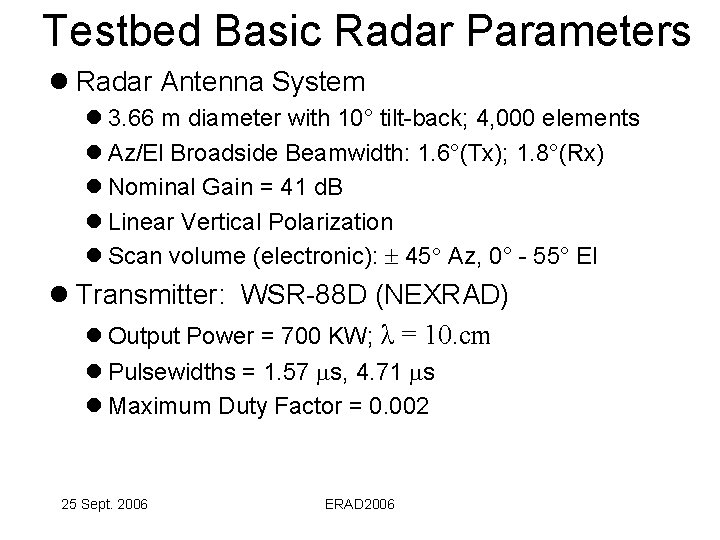
Testbed Basic Radar Parameters l Radar Antenna System l 3. 66 m diameter with 10° tilt-back; 4, 000 elements l Az/El Broadside Beamwidth: 1. 6°(Tx); 1. 8°(Rx) l Nominal Gain = 41 d. B l Linear Vertical Polarization l Scan volume (electronic): 45 Az, 0° - 55° El l Transmitter: WSR-88 D (NEXRAD) l Output Power = 700 KW; λ = 10. cm l Pulsewidths = 1. 57 s, 4. 71 s l Maximum Duty Factor = 0. 002 25 Sept. 2006 ERAD 2006
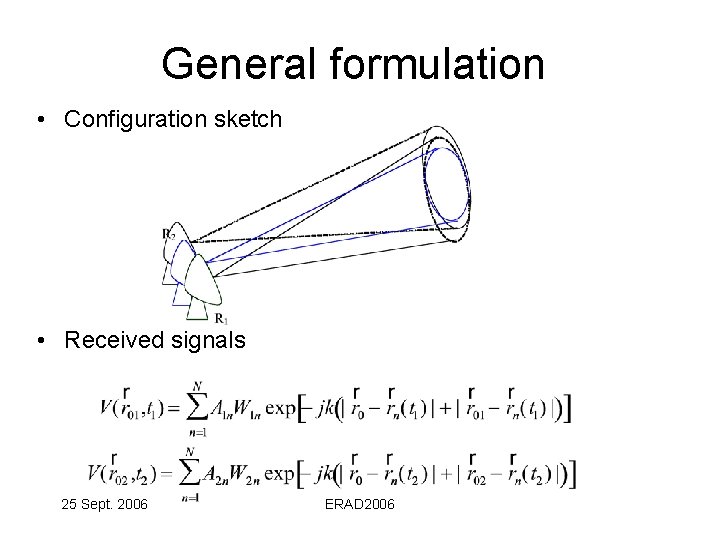
General formulation • Configuration sketch • Received signals 25 Sept. 2006 ERAD 2006
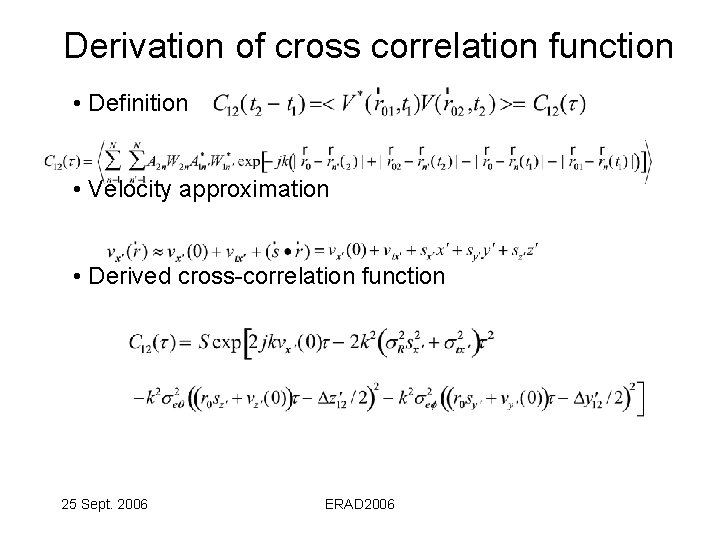
Derivation of cross correlation function • Definition • Velocity approximation • Derived cross-correlation function 25 Sept. 2006 ERAD 2006
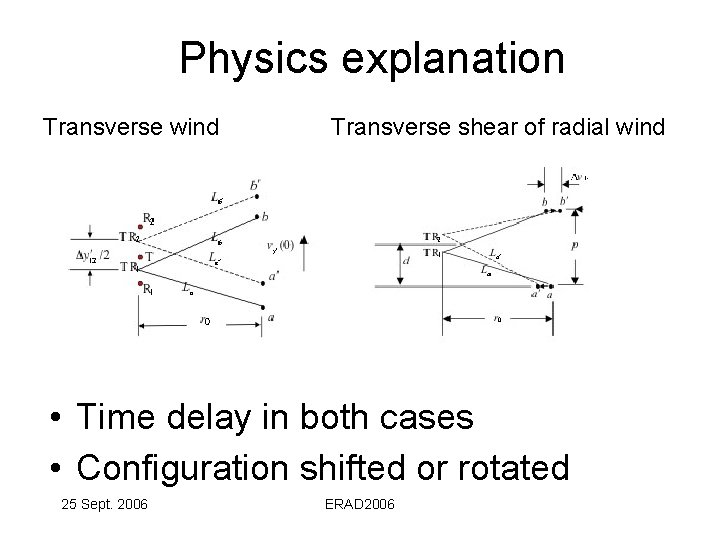
Physics explanation Transverse wind Transverse shear of radial wind • Time delay in both cases • Configuration shifted or rotated 25 Sept. 2006 ERAD 2006
- Slides: 25