
Cross Product This slideshow will be a review
Cross Product This slideshow will be a review of the professors lectures on the Cross Product To advance the slide, click the mouse button To go back, right click the mouse, and choose previous
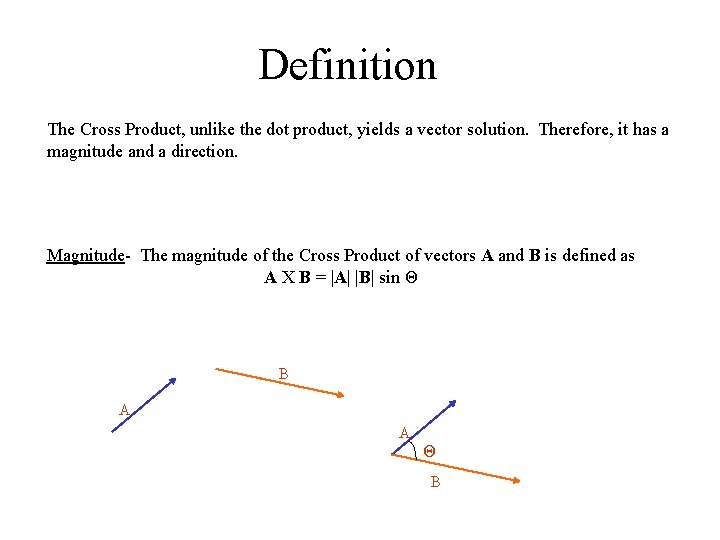
Definition The Cross Product, unlike the dot product, yields a vector solution. Therefore, it has a magnitude and a direction. Magnitude- The magnitude of the Cross Product of vectors A and B is defined as A X B = |A| |B| sin Θ B A A Θ B
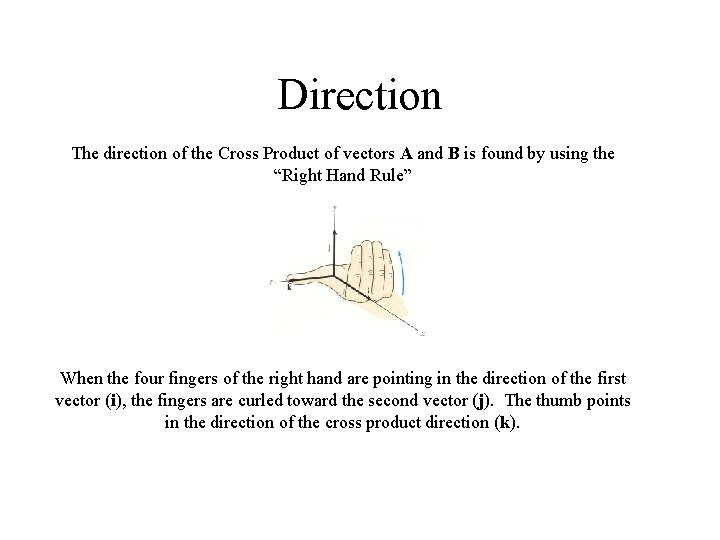
Direction The direction of the Cross Product of vectors A and B is found by using the “Right Hand Rule” When the four fingers of the right hand are pointing in the direction of the first vector (i), the fingers are curled toward the second vector (j). The thumb points in the direction of the cross product direction (k).
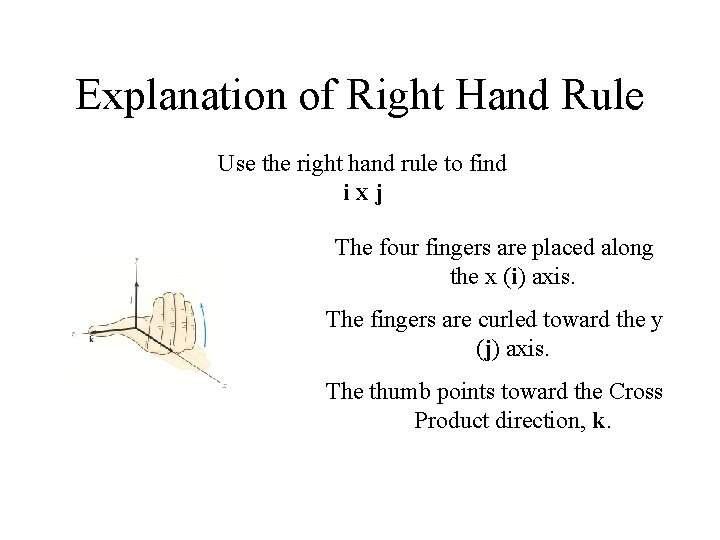
Explanation of Right Hand Rule Use the right hand rule to find i. Xj The four fingers are placed along the x (i) axis. The fingers are curled toward the y (j) axis. The thumb points toward the Cross Product direction, k.

Cross Product Identities Since the sine of 90° = 1, and the sine of 0° = 0, from A X B = sin Θ, we can derive: i. Xi=0 j. Xj=0 Since the angle between two i direction vectors would be 0, the equation would be: i X i = |i| sin 0° = (1)(1)(0) = 0 k. Xk=0 i. Xj=k j X i = -k j. Xk=i i X k = -j k. Xi=j k X j = -i
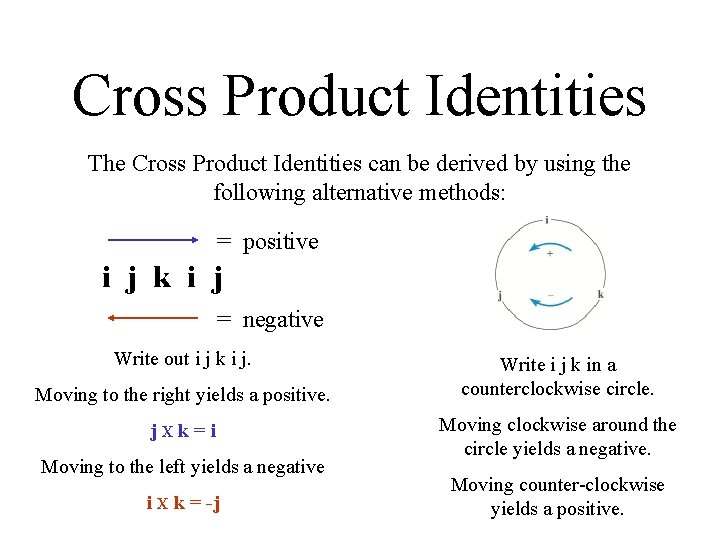
Cross Product Identities The Cross Product Identities can be derived by using the following alternative methods: = positive i j k i j = negative Write out i j k i j. Moving to the right yields a positive. j. Xk=i Moving to the left yields a negative i X k = -j Write i j k in a counterclockwise circle. Moving clockwise around the circle yields a negative. Moving counter-clockwise yields a positive.
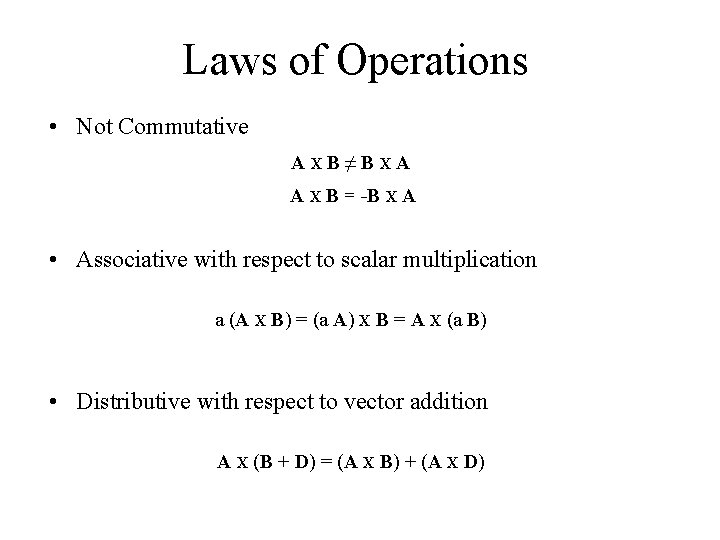
Laws of Operations • Not Commutative AXB≠BXA A X B = -B X A • Associative with respect to scalar multiplication a (A X B) = (a A) X B = A X (a B) • Distributive with respect to vector addition A X (B + D) = (A X B) + (A X D)
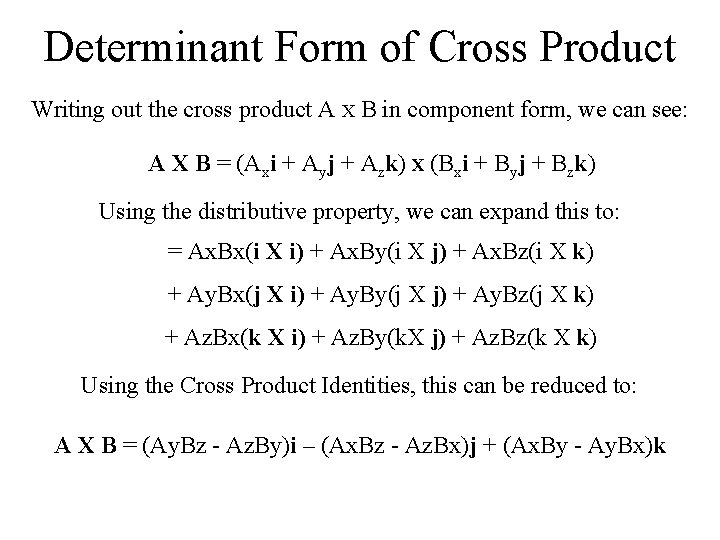
Determinant Form of Cross Product Writing out the cross product A X B in component form, we can see: A X B = (Axi + Ayj + Azk) X (Bxi + Byj + Bzk) Using the distributive property, we can expand this to: = Ax. Bx(i X i) + Ax. By(i X j) + Ax. Bz(i X k) + Ay. Bx(j X i) + Ay. By(j X j) + Ay. Bz(j X k) + Az. Bx(k X i) + Az. By(k. X j) + Az. Bz(k X k) Using the Cross Product Identities, this can be reduced to: A X B = (Ay. Bz - Az. By)i – (Ax. Bz - Az. Bx)j + (Ax. By - Ay. Bx)k

Determinant Form of Cross Product We found that the expanded form of the cross product was: A X B = (Ay. Bz-Az. By)i – (Ax. Bz-Az. Bx)j + (Ax. By-Ay. Bx)k This equation can also be written in a 3 X 3 determinant: i AXB= j k Ax Ay Az Bx By Bz Therefore, to find the cross product of any two Cartesian vectors (A and B), write this determinant form of the vectors.
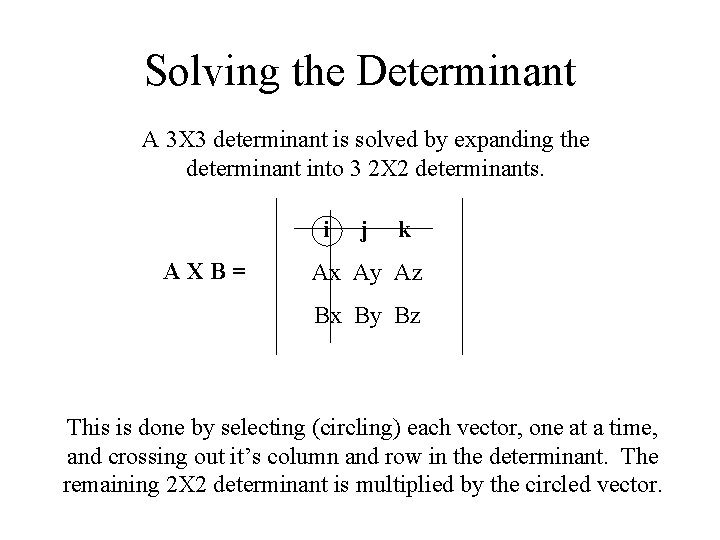
Solving the Determinant A 3 X 3 determinant is solved by expanding the determinant into 3 2 X 2 determinants. i AXB= j k Ax Ay Az Bx By Bz This is done by selecting (circling) each vector, one at a time, and crossing out it’s column and row in the determinant. The remaining 2 X 2 determinant is multiplied by the circled vector.
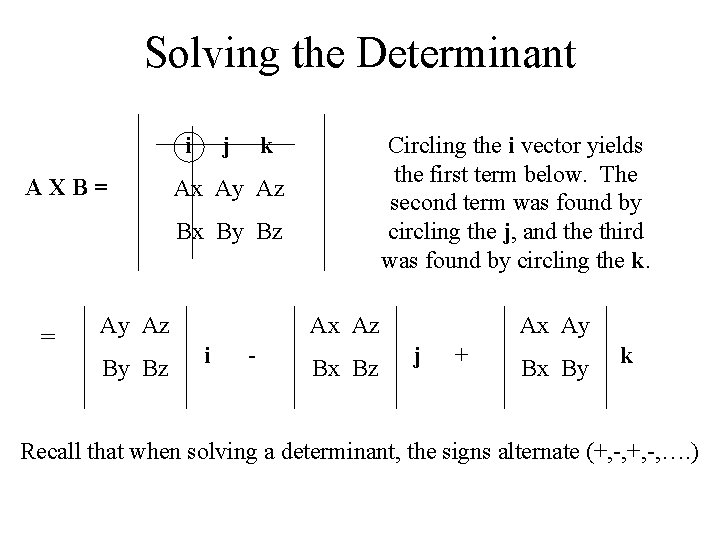
Solving the Determinant i AXB= j k Circling the i vector yields the first term below. The second term was found by circling the j, and the third was found by circling the k. Ax Ay Az Bx By Bz = Ay Az By Bz Ax Az i - Bx Bz Ax Ay j + Bx By k Recall that when solving a determinant, the signs alternate (+, -, …. )
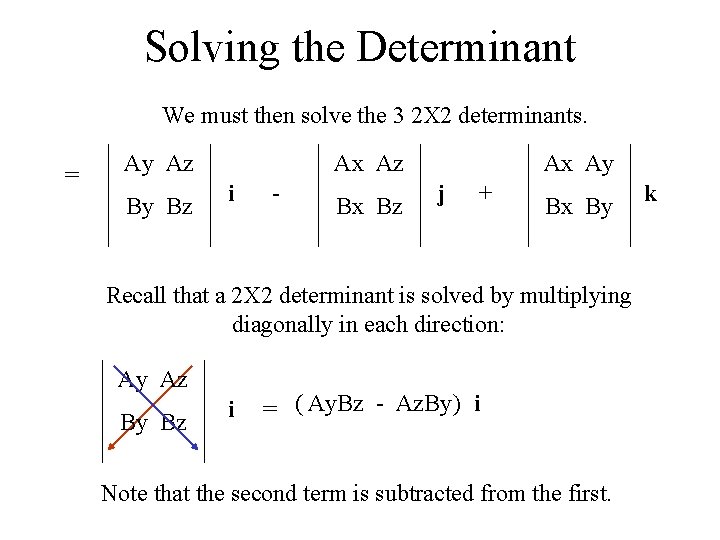
Solving the Determinant We must then solve the 3 2 X 2 determinants. = Ay Az By Bz Ax Az i - Bx Bz Ax Ay j + Bx By Recall that a 2 X 2 determinant is solved by multiplying diagonally in each direction: Ay Az By Bz i = ( Ay. Bz - Az. By ) i Note that the second term is subtracted from the first. k
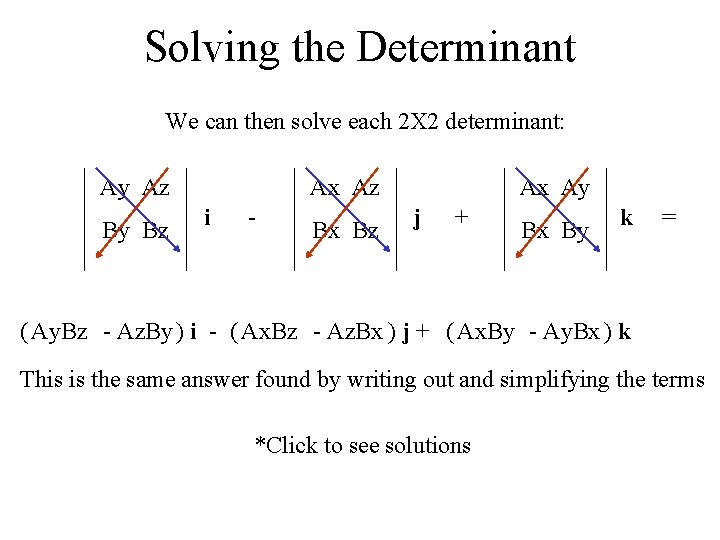
Solving the Determinant We can then solve each 2 X 2 determinant: Ay Az By Bz Ax Az i - Bx Bz Ax Ay j + Bx By k = ( Ay. Bz - Az. By ) i - ( Ax. Bz - Az. Bx ) j + ( Ax. By - Ay. Bx ) k This is the same answer found by writing out and simplifying the terms *Click to see solutions
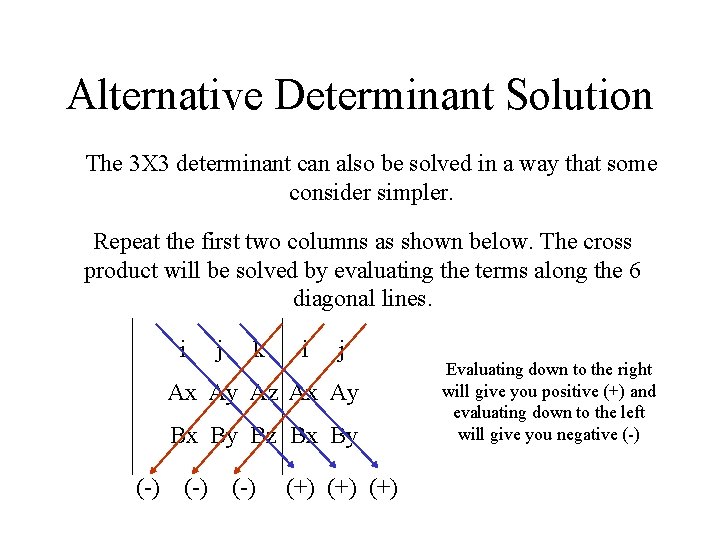
Alternative Determinant Solution The 3 X 3 determinant can also be solved in a way that some consider simpler. Repeat the first two columns as shown below. The cross product will be solved by evaluating the terms along the 6 diagonal lines. i j k i j Ax Ay Az Ax Ay Bx By Bz Bx By (-) (-) (+) (+) Evaluating down to the right will give you positive (+) and evaluating down to the left will give you negative (-)
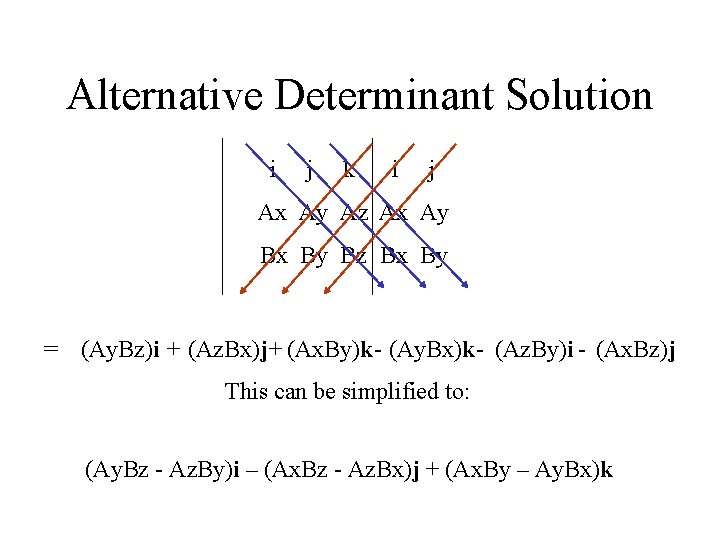
Alternative Determinant Solution i j k i j Ax Ay Az Ax Ay Bx By Bz Bx By = (Ay. Bz)i + (Az. Bx)j + (Ax. By)k- (Ay. Bx)k- (Az. By)i - (Ax. Bz)j This can be simplified to: (Ay. Bz - Az. By)i – (Ax. Bz - Az. Bx)j + (Ax. By – Ay. Bx)k
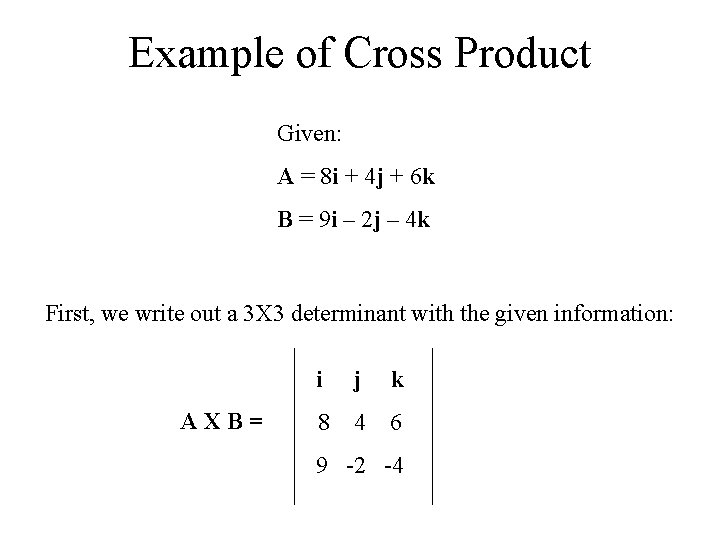
Example of Cross Product Given: A = 8 i + 4 j + 6 k B = 9 i – 2 j – 4 k First, we write out a 3 X 3 determinant with the given information: AXB= i j k 8 4 6 9 -2 -4
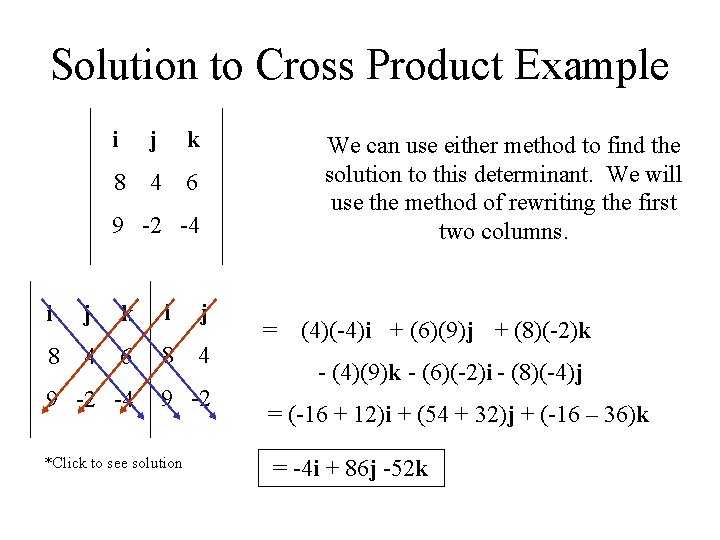
Solution to Cross Product Example i j k 8 4 6 We can use either method to find the solution to this determinant. We will use the method of rewriting the first two columns. 9 -2 -4 i j k i j 8 4 6 8 4 9 -2 -4 9 -2 *Click to see solution = (4)(-4)i + (6)(9)j + (8)(-2)k - (4)(9)k - (6)(-2)i - (8)(-4)j = (-16 + 12)i + (54 + 32)j + (-16 – 36)k = -4 i + 86 j -52 k
- Slides: 17