
CRM paper reading presentation A Case for Analytical
- Slides: 28
CRM paper reading presentation A Case for Analytical Customer Management Group 3 9534506 林依祈 9534529 洪瑗伶 9534532 王裕濱
企業電子化中心 Electronic Business Center Agenda v Introduction v Analytical CRM v Data Analytics Support for Analytical CRM v Organizational Issues in Analytical CRM Adoption v Conclusion 國立清華大學 業 程與 程管理學系
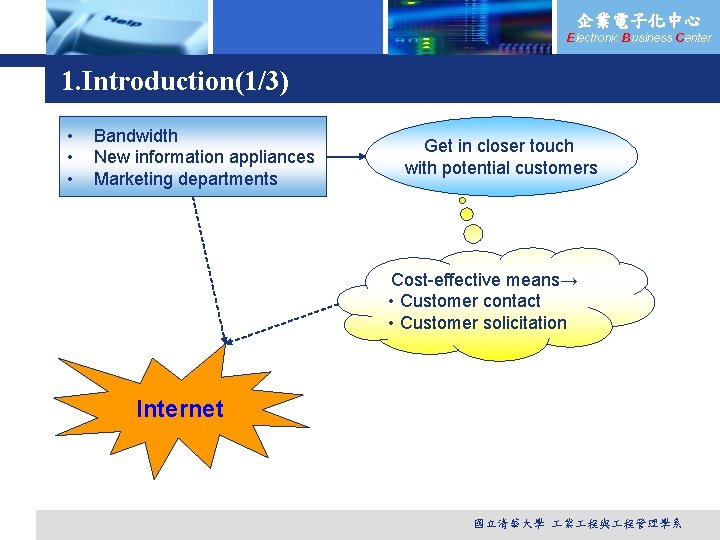
企業電子化中心 Electronic Business Center 1. Introduction(1/3) • • • Bandwidth New information appliances Marketing departments Get in closer touch with potential customers Cost-effective means→ • Customer contact • Customer solicitation Internet 國立清華大學 業 程與 程管理學系
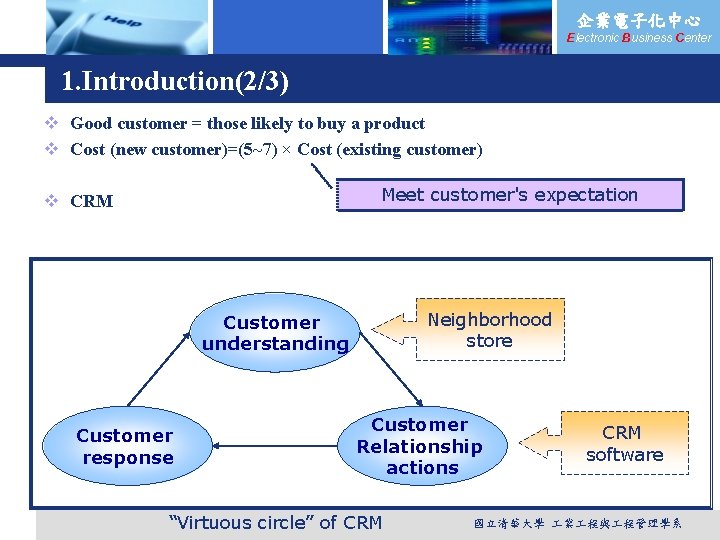
企業電子化中心 Electronic Business Center 1. Introduction(2/3) v Good customer = those likely to buy a product v Cost (new customer)=(5~7) × Cost (existing customer) Meet customer's expectation v CRM Neighborhood store Customer understanding Customer response Customer Relationship actions “Virtuous circle” of CRM software 國立清華大學 業 程與 程管理學系
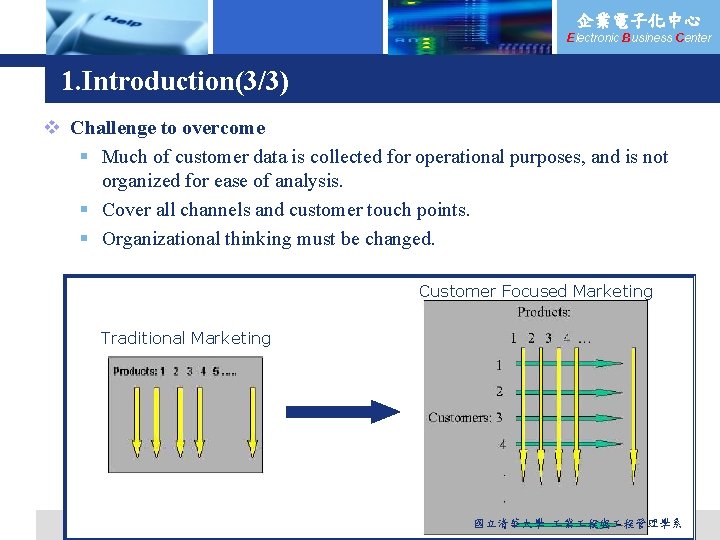
企業電子化中心 Electronic Business Center 1. Introduction(3/3) v Challenge to overcome § Much of customer data is collected for operational purposes, and is not organized for ease of analysis. § Cover all channels and customer touch points. § Organizational thinking must be changed. Customer Focused Marketing Traditional Marketing 國立清華大學 業 程與 程管理學系
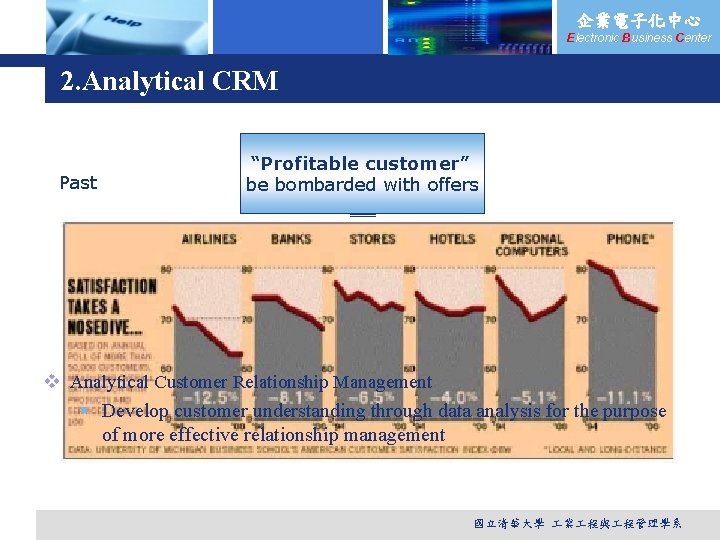
企業電子化中心 Electronic Business Center 2. Analytical CRM Past New “Profitable customer” be bombarded with offers Develop today’s the “less valuable” customer into tomorrow’s valuable ones v Analytical Customer Relationship Management § Develop customer understanding through data analysis for the purpose of more effective relationship management 國立清華大學 業 程與 程管理學系
企業電子化中心 Electronic Business Center 2. 1 Customer segmentation(1/2) v Define § The division of the entire customer population into smaller groups. v Base § Segment by the value that customers represent to an organization. § By the need they may have for specified products and services. v Purpose § Identify groups of customers with similar needs and behavior patterns. § Offer more tightly focused products, services, and communication. 國立清華大學 業 程與 程管理學系
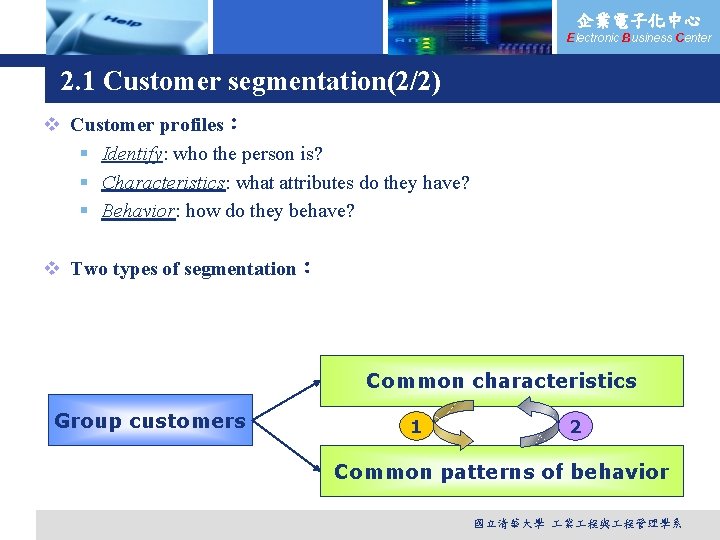
企業電子化中心 Electronic Business Center 2. 1 Customer segmentation(2/2) v Customer profiles: § Identify: who the person is? § Characteristics: what attributes do they have? § Behavior: how do they behave? v Two types of segmentation: Common characteristics Group customers 1 2 Common patterns of behavior 國立清華大學 業 程與 程管理學系
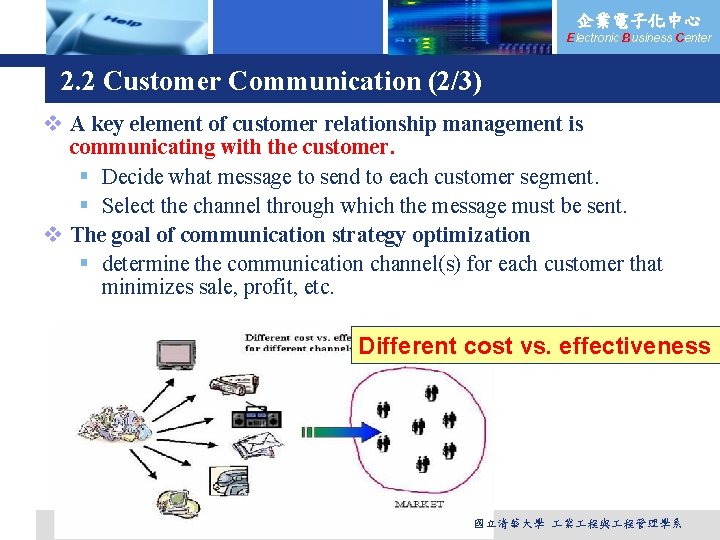
企業電子化中心 Electronic Business Center 2. 2 Customer Communication (2/3) v A key element of customer relationship management is communicating with the customer. § Decide what message to send to each customer segment. § Select the channel through which the message must be sent. v The goal of communication strategy optimization § determine the communication channel(s) for each customer that minimizes sale, profit, etc. Different cost vs. effectiveness 國立清華大學 業 程與 程管理學系
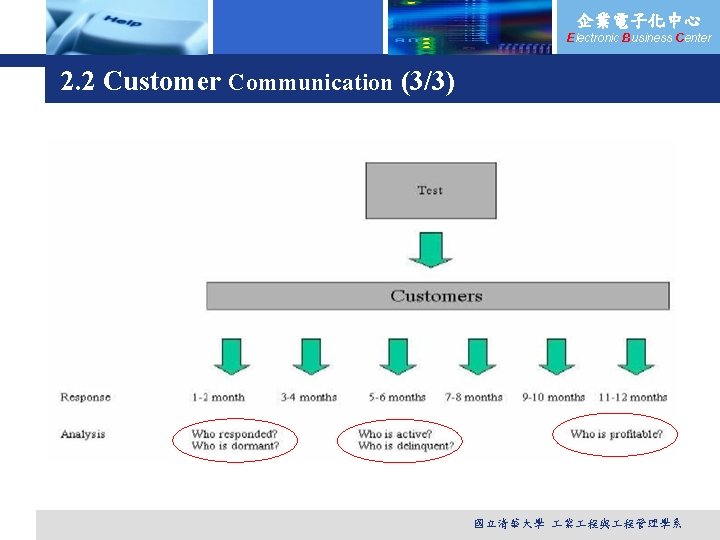
企業電子化中心 Electronic Business Center 2. 2 Customer Communication (2/3) v Response analysis § Measure the impact on the communication § Number of respondents, acquired customers; number of active customers, number of profitable customers v These are analyzed to § Determine how effective the overall customer communication campaign has been § Validate the goodness of customer segmentation § Calibrate and refine the models of the various communication channels used. 國立清華大學 業 程與 程管理學系
企業電子化中心 Electronic Business Center 2. 2 Customer Communication (3/3) 國立清華大學 業 程與 程管理學系
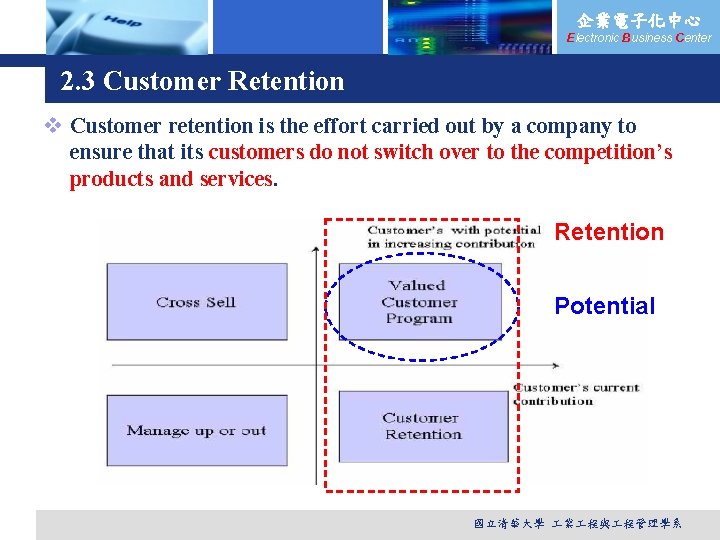
企業電子化中心 Electronic Business Center 2. 3 Customer Retention v Customer retention is the effort carried out by a company to ensure that its customers do not switch over to the competition’s products and services. Retention Potential 國立清華大學 業 程與 程管理學系
企業電子化中心 Electronic Business Center 2. 4 Customer Loyalty (1/2) v Loyalty can range from having a mild preference all the way to being a strong advocate for the company. v An average customer who feels closer to a company (high loyalty) is significantly more profitable than one who feels less close (low loyalty). v For example: § Sending a greeting card on a special day § Valuable relationship building action with low cost and high effectiveness 國立清華大學 業 程與 程管理學系
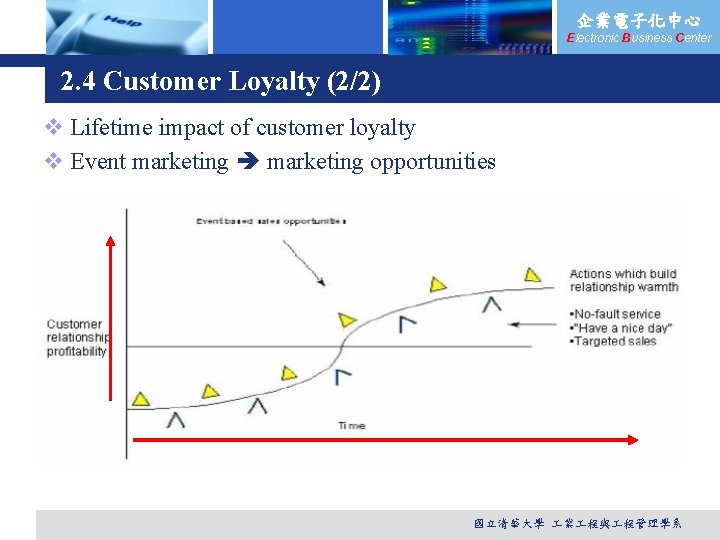
企業電子化中心 Electronic Business Center 2. 4 Customer Loyalty (2/2) v Lifetime impact of customer loyalty v Event marketing opportunities 國立清華大學 業 程與 程管理學系
企業電子化中心 Electronic Business Center 3. Data Analytics Support for Analytical CRM v We first outline a generic architecture, and then focus on the two key components, namely data warehousing and data mining. 國立清華大學 業 程與 程管理學系
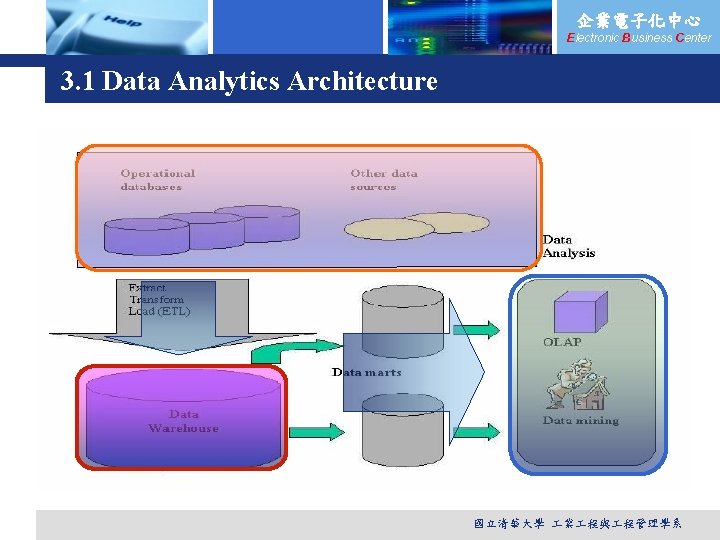
企業電子化中心 Electronic Business Center 3. 1 Data Analytics Architecture 國立清華大學 業 程與 程管理學系
企業電子化中心 Electronic Business Center 3. 2 Data Warehouse v Data source for the warehouse are often the operational system, providing the lowest level of data. v Refreshing a warehouse requires propagating updates on source data to the data stored in the warehouse. (time, frequency) v The key entities required for CRM include Customer, Product, Channel. . etc. 國立清華大學 業 程與 程管理學系
企業電子化中心 Electronic Business Center 3. 3 Data Mining v Data mining is now viewed today as an analytical necessity. v The primary focus of data mining is to discover knowledge , previously unknown, predict future events and automate the analysis of very large data sets. 國立清華大學 業 程與 程管理學系
企業電子化中心 Electronic Business Center 3. 3 Data Mining (cont. ) v There are two kinds of purposes to use data mining: First is to gain an understanding of the present behavior of the customers (descriptive model). Second is to use the model to make predictions about future behavior of the customers (predictive model). 國立清華大學 業 程與 程管理學系
企業電子化中心 Electronic Business Center 4. Organizational Issues in Analytical CRM Adoption v Customer First’ Orientation v Attention to Data Aspects of Analytical CRM v Organizational “Buy In” v Incremental Introduction of CRM 國立清華大學 業 程與 程管理學系
企業電子化中心 Electronic Business Center Customer First’ Orientation v Companies have traditionally organized their customer facing teams along product lines, called “Lines of Business” (LOB). § To build the next product in this line § To identify the customers who would be likely to buy this product v The customer focusing teams of an organization must be re-oriented to make them focus on customers in addition to product lines. § These teams can be organized around well-defined customer segments § Each given the charter of mapping our product design, marketing, sales, and service strategies that are geared to satisfying the needs of their customer segment. § Some of the activities might be targeted to individual customers. 國立清華大學 業 程與 程管理學系
企業電子化中心 Electronic Business Center Attention to Data Aspects of Analytical CRM v The most sophisticated analytical tool can be rendered ineffective if the appropriate data is not available. v To truly excel at CRM, § An organization needs detailed information about the needs, values, and wants of its customers. § Leading organizations gather data from many customer touch points and external sources. v It is critical that sufficient attention be paid to the data aspects of the CRM project, in addition to the software. 國立清華大學 業 程與 程管理學系
企業電子化中心 Electronic Business Center Organizational “Buy In” v There also enough examples of failures when technology is deployed without sufficient organizational “buy in” v The parts of the organization that will benefit the most from analytical CRM are the business units and not the IT department. v It is crucial to have “buy in” from the business units to ensure that the results will be used appropriately. 國立清華大學 業 程與 程管理學系
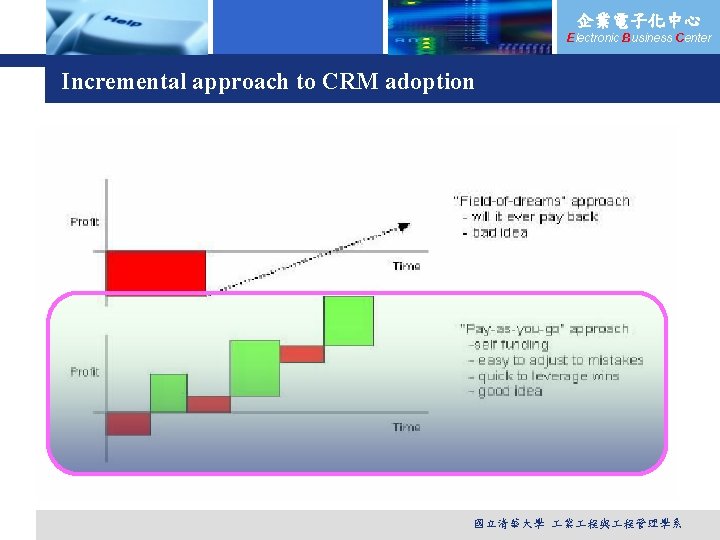
企業電子化中心 Electronic Business Center Incremental Introduction of CRM v Introducing CRM into an organization must be managed carefully. § High initial cost § Significant change on the organization’s processes v It is quite possible that insufficient care in its introduction leads to § high expense § small early benefits • low morale • excessive finger-pointing. 國立清華大學 業 程與 程管理學系
企業電子化中心 Electronic Business Center Incremental approach to CRM adoption 國立清華大學 業 程與 程管理學系
企業電子化中心 Electronic Business Center 5. Conclusion v The Internet provides an organization the ability to enter into a close, personalized dialog with its individual customers. v The maturation of data management technologies and analysis technologies have created the ideal environment for making customer relationship management a much more systematic effort. v There has been a significant growth of software vendors providing CRM software, and of using them, the focus so far has largely been on the “relationship management” part of CRM rather than on the “customer understanding” part. 國立清華大學 業 程與 程管理學系
企業電子化中心 Electronic Business Center v Ensuring that the right message is being delivered to the right person, that multiple messages being delivered at different times and through different channels are consistent, It is still in a nascent stage. v The best customers are being over communicated to, while insufficient attention is being paid to develop new ones into the best customers of the future. 國立清華大學 業 程與 程管理學系
企業電子化中心 Electronic Business Center v This paper described how Analytical CRM can fill the gap. Specifically, it described how data analytics can be used to make various CRM functions much more § customer segmentation § communication targeting § retention § loyalty v The paper hopes that the data mining community will address the analytics problems in this important and interesting application domain. 國立清華大學 業 程與 程管理學系