
CRM Crew Resource Management Rules of Engagement Participation
- Slides: 51
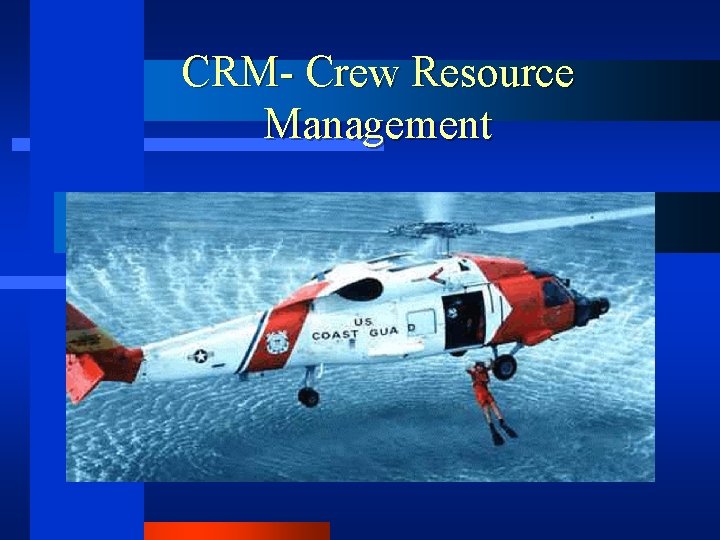
CRM- Crew Resource Management
Rules of Engagement Participation is Key Non-Attribution No Names – What Not Who
CRM – What is the Goal? To achieve Optimal Performance from a team executing multiple, complex tasks.
CRM – What is the Goal? Does Optimal Performance Equate to Perfection?
CRM…. . To Error is Human You Can Not Engage In Human Activity Without Introducing Human Error So, Can We Reach The Goal of CRM Without Eliminating Error?
Absolutely We Manage Our Errors We Incorporate Error Management into Every Aspect of CRM
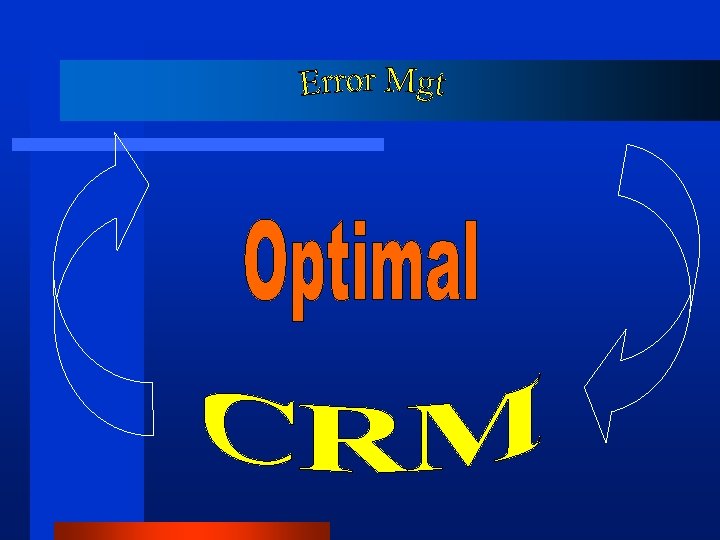
GOAL: OPTIMAL PERFORMANCE Error Management is the “What” Intervention/Prevention CRM is the “How” Trap, Mitigate, Avoid
Error Management Overview: – What it is… and, isn’t – What Error Management Seeks to Achieve – Where Error Lives – Where it Fits in Our Skills as Pilots/Aircrew
Error Management Systematic Approach to Determining Common Errors & Contributing Factors Drives Cultural Change to Accept: Error is Universal. Error is Inevitable. Shifts Focus from Who to What Teach aircrews to TRAP, MITIGATE & AVOID Error.
Error Management Error does not, has not, and will not cause an incident, an accident, or a fatality So, what does? Consequence
Error Management Consequences are not universal or inevitable. Errors happen all of the time. Incidents, accidents, and fatalities do not. EM targets the GAP between Error and Consequence!
Where Error Lives l LATENT – present but not visible…hidden in the things we do routinely l ACTIVE – present, in use…individual error
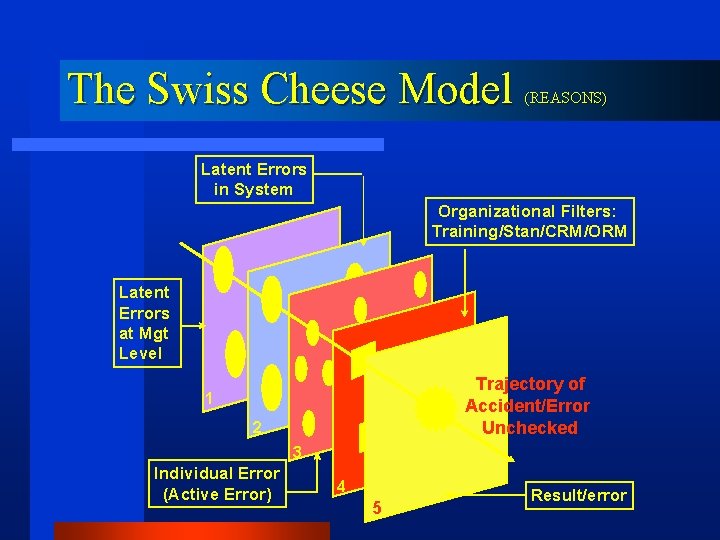
The Swiss Cheese Model (REASONS) Latent Errors in System Organizational Filters: Training/Stan/CRM/ORM Latent Errors at Mgt Level Trajectory of Accident/Error Unchecked 1 2 3 Individual Error (Active Error) 4 5 Result/error
Error Management… The Crux Mitigating the Consequence of Error Employ Error Trapping in Every Aspect of: Training Standardization CRM & ORM Error Trapping = Prevention & Intervention
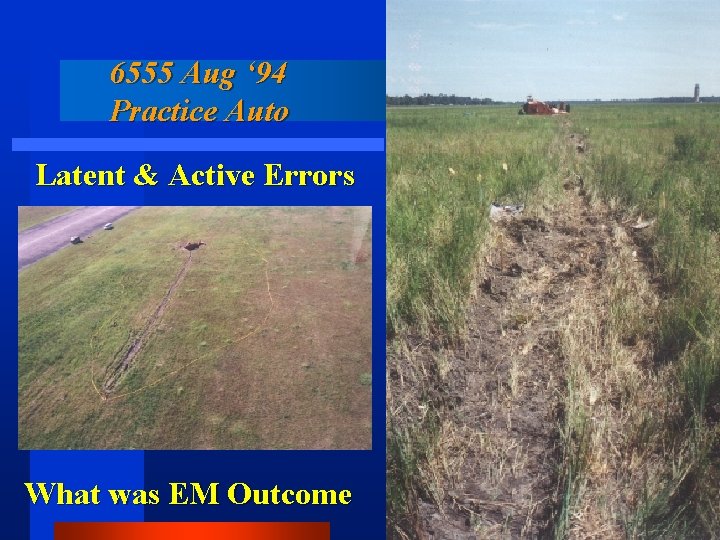
6555 Aug ‘ 94 Practice Auto Latent & Active Errors What was EM Outcome
EM & CRM Error Management must be imbedded in all four principles of CRM (SCAR)
CRM Principle - S. A. Situational Awareness… …is the realistic understanding of all factors which affect the safety and effectiveness of your crew and aircraft.
CRM Principle - S. A. l Elements of Situational Awareness? Spatial Orientation/attitude Orientation to traffic, geography & time Aircraft status & capabilities Aircrew status & Crew-life cycle Mission concept & Mission-life cycle
CRM Principle - S. A. Loss of Situational Awareness Still the Leading Cause of Aircraft Mishaps (NASA/FAA: causal factor in 65 -80% accidents) Rarely is it Instantaneous!
CRM Principle - S. A. Why do we lose Situational Awareness? Mode confusion/Automation Complacency Stress/Fatigue Stimulus Fixation Decision Making/Task Management Inadequate Error Management/Trapping “Roadblocks”
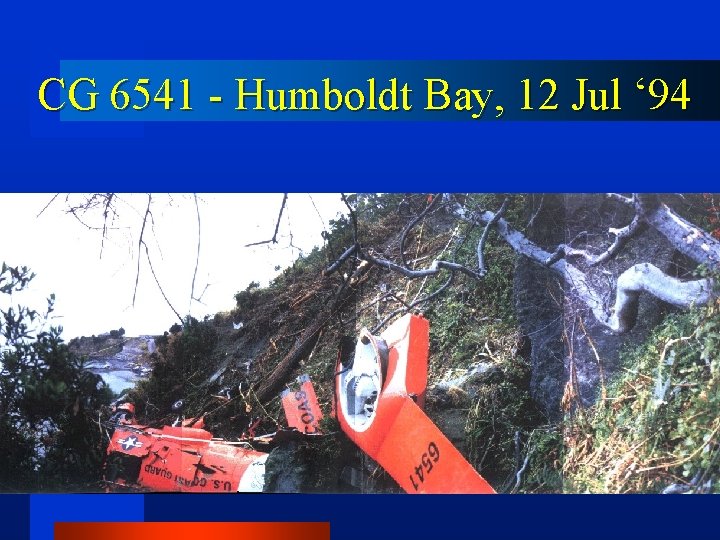
CG 6541 - Humboldt Bay, 12 Jul ‘ 94
CRM Principle - S. A. What are the “Loss of S. A. ” flags? Not Communicating No one flying the aircraft Deviating from Standards Violating Minimums Confusion Ambiguity Failure to meet targets Not addressing discrep’s Preoccupation
CRM Principle - S. A. What do you do when you suspect you have lost S. A. ? èReact è è Regain Reconstruct
ROADBLOCKS l The common obstructions to good CRM! l A combination of negative human factors, ingrained habits, and our own personal attitudes and those of the crew-members we are working with.
ROADBLOCKS l NORMS: unwritten rules that become pressures that act upon a group, be alert for “Killer Norms. ” l ODD MAN OUT: Ignore input from a particular member of the crew. Results in a loss of total crew effectiveness. l HIDDEN AGENDA: Intentionally withholding information about intentions or plans from the rest of the crew.
ROADBLOCKS (cont): l CHAIN OF ERRORS: Often the key is to recognize the chain developing-then a crewmember can act to change the situation. l BREAK THE CHAIN
ROADBLOCKS (cont): l HAZARDOUS ATTITUDES: Attitudes that impede effective CRM. – Macho - “I can do it. ” – Anti-Authority - “Don’t tell me. ” – Impulsivity - “Do something -quickly!” – Resignation - “What’s the use? ” – Missionitis - “Let’s press on. ”
FATIGUE Widely recognized enemy of pilots & crewmembers. – A low frustration threshold – Degraded coordination – Slowness in response – Carelessness – Acceptance of low standards of accuracy
ROADBLOCKS l STRENGTH OF AN IDEA: Tendency to unconsciously make the available evidence fit a preconceived situation; to see or hear what we want to hear, and substitute that for reality. It can take 15 seconds to “break” an idea that has been ingrained, but is incorrect.
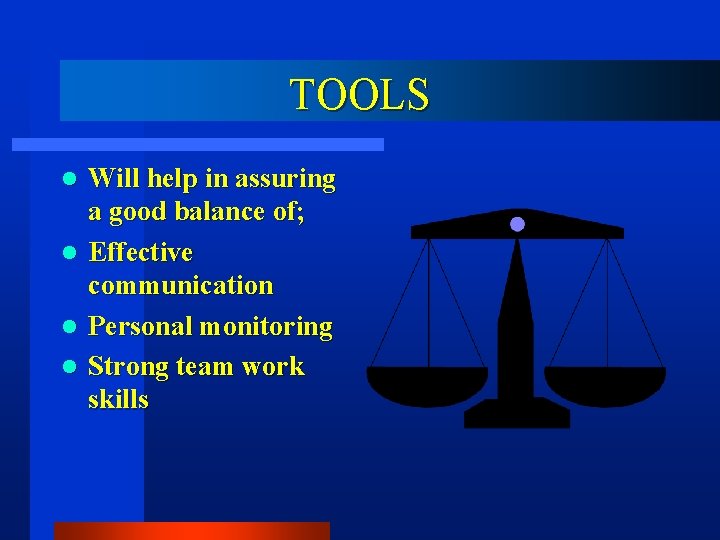
TOOLS Will help in assuring a good balance of; l Effective communication l Personal monitoring l Strong team work skills l
TOOLS cont: ERROR TRAPS STERILE COCKPIT/CABIN TWO CHALLENGE RULE
PERSONAL MONITORING “I’M SAFE” ILLNESS MEDICATION SLEEP ALCOHOL FATIGUE EATING/EXERCISE
CRM Principle - Communication Elements of Communication Skills The most obvious of the CRM principles. And, the easiest to affect through training. “Say what you mean, mean what you say. ”
CRM Principle - Communication Apply the A-B-C’s of communication Accurate Bold Concise
CRM Principle - Communication l Understand the communication loop Idea-Encode-Xmit-Receive-Decode-Idea Say what you mean, mean what you say. But, “Have I been understood? ”
CRM Principle - Assertiveness Elements of Assertive Behavior Authority with Participation Assertiveness with Respect The genuine, complete & direct communication of ideas, wants & needs.
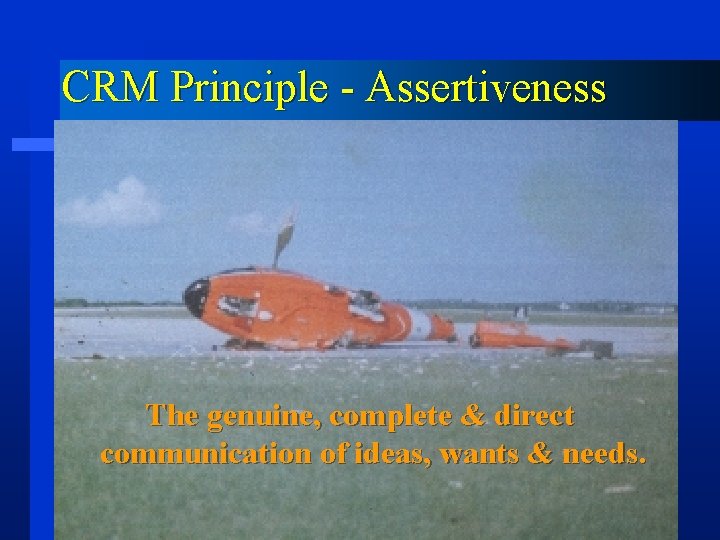
CRM Principle - Assertiveness The genuine, complete & direct communication of ideas, wants & needs.
CRM Principle - Assertiveness The Assertive Statement Open-up; get their attention State concern as “owned emotion” State the problem - real or perceived Offer a solution Obtain agreement/closure “Say what needs to be said”
CRM Principle - Risk Management RISK is a factor of: Probability Severity Exposure
Risk Management - M 3710. 1 D l What is an acceptable level of Risk? l …potential risks to the aircraft and crew shall be weighted against risks to the personnel and/or property in distress if the mission is not taken. l “probable loss of an aircrew is not an acceptable risk. ”
Operational Risk Management (ORM) History: 1996 - multi-dimensional workshop Developed common risk mgmt process Specifically tailored to our size and multi-mission nature.
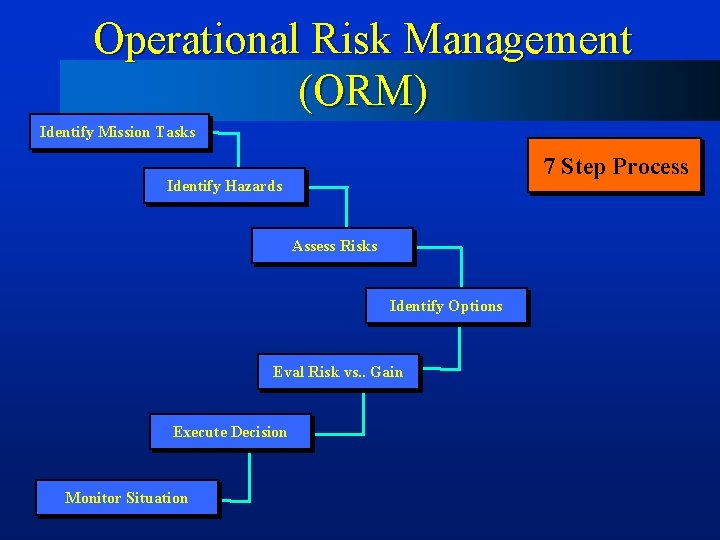
Operational Risk Management (ORM) Identify Mission Tasks 7 Step Process Identify Hazards Assess Risks Identify Options Eval Risk vs. . Gain Execute Decision Monitor Situation
Step #2: Identify Hazards l Use the “PEACE” Model to remember the 5 risk factors: – Planning – Event Complexity – Asset Selection – Communications – Environmental Conditions
Step #3: Assess the Risks SPE RISK ASSESSMENT MODEL l Risk=Severity x Probability x Exposure • Severity - Potential consequences measured in terms of degree of damage, injury, or impact on a mission. Could occur in one of these areas: • Injury or death, equip damage, mission degradation, reduced morale, adverse publicity, admin/disciplinary actions
Step #4: Identify the Options l STAAR – Spread Out – Transfer – Avoid – Accept – Reduce
Step #5: Evaluate Risk vs. . Gain l Analyze the operation’s degree of risk with the proposed controls in place l Determine if operational benefits exceed the degree of risk the operation presents l Consider cumulative risks l This is the “REALITY CHECK!”
Step #6: Execute the Decision l The risk control decision is made l Clear communication of decision clarifies rational behind risk management decision. l (Done it a hundred times, been there, etc. )
Step #7: Monitor Situation l Monitor situation to ensure controls are effective and in place l Identify and all changes requiring further risk management and act on them l Risk management is a continuous process
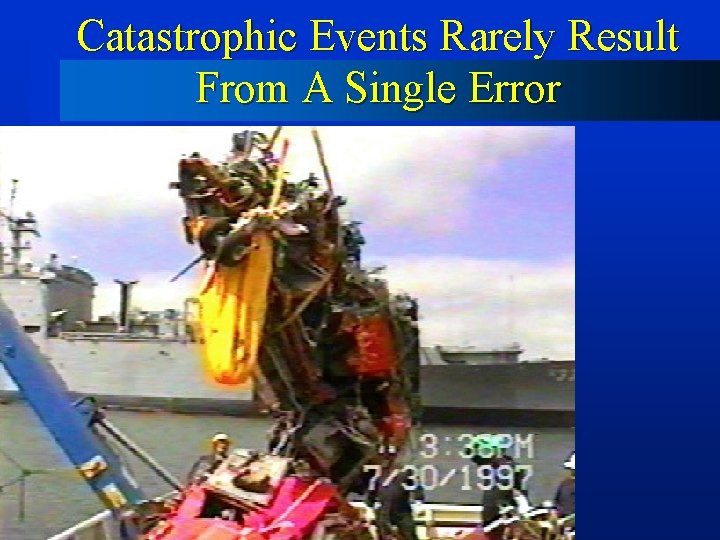
Catastrophic Events Rarely Result From A Single Error
Crew Resource Management The empowerment of all crewmembers to promote safety and increase overall aircrew performance. Think Error Management Execute CRM Skills