
Critique Synthesize Research for Use in Practice Debra
Critique & Synthesize Research for Use in Practice Debra D. Mark, Ph. D, RN, FAAN debramar@hawaii. edu
Objectives Discuss issues when critiquing the literature Discuss approaches for making clinical decisions based on the evidence Design evidence-based practice recommendations for your EBP Project
From Problems to Practice Recommendations – The Iowa Model 1. 2. 3. 4. Formulate a well-written PICO Find the evidence Critique the evidence Synthesize the evidence Develop a practice recommendation 5. Pilot the Practice Change 6. Implement the Practice Change 7. Evaluate the Practice Change
Other Literature Summaries Systematic Review Answers a single research question Uses RCTs only Defines databases & keywords Predetermined inclusion criteria i. e. , age, gender, etc. Literature Review Explores a body of literature Minimal focus on level of evidence No inclusion criteria Annotated Bibliography Series of abstracts

What? is a Literature Synthesis?
Literature Synthesis Definition: Combine separate elements to form a whole Thesis-driven Purpose: Judgments about similarities and differences: Independent variables Dependent variables Population Clinical problem Determine strengths, weaknesses, limitations, gaps For EBP: Includes level of evidence

When Am I Ready to Synthesize?

When You’ve: Exhausted the literature Know (really know) the state of the science Take a birds-eye view Ask yourself: What is the literature telling me to do? (that’s different from what we’re doing now)
Making Practice Recommendations
Base Clinical Decisions On: Quality, quantity & consistency of findings Level of evidence Volume of studies w/similar sample characteristics Consistency among evidence from all sources Feasibility for practice Relevance of research findings for practice Individual patient circumstances, values, preferences Other Risk/benefit ratio Titler, M. G. & Schmitt, M. (2001). Evidence-Based Practice Web-based course. http: //www. nursing. uiowa. edu/sites/users/Gardery/ebp/
Tips for Success Conduct thorough search for evidence Carefully critique the evidence Practice recommendations are not easy to make. Consider Organizational culture Patient values Provider tolerances “Don’t wallow in the literature” (M. Titler)
Not Enough Evidence? Seek help from a librarian Use lower levels of evidence Consult experts Consider conducting research, prn Greenhalgh, T. , Robert, G. , Mac. Farlane, F. , Bate, P. , & Kyriakidou, O. (2004). Diffusion of innovation in service organizations: systematic review and recommendations. Millbank Quarterly, 82(4), 581 -629.

How? Do I Write a Literature Syntheis?
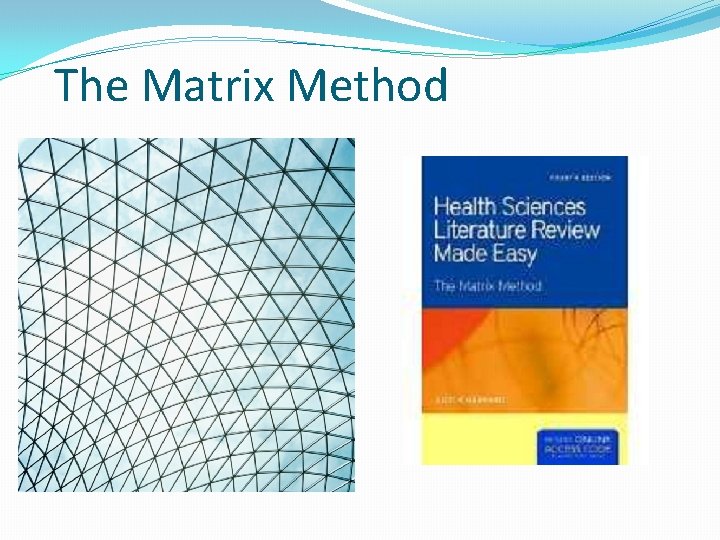
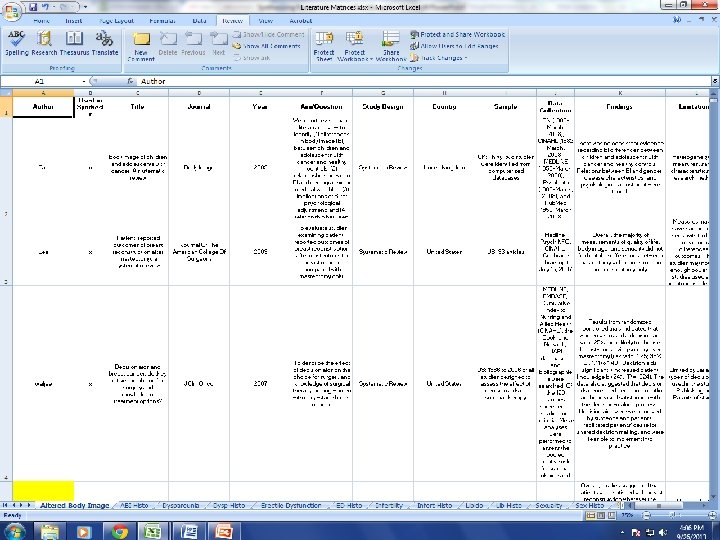
The Matrix Method
Put it Together in One Place Excel! One article per row Allows for sorting by: Date Author Level of evidence Etc. See the big picture Identify common themes
Organize by Sub-Topics: Sexuality �Altered Body Image �Dyspareunia �Erectile Dysfunction �Infertility �Libido

Writing a Synthesis Statement
Start with Search Method Search Strategy Keywords (Key concepts) Limits i. e. Years Searched Databases (Resources) Number of articles critiqued: ## Critique method: How many reviewers per article Blind review Grading Criteria: Mosby’s, USPSTF, etc.
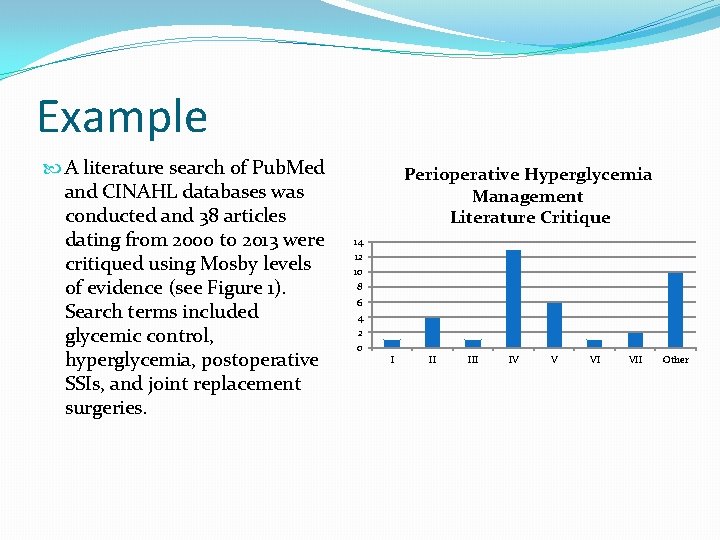
Example A literature search of Pub. Med and CINAHL databases was conducted and 38 articles dating from 2000 to 2013 were critiqued using Mosby levels of evidence (see Figure 1). Search terms included glycemic control, hyperglycemia, postoperative SSIs, and joint replacement surgeries. Perioperative Hyperglycemia Management Literature Critique 14 12 10 8 6 4 2 0 I II IV V VI VII Other
What Did You Find? Write one or more synthesis statements Start with each subtopic/worksheet
Example # 1: Hyperglycemia Mgt Hyperglycemia management reduces surgical site infections (SSI) regardless of a pre-existing history of diabetes, especially in the first 48 hours post-op Recommend blood glucose (BG) level screening prior to elective surgery. Ideal targets are: A pre-meal BG level < 110 mg/d. L A post-prandial BG level < 180 mg/d. L W ’s hat ? g n i iss m Delay surgery until BG is at an acceptable level Sliding scale insulin is not effective Conflicting evidence whether Hgb A 1 C is an indicator for increased risk of SSI
Example # 2: Phlebitis “A number of studies have found that the incidence of phlebitis is directly related to the method of administering intravenous infusions (Dayton, 1998, Level II; Stainback, 1996, Level III; Whitman & Coxe, 1997, Level I). ”
Example # 3: Post-op GI Assessment Return of motility sequence: small intestine, stomach, colon (Hotokezaka, et al. , 1996; Livingston & Passaro, 1990; Schippers, et al. , 1991) Monitoring bowel sounds does not serve to indicate recovery of motility s/p abdominal surgery patients (Huge et al. , 2000) Primary markers of return of GI motility are return of flatus and first BM (Bauer et al. , 1985) Practice Recommendation: Assess for flatus & first BM Monitor for ileus
Conclusion Discuss issues when critiquing the literature Discuss approaches for making clinical decisions based on the evidence Design evidence-based practice recommendations for your EBP Project

Your Turn! Turn your articles face-down Take a deep breath Take a birds-eye view Think about all of your evidence (to-date) Ask yourself: What is the literature telling me to do? Write three (3) evidence-based recommendations for your EBP Project When done, turn your articles over: Put citations & level of evidence after each recommendation
- Slides: 26