
Criticisms of NPVDCF 1 Assumes that cash flow


- Slides: 38
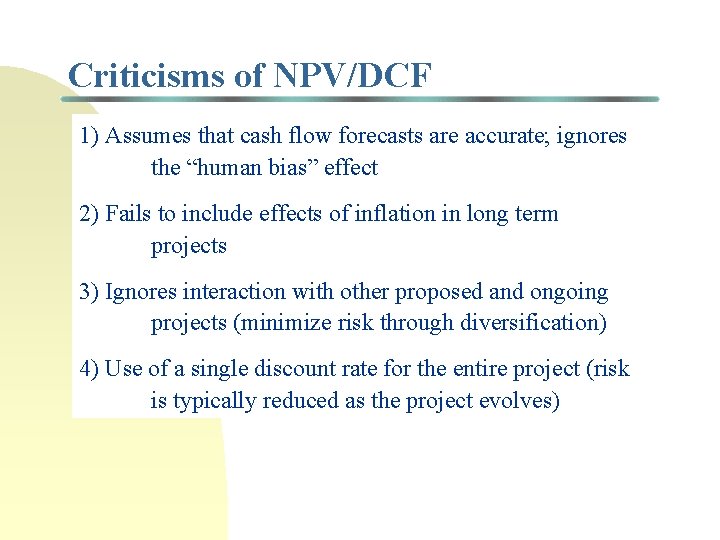
Criticisms of NPV/DCF 1) Assumes that cash flow forecasts are accurate; ignores the “human bias” effect 2) Fails to include effects of inflation in long term projects 3) Ignores interaction with other proposed and ongoing projects (minimize risk through diversification) 4) Use of a single discount rate for the entire project (risk is typically reduced as the project evolves)
Expected Commercial Value (ECV) Probability = pc Commercial Success (with net benefit = NPV) Probability = pt Technical Success Develop New Product Probability = 1 - pt Launch New Product Probability = 1 - pc Commercial Failure (with net benefit = 0) Technical Failure Risk class 1 Risk class 2
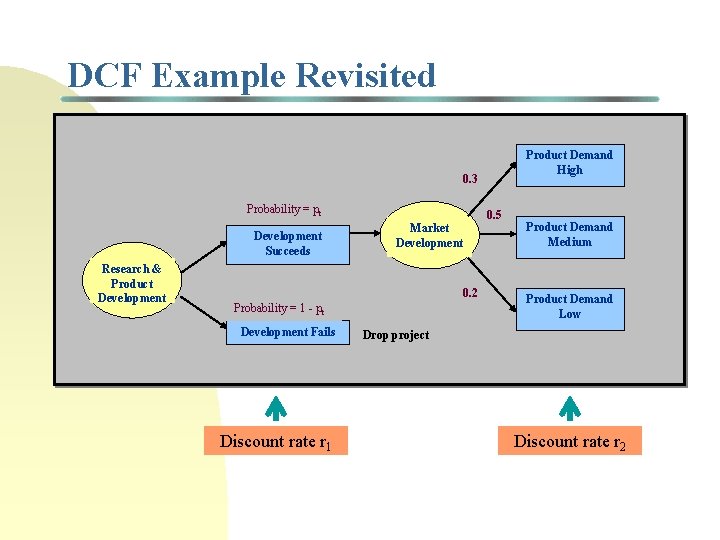
DCF Example Revisited Product Demand High 0. 3 Probability = pt Development Succeeds Research & Product Development Market Development 0. 2 Probability = 1 - pt Development Fails Discount rate r 1 0. 5 Product Demand Medium Product Demand Low Drop project Discount rate r 2
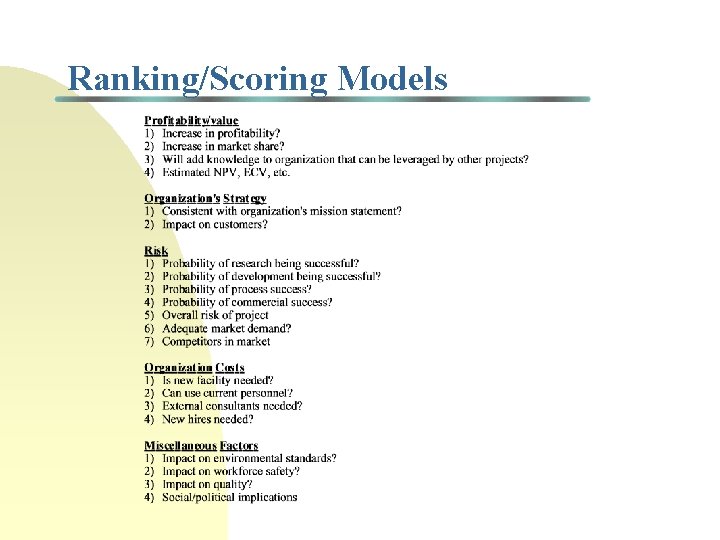
Ranking/Scoring Models
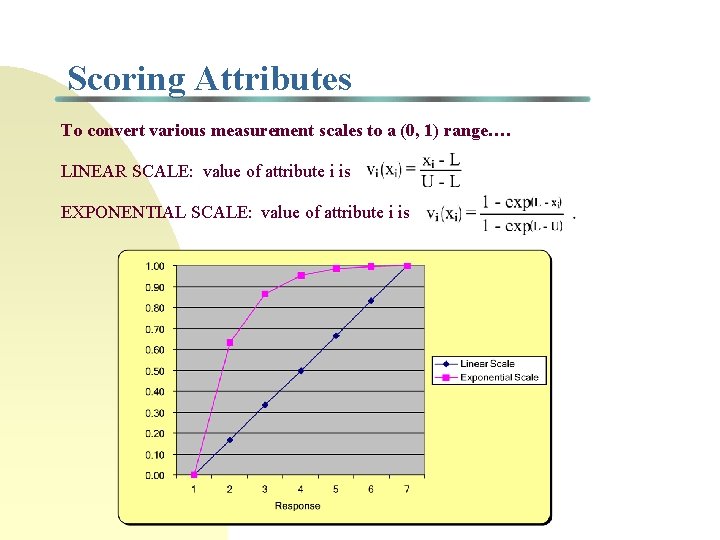
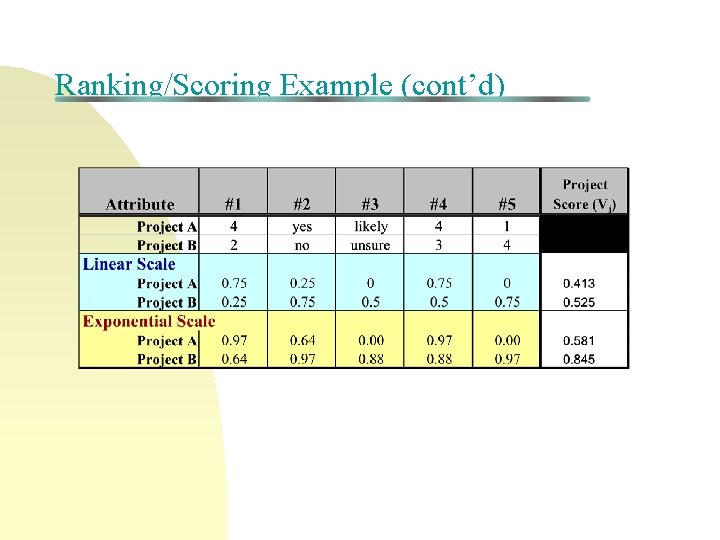
Scoring Attributes To convert various measurement scales to a (0, 1) range…. LINEAR SCALE: value of attribute i is EXPONENTIAL SCALE: value of attribute i is
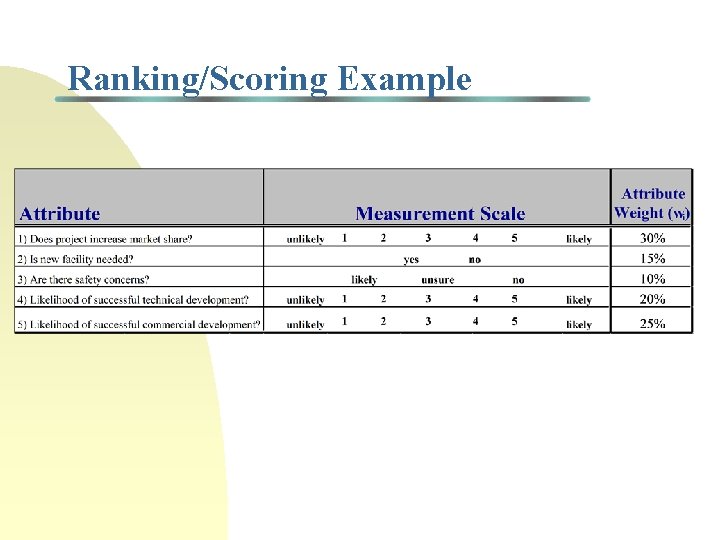
Ranking/Scoring Example
Ranking/Scoring Example (cont’d)
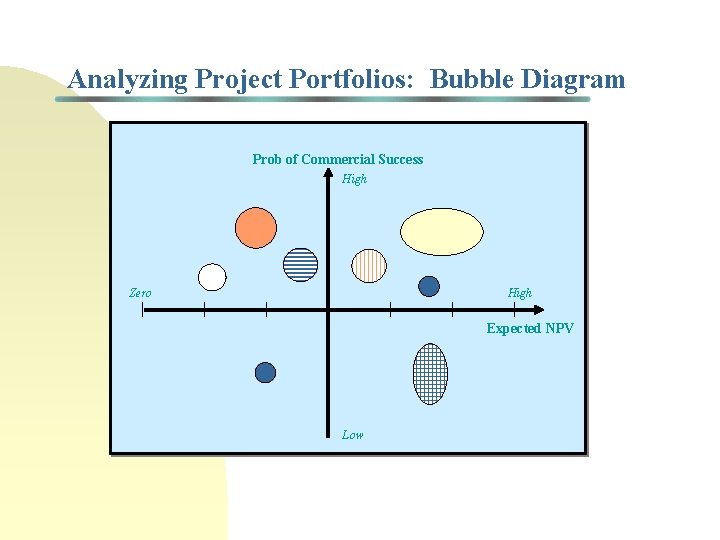
Analyzing Project Portfolios: Bubble Diagram Prob of Commercial Success High Zero High Expected NPV Low
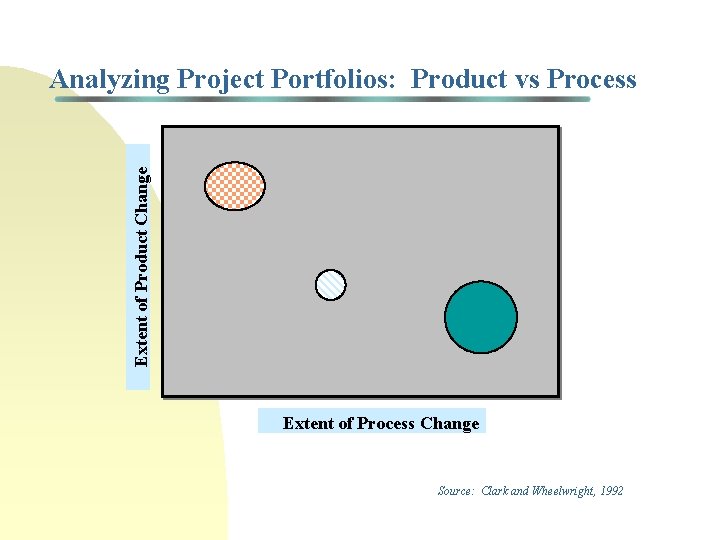
Extent of Product Change Analyzing Project Portfolios: Product vs Process Extent of Process Change Source: Clark and Wheelwright, 1992
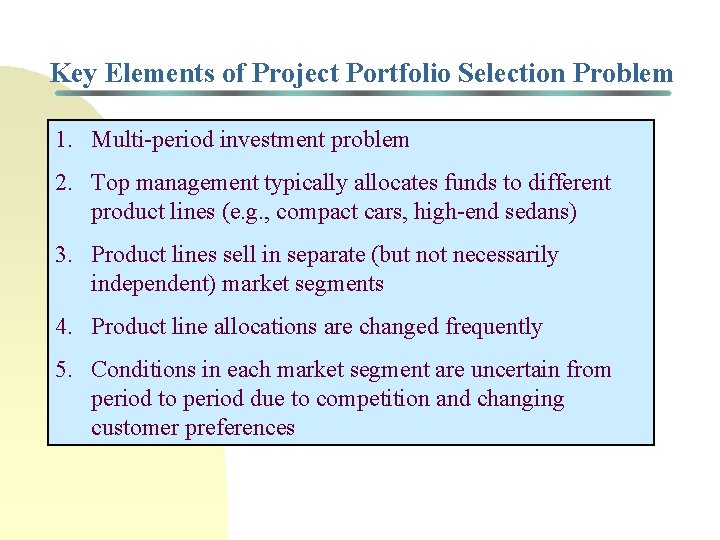
Key Elements of Project Portfolio Selection Problem 1. Multi-period investment problem 2. Top management typically allocates funds to different product lines (e. g. , compact cars, high-end sedans) 3. Product lines sell in separate (but not necessarily independent) market segments 4. Product line allocations are changed frequently 5. Conditions in each market segment are uncertain from period to period due to competition and changing customer preferences
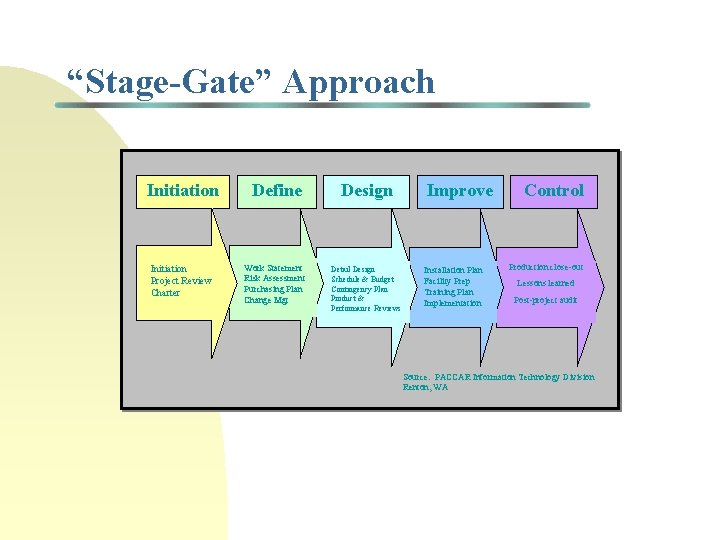
“Stage-Gate” Approach Initiation Define Design Initiation Project Review Charter Work Statement Risk Assessment Purchasing Plan Change Mgt Detail Design Schedule & Budget Contingency Plan Product & Performance Reviews Improve Installation Plan Facility Prep Training Plan Implementation Control Production close-out Lessons learned Post-project audit Source: PACCAR Information Technology Division Renton, WA
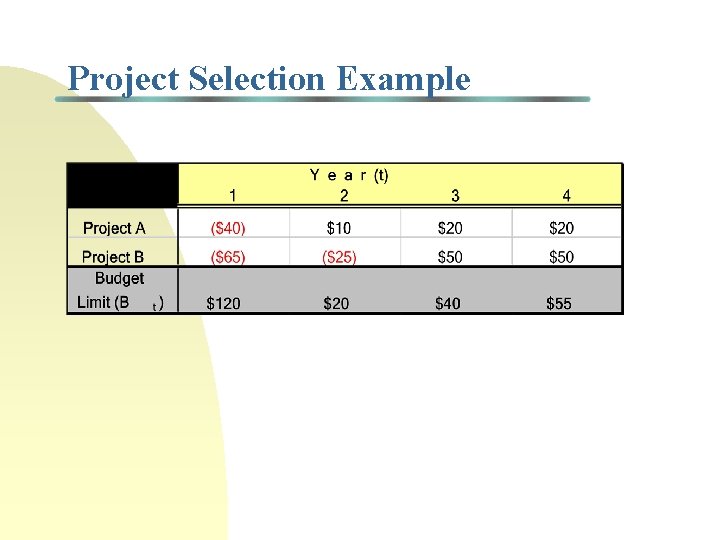
Project Selection Example
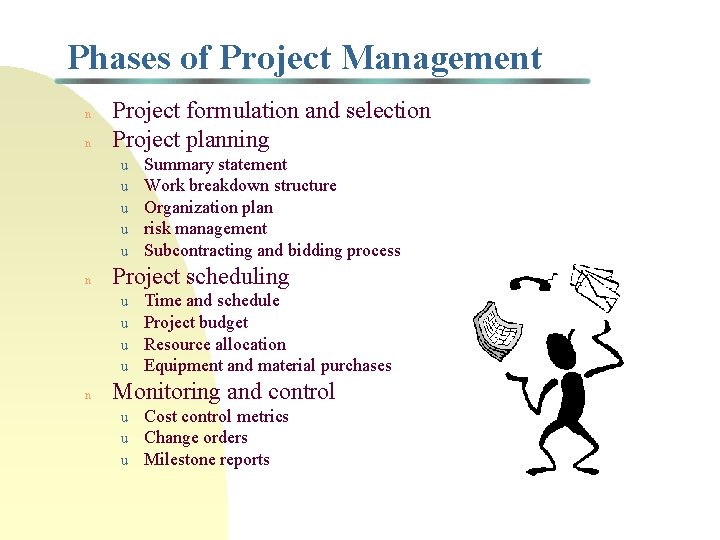
Phases of Project Management n n Project formulation and selection Project planning u u u n Project scheduling u u n Summary statement Work breakdown structure Organization plan risk management Subcontracting and bidding process Time and schedule Project budget Resource allocation Equipment and material purchases Monitoring and control u u u Cost control metrics Change orders Milestone reports
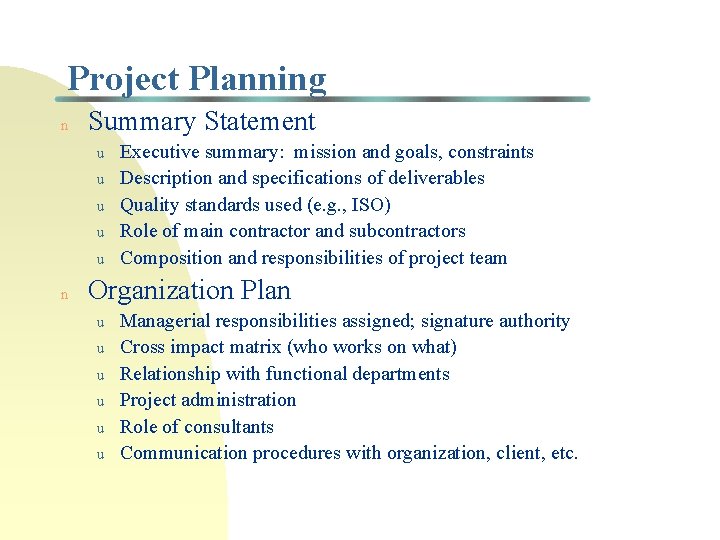
Project Planning n Summary Statement u u u n Executive summary: mission and goals, constraints Description and specifications of deliverables Quality standards used (e. g. , ISO) Role of main contractor and subcontractors Composition and responsibilities of project team Organization Plan u u u Managerial responsibilities assigned; signature authority Cross impact matrix (who works on what) Relationship with functional departments Project administration Role of consultants Communication procedures with organization, client, etc.
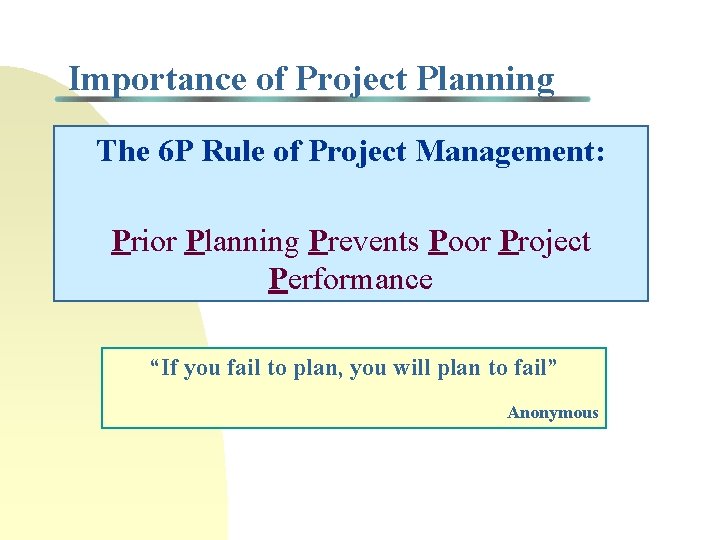
Importance of Project Planning The 6 P Rule of Project Management: Prior Planning Prevents Poor Project Performance “If you fail to plan, you will plan to fail” Anonymous
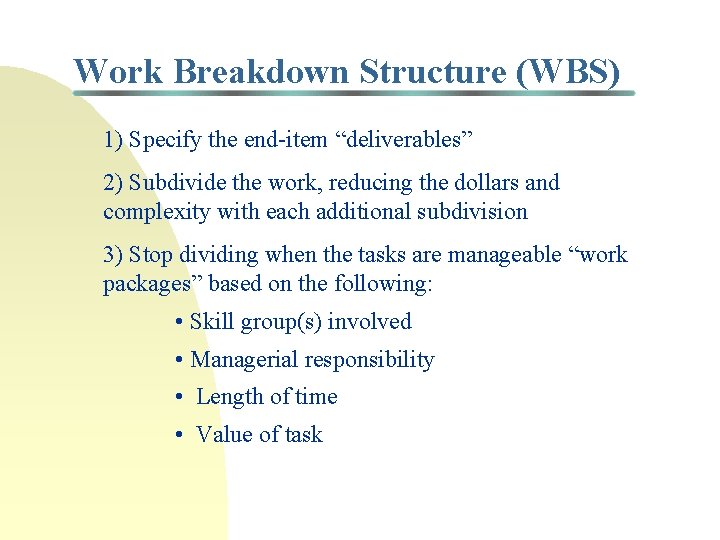
Work Breakdown Structure (WBS) 1) Specify the end-item “deliverables” 2) Subdivide the work, reducing the dollars and complexity with each additional subdivision 3) Stop dividing when the tasks are manageable “work packages” based on the following: • Skill group(s) involved • Managerial responsibility • Length of time • Value of task
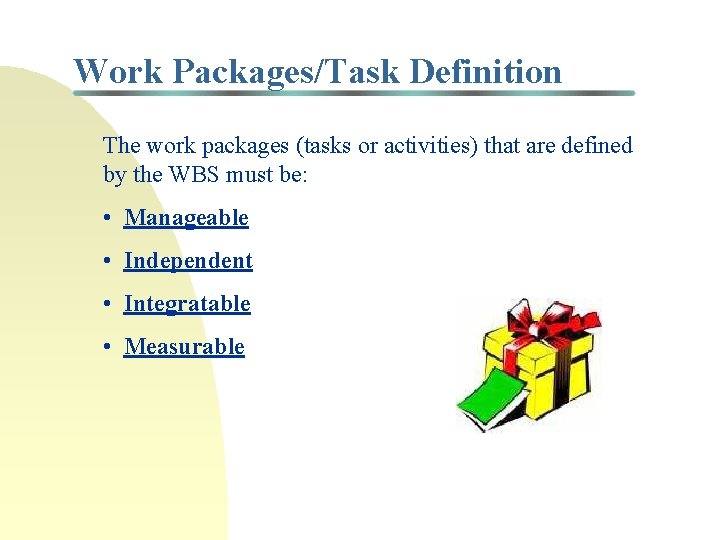
Work Packages/Task Definition The work packages (tasks or activities) that are defined by the WBS must be: • Manageable • Independent • Integratable • Measurable
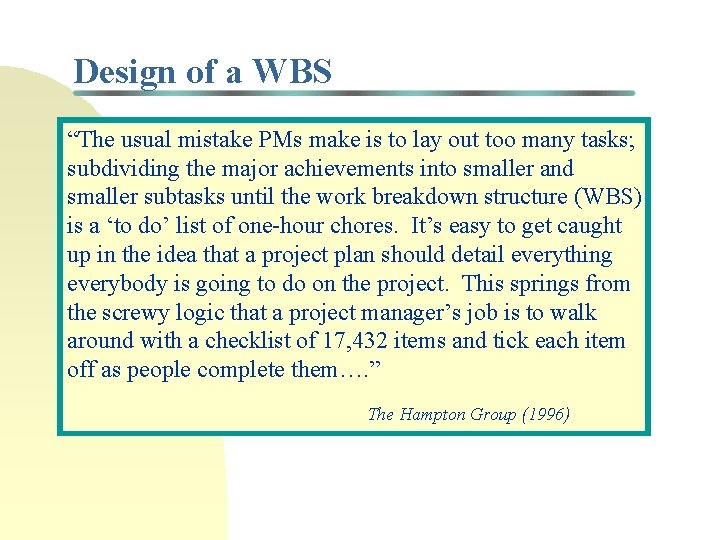
Design of a WBS “The usual mistake PMs make is to lay out too many tasks; subdividing the major achievements into smaller and smaller subtasks until the work breakdown structure (WBS) is a ‘to do’ list of one-hour chores. It’s easy to get caught up in the idea that a project plan should detail everything everybody is going to do on the project. This springs from the screwy logic that a project manager’s job is to walk around with a checklist of 17, 432 items and tick each item off as people complete them…. ” The Hampton Group (1996)
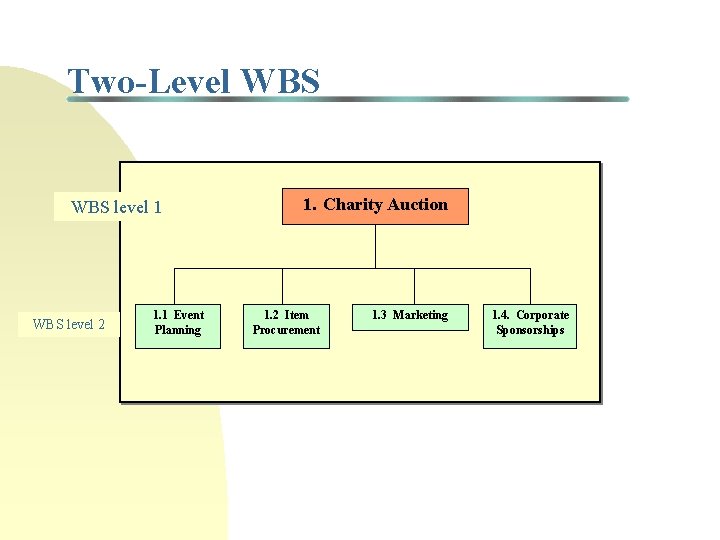
Two-Level WBS level 1 WBS level 2 1. 1 Event Planning 1. Charity Auction 1. 2 Item Procurement 1. 3 Marketing 1. 4. Corporate Sponsorships
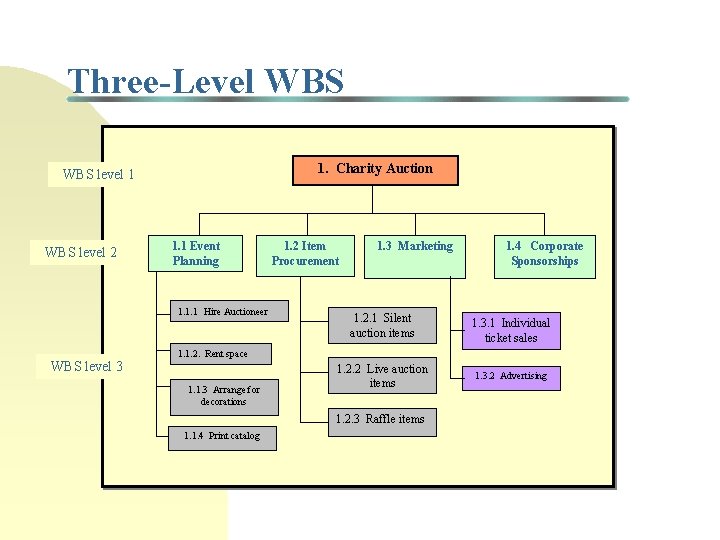
Three-Level WBS 1. Charity Auction WBS level 1 WBS level 2 1. 1 Event Planning 1. 1. 1 Hire Auctioneer WBS level 3 1. 2 Item Procurement 1. 3 Marketing 1. 4 Corporate Sponsorships 1. 2. 1 Silent auction items 1. 3. 1 Individual ticket sales 1. 2. 2 Live auction items 1. 3. 2 Advertising 1. 1. 2. Rent space 1. 1. 3 Arrange for decorations 1. 2. 3 Raffle items 1. 1. 4 Print catalog
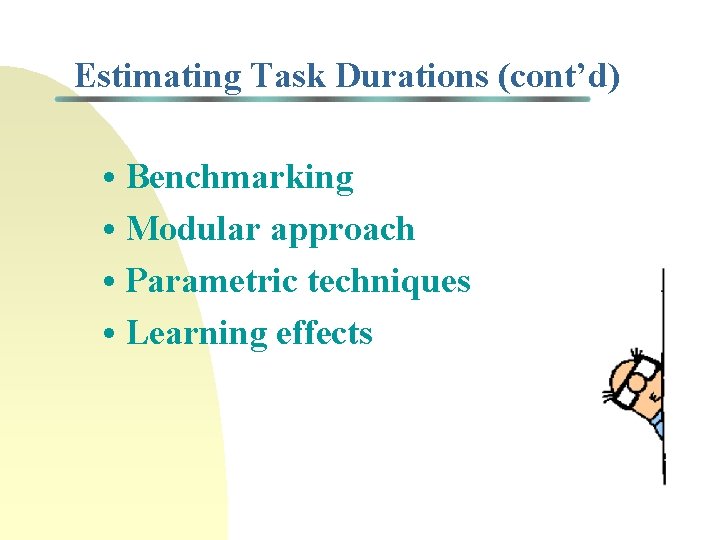
Estimating Task Durations (cont’d) • Benchmarking • Modular approach • Parametric techniques • Learning effects
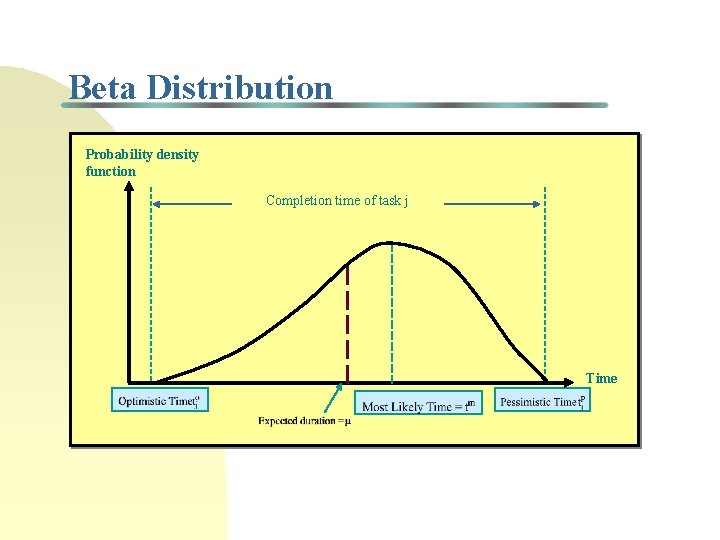
Beta Distribution Probability density function Completion time of task j Time
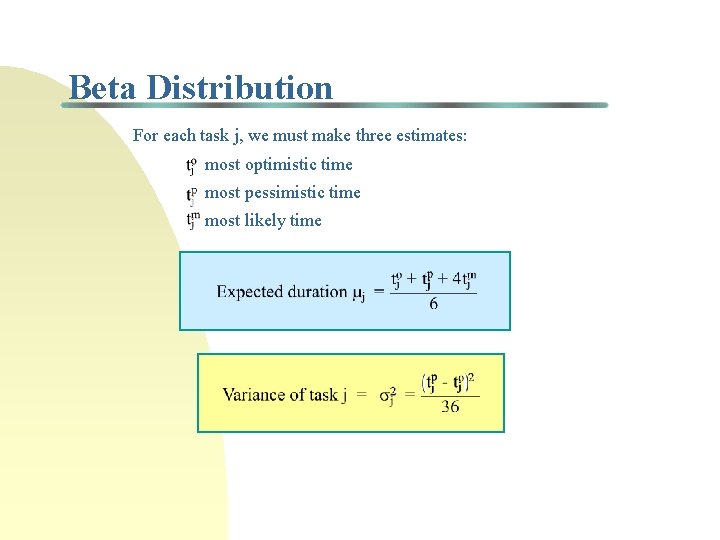
Beta Distribution For each task j, we must make three estimates: most optimistic time most pessimistic time most likely time
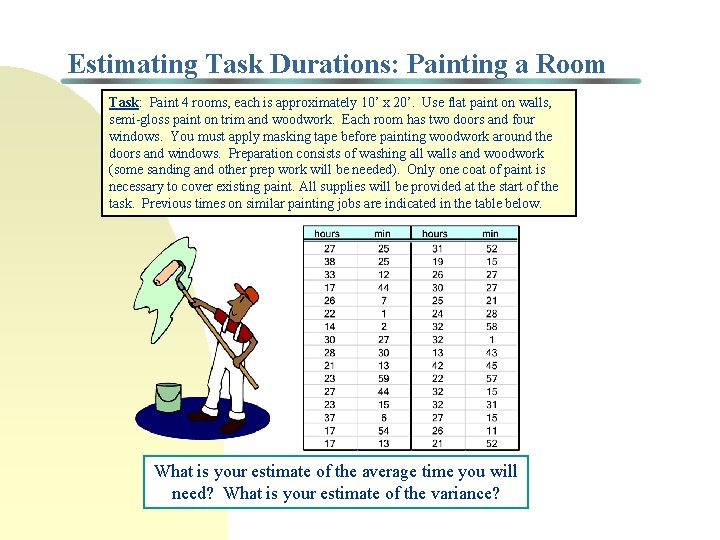
Estimating Task Durations: Painting a Room Task: Paint 4 rooms, each is approximately 10’ x 20’. Use flat paint on walls, semi-gloss paint on trim and woodwork. Each room has two doors and four windows. You must apply masking tape before painting woodwork around the doors and windows. Preparation consists of washing all walls and woodwork (some sanding and other prep work will be needed). Only one coat of paint is necessary to cover existing paint. All supplies will be provided at the start of the task. Previous times on similar painting jobs are indicated in the table below. What is your estimate of the average time you will need? What is your estimate of the variance?
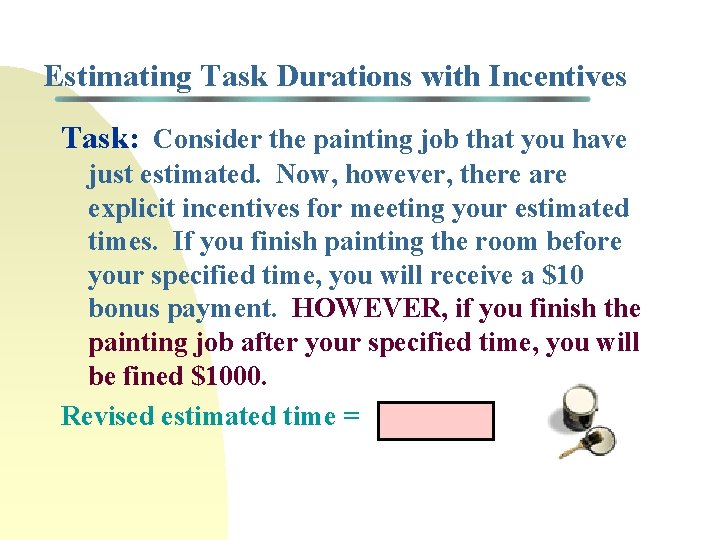
Estimating Task Durations with Incentives Task: Consider the painting job that you have just estimated. Now, however, there are explicit incentives for meeting your estimated times. If you finish painting the room before your specified time, you will receive a $10 bonus payment. HOWEVER, if you finish the painting job after your specified time, you will be fined $1000. Revised estimated time =
Estimating Task Durations with Incentives Task: Consider the painting job that you have just estimated. Now, however, there are explicit incentives for meeting your estimated times. If you finish painting the room before your specified time, you will receive a $10 bonus payment. If you finish the painting job after your specified time, there is no penalty. Revised estimated time =
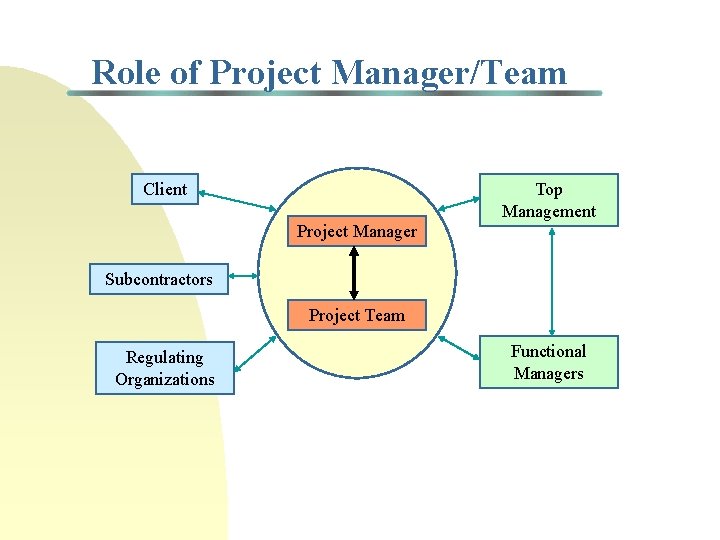
Role of Project Manager/Team Client Top Management Project Manager Subcontractors Project Team Regulating Organizations Functional Managers
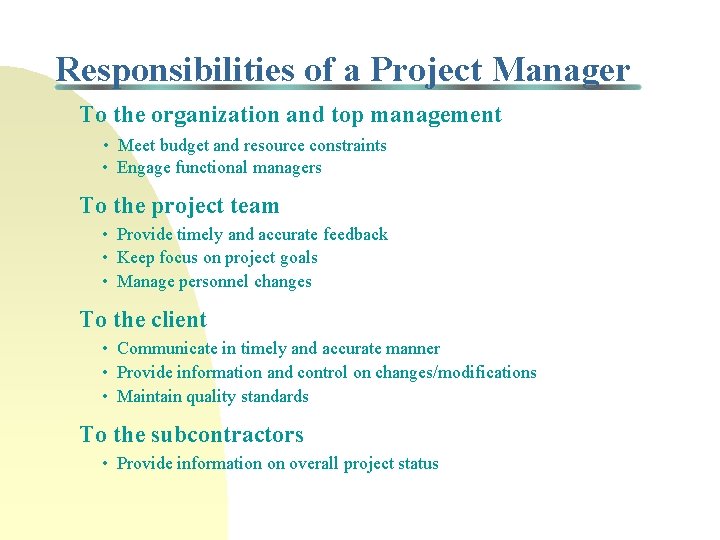
Responsibilities of a Project Manager To the organization and top management • Meet budget and resource constraints • Engage functional managers To the project team • Provide timely and accurate feedback • Keep focus on project goals • Manage personnel changes To the client • Communicate in timely and accurate manner • Provide information and control on changes/modifications • Maintain quality standards To the subcontractors • Provide information on overall project status
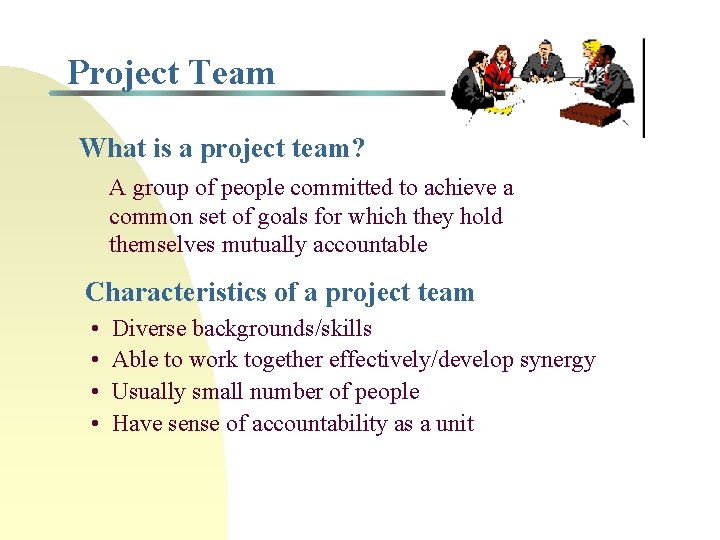
Project Team What is a project team? A group of people committed to achieve a common set of goals for which they hold themselves mutually accountable Characteristics of a project team • • Diverse backgrounds/skills Able to work together effectively/develop synergy Usually small number of people Have sense of accountability as a unit
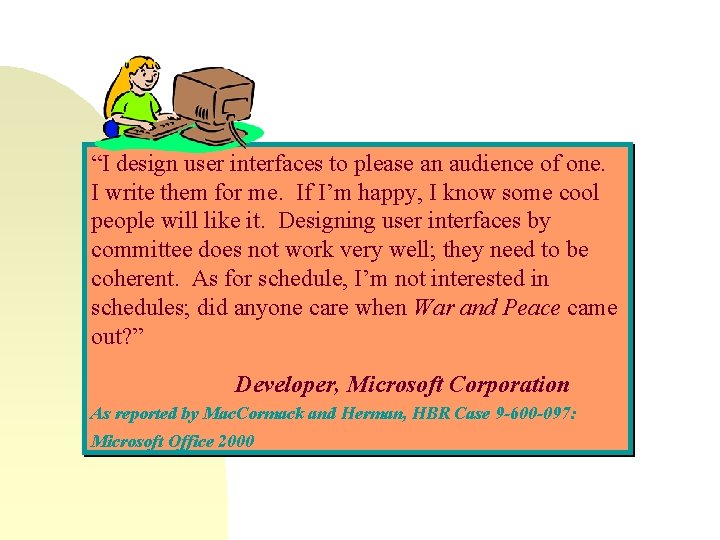
“I design user interfaces to please an audience of one. I write them for me. If I’m happy, I know some cool people will like it. Designing user interfaces by committee does not work very well; they need to be coherent. As for schedule, I’m not interested in schedules; did anyone care when War and Peace came out? ” Developer, Microsoft Corporation As reported by Mac. Cormack and Herman, HBR Case 9 -600 -097: Microsoft Office 2000
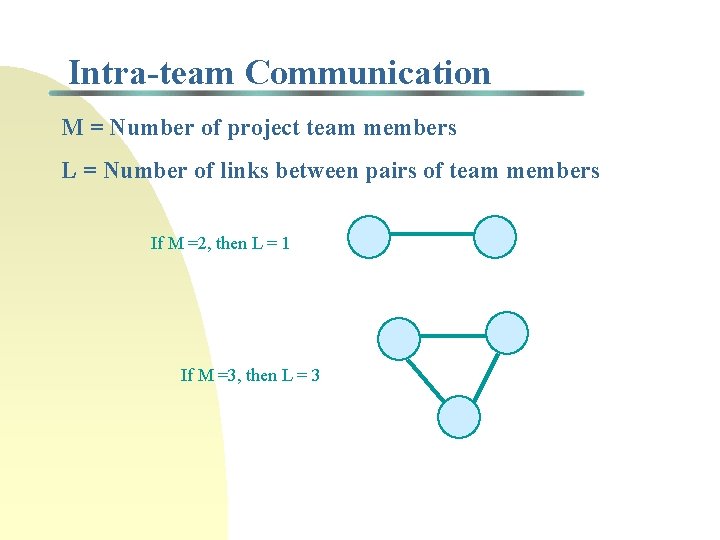
Intra-team Communication M = Number of project team members L = Number of links between pairs of team members If M =2, then L = 1 If M =3, then L = 3
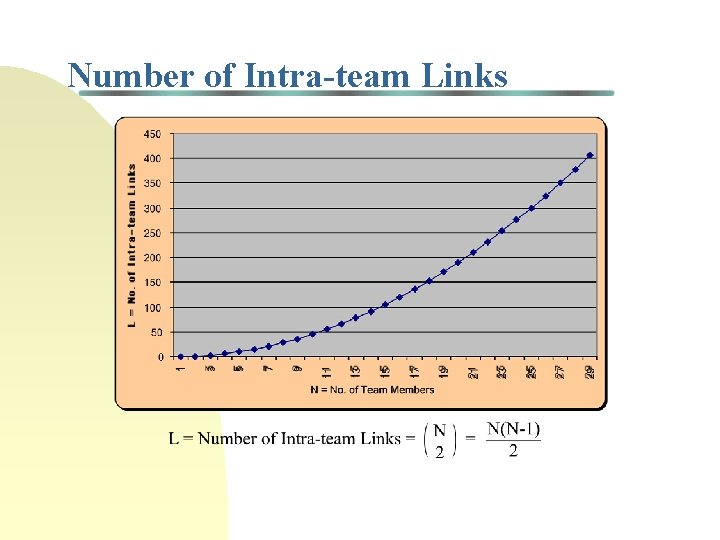
Number of Intra-team Links
Importance of Communication On the occasion of a migration from the east, men discovered a plain in the land of Shinar, and … said to one another, “Come, let us build ourselves a city with a tower whose top shall reach the heavens…. ” The Lord said, …“Come, let us go down, and there make such a babble of their language that they will not understand one another’s speech. ” Thus, the Lord dispersed them from there all over the earth, so that they had to stop building the city. Genesis 11: 1 -8
Project Performance and Group Harmony What is the relationship between the design of multidisciplinary project teams and project success? Two schools of thought: 1) “Humanistic school” -- groups that have positive characteristics will perform well 2) “Task oriented” school -- positive group characteristics detract from group performance
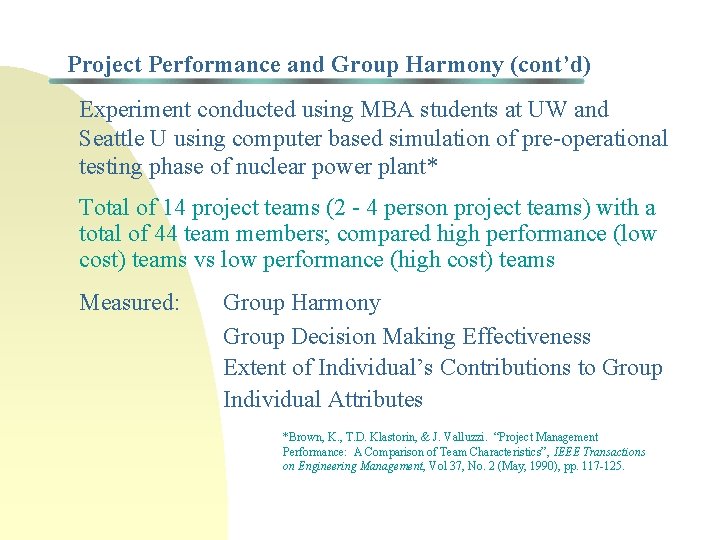
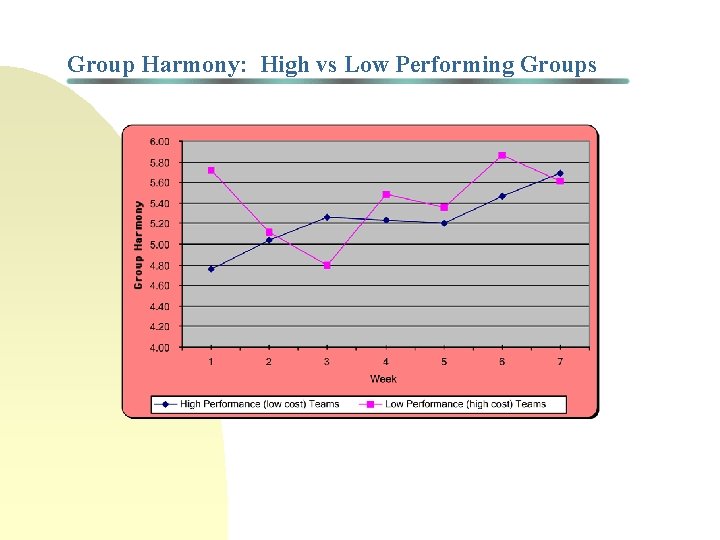
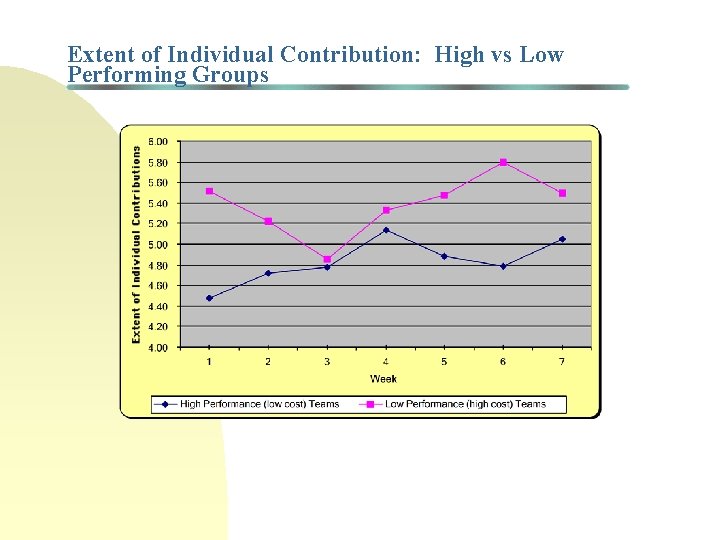
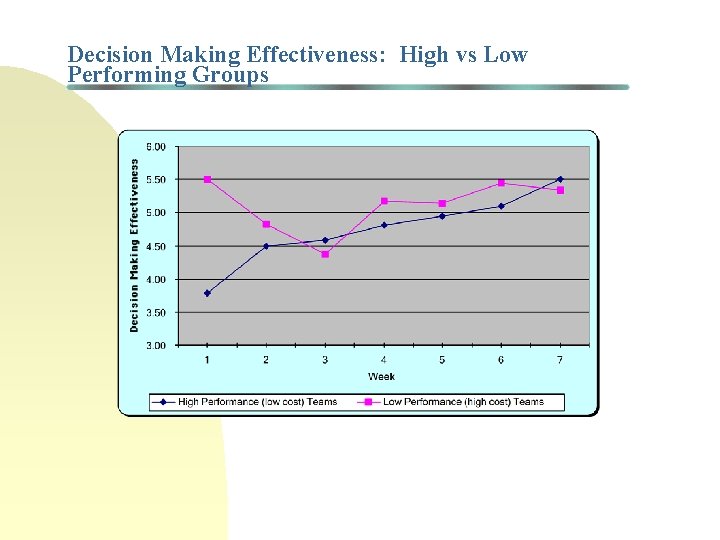
Project Performance and Group Harmony (cont’d) Experiment conducted using MBA students at UW and Seattle U using computer based simulation of pre-operational testing phase of nuclear power plant* Total of 14 project teams (2 - 4 person project teams) with a total of 44 team members; compared high performance (low cost) teams vs low performance (high cost) teams Measured: Group Harmony Group Decision Making Effectiveness Extent of Individual’s Contributions to Group Individual Attributes *Brown, K. , T. D. Klastorin, & J. Valluzzi. “Project Management Performance: A Comparison of Team Characteristics”, IEEE Transactions on Engineering Management, Vol 37, No. 2 (May, 1990), pp. 117 -125.
Group Harmony: High vs Low Performing Groups
Extent of Individual Contribution: High vs Low Performing Groups
Decision Making Effectiveness: High vs Low Performing Groups