
CriticalState Soil Mechanics For Dummies Paul W Mayne
- Slides: 22
Critical-State Soil Mechanics For Dummies Paul W. Mayne, Ph. D, P. E. Civil & Environmental Engineering Georgia Institute of Technology Atlanta, GA 30332 -0355 www. ce. gatech. edu Email: paul. mayne@ce. gatech. edu 2006
PROLOGUE q Critical-state soil mechanics is an effective stress framework describing mechanical soil response q q q In its simplest form here, we consider only shearinduced loading. We merely tie together two well-known concepts: (1) one-dimensional consolidation behavior, represented by e-logsv’ curves; and (2) shear stress -vs. normal stress (t-sv’) from direct shear box or simple shearing. Herein, only the bare essence of CSSM concepts are presented, sufficient to describe strength & compressibility response.
Critical State Soil Mechanics (CSSM) q Experimental evidence provided by Hvorslev (1936; 1960, ASCE); Henkel (1960, ASCE Boulder) Henkel & Sowa (1961, ASTM STP 361) q q q Mathematics presented elsewhere, including: Schofield & Wroth (1968); Burland (1968); Wood (1990). In basic form: 3 material constants (f', Cc, Cs) state (e 0, svo', OCR) plus initial Constitutive Models, include: Original Cam-Clay, Modified Cam Clay, Nor. Sand, Bounding Surface, MIT-E 3 (Whittle, 1993) & MIT-S 1 (Pestana) and others (Adachi, Oka, Ohta, Dafalias) "Undrained" is just one specific stress path Yet !!! CSSM is missing from most textbooks and undergrad & grad curricula in the USA.
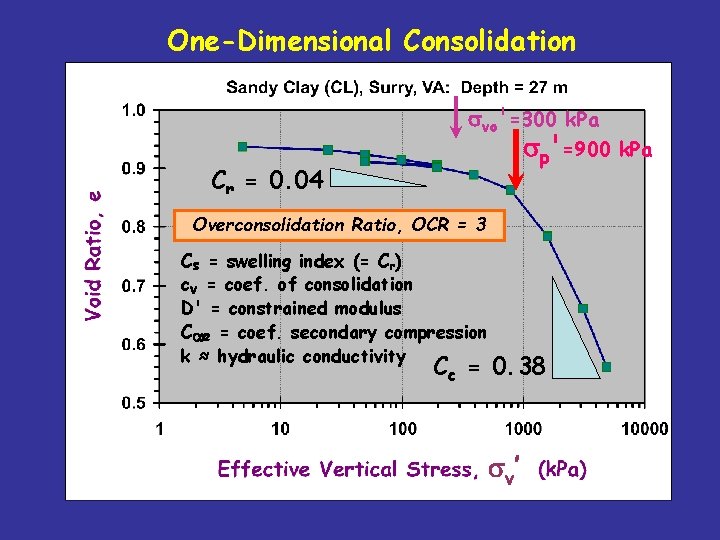
One-Dimensional Consolidation svo'=300 k. Pa sp'=900 Cr = 0. 04 Overconsolidation Ratio, OCR = 3 Cs = swelling index (= Cr) cv = coef. of consolidation D' = constrained modulus Cae = coef. secondary compression k ≈ hydraulic conductivity Cc = 0. 38 sv ’ k. Pa
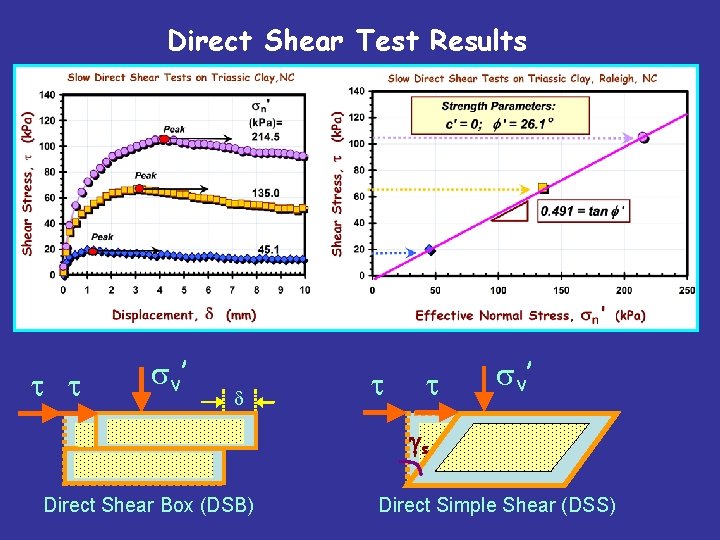
Direct Shear Test Results t t sv ’ d t t sv ’ gs Direct Shear Box (DSB) Direct Simple Shear (DSS)
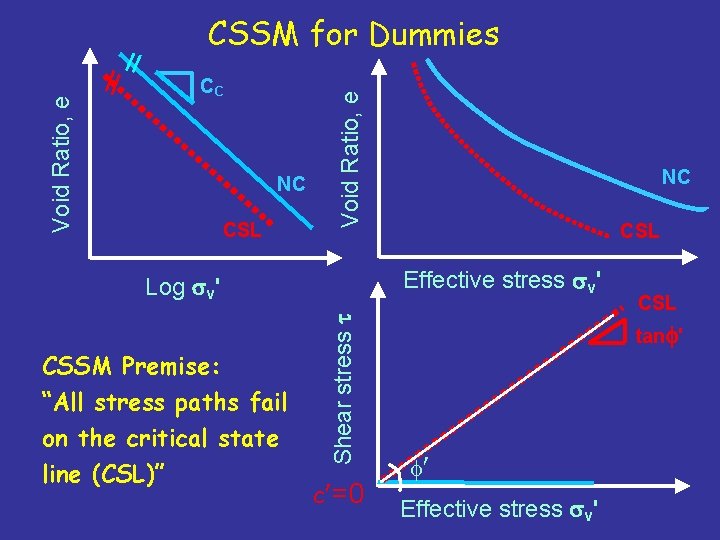
CC NC CSL Void Ratio, e CSSM for Dummies CSL Effective stress sv' Shear stress t Log sv' CSSM Premise: “All stress paths fail on the critical state line (CSL)” NC c =0 CSL tanf' f Effective stress sv'
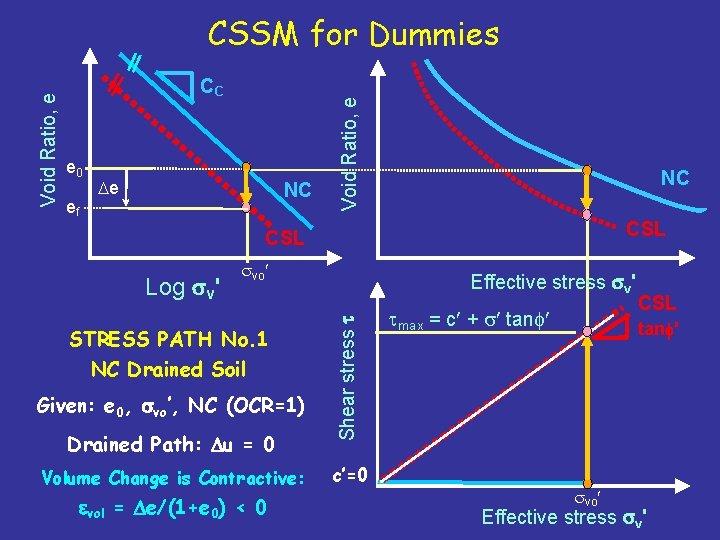
CC e 0 ef De NC Void Ratio, e CSSM for Dummies NC CSL STRESS PATH No. 1 NC Drained Soil Given: e 0, svo’, NC (OCR=1) Drained Path: Du = 0 Volume Change is Contractive: evol = De/(1+e 0) < 0 Effective stress sv' Shear stress t Log sv' svo c’=0 tmax = c + s tanf CSL tanf' svo Effective stress sv'
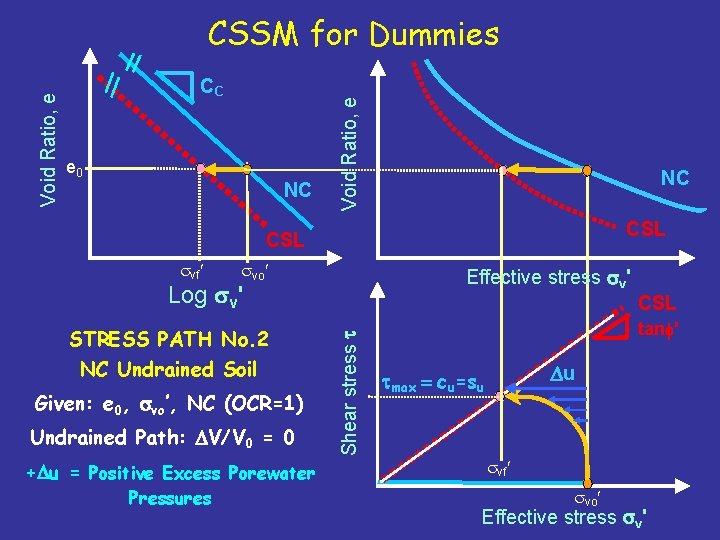
CC e 0 NC Void Ratio, e CSSM for Dummies NC CSL svf svo Effective stress sv' Log sv' Given: e 0, svo’, NC (OCR=1) Undrained Path: DV/V 0 = 0 +Du = Positive Excess Porewater Pressures Shear stress t STRESS PATH No. 2 NC Undrained Soil CSL tanf' Du tmax = cu=su svf svo Effective stress sv'
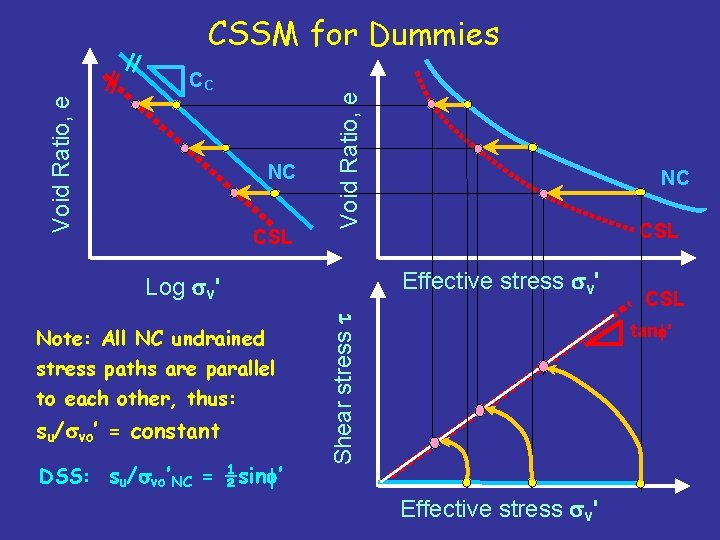
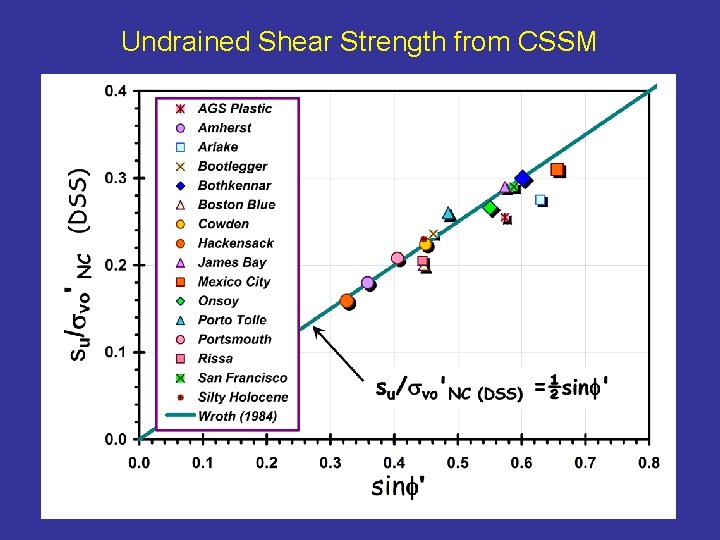
Void Ratio, e CC NC CSL Void Ratio, e CSSM for Dummies DSS: su/svo’NC = ½sinf’ Shear stress t su/svo’ = constant CSL Effective stress sv' Log sv' Note: All NC undrained stress paths are parallel to each other, thus: NC CSL tanf' Effective stress sv'
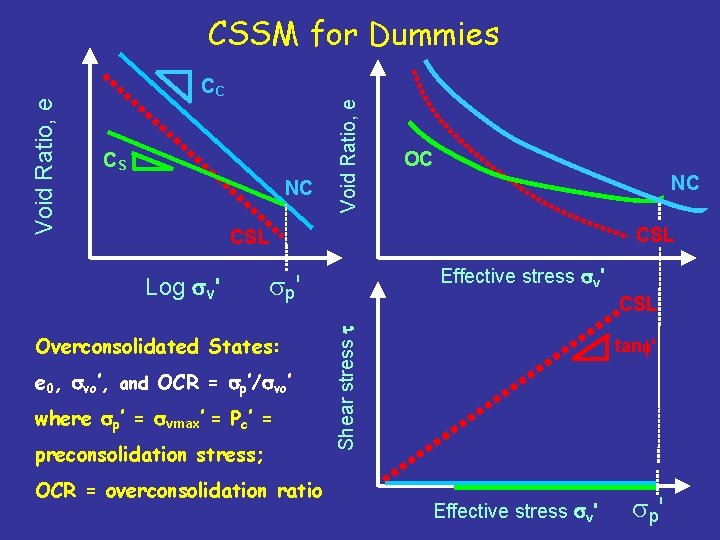
CS NC Void Ratio, e CC OC NC CSL Log sv' Effective stress sv' sp ' Overconsolidated States: e 0, svo’, and OCR = sp’/svo’ where sp’ = svmax’ = Pc’ = preconsolidation stress; OCR = overconsolidation ratio CSL Shear stress t Void Ratio, e CSSM for Dummies tanf' Effective stress sv' sp '
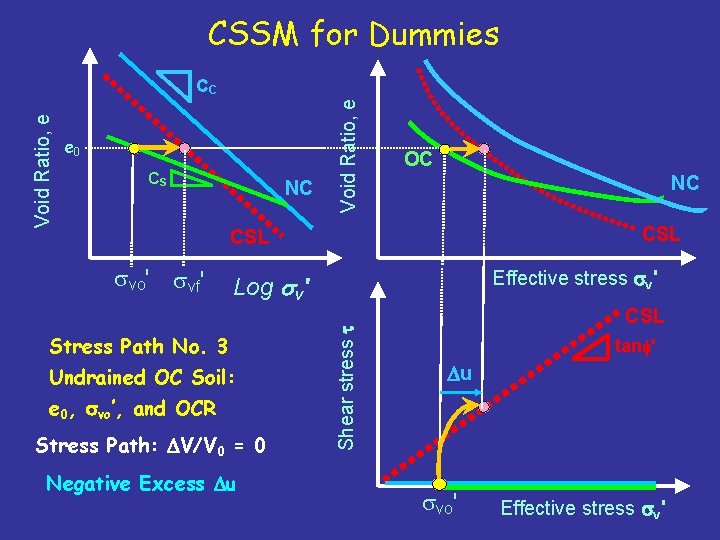
CSSM for Dummies CS NC Void Ratio, e e 0 OC NC CSL svo' svf' Effective stress sv' Log sv' Stress Path No. 3 Undrained OC Soil: e 0, svo’, and OCR Stress Path: DV/V 0 = 0 Negative Excess Du Shear stress t Void Ratio, e CC CSL tanf' Du svo' Effective stress sv'
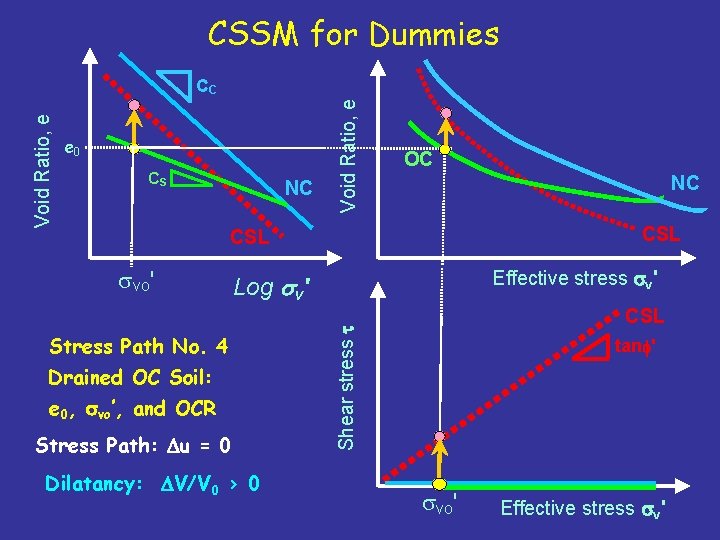
CSSM for Dummies CS NC Void Ratio, e e 0 OC NC CSL svo' Effective stress sv' Log sv' Stress Path No. 4 Drained OC Soil: e 0, svo’, and OCR Stress Path: Du = 0 Dilatancy: DV/V 0 > 0 CSL Shear stress t Void Ratio, e CC tanf' svo' Effective stress sv'
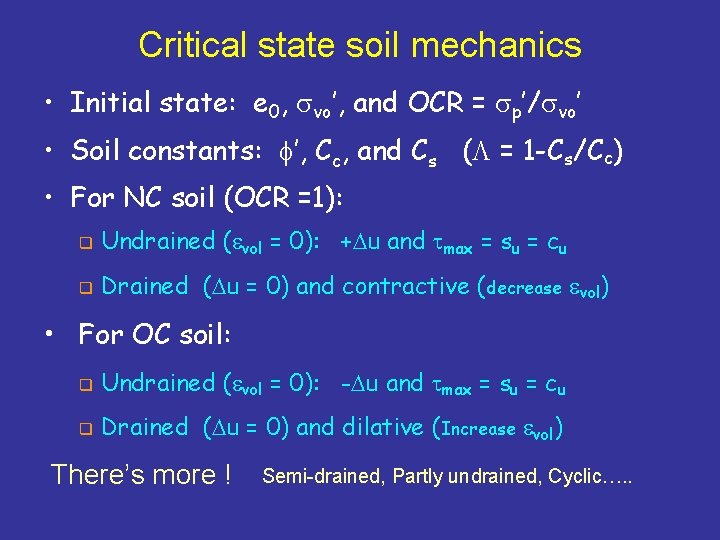
Critical state soil mechanics • Initial state: e 0, svo’, and OCR = sp’/svo’ • Soil constants: f’, Cc, and Cs (L = 1 -Cs/Cc) • For NC soil (OCR =1): q Undrained (evol = 0): +Du and tmax = su = cu q Drained (Du = 0) and contractive (decrease evol) • For OC soil: q Undrained (evol = 0): -Du and tmax = su = cu q Drained (Du = 0) and dilative (Increase evol) There’s more ! Semi-drained, Partly undrained, Cyclic…. .
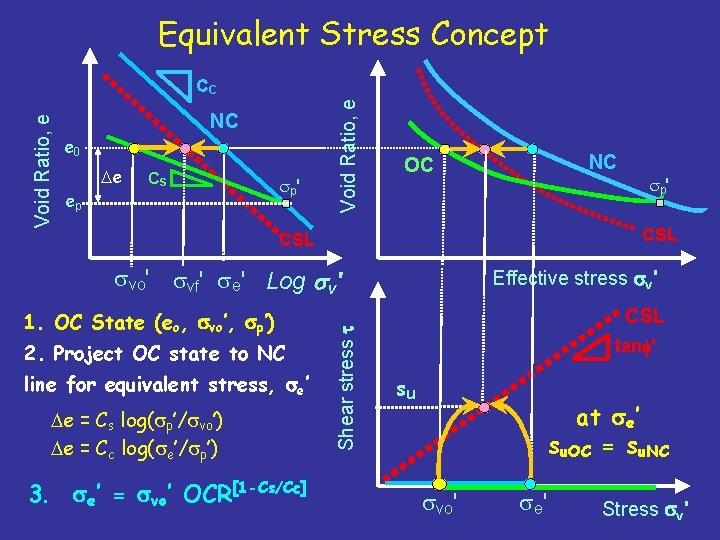
Equivalent Stress Concept NC e 0 De ep CS sp ' Void Ratio, e CC NC OC CSL 2. Project OC state to NC line for equivalent stress, se’ De = Cs log(sp’/svo’) De = Cc log(se’/sp’) 3. se’ = svo’ OCR[1 -Cs/Cc] Shear stress t svo' svf' se' Log sv' 1. OC State (eo, svo’, sp’) sp ' Effective stress sv' CSL tanf' su at se’ su. OC = su. NC svo' se ' Stress sv'
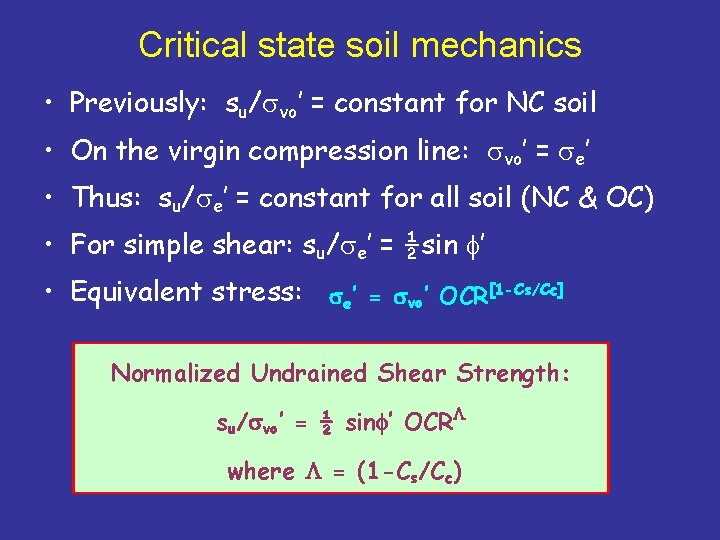
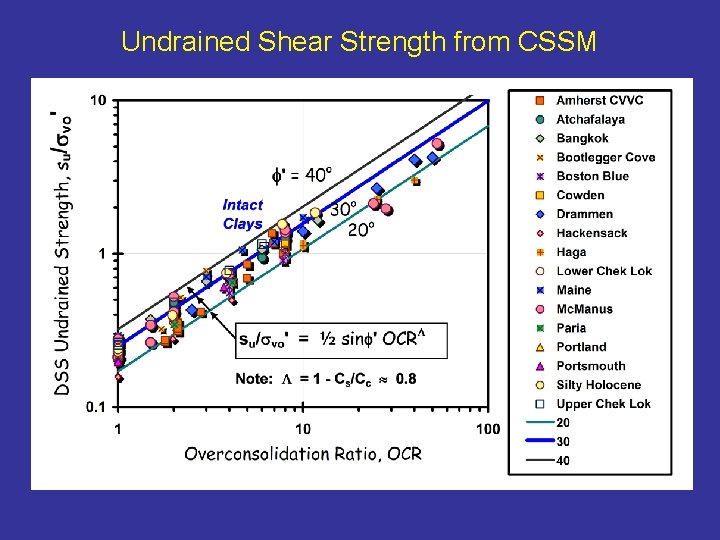
Critical state soil mechanics • Previously: su/svo’ = constant for NC soil • On the virgin compression line: svo’ = se’ • Thus: su/se’ = constant for all soil (NC & OC) • For simple shear: su/se’ = ½sin f’ • Equivalent stress: se’ = svo’ OCR[1 -Cs/Cc] Normalized Undrained Shear Strength: su/svo’ = ½ sinf’ OCRL where L = (1 -Cs/Cc)
Undrained Shear Strength from CSSM
Undrained Shear Strength from CSSM
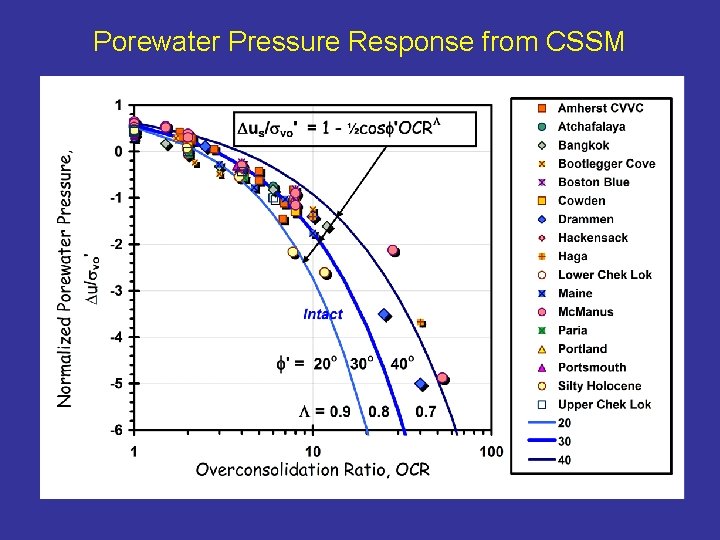
Porewater Pressure Response from CSSM
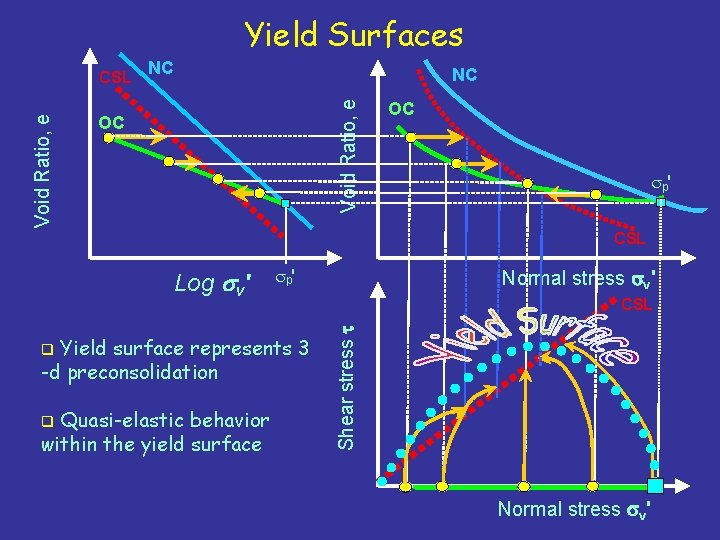
Yield Surfaces NC NC Void Ratio, e CSL OC OC sp ' CSL sp ' Yield surface represents 3 -d preconsolidation q Quasi-elastic behavior within the yield surface q Normal stress sv' CSL Shear stress t Log sv' Normal stress sv'
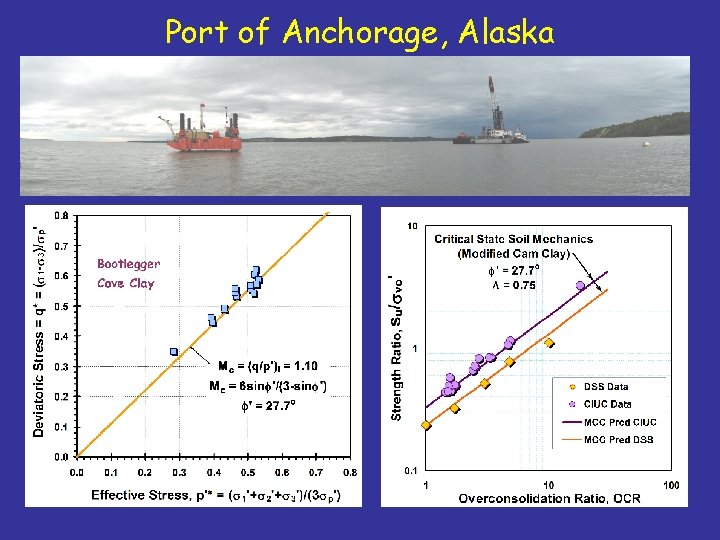
Port of Anchorage, Alaska
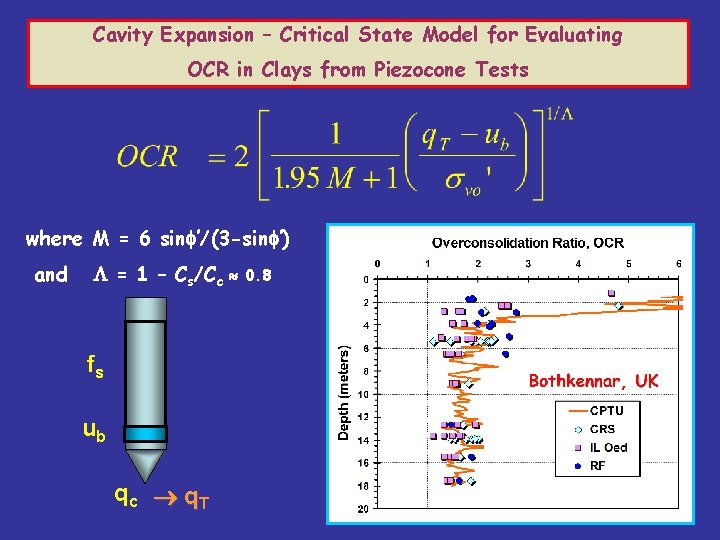
Cavity Expansion – Critical State Model for Evaluating OCR in Clays from Piezocone Tests where M = 6 sinf’/(3 -sinf’) and L = 1 – Cs/Cc fs ub qc q. T 0. 8
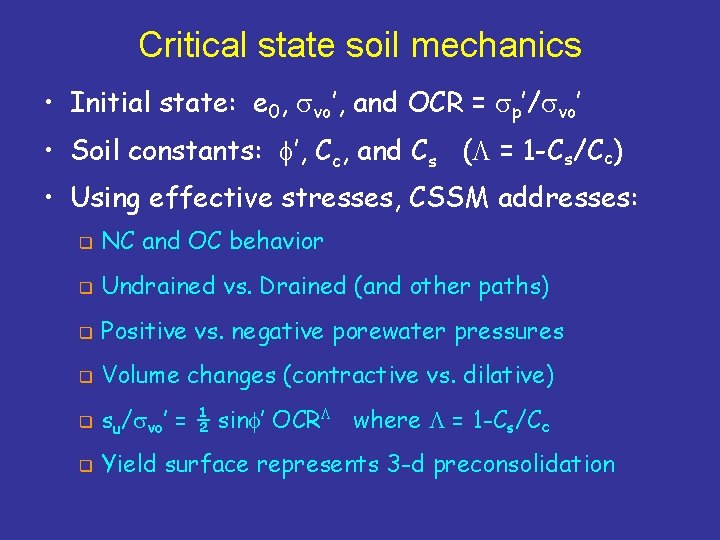
Critical state soil mechanics • Initial state: e 0, svo’, and OCR = sp’/svo’ • Soil constants: f’, Cc, and Cs (L = 1 -Cs/Cc) • Using effective stresses, CSSM addresses: q NC and OC behavior q Undrained vs. Drained (and other paths) q Positive vs. negative porewater pressures q Volume changes (contractive vs. dilative) q su/svo’ = ½ sinf’ OCRL where L = 1 -Cs/Cc q Yield surface represents 3 -d preconsolidation